
- The 10 Generative AI Trends at a Glance
- Trend 1. Generative AI Automation and the Rise of Agentic AI
- Trend 2. Multimodal AI Expands What Applications can Process
- Trend 3. RAG Becomes the Default Architecture for Enterprise Knowledge Retrieval
- Trend 4. Fine-Tuning and Custom LLMs for Domain-Specific Accuracy
- Trend 5. Open-Source LLMs Move From Option to Default in Regulated Industries
- Trend 6. Small Language Models Bring AI to the Edge
- Trend 7. Generative AI Coding Trends Reshaping the Developer Workflow
- Trend 8. The Scaling Gap Between AI Pilots and Production Deployments
- Trend 9. Generative AI in DevOps for Predictive and Automated Operations
- Trend 10: Mandatory AI Governance Becomes a Compliance Requirement
- Why Space-O Technologies Builds for These Trends
- Frequently Asked Questions About Generative AI Trends
Top 10 Generative AI Trends Shaping Enterprise

 Last Updated: May, 27 2026
Most enterprises have at least one generative AI workflow in production. Fewer have moved a second one. The gap between a single pilot and an integrated AI program is where competitive advantage is built or lost over the next 18 months, and the trends below are what separates the two.
Scaling is harder than the first deployment because the foundation model layer keeps moving. Global generative AI spending reached $644 billion in 2025, as per Gartner.
Yet only 33% of enterprises have scaled generative AI trends into organization-wide production, according to McKinsey. The pace of foundation model releases is part of what makes scaling difficult.
According to a timeline of selected large language models launched between December 2022 and December 2024, shows a release cadence that turns over multiple times per year, which means architecture decisions made today have to assume model swaps rather than fixed selections.
Teams that locked in a single foundation model 18 months ago are already on their second or third migration.
The 10 trends below affect how systems are built, not just which models are used. Each one carries a direct implication: an architecture decision, a compliance requirement, a capability to source, or a workflow to redesign. Some trends warrant immediate investment. Others require monitoring, not action. If you want to know what generative AI is and how it works, you can start with our complete guide to generative AI.
Space-O Technologies provides generative AI development services that cover every trend on this list, including RAG pipelines, agentic workflows, fine-tuned custom LLMs, open-source model deployments, AI coding copilots, and compliance-first enterprise builds. The table below maps each trend to what it changes in practice and where it sits on the act-or-monitor spectrum. The industry-by-industry breakdown of where this spending lands is covered in our generative AI use cases overview.
The 10 Generative AI Trends at a Glance
The table below summarizes the 10 trends covered in this guide. Each row pairs the trend name with the specific shift it produces in enterprise systems, so you can quickly identify which ones map to your current architecture, compliance scope, or product roadmap. For a wider look at where AI is heading beyond the generative layer, our roundup of top AI trends covers the full spectrum.
# | Generative AI Trend | What Changes for Enterprise Teams |
|---|---|---|
| 1 | Agentic AI | Single-step AI tools replaced by autonomous multi-step task execution |
| 2 | Multimodal AI | Applications process text, images, audio, and video in a single model context |
| 3 | RAG | LLM outputs grounded in real-time organizational knowledge, reducing hallucinations |
| 4 | Fine-tuning | Domain-specific accuracy that general models cannot match, using proprietary training data |
| 5 | Open-source LLMs | Private deployment without cloud API dependency, satisfying GDPR and HIPAA |
| 6 | Small Language Models | On-premise, edge-deployable AI with sub-100ms latency and no data transmission |
| 7 | AI Code Generation | 46% of code is AI-generated; developer role shifts to specification and validation |
| 8 | Enterprise Adoption | Scaling gap separates organizations with production AI from those stuck in pilots |
| 9 | AI in DevOps | Predictive CI/CD, automated security testing, and LLMOps for production AI systems |
| 10 | AI Governance | EU AI Act enforcement (August 2, 2026) makes compliance a legal requirement |
Looking to Build a Generative AI Solution for Your Business
Space-O Technologies maps each trend against your current systems, compliance scope, and roadmap, then identifies the 2 or 3 that move the needle for your specific use case.
Trend 1. Generative AI Automation and the Rise of Agentic AI
Standard generative AI automates a single task per prompt. Agentic AI automates entire workflows, with a planner agent decomposing a goal, dispatching execution agents, and routing outputs through validation before completing the objective.
For the full breakdown of generative AI vs agentic AI, see our deeper comparison, and for the architecture detail behind agentic systems, our guide on how to develop agentic AI covers planning layers, tool calling, and validation design.
Three deployment patterns are common today: automated code review agents that flag vulnerabilities and suggest refactors, CI/CD orchestration agents that monitor deployment risk and roll back failed builds, and documentation maintenance agents that update technical docs when code changes.
Each involves multiple decisions across multiple systems, which prompt-based AI cannot handle.
Where most agentic deployments fail
Two architectural failure modes account for most abandoned projects. Error propagation compounds when validation checkpoints are missing between steps. Hallucination compounding accumulates inaccuracy when retrieval grounding is missing.
Both are solved at pipeline construction time, not after deployment, and the agentic AI framework you choose (LangChain, CrewAI, LlamaIndex) shapes how easily the guardrails get built in.
Agentic systems also require modular, API-first, well-documented codebases. Monolithic systems need foundational refactoring first. Human-in-the-loop checkpoints get defined before any irreversible action (external API calls, database writes, customer communications). Conversational AI is one of the fastest-growing segments within this space — see our breakdown of conversational AI trends for the specifics.
Agentic AI development services from Space-O Technologies cover multi-agent design, orchestration framework selection, and checkpoint architecture.
Trend 2. Multimodal AI Expands What Applications can Process
Multimodal AI moves enterprise applications beyond text, enabling systems that process and generate across text, images, audio, and video within a single model context. Foundation models driving the shift include GPT-4o, Gemini 2.0 Flash, and Claude 3.x.
Three use cases show measurable production value: document processing that extracts structured data from scanned forms and handwritten notes without separate OCR layers; generative AI in healthcare imaging platforms that combine MRI scans, radiologist notes, and lab data for HIPAA-compliant diagnostic drafting; and visual commerce engines that match product images to catalog entries and generate description copy from image content alone.
Multimodal inference costs several times more than text-only
Images consume 1,000 to 5,000 tokens each, so a document with 10 embedded images can consume up to 50,000 tokens per query. Cost projection becomes a required design input before model selection. Video adds frame extraction, audio transcription, and context stitching on top, which is why infrastructure decisions, not model choice, determine whether multimodal AI scales.
The engineering work sits in the input pipeline, not the model
Image preprocessing, audio transcription, and context stitching between modalities are infrastructure decisions. Selecting a multimodal model is the first step. Building the input pipeline that delivers clean, structured context to it is the engineering work, and that work sits closer to data pipeline architecture than to AI model development.
Trend 3. RAG Becomes the Default Architecture for Enterprise Knowledge Retrieval
Retrieval-augmented generation (RAG) is the generative AI technology with the widest enterprise adoption in 2026, grounding LLM outputs in real-time retrieval from organizational knowledge bases to reduce hallucinations.
When a user submits a query, the system retrieves relevant documents from a vector database first, then passes both query and context to the LLM. The model generates a response grounded in verified data rather than training memory.
A production RAG architecture has four components: a vector database (Pinecone, Weaviate, pgvector), an embedding model, a retrieval pipeline that defines how documents are chunked and indexed, and a reranking layer that filters noise before generation.
RAG and fine-tuning solve different problems
RAG retrieves current, external knowledge at inference time. Fine-tuning modifies model weights through domain-specific training. RAG fits dynamic knowledge bases.
Fine-tuning fits specialized task performance and response style. The choice between RAG vs fine-tuning depends on whether the system needs current information or consistent domain behavior, and most enterprise systems use both.
Production RAG needs evaluation, not just deployment
Teams that deploy RAG without an evaluation framework cannot distinguish retrieval failures from generation failures when output quality degrades. Faithfulness, context recall, and answer relevance are the three required metrics. Agentic RAG extends this further, decomposing complex questions into sub-queries and synthesizing answers across multiple retrieval passes.
RAG development services from Space-O Technologies covers full pipeline architecture, including vector database selection, chunking strategy, and evaluation framework deployment.
Trend 4. Fine-Tuning and Custom LLMs for Domain-Specific Accuracy
Fine-tuning delivers accuracy in specialized domains that general-purpose foundation models cannot match, adapting model weights to proprietary data, domain language, and task-specific behavior.
Prompting adjusts the input. RAG augments the input with retrieved context. Fine-tuning modifies the model itself, changing how it generates responses across all future prompts.
Three industries where fine-tuning is required rather than optional: legal (contract interpretation, clause extraction, jurisdiction-specific drafting), healthcare (clinical note generation, ICD-10 coding, prior authorization), and finance (regulatory reporting, KYC document processing, credit decision analysis).
In each case, the model must understand institution-specific formats, terminology, and conventions that no general-purpose model has been trained on.
Dataset quality outweighs dataset size
The most common fine-tuning failure mode is training data that reflects the current system’s errors rather than the target system’s desired output. 500 correctly formatted, domain-relevant examples produce better fine-tuned models than 10,000 inconsistently labeled ones. LoRA, RLHF, and PEFT reduce compute cost significantly compared to full retraining, but none of them compensate for poor training data.
Fine-tuned models need refresh cycles, not one-time training
Regulatory language changes, new product lines, and updated compliance standards all shift the target distribution away from the original training set. Quarterly refresh cycles fit fast-moving domains like compliance and product documentation. Annual cycles fit stable domains like established clinical guidelines. Without scheduled retraining, model accuracy decays in production.
LLM development from Space-O Technologies covers the full fine-tuning pipeline, from dataset curation through evaluation benchmark design and ongoing refresh cycles. For organizations weighing the architectural trade-off, our RAG fine-tuning guide covers when to combine both rather than picking one.
Trend 5. Open-Source LLMs Move From Option to Default in Regulated Industries
Open-source LLMs are the enterprise generative AI trend driven by data privacy, cost control, and regulatory compliance, giving organizations full deployment control without cloud API dependency.
Three factors push the adoption: data sovereignty (GDPR, HIPAA, and the EU AI Act make cloud-only deployments untenable for regulated data), cost predictability at scale (proprietary API pricing scales linearly with token volume, while on-premise deployment converts variable cost to fixed infrastructure cost), and customizability (open-source models accept fine-tuning on proprietary data, proprietary API models do not).
Models leading enterprise adoption include Llama 4 (Meta), DeepSeek V3, Mistral Large, and Gemma (Google), each deployable on private infrastructure with enterprise-grade inference on standard GPU hardware.
Open-source is free; deployment is not
The model license cost is zero. The deployment cost is not. Total cost of ownership covers four categories that proprietary API pricing obscures: compute, storage (model weights for a 70B model require significant GPU memory), engineering (deployment and security hardening typically requires weeks of senior ML engineer time), and ongoing operations, including monitoring and security patching.
Open-source TCO becomes competitive with proprietary APIs above roughly 10 million tokens per month. Below that volume, proprietary APIs win because they eliminate the infrastructure overhead.
Migration needs parallel deployment, not a hard cutover
Moving from cloud APIs to private open-source deployment follows four stages: benchmark the open-source model against the proprietary API baseline, build the private inference stack on representative production hardware, run both in parallel, comparing output quality and latency, then migrate traffic incrementally with rollback triggers defined before migration begins. Organizations that skip the parallel phase and migrate all traffic at once see significantly higher post-migration incident rates.
Sovereign AI development services from Space-O Technologies covers private LLM deployment, including model quantization, security hardening, and migration planning. For organizations evaluating the build-versus-buy decision before committing, our build vs buy sovereign AI guide covers the trade-offs.
Trend 6. Small Language Models Bring AI to the Edge
Small language models (SLMs) are the generative AI trend enabling on-premise deployment, real-time inference, and data compliance for enterprises that cannot route sensitive data through cloud APIs.
SLMs are defined by parameter count: 1 billion to 30 billion parameters compared to 70 billion or more for frontier models.
Smaller parameter counts translate directly to lower inference cost, faster response times, and the ability to run on standard enterprise hardware rather than specialized GPU clusters.
Three advantages drive enterprise adoption: cost (SLMs run on CPU or consumer GPU hardware), latency (sub-100ms responses on local hardware, removing network round-trip from the inference path), and compliance (no data is transmitted externally, satisfying HIPAA, GDPR, and data residency requirements without additional compliance architecture).
Models in active deployment include Phi-3 (Microsoft), Gemma 2B (Google), and Llama 3.2 in 1B and 3B variants (Meta).
Compression makes edge deployment practical
Quantization reduces model weight precision from 32-bit float to 8-bit or 4-bit integer, cutting memory requirements by several times with minor accuracy loss on most generative tasks. Pruning removes low-importance connections. Knowledge distillation trains a smaller model to replicate a larger model’s outputs for a specific task, often producing an SLM that outperforms the source large model on that task while running on a fraction of the compute.
A fine-tuned SLM beats a generic frontier model on domain tasks
Three industries are deploying SLMs in production: manufacturing (quality inspection AI at the production line edge), finance (on-premise compliance document classification and contract analysis), and healthcare (HIPAA-compliant local clinical note generation).
The build implication is that SLM selection requires domain-specific benchmarking against target task performance, not parameter count comparison. A 7B fine-tuned SLM outperforms a generic 70B model on domain-specific tasks, which is the entire reason this trend matters.
Sovereign AI implementation services from Space-O Technologies covers SLM deployment, including quantization for target hardware and inference pipeline optimization. For organizations planning the architectural setup, our sovereign AI architecture guide covers the design decisions that determine whether edge deployment scales.
Trend 7. Generative AI Coding Trends Reshaping the Developer Workflow
Generative AI coding tools have shifted the developer role from code authorship to AI output specification, validation, and correction. AI coding tools deliver meaningful developer productivity gains, with the largest concentrated adoption across Fortune 100 engineering teams.
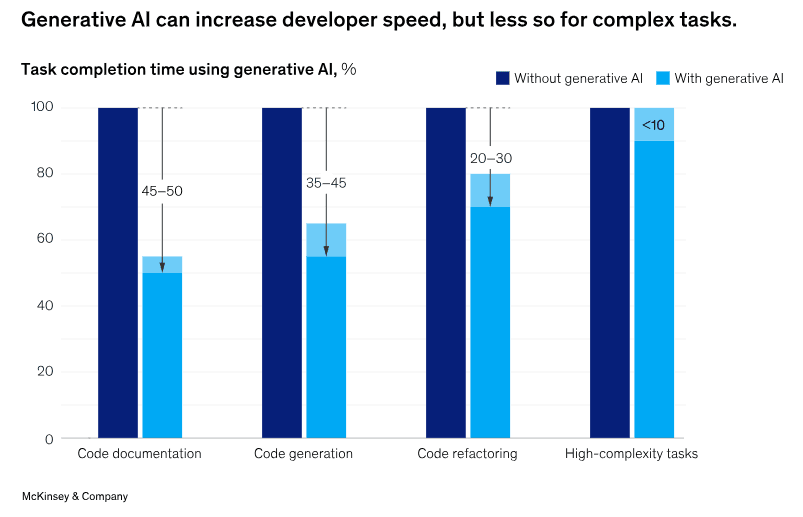
McKinsey research on developer productivity with generative AI shows the gains concentrate in specific task categories: code documentation, refactoring legacy code, and generating new code. Tasks involving novel problem-solving or complex system design see smaller gains, which matches the broader pattern that AI coding tools accelerate execution work but do not yet replace architectural judgment.
Four tools define the enterprise AI coding category: GitHub Copilot for inline code generation and function completion, Cursor for AI-native editing with codebase context awareness, Amazon CodeWhisperer for AWS-integrated code generation with built-in security scanning, and Tabnine for air-gapped deployment when data residency or IP protection is required.
Code generation alone caps productivity gains
AI coding tools address code generation. But code generation only accounts for a portion of total software development time. The rest covers requirements gathering, architecture design, code review, testing, documentation, and deployment.
Organizations that apply AI only at code generation hit a productivity ceiling. The gains compound when AI participates across the full SDLC, including requirements analysis, architecture design, automated test generation, and documentation.
The difference is not the coding tool. The difference is coverage. The full breakdown of generative AI in software development covers what AI integration looks like at each SDLC stage and why coding-only deployments hit a productivity ceiling.
Custom copilots outperform generic tools on internal codebases
Generic coding tools work from the file open in the editor. Custom copilots fine-tuned on an organization’s specific codebase, naming conventions, internal libraries, and architecture patterns understand the context generic tools cannot see.
Senior developers see higher suggestion acceptance rates on complex, architecture-sensitive tasks. Junior developers integrate with internal APIs more reliably because the copilot understands the contracts that generic tools generate code against blindly.
Hire generative AI engineers from Space-O Technologies to build and integrate custom AI copilots fine-tuned on your codebase, alongside production software systems.
Trend 8. The Scaling Gap Between AI Pilots and Production Deployments
Most enterprises run AI in at least one business function, but only a third have scaled AI across the organization. The other two-thirds are spending on pilots that have not produced measurable business value.
Industry-specific adoption rates reveal where the bar sits. Financial services leads, followed by healthcare (driven by EHR automation and clinical documentation), retail (dominated by personalization and inventory optimization), and manufacturing (led by quality inspection and predictive maintenance).
The personalization use case in retail is documented at depth in the VentureBeat marketing personalization research, which finds that AI-driven personalization delivers measurably higher conversion rates and customer retention than rule-based segmentation, with the gap widening at higher data volumes.
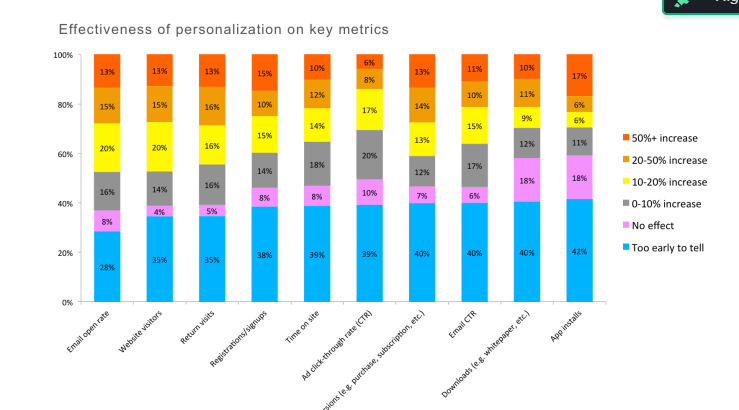
Source: VentureBeat Insight, Marketing Personalization research
Sector-level adoption figures matter because they set the competitive baseline. Organizations operating below their sector average face compounding competitive disadvantage, not just a missed opportunity.
Three execution characteristics separate scaled AI programs from abandoned pilots
First, defined ROI criteria before development begins. Successful deployments specify what business metric changes at what threshold constitute success before a line of code is written.
Failed pilots define success criteria after deployment, when the result is already fixed. Second, compliance architecture as a first-phase deliverable.
Regulated deployments that retrofit compliance after the core build incur multiples of the remediation cost compared to deployments where compliance is specified in phase one.
Third, development partners with production AI deployment experience. Firms with prior production deployments identify failure modes, drift patterns, and integration edge cases that prototype-focused or consulting-only partners miss.
Three failure modes account for most abandoned AI pilots
Use case selection without a defined ROI measurement, where teams build AI without specifying which process cost was being eliminated and by how much.
No baseline data strategy, where systems deployed without pre-deployment performance baselines cannot demonstrate measurable improvement at evaluation.
And prototype infrastructure in production, where systems built for proof-of-concept demos get deployed without MLOps monitoring, security hardening, or load testing, leading to visible failures that damage internal AI credibility and delay future investment approvals.
Generative AI consulting services from Space-O Technologies covers use case scoping, compliance architecture, and production readiness planning before development begins. For organizations starting from a clean baseline, our AI readiness assessment covers the gaps that surface only after a pilot fails.
Not Sure Which Generative AI Approach Fits Your Use Case?
From RAG pipelines to open-source LLMs deployed on-premise, Space-O Technologies maps the right architecture to your data, compliance requirements, and delivery timeline.
Trend 9. Generative AI in DevOps for Predictive and Automated Operations
Generative AI in DevOps shifts operations from reactive incident response to proactive operational intelligence. The trend operates across three application areas: AIOps (AI embedded in CI/CD pipelines for deployment risk scoring and automated incident triage), DevSecOps automation (AI-generated security test cases, vulnerability detection in dependencies, and OWASP pattern checks on AI-generated code), and MLOps for the AI systems themselves.
LLMOps extends standard MLOps with requirements specific to generative AI that traditional monitoring tools do not cover. Standard MLOps tracks model versioning and inference latency for predictive AI systems, where outputs are scores or classifications, while LLMOps tracks prompt versioning and output drift for systems that generate content.
The full architectural breakdown of generative AI vs predictive AI covers why the two require different monitoring infrastructure, different evaluation metrics, and often different teams.
Production AI needs a defined monitoring dashboard from day one
Five metrics define a complete generative AI monitoring dashboard: latency (p50, p95, p99), hallucination rate (automated evaluation against a static reference set), output drift (statistical comparison of output distributions across model versions), rejection rate (queries that trigger safety filters, broken down by filter and severity), and cost efficiency (tokens consumed per successful task completion).
Organizations without defined p95 latency SLAs for their generative AI endpoints operate systems with no defined acceptable performance boundary.
MLOps infrastructure is a delivery requirement, not a post-launch addition
Organizations deploying generative AI need monitoring dashboards, drift detection pipelines, human-in-the-loop validation gates, and documented rollback procedures from the first production deployment.
A generative AI application deployed without output monitoring is a system with no observable failure state. AI-generated security testing now covers a significant portion of the OWASP Top 10 attack surface on standard codebases, and tools like GitHub Advanced Security and Snyk Code incorporate AI vulnerability detection directly in CI/CD.
MLOps consulting services from Space-O Technologies covers model monitoring architecture, drift detection setup, LLMOps tooling selection, and production AI operations design. For the underlying pipeline architecture, our MLOps pipeline guide covers the full operational design.
Trend 10: Mandatory AI Governance Becomes a Compliance Requirement
The most consequential generative AI future trend in 2026 is mandatory governance: the EU AI Act enforcement deadline converts responsible AI from a strategic preference into a legal requirement with defined financial penalties.
The Act classifies AI deployments by risk level, with high-risk categories covering credit decisions, hiring and recruitment screening, healthcare diagnostics, and public safety applications.
Organizations deploying AI in high-risk categories face four mandatory requirements: bias auditing (documented testing of model outputs across demographic groups, retained for regulatory inspection), explainability (decision logic communicable to affected individuals in non-technical language), human oversight (documented review before the decision is finalized), and audit trail (all inputs, outputs, and decision logs retained with timestamps and user identifiers).
Compliance actions before the enforcement deadline
Three compliance actions need to be completed before the deadline: classify all current and planned AI systems by risk tier using the EU AI Act taxonomy, complete conformity assessments for high-risk systems documenting risk management, data governance, transparency mechanisms, and human oversight procedures, and register high-risk AI systems in the EU AI Act database where applicable. The classification step gates everything that follows, so it cannot be deferred.
Governance becomes a deployment accelerator, not a blocker
Organizations that implement AI governance infrastructure early approve new AI projects faster than organizations without defined governance. Every new project at a governance-mature organization references existing compliance templates, risk classification frameworks, and audit logging infrastructure rather than building compliance architecture from scratch. The intuition that governance slows AI down inverts in practice. Absence of governance is the blocker.
The governance requirement extends beyond the EU. Any organization processing EU citizen data or deploying AI that affects EU residents falls within scope regardless of where the organization is headquartered. Retrofitting governance requirements into a deployed AI system costs multiples of designing for compliance from the start.
Sovereign AI security best practices covers the architectural decisions, including private model deployments, audit logging design, and human checkpoint specification, that meet governance requirements without slowing development.
Why Space-O Technologies Builds for These Trends
Space-O Technologies is a custom generative AI development company that delivers production systems across all 10 trends covered above, including agentic AI pipelines, RAG architectures, fine-tuned custom LLMs, open-source model deployments, SLM edge systems, AI coding copilots, MLOps infrastructure, and compliance-first enterprise builds.
Full SDLC integration
AI is applied at requirements, architecture, testing, and documentation stages, not only at code generation. The difference between teams that limit AI to code generation and teams that integrate it across the SDLC is the difference between marginal productivity gains and compounding ones.
Compliance-first architecture
HIPAA, SOC 2 Type II, and PCI-DSS requirements are specified in system architecture before development begins, not retrofitted after the build. Private model deployments are available for all regulated industry clients, including on-premise open-source models for workloads where data cannot leave the organization’s infrastructure.
Milestone-based delivery
A working prototype delivers in 2 to 4 weeks before any long-term financial commitment. Pricing is itemized by phase with weekly status reporting at each milestone, and the prototype phase carries a defined go/no-go decision before the full engagement scopes.
Turn these generative AI trends into working software
Space-O Technologies builds production generative AI systems across every trend on this list, from RAG pipelines and agentic workflows to compliance-first enterprise deployments. No retainer required, working prototype in 2 to 4 weeks.
Frequently Asked Questions About Generative AI Trends
How long does it take to implement a generative AI system?
A working generative AI prototype takes 2 to 4 weeks to build and validate. A production-ready system with RAG architecture, compliance design, and MLOps monitoring takes 3 to 6 months, depending on integration complexity, the number of AI components, and regulatory scope (HIPAA, SOC 2, PCI-DSS). Fixed-milestone delivery plans provide schedule visibility at each phase, with a go/no-go decision point after the prototype before full-scale investment is required.
What is the difference between RAG and fine-tuning in generative AI?
RAG retrieves external documents at inference time to ground model outputs in current, verified organizational data. Fine-tuning modifies the model’s weights using domain-specific training data to change how the model generates across all future outputs. RAG is better for dynamic knowledge bases, factual accuracy, and current information retrieval. Fine-tuning is better for domain behavior, specialized terminology, and consistent output style. Both can be combined in a single deployment for organizations that need grounding and domain adaptation together.
What is agentic AI and how does it differ from standard generative AI?
Standard generative AI responds to a single prompt and produces a single output. Agentic AI executes sequences of tasks, including goal decomposition, tool calling, output generation, result validation, and iteration, with minimal human input between steps. Agentic systems require orchestration frameworks (LangChain, CrewAI), defined human-in-the-loop checkpoints, and output validation guardrails to prevent compounding errors across sequential task steps.
How does the EU AI Act affect generative AI projects?
Organizations deploying AI in high-risk categories, including credit decisions, hiring, healthcare diagnostics, and public safety, face mandatory bias audits, explainability documentation, and human oversight requirements under the EU AI Act. Non-compliance carries financial penalties calculated as a percentage of global annual revenue. Any organization processing EU citizen data or deploying AI that affects EU residents falls within scope regardless of company headquarters location.
What is the cost of building a generative AI system?
Generative AI system costs range from $15,000 to $30,000 for a focused RAG or AI copilot prototype, up to $400,000 or more for a full production deployment with custom LLM fine-tuning, compliance architecture, and MLOps infrastructure. Four primary cost drivers shape the estimate: number of AI components in the system, private versus public model deployment, regulatory compliance scope, and integration complexity with existing enterprise data systems. Space-O Technologies provides itemized cost estimates after a free discovery session.
Should our team build with proprietary APIs or open-source LLMs?
Proprietary APIs (OpenAI, Anthropic, Google) are the right starting point for early-stage deployments and applications below roughly 10 million tokens per month. Above that volume, open-source LLMs deployed on private infrastructure typically deliver lower total cost of ownership and remove cloud API dependency. Open-source becomes the default for regulated industries (healthcare, finance, legal) where data residency and compliance requirements rule out cloud-only deployments. Most enterprises start with proprietary APIs and migrate workloads to open-source as volume and compliance scope increase.
What does it take to move a generative AI pilot into production?
Three execution characteristics separate scaled deployments from abandoned pilots: defined ROI criteria specified before development begins (which business metric changes by how much), compliance architecture as a first-phase deliverable rather than a retrofit, and prototype infrastructure replaced with production-grade MLOps and security hardening before launch. Pilots that skip any of the three typically fail at the scale-up stage rather than at the prototype stage, which makes the failure expensive to recover from.
How do we monitor a generative AI system once it’s in production?
Production generative AI requires LLMOps tooling beyond standard application monitoring. The minimum monitoring set is five metrics: latency at p50, p95, and p99, hallucination rate measured against a static evaluation set, output drift across model versions, rejection rate on safety filter triggers, and cost efficiency in tokens per successful task. Tools like Weights and Biases, MLflow, and LangSmith cover the trace logging, prompt versioning, and evaluation infrastructure that traditional APM tools do not.


