

Discover how Space-O Technologies (AI) developed Canvas 8, an AI Figma-to-HTML conversion tool, using ReactJS, NodeJS, and Python.
Hire LLM Engineers
Build production-grade AI systems powered by large language models with LLM engineers who specialize in fine-tuning, RAG pipeline architecture, LangChain and LlamaIndex development, prompt engineering, multi-agent systems, and LLM deployment. Space-O AI offers pre-vetted LLM engineers for hire with proven expertise in GPT-4o, Claude, LLaMA, Mistral, Hugging Face Transformers, and the complete modern LLM development stack.
With 15+ years of experience and 500+ AI projects delivered worldwide, we are a leading LLM development company that ensures every engagement meets the highest standards of technical quality and enterprise reliability. Our engineers blend deep large language model expertise with real-world production delivery, ensuring every build is secure, compliant, and enterprise-ready under full ISO, GDPR, and NDA protection.
Hire LLM engineers from Space-O AI and empower your business with experts who turn complex language model requirements into reliable, scalable, and production-grade AI solutions.


Let’s Discuss Your Project
Our Valuable Clients


Core Expertise of Our LLM Engineers
Our LLM engineers bring specialized expertise across fine-tuning, RAG systems, prompt engineering, LangChain orchestration, multi-agent architectures, and MLOps, working with GPT-4o, Claude, LLaMA 3, Mistral, Hugging Face, and the full modern LLM stack.
LLM Fine-Tuning & Domain Adaptation
Our engineers fine-tune large language models on your proprietary datasets to make them behave precisely the way your business requires. They manage the complete pipeline from data preparation, cleaning, and JSONL formatting to training job execution, RLHF alignment, LoRA and QLoRA optimization, and iterative evaluation. Whether you need a model that speaks your brand’s terminology, handles domain-specific classification, or follows strict output formats, our LLM fine-tuning engineers deliver models that outperform generic prompting for your specific use case.
RAG Pipeline Architecture & Development
Retrieval-Augmented Generation is the foundation of enterprise LLM applications that need to answer questions based on your own data without hallucinating. Our RAG pipeline developers design complete architectures covering document ingestion, chunking strategies, embedding generation, vector database indexing, retrieval ranking, and context injection into the LLM prompt. They build RAG systems using Pinecone, Weaviate, ChromaDB, and Qdrant that deliver accurate, grounded, and citable responses at production scale.
Prompt Engineering & Optimization
Consistent LLM output at scale requires far more than writing a good prompt once. Our prompt engineering specialists design system prompt architectures, few-shot example libraries, chain-of-thought templates, output format constraints, and token optimization strategies that make your LLM application behave predictably across thousands of varied user inputs. They test prompts systematically against edge cases and iterate based on real failure patterns, not just successful demos.
LangChain & LlamaIndex Development
Our engineers build complex LLM applications using LangChain and LlamaIndex to orchestrate multi-step workflows, manage conversation memory, chain tool calls, and connect language models to external data sources and APIs. They design modular, maintainable application architectures that are easy to extend as your requirements grow, rather than monolithic prompt chains that break when requirements change.
Multi-Agent LLM Systems
Our engineers design and build multi-agent LLM architectures where specialized agents collaborate to handle tasks too complex for a single model call. Using LangGraph, AutoGen, and CrewAI, they build systems with planning agents, execution agents, verification agents, and human-in-the-loop checkpoints that handle enterprise-grade workflows reliably. Every multi-agent system is designed with observability and failure handling built in from the start.
LLM Evaluation & Benchmarking
Most teams underinvest in evaluation until something breaks in production. Our LLM evaluation engineers build structured evaluation frameworks that measure accuracy, hallucination rate, latency, cost per query, retrieval quality, and output consistency across your specific use cases. They implement automated evaluation pipelines using Ragas, DeepEval, and custom benchmarks so you have objective performance data before and after every model or prompt change.
LLM Deployment & MLOps
Shipping an LLM to production involves far more than deploying a model endpoint. Our LLM deployment engineers handle inference infrastructure, model serving with vLLM and TGI, API gateway configuration, autoscaling, cost monitoring, version management, and automated rollback. They implement LLMOps pipelines that track model behavior over time, detect performance degradation, and manage model updates without service disruption.
Open-Source LLM Development
For organizations that need data privacy, cost control, or customization beyond what hosted APIs offer, our engineers build production systems using LLaMA 3, Mistral, Falcon, Phi-3, and other open-source models. They handle quantization, model compression, hardware optimization for GPU and CPU inference, and self-hosted deployment on AWS, Azure, and GCP so your LLM runs entirely within your own infrastructure.
LLM API Integration & Connectivity
Our LLM integration engineers connect language model capabilities to your existing products and business systems through clean, maintainable API layers. They integrate OpenAI, Anthropic, Cohere, Google, and self-hosted model endpoints with your web applications, mobile products, CRMs, ERPs, and internal tools, handling authentication, rate limiting, fallback routing between models, and cost optimization across providers.
Types of LLM Engineers You Can Hire From Space-O AI
Not every LLM project requires the same skill profile. Our team includes specialists across every major LLM discipline so you get the exact depth of expertise your project requires rather than a generalist who learns on your budget.
LLM Fine-Tuning Specialists
Need a language model that behaves precisely for your domain, follows your output format consistently, or handles specialized terminology with accuracy? Hire LLM fine-tuning engineers who manage your complete fine-tuning pipeline from data curation and cleaning to LoRA training, RLHF alignment, evaluation, and iterative improvement. Our specialists work with GPT-4o-mini, LLaMA 3, Mistral, and Falcon across both hosted and self-managed infrastructure.
RAG Pipeline Engineers
Hire RAG pipeline developers who design retrieval-augmented generation systems that keep LLM responses grounded in your actual data. Our engineers handle the full stack from document processing and embedding pipelines to vector database configuration, hybrid search design, reranking, and RAG evaluation. They build systems that cite sources, handle multi-document reasoning, and scale to enterprise knowledge bases without performance degradation.
LangChain & LlamaIndex Developers
Hire LangChain developers and LlamaIndex developers who build structured, maintainable LLM application architectures. Our engineers go beyond basic chains to design agent workflows, memory management systems, tool-use pipelines, and custom retrieval integrations that are built for real production environments, not just proof-of-concept notebooks.
Prompt Engineering Specialists
Hire prompt engineering specialists who build systematic, tested, and optimized prompt architectures for your LLM applications. Our specialists design few-shot libraries, chain-of-thought templates, structured output schemas, and automated prompt evaluation pipelines that deliver consistent, high-quality model outputs at scale across diverse user inputs and edge cases.
Custom LLM App Developers
Hire LLM app developers to build full-stack applications powered by large language models, from document analysis tools and internal knowledge assistants to customer-facing AI products and enterprise automation platforms. Our developers handle the complete build from LLM backend architecture and data pipeline design to frontend interface and production deployment.
LLM Integration Engineers
Hire LLM integration engineers to connect language model capabilities to your existing products, internal tools, and enterprise systems. Our specialists build the API and middleware layer that makes LLM outputs accessible within your current workflows, handling multi-provider routing, fallback logic, response caching, and cost optimization across OpenAI, Anthropic, and open-source model providers.
AI Projects We Have Developed
-
Canvas 8: Cut Web Development Time by 80% With AI Figma to HTML Converter
-
How We Cut AI Agent Costs by 93% (And Stopped Fighting Our Configuration System)
How task-based model selection cut our multi-agent AI costs by 93% and reduced provider switching from 30 minutes to 5 seconds.
-
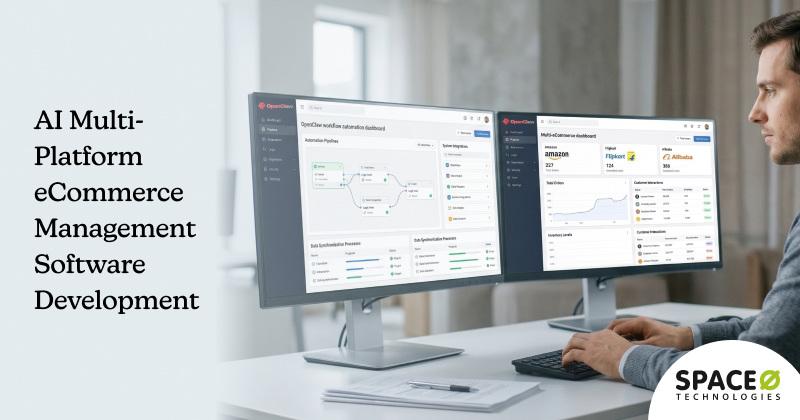
How We Developed an OpenClaw-Based Multi-Platform eCommerce Business Management Software
Learn how we developed a centralized AI eCommerce management platform that helps sellers centrally manage eCommerce across multiple marketplaces.
Client Testimonials

Project Summary
AI Development
AI System Development for Christian Church
Space-O Technologies developed a private AI system for a Christian church. The team built a system capable of uploading research information, allowing other church workers to query information in a natural way.
View All →
Project Summary
Retail
AI System Development for Gift Search Company
Space-O Technologies has developed an AI system for a gift search company. The team has built a recommendation engine, implemented dynamic pricing, and created tools for personalized marketing campaigns.
View All →
Project Summary
Nonprofit
AI System Development for Christian Church
Space-O Technologies developed a private AI system for a Christian church. The team built a system capable of uploading research information, allowing other church workers to query information in a natural way.
View All →
Project Summary
Consulting
POC Design & Dev for AI Technology Company
Space-O Technologies developed the POC of an AI product for life coaching conversations. Their work included wireframing, app design, engineering, and branding.
View All →
Project Summary
Software
Custom Mobile App Dev & Design for Software Company
Space-O Technologies was hired by a software firm to build a photo editing app that caters to restaurant owners. The team handled the development and design work, including the addition of AI-driven features.
View All →Engagement Models to Hire LLM Engineers
Our flexible engagement models let you hire dedicated LLM engineers full-time, augment your existing team with specialists, or execute a defined LLM project based on your specific scope and budget.

Dedicated LLM Engineers
Hire dedicated LLM engineers who work exclusively on your product as full-time contributors. Your dedicated engineer owns your LLM architecture, fine-tuning pipelines, RAG systems, and ongoing model improvements, giving you consistent depth of expertise without recruitment overhead or knowledge gaps between projects.
- Full ownership of your LLM infrastructure and pipelines
- Continuous model improvement and evaluation
- Deep familiarity with your data, systems, and business context
Recommended

Staff Augmentation
Add certified LLM engineers to your existing development team to fill specific skill gaps and accelerate delivery. Your in-house engineers maintain product ownership while gaining immediate access to fine-tuning expertise, RAG architecture knowledge, and production LLM deployment experience.
- Quick onboarding of pre-vetted LLM specialists
- On-demand access to fine-tuning, RAG, and MLOps expertise
- Flexible scaling as your LLM requirements evolve

Project-Based Engagement
Hire LLM engineers for well-defined projects with clear scope, deliverables, and timelines. Ideal for fine-tuning projects, RAG system builds, LLM application development, and proof-of-concept work where cost predictability and milestone-driven delivery matter most.
- Clear project scope and fixed cost agreed upfront
- Milestone-driven execution with defined deliverables
- Full documentation and knowledge transfer on completion
Why Hire LLM Engineers From Space-O AI
Hire LLM engineers ready to build production-grade large language model systems with measurable business impact. Enterprises and funded startups choose Space-O AI because our engineers bring hands-on LLM experience across hundreds of real-world deployments, not just familiarity with model APIs.

Pre-Vetted Talent, Ready in 48 Hours
Every LLM engineer on our team passes a rigorous multi-stage screening covering fine-tuning methodology, RAG architecture design, prompt engineering, LangChain implementation, and production deployment. We evaluate demonstrated project output, not just claimed familiarity. You get engineers ready to contribute from week one, not developers who need months to build the skills you hired them for.

15+ Years of AI & ML Experience
Our team brings deep specialization in machine learning and AI systems built over more than 15 years of delivery. This foundation means our LLM engineers understand transformer architectures, training dynamics, evaluation methodology, and production ML at a fundamental level. They make better architectural decisions because they understand why models behave the way they do, not just how to call their APIs.

500+ AI Projects Delivered
Our project track record spans enterprises, funded startups, and global organizations across healthcare, fintech, legal, e-commerce, and manufacturing. This breadth means our LLM engineers understand your industry’s data characteristics, compliance requirements, and user expectations before they make the first architectural decision on your project.

Full-Stack LLM Expertise
Our engineers handle the complete LLM stack from model selection, fine-tuning, and RAG design to application development, deployment infrastructure, and ongoing evaluation. You do not need to coordinate multiple specialized vendors for different layers of your LLM system. One team owns the full picture and delivers a cohesive, maintainable result.

Enterprise Security & Compliance
Security and compliance are built into every engagement. We maintain 99.9% uptime SLA, NDA-backed confidentiality, SOC 2 certification, and GDPR and HIPAA readiness. For LLM deployments specifically, we implement prompt injection safeguards, output filtering, data isolation, API key management, and audit logging to protect your users and your proprietary data throughout the system.

Agile Delivery
You always know what our engineers are working on, why, and what comes next. We use collaborative tools, weekly sprint reviews, and clear documentation to keep every stakeholder informed at every stage. No black-box development, no last-minute surprises, just consistent and honest communication from kickoff to delivery.
Awards and Recognitions That Validate Our AI Experience
When you hire LLM engineers from Space-O AI, you partner with an organization recognized for excellence in AI development:

Technology Stack Our LLM Engineers Use
Our LLM engineers are proficient across the complete modern large language model stack, from foundation models and fine-tuning frameworks to production inference infrastructure and observability tooling.
AI & LLM Platforms
Fine-Tuning Frameworks
RAG & Retrieval
API Frameworks
CRM & ERP Systems
AI Orchestration
RPA Platforms
Cloud AI Services
Vector Databases
Development Languages
Evaluation & Observability
Deployment & DevOps
Monitoring & Security
Hire LLM Engineers in 5 Simple Steps
Skip lengthy recruitment cycles and costly hiring mistakes. Our proven 5-step process gets you pre-vetted LLM engineers ready to start within 48 hours, precisely matched to your project requirements, model stack, and team structure.
Industries We Serve
As a leading LLM development company, we build large language model solutions across diverse sectors. Our engineers understand the data characteristics, compliance requirements, and user expectations specific to your industry, delivering LLM systems tailored to how your business actually operates.

Healthcare
Healthcare organizations need LLM systems that handle clinical language accurately while operating within strict compliance frameworks. Our engineers build clinical documentation assistants, patient triage chatbots, medical literature QA systems, and EHR query tools with full HIPAA compliance, PHI data isolation, and integration with major healthcare platforms.

Finance & Banking
Financial institutions need LLMs that deliver precision, maintain audit trails, and operate under regulatory oversight. Our engineers build financial report analysis tools, regulatory compliance assistants, loan document processors, fraud narrative analyzers, and customer service automation under SOC 2, GDPR, and PCI DSS requirements.

eCommerce
Retailers need LLMs that drive conversions and reduce support costs simultaneously. Our engineers build product description generators, customer support automation, shopping assistants, and personalized recommendation engines that integrate with your commerce platform and deliver measurable improvements in conversion rate and support ticket volume.

Legal & Compliance
Legal teams need LLMs that handle sensitive documents with precision and strict confidentiality. Our engineers build contract analysis tools, legal research assistants, clause extraction systems, and compliance checkers using fine-tuned models and RAG pipelines that handle legal language accurately while operating under the data handling standards legal work demands.

Education & eLearning
Education platforms need LLMs that personalize learning at scale. Our engineers build AI tutoring assistants, course content generators, student QA systems, and assessment tools that adapt to individual learner progress, integrate with LMS platforms, and maintain appropriate content boundaries for educational environments.

HR & Recruitment
HR teams benefit from LLMs that reduce screening time and improve candidate communication. Our engineers build resume screening tools, interview question generators, onboarding assistants, and employee policy QA systems that integrate with Workday, BambooHR, and Greenhouse while maintaining the human judgment layer that HR work requires.
Frequently Asked Questions About Hiring LLM Engineers
How much does it cost to hire LLM engineers from Space-O AI?
The cost to hire LLM engineers from Space-O AI depends on your project scope, required specialization, and engagement model. Hourly rates for our engineers with 3 or more years of production LLM experience start from $45 per hour for dedicated offshore engagements. We offer flexible pricing across dedicated engineer, staff augmentation, and project-based models. Contact us for a precise quotation based on your specific LLM requirements.
How quickly can I onboard LLM engineers from Space-O AI?
You can have pre-vetted LLM engineers ready to start within 48 to 72 hours of our initial discovery call. Our matching process covers requirements review, engineer selection, and project briefing within that window. We maintain a bench of available LLM specialists at all times so your project does not wait on a recruitment cycle.
What is the difference between an LLM engineer and a prompt engineer?
An LLM engineer builds the full system around the language model: fine-tuning pipelines, RAG architectures, deployment infrastructure, and evaluation frameworks. A prompt engineer optimizes the inputs given to an existing model within an existing system. LLM engineers can handle prompt engineering as part of their scope. Prompt engineers alone cannot replace LLM engineers on a production build.
Can your LLM engineers work with open-source models like LLaMA or Mistral?
Yes. Our engineers have production experience with LLaMA 3, Mistral, Falcon, Phi-3, and other open-source models. They handle quantization, LoRA fine-tuning, self-hosted deployment on AWS and Azure, and inference optimization for both GPU and CPU environments. Open-source model deployments are a strong option for organizations that need data privacy, cost control, or customization beyond what hosted APIs provide.
Do your LLM engineers handle both fine-tuning and RAG?
Yes. Our engineers handle both disciplines and will recommend the right approach, or combination of approaches, based on your specific requirements. Many production systems benefit from fine-tuning for behavior consistency combined with RAG for knowledge currency. Our engineers design the architecture that fits your use case rather than defaulting to one approach.
Can I hire LLM engineers for a short-term project only?
Yes. Our project-based engagement model is designed for exactly this. You define the scope, deliverables, and timeline, and we assemble the right team to execute it. Once the project is complete, the engagement closes with full documentation handover and no ongoing commitments unless you choose to extend.
What LLM frameworks do your engineers work with?
Our engineers work with LangChain, LlamaIndex, LangGraph, AutoGen, CrewAI, DSPy, and Haystack for orchestration and application development. For model fine-tuning, they use Hugging Face PEFT, Axolotl, and OpenAI’s fine-tuning API. For deployment, they use vLLM, TGI, BentoML, and Triton. For evaluation, they use Ragas, DeepEval, LangSmith, and Weights & Biases.
How do you ensure LLM outputs are accurate and not hallucinating?
Our engineers implement multiple safeguards against hallucination: RAG systems that ground responses in source documents, output validation layers that check structured response formats, evaluation pipelines that measure hallucination rate against benchmark datasets, and human-in-the-loop checkpoints for high-stakes outputs. We treat hallucination as an engineering problem to be measured and systematically reduced, not an inherent LLM limitation to be accepted.
What support do you provide after LLM deployment?
We provide 90 or more days of post-deployment support covering model monitoring, performance optimization, prompt refinement, RAG pipeline tuning, and model version migration when providers update or deprecate models. As the LLM landscape evolves, our team handles the technical adaptation work so your system stays current and reliable without requiring a new engagement from scratch.
How do you vet LLM engineers before placing them on client projects?
Our vetting process covers four stages: technical screening on LLM architecture, fine-tuning methodology, and RAG design; a practical assessment building a real LLM component under time constraints; a review of past deployed projects and client references; and a communication and problem-solving evaluation. Only engineers who pass all four stages are available for client engagements.