
- What is Generative AI?
- What is Agentic AI?
- Generative AI vs Agentic AI: Head-to-Head Comparison
- Traditional AI vs Generative AI vs Agentic AI: How the Three Compare
- Generative AI vs Agentic AI Use Cases: Where Each Technology Excels
- Generative AI vs Agentic AI: Which Should You Use?
- Generative AI vs Agentic AI Across Industries
- Generative AI vs Agentic AI vs AI Agents – Clearing Up the Confusion
- Why Choose Space-O AI for Generative AI and Agentic AI Development
- Frequently Asked Questions About Generative AI and Agentic AI
Generative AI vs Agentic AI: What’s the Difference and Which Does Your Business Need?

 Last Updated: May, 22 2026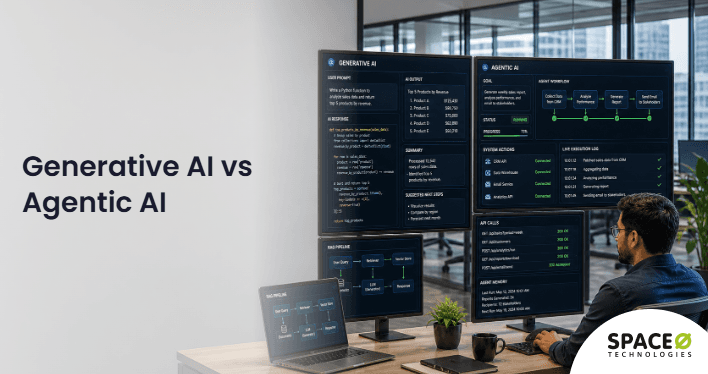
Generative AI and agentic AI are not the same technology, and treating them interchangeably is the most common mistake enterprises make when planning their next AI investment.
Generative AI responds. You give it a prompt, it produces an output, and the loop ends. Agentic AI executes. You define a goal, and it plans the steps, uses tools, takes actions, and continues until the job is done.
Treat agentic AI as a more powerful chatbot and you will underuse it. Deploy it where generative AI was sufficient and you will overcomplicate a workflow that did not need autonomous infrastructure.
The choice is a scoping question more than a tooling question, which is why most enterprise programs start with AI consulting before any build decision. This guide covers how each technology works, where each delivers value, and how to decide which one fits your use case. For foundational context on how generative AI works before comparing it with agentic systems, see our generative AI guide.
What is Generative AI?
Generative AI refers to artificial intelligence systems that create new content in response to a user’s prompt. These systems learn patterns from large datasets and produce outputs that match those patterns in new, contextually appropriate ways.
The most common form is large language models (LLMs) like GPT-4, Claude, and Gemini. Feed them a prompt, and they produce text. Other generative models produce images, audio, video, or code.
The key operating principle is reactive inference. A user provides input. The model runs one pass through its parameters and returns an output. Then it waits. It does nothing until prompted again.
This makes generative AI effective for:
- Creating first drafts of documents, emails, or reports
- Summarizing long-form content into key takeaways
- Generating code from natural language descriptions
- Translating, reformatting, or rephrasing existing content
- Answering questions using knowledge from its training data
What generative AI cannot do is take independent action. It cannot open your CRM, update a record, send an email on your behalf, or monitor a dashboard and respond when a threshold is crossed. It creates. It does not act.
For organizations building production-grade generative AI systems, see our generative AI development services.
What is Agentic AI?
Agentic AI refers to AI systems that pursue goals autonomously. Rather than responding to a single prompt with a single output, agentic systems break down a goal into sub-tasks, select the tools needed to execute each step, take actions in external systems, evaluate the results, and continue until the goal is achieved.
The fundamental shift is from reactive to proactive. Generative AI waits for direction. Agentic AI operates with intent. Agentic AI is one of the defining shifts in our breakdown of generative AI trends for 2025 and 2026.
A simple example: ask a generative AI tool to “summarize last week’s sales performance,” and it will write a summary if you paste in the data. An agentic system given the same goal will connect to your CRM, pull the relevant records, run the analysis, generate the summary, and send it to the right people. You set the goal once. It executes.
What makes agentic AI distinct:
- Planning: It decomposes complex goals into ordered steps
- Tool use: It connects to APIs, databases, browsers, and external services
- Memory: It retains context and past decisions across sessions
- Self-correction: It evaluates its own outputs and adjusts when something does not work
- Autonomy: It operates without human prompting at each stage
Building these systems requires a structured approach to planning, tool integration, memory, and guardrails, which is covered in detail in our guide on how to develop agentic AI. For organizations building autonomous systems and multi-agent workflows, our agentic AI development services cover the full architecture and deployment.
Generative AI vs Agentic AI: Head-to-Head Comparison
The clearest way to understand the generative AI vs agentic AI difference is to look at how each technology behaves across the dimensions that matter for real deployments.
| Labels | Generative AI | Agentic AI |
|---|---|---|
| Core function | Creates new content – text, images, code, audio – based on patterns learned during training | Pursues a defined goal by planning steps, using tools, and taking actions until the outcome is achieved |
| Trigger | Requires a human prompt for every output – it only acts when directly asked | Operates from a goal or objective, deciding on its own what steps to take and when |
| Autonomy | Low – the human remains in the loop at every step, reviewing and re-prompting as needed | High – once given a goal, it plans, executes, and self-corrects with minimal human involvement |
| Memory | Limited to the active context window – it forgets everything once the session ends | Maintains persistent memory across sessions, retaining context, past decisions, and learned preferences |
| Tool use | Operates mostly within its own model – limited ability to call external APIs or interact with live systems | Actively connects to APIs, databases, browsers, code environments, and third-party tools to execute tasks |
| Output | A finished artifact – a draft, summary, image, or code snippet ready for human review | A completed outcome – a filed report, a triggered workflow, a sent email, a resolved ticket |
| Inference loops | Runs a single pass from input to output, then waits for the next prompt | Runs multiple inference cycles in sequence, checking its own work and adjusting until the goal is met |
| Best for | Tasks where you need high-quality content created quickly, with a human reviewing before use | Tasks where you need end-to-end execution across multiple systems without prompting each step |
The core divide is straightforward: generative AI produces a deliverable. Agentic AI delivers an outcome.
It is also worth noting that agentic AI frequently uses generative AI as one of its components. When an agentic system needs to draft a message, generate a report, or communicate a result, it calls on a generative model to handle that language output. The two technologies are not in competition. In many architectures, they work together.
Traditional AI vs Generative AI vs Agentic AI: How the Three Compare
Placing agentic AI alongside traditional AI and generative AI clarifies where each technology fits and why most enterprise AI strategies eventually use all three rather than picking one.
Traditional AI: classification and prediction
Traditional AI (also called narrow AI or classical machine learning) was built to solve specific, well-defined tasks. Spam filters, fraud detection models, recommendation engines, and credit scoring algorithms are all traditional AI.
These systems do not create content and do not act autonomously. They classify, predict, and score based on patterns in training data.
Generative AI: content creation on demand
Generative AI marked the next shift. Instead of predicting a label, generative models learned to produce new content that resembled their training data.
This opened up applications in language, image creation, and code generation that traditional AI could not handle.
Agentic AI: autonomous goal execution
Agentic AI is the current frontier. Rather than simply generating content, agentic systems plan, decide, execute, and iterate. They use tools, interact with external systems, and operate over extended time periods without human input between steps.
The progression looks like this:
- Traditional AI: Analyzes data and classifies outcomes
- Generative AI: Creates content and responds on demand
- Agentic AI: Pursues goals and executes workflows autonomously
For a related comparison, see our guide to generative AI vs predictive AI, which covers the third major architecture type. Each generation builds on the previous one rather than replacing it. Most mature AI strategies use all three in combination, applying each where it performs best.
Generative AI vs Agentic AI Use Cases: Where Each Technology Excels
Each technology has a distinct profile of work it does well. Generative AI fits content creation tasks with human review at every step. Agentic AI fits multi-step execution tasks where continuous autonomy is the goal. The two work together more often than they compete.
Generative AI use cases
Generative AI performs best on tasks where the core requirement is producing high-quality content quickly, with a human reviewing and approving the output before it is used. Common deployments include:
- Marketing and content: writing ad copy, drafting email campaigns, generating blog outlines, producing product descriptions at scale
- Customer support: drafting responses to support tickets, summarizing case histories, and generating knowledge base articles from internal documentation
- Software development: writing boilerplate code, generating unit tests, producing inline documentation from existing functions
- Finance: summarizing earnings reports, generating client-facing narratives from raw data, drafting RFP responses
- Healthcare: generating clinical note drafts, producing patient education materials, translating medical summaries for non-specialist readers
In each case, a human remains in the decision loop. The AI creates the content. The person decides whether to use it, modify it, or discard it. For a comprehensive breakdown by industry, our generative AI use cases page covers where each architecture delivers the most value.
Agentic AI use cases
Agentic AI performs best when a task involves multiple steps, external systems, or ongoing execution that would be impractical to manage through repeated manual prompting. Common deployments include:
- Sales operations: an agent monitors the CRM for at-risk accounts, identifies deal patterns, drafts follow-up emails, and schedules outreach without a sales manager prompting each step
- Financial risk management: an agent pulls transaction data, runs anomaly detection, flags suspicious patterns, and files compliance alerts continuously rather than on demand
- Ecommerce operations: an agent monitors competitor pricing, adjusts product pricing within defined business rules, triggers purchase orders when stock hits a threshold, and logs every action with a rationale
- Software development workflows: an agent reviews pull requests, runs tests, logs failures as Jira tickets, and notifies the relevant engineer without a developer managing each stage of the pipeline manually
- HR and employee support: an agent handles onboarding workflows, routes policy questions, schedules required training, and updates HR records without HR staff intervening at each step
Where generative and agentic AI work together
The most effective AI architectures use generative and agentic AI in combination. The agentic layer handles execution and decision-making. The generative model handles communication and content output within that workflow.
In a customer service pipeline, the agentic system classifies the ticket, routes it, and decides whether escalation is needed. The generative model drafts the response. Neither technology handles the full workflow as well as both working together.
The same pattern shows up in sales (agent identifies the lead, generative model writes the outreach), finance (agent flags the anomaly, generative model drafts the compliance note), and software development (agent runs the pipeline, generative model writes the failure summary).
Generative AI vs Agentic AI: Which Should You Use?
“Which is better?” is not the right question. The right question is which approach fits the work you need done. The decision usually breaks down across three patterns: tasks that fit generative AI, tasks that fit agentic AI, and tasks where both belong in the same pipeline.
Choose generative AI when
- The task involves creating or transforming content (writing, summarizing, translating, generating)
- You need human review before any output is acted upon
- Your use case is single-step: one input, one output
- You are earlier in your AI adoption and need faster time-to-value
Choose agentic AI when
- The task involves multiple steps, decisions, or external systems
- You want the AI to act, not just respond
- You need continuous execution without prompting each stage
- Your goal is operational automation, not content assistance
Consider both when
- You are building workflows where content creation and execution happen in the same pipeline
- You want agents that communicate naturally while executing autonomously
- You are scaling AI across an enterprise where different teams have different requirements
Data and infrastructure readiness matter
The maturity of your data infrastructure also matters. Agentic AI requires more robust integration work, including connecting to live systems, managing permissions, and setting guardrails for autonomous action.
If your data is fragmented or your systems are not well-integrated, generative AI is often the right starting point.
Building agentic infrastructure on top of broken data pipelines produces systems that automate the wrong outcomes faster than humans could catch them.
A structured AI implementation roadmap sequences data readiness, use case prioritization, and architecture decisions in the order that produces working systems rather than abandoned pilots.
If you are unsure which architecture fits your workflows, AI consulting works through business requirements first and recommends the right technical approach before any build begins.
Generative AI vs Agentic AI Across Industries
The distinction between generative and agentic AI plays out differently in each industry, but the underlying logic is consistent: generative AI owns the content-creation slice of the workflow, agentic AI owns the multi-step execution slice, and the highest-leverage deployments combine both. The infrastructure that makes this possible is explored in our guide to agentic AI frameworks.
Financial services and banking
In financial services, the distinction shows up clearly in daily operations.
Generative AI handles content-intensive work: drafting earnings summaries, producing client-facing reports from raw data, generating compliance document drafts, and writing RFP responses.
These tasks involve producing structured language output from available information, with a compliance or legal team reviewing before release.
Customer-facing applications, including conversational AI in banking, extend the same generative capability to live customer interactions, with stricter accuracy and compliance gates.
Agentic AI handles execution-intensive work. Real-time fraud detection agents monitor transaction streams and flag anomalies as they occur.
Regulatory filing agents pull data from multiple systems and prepare submissions on schedule. Risk assessment agents track market signals and alert portfolio managers when defined thresholds are breached.
The governance implications are significant for this industry. Agentic systems in finance require strong auditability, human-in-the-loop controls for high-stakes decisions, and clear accountability for every autonomous action the system takes. SOC 2 Type II, PCI-DSS, and explainability requirements for credit and lending decisions all shape the architecture from day one.
Generative AI in banking carries additional explainability requirements where regulators expect transparent reasoning behind any automated outcome that affects a customer.
Ecommerce and retail
In ecommerce, generative AI has become standard for product description generation, email campaign drafting, and customer service response templates.
Agentic AI extends this further. A pricing agent monitors competitor listings, applies business rules, and updates SKU prices in real time. An inventory agent tracks stock levels, forecasts demand, and triggers purchase orders before stockouts occur.
A post-purchase agent follows up with customers, manages return requests, and updates order records without a customer service agent handling each case.
Retail operations involve repetitive, rule-governed decisions across large data volumes, which is exactly the condition where autonomous execution delivers the most value.
Healthcare
Generative AI in healthcare is widely used for clinical documentation, patient education content, and prior authorization letter drafts. It reduces documentation burden on clinicians without replacing clinical judgment.
Agentic AI operates in monitoring and coordination workflows. A patient monitoring agent tracks vitals from connected devices, identifies patterns that require clinical attention, and notifies the care team.
A care coordination agent manages referral workflows, schedules follow-up appointments, and confirms patient compliance with treatment plans.
These workflows involve multiple systems, multiple steps, and a continuous operational loop, which is exactly where agentic AI outperforms a prompt-based approach.
All generative AI in healthcare deployments require HIPAA-compliant architecture, private model deployment, and human-in-the-loop validation for any output that informs clinical decisions, regardless of whether the underlying technology is generative or agentic.
Generative AI vs Agentic AI vs AI Agents – Clearing Up the Confusion
These three terms appear together frequently, and the overlap causes real confusion in enterprise AI planning conversations. The distinction matters because each term refers to a different layer of the system, and conflating them leads to scoping errors that surface only after the build commits.
What is an AI agent?
An AI agent is an individual autonomous unit built to handle a specific function. A pricing agent, a support ticket agent, and a compliance reporting agent are all AI agents. Each has a defined scope and a specific task, with its own boundaries on what data it accesses and what actions it can take.
The full scope of AI agent development covers the architecture decisions that determine whether an agent stays reliable in production or breaks at the first edge case.
What is agentic AI?
Agentic AI refers to the broader paradigm where multiple agents collaborate, share memory, use tools, and coordinate toward a shared goal. Agentic AI describes the architecture and the operating model, not a single agent. The agents are the components. Agentic AI is the system that organizes them.
What is generative AI in this context?
Generative AI is the underlying model capability that most agents use for language output. When an agent drafts a response, summarizes a document, or generates a report, it is calling on a generative model to handle that output. The generative model is one tool the agent uses, not the agent itself.
A simpler way to think about it
A useful analogy: AI agents are individual team members, each with a specific role. Agentic AI is the operating model that organizes those team members and coordinates their work. Generative AI is the language skill those team members use to communicate. A team without organization is just individuals doing parallel work. An organization without language skill cannot communicate its decisions. All three layers are needed for the system to function.
For organizations building task-specific agents, AI agent development covers scoping, architecture, and production deployment.
Why Choose Space-O AI for Generative AI and Agentic AI Development
Generative AI and agentic AI serve different functions and fit different problems. Generative AI creates high-quality content on demand, with a human reviewing and directing each step. Agentic AI executes goals autonomously, using tools, making decisions, and completing multi-step workflows without a prompt at each stage. The most capable enterprise AI systems use both: agentic systems that execute workflows, and generative models that handle language output within those workflows.
Space-O AI builds both, with production deployments across healthcare, finance, retail, and operations. The team scopes the use case first, identifies which technology fits which slice of the workflow, and builds the architecture to connect them.
Generative AI builds
We build LLM-powered applications using GPT-4o, Claude, and open-source models, including retrieval-augmented generation (RAG) pipelines, fine-tuned models for domain-specific tasks, and enterprise chatbot systems integrated with existing infrastructure. See generative AI development and LLM development for the full service scope.
Agentic AI builds
We architect multi-agent systems with persistent memory, tool-use frameworks, orchestration layers, and human-in-the-loop controls. The agent’s decision boundaries are scoped carefully before the build begins, ensuring autonomous systems operate within defined guardrails. See agentic AI development for the full service scope.
Where to start
The question for your organization is not which technology is more advanced. It is determining which tasks are consuming the most time and which approach addresses those tasks at the right level of autonomy. Talk to our team to scope your use case, get an architecture recommendation, and move from evaluation to production-ready build.
Frequently Asked Questions About Generative AI and Agentic AI
Can agentic AI work without generative AI?
Yes. Agentic AI does not require a generative model to function. Some agents use rule-based logic, classification models, or structured API calls to accomplish their tasks. However, most modern agentic systems incorporate generative AI for language output because it improves the quality of communication within automated workflows.
Is agentic AI better than generative AI?
Neither is universally better. Generative AI outperforms on content creation tasks where human review is needed at every step. Agentic AI outperforms on multi-step execution tasks where continuous autonomy is the goal. Most enterprise AI strategies use both in combination.
What are examples of agentic AI in business?
Common examples include fraud detection agents in financial services, inventory management agents in retail, customer support escalation pipelines, automated regulatory filing systems, and software development agents that run tests and log bugs automatically.
How do I know if my business needs agentic AI or generative AI?
If your task is creating content, drafts, or summaries with a human reviewing the output, generative AI is the right fit. If your task involves executing a multi-step process across multiple systems without manual prompting between steps, agentic AI is the better approach. Many workflows benefit from both working in combination.


