- What Is RAG (Retrieval-Augmented Generation)?
- What is Fine-Tuning?
- RAG vs. Fine-Tuning: A Direct Comparison
- When to Use RAG
- When to Use Fine-Tuning
- Can You Combine RAG and Fine-Tuning?
- RAG vs. Fine-Tuning: Cost Breakdown
- Real-World Use Cases by Industry
- How to Choose Between RAG and Fine Tuning
- Build Smarter AI With the Right LLM Architecture
- Frequently Asked Questions
RAG vs. Fine-Tuning: Which Approach Is Right for Your AI System?

 Last Updated: June, 8 2026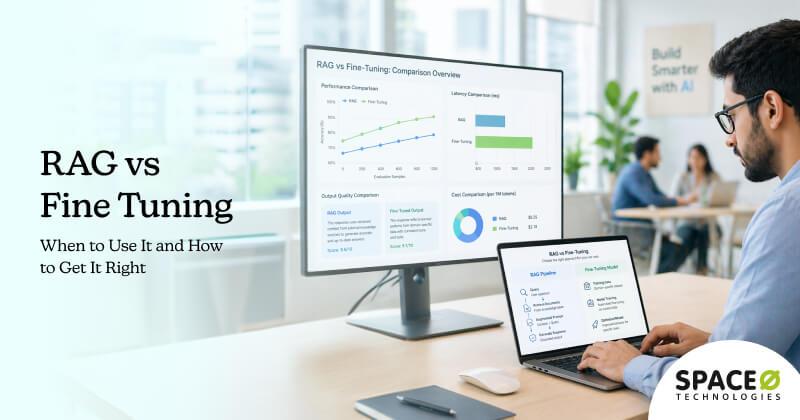
Most teams building on large language models (LLMs) hit the same decision point early in development: do you give the model better access to information, or do you change how the model itself behaves? This is the core question behind the rag vs fine tuning debate, and it is one of the most consequential architectural choices in LLM application development.
Both approaches improve what an LLM can do, but they solve different problems. Retrieval-Augmented Generation (RAG) connects the model to external knowledge at query time. Fine tuning changes the model’s internal behavior through additional training on a curated dataset. Getting this decision wrong means building the wrong system, allocating budget in the wrong direction, and potentially rebuilding from scratch.
According to McKinsey’s 2024 State of AI report, 65% of organizations are now regularly using generative AI in at least one business function. As adoption scales, the pressure to choose the right implementation strategy grows with it. Our RAG development services team works through this decision daily with enterprise clients across healthcare, finance, and SaaS.
This guide covers exactly how RAG and fine-tuning work, where each approach performs best, how costs compare, and when combining both makes practical sense for production systems.
What Is RAG (Retrieval-Augmented Generation)?
RAG is a technique that connects a pre-trained language model to an external knowledge source at inference time. Instead of relying solely on what the model learned during training, RAG retrieves relevant documents from a knowledge base and passes them as context alongside the user’s query before generating a response.
The concept was introduced in a 2020 paper by researchers at Facebook AI Research, and it has since become one of the most widely deployed patterns in enterprise AI development. RAG addresses two of the most common failure modes in raw LLM deployments: hallucination and outdated knowledge.
The core components of a RAG system include an embedding model, a vector database, a retriever, and the language model itself. Documents are chunked, converted into vector embeddings, and stored in the vector database. When a query arrives, the same embedding model converts it to a vector, the retriever finds the most semantically similar document chunks, and those chunks are injected into the prompt before the LLM generates its response.
How RAG Works in Practice
A production RAG pipeline follows a consistent set of steps from document ingestion through to answer generation. Here is how each stage works in a typical enterprise deployment:
- Ingesting and chunking source documents such as PDFs, internal wikis, product documentation, and support ticket histories
- Generating vector embeddings for each chunk using a model such as OpenAI’s text-embedding-3 or a self-hosted alternative like BGE or E5
- Storing those embeddings in a vector database such as Pinecone, Weaviate, or pgvector
- At query time, converting the user’s question into an embedding and retrieving the top-K most semantically relevant chunks
- Constructing a prompt that includes the retrieved context alongside the original question
- Passing the assembled prompt to the LLM to generate a grounded, citation-ready answer
A common production example is an enterprise knowledge base assistant that answers employee or customer questions from internal documentation, always citing the specific source document it retrieved from. This pattern is reliable, maintainable, and keeps sensitive data inside your own infrastructure.
What is Fine-Tuning?
Fine tuning is the process of taking a pre-trained language model and continuing its training on a smaller, curated dataset. The goal is not to teach the model general world knowledge but to shift its behavior, output format, tone, or domain-specific language handling in a targeted direction.
There are two main approaches. Full fine tuning updates all of the model’s parameters and requires significant GPU compute resources. Parameter-efficient methods such as LoRA (Low-Rank Adaptation) and QLoRA update only a small fraction of the model’s weights, making fine tuning accessible on more modest hardware. The Hugging Face PEFT library has become the standard tooling for parameter-efficient fine tuning in production environments.
Fine tuning is the right tool when you need the model to behave consistently and predictably, regardless of what is in the knowledge base. It does not add new factual knowledge as reliably as RAG does. What it changes is how the model writes, structures output, interprets instructions, and handles domain-specific terminology.
When is Fine-tuning the Right Choice?
Fine tuning fits best when behavioral consistency and output control matter more than knowledge freshness. These are the scenarios where it earns its higher upfront cost:
- You need the model to produce a specific output format on every response, such as structured JSON, SOAP clinical notes, or a defined compliance report template
- You want to teach the model a brand voice, persona, or communication style that must stay consistent across all interactions
- You need to reduce prompt length by baking task instructions into the model weights rather than repeating them in every system prompt
- Your domain uses specialized vocabulary that the base model handles poorly, such as medical terminology, legal contract language, or proprietary product nomenclature
- You have a high-quality labeled dataset of 500 or more input-output pairs that accurately represents the desired model behavior
- Your use case has strict latency requirements where the added roundtrip time of a retrieval step is not acceptable
Evaluating Whether Fine-tuning is Worth the Investment for Your LLM Project?
Talk to our AI engineering team for a free technical assessment.
RAG vs. Fine-Tuning: A Direct Comparison
Choosing between these two approaches is clearer when you map them against the factors that matter most in your deployment context. The table below provides a side-by-side comparison across the dimensions that enterprise teams most often raise when evaluating LLM architecture decisions.
| Factor | RAG | Fine Tuning |
|---|---|---|
| Knowledge source | External documents retrieved at query time | Baked into model weights at training time |
| Information freshness | Handles real-time and frequently updated data | Reflects knowledge only up to training cutoff |
| Upfront cost | Lower (no training required) | Higher (data prep and GPU compute) |
| Per-query cost | Higher (retrieval and longer prompts add tokens) | Lower (no retrieval step) |
| Hallucination risk | Lower, as answers are grounded in retrieved source documents | Can still hallucinate if training data had gaps |
| Maintenance | Update knowledge base without retraining the model | Requires retraining when knowledge changes |
| Output style control | Limited, relies on prompt engineering | High, tone and format are baked into weights |
| Latency | Higher, vector search adds roundtrip time | Lower, no retrieval step required |
| Data privacy | Proprietary data stays in your vector database | Training data must be processed by the model provider |
| Time to deploy | Faster, no training pipeline needed | Slower, training and evaluation cycles required |
The table above gives you a structural picture, but these factors interact in practice. Below is a more detailed breakdown of the dimensions that most often determine which approach is the right fit.
1. Knowledge Source and Freshness
RAG pulls from external, updatable documents at query time, meaning answers always reflect whatever is currently in your knowledge base. Fine tuning bakes knowledge into model weights during training, so the model draws on that knowledge directly without any external lookup. When your data changes frequently, updating a vector index costs far less than re-running a training job.
2. Cost Structure
RAG carries lower upfront cost since no training pipeline is required. However, each query in a RAG system typically consumes two to five times more tokens than a direct LLM call, because retrieved chunks are appended to the context window. At high query volumes, this overhead adds up. Fine tuning has a higher upfront cost for data preparation and compute, but lower ongoing inference cost since there is no retrieval step adding to token consumption.
3. Accuracy, Hallucination, and Style Control
RAG grounds each answer in retrieved source documents, which reduces hallucination significantly on factual queries. Fine tuning can still hallucinate when a query falls outside the training data. On the other side, fine tuning gives precise control over response format, tone, and persona, because those patterns are embedded in the model weights. RAG relies on prompt engineering for stylistic consistency, which is harder to maintain reliably at scale.
When to Use RAG
RAG is the right default for most enterprise LLM applications, particularly where knowledge freshness, factual accuracy, and data privacy are the primary requirements. Consider RAG when your situation fits one or more of these criteria:
- Your knowledge base updates frequently, such as product documentation, internal policies, compliance regulations, or support ticket histories
- Your application needs to provide grounded, factual answers with source citations that users can verify against original documents
- You cannot share proprietary training data with a model provider due to security, compliance, or contractual restrictions
- You want to reach production faster with lower upfront investment and no training pipeline to build or maintain
- Your knowledge base is too large or too dynamic to fit within a single model context window
- You are building internal knowledge assistants, enterprise search tools, customer support bots, or regulatory compliance copilots
RAG is also the better choice when your data changes faster than you can retrain a model. Policies get updated, products evolve, regulations are revised. Rebuilding your vector index is far less expensive than relaunching a fine-tuning job every time source content changes. Our generative AI integration services cover the full RAG pipeline from document ingestion and embedding through to production deployment and monitoring.
When to Use Fine-Tuning
Fine-tuning earns its place when the problem is about behavior, not knowledge. If you need the model to consistently produce a specific type of output, speak in a defined voice, or handle domain-specific instructions correctly, fine-tuning is the right tool. Consider it when your requirements match these conditions:
- Your application requires structured output in a fixed format on every response, such as JSON schemas, clinical documentation templates, or compliance report structures
- Low inference latency is a hard requirement and you cannot afford the extra roundtrip time from a retrieval step
- You need the model to represent a specific brand voice, persona, or communication style consistently across millions of interactions
- Your domain uses specialized vocabulary or jargon that the base model mishandles, including medical terminology, legal language, or proprietary product nomenclature
- You have a well-labeled dataset of high-quality input-output pairs that accurately represents the desired model behavior
- You are building code generators, automated clinical note writers, or branded customer-facing chatbots that must behave in a defined and predictable way
Fine tuning also reduces prompt length over time. Baking instructions into the model weights eliminates the need for long system prompts, which lowers token cost per query and keeps the context window available for more task-relevant content. Our LLM development services include both LoRA and full fine-tuning pipelines tailored to enterprise use cases across healthcare, finance, and SaaS.
Not Sure Whether Fine-tuning or RAG is the Right Fit for Your LLM Project?
Get a free architecture consultation from Space-O’s AI engineering team.
Can You Combine RAG and Fine-Tuning?
Yes, and in many production systems this hybrid approach delivers the best results. The two techniques are not mutually exclusive. You can fine tune a model to control its behavior, tone, and output format, then use RAG to supply accurate, up-to-date factual content at query time.
A practical example is a clinical decision support tool built for a healthcare provider. The base model is fine tuned on medical dialogue so it structures responses in the format clinicians expect and uses correct clinical terminology. RAG then connects that model to a live database of clinical guidelines, drug interaction data, and peer-reviewed literature, ensuring every answer reflects current evidence rather than the model’s training snapshot.
The hybrid approach makes the most sense in high-stakes domains where both consistency and accuracy are required. Healthcare, finance, legal, and regulated enterprise environments often demand the output precision that fine tuning delivers alongside the factual grounding that RAG provides. Our enterprise AI development team has built hybrid LLM systems across clinical and financial services environments where neither approach alone was sufficient.
The tradeoff is real. Hybrid systems are more complex to build, test, and maintain. You are running a training pipeline and a retrieval pipeline simultaneously. This path is recommended only when RAG alone fails on consistency, or fine tuning alone fails on factual accuracy. For most teams, starting with RAG and adding fine tuning selectively is the more practical sequence.
RAG vs. Fine-Tuning: Cost Breakdown
Understanding the cost structure of each approach helps you size the investment and set accurate expectations before committing to a direction.
RAG cost drivers include vector database hosting (Pinecone, Weaviate, or a self-hosted alternative like pgvector), embedding API calls for both document ingestion and query time, retrieval and reranking compute, and the cost of longer prompts due to context injection. At high query volumes, the token overhead from retrieved chunks becomes a meaningful ongoing cost.
Fine-tuning cost drivers include dataset creation and labeling (often the highest single cost), compute for the training run measured in GPU hours on services such as AWS, GCP, or Azure, storage for the fine-tuned model weights, and evaluation infrastructure to validate model behavior before deployment. Parameter-efficient methods like LoRA reduce compute costs substantially but still require careful data preparation and evaluation cycles.
As a general rule, RAG is more cost-effective for most enterprise deployments, particularly during early scaling.
Fine-tuning pays off at high query volumes where a reduction in per-query token consumption outweighs the upfront training investment, or in scenarios where prompt engineering alone cannot achieve the output consistency required. Both costs vary widely depending on model choice, data volume, and infrastructure configuration, so exact numbers should be validated against your specific setup before making architecture decisions.
Real-World Use Cases by Industry
How this decision plays out in practice varies by industry. Here are three patterns that reflect the most common deployment scenarios across the sectors our clients operate in.
1. Healthcare
RAG is the dominant pattern for clinical knowledge assistants. Medical literature updates constantly, and clinicians need answers grounded in current guidelines, not a model’s training snapshot from months ago. A healthcare organization might deploy RAG over a curated corpus of clinical guidelines, drug formularies, and peer-reviewed journals. Fine tuning enters the picture when the output format matters as much as the content, such as generating structured SOAP notes or discharge summaries in the precise format a hospital system expects. Our AI for healthcare practice has built RAG and fine-tuned systems for clinical environments with full HIPAA compliance built into the architecture.
2. Finance
Financial services firms use RAG extensively for regulatory compliance assistants, investment research tools, and internal policy chatbots. Regulations change frequently, and the cost of an outdated answer in a compliance context is significant. Fine tuning is applied in financial services to produce consistent risk assessment reports, credit analysis summaries, and structured audit findings where format and tone must meet institutional and regulatory standards.
3. Enterprise SaaS
Product teams at enterprise SaaS companies typically start with RAG to power internal knowledge base assistants and customer support bots. RAG keeps the assistant current as products evolve without requiring any retraining. Fine tuning becomes relevant when building customer-facing chatbots that must represent a specific brand voice, handle proprietary product workflows in a defined way, or consistently produce formatted output that matches the product’s design language.
How to Choose Between RAG and Fine Tuning
If you are still deciding, work through these six questions before committing to an approach. Your answers will point toward the right architecture for your specific situation.
- Does your knowledge base change more than once a month?
- Do you have a labeled dataset of 500 or more high-quality input-output pairs ready to use?
- Is inference latency a hard constraint with no tolerance for retrieval overhead?
- Is your training data too sensitive to share with any external model provider?
- Is consistent output format and tone more important than factual grounding for your use case?
- Does your team have the infrastructure and capacity to build and maintain a training pipeline?
If you answered yes to questions 1, 4, and no to 3, RAG is almost certainly the right starting point. If you answered yes to questions 2, 3, and 5, fine tuning is likely the stronger fit. If you answered yes to questions 2, 4, and 5 together, a hybrid approach deserves serious consideration before you finalize your architecture.
Getting this decision right at the start saves significant development time and cost. Our RAG consulting services include a structured architecture review that helps teams make this call confidently before writing a line of production code.
Ready to Make the Right LLM Architecture Decision for Your AI Initiative?
Schedule a free consultation with our team, and we will walk through your requirements, data, and constraints together.
Build Smarter AI With the Right LLM Architecture
RAG and fine tuning solve genuinely different problems. RAG delivers factual grounding, knowledge freshness, and faster time to deployment. Fine tuning delivers behavioral consistency, output control, and lower inference latency at scale.
The right answer depends on what your system needs to do, what data you have available, and what operational constraints you are working within. For most enterprise teams, RAG is the faster and more practical starting point, with fine tuning added selectively when output consistency demands it.
Space-O AI brings 15 years of AI development experience and 500+ production AI systems delivered across healthcare, finance, manufacturing, and enterprise SaaS. Our team of 80+ AI engineers has built RAG pipelines over multi-million document corpora, fine-tuned LLMs using LoRA and QLoRA on domain-specific datasets, and deployed hybrid systems that combine both approaches in high-throughput production environments.
We have built HIPAA-compliant clinical knowledge assistants powered by RAG, fine-tuned models for structured financial reporting, and enterprise-grade hybrid LLM systems that serve millions of queries per month. Every engagement starts with an architecture review to ensure you are building the right system for your actual requirements, not a system that looks good in a proof of concept but fails under production load.
Ready to determine whether RAG, fine-tuning, or a hybrid architecture is the right fit for your AI initiative? Contact us to schedule a free technical consultation and discuss your requirements, timeline, and next steps with our LLM engineering team.
Frequently Asked Questions
What is the main difference between RAG and fine-tuning?
RAG retrieves external information at query time and passes it as context to the LLM before generating a response. Fine-tuning modifies the model’s internal weights through additional training on a curated dataset. RAG improves factual accuracy and knowledge freshness. Fine-tuning improves behavioral consistency, output format, and domain-specific language handling. They solve different problems and are often complementary rather than competitive.
Is RAG better than fine-tuning for enterprise applications?
For most enterprise applications, RAG is the better starting point. Enterprise knowledge changes constantly, data privacy is often a concern, and most teams cannot justify the cost and complexity of a training pipeline early in their AI journey. Fine-tuning becomes the right choice when output consistency, latency, or highly specialized domain behavior are the primary requirements, and a labeled training dataset is available.
Can RAG and fine-tuning be used together?
Yes. A hybrid approach fine-tunes the model for behavioral consistency and output format, then uses RAG to supply accurate, up-to-date factual content at query time. This combination is common in high-stakes domains such as healthcare, finance, and legal services, where both precision and consistency are required. The tradeoff is higher system complexity and a greater operational burden to maintain both pipelines.
Which approach has a lower implementation cost?
RAG has a lower upfront implementation cost because no training pipeline is required. However, per-query inference costs are higher due to retrieval overhead and longer prompts. Fine-tuning has a higher upfront cost in data preparation and compute, but lower ongoing inference cost. At high query volumes with a consistent and well-defined use case, fine-tuning can become more cost-effective over time than a high-volume RAG deployment.
Does fine-tuning eliminate the need for a vector database?
No. Fine-tuning changes how the model behaves but does not give it access to current external information. If your application needs to answer questions from a frequently updated knowledge base, you still need RAG regardless of whether the underlying model has been fine-tuned. Fine-tuning and vector databases serve different purposes in the LLM stack and are often used together in production systems.
How long does it take to implement RAG vs fine tune an LLM?
A well-scoped RAG system can be built and deployed in two to six weeks, depending on data volume, source complexity, and integration requirements. Fine-tuning timelines vary widely based on dataset size and quality, but a production-ready fine-tuning pipeline typically takes four to 12 weeks from data preparation through evaluation and deployment. Hybrid systems combining both approaches generally require eight to 16 weeks, depending on the complexity of the use case and the maturity of your existing data infrastructure.
Build a RAG System That Delivers Accurate Answers


What to read next