
Top 10 Generative AI Consulting Companies in 2026

 Last Updated: May, 13 2026
You are evaluating generative AI consulting companies, and the list keeps getting longer.
Every firm has rebranded. Every pitch deck now mentions LLMs, RAG, and fine-tuning.
Most of them mean they have a team that has used the OpenAI API and a sales deck written in late 2023. Identifying a firm that can actually do the work evaluate the right model for your specific use case, design a RAG pipeline that performs in your data environment, and deliver a production-ready system with governance in place that is a much shorter list.
This guide cuts through the noise.
We evaluated ten generative AI consulting companies across methodology depth, delivery track record, use case range, and pricing. We included firms at the mid-market level (from $10,000) and the enterprise level ($250,000+), so you can see the full spectrum and identify the tier that fits your budget and complexity.
Whether you are building an internal knowledge assistant, a document automation workflow, or a customer-facing AI application, the right consulting partner depends on more than a good proposal. It depends on whether they have actually built what you need before. Space-O Technologies provides generative AI development services that span every capability covered in this comparison, from RAG pipelines and fine-tuned LLMs to compliance-first enterprise builds.
If you want an independent assessment of your use case before committing to a partner, our generative AI consulting team evaluates your requirements and recommends the right architecture before any engagement begins. For a broader view across AI disciplines, our roundup of top AI consulting firms covers providers specializing in machine learning, computer vision, and predictive systems.
5 Criteria for Evaluating a Generative AI Consulting Company
Not every firm that offers AI consulting has the depth to advise on generative AI specifically. For background on the technology itself before evaluating providers, our generative AI guide covers how these systems work and what capabilities to look for. Before evaluating any company on this list, use these five criteria to separate firms with real expertise from those with a repositioned service page.
1. Do they start with use case evaluation, not model recommendation?
The right consulting firm begins with your business problem, not a preferred technology. If a firm leads with a specific model or vendor before understanding your use case, they are not consulting. They are reselling a pre-decided solution. Ask how they approach the discovery phase and what criteria they use to recommend one model over another.
2. Can they demonstrate RAG and fine-tuning capability specifically?
These are the two architectural approaches that determine whether a generative AI application performs reliably in production. The trade-off between RAG vs fine-tuning is one of the first architectural decisions every engagement should address. Ask for documented examples of both, including accuracy benchmarks. General AI experience is not a substitute.
3. How do they address responsible AI and output governance?
A generative AI consulting partner that does not address hallucination risk, output guardrails, and human-in-the-loop review workflows is not ready to advise on enterprise deployments. Hallucination risk is typically addressed through RAG development that grounds outputs in verified organizational data, paired with output validation layers and human review gates for high-stakes responses.
This is particularly critical in finance, healthcare, and legal, where a wrong output has real consequences. Ask specifically how they design the governance layer and what post-deployment monitoring looks like.
4. What does their post-deployment methodology include?
Generative AI systems degrade over time as data drifts and use patterns change. The consulting engagement should include a clear framework for ongoing output monitoring, model evaluation, and retraining, not just delivery and handoff.
The post-deployment phase typically falls under MLOps consulting, which covers drift detection, retraining cycles, and the production monitoring infrastructure that keeps generative AI systems reliable after launch. Firms that do not address this upfront are leaving you with a maintenance problem they will charge you to fix later.
5. Does their pricing match your project scale?
Enterprise consulting firms (Accenture, IBM) carry minimum engagement thresholds that make them impractical for mid-market budgets. Specialized firms at the $10,000 to $50,000 entry point can often deliver more focused and faster consulting for a defined generative AI use case, particularly for focused capabilities like LLM development and fine-tuning where scope can be tightly defined upfront. Know what you are paying for before the engagement begins.
Not Sure Where to Start with Generative AI Solution Development?
Space-O Technologies maps your use case to the right model, architecture, and deployment path in a single discovery session. No commitment, no slide deck.
Top 10 Generative AI Consulting Companies
The table below summarizes pricing, ratings, and best-fit profile for each of the ten generative AI consulting companies covered above, so you can quickly identify the tier and specialization that match your engagement scope.
| Company | HQ | Industry Focus | Engagement Type | GenAI Specialization |
|---|---|---|---|---|
| Space-O Technologies | Tempe, AZ | Finance, Healthcare, Legal, Retail | Consulting + Implementation | RAG, Fine-tuning, LLM apps |
| LeewayHertz | San Francisco, CA | Healthcare, Finance, Retail, Logistics | Consulting + Implementation | LLM strategy, RAG, Multi-agent |
| Markovate | Sacramento, CA | Healthcare, Software, Retail, Fitness | Consulting + Implementation | LLM apps, GANs, RAG |
| Neurons Lab | London, UK | Financial services | Consulting + Implementation | RAG, LLM strategy, Architecture |
| Fractal.AI | New York, NY | Retail, Healthcare, BFSI, Consumer goods | Consulting + Implementation | Analytics + GenAI, LLM strategy |
| Diceus | Warsaw, Poland | Fintech, Insurtech | Consulting + Implementation | LLM integration, Conversational AI |
| Master of Code Global | Winnipeg, Canada | Retail, Telecom, Financial services | Consulting + Implementation | Conversational AI, Contact center AI |
| InData Labs | Cyprus | Retail, Healthcare, Finance, Logistics | Consulting + Implementation | NLP, Document processing, Semantic search |
| Accenture | Dublin, Ireland | Finance, Healthcare, Manufacturing, Retail | Enterprise programs | LLM strategy, AI accelerators, Change management |
| IBM Consulting | Armonk, NY | Banking, Insurance, Public sector | Enterprise programs | watsonx, Responsible AI, Compliance |
Below is a closer look at each of these ten generative AI consulting companies, including their delivery model, portfolio depth, pricing, and the type of engagement each is best suited for.
1. Space-O Technologies
| Established | 2010 |
| Notable clients | Nike, McAfee, NAQEL |
| Team size | 100–300 |
| Min. project size | $10,000 |
| Hourly rate | $25–$49/hr |
| HQ | Tempe, AZ |
| Clutch rating | 4.8/5 |
Space-O Technologies is a generative AI consulting firm that takes business use cases from initial evaluation through production deployment. Their consulting process opens with model selection, assessing whether a use case is best served by a proprietary model such as GPT-4 or Claude, an open-source alternative, or a fine-tuned domain-specific model, before any architecture or integration work begins.
Their generative AI consulting practice covers the full delivery cycle. For knowledge-intensive applications, Space-O advises on and implements RAG development pipelines that ground model outputs in proprietary data, reducing hallucinations and improving factual accuracy.
For organizations in regulated industries with specialized terminology or compliance requirements, they evaluate fine-tuning feasibility and oversee training on domain-specific datasets through their LLM development practice. Their advisory work spans conversational AI systems, internal knowledge assistants, document automation platforms, and generative AI features integrated into existing SaaS products.
Responsible AI practices are embedded into every engagement from the start. Space-O implements output guardrail layers, accuracy benchmarking protocols, and human-in-the-loop review workflows for high-stakes applications in finance, healthcare, and legal.
Every engagement concludes with model evaluation reports, architecture documentation, and an MLOps framework for output monitoring and retraining as operational data evolves.
Portfolio highlights
- Vision RAG system: Designed and deployed a production-ready Vision RAG pipeline for advanced document analysis, enabling accurate retrieval from visual and text-based enterprise documents at scale.
- Fine-tuned LLM for healthcare: Fine-tuned a Llama 2 model on domain-specific COVID-19 patient data, delivering a specialized clinical language model benchmarked against accuracy targets for medical application use.
- AI document analyzer and QA system: Built a generative AI document analysis and question-answering system that allows staff to retrieve precise answers from large document libraries without manual search, reducing document review time significantly.
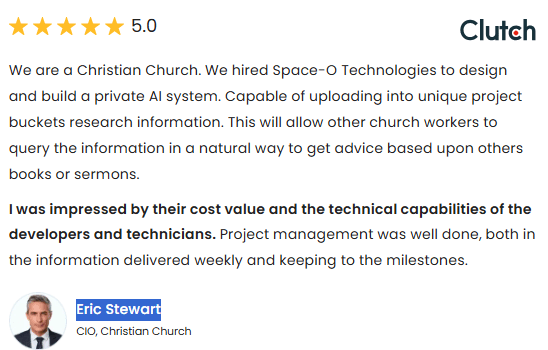
Client testimonial
“Impressed by their cost value and the technical capabilities of the developers and technicians.”
Eric Stewart, CIO (Clutch, 5.0/5)
Key highlights
- End-to-end generative AI consulting from model evaluation and architecture design through RAG implementation, fine-tuning oversight, and production deployment, with no handoffs between strategy and execution teams
- Mid-market entry point from $10,000 makes expert generative AI consulting accessible outside large enterprise budgets
- Responsible AI governance built into every engagement: output guardrails, accuracy benchmarking, and human review workflows for regulated industries
Best for
Mid-market businesses that need a single consulting partner to evaluate, architect, and deliver a production-grade generative AI application, particularly in finance, healthcare, or legal where output accuracy and auditability are non-negotiable.
2. LeewayHertz
| Established | 2007 |
| Notable clients | ESPN, NASCAR, Hershey’s, McKinsey |
| Team size | 51-200 |
| Min. project size | $10,000 |
| Hourly rate | $50–$99/hr |
| HQ | San Francisco, CA |
| Clutch rating | 4.4/5 |
Leewayhertz is one of the more established names in the generative AI consulting space, with a dedicated practice covering LLM strategy, enterprise generative AI application consulting, and agentic AI architecture
Their generative AI consulting methodology addresses the full stack: model selection and vendor evaluation, RAG pipeline architecture, fine-tuning strategy, and integration with enterprise systems including CRMs, ERPs, and knowledge management platforms.
They also advise on multi-agent architectures for businesses exploring autonomous workflow automation alongside generative AI. For deeper background on the framework choices that shape multi-agent design, our agentic AI frameworks guide compares the leading options. Their team includes AI researchers and solution architects with domain expertise across healthcare, finance, retail, and logistics.
Key highlights
- Research-grounded consulting: published LLM benchmark analysis and model comparisons inform recommendations rather than vendor defaults
- Multi-agent architecture consulting available alongside generative AI engagements for businesses building toward full workflow automation
- Enterprise system integration advisory across CRM, ERP, and knowledge management platforms
Best for
Technology-forward enterprises that want a research-backed consulting partner for complex generative AI architecture decisions, particularly where multi-agent and RAG capabilities need to be evaluated together.
3. Markovate
| Established | 2015 |
| Notable clients | PacProfs Inc, MedME |
| Team size | 51–200 |
| Min. project size | $50,000+ |
| Hourly rate | $50 – $99/hr |
| HQ | Sacramento, CA |
| Clutch rating | 4.8/5 |
Markovate is a generative AI consulting firm with over 65 completed AI projects across healthcare, software, retail, travel, and fitness. Their consulting practice focuses on practical generative AI implementation: advising on LLM selection, designing the application architecture, and guiding clients through training and deployment workflows for production-grade systems.
Their team has hands-on advisory experience with large language models, generative adversarial networks (GANs), and reinforcement learning applications across industries. For organizations evaluating which approach fits their use case, our guide on the types of machine learning covers the trade-offs across each method.
Markovate’s track record with enterprise clients such as Dell and Ford demonstrates consulting capability at scale. For mid-market clients, their pricing structure and team model make expert generative AI consulting accessible at the $10,000 entry level, which is less common among firms with comparable enterprise references.
Key highlights
- 65+ completed generative AI projects across five industries provides a broad consulting reference base for use case evaluation and architecture recommendations
- Business-case-first consulting model: measurable value identification before model or architecture selection begins
- Mid-market pricing with enterprise client references including Dell and Ford
Best for
Mid-market businesses looking for a consulting partner with a strong delivery track record and enterprise-level reference clients, without enterprise-level pricing requirements.
4. Neurons Lab (AI Consultancy)
| Established | 2019 |
| Notable clients | HSBC, Visa, and AXA |
| Team size | 50-200 |
| Min. project size | $20,000 |
| Hourly rate | NA |
| HQ | London, UK, and Singapore. |
| Clutch rating | 5/5 |
Neurons Lab is a specialized AI consulting firm with strong generative AI depth, particularly in financial services and enterprise knowledge management applications. Their consulting practice focuses on LLM strategy, RAG architecture, and the design of generative AI systems that integrate with complex enterprise data environments.
This upfront consulting rigor reduces downstream rework and is particularly valuable for enterprises where the cost of a misaligned architecture is high. Our LangChain RAG development guide covers the architecture patterns that drive these design decisions.
Financial services focus with regulatory expertise for compliant GenAI deployments. This regulatory depth is built into their engagement methodology rather than treated as a compliance add-on.
Key highlights
- Architecture-first consulting methodology: significant upfront investment in data readiness evaluation, model selection, and RAG design before any implementation begins
- Regulatory consulting depth for generative AI in financial services: FCA, SEC, and Basel compliance frameworks built into the engagement methodology
- Focused generative AI practice within a specialized firm, rather than a broad technology consultancy with a repositioned AI service
Best for
Financial services organizations and enterprises with complex data environments that need rigorous upfront generative AI architecture consulting before committing to an implementation approach.
5. Fractal.AI
| Established | 2000 |
| Notable clients | Microsoft, Apple, and Nvidia |
| Team size | 5,000+ |
| Min. project size | NA |
| Hourly rate | NA |
| HQ | NY (USA) |
| Clutch rating | 4.8 |
Fractal.AI is a global generative AI consulting and advanced analytics company serving Fortune 500 and mid-market enterprises across retail, healthcare, banking and financial services (BFSI), and consumer goods.
Their consulting methodology positions generative AI as part of a broader enterprise intelligence strategy. Engagements typically involve use case prioritization across the AI stack, followed by architecture design and an integration plan that connects generative AI outputs to existing decision-making workflows.
Fractal.AI has delivery hubs in the US, UK, India, and Australia, making them operationally viable for multinationals that need consistent advisory and delivery across regions.
Key highlights
- Advanced analytics foundation underpins generative AI consulting: data readiness assessments and architecture decisions are informed by deep enterprise data experience
- Multi-AI consulting capability covers predictive, analytical, and generative AI in a single engagement, avoiding fragmented advisory across multiple firms
- Global delivery across US, UK, India, and Australia for enterprises managing multi-region generative AI programs
Best for
Fortune 500 and large mid-market enterprises that need generative AI consulting as part of a broader enterprise intelligence program, particularly where data engineering and analytics maturity need to be addressed alongside LLM architecture.
If you are a mid-market business with a specific generative AI use case rather than an enterprise-wide program, our AI consulting team scopes your use case in a single session and recommends the right build path before any investment is made.
6. Diceus
| Established | 2011 |
| Notable clients | UNIQA Ukraine, Vienna Insurance Group (VIG) |
| Team size | 100–250 |
| Min. project size | $10,000 |
| Hourly rate | $25–$49/hr |
| HQ | Delaware, USA |
| Clutch rating | 4.9/5 |
Diceus offers generative AI consulting and implementation services with a strong focus on financial services and insurance technology clients. Their consulting practice covers LLM integration strategy, conversational AI design, and the deployment of generative AI capabilities within existing fintech and insurtech platforms.
For background on the conversational AI patterns specific to financial services, our conversational AI in banking guide covers compliance-aware deployment models.
Their generative AI consulting approach is practical and delivery-oriented. They carry particular consulting depth in legacy system integration, advising clients on how to layer generative AI onto established financial technology platforms without requiring full re-architecture.
Diceus operates at a mid-market price point with capacity across both advisory and implementation phases, making them a viable option for financial technology firms that need generative AI consulting without enterprise-tier investment thresholds.
Key highlights
- Legacy system integration consulting: specific advisory capability for layering generative AI onto established financial technology platforms without full re-architecture
- Practical delivery model combining use case scoping, architecture advisory, and implementation in a single engagement
- Mid-market pricing accessible to growth-stage fintech and insurtech organizations
Best for
Fintech and insurtech companies that need generative AI consulting grounded in practical integration with legacy systems, particularly those operating at mid-market scale.
7. Master of Code Global
| Established | 2004 |
| Notable clients | Tom Ford, Burberry |
| Team size | 250–500 |
| Min. project size | $25,000 |
| Hourly rate | $50–$99/hr |
| HQ | California, USA |
| Clutch rating | 5/5 |
Master of Code Global is a conversational AI and generative AI consulting firm with deep specialization in LLM-powered customer experience applications. Their consulting practice focuses on businesses deploying generative AI in customer-facing workflows: intelligent virtual assistants, contact center automation, and AI-powered self-service platforms.
Our LangChain document processing guide covers the production patterns for these specific use cases.
Engagements begin with a conversation design audit, evaluating where generative AI can replace or augment existing customer interaction workflows, followed by model selection, RAG architecture for knowledge-grounded responses, and integration with contact center platforms such as Salesforce, Genesys, and Twilio.
Master of Code’s consulting practice includes an analytics layer: designing the measurement framework that evaluates generative AI performance in customer-facing workflows after deployment, covering containment rates, escalation patterns, and customer satisfaction outcomes.
Key highlights
- Conversation design consulting as a distinct service within generative AI engagements, evaluating workflow automation potential before model or architecture decisions
- Contact center platform integration advisory for generative AI deployments across Salesforce, Genesys, and Twilio environments
- Post-deployment analytics consulting: performance measurement frameworks built into the engagement, not added as an afterthought
Best for
Enterprises in retail, telecommunications, and financial services deploying generative AI in customer-facing workflows, particularly those integrating with established contact center platforms.
8. InData Labs
| Established | 2014 |
| Notable clients | Wargaming.net, GSMA |
| Team size | 51-200 |
| Min. project size | $10,000+ |
| Hourly rate | $50 – $99 |
| HQ | Cyprus |
| Clutch rating | 4.0/5 |
InData Labs is a data science and generative AI consulting firm that focuses on building custom AI solutions for mid-market clients across retail, healthcare, finance, and logistics. Their consulting methodology emphasizes data quality as a prerequisite for generative AI performance.
InData Labs has particular consulting depth in NLP-driven generative AI applications: text classification, summarization, document processing, and semantic search systems.
Their delivery model combines advisory and implementation within the same team, which avoids the common problem of strategy consultants handing off to an execution team with limited context on why specific architecture decisions were made.
Key highlights
- Data-first consulting methodology: dedicated data readiness assessment before any model or architecture recommendations are made
- NLP and document processing depth: specialized generative AI consulting across text classification, summarization, semantic search, and document automation use cases
- Advisory and implementation in the same team, preserving architecture context through the full delivery cycle
Best for
Mid-market businesses in data-intensive industries (retail, healthcare, logistics) that need generative AI consulting grounded in data quality assessment, particularly for document processing and NLP-driven use cases.
9. Accenture
| Established | 1989 |
| Notable clients | Microsoft, Walmart, Nokia |
| Team size | 700,000+ |
| Min. project size | Enterprise (typically $500,000+) |
| Hourly rate | NA |
| HQ | Dublin, Ireland |
| Clutch rating | Not listed |
Accenture’s generative AI consulting practice operates through its AI and Data group, which has invested significantly in large language model capabilities, industry-specific generative AI accelerators, and enterprise change management for AI adoption.
What differentiates Accenture in generative AI consulting is their investment in proprietary accelerators and pre-built solution templates for common enterprise use cases: internal knowledge assistants, contract analysis, customer service automation, and code generation platforms.
Accenture also brings significant change management and adoption capability to generative AI engagements. Deploying a generative AI solution in a large enterprise is as much an organizational challenge as a technical one, and their consulting model addresses user adoption, governance policy development, and executive alignment as part of the engagement.
Key highlights
- Proprietary generative AI accelerators across key enterprise use cases reduce time-to-recommendation and provide validated architecture baselines
- Industry-specific consulting tracks for generative AI in financial services, healthcare, manufacturing, and retail
- Change management and adoption consulting integrated into generative AI engagements, not treated as a separate workstream
Best for
Global enterprises running large-scale generative AI transformation programs that require use case prioritization, organizational change management, and enterprise-wide rollout planning alongside technical consulting.
10. IBM Consulting
| Established | 1991 |
| Notable clients | Etihad Airways, Raiffeisen Bank International |
| Team size | 160,000+ |
| Min. project size | Enterprise (typically $250,000+) |
| Hourly rate | NA |
| HQ | Armonk, NY |
| Clutch rating | Not listed |
IBM Consulting’s generative AI practice is anchored by the watsonx platform, IBM’s enterprise AI and data stack built specifically for regulated industries. Their consulting approach focuses on responsible AI governance, model selection within a multi-model framework, and the integration of generative AI into existing enterprise technology architectures.
Their consulting team advises on on-premise and hybrid cloud deployment models, data residency requirements, and the governance frameworks needed for generative AI in banking, insurance, and public sector contexts.
For deeper background on the design decisions behind compliant on-premise generative AI, our guide on sovereign AI architecture covers the architectural patterns these deployments require.
For organizations with significant compliance constraints and large-scale deployment requirements, IBM offers regulatory depth that smaller consulting firms typically cannot match.
Key highlights
- Watsonx Platform Consulting gives enterprise clients a governed, multi-model generative AI environment built for regulated industries
- Deep regulatory consulting capability for generative AI deployments in banking, insurance, and public sector contexts
- Global delivery scale for large, multi-workstream generative AI transformation programs
Best for
Large enterprises in regulated industries (banking, insurance, government) where generative AI consulting must address data governance, compliance architecture, and enterprise-scale deployment alongside model selection and integration.
How to Choose the Right Generative AI Consulting Partner
The right consulting partner depends on your use case, your organization’s scale, and how far along you are in your generative AI journey. These five questions will guide the evaluation.
1. Does the firm’s consulting process start with use case evaluation or model recommendation?
Firms that lead with a specific model or technology before understanding your use case are not consulting. The right consulting partner begins with your business problem, evaluates multiple approaches, and recommends the architecture that fits your specific requirements.
2. Can they demonstrate RAG and fine-tuning capability specifically?
Ask for documented examples of RAG pipeline consulting and fine-tuning advisory work, including the accuracy benchmarks achieved. General AI consulting experience is not a substitute for generative AI architecture depth.
3. How do they address responsible AI and output governance?
Ask specifically how they design the governance layer and what their post-deployment monitoring approach includes. Firms that do not address hallucination risk and output guardrails are not ready to advise on enterprise generative AI deployments.
4. What is their approach to post-deployment optimization?
The consulting engagement should include a clear framework for post-deployment monitoring, evaluation, and retraining, not just delivery and handoff.
5. Does their pricing model match your project scale?
Specialized firms at the $10,000–$50,000 entry point can often deliver more focused and faster consulting for defined generative AI use cases. Know what you are paying for before the engagement begins. To understand which AI approach your use case actually requires before engaging a consulting partner, see our guides on generative AI vs agentic AI and generative AI vs predictive AI.
Why Space-O Technologies for Your Generative AI Initiative
Most mid-market businesses do not need a global consulting firm to get generative AI into production. They need a single partner who can evaluate the right model, design the architecture, build the system, and leave a governance framework behind, without a six-month engagement timeline or a $500,000 minimum.
That is the gap Space-O Technologies was built to fill.
Over 500 AI projects across healthcare, finance, retail, and operations give Space-O a consulting reference base most specialist firms cannot match at this price point. Every engagement starts with a use case evaluation, then moves to architecture and implementation only when the foundation is clear.
The work covers RAG pipelines that ground outputs in proprietary data, fine-tuned models benchmarked against domain accuracy requirements, responsible AI guardrails for regulated contexts, and an MLOps framework that keeps deployments running after launch.
The portfolio reflects the range: a Replit prototype rebuilt into production-ready software, a Stable Diffusion XL model fine-tuned on a brand-specific visual dataset, and an AI integration project for a distribution company where generative AI was embedded into existing enterprise operations.
For mid-market businesses in finance, healthcare, or legal where output accuracy is non-negotiable and the consulting partner needs to understand both the technology and the regulatory environment, Space-O Technologies is the right starting point.
Ready to scope your generative AI initiative?
Production-ready prototype in 2 to 4 weeks before any long-term commitment. Talk to our team and get a fixed-milestone delivery plan with a go/no-go decision after the prototype.
Frequently Asked Questions
What does a generative AI consulting company actually do?
A generative AI consulting company evaluates your business use case, recommends the right model and architecture, designs the integration with your existing systems, and advises on governance and responsible AI requirements. The consulting engagement covers model selection (proprietary versus open-source versus fine-tuned), RAG pipeline design, and the governance framework needed for production deployment. The firm should also define the post-deployment monitoring approach before the build begins. A typical output is a working application like an AI document analyzer and QA system that delivers measurable time savings against the use case scoped at the start. Most of the firms listed here also deliver hands-on generative AI software development, not just advisory.
How much does generative AI consulting cost?
Specialized mid-market consulting firms typically start at $10,000–$25,000 for a defined use case. Enterprise consulting firms (Accenture, IBM) carry minimum engagement thresholds of $250,000 or more. The right entry point depends on the complexity of your use case, your compliance requirements, and whether you need strategic advisory alongside technical architecture consulting.
What is the difference between generative AI consulting and AI consulting?
AI consulting covers the full spectrum of artificial intelligence: machine learning, predictive modeling, computer vision, natural language processing (NLP), and generative AI. Generative AI consulting is a narrower specialization focused on LLM strategy, RAG architecture, fine-tuning, and the deployment of systems that generate content. The distinction matters because the skills, tooling, and architecture decisions involved in generative AI are specific enough that general AI consulting experience does not automatically transfer. Teams with machine learning workloads running alongside generative AI initiatives should also review our guide to machine learning consulting companies.
How long does a generative AI consulting engagement take?
A focused consulting engagement for a defined use case typically runs four to eight weeks, covering use case evaluation, model selection, architecture design, and a production deployment plan. More complex programs involving multiple use cases, enterprise system integration, or governance framework development can run three to six months. The initial scoping phase typically takes one to two weeks.
What should I look for in a generative AI consulting company?
The five most important criteria: use case-first approach (not model-first), documented RAG and fine-tuning advisory capability, responsible AI and output governance frameworks, post-deployment monitoring methodology, and pricing that matches your project scale. Firms that cannot demonstrate specific generative AI architecture consulting work, rather than general AI experience, should be evaluated with caution.


