
- What are AI Chatbots in Banking?
- What Types of Chatbots Are Used in Banking?
- What are the Key Use Cases of AI Chatbots in Banking?
- 1. Customer support automation
- 2. Account management and transaction execution
- 3. KYC and digital onboarding
- 4. Fraud detection and real-time alerts
- 5. Loan and credit card applications
- 6. Personalized financial advisory
- 7. Payment reminders and proactive notifications
- 8. Cross-selling and upselling
- 9. Omnichannel banking support
- 10. Internal employee-facing chatbots
- 11. Regulatory compliance assistance
- What are the Benefits of AI Chatbots for Banks and Customers?
- Which Banks are Already Using AI Chatbots Successfully?
- What Technology Stack Powers AI Banking Chatbots?
- How to Build an AI Chatbot for Banking
- Step 1: Define use cases and user journeys
- Step 2: Analyze real query patterns from support data
- Step 3: Choose the right AI and NLP framework
- Step 4: Design conversation flows and fallback logic
- Step 5: Integrate with core banking systems via APIs
- Step 6: Implement security, compliance, and authentication
- Step 7: Test, train, and validate with real banking data
- Step 8: Deploy across channels
- Step 9: Monitor, optimize, and continuously improve
- What Security and Compliance Standards Must Banking Chatbots Meet?
- What Are the Biggest Challenges of Implementing Chatbots in Banking?
- How Much Does It Cost to Build an AI Chatbot for Banking?
- How Does Space-O AI Build Intelligent Banking Chatbots?
- Frequently Asked Questions About AI Chatbot in Banking Industry
AI Chatbots in Banking: Use Cases, Benefits & How to Build AI Chatbots

 Last Updated: June, 11 2026
Key Takeaways
- AI chatbots in banking use NLP, ML, and LLMs to automate customer interactions, execute transactions, and deliver personalized financial guidance in real time.
- Common use cases span account management, fraud detection, loan applications, KYC onboarding, and proactive financial advisory.
- A well-built banking chatbot integrates with core banking systems via APIs and follows strict compliance standards like PCI-DSS, GLBA, SOC 2, and CCPA.
- Development costs range from $30,000 for basic FAQ bots to $400,000+ for advanced AI-powered multi-channel solutions.
- The strongest results come from banks that treat their chatbot as a core service channel, not an add-on feature.
What happens when a customer needs a quick balance check at 11 PM on a Saturday? Or wants to dispute a suspicious charge while boarding a flight? They are not calling a branch. They are not waiting on hold. They expect an instant, accurate answer through their phone.
That expectation is exactly why chatbots in the banking industry have moved from a “nice to have” to a strategic priority. The global conversational AI market is projected to grow from $17.05 billion in 2025 to $49.8 billion by 2030, according to MarketsandMarkets. Banking and financial services are driving a major share of that growth.

But here is the challenge. Most banks still struggle with the basics: long hold times, disconnected digital experiences, and support teams stretched thin across rising query volumes. Customers are leaving for competitors who make banking feel effortless.
Banking AI chatbots solve this problem. They handle routine queries instantly, execute real transactions, detect fraud in real time, and scale support without scaling headcount. At Space-O AI, we have helped financial institutions build AI chatbot solutions that handle exactly these challenges, combining NLP, generative AI, and secure banking integrations into one conversational layer.
This guide walks through everything: what these chatbots actually are, where they work best, the technology behind them, examples from leading US banks, compliance requirements, costs, and how to get started.
What are AI Chatbots in Banking?
A banking AI chatbot is a virtual assistant powered by artificial intelligence that interacts with customers through text or voice. It handles tasks like balance inquiries, fund transfers, fraud alerts, loan applications, and personalized financial guidance without human intervention.
What separates a modern bank chatbot from older systems? Intelligence.
Traditional bots relied on scripted decision trees. Every possible input had to be pre-programmed. If a customer phrased a question differently than expected, the bot failed.
Today’s AI-powered chatbots use natural language understanding to interpret what a customer means, not just what they type. They analyze intent, extract entities (account numbers, dates, amounts), and maintain context across multi-turn conversations. Paired with large language models, they generate responses that adapt to the customer’s tone and financial literacy level.
At the infrastructure level, a chatbot in banking connects to core banking systems, CRMs, payment gateways, and fraud detection engines through secure APIs. This lets it pull real-time account data, execute transactions, and trigger backend workflows.
How it works in 5 steps:
- The customer sends a message through the bank’s mobile app, website, or messaging platform.
- The NLP engine identifies the customer’s intent and extracts relevant details.
- The system retrieves data from core banking systems through secure API calls.
- The AI generates a context-aware response or completes the action.
- If the query is too complex, the chatbot escalates to a human agent with full conversation history.
Want a broader foundation before diving deeper? This AI chatbot guide covers the fundamentals from the ground up.
What Types of Chatbots Are Used in Banking?
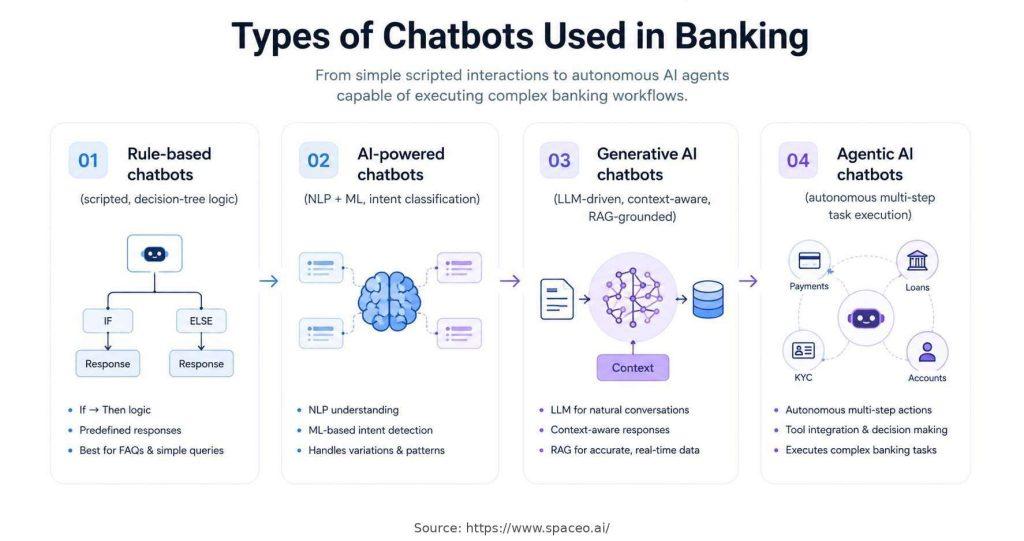
Not all chatbots are built the same. The type a bank deploys depends on task complexity, personalization needs, and technical infrastructure.
1. Rule-based chatbots
These run on predefined scripts and decision trees. Fixed if-then logic: customer says “balance,” bot routes to the balance flow.
They work for simple, high-volume queries like branch hours or interest rate lookups. But they break when customers use unexpected phrasing, ask follow-ups, or need multi-step help.
2. AI-powered chatbots (NLP + ML)
These use natural language processing and machine learning to understand intent rather than matching keywords. They handle phrasing variations, track context across messages, and improve over time.
An AI banking bot in this category recognizes “Move $500 to my savings” and “Transfer five hundred to savings” as the same request. This makes NLP-based bots the most widely deployed across US banks today.
Want to understand the specific methods behind this? This resource on AI techniques used in chatbots breaks down the NLP and ML approaches.
3. Generative AI chatbots (LLM + RAG)
Built on large language models, these generate original, context-aware responses instead of selecting from templates. Combined with retrieval-augmented generation (RAG), they ground every answer in verified bank data, reducing hallucination risk.
They shine in complex conversations: explaining loan terms in plain language, analyzing spending patterns, or walking someone through mortgage pre-qualification.
4. Agentic AI chatbots
These go beyond conversation into autonomous task execution. They plan multi-step workflows, interact with multiple backend systems, and complete end-to-end processes.
Example: An agentic chatbot receives a loan inquiry, checks the credit profile, calculates eligibility, presents rate options, collects documents, and submits the application. All within one flow. Interested in this approach? Here is how developing agentic AI works in practice.
For a detailed breakdown of each category, see this page on types of AI chatbots.
Pro Tip: Start with AI-powered (NLP + ML) chatbots for your highest-volume use case. Once stable, layer in generative AI for advisory conversations. Agentic workflows should come last, only after your API integrations and security architecture are battle-tested.
Not Sure Where a Chatbot Fits in Your Banking Operations?
Our team at Space-O AI runs a free assessment where we analyze your support data, query patterns, and existing infrastructure to identify the chatbot use case for your institution. No pitch deck. Just a clear picture of where automation makes sense and where it does not.
What are the Key Use Cases of AI Chatbots in Banking?
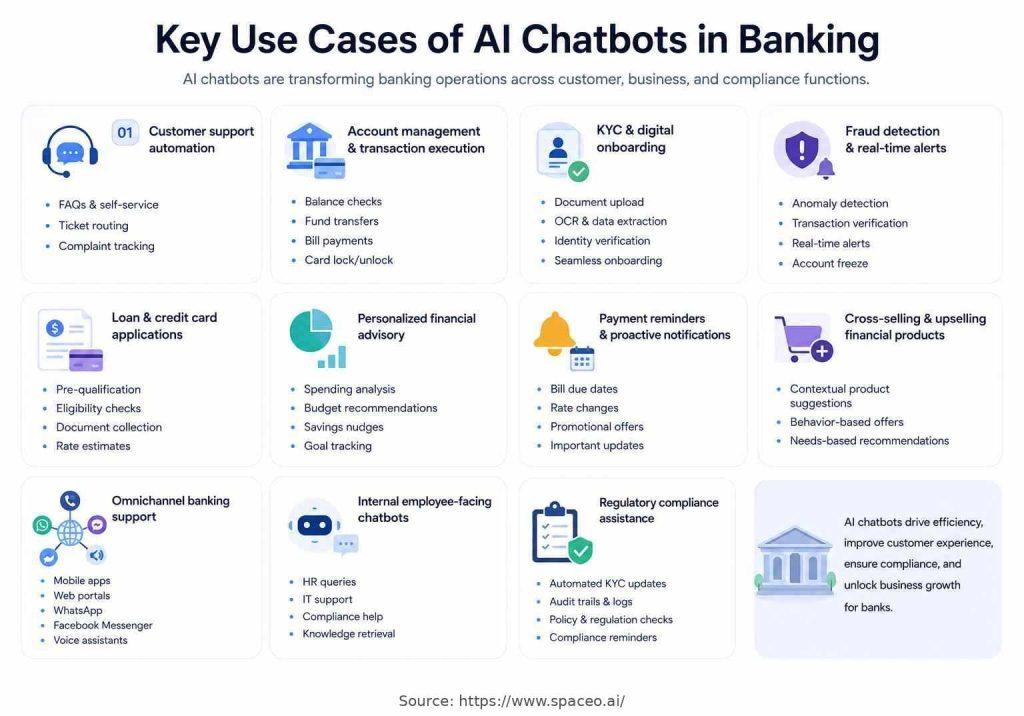
The real value of chatbots for banks and financial services shows up in how they handle specific, high-impact workflows. Here are the use cases that deliver the most measurable results.
1. Customer support automation
AI chatbots handle FAQs (branch hours, interest rates, fee structures, account types) without human agents. They classify queries by intent and either resolve instantly or route to the right department with full context. Banks that automate first-level support resolve 60 to 85% of routine queries without escalation.
That matters because the average cost of a human-handled call is $5 to $12, while a chatbot interaction costs a fraction. At scale, this frees up hundreds of agent hours per week for complex cases that actually need human judgment.
2. Account management and transaction execution
Customers check balances, view transactions, transfer funds, pay bills, and lock or unlock cards through a conversational interface. The chatbot banking experience replaces multi-step app navigation with a simple “Pay my credit card bill” or “Show last week’s transactions.”
Once a customer gets a balance check in 2 seconds instead of navigating three screens, they rarely go back to the old way. Banks also see fewer branch visits and call center contacts for these routine tasks, which compounds the efficiency gains over time.
3. KYC and digital onboarding
Onboarding traditionally takes days: manual document collection, identity checks, compliance reviews. AI chatbots compress this into a guided flow with document upload, OCR-based verification, and automated compliance checks. Timelines drop from days to hours.
Every day of delay in onboarding increases the risk that a new customer drops off before completing their application. Chatbot-driven KYC keeps the customer engaged in one continuous session while maintaining the full audit trail regulators require.
4. Fraud detection and real-time alerts
Chatbots integrate with fraud engines to respond instantly when suspicious activity is flagged. The customer gets a real-time alert and confirms or denies the transaction in seconds.
If fraud is confirmed, the chatbot freezes the account, starts a dispute, and connects to a specialist. No phone queue. The speed difference is critical because every hour between a fraudulent transaction and account lockdown increases the bank’s financial exposure. A chatbot closes that loop in seconds rather than the hours it takes through traditional phone verification.
5. Loan and credit card applications
Chatbots guide the entire lending journey in one flow:
- Pre-qualification checks based on income and credit data
- Rate estimates and repayment calculations
- Document collection
- Application submission to underwriting
For banks building AI solutions for banking, loan automation is one of the highest-ROI chatbot use cases. Customers who might abandon a 15-minute web form are far more likely to complete the same process when guided step by step through a conversation. Banks using chatbot-assisted lending report higher application completion rates and shorter time-to-decision.
6. Personalized financial advisory
A financial bot analyzes spending patterns, income flows, and account activity to deliver tailored insights:
- Flagging forgotten recurring subscriptions
- Suggesting higher-yield savings for idle funds
- Alerting when credit utilization approaches limits
- Monthly spending breakdowns by category
This transforms the chatbot from a support tool into a proactive financial advisor. The strategic value is in customer retention: customers who receive personalized financial guidance from their bank are significantly less likely to switch to a competitor. It creates a relationship that goes beyond transactions.
7. Payment reminders and proactive notifications
Instead of waiting for customers to reach out, banking AI chatbots proactively surface upcoming bill due dates, low balance warnings, rate changes, and relevant offers.
This proactive financial chat layer keeps customers informed without requiring login. It also directly impacts the bank’s bottom line by reducing late payment defaults and the associated collection costs. A simple “Your credit card payment of $450 is due in 3 days” message with a one-tap pay button can prevent a missed payment and the negative customer experience that follows.
8. Cross-selling and upselling
Chatbots analyze transaction history and product usage to identify relevant product opportunities. A frequent traveler gets a no-foreign-fee card suggestion. Someone with growing savings sees an investment option.
Contextual relevance drives conversions. Generic pushes do not. The difference between a well-timed, data-driven recommendation and a random product promotion is the difference between a 2% and a 15% click-through rate. Chatbots make this contextual targeting possible at scale across millions of customer interactions.
9. Omnichannel banking support
Customers expect to start on one channel and continue on another without repeating themselves. Modern chatbots for banks maintain state across mobile apps, web, WhatsApp, Messenger, Apple Business Chat, SMS, and voice.
An AI banking app interaction should feel consistent regardless of where it starts. The technical backbone here is a centralized conversation engine with channel-specific adapters. The customer sees one seamless experience; behind the scenes, the chatbot synchronizes context, authentication status, and conversation history across every touchpoint.
10. Internal employee-facing chatbots
Not just customer-facing. Many institutions deploy internal chatbots for HR policy questions, IT support, compliance procedures, and knowledge retrieval. According to industry research, 71% of financial institutions now use chatbots for internal staff support.
The ROI is often faster than customer-facing deployments because internal queries are more predictable and the tolerance for limited scope is higher. A chatbot that answers “What is our PTO policy?” or “How do I reset my VPN?” saves HR and IT teams thousands of repetitive tickets per month.
11. Regulatory compliance assistance
Chatbots automate compliance workflows: KYC updates, document expiration tracking, policy acknowledgment, and reporting triggers. They enforce rules consistently and maintain audit trails.
For banks managing thousands of customer accounts across multiple regulatory jurisdictions, manual compliance tracking is a staffing nightmare. Chatbots handle the volume consistently, flag exceptions for human review, and generate the documentation auditors need without anyone scrambling before an examination.
Want a broader view of where AI delivers value across banking operations? Check out this guide on AI use cases in banking.
What are the Benefits of AI Chatbots for Banks and Customers?
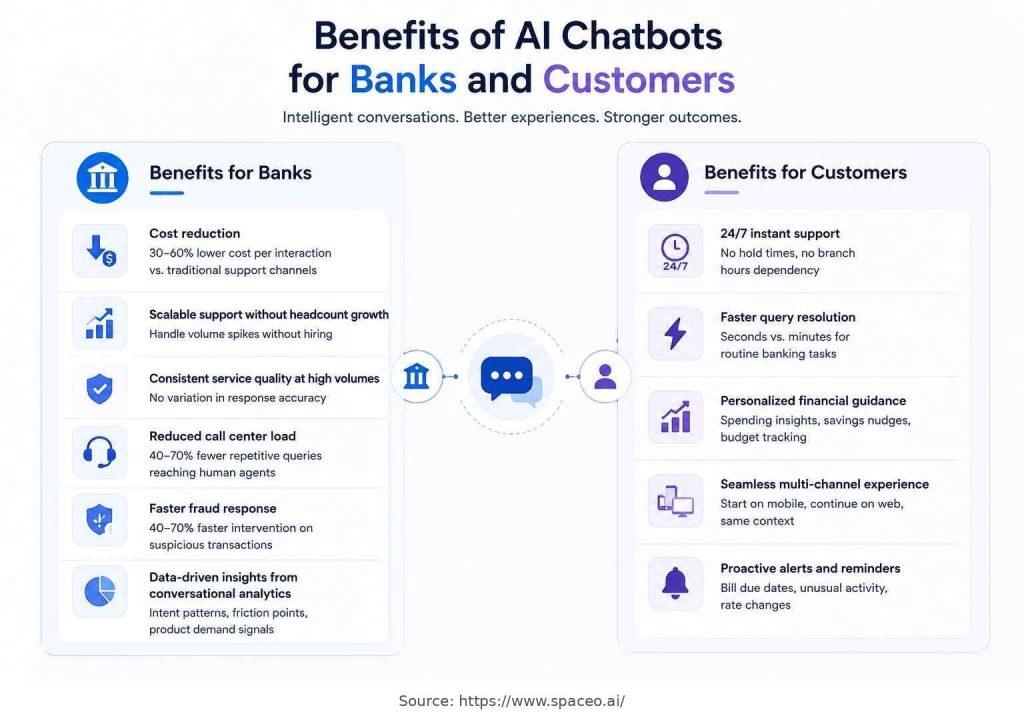
The adoption of chatbots in financial services is driven by measurable impact on both sides. But the benefits look different depending on whether you are running the bank or using it. Here is how the value breaks down.
Benefits for banks
1. Cost reduction
Every customer call that hits a human agent costs a bank between $5 and $12 on average, depending on complexity and region. A chatbot interaction costs a fraction of that. When a bank handles millions of customer queries per year, even shifting 30% of volume to automated resolution translates into significant savings.
Chatbot financial services reduce the cost per interaction by handling balance checks, payment status inquiries, card controls, and FAQs automatically. Human agents are freed to focus on cases that actually require judgment, empathy, or cross-sell expertise, which is where their time generates the most revenue.
2. Scalable support without headcount growth
Tax season. Year-end statements. A new product launch. A data breach notification. Every one of these events triggers a surge in customer queries. Without chatbots, banks are either understaffed (long wait times, angry customers) or overhire (expensive during normal periods).
Chatbots in the banking industry absorb spikes without breaking a sweat. A single system can handle thousands of simultaneous conversations with no degradation in response time or accuracy. When the surge ends, the cost stays flat. That kind of elastic capacity is impossible to replicate with human agents alone.
3. Consistent service quality at high volumes
Human agents are inconsistent by nature. Training gaps, fatigue, mood, and experience all create variation. One agent gives accurate interest rate information. Another misquotes the same product. In banking, that inconsistency creates compliance exposure.
Banking chatbots deliver the same accuracy, tone, and compliance-safe language across every interaction. Whether it is the first query of the day or the ten-thousandth, the response quality does not drift. This consistency is especially valuable for regulated disclosures, fee explanations, and product eligibility criteria where a wrong answer creates real legal risk.
4. Reduced call center load
The majority of inbound customer queries at most banks are repetitive: “What is my balance?” “When is my payment due?” “How do I reset my password?” “What is the routing number?” These are high-volume, low-complexity interactions that consume agent time without generating value.
When a chatbot handles these automatically, agents get their time back for the interactions that matter: complex disputes, hardship applications, relationship conversations, and revenue-generating advisory calls. The result is not just efficiency but better utilization of the most expensive resource in any contact center, your people.
5. Faster fraud response
Fraud moves fast. The window between a suspicious transaction and financial loss is often minutes. Traditional fraud response relies on phone-based verification: the bank calls the customer, the customer misses the call, leaves a voicemail, tries again tomorrow. Every hour of delay increases exposure.
A chatbot closes that loop in seconds. The system flags anomalous activity, sends a real-time alert through the banking app or messaging channel, and the customer confirms or denies the transaction immediately. If it is fraud, the account freezes instantly. That speed difference is not incremental. It fundamentally changes the fraud loss equation.
6. Data-driven insights from conversational analytics
Every chatbot interaction generates structured data that most banks are currently blind to: what customers ask about most frequently, where they get confused, which products generate the most questions, what language patterns signal frustration, and where journeys break down.
When aggregated across millions of interactions, this data becomes a goldmine for product development, process improvement, and proactive service design. Banks using conversational ai in financial services are not just answering questions. They are building a real-time feedback loop that makes the entire institution smarter over time.
Benefits for customers
1. 24/7 instant support
Banking does not stop at 5 PM, and neither should support. Customers checking a suspicious charge at midnight, confirming a wire transfer over the weekend, or needing a card replacement during a holiday all expect instant help. A chatbot delivers that without requiring the bank to staff a 24/7 call center.
For routine tasks (balance checks, recent transactions, payment confirmations, card lock/unlock), the response is measured in seconds, not minutes or hours. That immediacy is no longer a luxury. It is the baseline expectation.
2. Faster query resolution
Think about what it takes to check a balance through traditional channels: open the app, navigate to accounts, find the right account, scroll to the current balance. Or call the bank, wait on hold, verify identity, ask the question, get the answer. With a chatbot, the entire interaction is: “What is my checking balance?” and the answer appears in under two seconds.
The impact of AI in banking customer service is most visible in these everyday moments. The cumulative time saved across hundreds of micro-interactions per year adds up to a meaningfully better banking experience.
3. Personalized financial guidance
Generic “tips to save money” do not help anyone. Personalized guidance does. A chatbot connected to account data can tell a customer: “You spent $340 more on dining this month compared to last month,” or “You have $2,100 sitting in your checking account earning nothing. Moving $1,500 to your high-yield savings would earn roughly $65 this year at the current rate.”
That level of specificity turns a support tool into a personal financial advisor available on demand. It builds loyalty because the bank is actively helping the customer make better decisions, not just processing transactions.
4. Seamless multi-channel experience
A customer starts asking about mortgage rates on their phone during a commute. Later that evening, they want to continue the conversation on their laptop with more details. With a well-built chatbot, the context carries over. No repeating information. No starting from scratch.
Session continuity across channels (mobile, web, messaging apps, voice) creates a unified experience that matches how people actually use their devices throughout the day.
5. Proactive alerts and reminders
Most banking apps are passive. Customers have to open the app and go looking for information. A chatbot flips that model. It proactively pushes relevant information to the customer before they even think to ask.
Upcoming bill due in 3 days? Alert sent. Unusual login from a new device? Verification prompt delivered. Credit card approaching its limit? Spending nudge shared. This proactive layer builds trust because customers feel the bank is watching out for them, not waiting for them to discover problems on their own.
Still Routing Every “Where Is My Statement?” to a Human Agent?
Banks using AI chatbots resolve routine queries in seconds while agents focus on loan advisory, disputes, and relationship management. If your team is still stuck on balance checks and password resets, that is revenue-generating capacity sitting idle.
Which Banks are Already Using AI Chatbots Successfully?
The best way to understand the impact of financial chatbots is to look at what leading institutions are doing today. Here are the standout examples with verified data.
- Erica (Bank of America): The most widely adopted banking chatbot in the US. Erica has surpassed 3 billion client interactions since launching in 2018, serving nearly 50 million users. It handles spending tracking, bill reminders, balance alerts, transaction search, and credit score monitoring. 98% of users get answers without being transferred to a human agent, with an average interaction time of just 48 seconds.
- Eno (Capital One): Capital One’s virtual assistant Eno handles fraud detection with real-time alerts, generates virtual card numbers for secure online shopping, tracks transactions, and sends payment reminders. It works across the mobile app, desktop site, SMS, email, and browser extensions for Chrome, Firefox, Edge, and Safari.
- Fargo (Wells Fargo): An LLM-powered virtual assistant built in partnership with Google Cloud. Originally launched on Google Dialogflow and PaLM 2, it has evolved to use Gemini Flash 2.0 in a multi-model architecture. According to VentureBeat, it averages 2.7 interactions per session and is on track to reach 100 million interactions annually.
- LLM Suite (JPMorgan Chase): JPMorgan’s internal AI assistant is available to 250,000 employees for writing, research, document summarization, and idea generation. Half of them use it roughly every day. The bank also uses AI-powered tools in its call centers (EVEE) and payments division (Commerce Center virtual assistant) for client-facing interactions.
- Smart Assistant (U.S. Bank): One of the first major national banks to combine voice and text support in a single virtual assistant. Customers interact through natural language to manage accounts, make payments, and search transactions within the U.S. Bank mobile app.
- Ally Assist (Ally Bank): Built for a digital-only bank where the chatbot is the primary service channel, not a supplement to branches. Handles balance checks, transfers, and common queries through a clean conversational interface.
- Clari (TD Bank): Handles account inquiries, bill payments, transfers, and card management without agent involvement. Available through the TD mobile app for everyday banking tasks.
- NOMI (Royal Bank of Canada): Delivers personalized financial insights including budgeting, cash flow analysis, and spending categorization. RBC has reported over 2 billion personalized insights delivered to customers through NOMI since launch.
What Technology Stack Powers AI Banking Chatbots?
Building a production-grade chatbot for financial services requires a layered architecture. Each component handles a specific function. Here is what each layer does.
Exploring your options? Our guide on choosing the right AI tech stack covers the decision framework.
1. NLP and NLU engines
Handle intent classification (what the customer wants), entity extraction (account numbers, dates, amounts), and sentiment analysis (detecting frustration or urgency). Banks building custom models benefit from specialized NLP development services trained on banking vocabulary.
2. Large language models and generative AI
LLMs power the generative capabilities. They produce original, context-aware responses instead of selecting templates. For banking, these models are fine-tuned on financial domain data. Teams focused on LLM development build custom pipelines for banking compliance.
3. RAG architecture for grounded responses
Retrieval-augmented generation grounds every answer in verified bank data, addressing hallucination risk. The system retrieves relevant information first, then generates a traceable response. Building this correctly requires experienced RAG development teams.
4. Dialogue management and conversation orchestration
Manages multi-turn conversations: context tracking, interruption handling, slot-filling, and escalation decisions. Critical for banking interactions spanning multiple steps.
5. Core banking API integration layer
Connects the chatbot to core banking, CRMs, payment gateways, and fraud engines. Secure API calls enable real-time data retrieval, transaction execution, and workflow triggers. This separates chatbots that answer generic questions from those that actually complete tasks.
6. Security stack
Every interaction passes through:
- Encryption (TLS 1.2+ in transit, AES-256 at rest)
- Authentication (MFA, OAuth 2.0)
- PII tokenization
- Role-based access controls
7. Cloud infrastructure
Most run on AWS, Azure, or GCP with on-premise or hybrid options for strict data residency. Handles scaling, latency optimization, model serving, and disaster recovery.
8. Analytics and monitoring
Tracks containment rates, fallback frequency, accuracy, handling time, and satisfaction scores. Feeds continuous improvement.
How to Build an AI Chatbot for Banking
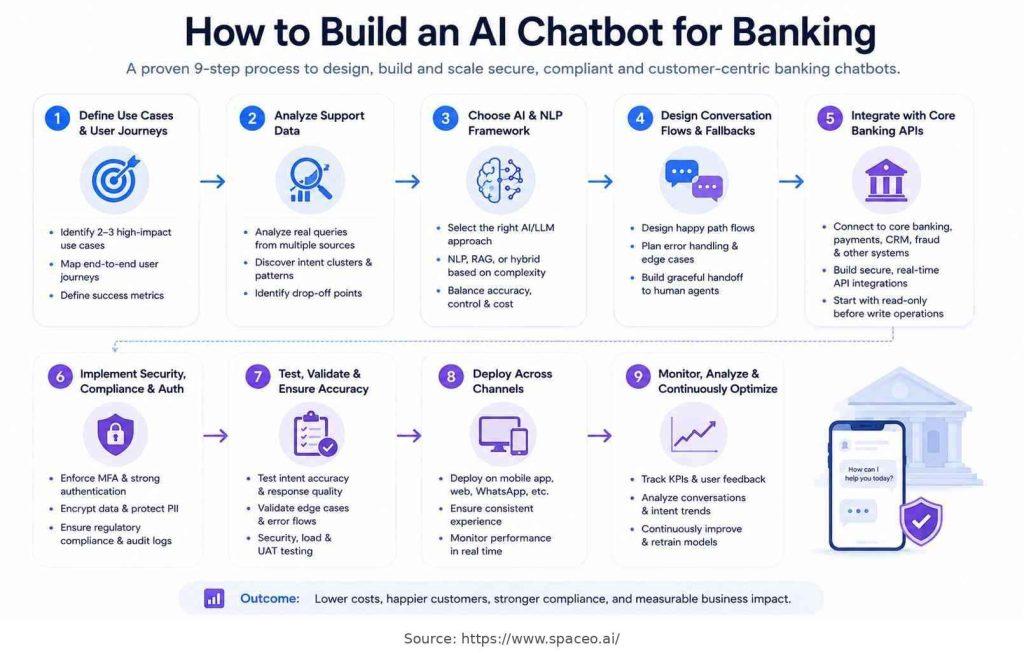
Building a chatbot for banking is not a plug-and-play exercise. It requires alignment between technology, compliance, customer experience, and operations. Banks that treat it as “just a tech project” usually end up with something that frustrates more customers than it helps. Here is the process that actually works.
Step 1: Define use cases and user journeys
Start narrow. Identify the 2 to 3 specific banking tasks the chatbot will handle at launch. Do not try to automate everything at once.
The best starting points share three traits:
- High volume: Tasks your call center handles hundreds or thousands of times per day (balance checks, payment status, card controls)
- Well-defined scope: Clear inputs, predictable outputs, limited edge cases
- Measurable success: You can track resolution rate, handling time, and customer satisfaction before and after
For each use case, map the complete user journey. Not just the happy path. Include error states (what happens when the customer enters an invalid account number?), edge cases (what if the customer has three savings accounts?), and escalation triggers (when should the bot hand off to a human?).
Not sure which processes are actually ready for automation? An AI readiness assessment helps separate the quick wins from the projects that need operational changes first.
Step 2: Analyze real query patterns from support data
This step is where most chatbot projects either succeed or fail. The quality of your training data determines the quality of your chatbot.
Pull data from every source available:
- Call center transcripts (what do customers actually say, word for word?)
- Support ticket logs (what are the most common categories and sub-categories?)
- Live chat transcripts (how do customers phrase things in text vs. voice?)
- App feedback and reviews (where are customers getting stuck?)
- Search queries within your banking app (what are customers looking for but not finding?)
Analyze this data for intent clusters (groups of questions that mean the same thing), language patterns (the specific words and phrases your customers use), and drop-off points (where customers abandon the self-service path and call instead).
This real-world data becomes the foundation for your intent model. Skip it, and you build a bot that answers questions nobody is asking in language nobody uses.
Step 3: Choose the right AI and NLP framework
The framework decision depends on your use case complexity and compliance environment. Here is how to think about it:
- Simple FAQ and routing: An intent-classification model (like a fine-tuned BERT variant) paired with a rule engine is often enough. Fast to build, easy to control, low hallucination risk.
- Multi-step transactional conversations: You need a dialogue management system with slot-filling, context tracking, and API orchestration. Frameworks like Rasa or custom-built orchestration layers work here.
- Complex advisory and generative conversations: A large language model (GPT, Claude, Llama) with RAG grounding and compliance guardrails. More powerful, but requires more investment in safety layers.
Do not over-engineer. If 80% of your use cases are simple FAQ queries, you do not need a generative AI system on day one.
Need a structured approach to these decisions? An AI implementation roadmap maps framework choices to specific banking workflows and compliance constraints.
Step 4: Design conversation flows and fallback logic
This is conversation design, not software engineering. Every flow needs three layers:
- Happy path: The ideal interaction where everything goes smoothly. Customer asks, bot answers, task completed.
- Error recovery: What happens when the bot does not understand? When the customer provides invalid input? When the backend API times out? Each scenario needs a specific, helpful response rather than a generic “I did not understand.”
- Graceful fallback: When the bot hits its limits, the handoff to a human agent must be seamless. The agent should receive the full conversation transcript, the identified intent, any data already collected, and the reason for escalation. The customer should never have to repeat themselves.
In banking, fallback logic is not just good UX. It is risk management. A wrong answer about interest rates, account fees, or loan terms creates legal liability. Every uncertain response should trigger clarification (“Just to make sure I get this right, are you asking about…”) rather than a confident guess.
Step 5: Integrate with core banking systems via APIs
This is where most banking chatbot projects encounter the highest technical complexity.
The chatbot needs authenticated, real-time connections to:
- Core banking system for account data, balances, and transaction history
- Payment gateway for fund transfers, bill payments, and card operations
- CRM for customer profiles, interaction history, and case management
- Fraud detection engine for real-time alerts and transaction verification
- Document management for KYC, loan applications, and compliance records
Legacy core banking systems (many US banks still run COBOL-based platforms) rarely have clean, modern APIs. Expect to build a middleware or integration layer that handles data transformation, error handling, rate limiting, and security between the chatbot and backend systems.
Start with read-only integrations (balance checks, transaction history) before tackling write operations (transfers, payments) that carry higher risk.
Step 6: Implement security, compliance, and authentication
Security is not a layer you add at the end. It must be architected into every component from the start:
- Encryption: TLS 1.2+ for data in transit, AES-256 for data at rest
- Authentication: MFA triggered before any sensitive action (transfers, account changes, loan applications)
- PII handling: Tokenize or mask personal data before it reaches the AI model. Never pass raw SSNs, account numbers, or addresses to an LLM.
- Audit logging: Every interaction logged with immutable records (query, response, data accessed, actions taken)
- Access controls: Role-based permissions ensuring the chatbot only accesses data relevant to the specific customer and query
Every interaction must comply with PCI-DSS, GLBA, and other applicable standards before going live. Do not plan to “add compliance later.” It is far more expensive to retrofit than to build correctly from the start.
Step 7: Test, train, and validate with real banking data
Testing a banking chatbot is fundamentally different from testing a general-purpose bot. The stakes are higher.
Your testing plan should cover:
- Accuracy testing: Does the bot give the correct balance, the right due date, the accurate interest rate? Test against known account data.
- Phrasing variation: Test the same intent expressed 20 different ways. “What is my balance” vs. “How much money do I have” vs. “Check my account” vs. “Show me what is in checking.”
- Multi-turn conversation: Test complex interactions that span 5 to 10 turns with context switching, interruptions, and corrections.
- Edge cases: Empty accounts, closed accounts, joint accounts, accounts under dispute, international transfers, currency conversion.
- Compliance validation: Ensure the bot never exposes unauthorized data, provides non-compliant financial guidance, or makes claims that could constitute investment advice.
- Adversarial testing: Attempt prompt injection, social engineering, and data extraction attacks to verify security guardrails.
Step 8: Deploy across channels
Launch on the channels your customers actually use. For most US banks, that means:
- Mobile banking app (highest volume)
- Web portal (second highest)
- WhatsApp Business API (growing fast, especially for younger demographics)
- Voice channel (IVR replacement or voice-enabled assistant)
Use a centralized conversation engine with channel-specific adapters. The core logic, intent models, and integration layer remain the same. Each channel adapter handles the presentation format (text vs. voice vs. rich cards) and platform-specific constraints.
Space-O AI has delivered this multi-channel approach in projects like our WhatsApp-based AI chatbot where real-time API integration, secure data handling, and cross-channel consistency were critical requirements.
Step 9: Monitor, optimize, and continuously improve
Deployment is not the finish line. It is the starting line.
Set up dashboards tracking these metrics from day one:
- Containment rate: What percentage of conversations resolve without human escalation?
- Fallback rate: How often does the bot fail to understand the customer?
- Response accuracy: Are answers factually correct when verified against source systems?
- Average handling time: How long does a typical chatbot conversation take?
- CSAT score: Are customers satisfied with the chatbot experience?
- Escalation reasons: Why are conversations being handed to human agents?
Review this data weekly for the first 3 months. Identify the top 10 failed intents each week and retrain. Expand conversation flows based on what customers are actually asking for. The chatbot should get measurably better every month.
Want expert guidance through this process? Our AI chatbot consulting services provide structured support from discovery through deployment and ongoing optimization.
What Security and Compliance Standards Must Banking Chatbots Meet?
Security is the single most important consideration for any financial services chatbot deployment. The CFPB has specifically flagged the risks of poorly designed chatbots in consumer finance, including frustration, reduced trust, and potential federal violations.
1. Data privacy and PII protection
Mask or tokenize PII before processing by AI models. Never store sensitive data in conversation logs without encryption and access controls. Follow data minimization principles.
2. Encryption standards
Data in transit: TLS 1.2 or higher. Data at rest: AES-256 aligned with FIPS 140-2. Baseline requirements for any system handling financial data.
3. Authentication protocols
Sensitive actions (transfers, account changes, loan applications) require MFA within the chatbot flow. OAuth 2.0 and biometric verification add additional layers.
4. US regulatory compliance frameworks
Banking chatbots operating in the US must comply with:
- PCI-DSS for payment card data
- GLBA (Gramm-Leach-Bliley Act) for customer financial privacy
- SOC 2 for service organization controls
- CCPA for California consumer privacy
- Dodd-Frank consumer protection provisions
- FFIEC guidance on technology risk management
- CFPB enforcement standards on chatbot-related consumer harm
5. AI guardrails and hallucination prevention
RAG grounds responses in verified data. Validation layers check outputs against compliance rules. Confidence thresholds trigger escalation when the system is uncertain.
6. Audit trails and logging
Every interaction generates an immutable log: query, response, data accessed, actions taken, escalation events. SIEM integration enables real-time threat detection.
Compliance Checklist
- Consent management and data minimization in place
- TLS 1.2+ and AES-256 encryption implemented
- MFA and role-based access controls configured
- PCI-DSS, GLBA, SOC 2, CCPA alignment verified
- RAG grounding and response validation active
- Immutable audit logs with SIEM integration
- Human escalation workflows tested
- Regular compliance review cadence established
What Are the Biggest Challenges of Implementing Chatbots in Banking?
Every AI chatbot for banks deployment faces practical obstacles. The institutions that succeed treat these as design constraints, not reasons to delay.
1. Customer trust and adoption resistance
Many customers remain skeptical about sharing financial information with a bot, especially older demographics who built their banking habits around phone calls and branch visits. A J.D. Power report found that less than 30% of consumers trust AI chatbots for financial information and advice.
How to solve it: Keep the initial experience simple, transparent, and useful. Make verification steps visible. Always offer an easy path to a human agent. Trust builds through consistent positive experiences, not marketing claims about AI capabilities.
2. Integration with legacy core banking systems
Many US banks run core systems built decades ago on COBOL-based architectures that were never designed for real-time API access. These systems power critical operations like account ledgers and transaction processing, so connecting a chatbot to them requires middleware, data transformation, and careful testing with zero room for downtime.
How to solve it: Use middleware that abstracts legacy complexity. Start with read-only use cases (balance checks, transaction history) before write operations (transfers, payments). Phase the integration so failures in one layer do not cascade into core banking operations.
3. Handling complex multi-step queries
Banking queries are rarely one-step. A customer asking about mortgage refinancing may need rate comparisons, eligibility checks, document requirements, cost estimates, and timeline expectations in a single conversation. A bot that can only handle one question at a time forces the customer back to the phone.
How to solve it: Design conversations as execution workflows, not scripts. Use dialogue management that maintains context across turns, handles interruptions (“Actually, go back to the rate options”), and collects additional information progressively rather than dumping everything at once.
4. Multilingual support
US banks serve diverse populations with varying language preferences and financial literacy levels. A chatbot that only works well in formal English misses a significant portion of the customer base, and poorly translated responses erode trust faster than no translation at all.
How to solve it: Deploy multilingual NLP models trained on real conversational data, not just formal translations. Test across informal phrasing, code-switching, and regional terminology. Prioritize languages based on actual customer support data rather than assumptions.
5. Balancing automation with human escalation
Over-automating frustrates customers who need human judgment for disputes, hardship programs, or emotionally charged situations like fraud recovery. Under-automating wastes the efficiency gains that justify the investment. Getting the balance wrong in either direction damages the customer relationship.
How to solve it: Define escalation criteria based on query complexity, detected sentiment, and risk level. When the chatbot hands off, pass the full conversation history so customers never have to repeat themselves. The agent should see exactly what was discussed, what data was collected, and why escalation was triggered.
6. Preventing hallucinated responses
Generative AI can produce confident-sounding answers that are factually wrong. In most industries, that is an inconvenience. In banking, an incorrect interest rate quote, a wrong fee disclosure, or a misleading eligibility statement creates legal liability and regulatory exposure.
How to solve it: RAG architecture grounds every response in verified bank data. Add validation layers that check outputs against compliance rules before delivery. Set confidence thresholds below which the bot asks for clarification rather than guessing. When in doubt, escalate.
7. Meeting evolving regulatory requirements
Financial regulations change. The CFPB, OCC, FDIC, and state regulators issue new guidance regularly. A chatbot that is compliant today may fall out of compliance with a single regulatory update, and the bank bears full responsibility for what its chatbot tells customers.
How to solve it: Build compliance as a configurable layer, not hardcoded logic. Use policy engines that can be updated without redeploying the entire chatbot. Assign ongoing regulatory monitoring to a dedicated team that reviews chatbot responses against current guidance on a scheduled cadence.
How Much Does It Cost to Build an AI Chatbot for Banking?
Building an AI chatbot for banks costs between $30,000 and $400,000+, depending on complexity. A basic FAQ bot on a single channel sits at the lower end. A fully integrated, generative AI-powered system with agentic workflows, omnichannel deployment, and enterprise compliance sits at the higher end. Most mid-market banks land somewhere in the $50,000 to $150,000 range for a chatbot that handles real transactions and connects to core banking systems.
- Use case complexity: Simple FAQs vs. multi-step transactional workflows
- Backend integrations: Core banking, CRM, fraud systems, payment gateways
- Security and compliance: Encryption, MFA, audit logging, regulatory alignment
- AI capability level: Rule-based vs. NLP vs. generative AI with RAG
- Channel coverage: Single channel vs. omnichannel
- Team experience: In-house vs. specialized AI development partner
Cost breakdown by complexity
| Complexity | What It Includes | Estimated Cost | Timeline |
|---|---|---|---|
| Basic | FAQ handling, single-channel support, and limited integrations | $30,000 – $50,000 | 3–5 months |
| Mid-Level | Core banking integrations, multi-step conversations, and support for 2–3 channels | $50,000 – $150,000 | 5–9 months |
| Advanced | Generative AI with RAG, agentic workflows, omnichannel support, and enterprise-grade compliance | $150,000 – $400,000+ | 9–14+ months |
The investment scales with value. A basic bot saves call center costs. A mid-level bot automates transactions. An advanced system transforms the digital banking experience.
For broader AI project budgeting context, see our AI chatbot development cost guide. When ready to scope specific requirements, our AI chatbot developers provide detailed estimates based on your infrastructure.
Pro Tip: Budget 15 to 20% of your initial build cost for the first year of post-launch optimization. The real ROI in AI chatbots banking comes from continuous tuning based on live data, not from the initial deployment alone.
How Does Space-O AI Build Intelligent Banking Chatbots?
Building a banking chatbot that works requires more than technical skill. It requires understanding how banks operate, how compliance works in practice, and where customer journeys break down.
At Space-O AI, we build AI chatbot solutions specifically architected for the security demands and regulatory environment of banking. Here is how.
1. Discovery-first approach
We start with your data, not code. Our team audits call center transcripts, ticket categories, chat logs, and app feedback to reveal what customers actually ask, how they phrase it, and which queries consume the most agent time. Use cases get mapped by impact and each receives a conversation blueprint before development begins.
Our conversational AI development services cover the full lifecycle from discovery through deployment and ongoing tuning.
2. Generative AI with RAG for auditable responses
Every response is grounded in your verified data: product databases, policy documents, account records, and compliance-approved content. Our RAG implementations include source attribution (every answer traceable to a specific document), confidence scoring (low-confidence responses trigger escalation), and compliance filtering (outputs checked against regulatory rules before delivery).
3. Agentic workflows for end-to-end task execution
Most chatbots answer questions. Ours complete tasks. A loan inquiry does not just get answered. The system checks eligibility, pulls credit data, calculates rates, collects documents, and submits the application, all within one conversational flow. We apply the same approach to KYC onboarding, dispute resolution, and cross-selling workflows.
Curious where this technology is heading? Our analysis of conversational AI trends covers what is shaping the next wave.
4. Voice AI and multimodal capabilities
We build chatbots that work across text and voice, letting customers type in the app and continue by phone without losing context. Our voice implementations handle natural speech, banking terminology, accent variations, and ambient noise, replacing rigid IVR menus with natural conversations.
5. Proactive intelligence
Reactive chatbots wait. Ours reach out first. Using behavioral data and predictive models, our chatbots surface bill reminders with one-tap payment, spending pace alerts with budget summaries, and idle balance suggestions for higher-yield accounts. This turns the chatbot from a cost center into a retention driver.
6. Security-first architecture
Every component is designed with compliance embedded from sprint one:
- PII tokenization before data reaches the AI model
- End-to-end encryption across every interaction
- MFA-gated access for sensitive actions
- Immutable audit logs for every conversation turn
- Role-based access controls at every integration point
- PCI-DSS, GLBA, SOC 2, CCPA, and FFIEC alignment from day one
Ready to build? Whether you need a focused FAQ chatbot or a full-scale ai based chatbot service for financial industry needs, reach out to our team to discuss your requirements.
Frequently Asked Questions About AI Chatbot in Banking Industry
Can AI chatbots in banking fully replace human customer service agents?
No. The most effective implementations use a hybrid model where the chatbot handles routine queries automatically, and complex or sensitive cases escalate to human agents with full context. The chatbot makes agents more effective by filtering repetitive questions and giving complete background on escalated cases.
What types of banks benefit most from deploying AI chatbots?
Retail banks with high inquiry volumes see the fastest ROI. Digital-first neobanks use chatbots as their primary channel. Credit unions deploy them to scale without proportional headcount. Large commercial banks automate internal workflows alongside customer support. The key factor is query volume and interaction complexity, not institution size.
How long does it typically take to deploy a banking chatbot?
Basic FAQ chatbot: 3 to 5 months. Mid-level with CRM integration: 5 to 9 months. Advanced with generative AI, RAG, agentic workflows, and enterprise integration: 9 to 14 months. Timeline depends on legacy system complexity and compliance scope.
What is the difference between a banking chatbot and a virtual assistant?
The terms overlap. A chatbot is typically text-based and task-specific. A virtual assistant like Erica covers voice, proactive insights, and multi-step advisory. Modern AI chatbots are closing this gap quickly with generative AI and agentic capabilities.
Can a banking chatbot handle transactions securely?
Yes. Modern chatbots execute fund transfers, bill payments, card controls, and loan submissions through authenticated API connections protected by MFA, encryption, and PII tokenization.
How do AI chatbots prevent hallucinated financial advice?
RAG architecture retrieves verified information from the bank’s knowledge base first, then generates a grounded response. Validation layers check compliance rules. Confidence thresholds trigger human escalation when the system is uncertain.
Which messaging platforms can banking chatbots be deployed on?
Mobile apps, web portals, WhatsApp Business API, Facebook Messenger, Apple Business Chat, Google Business Messages, SMS, and voice. Best practice is omnichannel with session continuity.
What KPIs should banks track after deploying a chatbot?
Containment rate, first contact resolution, average handling time, cost per interaction, CSAT scores, fallback rate, response accuracy, and escalation rate. These map directly to ROI measurement.
Building an AI Banking Chatbot?


