
- What Are AI Techniques in Chatbots?
- How AI Chatbots Process a Message: Step-by-Step Workflow
- 11 Core AI Techniques Used in Chatbots
- 1. Natural Language Processing (NLP)
- 2. Natural Language Understanding (NLU) and intent recognition
- 3. Named Entity Recognition (NER) and entity extraction
- 4. Machine Learning (ML)
- 5. Deep learning and neural networks
- 6. Natural Language Generation (NLG)
- 7. Sentiment analysis
- 8. Speech recognition and voice AI
- 9. Dialogue Management Systems
- 10. Reinforcement Learning and RLHF
- 11. Knowledge Graphs
- 16. AI Agent Frameworks
- 17. Multi-Agent Systems
- 18. Memory and Tool Use (Agentic Capabilities)
- Emerging and Advanced AI Techniques Used in Chatbots
- AI Models Commonly Used in Chatbots
- How to Choose the Right AI Techniques for Your Chatbot
- 7 Common Challenges in Building AI Chatbots
- Building Production-Ready AI Chatbots with Space-O AI
- Frequently Asked Questions About AI Techniques in Chatbots
18 AI Techniques Used in Chatbots: How Modern AI Bots Actually Work

 Last Updated: June, 3 2026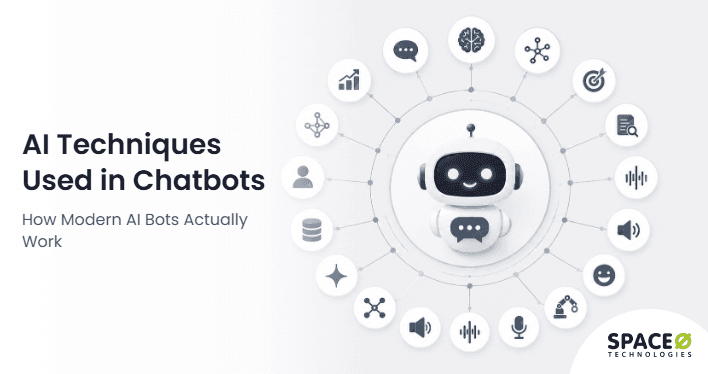
Rule-based chatbots are easy to build. You set keyword triggers, map them to fixed responses, and deploy quickly. But they fall apart the moment users stop asking predictable questions. Real conversations are messy, contextual, and rarely follow scripts.
That’s where the gap appears between basic bots and modern AI systems that understand intent, maintain context, and respond using real data instead of fixed replies.
This difference has a measurable business impact.
According to the RepAI report, visitors who use AI chat convert at 12.3% compared to just 3.1% for those who do not, roughly a 4x lift. As chatbots shift from support tools to revenue drivers, the underlying AI techniques become critical.
Most explanations still focus on basic NLP or machine learning, but modern systems go much further, using large language models, retrieval pipelines, and agent-based reasoning to handle real-world complexity.
Our leading AI chatbot development services provider has built conversational systems across healthcare, eCommerce, and enterprise environments where accuracy, compliance, and reliability directly affect outcomes. That experience shapes how we look at the core techniques behind production-ready bots.
By the end of this guide, you will know the 18 foundational and advanced AI techniques behind modern chatbots, understand how each one works in plain terms, and have a clear sense of which techniques fit your specific use case, accuracy needs, and budget.
What Are AI Techniques in Chatbots?
AI techniques in chatbots are the underlying methods, including algorithms, models, and processing layers, that enable a system to understand language, detect intent, retrieve relevant information, and generate meaningful responses.
Instead of relying on fixed scripts, modern chatbots combine multiple techniques in a single pipeline. This allows them to handle varied phrasing, maintain context across multiple turns, and respond using real knowledge instead of prewritten answers.
Chatbot technology has evolved in three clear phases.
- Early systems were rule-based and depended on keyword matching.
- The next phase introduced machine learning and natural language processing for intent detection and entity extraction.
- Today’s systems are largely powered by transformer-based large language models, retrieval-augmented generation, and agent-style architectures.
| Capability | Rule-Based Chatbots | AI Chatbots |
|---|---|---|
| Language understanding | Keyword matching | Intent and context awareness |
| Conversation flow | Fixed scripts | Dynamic, multi-turn dialogue |
| Learning ability | None | Improves with data and feedback |
| Personalization | Limited | Context-aware responses |
| Knowledge handling | Predefined answers | Retrieval plus generation (RAG) |
| Scalability | Limited | High |
The shift is not just technical; it changes how chatbots behave in real conversations and how reliably they can handle variation in user input.
The difference shows up quickly in real usage. A rule-based bot breaks when a user rephrases a question outside its script. An AI-powered system can interpret intent and adjust the response accordingly.
In practice, the real challenge is not choosing a single technique but deciding how to combine them based on accuracy needs, latency limits, and budget constraints. Many teams start with chatbot consulting services to avoid overengineering early and focus on techniques that actually impact outcomes.
Before breaking down each method, it helps to understand how these techniques connect inside a working chatbot system.
How AI Chatbots Process a Message: Step-by-Step Workflow
A modern AI chatbot processes every message through a pipeline, where each stage hands structured information to the next. Understanding this flow makes the individual techniques easier to place, because each one owns a specific job in the chain.
1. User input
The system receives a message in text or voice format. If it’s voice, it’s first converted into text for processing.
2. NLP and language understanding
The input is cleaned and broken into meaningful components so the system can interpret structure and basic meaning.
3. Intent and entity detection
The chatbot identifies what the user wants and extracts key details like dates, names, or IDs needed to complete the request.
4. Context and dialogue tracking
Conversation history is stored so the chatbot can maintain continuity and understand follow-up references.
5. Knowledge retrieval
Relevant information is pulled from databases, APIs, or documents to ensure responses are accurate and grounded.
6. Response generation
A language model generates the final reply based on intent, context, and retrieved data. In advanced systems, this step may also trigger actions.
With the pipeline in view, we can look at the techniques that power each stage, starting with the foundational layer.
Planning an AI Chatbot, But Unsure Which Techniques Fit Your Use Case?
Our team helps you map the right combination of NLP, retrieval, and generation to your accuracy and budget targets before a single line of code is written.
11 Core AI Techniques Used in Chatbots
The techniques in this section are the foundation that nearly every capable chatbot relies on, regardless of how advanced its generative layer is. They handle the unglamorous but essential work of turning messy human language into structured meaning, classifying what users want, and keeping conversations coherent. A chatbot can have the most powerful language model available and still fail if these fundamentals are weak.
Think of these eleven techniques as a toolkit rather than a menu. Most production chatbots combine several of them, layering intent recognition on top of NLP, adding sentiment analysis for escalation, and using dialogue management to tie multi-turn conversations together.
Here is how each one works and where it earns its place.
1. Natural Language Processing (NLP)
Every other technique in this list builds on Natural Language Processing, which makes it the right place to start.
NLP is what lets a chatbot read human text and make sense of it, bridging the gap between the way people actually write and the structured data an algorithm can work with.
In practice, NLP processes a message through several stages. Tokenization breaks a sentence such as “I want to track my order” into individual units, then lemmatization reduces words to their base form so that “running” and “ran” both map to “run.”
Part-of-speech tagging labels each word as a noun, verb, or adjective, and dependency parsing maps how those words relate to each other. Semantic analysis then pulls the underlying meaning out of that parsed structure.
Because NLP works from meaning instead of exact keywords, a chatbot can handle the synonyms, typos, and rephrasing that break a rule-based system.
When a user types “Book a flight to London next Tuesday,” NLP identifies “book” as the action, “London” as the destination, and “next Tuesday” as the date, giving the rest of the pipeline clean signals to act on. That foundation is what makes the next technique, understanding intent, possible.
2. Natural Language Understanding (NLU) and intent recognition
Where NLP stops at parsing words, Natural Language Understanding takes on the harder job of grasping purpose.
NLU interprets what the user is actually trying to accomplish, which is why the two terms are related but not interchangeable.
NLP is the broad discipline of processing language, and NLU is the comprehension-focused subset that figures out meaning and intent.
Intent recognition is the practical heart of NLU.
The chatbot converts a message into a numerical representation, compares it against patterns learned from thousands of labeled example utterances, and assigns a confidence score to each possible intent.
The highest-scoring intent wins, and when no intent clears a confidence threshold, the system falls back to a clarifying question rather than guessing. Enterprise chatbots typically target 90% or higher accuracy on their primary intents.
It is this layer that lets a chatbot treat “Where is my package,” “I haven’t received my order,” and “track my shipment” as the same request, despite the different wording. Strong NLU reduces the frustration of being misunderstood, which is the single fastest way to lose a user’s trust in a conversational system.
3. Named Entity Recognition (NER) and entity extraction
If intent recognition determines what a user wants, Named Entity Recognition (NER) identifies the specific details required to fulfill that request.
NER extracts structured information such as names, dates, times, locations, monetary values, product IDs, or order numbers from natural language input. Most production systems also define custom entities tailored to the business itself, such as policy numbers, subscription plans, or internal product categories.
The extracted values are then mapped into predefined slots or parameters that backend systems need in order to execute an action. Advanced systems also maintain entity memory across multiple conversation turns, allowing the chatbot to remember information users have already provided instead of repeatedly asking for it.
For example, from the message “I need to reschedule my appointment for next Tuesday at 3 PM,” the chatbot can immediately extract the intent, date, and time in a single pass.
This significantly reduces conversational friction. A well-designed chatbot gathers information efficiently and naturally, while a poorly implemented one forces users through repetitive question chains that make the experience feel robotic.
4. Machine Learning (ML)
Machine learning gives chatbots the ability to improve through data instead of relying entirely on manually written rules. It powers critical capabilities such as intent classification, response ranking, personalization, and continuous optimization.
Several forms of machine learning work together inside conversational systems.
Supervised learning trains models using labeled examples and is commonly used for intent detection and entity extraction. Unsupervised learning identifies hidden patterns in unlabeled conversation data, helping teams cluster recurring customer issues or detect anomalies. Reinforcement learning improves decision-making through feedback signals that reward successful outcomes.
To evaluate performance, teams monitor metrics such as accuracy, precision, recall, and F1 score rather than relying on intuition alone.
A customer support chatbot trained on historical conversations can learn that phrases like “can’t log in,” “password issues,” and “login not working” all relate to authentication problems and should follow the same resolution path.
Because chatbot quality depends heavily on data preparation, training, and tuning, many organizations work with experienced conversational AI engineers or teams specializing in machine learning development to improve model performance at scale.
5. Deep learning and neural networks
Deep learning extends machine learning by using multi-layered neural networks capable of capturing subtle language patterns and contextual relationships that simpler models often miss.
Earlier chatbot systems relied heavily on architectures such as Recurrent Neural Networks (RNNs) and Long Short-Term Memory (LSTM) networks, which processed language sequentially while maintaining memory of earlier words in a sentence. Sequence-to-sequence models later improved response generation by mapping input sentences to output responses using encoder-decoder structures, while attention mechanisms helped models focus on the most relevant parts of a message.
These innovations eventually led to transformer architectures, which now power modern large language models and state-of-the-art conversational AI systems.
Deep learning becomes especially valuable when meaning depends on nuance or context.
For example, in the sentence “I love this product but hate the delivery,” a deep learning model can separately identify positive sentiment toward the product and negative sentiment toward shipping. That ability to interpret layered meaning is what makes advanced chatbots feel context-aware rather than scripted.
6. Natural Language Generation (NLG)
Natural Language Generation (NLG) is responsible for producing the chatbot’s actual responses. If NLU interprets incoming language, NLG handles outgoing communication by turning structured data or decisions into fluent, human-readable text.
NLG systems range from simple template-based approaches to fully generative large language models.
Template-based generation inserts dynamic values into predefined sentence structures, making responses predictable and easy to control but often repetitive. Generative NLG, powered by transformer-based models, creates original responses dynamically while adapting tone, phrasing, and detail level to the conversation.
Modern NLG systems also incorporate personalization and tone management so the same information can be delivered differently depending on the situation.
For example, a templated system may respond with “Your order status is: shipped,” while a generative system could say “Good news. Your order shipped this morning and should arrive by Thursday.”
As AI generative systems become more capable, reliability and factual accuracy become increasingly important. That is why modern chatbot architectures often combine NLG with retrieval systems and grounding generative AI development techniques to reduce hallucinations and maintain consistency.
7. Sentiment analysis
Sentiment analysis gives chatbots emotional awareness by identifying the feeling behind a message rather than interpreting only its literal meaning.
The system analyzes signals such as wording, punctuation, repetition, capitalization, and sentence structure to classify sentiment as positive, negative, or neutral. More advanced implementations also estimate emotional intensity and track how sentiment changes throughout a conversation.
This enables the chatbot to adapt its tone and escalation strategy dynamically.
For instance, the message “This is the THIRD time I’m asking” signals strong frustration through capitalization and emphasis.
A sentiment-aware chatbot can recognize the escalation risk, soften its tone, prioritize empathy, and offer immediate transfer to a human agent.
Without sentiment analysis, escalation logic often depends on simplistic keyword triggers. With it, the chatbot responds more appropriately to the customer’s emotional state, which plays a major role in preserving satisfaction during high-friction interactions.
8. Speech recognition and voice AI
Speech recognition expands conversational AI beyond text by enabling spoken interactions through voice assistants, phone support systems, and hands-free interfaces.
The process typically consists of two layers. Automatic Speech Recognition (ASR) converts spoken audio into text, while Text-to-Speech (TTS) synthesizes written responses into natural-sounding audio. Between those stages sits the same NLP, NLU, and dialogue infrastructure used in text-based chatbots.
This architectural overlap is why many text chatbot systems can later be extended into voice-enabled experiences without rebuilding their intelligence layer from scratch.
For example, a traveler might say, “I need to change my flight to tomorrow morning.” The system transcribes the speech, extracts the entities, checks availability, and responds verbally within seconds.
Voice AI is particularly valuable for accessibility, mobile interactions, customer service hotlines, and smart-device ecosystems where typing is inconvenient or impossible.
9. Dialogue Management Systems
Dialogue management is the orchestration layer that keeps multi-turn conversations coherent and goal-oriented.
Rather than treating every message independently, the dialogue manager maintains conversational state by tracking identified intents, extracted entities, completed steps, missing information, and previous interactions.
Using rule-based flows, probabilistic models, or neural policies, it determines the chatbot’s next action, whether that means asking a follow-up question, confirming information, executing a backend task, or recovering from a misunderstanding.
This capability is what makes conversations feel continuous rather than fragmented.
During a flight-booking interaction, for example, the system remembers that the destination has already been provided but the travel date is still missing, so it requests only the necessary information instead of restarting the conversation flow.
Even highly accurate NLP models can feel frustrating without strong dialogue management because users quickly notice when context is lost or information must be repeated.
10. Reinforcement Learning and RLHF
Reinforcement learning improves chatbot behavior through feedback-driven optimization rather than relying solely on static training examples.
Instead of learning only from labeled datasets, the system experiments with different responses, receives reward signals based on performance, and gradually adapts toward behaviors that produce better outcomes.
In modern conversational AI, the most influential approach is Reinforcement Learning from Human Feedback (RLHF). Human reviewers rank multiple model responses, those rankings train a reward model, and the language model is optimized to generate outputs humans consistently prefer.
RLHF is one of the main reasons current AI assistants feel more helpful, conversational, and aligned than earlier language models.
The same principles can optimize narrower business objectives as well. A customer support chatbot may prioritize responses that resolve issues in fewer steps, while a sales assistant may optimize for engagement or conversion-related outcomes.
By shaping the reward signal around business goals, reinforcement learning helps align chatbot behavior with measurable operational results.
11. Knowledge Graphs
Knowledge graphs give chatbots a structured representation of information by modeling entities and the relationships between them.
Instead of storing knowledge only as unstructured text, a knowledge graph organizes information into connected nodes and edges. Products, policies, customers, or locations become entities, while their relationships define how they interact.
This structure enables reasoning over relationships rather than simple keyword retrieval.
For example, if a customer asks which accessories are compatible with a specific laptop model, the chatbot can traverse explicit compatibility relationships inside the graph instead of relying solely on semantic similarity or keyword matching.
Knowledge graphs are especially effective in domains where accuracy depends heavily on relationships, dependencies, or business rules.
An insurance chatbot, for instance, can determine whether a policy covers a particular scenario by following structured links between coverage types, exclusions, conditions, and policy definitions. Combined with vector retrieval systems, knowledge graphs help conversational AI balance semantic flexibility with factual precision.
Need a chatbot that understands customers, not just keywords?
We combine intent recognition, entity extraction, sentiment analysis, and dialogue management into systems that reach 90% or higher accuracy on the requests that matter to your business. Let us show you what that looks like for your use case.
16. AI Agent Frameworks
AI agent frameworks turn chatbots from passive responders into systems capable of completing tasks autonomously.
Instead of answering one prompt at a time, an AI agent works through a reasoning loop. It receives a goal, breaks it into steps, selects actions, evaluates results, and continues until the task is completed.
Agents can also interact with external tools and APIs, allowing them to move beyond conversation into execution. You can explore this architecture further in this detailed guide to AI agent development.
For example, rather than explaining how to reset a subscription, an agentic chatbot can verify the account, process the request, and confirm completion inside the same conversation.
Because these systems can take real actions, building this reliably takes careful design around permissions, error handling, and guardrails, which is the focus of dedicated agent AI development, where the goal is an agent that is both autonomous and safe.
17. Multi-Agent Systems
Multi-agent systems coordinate multiple specialized AI agents that work together to solve complex tasks.
Instead of relying on one general-purpose agent, responsibilities are divided among focused agents optimized for different functions. One agent may retrieve information, another may validate compliance, while another handles workflow execution.
An orchestration layer coordinates communication between them and assembles the final response.
This architecture improves scalability, reliability, and control because each agent can be tested and optimized independently.
For example, a customer support workflow may involve a triage agent, a knowledge retrieval agent, and a compliance-checking agent before the final response is delivered.
For complex enterprise workflows, this architecture is increasingly the right answer. A customer request might pass through a triage agent, a knowledge agent, and a compliance-checking agent before a response is sent, each contributing its specialty. Designing these coordinated systems is the province of custom AI agent development, where the orchestration logic matters as much as the individual agents.
18. Memory and Tool Use (Agentic Capabilities)
Memory and tool use are what transform a chatbot into a true AI assistant.
Memory allows the chatbot to retain context across conversations. Short-term memory preserves active conversation flow, while long-term memory stores user preferences, past interactions, and history across sessions.
Tool use allows the chatbot to interact with external systems through APIs, databases, CRMs, payment systems, or workflow platforms.
Together, these capabilities let the chatbot both remember and act.
For example, a returning customer can say “Reorder my usual,” and the chatbot can recall previous purchases, place the order through connected systems, and confirm delivery in a single interaction.
Memory makes the experience feel personalized, while tool use makes the chatbot operationally useful.
Emerging and Advanced AI Techniques Used in Chatbots
The techniques in this section are what separate modern conversational AI from traditional chatbots. Foundational techniques help a chatbot understand language and generate responses. These advanced systems add reasoning, factual grounding, multimodal understanding, memory, and autonomous action, turning a chatbot into an intelligent assistant capable of completing real work.
If your chatbot needs to answer using internal knowledge, avoid hallucinations, process images and documents, or interact with external systems, these are the technologies that make it possible.
1. Transformer Architecture
The transformer architecture is the foundation behind nearly every modern chatbot model, including GPT, Claude, and Gemini. Its biggest breakthrough was changing how language is processed.
Earlier neural networks handled words sequentially, one at a time, which made long-range context difficult to maintain. Transformers process entire sequences simultaneously, allowing them to understand relationships between words much more effectively.
The key mechanism is self-attention, which measures how strongly each word relates to every other word in a sentence. This helps the model capture context, meaning, and dependencies even across long conversations.
For example, in the question “What time does the New York office open?”, the model connects “time,” “New York,” and “open” together in a single pass to interpret the request accurately. This contextual understanding is what powers today’s highly conversational AI systems for banking and insurance.
2. Large Language Models (LLMs)
Large Language Models (LLMs) are transformer-based systems trained on massive amounts of text data to generate fluent, context-aware responses. They power the most advanced conversational AI systems used today.
During pretraining, an LLM learns language patterns from billions of examples. It can then be adapted to specific industries or workflows through fine-tuning on domain-specific data.
Two capabilities matter most for chatbots
- The first is the context window, which determines how much conversation history the model can process at once.
- The second is LLM fine-tuning, which teaches the model industry terminology, workflows, and communication style.
This is what allows LLM-powered chatbots to move beyond scripted responses into natural, open-ended conversations. A healthcare chatbot, for example, can understand medical terminology while still responding in patient-friendly language.
Building and adapting these models is specialized work, which is why teams turn to LLM development services to handle model selection, fine-tuning, and deployment correctly.
3. Retrieval-Augmented Generation (RAG)
Retrieval-Augmented Generation (RAG) helps solve one of the biggest weaknesses of large language models: hallucinations.
Instead of relying only on training data, RAG retrieves verified information from external sources before generating a response. This grounds answers in current, trusted content.
The process works in two stages: retrieve, then generate. When a user asks a question, the system searches a vector database for semantically relevant documents and passes those results to the language model as context.
This allows the chatbot to answer from real company knowledge instead of assumptions.
For example, an enterprise chatbot answering “What is our refund policy for international orders?” can retrieve the latest policy document and generate a response directly from it. This improves accuracy while keeping information current without retraining the model.
Because RAG is central to reliable enterprise chatbots, teams often implement it through generative AI integration and scale it under the governance of an enterprise AI development company, where security, compliance, and performance all have to hold up under real load.
4. Multimodal AI Processing
Multimodal AI allows chatbots to process more than text by combining images, audio, documents, and visual inputs into a single understanding of the request.
This capability is becoming increasingly important because users often prefer showing a problem instead of describing it.
A multimodal chatbot can analyze uploaded images, scanned files, screenshots, or voice input alongside written questions. It combines computer vision, speech processing, and language understanding to interpret all inputs together.
For example, a customer can upload a photo of a damaged product and ask whether it qualifies for warranty coverage. The chatbot can analyze the image, identify the issue, and generate a contextual response.
These capabilities expand chatbot use cases far beyond text-only support systems.
Eliminate Hallucinations with Enterprise-Grade RAG and Agents.
We build AI-powered chatbots that ground every answer in your verified knowledge and act through secure tool integrations, so reliability holds up at scale. Bring us your hardest accuracy and automation requirements.
AI Models Commonly Used in Chatbots
The techniques covered above are implemented through specific AI models, and understanding the major ones helps clarify what different chatbot platforms actually offer. Some models specialize in generating natural conversations, while others are optimized for understanding language, retrieving meaning, or supporting efficient self-hosted deployments.
The most widely used conversational models today include GPT from OpenAI, Claude from Anthropic, and Gemini from Google. For understanding-focused tasks, models such as BERT and T5 remain highly influential, while open-source models like LLaMA and Mistral are popular for organizations that want greater control or on-premise deployment options.
| Model | Primary Strength | Best Chatbot Use Cases | Context Handling |
|---|---|---|---|
| GPT (OpenAI) | Generation | Response generation, open-ended conversation | Large context windows |
| Claude (Anthropic) | Reasoning and long context | Grounded enterprise assistants, long documents | Very large context windows |
| Gemini (Google) | Multimodal | Text plus image conversations | Large multimodal context |
| BERT | Understanding | Intent classification, NER, sentiment | Full bidirectional context |
| T5 | Versatility | Multiple tasks via text-to-text | Encoder-decoder |
| LLaMA / Mistral | Efficiency and control | Open-source and self-hosted deployments | Extended context windows |
In real-world deployments, these models are often combined rather than used independently. A BERT-style model may handle intent classification and entity extraction, while GPT, Claude, or Gemini generates the final conversational response.
The right model choice depends less on brand preference and more on the role each model needs to play inside the chatbot pipeline.
How to Choose the Right AI Techniques for Your Chatbot
Choosing the right AI techniques is ultimately about matching capabilities to business requirements. Overengineering increases cost and complexity, while underpowered systems frustrate users and limit adoption.
These five considerations help narrow the decision quickly.
1. Define your use case complexity
Start by identifying what the chatbot actually needs to do.
A simple FAQ chatbot may only require NLP and intent classification, while multi-step workflows like appointment booking or order tracking need entity extraction and dialogue management. More advanced assistants that reason over internal knowledge or complete tasks typically require LLMs, RAG, and agentic workflows.
The complexity of the use case determines the sophistication of the architecture.
2. Establish your accuracy requirements next
Not every chatbot requires the same level of precision.
Internal productivity tools may tolerate moderate accuracy, while customer-facing systems require much higher reliability. In regulated industries such as healthcare, banking, or insurance, incorrect responses can create legal or operational risk, making techniques like RAG, human escalation, and validation layers essential.
The cost of a wrong answer should determine the level of AI sophistication you invest in.
3. Assess your data availability honestly
Your available data strongly influences which techniques are practical.
Limited datasets usually favor pretrained models and retrieval-based systems. Moderate datasets can support custom intent classifiers, while large proprietary datasets enable fine-tuning and more specialized conversational behavior.
The more relevant training data you have, the more customized and accurate the chatbot can become.
4. Calculate your budget realistically
Different AI architectures come with very different cost profiles.
Basic NLP systems are relatively inexpensive, while transformer-based chatbots with RAG, vector databases, and agentic workflows require higher investment in infrastructure, monitoring, maintenance, and optimization.
It is important to budget for long-term operation and scaling, not just initial development.
5. Plan for scalability and evolution last
Chatbot requirements tend to grow quickly after deployment, so scalability should be considered early.
Cloud-hosted LLM APIs are easy to scale but can become expensive at high usage volumes. RAG architectures make it easier to update knowledge without retraining models, while modular systems simplify future integrations, multilingual support, and workflow expansion.
Designing for flexibility early prevents expensive rebuilds later.
For businesses evaluating these tradeoffs, AI consulting services can help identify the right techniques, architecture, and deployment strategy before major implementation decisions are locked in.
7 Common Challenges in Building AI Chatbots
Building an effective AI chatbot is not just about adding advanced models and automation. Real-world deployments introduce challenges around accuracy, security, scalability, and compliance that can quickly undermine user trust if they are not addressed early.
The teams that succeed are the ones that design for these risks from the beginning instead of reacting after launch.
1. Hallucinations and factual errors
Large language models can generate responses that sound convincing but are factually incorrect.
This becomes especially risky in industries like healthcare, finance, or legal services, where inaccurate answers can damage trust or create compliance issues.
The most reliable mitigation is Retrieval-Augmented Generation (RAG), which grounds responses in verified business data rather than relying only on model memory. Many organizations also add citations, validation layers, and human escalation for low-confidence responses.
2. Data privacy and compliance
Chatbots often process sensitive customer information, making privacy and compliance a major concern.
Industries such as healthcare and finance must follow strict regulations like HIPAA, GDPR, or PCI DSS. A single data exposure incident can lead to legal penalties and long-term reputational damage.
To reduce risk, chatbot systems should encrypt sensitive data, minimize unnecessary retention, enforce access controls, and maintain clear audit logs from the start.
3. Bias in training data
AI models learn patterns from training data, including its biases.
If left unchecked, a chatbot may produce unfair, exclusionary, or inconsistent responses that negatively affect user experience and create reputational or legal risks.
Reducing bias requires diverse datasets, regular output audits, fairness testing, and evaluation across different user groups before deployment.
4. Context and memory limitations
Even advanced models have finite context windows and imperfect memory handling.
When a chatbot forgets earlier details, loses conversation flow, or repeatedly asks for the same information, the experience quickly feels frustrating and unintelligent.
Strong dialogue management, memory systems, and appropriately sized context windows help maintain continuity across longer conversations.
5. Security vulnerabilities
Conversational AI systems are increasingly targeted by attacks such as prompt injection, jailbreak attempts, and sensitive data extraction.
Without proper safeguards, attackers may manipulate the chatbot into bypassing restrictions or exposing protected information.
To reduce these risks, teams implement guardrails, sanitize inputs, restrict tool permissions, and continuously monitor for suspicious behavior.
6. Scalability and latency
A chatbot that performs well during testing may struggle under real production traffic.
Slow response times, overloaded APIs, or system failures during peak usage directly impact user satisfaction and business reliability.
Production-ready chatbot systems need scalable infrastructure, load testing, caching strategies, and monitoring designed for high-volume traffic.
7. Training and infrastructure costs
Advanced conversational AI systems can become expensive to operate over time.
Large language models, vector databases, inference workloads, and continuous monitoring all introduce recurring infrastructure costs that many businesses underestimate during planning.
Keeping costs sustainable often means selecting appropriately sized models, using RAG instead of unnecessary fine-tuning, and tracking cost per conversation as an operational metric.
Treating these challenges as design inputs rather than afterthoughts is what separates a chatbot that survives contact with real users from one that quietly fails. Each has a known mitigation, and addressing them early is far cheaper than retrofitting fixes later.
Building Production-Ready AI Chatbots with Space-O AI
The biggest takeaway from these 18 techniques is that no single technology creates a successful chatbot on its own.
NLP and NLU help the system understand language. Machine learning and deep learning improve accuracy over time. Transformers and LLMs generate conversational responses, while RAG, knowledge graphs, and memory systems keep those responses grounded and reliable. Agents and tool integrations then allow the chatbot to take meaningful action.
The real challenge is combining the right techniques for your use case, accuracy requirements, compliance needs, and budget.
Space-O AI brings more than 15 years of development experience, 500+ delivered AI projects, 80+ AI specialists, 97% client retention, and 99.9% system uptime to building production-ready conversational AI systems.
Our AI development team has implemented the techniques covered in this guide across enterprise environments where reliability, scalability, and compliance are critical.
Some recent implementations include:
- An AI product recommendation chatbot for Moov, a Saudi eCommerce platform, using vector embeddings and conversational AI to improve product discovery efficiency by 85%.
- An AI recommendation engine for Clime, a sustainable eCommerce startup, built with NLP and hybrid intent classification.
- A WhatsApp AI chatbot for a US roofing company using NLP and GPT models to reduce data retrieval time to one-tenth of traditional workflows.
Whether you need intent classification, LLM fine-tuning, RAG implementation, or fully agentic AI systems, our team helps businesses deploy conversational AI that performs reliably in production.
Ready to build your AI chatbot? Contact Space-O AI for a free consultation and architecture discussion tailored to your requirements.
Launch an AI Chatbot Built for Accuracy and Scale
Whether you need RAG-powered support, AI agents, or custom LLM solutions, Space-O AI helps you deploy secure, production-ready conversational systems faster.
Frequently Asked Questions About AI Techniques in Chatbots
What AI techniques are used in chatbots?
Modern chatbots combine several techniques. The foundational ones include natural language processing, natural language understanding and intent recognition, named entity recognition, machine learning, deep learning, natural language generation, sentiment analysis, speech recognition, dialogue management, reinforcement learning, and knowledge graphs. Advanced chatbots add transformer architecture, large language models, retrieval-augmented generation, multimodal processing, AI agents, multi-agent systems, and memory with tool use. Most production systems blend a handful of these based on the use case.
What is the difference between NLP and NLU?
Natural language processing is the broad discipline of working with human language, covering everything from breaking text into tokens to analyzing grammar. Natural language understanding is the comprehension-focused subset of NLP that determines meaning and intent, figuring out what a user actually wants. In short, NLP processes the language and NLU interprets its purpose, and a chatbot needs both.
How does NLP help chatbots understand language?
NLP converts unstructured human text into structured data through tokenization, lemmatization, part-of-speech tagging, dependency parsing, and semantic analysis. These steps let a chatbot work from meaning rather than exact keywords, so it can handle synonyms, typos, and rephrasing that would break a rule-based system, and pass clean signals to the intent and entity recognition stages.
What is RAG in AI chatbots and how does it reduce hallucinations?
Retrieval-augmented generation grounds a language model’s answers in verified information. When a user asks a question, the system retrieves relevant documents from a knowledge base using semantic vector search, then has the model generate a response constrained to that retrieved content, often with source citations. Because the answer is based on trusted sources rather than the model’s training data alone, RAG dramatically reduces factual errors and lets you update knowledge without retraining.
How do LLM chatbots work?
A large language model chatbot is built on a transformer that has learned language patterns from billions of text examples during pretraining. It can be fine-tuned on your own data to learn your terminology and tone, and it uses its context window to consider the conversation and any reference material when generating a reply. In production it is usually paired with RAG for accuracy and with dialogue management for multi-turn coherence.
What are transformer models in chatbots?
Transformers are the neural network architecture behind nearly every modern chatbot model, including GPT, Claude, and Gemini. Their core innovation is self-attention, which lets the model weigh the relationship between every word in a sequence simultaneously, capturing context regardless of distance. This parallel processing makes transformers fast to train and exceptionally good at understanding context, which is why they replaced earlier sequential approaches like RNNs and LSTMs.
Which AI model is best for chatbots?
There is no single best model, only the best fit for the job. GPT, Claude, and Gemini excel at generating natural, context-aware responses, with Claude and Gemini standing out for long context and multimodal input respectively. BERT is strong for understanding tasks like intent classification, and open models like LLaMA and Mistral suit teams that need control or self-hosting. Many chatbots combine a smaller understanding model with a larger generation model rather than relying on one.
How do AI chatbots learn and improve from conversations?
Chatbots improve through machine learning and reinforcement learning. Supervised learning trains intent and entity models on labeled conversations, unsupervised learning surfaces patterns in unlabeled chats, and reinforcement learning, especially RLHF, optimizes responses toward outcomes that humans prefer. Over time, analyzing real conversations reveals new intents, gaps, and failure points, which feed retraining and tuning so the chatbot keeps getting more accurate.
Still Deciding Which Techniques Your Chatbot Needs?


