
- What is Enterprise AI Agent Development?
- What Are the Core Components of Enterprise AI Agent Development?
- Key Strategic Advantages of Developing an Enterprise AI Agent
- 1. End-to-end process visibility and predictive insight
- 2. Operational efficiency without linear headcount growth
- 3. Automation of complex, cross-system workflows
- 4. Real-time decision support at the point of action
- 5. Adaptability and continuous improvement
- 6. Human-machine collaboration with audit-grade trust
- 7. Scalable, cost-efficient growth
- 7 Top Enterprise AI Agent Frameworks and Platforms You Need to Know
- How to Build an Enterprise AI Agent: 7 Step-by-Step Process
- How Much Does Enterprise AI Agent Development Cost?
- 5 Common Challenges of Enterprise AI Agent Development and How to Overcome Them
- Best Practices for Scaling Enterprise AI Agents From Pilot to Production
- 1. Start with phased rollouts and limited scope
- 2. Build observability and trace-level monitoring from day one
- 3. Establish rigorous evaluation as a continuous CI gate
- 4. Implement version control for prompts, configs, tools, and models
- 5. Create continuous feedback loops from real production data
- 6. Standardize and modularize agent components
- 7. Design for failure recovery and graceful degradation
- Which Industries Benefit Most From Enterprise AI Agent Development?
- Build Custom Enterprise AI Agents With Space-O AI
- Frequently Asked Questions About Enterprise AI Agent Development
Enterprise AI Agent Development: A Complete Guide to Building Production-Ready Systems

 Last Updated: June, 10 2026
An AI agent inside a large enterprise is no longer a chatbot bolted onto a website or a model running in a notebook. It is autonomous software that reasons over a goal, calls real tools, and acts across the same ERP, CRM, data warehouse, identity, and audit systems the business already runs on, trusted to operate mission-critical workflows for years without quietly drifting. This shift is the rise of enterprise AI agent development.
The gap between an agent demo and that level of production reliability is now measurable.
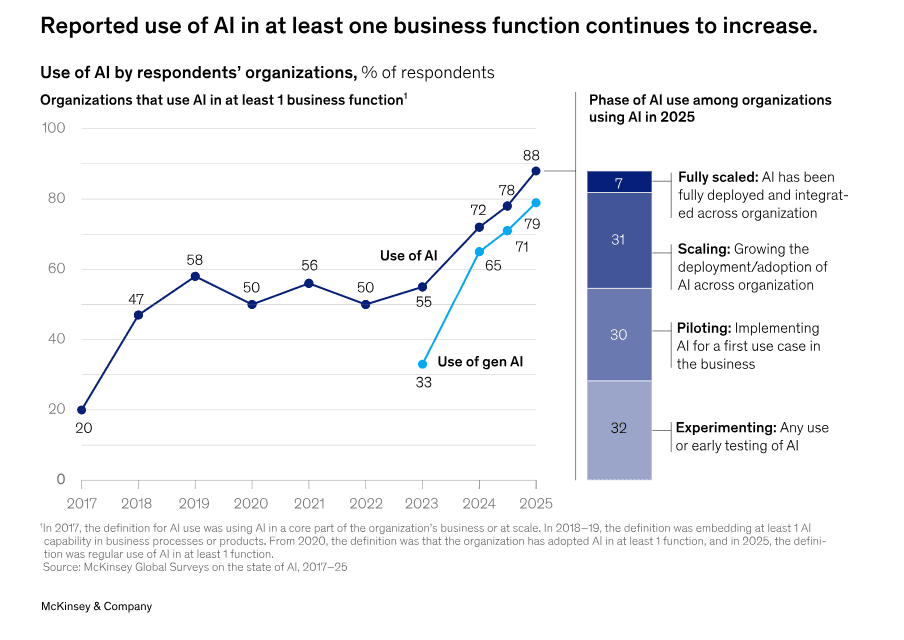
Gartner predicts that more than 40% of agentic AI projects will be canceled by the end of 2027 over cost, unclear value, and weak controls, while McKinsey’s State of AI research shows most organizations now use AI in at least one business function yet far fewer have scaled it reliably across the enterprise.
Closing that pilot-to-production gap is exactly what enterprise AI software development sets out to do.
As a reliable enterprise AI software development company in the USA, Space-O AI has built production systems across healthcare, finance, retail, and manufacturing. This guide brings together what consistently works into one complete view of enterprise AI agent development, so you can scope, build, or go for an expert AI agent development company with confidence.
By the end, you will know what the discipline is, how an enterprise agent differs from a regular AI app, the best tools for enterprise ai agent development, the step-by-step build process, what it costs, the common challenges, the best practices for scaling, and the industries where it pays off the fastest.
What is Enterprise AI Agent Development?
Enterprise AI agent development is the practice of building autonomous AI systems that integrate deeply into a company’s core business operations. These agents don’t just answer questions—they reason through problems, make decisions, execute multi-step workflows, and take actions across systems like CRM, ERP, databases, and other enterprise tools.
Unlike standalone AI models or chatbots, enterprise agents are goal-driven systems that can plan tasks, call APIs, access internal data, and complete real business processes with minimal human intervention. They operate within the same infrastructure and governance frameworks as other critical business systems, which means they must meet strict requirements for security, compliance, audit trails, and reliability.
This is continuous product engineering, not a one-time AI project. Successful enterprise agents require ongoing development, monitoring, and refinement, with human oversight built in for high-stakes decisions. This is why most successful initiatives begin with expert AI consulting services before any production code is written.
What Are the Core Components of Enterprise AI Agent Development?
Enterprise AI agents differ from basic AI features through five foundational components that appear in every production-ready system. Check these components before outsourcing enterprise AI agent development platforms or build enterprise AI agents.
1. Controlled autonomy
Enterprise AI agents make their own decisions about how to complete tasks, but work within strict boundaries. They use only approved tools, follow role-based permissions, and require human approval for high-risk actions. This controlled autonomy lets agents handle complex workflows while staying safe for production use.
2. Deep system integration
Enterprise agents integrate directly into your business stack—ERP systems, CRM platforms, data warehouses, and workflow tools. They’re built into your infrastructure through secure APIs, not added as external bolt-on tools. This integration makes them core business systems your organization relies on daily.
3. Trusted data foundation
Every action an enterprise AI agent takes uses verified, cataloged data with clear origins. In enterprise environments, wrong answers create compliance risks, not just poor user experience. Quality-controlled data foundations determine whether your agent builds or breaks organizational trust.
4. Full-process evaluation
Enterprise agents are evaluated on their entire decision-making process, not just final outputs. Trajectory evaluation monitors each step the agent takes, tracks performance drift over time, and enables continuous improvement. Getting the right answer through the wrong process isn’t acceptable for enterprise reliability.
5. Complete audit trails
Production enterprise agents log every decision, tool call, and data access. This observability makes debugging simple, audits routine, and regulatory compliance straightforward. Building audit trails from the start costs far less than adding them after security incidents.
An AI agent development company for enterprises like Space-O AI always keeps in mind to include these core components during building and launching agents.
In the next section, we will cover what advantages you get from building an AI agent for your enterprise and its growth.
Key Strategic Advantages of Developing an Enterprise AI Agent
The strategic case for enterprise AI agents is no longer about experimenting with new technology. It’s about whether a business can compete on the speed, intelligence, and unit economics that autonomous, integrated software now enables. Seven outcomes consistently make enterprise AI agent development matter at the executive level.
1. End-to-end process visibility and predictive insight
Agents surface patterns across systems that no single dashboard could connect—demand signals, fraud indicators, equipment risk, and customer churn drivers. This insight moves leadership from quarterly hindsight to weekly foresight, the precondition for decisions faster than traditional planning cycles.
2. Operational efficiency without linear headcount growth
Routine, repetitive work in support, finance, supply chain, HR, and IT moves to enterprise AI agents, lifting throughput at the same headcount. The visible signal is shorter handle times, faster cycle counts, and fewer ticket escalations in the segments the agent actually touches.
3. Automation of complex, cross-system workflows
Workflows that previously spanned three or four systems and spreadsheets become a single orchestrated path, with the agent calling each system through governed contracts and handling exceptions gracefully. Process owners get a system of work, not a stack of integrations.
4. Real-time decision support at the point of action
An agent puts predictive and generative capability at the moment a decision is being made—whether on a service call, credit application, maintenance route, or clinical encounter. The lift isn’t just accuracy; it’s the elimination of latency between data and action.
5. Adaptability and continuous improvement
Because enterprise agents are built around trajectory evaluation and trace data, they get measurably better against real production behavior, not just the version they shipped with. That compounding improvement is what regular software cannot match.
6. Human-machine collaboration with audit-grade trust
When the agent proposes, a human approves, and every step is logged, you get the productivity of automation without surrendering accountability. Regulated functions move first when this combination is engineered properly.
7. Scalable, cost-efficient growth
A single well-built agent capability serves new regions, products, and customer segments at marginal cost, instead of replicating teams. The pattern shows up most clearly in retail support, financial servicing, and manufacturing knowledge work.
Each of these is a business case the CFO can read. Together they explain why enterprise AI agents have moved from innovation budget to operating budget at companies that have deployed them successfully. Enterprise AI agent development now sits alongside cloud engineering and data platform work in the modern enterprise technology organization.
7 Top Enterprise AI Agent Frameworks and Platforms You Need to Know
The ecosystem of the best enterprise ai agent development tools has consolidated to a working set of frameworks and platforms that appear in most production builds. The right choice depends on your workflow, data residency requirements, and the size of the operations team that will run the system after launch.
Most enterprises combine two or three categories below into a single, best AI agent platform for enterprise development that teams can actually operate. While no-code automation platforms like n8n suit lightweight workflow automation, production enterprise agents usually need the code-first frameworks below for the control, security, and observability the discipline demands.
1. LangChain and LangGraph
LangChain remains the most widely adopted framework and top AI agent development tools for enterprises, chaining models, retrieval, while LangGraph extends it for stateful, multi-step agentic workflows. The ecosystem breadth is the main reason teams pick it for building enterprise agents with many integrations.
2. Microsoft Semantic Kernel and AutoGen
Semantic Kernel fits enterprises already standardized on Microsoft Azure, with native ties to Azure OpenAI, Microsoft Graph, and the broader Microsoft stack. AutoGen layers in multi-agent conversation patterns when reasoning across roles becomes necessary.
3. CrewAI
CrewAI is built around role-based agent collaboration, which suits operations and customer-experience workflows where each agent has a clearly bounded job and they hand off in sequence. It is lighter weight than LangGraph and faster to stand up for that pattern.
4. LlamaIndex
LlamaIndex is the dominant choice for retrieval-augmented agents built on large internal document corpora, with strong support for parsing, indexing, and structured retrieval from enterprise content. It is often paired with a downstream framework for orchestration.
5. AWS Bedrock AgentCore
Bedrock AgentCore is the AWS-native path for building, deploying, and governing AI agents directly inside AWS, with native ties to IAM, KMS, and CloudWatch. Enterprises that need data residency and audit aligned to AWS controls reach for it.
6. OpenAI Agents SDK and Agent Builder
The OpenAI Agents SDK is the most direct way to build OpenAI agents on the GPT model family, with managed tool use and built-in evaluation hooks, while the companion OpenAI Agent Builder adds a visual canvas for assembling the same patterns with less code.
Together they are the fastest path when speed-to-launch matters more than framework portability, with the trade-off that an agent built tightly around one vendor’s SDK is harder to move later.
7. Databricks and Snowflake Cortex
Databricks and Snowflake Cortex bring agent development directly to the governed data layer, which is the right call when the data platform is the strategic asset and the agent is meant to live where the data already does. Both reduce data movement and the security review that comes with it.
8. NVIDIA NIM and Enterprise Inference Stacks
For enterprises self-hosting open models, NVIDIA NIM and similar inference stacks package serving, quantization, and observability into a deployable unit. This path matters most for regulated industries and high-throughput use cases where per-call cost or data residency rules out an external API.
The right choice is rarely one of these in isolation. Most production builds combine a framework for orchestration, a platform for data and serving, and explicit observability tooling, chosen against the success metrics from step one of the build process below.
Picking the wrong combination of enterprise AI agent development tools, or trusting enterprise AI agent development companies without scoring them against your real workflow, is a leading reason early initiatives stall.
Not Sure Which Framework Fits Your Use Case?
Space-O AI engineers select, integrate, and tune the stack around your goals, budget, and compliance posture.
How to Build an Enterprise AI Agent: 7 Step-by-Step Process
Most coverage of how to build an AI agent stops at choosing a model and wiring up the first tool.
That’s why so many builds stall and they were never scoped to a measurable outcome, never integrated against production-shaped data, and never given a path to improve once live. The seven steps of the AI agent development process below guide AI agents that reach production, run in order, with each step producing the input the next one depends on.
1. Identify and prioritize use cases
This first step decides whether everything after it has a target. Map the processes where autonomous reasoning, prediction, or generation can deliver measurable ROI—fraud review, demand forecasting, ticket triage, document extraction, internal support agents, and predictive maintenance. Score each candidate on value, feasibility, data readiness, integration count, and compliance exposure.
Pick the first agent from the top of that ranked list, write the problem as one sentence with a baseline cost, and lock numeric acceptance criteria: task success rate, latency, cost per task, and approval rate. These become the gates that later evaluation enforces, and without them the project has nothing concrete to deliver against.
2. Assess data readiness
An enterprise agent is only as strong as the data it can read. Inventory the sources each use case depends on, profile them against explicit thresholds for completeness, accuracy, freshness, consistency, and PII exposure, and resolve silos and conflicts before any agent logic is built.
Carry provenance on every record so each agent output is traceable to its origin, and confirm data residency, retention, and access controls against HIPAA, PCI, GDPR, or SOC 2 wherever they apply. Building an agent on ungoverned data is the single most expensive failure to debug after launch.
3. Design agent-first architecture
Architecture decides what the agent can do, what it’s allowed to do, and how it stays observable. Choose the orchestration pattern from the workflow: a single agent for bounded tasks, a planner-executor split for multi-step work, and a multi-agent setup only when distinct roles genuinely need to be handed off.
Define every tool the agent can call like a public API—typed inputs, validated outputs, timeouts, retries, and cost ceilings per call. Build security guardrails into the loop, allowlist tools per role with least privilege, isolate untrusted content, filter outputs before they execute, and gate irreversible actions behind human approval with an audit trail. Specify the trace format and dashboards before code is written.
4. Select models, platforms, and tools
The model, platform, and supporting tools directly affect quality, speed, cost, and how easy the agent is to manage after launch. When companies bundle them together too early, they often end up stuck with tools that don’t match their workflows, security needs, or long-term operations.
- Model selection. Test a few models using your real workflows and data, not public benchmarks alone. Compare them on task success, reasoning quality, response speed, and cost per task. Use powerful reasoning models for complex planning, lightweight models for high-volume subtasks, long-context models for large documents, and self-hosted models when data privacy or API cost is a concern. Teams fine-tuning a base model for their domain often pair the build with dedicated LLM consulting and development services.
- Platform selection. Choose a platform based on security, scalability, data residency, and operational fit instead of feature lists. Compare managed and self-hosted options on cost, latency, maintenance effort, and vendor lock-in. The best platform is usually the one that works smoothly with your existing cloud, data, and identity systems.
- Tools and observability. Select orchestration frameworks, vector databases, monitoring platforms, and MLOps systems that work well together. Monitoring and evaluation tools are critical because they help teams debug agent trajectories, track costs, audit outputs, and improve the system after deployment.
- Vendor selection. Evaluate AI software vendors using real proof-of-value projects with your own data and integrations. Score two or three on a real run against your data and integrations, not on slide decks, and weight industry-specific references and production reliability above brand recognition or generic benchmarks.
5. Build and integrate the agent
This phase turns the design into working software, assembled component by component against a production-shaped scenario rather than all at once. Stand up the data pipeline, then the model and reasoning service, then each tool integration, validating each on real data before connecting the next.
Wire integrations through versioned API contracts into the ERP, CRM, data warehouse, and identity provider so each side can change independently. Engineer error handling, retries, circuit breakers, and fallback responses, surface errors to monitoring rather than swallowing them, and enforce least privilege with short-lived, narrowly scoped credentials per tool.
For in-depth development guidance, we offer a complete AI software development guide, covering implementation detail at the component level for teams that want the deep dive.
6. Test the agent end-to-end and build audit-ready governance
Checking only the final agent output makes it hard to understand why a run failed. Problems can appear silently when prompts, retrieval sources, tools, or model versions change. Build a labeled evaluation dataset that includes normal use cases, edge cases, and intentional failure scenarios, then keep expanding it as new issues appear in production.
Measure multiple factors separately: task success, factual accuracy, trajectory quality, latency, cost, and safety. If you use AI models to evaluate outputs, first validate them against human-reviewed examples. Run stress tests and adversarial scenarios regularly, and block releases in CI/CD if evaluation scores fall below defined thresholds.
At the same time, build governance into the agent from the start with model registries, data lineage tracking, approval workflows, audit logs, and incident response processes, because adding governance later is usually far more expensive than designing it early.
7. Roll out in stages and run a continuous improvement loop
Deployment is where the agent moves from testing environments into real-world business operations, and the work continues long after launch. A safer rollout approach is to release the agent gradually using feature flags, starting with staging environments and then a small percentage of live traffic. Expand usage only if metrics like error rates, response time, customer satisfaction, and cost remain within acceptable limits, and define rollback conditions and ownership before deployment begins.
Monitoring should go beyond basic uptime tracking, with visibility into response times, success and failure rates, tool usage behavior, and cost per task, plus alerts on cost spikes or unexpected tool activity that signal drift. Continuous improvement is equally important: refresh knowledge sources, refine prompts and configurations from real production feedback, and feed escalations back into the evaluation dataset so the agent becomes more reliable and accurate over time.
Need Expert Guidance Building Your Enterprise AI Agent?
Space-O AI’s development team has delivered production-ready AI agents across finance, healthcare, and retail. Discuss your use case and get a tailored roadmap.
How Much Does Enterprise AI Agent Development Cost?
Enterprise AI agent development typically costs between $75,000 and $500,000 for most production implementations, with simple agents starting around $50,000 and full enterprise transformations exceeding $1 million.
These costs are driven by scope, data readiness, integrations, and compliance requirements. The figures below are planning anchors to help you budget, not quotes. A narrow internal automation agent is fundamentally different from a regulated, customer-facing agent platform.
| Project type | Estimated investment (USD) | Typical timeline | What it usually includes |
|---|---|---|---|
| AI agent feature in an existing app | $50,000+ | 6 to 12 weeks | Limited scope, clean data, one or two tool integrations |
| Custom RAG or single-purpose agent | $75,000 to $500,000 | 3 to 6 months | Retrieval layer, tool use, UI, enterprise security and access |
| Enterprise multi-agent platform | $200,000 to $2,000,000+ | 6 to 12 months | Multi-workflow scope, several integrations, orchestration, governance |
| Full enterprise AI agent transformation | $1,000,000 to several million | 12+ months | Data modernization, process re-engineering, change management |
Most mid-market builds that go beyond experiments but stop short of full transformation land in the $100,000 to $300,000 range. Geographic team rates, the pricing model you pick, and data preparation work often shift the total. Six factors below move the number more than anything else, and knowing which ones apply to your build turns a generic range into a defensible budget.
What drives enterprise AI agent development costs?
Six factors determine your final investment more than anything else:
1. Scope and workflow count
Building one agent for a single task costs far less than a multi-agent platform. Each additional workflow adds its own data sources, tool integrations, and quality benchmarks that must be built and maintained separately.
2. Data quality and preparation
Poor data quality is the biggest hidden cost in most projects. Cleaning up siloed, inconsistent, or ungoverned data often takes longer and costs more than teams expect when scoping the project.
3. Number of system integrations
Integration count is a bigger cost driver than model selection. Every system connection (CRM, ERP, database, or API) requires security configuration, API contract definition, error handling, and end-to-end testing.
4. Hosting and infrastructure choice
Self-hosted open-source models have lower per-use costs but require dedicated infrastructure and ongoing maintenance. Cloud-based managed APIs cost more per call but eliminate operational overhead. Your choice depends on usage volume and technical capacity.
Careful planning and clear success metrics at the start reduce AI agent development costs more than negotiating model pricing. Most budget overruns come from rework after launch, not the original development.
Want a Custom Enterprise AI Agent Cost Estimate?
Space-O AI evaluates your data, required integrations, and compliance needs to provide accurate project scoping based on real-world requirements.
5 Common Challenges of Enterprise AI Agent Development and How to Overcome Them
Enterprises face a specific set of obstacles when turning agents from experiments into reliable software. Naming them early is far cheaper than debugging them in production, and each one has a known response that production teams reach for.
1. Data Silos, quality issues, and ungoverned sources
Agents need consistent, accessible, high-quality data to ground their reasoning, yet most enterprises run fragmented systems and legacy stores that make this hard. The result is confident wrong answers that ship to users and an audit trail that cannot show why.
How to overcome it:
- Sequence the data foundation ahead of agent logic; never run them in parallel.
- Set explicit quality bars for completeness, accuracy, freshness, and PII exposure each source must clear.
- Resolve silos and pick a system of record per entity before any agent build.
- Attach provenance, including source, version, and timestamp, to every record so every agent output is traceable.
2. Integration complexity across ERP, CRM, and identity
Giving an agent real tools across existing systems requires deliberate architecture, clean versioned contracts, and real change management. Loose coupling and rushed connectors create regressions months later when the upstream systems change.
How to overcome it:
- Design tool and integration contracts first, with system owners in the room.
- Use clearly versioned APIs so each side can evolve independently.
- Validate the pilot agent on production-shaped data, not a sanitized sandbox.
- Treat change management as engineering work, not a comms exercise.
3. Autonomy, governance, and audit-grade trust
As agents move from isolated tools to coordinated systems, autonomy, accountability, and failure modes become central. Without governance built in, the only fix at audit time is a rebuild.
How to overcome it:
- Stand up the model registry, data lineage, and approval workflows before launch.
- Gate irreversible or high-value agent actions behind human approval with full audit trails.
- Map each use case to the relevant regulatory framework early in design.
- Treat the incident process as part of the launch artifact, not a runbook to be written later.
4. Security risks and prompt-injection exposure
Untrusted inputs, retrieved documents, and powerful tools wired into the agent loop without isolation create a direct path to data loss or unauthorized action. Prompt wording alone cannot defend against this.
How to overcome it:
- Isolate untrusted content in clearly delimited lower-trust sections.
- Filter outputs and tool calls for policy violations and leaked secrets before execution.
- Allowlist tools per role with least privilege and short-lived, narrowly scoped credentials.
- Sandbox side-effecting tools and require human approval for irreversible operations.
5. Skills gaps and organizational readiness
There is often a gap between the team that experiments with agents and the engineering, security, and operations functions that must support them in production. That gap is where projects stall.
How to overcome it:
- Pair internal staff with senior practitioners for the first build.
- Define clear ownership: business owner for outcomes, engineering for architecture and build, operations for evaluation and improvement.
- Hire AI developers with production agent experience to lead the first system end to end.
- Build the internal team alongside the system, not after it ships.
6. Cost control and scaling beyond the pilot
Many organizations ship a successful agent pilot but cannot scale it affordably across processes and regions. Run-cost and integration sprawl are the usual culprits.
How to overcome it:
- Architect tiered model routing from day one so subtasks run on cheaper models.
- Cache similar queries and slow-changing retrievals to reduce repeat work.
- Set per-trajectory ceilings on tokens, latency, and tool calls.
- Plan production architecture, observability, and rollout discipline before the pilot, so scaling is an extension of the design rather than a rebuild.
Addressing these six is not only a technology problem. It requires new operating models, with agents woven into how processes are designed, monitored, and managed across the business.
Best Practices for Scaling Enterprise AI Agents From Pilot to Production
Building the first agent is the easy half. Scaling it to multiple processes, regions, and teams without quality, cost, or trust eroding is where most initiatives succeed or fail. Seven enterprise ai agent development best practices appear repeatedly in enterprise AI agents that survive their second year.
1. Start with phased rollouts and limited scope
Ship the simplest agent that delivers a measurable outcome, behind a feature flag and to a small slice of traffic. Expand only when error rate, latency, satisfaction, and cost stay within target. Resist adding capabilities mid-rollout—each new feature requires separate evaluation and governance.
2. Build observability and trace-level monitoring from day one
Instrument a connected trace for every run that links input, plan, tool calls, results, latency, and cost. Without trace-level visibility, you cannot debug incidents, surface new failure modes, or explain cost spikes. Retrofitting observability after an incident costs several times more than building it upfront.
3. Establish rigorous evaluation as a continuous CI gate
Move evaluation from a launch checkbox to a continuous gate that scores task success, groundedness, trajectory quality, latency, cost, and safety on every change. Block releases when scores fall below threshold, catching regressions before customers experience them rather than after.
4. Implement version control for prompts, configs, tools, and models
Keep prompts, tool definitions, model versions, and configurations in source control with changelogs and evaluation results attached. Every change becomes traceable, reversible in minutes, and explainable to auditors—the bar production agents must clear.
5. Create continuous feedback loops from real production data
Review failed runs weekly, feed escalations back into the evaluation set, refresh the knowledge base on a regular schedule, and refine prompts and configurations from observed behavior. Agents that measurably improve have real feedback loops, not one-time post-launch reviews.
6. Standardize and modularize agent components
Wrap models, tools, retrievers, and sub-agents behind stable internal interfaces so later changes don’t force rewrites. Standardization lets a successful first agent serve second and third use cases at marginal cost, instead of becoming a one-off system nobody can extend.
7. Design for failure recovery and graceful degradation
Wrap external tool calls in retries with exponential backoff, use circuit breakers after sustained failures, and degrade gracefully by maintaining core functionality when non-critical features fail.
Done together, these seven are the difference between an enterprise agent that compounds value across the business and one that quietly degrades into a maintenance burden. Many enterprises pair the build with ongoing maintenance and support so the agent keeps improving during development and after launch.
Which Industries Benefit Most From Enterprise AI Agent Development?
The development process is the same across industries, but the critical success factor shifts based on each sector’s risk profile and data reality. Five sectors consistently see the fastest ROI from enterprise AI agents.
1. Healthcare
Clinical decision-support agents, patient-portal assistants, and medical billing automation require exceptional data readiness and rigorous evaluation. An ungrounded clinical or coverage answer becomes a compliance event, not just a user experience issue. Provenance tracking for every retrieved fact, HIPAA-aligned audit trails, and adversarial testing for unsafe outputs are non-negotiable.
Space-O has published detailed guidance on AI for healthcare that covers these requirements.
2. Financial services and banking
Servicing, underwriting, and fraud-review agents depend on precise use case scoping and architecture. The autonomy boundary between an automated lookup and an approval-gated transaction determines whether you gain efficiency or risk unauthorized actions. Getting this boundary right is critical for AI for finance implementations.
3. Retail and eCommerce
High-volume recommendation, search, and support agents succeed or fail based on model selection and deployment strategy. Tiered routing and cost-per-task monitoring prevent popular agents from becoming unaffordable at peak traffic. Personalization gains compound only when latency and unit economics hold under load, as demonstrated in successful AI for retail deployments.
4. Manufacturing and supply chain
Predictive maintenance, quality inspection, and operations-knowledge agents require strong data readiness and continuous iteration. Shop-floor data drifts as production lines and equipment change, so agents must adapt continuously. AI for manufacturing projects prioritize this iterative improvement cycle.
5. Telecom and large SaaS platforms
High-throughput automation, churn prevention, and developer-copilot agents are shaped by architecture and observability requirements. The volume of decisions per second makes monitoring and cost control structural necessities, not optional features.
Build Custom Enterprise AI Agents With Space-O AI
Enterprise AI agent success does not come from experimenting with isolated tools or chasing the latest model release. It comes from building agents that are secure, scalable, integrated with your business data, and designed to deliver measurable operational value over time.
As one of the best enterprise AI agent development companies, Space-O AI helps enterprises move beyond pilots and build production-ready AI agents that support real business workflows. With 15+ years of software engineering experience, 500+ delivered projects, and a team of 80+ AI developers and specialists, we build enterprise AI solutions focused on performance, governance, reliability, and long-term ROI.
Our AI software development team works across AI strategy, agent architecture, data pipelines, MLOps, enterprise integrations, and multi-agent orchestration to help businesses reduce manual work, improve decision-making, automate operations, and scale AI adoption safely. Whether you need an agent integrated into ERP and CRM systems, enterprise search, intelligent automation, or custom agents grounded in your internal data, we build systems designed for real production environments, not demos.
If you are planning to build an enterprise AI agent or scale an existing AI initiative, connect with our AI development team to discuss your use case, technical requirements, and the fastest path to secure deployment.
Reliable Enterprise AI Agents Start With the Right Process Decisions
Work with senior AI engineers who scope, design, and ship integrated agents, secure data layers, and production-ready systems built for long-term reliability.
Frequently Asked Questions About Enterprise AI Agent Development
Should we build enterprise AI agents in-house or work with an external development partner?
Most enterprises use a hybrid approach. Internal teams bring business knowledge, existing system integrations, and long-term ownership, while external AI partners contribute specialized agent engineering expertise and proven production experience. Whether you build your own AI agent in-house or with a partner, many companies work with an external team for the first few implementations and gradually move operations in-house once the architecture and workflows are established.
How do we choose the right enterprise AI agent development company?
Evaluate vendors using a real proof-of-value project with your own data and integrations instead of relying only on presentations or feature lists. Focus on production reliability, enterprise integration experience, security practices, compliance readiness, and post-launch support. Strong experience with ERP, CRM, identity systems, and regulated environments is often more important than brand recognition.
How can enterprises reduce hallucinations and prevent data leakage in AI agents?
Enterprise agents should ground responses using verified internal data sources instead of relying only on model memory. Add governance layers such as output filtering, access controls, policy checks, audit logs, and human approval for sensitive actions. For high-security use cases, many organizations use self-hosted or region-locked models to maintain data residency and compliance.
What is the best first use case for an enterprise AI agent?
The best starting point is usually a high-volume process with measurable inefficiencies and lower operational risk. Common examples include document processing, ticket routing, internal knowledge assistants, fraud review support, and workflow automation. Starting with a contained use case helps teams validate architecture, governance, and ROI before expanding agent adoption.
How do businesses measure ROI from enterprise AI agents?
Measure ROI using clear before-and-after business metrics such as reduced handling time, lower operational costs, fewer errors, faster workflows, improved conversion rates, or reduced fraud losses. Successful enterprises track both business outcomes and agent operating costs continuously instead of relying on broad productivity estimates.
Should we build custom enterprise AI agents or buy an off-the-shelf platform?
Off-the-shelf agent platforms work well for standardized use cases where customization is limited. Custom enterprise AI agent development is more suitable when competitive advantage depends on proprietary data, unique workflows, or deep integrations with internal systems. Many enterprises combine both approaches by using packaged tools for common functions and custom agents for business-critical operations.
When should we use open-source models instead of managed LLM APIs for an agent?
Self-hosted open-source models are a good fit when organizations need strict data residency, lower inference costs at scale, or full infrastructure control. Managed LLM APIs are usually preferred for faster deployment, lower operational overhead, and access to the latest model capabilities. Many enterprise agents use multiple models together based on workload, security, and cost requirements.
What ongoing costs should enterprises expect after launching an AI agent?
Post-launch costs typically include model usage fees, cloud infrastructure, monitoring and observability tools, security and compliance reviews, retraining, evaluation updates, and ongoing engineering support. Enterprises should also budget for continuous optimization, because maintaining reliable agents is an ongoing operational effort rather than a one-time deployment.
Turn Your Enterprise AI Agent Vision Into Production Reality


