
5 AI Agent Development Best Practices in 2026

 Last Updated: May, 22 2026
Getting an AI agent to work in a notebook takes an afternoon. Getting it to run reliably for real users, without leaking data, burning the budget, or breaking on messy input, is a completely different problem.
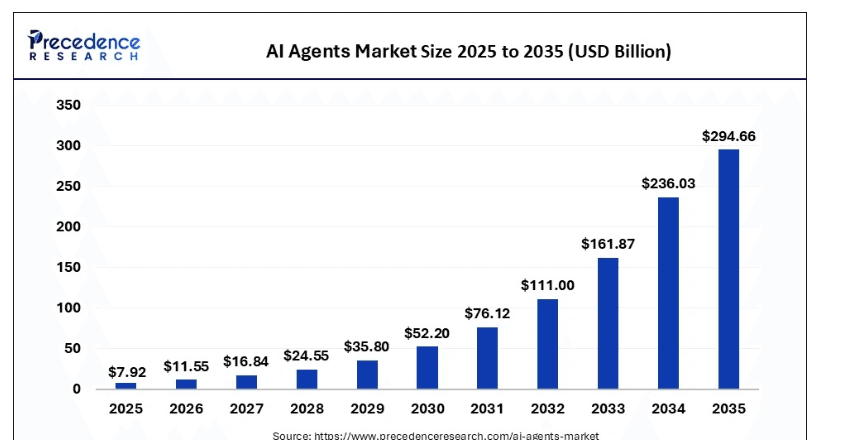
As per a survey from Precedence Research, 79% of organizations had adopted AI agents, yet only 11% were running them in production, even as the market scales at a 43.57% CAGR through 2035. Closing that prototype-to-production gap is exactly what AI agent development best practices exist to answer.
At Space-O AI, our AI agent development company has taken agents from prototype to production in healthcare, finance, retail, and manufacturing. We see the same patterns succeed, and the same mistakes repeat. This guide distills those lessons into five AI agent development best practices you can apply to your own projects.
By the end, you will know what separates an AI agent that performs better in demos than reliably in production and what to do next if you are stuck in between.
5 Best Practices for AI Agent Development to Launch Production‑Ready Agents
AI agents do not behave like traditional software. They are probabilistic, they act through tools, and they can fail in open‑ended ways. You do not “prove” them correct once; you watch how they behave across many runs.
In practice, wrong answers rarely come from the model alone. They come from missing contracts, unbounded loops, ungrounded claims, or changes nobody can trace. The best practices for AI agent development below focus on the system around the model, where reliability is actually decided.
AI consulting services help teams apply these practices early, before a single line of production code is written.
1. Start Simple, Then Architect Around Tools, Memory, and Control
Most teams overcomplicate their first agent. They reach for multi‑agent orchestration, custom planners, and graphs before they have tested a single, well‑instructed model call on a real workflow.
That early complexity becomes a cost you keep paying in security, evaluation, and observability. A minimal, well‑scoped agent is the fastest way to learn what really matters in your use case.
- Start with one focused agent and a clear task: Give it a narrow responsibility, a strong system prompt, and a small set of tools. Prove it can solve a real user scenario end-to-end before adding more moving parts.
- Let the model earn the complexity: Modern models handle function calling, basic planning, and short‑term memory surprisingly well. In many enterprise workflows, a single, well‑designed agent beats an elaborate graph. Only add orchestration frameworks when you hit clear limits.
- Introduce architecture when you outgrow “simple”: Once the simple version is not enough, scale on purpose. A production agent typically has a planner that decides what to do next, a memory subsystem that manages context, and a tool layer that takes actions.
- Treat tools like real APIs: Define strict tool contracts, validate inputs and outputs at runtime, use idempotency keys for writes, and set timeouts and cost ceilings per call. Expose tools behind a standard interface so you can swap models or orchestrators without rewriting everything.
- Decompose by responsibility, not by prompt size: When one agent is no longer enough, add an orchestrator and split work into specialized sub‑agents. Keep deterministic code for steps that are already solved in your existing systems. Avoid the “giant prompt that does everything” pattern.
- Design memory, don’t just “add a vector DB”: Give the agent a working memory budget, summarize older turns beyond a threshold, and separate long‑term memory into factual knowledge and important past cases. Use your vector database as the retrieval index inside that design, not as the design itself.
- Bound the control loop: Explicitly separate plan, act, and observe. Cap the number of iterations and total wall‑clock time. A confused agent should fail fast and clearly, not spin indefinitely.
- Version your system prompt: Treat the system prompt as a living specification. Define role, goal, tools, output format, and escalation rules. Give each version an ID, keep a simple evaluation history, and roll back when a change makes things worse.
In short, architecture decides what the agent can do. The next practice focuses on what it is allowed to do.
2. Build Security and Guardrails in from the Start
The moment an agent can call tools, it becomes an attack surface. Best practices for secure AI agent development treat security as a design constraint, not a post‑launch hardening step.
There are two main risks:
- The agent takes a harmful action on its own.
- Untrusted input (users, retrieved documents, tool outputs) steers the agent into doing something it should not.
Prompt injection is no longer theoretical; it is the most common real‑world failure pattern. Prompt wording alone cannot fix it.
Focus on four habits:
- Isolate untrusted content: Wrap user content and retrieved documents in clearly marked, lower‑trust sections. Tell the model that these sections cannot override its core instructions. This reduces some injection risks but does not remove the need for technical controls.
- Filter on the way out: Before an action executes or a response is sent, check it for policy violations, sensitive data, unexpected tool calls, or risky prompts. Map these checks to something your security team understands, such as an OWASP‑style threat model.
- Enforce least privilege in code: Allowlist tools per agent role, validate numeric ranges, and use short‑lived, narrowly scoped credentials. An agent that only needs read access to CRM data should not have write permissions “just in case.”
- Sandbox side effects and gate irreversible actions: Run side‑effecting tools in constrained environments. Require human approval with an audit trail for actions like payments, deletions, or mass communications. Tell users clearly what the agent can and cannot do, and confirm before executing anything that cannot be undone.
A secure agent can still be confidently wrong. The next practice tackles that problem by grounding responses in real data.
3. Ground Agents with Agentic RAG
If your agent answers purely from model knowledge, it will eventually invent facts. Sometimes those inventions are harmless. In regulated industries, they are not.
Agentic RAG (retrieval‑augmented generation) grounds the agent’s decisions in your actual data and sources. The difference from basic RAG is that the agent itself controls when and how to retrieve, and checks whether the evidence is enough before acting.
Key habits here:
- Engineer retrieval, not just embeddings: Chunk content along semantic boundaries, not arbitrary token counts. Use reranking to improve the top results. Combine vector search with keyword or structured queries so IDs, codes, and exact phrases are not lost.
- Let the agent decide when to retrieve: The agent should issue targeted queries based on the task, retrieve again when the first pass is weak, and skip retrieval when the answer does not need external data. Forcing retrieval into every step adds cost without always adding value.
- Carry provenance with every fact: Attach source, version, and timestamp to retrieve information. In many enterprises, this traceability is the difference between “interesting PoC” and “approved for production.”
- Add a sufficiency gate: Ask: “Do we have enough evidence to answer safely?” If not, the agent should escalate or refuse instead of guessing. Evaluate retrieval precision and recall directly so you know whether failures come from search, reasoning, or something else.
Grounding improves correctness, but you still have to prove the agent works end to end. That makes evaluation and observability one of the important AI agent development lifecycle best practices.
4. Evaluate Full Trajectories, Observe, and Improve Continuously
If you only look at the final answer, you miss why an agent succeeds or fails. A seemingly correct output might have used a wrong tool call or violated a policy. That is not sustainable.
Enterprise AI agent development best practices now treat the full trajectory—every step, tool call, and decision as the unit of evaluation.
Use three building blocks:
- Build a realistic evaluation set: Collect at least 30–50 scenarios per agent: typical tasks, edge cases, and deliberate “bad” situations like malformed inputs, missing context, or conflicting instructions. Keep adding to this set as you see new failures in production.
- Score multiple dimensions: Do not collapse everything into a single score. Track task success, tool‑use accuracy, groundedness, latency, and cost separately. An AI agent that is accurate but too expensive, or fast but unsafe, still needs work. If you use an LLM to judge outputs, calibrate it against human labels first.
- Gate releases with evaluation: Treat evaluation like a CI test suite. When you change prompts, tools, or configuration, run the suite and block release if scores drop below your thresholds. This is how you avoid silent regressions after “just one more tweak.”
- Instrument and close the loop: Log a trace for every request: inputs, intermediate steps, tool calls, results, tokens, latency, and cost. When something goes wrong, this trace lets you replay and understand it. Feed the most important failures back into your evaluation set and prompts so the agent improves over time.
Knowing the agent works is one thing. Keeping it reliable and affordable at scale is another.
5. Engineer for Reliability, Cost, and Safe Deployment
Many agents work in a demo and then fail in production: timeouts, stuck loops, cost spikes, or changes no one can roll back. AI agent development lifecycle best practices treat reliability and cost as engineering concerns, not afterthoughts.
Focus on four areas:
- Make external calls resilient: Wrap calls to models and APIs with retries and sensible backoff. Use circuit breakers when a service is failing repeatedly. Design graceful degradation paths so non‑critical enrichments can fail without breaking the main user flow.
- Control cost and latency by design: Cache slow‑changing retrievals and repeated queries. Set per‑request ceilings on tokens and time. Route simple tasks to smaller, cheaper models and reserve the largest models for complex work. In many stacks, this routing is where most cost savings come from.
- Version everything that changes behavior: Store prompts, tool definitions, configuration, and routing logic in version control. Keep a changelog with evaluation results. If something goes wrong, you should be able to answer “what changed?” in minutes and roll back safely.
- Deploy in stages with a backout plan: Use shadow mode, canary, or ring deployments. Define up‑front what metrics would trigger a rollback: error rates, cost spikes, or policy violations. When an incident happens, you should be able to disable or roll back the agent quickly.
Done together, these five best practices are what move an AI agent from prototype to a production system you can trust.
Want These Practices Applied to Your Agent Without Trial and Error?
Space-O AI designs, secures, evaluates, and deploys production-grade AI agents end to end, so you skip the failed first launch. Consult with our agentic AI development company to map the fastest safe path to production.
Common AI Agent Development Mistakes to Avoid for Successful Launch
Even strong teams repeat a predictable set of mistakes when they move from prototype to production. Recognizing these patterns early is much cheaper than debugging them under real user traffic.
1. Over‑engineering before validating the basics
Teams jump straight into complex multi‑agent graphs, custom planners, and orchestration layers before they have proved that a single, well‑designed agent cannot solve the task. The extra moving parts create noise in logs and traces, so it becomes hard to see where the real problem is: the prompt, the tools, the data, or the product fit.
Why it hurts
You spend weeks tuning architecture decisions that might be unnecessary, and every new bug now has more places to hide. This also makes it harder to reason about security, evaluation, and SLAs, because you are trying to stabilize the whole graph instead of one agent.
What to do instead
Start with the simplest viable agent that can perform one real task end-to-end. Give it clear goals, minimal tools, and a strong system prompt. Only add additional agents, orchestration, or planning logic when your traces and evaluation clearly show that the single‑agent design has hit a limit.
2. Treating evaluation as a one‑time launch checklist
Agents are tested right before launch, often with a small, hand‑picked set of scenarios. Once they are in production, prompts, tools, and configurations change frequently, but there is no systematic way to check whether each change makes the agent better or worse. Quality drifts quietly over time.
Why it hurts
You cannot answer simple questions like “When did this regression start?” or “Did our last prompt change break anything?” Failures only surface when a user complains or a stakeholder escalates an incident. By then, dozens or hundreds of bad trajectories may have already run.
What to do instead
Treat evaluation as a continuous, automated process. Build a realistic evaluation set that includes happy paths, edge cases, and known failure modes. Score whole trajectories, not just final answers, across dimensions like task success, safety, latency, and cost. Make this suite a standing CI gate with minimum thresholds, so no change to prompts, tools, or routing goes live without passing it.
3. Ignoring the security surface of tools and retrieval
Untrusted user inputs, retrieved documents, and powerful tools (payments, data exports, system changes) are wired directly into the agent loop with minimal isolation. Prompt injection, data leakage, and unexpected tool calls are treated as edge cases instead of baseline risks.
Why it hurts
A single cleverly crafted message or malicious document can steer the agent into exposing secrets, corrupting data, or executing actions it was never intended to perform. Because the system was not designed with guardrails, the only “fix” is to patch prompts and hope for the best.
What to do instead
Design for security from day one. Isolate untrusted inputs and retrieved content into clearly marked, lower‑trust sections. Filter outputs and actions before they execute: check for policy violations, sensitive data, and suspicious tool calls. Restrict tools by role using allowlists and least‑privilege access. Sandbox side‑effecting tools and require human approval for irreversible or high‑impact actions before you grant the agent autonomy.
4. Adding observability only after something breaks
Teams launch agents with minimal logging—maybe just final outputs and error counts. When something goes wrong, they scramble to add tracing, but by then the most damaging trajectories are gone, and there is no way to reconstruct what actually happened.
Why it hurts
Without trace‑level visibility, you cannot see how the agent is planning, which tools it is calling, where it is getting confused, or why costs are spiking. Every investigation becomes guesswork and manual log‑diving, which slows down incident response and erodes trust.
What to do instead
Build observability into the agent from the first pre‑production run. Emit a structured trace for every request that links the user input, intermediate reasoning steps, tool calls, results, and key metrics like latency and token usage. Use these traces to debug incidents, discover new failure modes, and continuously enrich your evaluation set. This way, each incident directly improves how the agent behaves in the future.
Avoiding these four patterns removes a large share of the hidden risk in AI agent projects. You get simpler architectures, predictable quality, fewer security surprises, and clearer visibility into how your agents behave in the real world.
The Path From Prototype to Production Starts Here
AI agent development best practices come down to closing one gap: the distance between an agent that demonstrates well and one that runs reliably, securely, and affordably for real users.
Start simple and architect deliberately, build security in, ground with agentic RAG, evaluate and observe continuously, and engineer for reliability and safe deployment. These are the disciplines that move a project from the 79% who adopt to the 11% who actually operate in production.
Space-O AI brings 15+ years of software engineering experience and 500+ delivered projects to this exact problem. Our team of 80+ AI developers and specialists has built production AI systems across healthcare, finance, retail, and manufacturing, where reliability, compliance, and measurable ROI are not optional.
We approach agent development as production engineering, not experimentation, and that is why we rank among the top AI agent development companies that teams trust with production systems.
That experience shows up in the work: HIPAA-aligned agentic systems with audit trails, secure-by-design tool layers, agentic RAG grounded in verified enterprise data, and MLOps that keep agents accurate over time.
Ready to move your AI agents from prototype to production? Contact our AI development team for a free consultation to discuss your use case, architecture, timeline, and the fastest safe path to deployment.
Reliable AI Products Start With the Right Architecture Decisions
Work with senior AI engineers who design scalable agent workflows, secure data pipelines, and production-ready AI systems built for long-term growth.
Frequently Asked Questions About Best Practices of AI Agent Development
What are the most important AI agent development best practices?
The five that matter most are: start simple and architect around tools, memory, and control; build security and guardrails in from the start; ground agents with agentic RAG; evaluate full trajectories with strong observability; and engineer for reliability, cost, and safe deployment.
How is AI agent development different from traditional software development?
Traditional software is deterministic and tested per input. An AI agent is probabilistic, stateful, and acts through tools, so you measure correctness statistically across many runs. That is why the best practices focus on architecture, evaluation, and governance around the model.
What are the best practices for secure AI agent development?
Treat security as part of the initial design. Isolate untrusted and retrieved content, filter outputs before actions execute, allowlist tools per role with least‑privilege access, sandbox side‑effecting tools, and gate irreversible or high‑value actions behind human approval and audit trails.
How do you evaluate an AI agent before production?
Test whole trajectories, not just final answers. Build an evaluation set of realistic scenarios and known failures, score multiple dimensions such as success, safety, and cost, calibrate any LLM‑based judges, and run this suite as a release gate whenever you change the agent.
What is the AI agent development lifecycle?
The lifecycle spans: scope and design, build, evaluate, deploy, and operate. Teams that treat these as connected stages and apply the best practices in this guide across them—move from prototype to production faster and with fewer surprises.
How long does it take to move an AI agent from prototype to production?
It depends on scope, data readiness, and compliance requirements. Teams that plan for security, evaluation, and observability from day one typically reach a stable production agent much faster than teams that retrofit these concerns after a failed launch.
Ready to Launch AI Agents That Actually Ship to Production?


