- What Determines Your Sovereign AI Deployment Timeline?
- The 4 Phases of Sovereign AI Deployment (With Typical Timelines)
- Deployment Timeline by Organization Type
- What Causes Sovereign AI Deployments to Run Over Schedule?
- How to Accelerate Your Sovereign AI Deployment
- Build Your Sovereign AI Roadmap With Space-O AI
- Frequently Asked Questions
Timeline to Deploy Sovereign AI: Phases, Milestones, and What to Expect

 Last Updated: April, 7 2026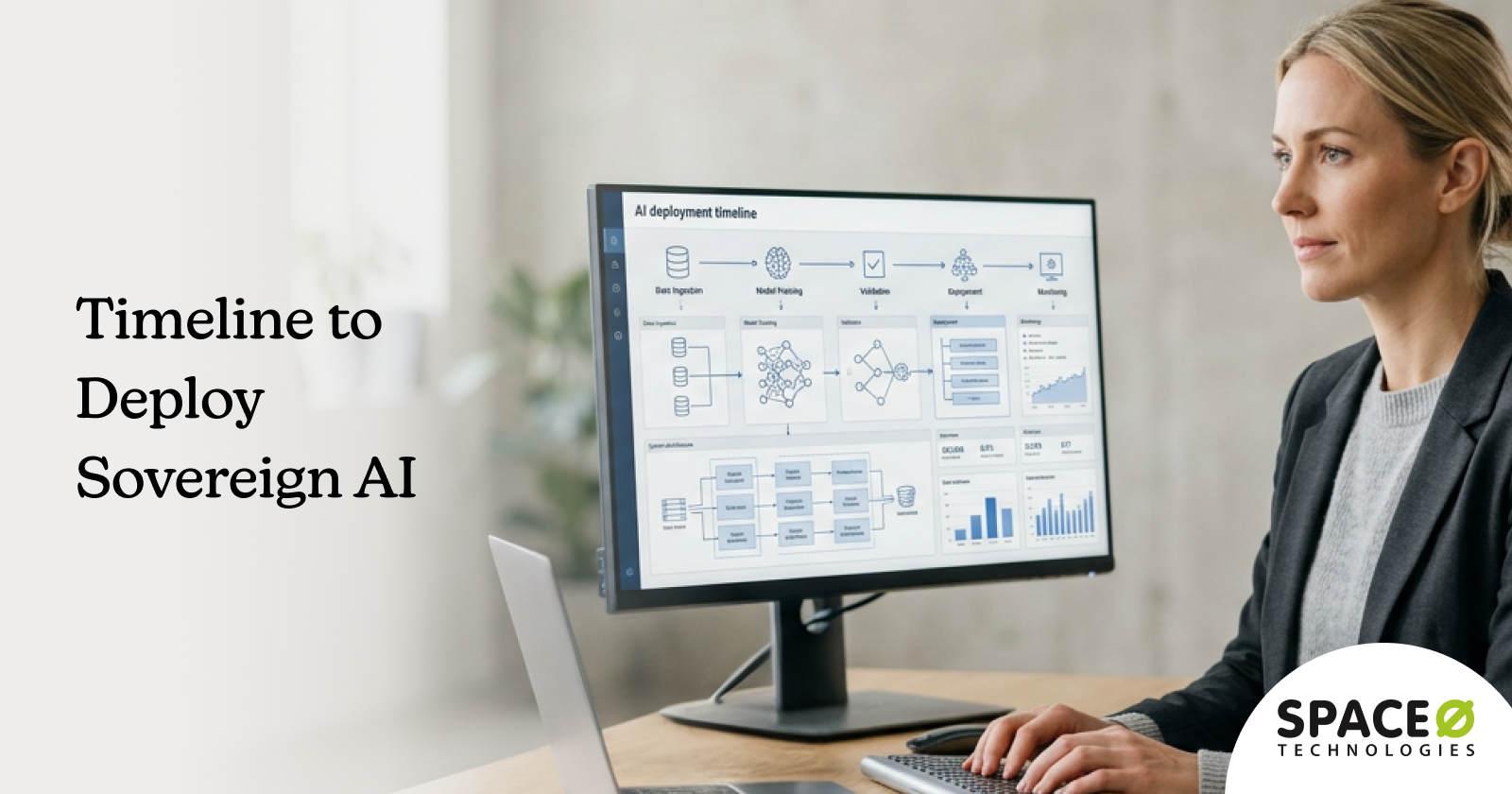
Deploying sovereign AI is one of the most strategically important decisions an enterprise can make today. But without a clear timeline and a structured deployment plan, most organizations find themselves caught between ambitious roadmaps and operational reality. Industry research shows that 95% of enterprises plan sovereign AI platforms, yet only 13% are operationally ready to execute.
At Space-O AI, we have helped enterprises across healthcare, financial services, and regulated industries navigate the full timeline to deploy sovereign AI, from governance foundation through live production environments. Our sovereign AI development services are built around phase-by-phase execution, so your deployment moves forward with the right controls, the right infrastructure, and a realistic schedule your stakeholders can commit to.
What Determines Your Sovereign AI Deployment Timeline?
The timeline to deploy sovereign AI is not fixed. The same technology stack can take 12 months in one organization and 36 in another, depending on regulatory complexity, infrastructure maturity, and organizational readiness. Before estimating your own timeline, you need to understand the variables that shape it.
Here are the six factors that most directly affect how long deployment takes:
- Organizational readiness: Many enterprises add sovereign AI to their roadmaps without allocating budget, defining workload scope, or assigning ownership. Resolving those gaps before infrastructure work begins adds months to the schedule and cannot be skipped.
- Regulatory and compliance requirements: Healthcare, financial services, and government organizations face data residency laws, audit obligations, and procurement rules that introduce process overhead at every phase of deployment.
- Infrastructure approach: On-premises builds require facility preparation, hardware procurement, and network configuration. Private cloud and hybrid models are faster, but they introduce vendor dependency decisions that need careful evaluation upfront.
- Hardware procurement lead times: GPU clusters and specialized compute hardware carry lead times of three to six months in constrained markets. Failing to account for this in the project plan is one of the most common causes of schedule overrun.
- Skill availability: Sovereign AI environments require deep expertise in Kubernetes, MLOps, and AI/ML platform management. Most enterprise IT teams have skill gaps here that require hiring, training, or a deployment partner to fill.
- Deployment scope: A single lighthouse use case can go live in six to nine months. A full enterprise rollout across departments is a multi-year initiative that should never be attempted as a single-phase project.
Working with an experienced sovereign AI implementation partner from Phase 1 onward significantly reduces timeline uncertainty in each of these areas.
The 4 Phases of Sovereign AI Deployment (With Typical Timelines)
Most sovereign AI deployments follow four overlapping phases. These phases rarely run in strict sequence. Infrastructure procurement often begins while governance work is still in progress, and monitoring starts before the full rollout is complete. Understanding each phase and its realistic duration is the foundation of a credible deployment plan.
Phase 1: Assessment and governance foundation
Estimated duration: Months 1–3
This phase establishes the strategic and policy foundation before any infrastructure is procured or deployed. The goal is clarity on scope, not completeness. Organizations that skip or rush this phase frequently encounter costly rework later when compliance requirements or data classification needs surface mid-project.
- Inventory AI use cases, data sources, classification levels, and applicable regulatory requirements
- Define which workloads require sovereign controls vs. standard cloud handling
- Establish policy baselines covering region constraints, encryption standards, identity model, and logging strategy
- Draft governance framework and assign decision ownership across business and IT
- Allocate budget and align deployment scope with upcoming regulatory or procurement deadlines
Phase 2: Infrastructure procurement and data preparation
Estimated duration: Months 3–9 (up to 12 for on-premises builds)
This phase involves the physical and logical infrastructure work that makes sovereign AI operationally possible. On-premises builds are the most time-intensive here, as hardware procurement, facility preparation, and network configuration must all complete before any model work can begin. Starting hardware procurement early, before architecture is fully finalized, is one of the most effective ways to keep this phase on schedule.
- Procure and configure hardware including GPU clusters, secure storage, and network segmentation
- Build data pipelines covering ingestion, validation, tagging, residency enforcement, and CMK/EKM secure storage
- Set up model governance including registry, versioning, evaluation, and approval workflow
- Configure key management infrastructure and identity architecture
- Design, validate, and test segmented network environments
Phase 3: Model deployment and staged rollout
Estimated duration: Months 6–18
With infrastructure in place, this phase moves from setup to active deployment. A staged rollout approach, moving from dev to test to production with separation of duties at each stage, is the standard for sovereign environments. Starting with one high-value lighthouse use case rather than a broad rollout reduces risk and generates early proof of value that justifies continued investment.
- Apply infrastructure as code with policy compliance checks running pre-deployment
- Execute staged rollout: dev to test to prod with formal separation of duties at each gate
- Launch lighthouse use case and validate performance, latency, governance, and regulatory compliance
- Conduct user acceptance testing and structured stakeholder reviews
- Expand to additional use cases based on lighthouse outcomes and compliance validation
For a deeper look at how infrastructure choices affect rollout speed, see our breakdown of sovereign AI architecture.
Phase 4: Monitoring, optimization, and scale
Estimated duration: Month 12 onward (continuous)
Sovereign AI is not a one-time deployment. Ongoing monitoring, key management, model governance, and continuous improvement are permanent operational requirements. Organizations that treat Phase 3 completion as the finish line accumulate compliance risk and model performance debt over time.
- Track model drift, anomalies, performance metrics, and safety signals on a continuous basis
- Rotate and revoke cryptographic keys, retire superseded models, and maintain complete audit trails
- Feed a continuous improvement backlog and expand to additional use cases as capacity allows
- Review infrastructure costs against projected ROI and optimize utilization across the sovereign stack
- Align ongoing operations with evolving data residency and AI governance regulations
Deployment Timeline by Organization Type
The phase durations above reflect a broad enterprise baseline. The right estimate for your organization depends on your sector, regulatory environment, and infrastructure starting point.
The table below reflects typical end-to-end timelines for organizations beginning a phased sovereign AI rollout. These ranges assume a realistic starting scope of one or two use cases, not a simultaneous full-enterprise deployment.
| Organization Type | Typical Timeline | Key Driver |
|---|---|---|
| Enterprise (regulated) | 2–4 years | Compliance complexity, data gravity, operating model change |
| Government / public sector | 3–5 years | Procurement cycles, policy mandates, national security controls |
| Telecom / critical infrastructure | 2–3 years | Infrastructure maturity, existing network assets |
| Financial services | 2–3 years | Data residency laws, audit requirements, third-party risk |
| Healthcare organizations | 2–4 years | HIPAA or local regulations, patient data sensitivity |
| SME / mid-market | 1–2 years | Smaller scope, managed services path available |
Organizations with existing private cloud infrastructure or prior on-premises AI experience typically compress these ranges by six to twelve months. Those starting from a standard public cloud baseline tend to sit at the longer end of each range.
Explore our sovereign AI development services to understand how we scope and phase deployments across these sectors.
What Causes Sovereign AI Deployments to Run Over Schedule?
Understanding the most common delay causes is the fastest way to avoid them. Most sovereign AI projects run over schedule for organizational and process reasons, not technical ones.
No clear workload prioritization
Most enterprises include sovereign AI in their roadmaps without a detailed action plan, workload tiering, or defined scope. Without clear boundaries on what must be sovereign and what does not, projects expand indefinitely and priorities shift with every stakeholder conversation.
- Define sovereign vs. non-sovereign workloads in Phase 1 before any procurement begins
- Use a risk-based tiering framework to establish the initial deployment scope
- Limit the first deployment to one or two lighthouse use cases with explicit ROI criteria
Hardware and infrastructure bottlenecks
GPU cluster procurement, secure data center buildouts, and custom network configurations add months that most initial project plans do not account for. In constrained markets, GPU lead times alone can push a nine-month plan to fifteen months without a single line of code changing.
- Begin hardware procurement in Phase 1, before architecture design is fully finalized
- Evaluate colocation or managed sovereign cloud as a faster alternative to full on-premises builds
- Build three to six month hardware lead times into all project schedules from the start
Skill gaps in sovereign AI operations
Sovereign environments require deep expertise in Kubernetes, MLOps, and AI/ML platform management. According to McKinsey’s sovereign AI research, identifying these gaps late in the project, when they become active blockers, is far more costly than addressing them during the planning phase.
- Map technical skill gaps explicitly during the Phase 1 assessment
- Engage a sovereign AI deployment partner for specialized roles before gaps become blockers
- Run internal capability-building programs in parallel with infrastructure build phases
Underestimating organizational change
Sovereign AI migrations are slow not because the technology is immature, but because enterprises struggle to decide where sovereignty truly matters and to adapt their operating models accordingly. Governance decisions, policy changes, and stakeholder alignment take time that technical-only planning never budgets for. The World Economic Forum’s analysis of sovereign AI initiatives consistently identifies organizational readiness as the primary differentiator between deployments that succeed and those that stall.
- Treat sovereign AI as a business transformation initiative, not an IT project
- Assign executive sponsorship at the start and tie deployment milestones to business outcomes
- Align deployment phases explicitly with regulatory review cycles and procurement calendars
How to Accelerate Your Sovereign AI Deployment
Not every organization has a three to four year runway. These strategies can compress the timeline without sacrificing the data control and compliance integrity that make sovereign AI worth deploying.
- Start with a managed sovereign AI solution: Managed platforms eliminate the infrastructure build phase and can bring initial use cases live in months rather than years. This is the fastest path for organizations facing near-term regulatory pressure.
- Run a 90-day proof of concept: A time-boxed pilot on a single use case validates your approach, surfaces hidden complexity early, and builds stakeholder confidence before full investment is committed.
- Prioritize a lighthouse use case with clear ROI: A focused first deployment with measurable business outcomes accelerates buy-in and creates a repeatable template for subsequent rollouts.
- Partner with a sovereign AI deployment specialist: Partners with pre-built compliance frameworks, validated infrastructure blueprints, and sector-specific deployment experience reduce the trial-and-error cycles that consume the most calendar time. According to Deloitte’s 2026 State of AI in the Enterprise report, 72% of enterprise leaders now cite data sovereignty and compliance as their top AI challenge, making specialist partnership more valuable than ever.
- Use your nearest regulatory deadline as a forcing function: Aligning deployment scope to an upcoming compliance requirement provides urgency, budget justification, and a clear definition of done that open-ended roadmaps rarely achieve.
See our guides on how to implement sovereign AI for a full look at how to structure an accelerated rollout.
Talk to Our Sovereign AI Deployment Team
No commitment required · Response within 24 hours
Build Your Sovereign AI Roadmap With Space-O AI
Sovereign AI deployment is a multi-year initiative, but the right phase structure, clear scope, and an experienced partner can compress timelines and prevent the organizational bottlenecks that derail most projects. The technology is ready. What separates organizations that deploy successfully from those that stall is a realistic plan and the operational discipline to execute it phase by phase.
Space-O AI brings 15+ years of experience and 500+ delivered projects to sovereign AI engagements. Our team of 80+ AI engineers and infrastructure specialists has built HIPAA-compliant AI platforms, sovereign data pipelines, on-premises LLM environments, and private cloud deployments for enterprises across healthcare, financial services, government, and regulated industries. We understand what each deployment phase requires and where the hidden delays live.
From governance framework design in Phase 1 through model monitoring in Phase 4, Space-O AI provides end-to-end sovereign AI deployment support. Our work spans on-premises builds, private cloud configurations, hybrid sovereign environments, and managed sovereign AI platforms, all tailored to your sector’s specific regulatory and operational requirements.
Ready to map your sovereign AI deployment timeline? Contact our team for a free consultation to discuss your requirements, current infrastructure, and a realistic phase plan for your organization.
Frequently Asked Questions
How long does it take to deploy sovereign AI?
Most enterprise sovereign AI deployments take two to four years end-to-end. Government and heavily regulated organizations typically sit at the longer end of that range. SMEs using managed sovereign AI services can deploy initial use cases in as little as six to twelve months with the right partner in place.
What is the fastest way to deploy sovereign AI?
Starting with a managed sovereign AI platform and a single lighthouse use case is the fastest path. This approach avoids long infrastructure procurement cycles and allows teams to demonstrate value early while building internal capability over time.
Can sovereign AI be deployed in under a year?
For a narrow scope of one or two use cases, yes, particularly with managed sovereign cloud options. A full enterprise rollout in under twelve months is not realistic for most organizations given procurement cycles, regulatory requirements, and the organizational change work involved.
What are the main phases of a sovereign AI deployment?
The four main phases are: (1) assessment and governance foundation, (2) infrastructure procurement and data preparation, (3) model deployment and staged rollout, and (4) monitoring, optimization, and scale. Most organizations run these phases in overlapping waves rather than strict linear sequence.
What makes sovereign AI deployments slower than standard cloud AI?
Sovereign AI requires data residency compliance, custom infrastructure, specialized governance frameworks, and in many cases dedicated hardware procurement. Unlike standard cloud AI where you consume existing shared infrastructure, sovereign AI involves building and validating controlled environments from the ground up, which inherently takes longer.


What to read next