- What Is Python Staff Augmentation and How Does It Work?
- Benefits of Python Staff Augmentation for AI-Driven Projects
- When Should You Choose Python Staff Augmentation Over Hiring or Outsourcing?
- Key AI and Python Skills to Look for in Augmented Developers
- Real-World Use Cases of AI-Powered Python APIs
- How to Successfully Integrate Augmented Python Developers into Your AI Team
- Challenges in Python Staff Augmentation and How to Overcome Them
- How Much Does Python Staff Augmentation Cost?
- Partner with SpaceO AI for Your Python Staff Augmentation Needs
- Frequently Asked Questions on Python Staff Augmentation
Python Staff Augmentation: Scale Your AI-Ready Dev Team Fast

 Last Updated: March, 25 2026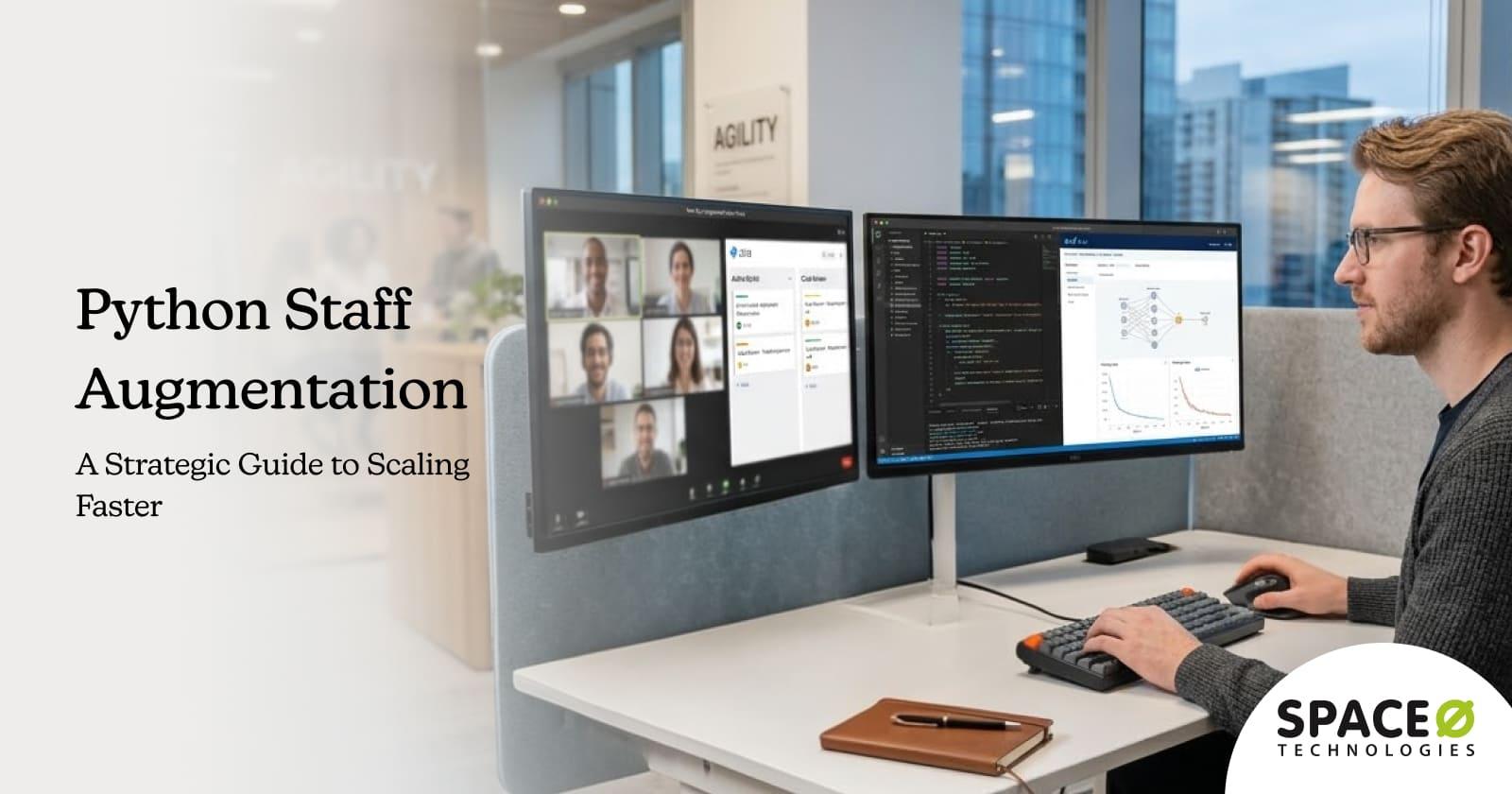
Your AI roadmap is ready, but your team is not. Engineering leaders across industries face the same bottleneck: they need Python developers with AI and ML expertise, and they need them now. Traditional hiring takes months, top candidates field multiple offers, and niche skills like MLOps and LLM integration are nearly impossible to recruit for through conventional channels.
Python staff augmentation solves this problem by embedding pre-vetted, production-ready developers directly into your existing team. According to Valuates Reports, the global IT staff augmentation service market was valued at $1.03 billion in 2024 and is projected to reach $1.46 billion by 2031, growing at a CAGR of 5.1% as more companies shift toward flexible, on-demand talent models.
Partnering with an experienced Python development services provider simplifies this process. Instead of months spent on job postings, interviews, and onboarding, augmentation lets you bring in production-ready Python developers within one to two weeks. Whether the need is a senior ML engineer for a single sprint or a dedicated team for a long-term AI product, this model gives you the speed and control to move at the pace your roadmap demands.
This guide covers what Python staff augmentation is, when to choose it over hiring or outsourcing, what AI skills to prioritize, and how to integrate augmented developers into your workflow. Let’s start by understanding how this model works.
What Is Python Staff Augmentation and How Does It Work?
Python staff augmentation is a flexible hiring model where you bring in external Python developers who work as an extension of your in-house team. Unlike traditional outsourcing, where a vendor manages the entire project independently, augmented developers operate under your direct supervision, follow your processes, and contribute to your codebase.
In the context of AI-driven development, this model is particularly valuable. Building AI products requires specialized skills in machine learning, natural language processing (NLP), computer vision, and data engineering. These skills are difficult to find through traditional hiring channels, and the onboarding timeline for full-time hires often stretches to three to six months.
Here is how a typical Python staff augmentation engagement works:
- Discovery call to define your technical requirements, project scope, and team gaps
- Skill matching where the augmentation partner identifies pre-vetted Python developers with the right expertise
- Onboarding is where selected developers gain access to your tools, repositories, and documentation
- Agile integration where augmented developers join your sprints, attend standups, and participate in code reviews
Whether you need to hire Python developers for a short sprint or embed a dedicated team for long-term AI development, staff augmentation gives you the speed and flexibility that traditional hiring cannot match.
Types of Python staff augmentation models
Choosing the right augmentation model depends on your project complexity, internal management capacity, and timeline. Here is how the most common models compare.
| Model | Duration | How It Works | Best For |
|---|---|---|---|
| Short-term augmentation | 1–3 months | Bring in developers for a specific deliverable or sprint cycle | AI feature delivery, delivery crunches, and covering unexpected attrition |
| Long-term dedicated resources | 6+ months | Embed developers as ongoing members of your team | Scaling AI platforms, building MLOps infrastructure, and product development |
| Managed augmentation | Flexible | Augmentation partner provides a team lead or delivery manager alongside developers | Teams with limited internal management bandwidth |
| Unmanaged augmentation | Flexible | Individual developers report directly to your engineering manager | Experienced teams that prefer full control over day-to-day management |
Most companies start with short-term augmentation to test the model and then transition to long-term dedicated resources once they see results. With this foundation in place, let’s explore the specific benefits Python staff augmentation delivers for AI-driven projects.
Benefits of Python Staff Augmentation for AI-Driven Projects
Python staff augmentation offers distinct advantages for businesses investing in AI development. With 57.9% of developers worldwide now using Python and demand for Python developers growing 32% year over year, companies that can quickly access this talent pool gain a measurable competitive advantage. Here are the key benefits.
Faster time-to-market for AI features
Ship machine learning models, NLP chatbots, and predictive analytics capabilities faster by adding experienced Python AI developers without enduring months-long hiring cycles that delay critical project milestones.
Access to niche AI and ML talent
Tap into pre-vetted specialists in machine learning development services, LLM integration, computer vision, and MLOps who are difficult to find through traditional recruitment channels or job boards.
Cost-efficient scaling without long-term overhead
Scale your Python development team up or down based on project phases, paying only for the capacity you need instead of bearing full-time salaries, benefits, and infrastructure costs year-round.
Reduced onboarding and ramp-up time
Augmented developers come with production-ready skills and proven project experience. They integrate into your Agile workflows and start contributing within days, not the three to six months required for full-time hires.
Full control over your codebase and IP
Unlike outsourcing, you retain complete ownership of your code, development process, and intellectual property. Augmented developers work within your repositories and follow your engineering standards directly.
Risk mitigation through flexible engagement
Respond to shifting project requirements, sudden team attrition, or new AI initiatives without long-term hiring commitments. Scale resources as your needs change, with replacement guarantees from your augmentation partner.
These benefits make Python staff augmentation especially effective for teams building AI products where timelines are tight and skill requirements are specialized. But how does this model compare to full-time hiring and outsourcing? Let’s break down the key differences.
Ready to Add AI-Skilled Python Developers to Your Development Team Today?
Our pre-vetted Python developers specialize in AI, ML, and backend development. Get matched with the right talent within days, not months.
When Should You Choose Python Staff Augmentation Over Hiring or Outsourcing?
Choosing the right engagement model can determine the success of your AI project. Understanding the differences between staff augmentation, full-time hiring, and Python development outsourcing helps you make a decision that aligns with your timeline, budget, and level of control.
Python staff augmentation vs. full-time hiring
Hiring full-time Python developers gives you long-term stability but comes with significant overhead and delays. Staff augmentation bridges that gap by providing skilled developers quickly without the permanent commitment. The following table highlights the key differences between these two models.
| Factor | Staff Augmentation | Full-Time Hiring |
|---|---|---|
| Time to onboard | 1–2 weeks | 2–4 months |
| Cost structure | Hourly or monthly rate | Salary + benefits + overhead |
| Flexibility | Scale up or down anytime | Fixed headcount |
| Commitment | Project-based or renewable | Long-term employment |
| Ramp-up effort | Minimal (pre-vetted talent) | Extensive (interviews, training) |
| Best for | Urgent AI skill gaps, sprint needs | Core team, long-term product ownership |
Staff augmentation is the stronger choice when you face urgent delivery deadlines, need niche AI or ML skills for a defined period, or want to avoid the overhead of permanent hires during uncertain project phases.
Python staff augmentation vs. outsourcing
Outsourcing hands over project delivery to an external team, while augmentation integrates developers into your existing workflow. For companies that want to maintain engineering standards and direct control, augmentation offers a better fit. This table outlines the core differences.
| Factor | Staff Augmentation | Outsourcing |
|---|---|---|
| Control | You manage the team directly | Vendor manages delivery |
| Integration | Developers join your Agile squads | Separate team with own processes |
| IP ownership | Full ownership from day one | Defined by contract terms |
| Communication | Direct (Slack, Jira, standups) | Through the project manager |
| Flexibility | Adjust team size per sprint | Scope-locked contracts |
| Best for | Team extension, Agile environments | Well-defined projects, fixed scope |
If your priority is end-to-end managed delivery with a fixed scope, outsourcing may work. But if you need developers who blend into your workflow and follow your engineering standards, staff augmentation is the right choice. For teams looking to reduce costs while accessing a global talent pool, you can also hire offshore Python developers who work as dedicated members of your in-house team.
Decision framework: which model fits your scenario?
Use this framework to match your situation to the right engagement model:
- Choose staff augmentation when you need to scale quickly for an AI sprint, fill a niche skill gap (like MLOps or NLP), or maintain direct control over code quality and processes
- Choose full-time hiring when you need a permanent team member for long-term product ownership and can afford a 2–4 month hiring timeline
- Choose outsourcing when you have a well-defined project scope, want end-to-end delivery management, and prefer fixed-cost contracts
The decision often comes down to how much control you need and how quickly you need to move. Now that you know which model fits your needs, let’s look at the specific AI and Python skills your augmented developers should bring to the table.
Stop Losing Time to Lengthy Hiring Processes for Your Python AI Projects
SpaceO AI provides dedicated Python developers with AI and ML expertise. They integrate into your team within days. Start scaling your project today.
Key AI and Python Skills to Look for in Augmented Developers
Python is the most widely used language for AI and machine learning development, and its dominance continues to grow. When augmenting your team for AI projects, hiring developers with the right combination of backend, AI, and cloud skills is critical. Here are the specific skill sets to prioritize.
Core Python backend skills
Your augmented developers should have strong proficiency in at least one major Python web framework. Django works best for complex applications with built-in ORM, authentication, and admin panels. Flask is ideal for lightweight, modular projects. FastAPI delivers high-performance async APIs suitable for AI-serving workloads.
Beyond framework expertise, look for experience in REST and GraphQL API development, database design with PostgreSQL or MySQL, async programming with asyncio, and deployment using Docker and Kubernetes. These skills form the foundation for building the backend systems that power AI features.
AI and machine learning skills
For AI-driven projects, your augmented Python developers should bring hands-on experience with production ML workflows. Key capabilities include:
- Model development using TensorFlow, PyTorch, or scikit-learn
- NLP and LLM integration, including retrieval-augmented generation (RAG), embeddings, and vector search
- Computer vision for image recognition, object detection, and quality inspection
- MLOps and model deployment using MLflow, Kubeflow, or cloud-native ML services
- Data pipeline development for ETL/ELT workflows that prepare training data at scale
The ability to move models from notebooks to production is what separates a strong AI developer from a capable data scientist. Prioritize candidates who have deployed Python AI use cases into real-world business environments.
Data engineering and cloud skills
AI projects generate and consume large volumes of data. Your augmented developers should understand data engineering fundamentals, including building data pipelines, managing data lakes, and working with streaming data.
Cloud platform expertise is equally important. Look for experience with AWS (SageMaker, Lambda), Google Cloud (Vertex AI), or Microsoft Azure (Azure ML). Proficiency in containerization with Docker and orchestration with Kubernetes ensures smooth deployments across environments.
When you hire augmented developers with this combination of backend, AI, and cloud skills, you position your team to deliver AI features that perform reliably in production. To understand the practical impact of these skills, let’s look at how businesses are using augmented Python teams to build AI-powered APIs right now.
Real-World Use Cases of AI-Powered Python APIs
One of the strongest reasons to invest in Python staff augmentation is what augmented developers can actually build. Developing AI-powered Python APIs is becoming the backbone of modern products, and Python is the language behind most of them. Here are five high-impact use cases where augmented Python teams deliver real business value.
Intelligent document processing
Companies in insurance, legal, and financial services process thousands of documents daily. Augmented Python developers build APIs that combine OCR engines with NLP models to extract structured data from invoices, contracts, and claims. A typical pipeline uses libraries like spaCy, Tesseract, and Hugging Face Transformers to classify documents, extract key fields, and validate data automatically. These APIs replace hours of manual data entry with automated extraction that runs in seconds.
Real-time fraud detection
Fintech and eCommerce platforms need fraud scoring at the point of transaction. Python developers build FastAPI-based inference endpoints that serve trained ML models (XGBoost, LightGBM, or deep learning classifiers) with low latency. These APIs analyze transaction patterns, device fingerprints, and behavioral signals in real time, flagging suspicious activity before payment is processed. The result is fewer chargebacks, lower fraud losses, and a faster checkout experience for legitimate users.
AI-powered recommendation engines
Recommendation systems drive revenue for eCommerce, media, and SaaS platforms. Augmented Python developers build APIs that serve personalized recommendations using collaborative filtering, content-based models, or hybrid approaches. These APIs integrate with product catalogs and user behavior data to deliver real-time suggestions through REST endpoints. Stronger recommendations lead to higher engagement, better conversion rates, and increased average order values.
Predictive maintenance for IoT platforms
Manufacturing and logistics companies use sensor data to predict equipment failures before they happen. Python developers build APIs that ingest time-series data from IoT devices, run it through trained anomaly detection models (using libraries like Prophet, statsmodels, or PyTorch), and return maintenance alerts with confidence scores. This shifts teams from reactive repairs to proactive maintenance, reducing unplanned downtime and extending equipment lifespan.
Conversational AI and LLM-powered assistants
Businesses across industries are building custom AI assistants using large language models. Augmented Python developers create APIs that orchestrate LLM calls with retrieval-augmented generation (RAG), pulling context from internal knowledge bases, vector databases (Pinecone, Weaviate, or pgvector), and structured data sources. These APIs power customer support chatbots, internal knowledge assistants, and domain-specific copilots that handle routine queries so human agents can focus on complex issues.
Each of these use cases requires Python developers who understand both backend API architecture and AI/ML model serving. This is precisely the skill profile that staff augmentation delivers faster than any other hiring model. With this context in mind, let’s walk through the practical steps for integrating augmented developers into your team.
How to Successfully Integrate Augmented Python Developers into Your AI Team
Adding skilled developers to your team is only half the equation. Successful Python staff augmentation depends on a structured integration process that gets augmented developers productive quickly while maintaining your engineering standards.
Step 1: Define skill requirements and project scope
Start by documenting the specific technical skills, domain expertise, and project deliverables you need. A clear scope prevents mismatches and reduces wasted ramp-up time.
Action items
- List required Python frameworks (Django, FastAPI, Flask) and AI/ML libraries
- Define project milestones and expected deliverables
- Specify experience level (mid-level, senior, lead) and team size needed
- Identify domain knowledge requirements (fintech, healthcare, SaaS)
Step 2: Choose the right augmentation partner
Not all augmentation providers offer the same depth of talent screening or AI specialization. A partner that also offers Python consulting services can help you audit your existing architecture and define the right team composition before onboarding.
Action items
- Evaluate the partner’s technical screening and vetting process
- Review their portfolio of AI and ML projects delivered to production
- Ask about trial periods, replacement guarantees, and SLAs
- Confirm experience with your tech stack and industry vertical
Step 3: Structure onboarding and access provisioning
A well-planned onboarding process reduces the time from contract signing to productive contribution. Treat augmented developers like new in-house team members during this phase.
Action items
- Execute NDAs and set up role-based access controls for repositories, cloud environments, and tools
- Provide architecture documentation, coding standards, and a codebase walkthrough
- Assign a buddy or mentor from your in-house team for the first two weeks
- Set up the development environment, CI/CD access, and communication channels
Step 4: Integrate into Agile workflows
Augmented developers should participate in your existing Agile ceremonies from day one. This builds alignment and accountability across the entire team.
Action items
- Include them in daily standups, sprint planning, and retrospectives
- Assign tasks through your existing project management tools (Jira, Linear, Asana)
- Require participation in code reviews, both submitting and reviewing
- Establish a time zone overlap of at least four hours for real-time collaboration
Step 5: Establish KPIs and reporting cadence.
Track performance through measurable indicators to ensure augmented developers deliver consistent value throughout the engagement.
Action items
- Monitor delivery velocity, sprint completion rates, and code quality metrics
- Schedule weekly or bi-weekly check-ins with the augmentation partner
- Use pull request metrics (review turnaround, merge rate) as quality indicators
- Set up a feedback loop for continuous improvement and expectation alignment
A structured integration process is what separates a productive augmentation engagement from a frustrating one. However, even with the right process, certain challenges can arise. Let’s look at the most common ones and how to overcome them.
Scale Your Python AI Team with Developers Who Integrate from Day One
SpaceO’s augmented Python developers join your Agile squads, follow your standards, and deliver results. Get a dedicated team matched to your needs.
Challenges in Python Staff Augmentation and How to Overcome Them
Even with a strong integration plan, Python staff augmentation comes with challenges that require proactive management. Here are the most common obstacles and practical solutions to address them.
Communication gaps across time zones
When augmented developers work from a different region, delays in communication can slow down sprint progress, create misunderstandings, and lead to rework if requirements are not clearly documented.
Solution
- Establish a minimum of four hours of daily overlap for real-time collaboration
- Use async communication tools like Slack, Loom, and Notion for handoffs and updates
- Define a clear escalation path for blockers and critical issues
- Document all decisions and requirements in a shared knowledge base
Maintaining code quality and consistency
Without shared standards, augmented developers may write code that does not align with your existing patterns, increasing technical debt and review overhead.
Solution
- Enforce shared coding standards, linting rules, and formatting configurations from day one
- Require mandatory code reviews with at least one in-house reviewer per pull request
- Set up automated CI/CD gates with unit tests, integration tests, and static analysis
- Conduct periodic code quality audits to catch drift early
Security and IP protection risks
Granting external developers access to your codebase and infrastructure introduces security considerations that must be managed carefully from the start.
Solution
- Execute NDAs and security agreements before granting any access
- Implement role-based access controls, limiting developers to the necessary repositories and environments
- Use VPN, SSO, and multi-factor authentication for all access points
- Conduct regular access reviews and revoke permissions immediately when engagements end
Cultural and process misalignment
Augmented developers may be accustomed to different development methodologies, communication styles, or team dynamics that create friction with your internal culture.
Solution
- Invest in team-building activities and knowledge-sharing sessions during the first week
- Assign a dedicated integration lead from your in-house team
- Document your development processes, sprint rituals, and communication expectations clearly
- Include augmented developers in team retrospectives to address friction early
Skill verification and performance concerns
There is always a risk that an augmented developer’s skills do not match expectations, leading to underperformance and missed deadlines.
Solution
- Demand live technical assessments and coding challenges before finalizing contracts
- Negotiate a trial period of two to four weeks to evaluate performance in your environment
- Review the developer’s past AI and ML project portfolio for relevant production experience
- Set clear KPIs from the start and ensure the augmentation partner offers a replacement guarantee
These challenges are manageable with the right preparation and a reliable augmentation partner. Now let’s address one of the most common questions engineering leaders ask: how much does Python staff augmentation cost?
How Much Does Python Staff Augmentation Cost?
The cost of Python staff augmentation typically ranges from $15 to $150 per hour, depending on the developer’s experience level, geographic location, and AI specialization. Projects requiring niche expertise in machine learning, LLM integration, or MLOps command a premium over standard backend development.
The following table provides a general cost breakdown by region and seniority level.
| Developer Level | North America | Eastern Europe | India and Asia-Pacific |
|---|---|---|---|
| Junior Python Developer | $40–$60/hr | $25–$40/hr | $15–$25/hr |
| Mid-Level Python Developer | $60–$90/hr | $35–$55/hr | $22–$40/hr |
| Senior Python/AI Developer | $90–$150/hr | $50–$80/hr | $35–$60/hr |
These rates are indicative and vary based on the augmentation partner, engagement duration, and specific skill requirements. Developers with AI and ML specialization typically cost 20–30% more than standard Python backend developers due to the scarcity of production-level AI talent.
Several factors influence the final cost of your engagement:
- AI and ML specialization premium: Developers experienced in TensorFlow, PyTorch, NLP, or MLOps command higher rates than general Python developers
- Engagement duration: Longer engagements (6+ months) often come with discounted rates compared to short-term contracts
- Team size: Augmenting with multiple developers may qualify you for volume-based pricing
- Managed vs. unmanaged model: Managed augmentation (with a delivery lead) costs more but reduces your internal management overhead
The shift toward remote work has pushed companies toward global talent pools and flexible augmentation models. This trend has made it possible to access top-tier Python AI talent at competitive rates, regardless of your company’s location.
With a clear understanding of costs and the factors that influence them, let’s address the most frequently asked questions about Python staff augmentation.
Get a Transparent, Custom Quote for Your Python Staff Augmentation Needs Today
Tell us your project requirements, team size, and timeline. We will deliver a detailed, no-obligation cost estimate within 24 hours of inquiry.
Partner with SpaceO AI for Your Python Staff Augmentation Needs
Python staff augmentation gives businesses the fastest path to scaling AI-capable development teams. From accessing niche ML talent and reducing hiring timelines to maintaining full control over your codebase, this model offers flexibility, speed, and cost efficiency for AI-driven projects.
SpaceO AI is a trusted software development partner with over 15 years of deep industry experience delivering solutions for businesses worldwide. We serve startups, mid-market companies, and enterprises building innovative AI-powered technology solutions that drive measurable business results.
Our team of 80+ skilled developers specializes in Python, AI, and machine learning development for global clients. We have helped businesses build production-ready ML models, scalable APIs, and AI-powered applications, delivering proven results across healthcare, fintech, retail, and SaaS industries.
Ready to scale your Python team for your next AI project? Contact us today for a free consultation. Our experts will assess your requirements, recommend the right team composition, and provide a transparent quote so you can move forward confidently.
Frequently Asked Questions on Python Staff Augmentation
How quickly can augmented Python developers start working on my project?
Most augmentation partners can match and onboard pre-vetted Python developers within one to two weeks. This is significantly faster than full-time hiring, which typically takes two to four months when you factor in job postings, interviews, offer negotiations, and notice periods.
What AI and ML skills should I look for when augmenting my Python team?
Prioritize developers with hands-on experience in TensorFlow, PyTorch, or scikit-learn for model development. For AI-driven projects, look for expertise in NLP, LLM integration (RAG, embeddings, vector search), MLOps, computer vision, and data pipeline development. Production deployment experience is critical.
Is Python staff augmentation suitable for building AI-powered applications?
Yes. Python is the dominant language for AI and ML development, used by 57.9% of developers worldwide. Staff augmentation gives you access to specialized AI talent, including ML engineers, data scientists, and MLOps specialists, without the delays and costs of full-time hiring.
How do you ensure code quality with augmented Python developers?
Enforce shared coding standards, mandatory code reviews, and automated CI/CD pipelines with unit and integration tests. Require augmented developers to follow your existing engineering practices and conduct regular code quality audits to maintain consistency across the team.
What is the typical cost of Python staff augmentation?
Costs range from $15 to $150 per hour, depending on developer seniority, geographic location, and AI specialization. Junior developers in Asia-Pacific start around $15–$25 per hour, while senior AI/ML specialists in North America can cost $90–$150 per hour.
Can I scale my augmented Python team up or down mid-project?
Yes. Flexibility is one of the primary advantages of staff augmentation. You can add developers during high-intensity sprint phases and scale down during maintenance periods. Most augmentation partners offer flexible contracts that allow team size adjustments with short notice.
How do you handle IP protection and data security with augmented staff?
Reputable augmentation partners require NDAs and security agreements before any engagement begins. Implement role-based access controls, VPN requirements, multi-factor authentication, and regular access audits. Ensure your contract explicitly defines IP ownership, data handling policies, and confidentiality terms.


Need AI-Skilled Python Developers Fast?
What to read next