POC vs Prototype vs MVP: Which Should You Build First?

 Last Updated: December, 1 2025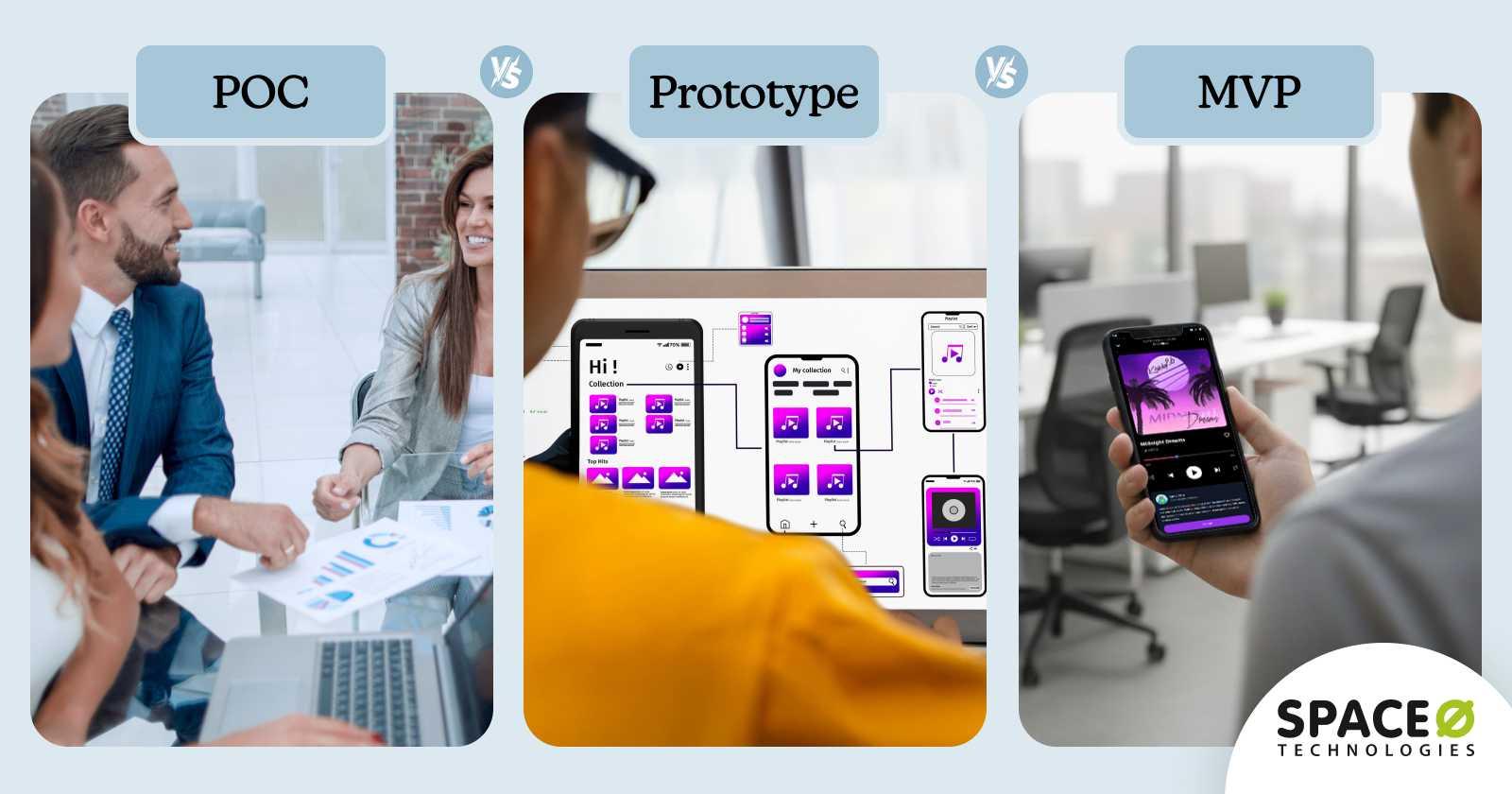
Bringing a new product idea to life is exciting, but it comes with risks, costs, and countless decisions. One of the biggest challenges is figuring out how to validate your idea effectively before investing heavily in development.
This is crucial because, according to DesignRush, 34% of startups fail due to a lack of product-market fit. This is where POC (Proof of Concept), Prototype, and MVP (Minimum Viable Product) come into play. While they may sound similar, each serves a distinct purpose in the product development journey.
Choosing the right approach at the right time can save resources, reduce risk, and set your product up for success. In this guide, we’ll break down the differences between POC, Prototype, and MVP, explore their benefits, and help you decide which path is best for your next product.
What Is a Proof of Concept (POC)?
A Proof of Concept (POC) is the first step in validating an idea. Its primary goal is to determine whether the core concept is technically feasible. At this stage, user interface, design, or full functionality isn’t the focus; you only need to answer: “Can this AI solution be built and work as intended?”
Real-world scenario:
| Imagine you’re an AI startup aiming to develop a tool that predicts customer churn for e-commerce companies. Before investing in full-scale development, your team creates a POC to test whether existing data and AI models can generate accurate predictions. The POC proves the concept is feasible, without wasting time on a complete application. |
When to build a POC
- You’re exploring an AI solution with uncertain technical feasibility.
- You need to validate data quality, model performance, or algorithm effectiveness.
- You want to convince stakeholders or investors that your AI idea is technically viable.
In the context of POC vs prototype vs MVP, the POC comes first. It’s about feasibility, not usability or market demand. It helps you avoid costly mistakes by proving the core concept works before investing in design or development.
Once feasibility is confirmed, the next step is creating a prototype, which focuses on how users will interact with your product.
What Is a Prototype?
A prototype is a visual or interactive representation of your product. Unlike a POC, a prototype demonstrates how users will interact with your solution, even if it isn’t fully functional. It’s designed to answer: “What will the product feel like to users?”
Real-world scenario:
| After your POC confirms that your AI churn prediction model works, you create a prototype to show the user interface for your dashboard. Users can see how predictions are displayed, how they navigate reports, and how notifications are triggered, even if the backend isn’t fully implemented. Feedback from the prototype helps refine the workflow and user experience. |
When to build a prototype
- You want to validate usability and design decisions.
- Early user testing is required before investing in full development.
- Stakeholders need to visualize the product before committing resources.
Here, in proof of concept vs prototype, the prototype builds on the POC. The POC asks, “Can we do it?”, and the prototype asks, “How should we do it?” It turns abstract ideas into tangible experiences, letting you gather feedback on usability, design, and user interactions before full development begins.
For AI products, working with an AI consulting company during prototype design ensures your interface aligns with how users will actually interact with your AI models.
What Is a Minimum Viable Product (MVP)?
A Minimum Viable Product (MVP) is the first functional version of your product that real users can interact with, and ideally, pay for. The goal is to answer: “Will customers actually buy or use this?”
Real-world scenario:
| Your AI churn prediction tool has a working backend and refined interface based on the prototype. The MVP allows a select group of e-commerce companies to upload their data, receive churn insights, and test notifications. You can now gather real-world feedback, measure adoption, and validate whether the product solves a pressing problem. |
When to build an MVP
- You’ve validated technical feasibility (POC) and user experience (prototype).
- You want to test whether real customers will actually use or pay for your product.
- You need actionable feedback to prioritize features and guide full-scale product development.
In POC vs prototype vs MVP, the distinction is clear: the POC tests feasibility, the prototype tests usability and user interaction, and the MVP tests market viability. Following this sequence ensures a structured approach to MVP product development, allowing you to validate your idea step by step, gather actionable feedback, and make informed decisions before investing in full-scale development.
Confused About Which Stage Your AI Product Needs First?
At Space-O AI, we have validated 500+ AI projects. We identify your biggest risk and build the stage that saves you money.
POC vs Prototype vs MVP: Key Differences
You now understand what each approach does. But how do they actually stack up against each other? Here’s the complete comparison so you can see exactly what separates proof of concept vs prototype, vs MVP.
| Aspect | POC (Proof of Concept) | Prototype | MVP |
| Primary Question | Can we build this technically? | How will users interact with this? | Will customers actually pay for this? |
| Answers | Technical feasibility | Design and UX validation | Market demand and product-market fit |
| Internal or External | Internal only | Can be shown to stakeholders | Released to real users |
| Audience | Development team | Investors, stakeholders, and limited users | Real customers in the market |
| Scope | Single technical assumption | Key user flows and design patterns | Core features that solve the main problem |
| Code Quality | Low (throwaway code) | Medium (reusable components) | High (production-ready) |
| Functionality | Minimal—proves concept only | Limited—demonstrates design | Full—working product |
| User Testing | None | Limited (5-10 users) | Extensive (50+ users) |
| Cost (Non-AI) | $5–20K | $20–50K | $50-200K+ |
| Cost (AI development) | $15–50K | $25–70K | $70,000-$150,000+ |
| Timeline | 2–4 weeks | 6–8 weeks | 10–16 weeks |
| Success Metric | Technical feasibility confirmed | User satisfaction > 75% | Activation > 40%, retention > 50% |
How to Choose the Right Approach for Your Business
You know what each approach does. You understand the costs. Now comes the critical decision: which one should you actually build first?
This isn’t one-size-fits-all. Whether you’re a startup validating your first idea or an enterprise adding new capabilities, your answer depends on three things: technical risk, design clarity, and market knowledge. Let’s work through this.
Step 1: Assess Your Technical Risk
Ask yourself: are we uncertain about whether this is technically feasible? Your answer determines whether you can move fast or need to validate first.
High technical risk = Start with POC
You have a high technical risk if:
- You’re using technology your team hasn’t worked with before
- You’re building AI software development, and the model approach is unproven
- You’re integrating complex systems that have never been integrated this way
- You’re unsure about scalability or performance at the volumes you need
- You’re uncertain about third-party APIs or data access
Example: You want to build an AI tool that understands medical images. Your team has never worked with computer vision models, so the technical risk is high. In this case, start with a POC to test whether your AI model can accurately analyze sample images before investing in a full-scale solution.
Low technical risk = Skip to prototype or MVP
You have low technical risk if:
- You’re using proven technology your team knows well
- The technical architecture is straightforward
- You’ve built similar products before
- You’re confident the technology will work
Example: You’re building a booking system using standard web technologies. Your team has built dozens of these before, so the technical risk is low. In this case, you can skip the POC and move straight to prototyping or MVP development to validate usability and market fit.
Step 2: Assess Your Design Clarity
Ask yourself: Do we know exactly how users will interact with this product? Your answer determines whether you can design once or need to iterate with real feedback first.
Unclear design = You need a prototype
Your design is unclear if:
- Users will interact with complex workflows
- You’re unsure about information architecture
- Stakeholders disagree on the interface
- You’re building something novel that users haven’t seen before
- You want investor confidence before committing development budget
Example: You’re building a project management tool for technical teams. Is the main view a timeline, a kanban board, or a table? You’re not sure. Design is unclear. Build a prototype.
Clear design = Skip prototype, go straight to MVP
Your design is clear if:
- You have existing competitors you can reference
- Your interface follows familiar patterns
- Stakeholders are aligned on how it should work
- You’ve already sketched and discussed extensively
Example: You’re building a to-do list app. Everyone knows how these work. Design is clear. Skip the prototype.
Step 3: Assess Your Market Knowledge
Ask yourself: do we know that customers or users actually want this? Your answer determines whether you need real market validation or can move straight to building.
Uncertain market = You must validate with MVP
Your market is uncertain if:
- You’re entering a new market segment
- You’re unsure if customers will pay
- You’re solving a problem you’re not 100% sure customers have
- You haven’t validated with real potential users
Example: You want to build AI-powered expense reporting for accountants. You think accountants need this. But have you talked to 20 accountants? If not, your market is uncertain, and you must plan for MVP.
Clear market = You can move faster
Your market is clear if:
- Customers are actively asking for this solution
- You’ve pre-sold to early customers
- The problem is obvious and widespread
- You have significant inbound interest
Example: Your consulting firm keeps getting asked to help clients with reporting. You’ve identified a clear need. The market is clear. You can move faster.
The path you choose depends on three things: your technical risk, your design clarity, and your market knowledge. High risk in any of these areas means you need that validation stage first. Low risk across all three means you can move straight to MVP. Follow your biggest risk, not a template.
And if you’re planning for AI software development, remember: technical risk is almost always higher, which means that POC isn’t optional; it’s where you discover if your approach actually works before committing serious resources to an MVP.
Ready to Build Your AI Product the Right Way?
Our AI experts ensure your product is technically feasible, user-ready, and market-validated before scaling.
Validate Your Product the Right Way With Space-O AI
Understanding POC vs prototype vs MVP determines whether you’ll discover problems early or after major investment. Choosing the right validation sequence for your business prevents costly mistakes, accelerates market launch, and ensures your product solves real problems. The path you choose today shapes your product’s success tomorrow.
Building successful AI products requires more than understanding the right sequence. You need a partner who can execute each stage properly: POC that truly validate feasibility, prototypes that reveal user expectations, and MVPs that achieve real market adoption. That’s where Space-O AI comes in.
With over 15 years of experience as a top AI software development company and more than 500 successful projects delivered, we combine technical expertise with business insight to create solutions that deliver measurable results while minimizing costly mistakes.
We help businesses validate AI concepts with POCs, design intuitive AI interfaces through prototypes, and launch market-ready solutions via MVPs. Connect with our experts today for a free consultation and kickstart your AI product development journey.
Frequently Asked Questions About POC vs. Prototype vs. MVP
Do I really need all three stages?
No. The stages you need depend on your biggest risks. If you have high technical uncertainty, start with POC. If the design is unclear, add a prototype. If market demand is uncertain, you need an MVP. Some projects need all three, while others need just one or two. The key is eliminating unnecessary stages while validating the risks that could sink your project.
Can I skip the prototype stage?
Only if your design is completely locked in and all stakeholders strongly agree on the approach. If there’s any uncertainty about how users will interact with your product or how it should be organized, skipping the prototype is risky because you’ll discover design problems after launch, when fixing them becomes much more expensive and time-consuming.
How do I know if my prototype is successful?
Test it with 8-10 potential users or stakeholders and watch whether they can complete the main workflow without constant guidance. Ask if they understand how the product works and whether they’d actually use it. If the majority successfully navigate your prototype and provide positive feedback, it’s working. If they’re confused or suggest major redesigns, that feedback tells you exactly what to iterate on.
What’s the main difference between POC and MVP?
When comparing proof of concept vs MVP, the main difference lies in their purpose and focus. A POC answers whether your technical approach is feasible, while an MVP determines whether customers actually want what you’re building.
A POC is used for internal validation of technical assumptions with minimal code, whereas an MVP is a functional product released to real users to test market demand. Both are essential, but they serve completely different roles at different stages of product development.


Validate Your AI Product Risk-Free
What to read next