- What Is AI Pediatric Patient Portal Development?
- Benefits of Developing an AI-Driven Pediatric Patient Portal
- Features of an AI-Driven Pediatric Patient Portal
- AI-Driven Pediatric Patient Portal Development Process: Step by Step
- Step 1: Requirements gathering and AI readiness assessment
- Step 2: AI-first UX/UI design for families
- Step 3: Core portal development with AI infrastructure
- Step 4: EHR integration and AI data pipelines
- Step 5: HIPAA compliance and security implementation
- Step 6: AI model development and deployment
- Step 7: Testing, validation, and launch
- AI-Driven Pediatric Patient Portal Development Cost: What to Expect
- Trends Shaping AI-Driven Pediatric Patient Portal Development
- Challenges in AI-Driven Pediatric Patient Portal Development and How to Overcome Them
- Challenge 1: Complex proxy access and AI personalization
- Challenge 2: Data quality for AI model performance
- Challenge 3: AI safety in pediatric clinical context
- Challenge 4: Adolescent privacy in AI systems
- Challenge 5: Parent adoption of AI features
- Challenge 6: Integration of AI with pediatric EHR systems
- Build Your AI-Driven Pediatric Patient Portal with Space-O AI
- Frequently Asked Questions on Pediatric Portal Development
- 1. What is AI-driven pediatric patient portal development, and how does it differ from standard portals?
- 2. How does AI improve pediatric patient portal experiences for families?
- 3. How do we handle proxy access for parents and caregivers in an AI-powered portal?
- 4. What happens when a child reaches adolescence – how does AI adapt?
- 5. Is HIPAA compliance different for AI-powered pediatric patient portals?
Pediatric Patient Portal Development: A Complete Guide

 Last Updated: March, 10 2026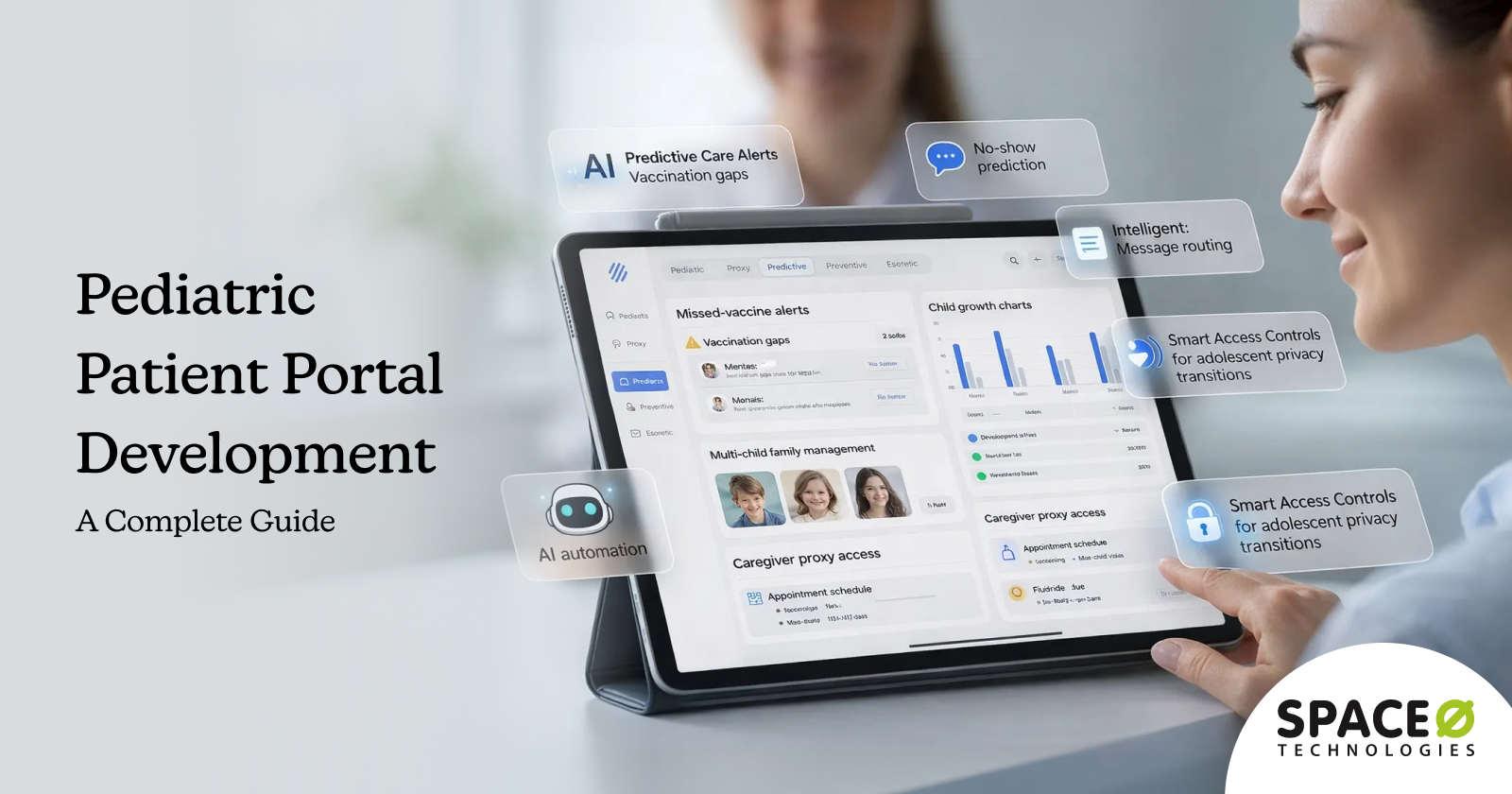
Pediatric healthcare is rapidly shifting toward digital-first care delivery models. According to Coherent Market Insights, the global pediatric telehealth market is estimated at $34.42 billion in 2025 and is expected to reach $126.98 billion by 2032, highlighting the accelerating demand for technology-driven pediatric care solutions.
As telehealth expands, healthcare providers must offer secure, intelligent digital platforms that support both children and their caregivers.
AI-enabled pediatric patient portals are becoming a critical component of this transformation. Unlike general patient portals, pediatric solutions must accommodate guardian access controls, vaccination tracking, developmental milestones, secure communication, and coordinated care across multiple providers.
By integrating AI capabilities such as predictive insights, automated reminders, conversational assistance, and personalized health guidance, pediatric portals evolve from basic access tools into proactive care management platforms.
In this blog, we explore how to develop AI pediatric patient portals. Get insights from our 15+ years of experience as a leading AI patient portal development company on the key features, benefits, development process, architecture considerations, and cost factors you should evaluate when building intelligent digital pediatric care solutions.
What Is AI Pediatric Patient Portal Development?
AI pediatric patient portal development refers to the process of designing and building intelligent digital platforms specifically tailored for pediatric healthcare, enhanced with artificial intelligence capabilities. These portals enable parents and guardians to securely access their child’s medical records, manage appointments, track vaccinations, communicate with providers, and monitor developmental milestones, while leveraging AI to improve personalization, automation, and care coordination.
Unlike standard patient portals, pediatric portals must support multi-user access models where caregivers, guardians, and sometimes adolescents have different permission levels. AI enhances this framework by automating reminders for immunizations, generating personalized health guidance based on age and medical history, supporting conversational assistance for common queries, and providing predictive insights to flag potential care gaps.
AI pediatric patient portal development also involves integrating the portal with EHR systems, telehealth platforms, lab systems, and billing solutions while maintaining strict compliance with healthcare data privacy regulations. Machine learning models, natural language processing, and intelligent automation are incorporated to streamline workflows, reduce administrative burden, and enhance caregiver engagement.
What makes AI-driven pediatric portals different
- Predictive care intelligence: Machine learning models analyze patient data to identify immunization gaps, predict no-shows, and flag children who need proactive outreach before problems develop
- Conversational AI for family support: AI chatbots provide 24/7 guidance on common pediatric concerns like fever management, feeding questions, and developmental milestones, reducing after-hours calls
- Personalized content generation: Generative AI creates age-appropriate explanations of diagnoses, treatment plans, and medication instructions tailored to each child’s situation and the family’s health literacy level
- Intelligent message routing: NLP analyzes parent messages to determine urgency and automatically routes to appropriate care team members
- Smart proxy access management: AI-enhanced access controls adapt to complex family structures, custody arrangements, and adolescent privacy transitions
Understanding these benefits helps clarify why pediatric practices increasingly prioritize AI-powered portal solutions over conventional alternatives.
Benefits of Developing an AI-Driven Pediatric Patient Portal
AI-powered pediatric patient portals deliver measurable value for both families and healthcare practices. When designed with intelligent automation and pediatric-specific workflows, these platforms transform how care is coordinated, communicated, and delivered.
1. For parents and caregivers
1.1 AI-powered health management across all children
Parents can view immunization records, growth charts, upcoming appointments, and medication lists for all their children in one unified dashboard, with AI highlighting items needing attention and predicting upcoming care needs.
1.2 24/7 intelligent support without waiting
AI chatbots provide instant guidance on common pediatric concerns anytime, while machine learning triages urgent issues for immediate clinical attention, reducing anxiety and improving care access.
1.3 Personalized communication with the care team
NLP-powered message routing ensures parent questions reach the right team member quickly, while AI assists with drafting responses and generating plain-language explanations of clinical information.
1.4 Automated administrative tasks
AI pre-fills forms using historical data, predicts which documents families will need, and automates school physical and camp form generation, saving time and reducing errors.
2. For pediatric practices
2.1 Reduced staff workload through intelligent automation
AI chatbots handle routine inquiries, predictive models identify at-risk appointments for proactive outreach, and automated workflows decrease incoming phone calls significantly, allowing staff to focus on complex patient needs.
2.2 Improved preventive care through predictive analytics
Machine learning identifies children at risk for missed immunizations or well-child visits before gaps occur, enabling targeted outreach that improves quality metrics and health outcomes.
2.3 Higher retention through personalized experiences
AI-driven personalization creates engagement that feels tailored to each family, increasing satisfaction scores and strengthening patient loyalty compared to generic portal experiences.
2.4 Proactive chronic condition management
For children with asthma, ADHD, diabetes, or allergies, AI monitors symptom patterns, predicts adherence risks, and triggers interventions between visits, improving outcomes and reducing emergency utilization.
With these benefits established, let’s examine the specific features that make AI-driven pediatric patient portals effective.
Features of an AI-Driven Pediatric Patient Portal
Building an effective AI-powered pediatric patient portal requires a combination of foundational functionality and intelligent automation. The right feature set addresses both the operational needs of pediatric practices and the engagement expectations of modern families.
1. Core features for pediatric patient portals
Every pediatric patient portal needs foundational features that address the unique requirements of children’s healthcare. These capabilities form the baseline for family engagement and clinical workflow support.
1.1 Proxy access management
Supports multiple authorized caregivers accessing a single child’s record with configurable permission levels. Parents, grandparents, divorced co-parents, foster parents, and school nurses each receive appropriate access based on their relationship and legal authorization.
1.2 Immunization tracking
Displays age-appropriate vaccine schedules, tracks compliance status, and integrates with state immunization registries for bidirectional data exchange. Ensures children stay current with CDC-recommended vaccines and meet school enrollment requirements.
1.3 Growth chart visualization
Presents height, weight, and head circumference data as interactive percentile charts based on WHO and CDC standards. Helps parents understand their child’s growth trajectory compared to age-based norms at each well-child visit.
1.4 Developmental milestone tracking
Delivers screening questionnaires like ASQ and M-CHAT through the portal and routes results to care teams for clinical review. Enables early identification of developmental concerns and timely intervention referrals.
1.5 School and camp form management
Pre-populates sports physicals, camp health forms, and school documentation using EHR data with digital signature capabilities. Reduces administrative burden on staff while giving parents faster access to required paperwork.
1.6 Secure messaging
Enables direct communication between families and care teams with message threading and attachment support. Allows parents to ask questions, report symptoms, and request prescription refills without scheduling phone calls.
1.7 Appointment scheduling
Provides self-service booking for well-child visits, sick appointments, and follow-ups with real-time availability. Reduces scheduling calls and gives families 24/7 access to book convenient appointment times.
1.8 Adolescent privacy controls
Implements state-specific minor consent rules that gradually transfer portal control from parent to teen based on age and care type. Ensures compliance with privacy laws while respecting adolescent autonomy.
These core features establish the foundation for pediatric patient engagement. AI capabilities transform these baseline functions into intelligent, proactive tools that anticipate family needs.
2. AI-powered features for intelligent pediatric care
Artificial intelligence elevates pediatric patient portals from reactive information displays to proactive care coordination platforms. These features reduce administrative burden, improve clinical outcomes, and create personalized experiences.
2.1 Predictive immunization gap analysis
Machine learning models analyze patient demographics, appointment history, and engagement patterns to identify children at risk of falling behind on vaccines before gaps occur. Enables proactive outreach that improves compliance rates.
2.2 Conversational AI chatbots
AI-powered assistants provide 24/7 guidance on common pediatric concerns like fever, feeding, sleep, and developmental questions using evidence-based clinical protocols. Reduces after-hours call volume while ensuring families receive accurate information anytime.
2.3 NLP-powered message routing
Natural language processing analyzes parent messages to classify intent, determine urgency, and automatically route to appropriate care team members. Ensures urgent concerns receive immediate clinical attention while routine requests flow efficiently.
2.4 Generative AI health education
Large language models create personalized explanations of diagnoses, treatment plans, and medication instructions tailored to the child’s age and the family’s health literacy level. Improves understanding without requiring clinicians to write custom content.
2.5 No-show prediction
Machine learning identifies appointments at high risk of cancellation based on historical patterns, demographics, and engagement signals. Enables proactive confirmation outreach and optimizes scheduling to reduce empty appointment slots.
2.6 Intelligent growth pattern analysis
ML algorithms analyze growth trajectories to identify concerning patterns that might indicate nutritional issues, chronic conditions, or other health concerns requiring clinical attention. Flags potential problems before they become serious.
2.7 AI-driven scheduling optimization
Predictive models suggest appointment times based on family preferences, recommend well-child visit timing based on immunization schedules, and automatically reschedule cancelled appointments based on urgency and availability.
2.8 Smart form automation
AI predicts which documents families will need based on the child’s age and time of year, pre-populates forms using EHR data, and extracts requirements from uploaded school documents. Dramatically reduces administrative time for staff and families.
2.9 Anomaly detection for access security
Machine learning monitors caregiver access patterns to identify unusual behavior that might indicate unauthorized use or security concerns. Adds an intelligent security layer that adapts to family patterns and flags issues for review.
2.10 Adolescent privacy rule engine
ML-powered system automatically applies state-specific minor consent laws, manages graduated access transitions, and adapts AI personalization as teens gain control over their health information.
These AI features work together to create an intelligent ecosystem where the portal anticipates needs, automates routine tasks, and surfaces insights that improve both family experience and clinical outcomes.
If you’re considering AI capabilities for your pediatric portal, our team can advise on which features will deliver the greatest value for your practice. As a patient portal integration service provider, we at Space-O AI help healthcare organizations connect AI tools with existing clinical workflows.
Now, let’s proceed and take a look at the step-by-step AI-driven pediatric patient portal development process.
Get Expert Guidance on Choosing the Right Features for Your AI PediatricPortal
Space-O AI helps healthcare organizations design and develop AI-powered pediatric patient portals aligned with compliance and usability standards.
AI-Driven Pediatric Patient Portal Development Process: Step by Step
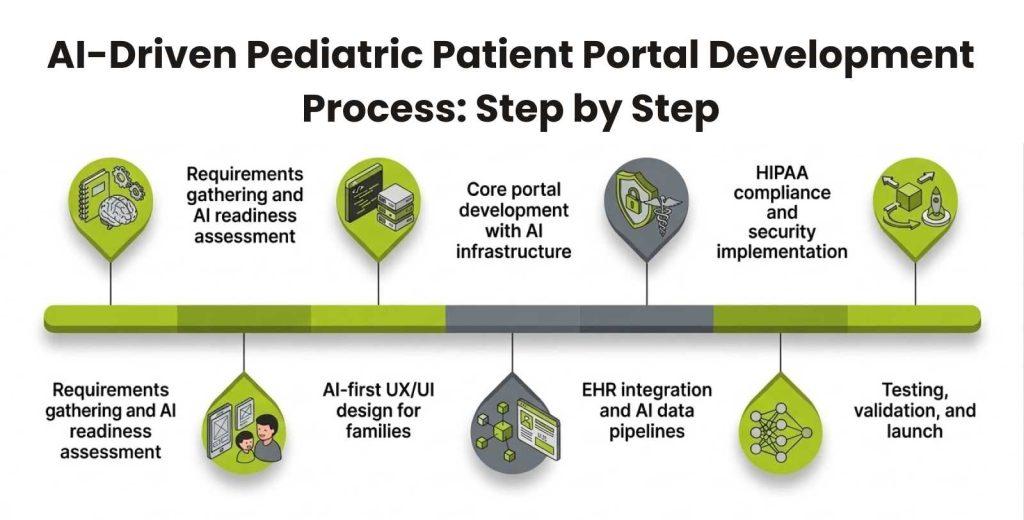
Successful AI-powered pediatric patient portal development follows a structured process that addresses clinical workflows, AI implementation, family experience, and regulatory compliance.
Step 1: Requirements gathering and AI readiness assessment
The development process begins with a comprehensive discovery to understand your practice’s specific needs, existing systems, data infrastructure, and AI readiness. This phase establishes the foundation for all subsequent work.
You can hire an experienced patient portal consulting company to get expert consulting services. Such companies bring years of experience to help you strategie your pediatric patient portal development project.
Action items
- Conduct stakeholder interviews with clinicians, nurses, front desk staff, and practice administrators
- Assess data quality and availability for AI model training
- Document current workflows that AI can automate or enhance
- Review applicable state minor consent laws and proxy access requirements
- Define AI use cases with clear success metrics and KPIs
Step 2: AI-first UX/UI design for families
AI-powered pediatric portal design must accommodate multiple user types while surfacing intelligent features naturally. Family-centered design principles guide interface decisions with AI capabilities seamlessly integrated.
Action items
- Create user personas for parents, grandparents, adolescents, and clinical staff
- Design AI-powered family dashboards with predictive insights and smart notifications
- Develop conversational AI interfaces for chatbot interactions
- Ensure mobile-first responsive design optimized for AI features
- Conduct usability testing with actual parents to validate AI interaction patterns
Step 3: Core portal development with AI infrastructure
Development builds the portal infrastructure, implements pediatric-specific functionality, and establishes the AI/ML foundation. Modular architecture allows phased rollout of intelligent features.
Action items
- Implement proxy access management with AI-powered anomaly detection
- Build immunization tracking with predictive gap analysis
- Develop a growth chart visualization with ML-powered pattern recognition
- Create an AI-enhanced school and camp form automation
- Integrate secure messaging with NLP-powered routing
Step 4: EHR integration and AI data pipelines
Seamless data exchange with existing systems ensures the portal reflects accurate information while feeding AI models with the data they need for personalization and prediction.
Action items
- Establish HL7 FHIR connections with your EHR platform
- Build data pipelines for AI model training and inference
- Integrate with state immunization information systems (IIS)
- Implement bidirectional data synchronization protocols
- Ensure data quality standards for AI processing
Step 5: HIPAA compliance and security implementation
Pediatric portals require additional compliance measures beyond standard HIPAA requirements. Minors have different privacy rights, proxy access creates complex permission scenarios, and AI systems processing PHI need specific safeguards and audit capabilities.
Action items
- Implement AI-enhanced proxy access controls with tiered permission levels for different caregiver relationships
- Build state-specific minor consent rule engines that automatically adjust access based on age and care type
- Configure comprehensive audit logging for both human access and AI automated decisions
- Apply TLS 1.3 encryption for data transmission and AES-256 for stored data, including AI training sets
- Design access revocation workflows that propagate immediately across all systems, including AI components
Step 6: AI model development and deployment
AI capabilities require careful implementation to ensure accuracy, safety, and ongoing performance in clinical contexts. Models must be trained on quality data and monitored continuously.
Action items
- Deploy NLP models for message triage and routing
- Implement predictive models for no-show and immunization gap analysis
- Configure conversational AI with pediatric-specific knowledge bases
- Establish human oversight workflows for AI recommendations
- Set up model monitoring and continuous improvement pipelines
Step 7: Testing, validation, and launch
Comprehensive testing ensures the portal and its AI components function correctly, meet performance requirements, and satisfy compliance obligations before families begin using it.
Action items
- Execute functional testing across all features and AI capabilities
- Validate AI model accuracy and safety with clinical review
- Perform security penetration testing, including AI infrastructure
- Conduct a HIPAA compliance audit with AI-specific documentation review
- Complete user acceptance testing with pilot families
- Plan phased rollout with staff training on AI features
Organizations seeking experienced development partners can hire patient portal developers with healthcare AI expertise to accelerate this process.
With the development process mapped out, the next important consideration is the cost of building an AI-driven pediatric patient portal and how development scope and AI complexity influence pricing.
Don’t Let AI Implementation Complexity Delay Your Pediatric Portal Project
With 500+ healthcare projects delivered, we understand how to implement AI responsibly while navigating proxy access, EHR integration, and compliance requirements.
AI-Driven Pediatric Patient Portal Development Cost: What to Expect
AI-powered pediatric patient portal development typically costs between $40,000–$500,000+, depending on AI complexity, feature scope, integration requirements, and platform needs. Understanding the factors that influence cost helps organizations budget appropriately and make informed decisions. Before diving into factors, let’s take a look at the costs by complexity level.
Cost by Complexity Level
The following table provides cost estimates based on portal and AI complexity:
| Complexity Level | Features Included | Estimated Cost Range | Timeline |
| Basic AI | Scheduling, messaging, record viewing, basic chatbot, simple automation | $40,000–$100,000 | 2–4 months |
| Standard AI | Above, plus predictive analytics, NLP routing, immunization gap prediction, and EHR integration | $100,000–$220,000 | 4–8 months |
| Enterprise AI | Above, plus generative AI, advanced ML models, multi-platform apps, and comprehensive AI governance | $220,000–$400,000+ | 8–18 months |
Basic AI Tier: Suitable for pediatric practices seeking intelligent automation without extensive custom ML development. Includes a rule-based chatbot for common questions, automated reminders, and simple workflow automation. Best for practices ready to start their AI journey with proven, lower-risk capabilities.
Standard AI Tier: Designed for mid-size pediatric groups requiring predictive capabilities and intelligent personalization. Adds machine learning for immunization gap prediction, NLP-powered message routing, no-show prediction, and AI-enhanced growth monitoring. Ideal for practices prioritizing proactive care management.
Enterprise AI Tier: Built for children’s hospitals and large pediatric networks needing advanced AI capabilities. Includes generative AI for personalized content, custom ML models trained on practice data, comprehensive conversational AI, and full AI governance infrastructure. Supports complex multi-location deployments with sophisticated AI requirements.
Ongoing Costs
Beyond initial development, AI-driven pediatric patient portals require ongoing investment to ensure reliability, security, and long-term effectiveness.
Key ongoing cost areas include:
- Cloud hosting and infrastructure to support scalability, availability, and secure data storage
- AI operations and usage for chatbots, predictive models, and automated workflows
- AI monitoring and retraining to maintain accuracy, safety, and clinical relevance
- Maintenance and feature updates including bug fixes, performance improvements, and enhancements
- EHR integration maintenance to ensure continued data synchronization and API compatibility
- Compliance and security management such as HIPAA reviews, audits, and penetration testing
- Support and user training for staff onboarding, troubleshooting, and adoption of AI features
Planning for these ongoing needs helps pediatric practices maintain compliance, protect patient data, and continuously improve portal performance as adoption grows.
Factors Affecting Development Cost
AI capability depth
Basic portals with simple automation cost less than platforms with advanced machine learning, predictive analytics, conversational AI, and generative content capabilities.
Data infrastructure requirements
AI systems require robust data pipelines, storage, and processing infrastructure. Practices with limited data maturity may need additional investment in data preparation.
EHR integration depth
Simple read-only connections cost less than bidirectional integrations with real-time AI processing. Multiple EHR platforms increase complexity further.
Multi-platform requirements
Web-only portals cost less than solutions requiring native iOS and Android applications with full AI feature parity.
Compliance and AI governance
Enterprise-grade security, AI audit logging, model monitoring, and comprehensive compliance infrastructure add development and ongoing operational costs.
ROI Considerations
While AI-powered development requires significant investment, intelligent pediatric portals deliver measurable returns. Practices typically see meaningful reductions in phone call volume, improved immunization compliance rates, higher patient retention, and increased family satisfaction scores. AI automation often pays for itself through staff time savings and improved care quality metrics.
For practices evaluating portal investments, we are an experienced healthcare AI consulting company that can help build a business case with realistic ROI projections based on your practice’s specific metrics and AI readiness.
With costs understood, let’s examine emerging trends shaping the future of AI-driven pediatric patient portals.
Trends Shaping AI-Driven Pediatric Patient Portal Development
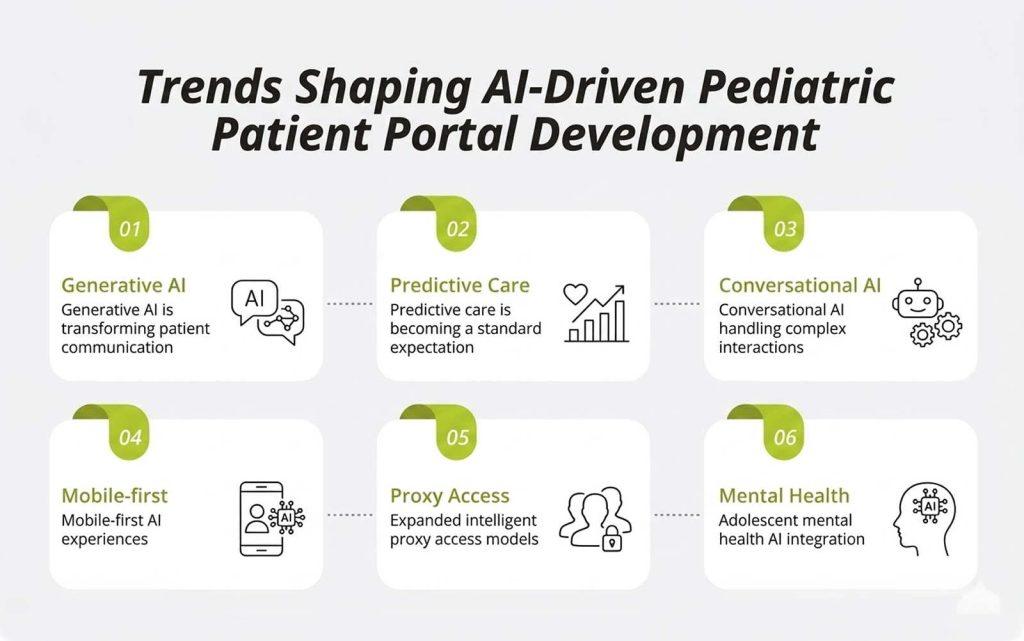
The AI-powered pediatric patient portal landscape continues to evolve rapidly as new technologies emerge and family expectations shift. Understanding these trends helps organizations make forward-looking investment decisions.
1. Generative AI is transforming patient communication
Large language models are revolutionizing how pediatric portals communicate with families. Rather than static educational materials, generative AI creates personalized explanations of diagnoses, treatment plans, and medication instructions tailored to each child’s specific situation and the family’s health literacy level.
Practices adopting generative AI see improved engagement metrics as families find portal content more relevant, accessible, and actionable.
2. Predictive care is becoming a standard expectation
Machine learning models are moving beyond simple reminder systems to predictive identification of children at risk for missed preventive care. By analyzing appointment patterns, demographic factors, and engagement behaviors, AI systems can trigger proactive outreach before care gaps develop.
This shift from reactive reminders to predictive intervention is becoming a baseline expectation for modern pediatric practices.
3. Conversational AI handling complex interactions
AI chatbots are evolving beyond simple FAQ responses to handle nuanced pediatric conversations. Advanced conversational AI can guide parents through symptom assessment, provide personalized developmental guidance, and seamlessly escalate to human staff when clinical judgment is needed.
Voice-enabled interactions are emerging as parents appreciate hands-free access while caring for sick children.
4. Mobile-first AI experiences
Parents increasingly expect native mobile experiences with AI-powered push notifications, predictive insights, and conversational interfaces optimized for smartphone interaction.
Portals designed without mobile-first AI principles will struggle to achieve adoption targets.
5. Expanded intelligent proxy access models
AI is enabling more sophisticated family access management. Machine learning helps navigate complex custody arrangements, predicts which caregivers need access based on care patterns, and adapts permissions as family structures evolve.
Modern AI-driven portals implement granular permission systems that reflect real family complexity while maintaining security.
6. Adolescent mental health AI integration
The adolescent mental health crisis has accelerated demand for AI-powered behavioral health features. This includes intelligent mood tracking, AI-powered crisis resource recommendations, and conversational AI that respects teen privacy preferences while maintaining appropriate safety guardrails.
Portals with thoughtful AI mental health features are becoming differentiators for pediatric practices.
These trends inform how organizations should approach AI-driven portal development today. Now let’s examine the common challenges that can derail implementation.
Challenges in AI-Driven Pediatric Patient Portal Development and How to Overcome Them
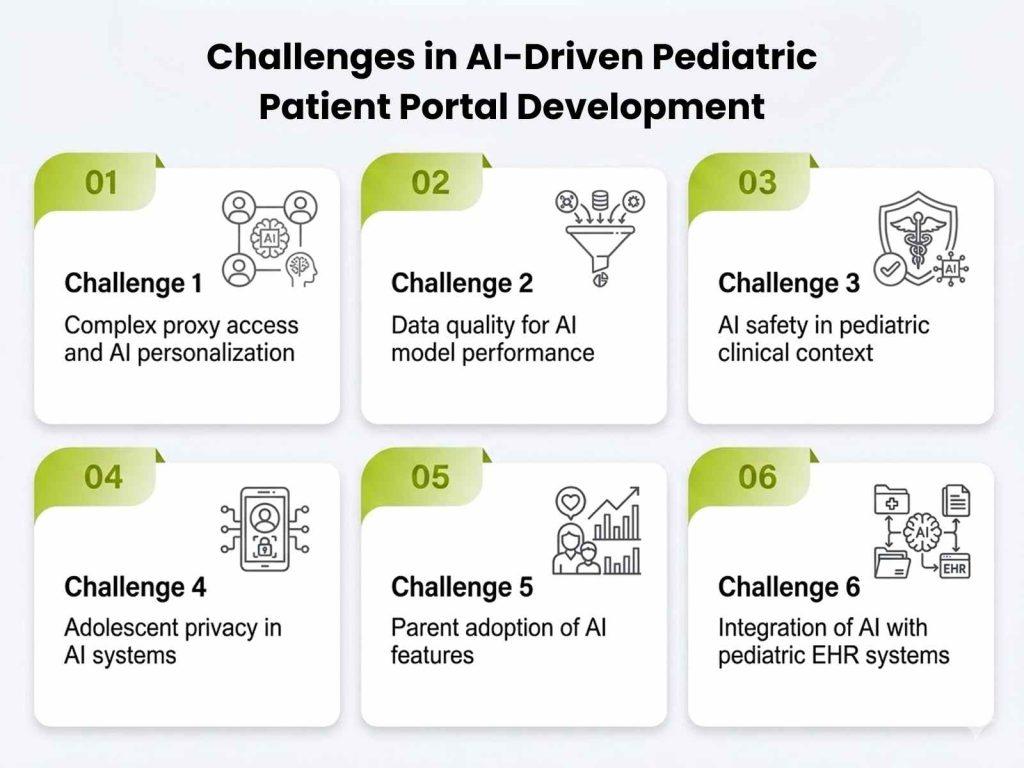
AI-powered pediatric patient portal projects encounter predictable challenges that can delay timelines and increase costs if not addressed proactively. Understanding these obstacles and their solutions helps organizations plan more effectively.
Challenge 1: Complex proxy access and AI personalization
Managing multiple caregivers with different legal relationships creates complexity for AI systems that personalize experiences. AI models must understand which caregiver is interacting and adapt recommendations accordingly while respecting access permissions.
How to overcome it
- Implement AI systems that maintain separate personalization contexts for each authorized caregiver
- Build consent tracking that informs AI about which data can be used for which user’s experience
- Create AI-powered anomaly detection that flags unusual access patterns
- Design clear interfaces for managing how AI uses family data
- Ensure AI personalization immediately reflects access permission changes
Challenge 2: Data quality for AI model performance
AI models require quality data to deliver accurate predictions and personalized experiences. Many pediatric practices have incomplete records, inconsistent data entry, or limited historical depth that impact model performance.
How to overcome it
- Assess data quality and completeness before AI development begins
- Implement data cleaning and normalization pipelines as part of the portal infrastructure
- Design AI models that perform gracefully with incomplete data
- Build feedback loops that improve data quality over time
- Start with AI use cases that are less sensitive to data gaps
Challenge 3: AI safety in pediatric clinical context
AI recommendations in pediatric healthcare carry significant responsibility. Models must be accurate, and errors could impact child health. Ensuring AI safety while delivering useful automation requires careful design.
How to overcome it
- Implement human-in-the-loop workflows for all clinical AI recommendations
- Establish clear boundaries between AI suggestions and clinical decisions
- Build comprehensive AI monitoring with clinical outcome tracking
- Create escalation paths when AI confidence is low
- Maintain clinical oversight of AI system performance
Challenge 4: Adolescent privacy in AI systems
As children become teenagers, they gain privacy rights that AI systems must respect. AI personalization trained on childhood data must adapt as teens gain control over their information.
How to overcome it
- Implement AI systems that recognize and enforce age-based privacy transitions
- Build a graduated AI personalization that adapts as teens gain portal control
- Allow teens to control what historical data AI can use for their experience
- Create clear notifications when AI behavior changes due to privacy transitions
- Design AI interactions appropriate for adolescent users
Challenge 5: Parent adoption of AI features
Families may be skeptical of AI in healthcare, particularly for their children. Building trust in AI-powered features requires thoughtful introduction and transparent communication.
How to overcome it
- Introduce AI features gradually with clear explanations of how they work
- Provide transparency about what data AI uses and how decisions are made
- Allow families to opt out of specific AI features while maintaining core functionality
- Train front desk staff to explain AI benefits and address concerns
- Collect and respond to family feedback about AI experiences
Challenge 6: Integration of AI with pediatric EHR systems
Pediatric EHR systems may have limited API capabilities for the real-time data access AI requires. Building AI data pipelines while maintaining system performance requires specialized expertise.
How to overcome it
- Prioritize FHIR R4 compliance for modern AI-friendly data access
- Build asynchronous data pipelines that don’t impact EHR performance
- Implement caching strategies that balance data freshness with system load
- Plan extended integration testing for AI data flows
- Design AI systems that gracefully handle data latency or gaps
Eliminate Pediatric Portal Development Challenges With Our Experts
Leverage 15+ years of AI patient portal development experience to create scalable pediatric healthcare solutions.
Build Your AI-Driven Pediatric Patient Portal with Space-O AI
Building an AI-driven pediatric patient portal requires specialized expertise across healthcare workflows, artificial intelligence, and regulatory compliance. Pediatric care introduces additional complexity, from proxy access management and adolescent privacy transitions to family-centered user experiences, that generic portal solutions often fail to address.
Space-O AI brings 15+ years of experience in healthcare technology and has successfully delivered 500+ AI projects for organizations worldwide. Our team has extensive experience building HIPAA-compliant patient engagement platforms that integrate advanced AI capabilities with existing EHR systems and clinical workflows.
With a talent pool of 80+ developers, including specialists in healthcare AI, machine learning, natural language processing, predictive analytics, and generative AI, we support pediatric practices and healthcare organizations throughout the entire portal lifecycle. This includes strategy and requirements definition, secure development, AI implementation, EHR integration, testing, deployment, and ongoing optimization.
If you are planning to build or modernize a pediatric patient portal, our healthcare AI specialists can help you define the right feature set, implementation approach, and roadmap aligned with your clinical, operational, and compliance requirements. Book your free consultation today.
Frequently Asked Questions on Pediatric Portal Development
1. What is AI-driven pediatric patient portal development, and how does it differ from standard portals?
AI-driven pediatric patient portal development creates intelligent platforms that combine traditional patient engagement features with artificial intelligence. Unlike standard portals that simply display information, AI-powered portals use machine learning to predict care gaps, deploy chatbots for 24/7 family support, generate personalized health education content, and automate routine workflows. These intelligent capabilities transform passive record access into proactive care coordination.
2. How does AI improve pediatric patient portal experiences for families?
AI enhances pediatric portal experiences through personalized content that adapts to each child’s age and situation, 24/7 chatbot support for common questions, predictive reminders that anticipate family needs, and intelligent automation that reduces administrative burden. Families benefit from more relevant information, faster responses, and proactive care coordination that feels tailored to their specific circumstances.
3. How do we handle proxy access for parents and caregivers in an AI-powered portal?
AI-driven pediatric portals implement intelligent proxy access that adapts to complex family structures. Machine learning monitors access patterns to detect anomalies, while AI-powered consent management tracks authorizations and enforces permissions automatically. Each caregiver receives personalized AI experiences based on their specific access level and relationship to the child.
4. What happens when a child reaches adolescence – how does AI adapt?
As children become teenagers, AI systems automatically adapt to respect evolving privacy rights. Machine learning rule engines apply state-specific minor consent laws, AI personalization shifts to the teen’s preferences, and predictive models adjust to adolescent-appropriate interactions. The portal provides graduated transitions that give teens increasing control while maintaining appropriate safety guardrails.
5. Is HIPAA compliance different for AI-powered pediatric patient portals?
Yes, AI-powered portals face additional compliance complexity. Beyond standard HIPAA requirements for minor privacy, AI systems require audit logging of automated decisions, governance frameworks for model behavior, and safeguards for data used in training and inference. Portals must implement AI-specific controls for transparency, fairness, and ongoing monitoring while maintaining traditional privacy protections.


Build an AI Pediatric Patient Portal
What to read next