- What Is a Patient Portal EHR Integration?
- Key Benefits of EHR Integration in Patient Portals
- Core Features of an EHR-Integrated Patient Portal
- How to Integrate a Patient Portal with EHR Systems
- Common Challenges in EHR Integration (And How to Overcome Them)
- AI-Powered Capabilities for EHR-Integrated Portals
- Partner with Space-O AI for Your Patient Portal Development
- Frequently Asked Questions on Patient Portal EHR Integration
- 1. What is the difference between a patient portal and an EHR?
- 2. How long does it take to integrate a patient portal with an EHR system?
- 3. What are the HIPAA requirements for EHR-integrated patient portals?
- 4. Can existing patient portals be upgraded with EHR integration?
- 5. Which EHR systems support FHIR-based integration?
- 6. How does AI enhance patient portal EHR integration?
- 7. What are the cost factors and timeline for EHR integration?
How to Integrate Patient Portals with EHR Systems: A Complete Guide

 Last Updated: February, 12 2026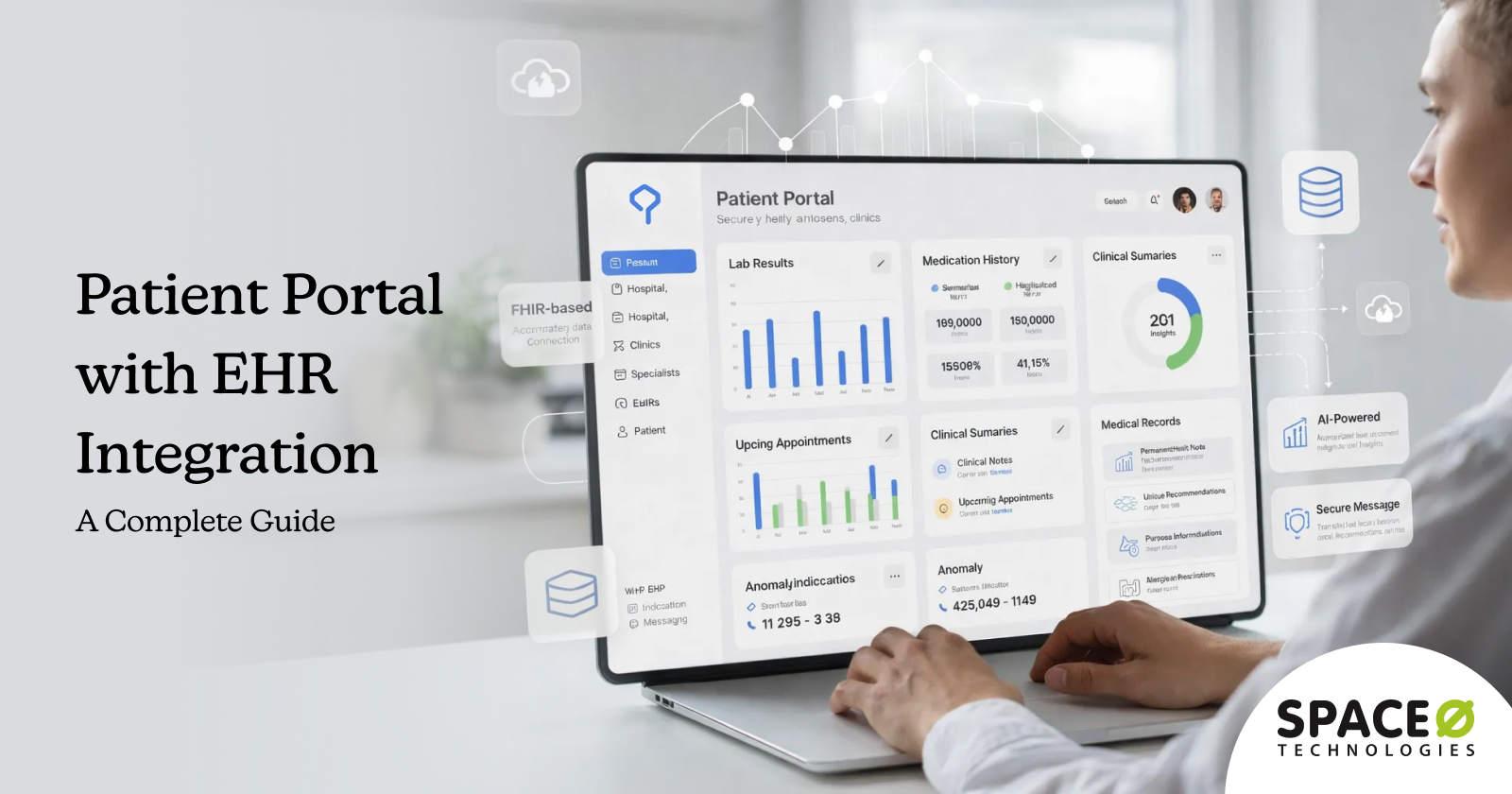
Healthcare is becoming increasingly digital, but many organizations still struggle with fragmented systems that do not communicate effectively. Patients expect seamless access to their medical records, appointment details, prescriptions, lab reports, and billing information in one place. Providers, on the other hand, need real time data synchronization between systems to deliver accurate, efficient, and coordinated care.
When patient portals operate separately from Electronic Health Record systems, the result is duplicated data, manual updates, delayed information sharing, and inconsistent patient experiences. True digital transformation in healthcare requires deep integration between patient facing applications and core clinical systems.
The urgency of this integration is reflected in patient behavior. According to a 2025 JMIR report, 61.3% of patients accessed patient portals in the last 12 months, and among portal users, 43.7% reported using multiple portals due to fragmented data across providers. This clearly signals the need for unified, interoperable solutions that eliminate data silos.
A patient portal with EHR integration is not just a technical upgrade. It is a strategic move toward interoperability, improved patient engagement, streamlined workflows, and better clinical outcomes.
In this blog, we explore how to integrate patient portals with EHR software. Drawing from our 15+ years of experience as a leading AI patient portal development company on the key benefits, integration methods, technical considerations, development process, and cost factors you should evaluate when building a connected, intelligent digital healthcare ecosystem.
What Is a Patient Portal EHR Integration?
Patient portal EHR integration refers to the seamless connection between a patient facing portal and an Electronic Health Record system, enabling secure, real time exchange of clinical and administrative data.
In a standalone setup, a patient portal functions as an independent application where patients can view limited information or submit requests. However, without EHR integration, data must often be manually updated or transferred between systems, leading to delays, errors, and inconsistencies.
With proper integration, the patient portal becomes an extension of the EHR. It pulls structured data such as:
- Medical history
- Diagnoses and treatment plans
- Lab and imaging results
- Medication lists and prescriptions
- Appointment schedules
- Billing and insurance details
At the same time, patient generated inputs such as appointment requests, intake forms, symptom updates, messages, and document uploads are automatically pushed back into the EHR. This creates a two way, synchronized data flow.
Now that we understand the foundation, let’s explore the specific benefits this integration delivers.
Key Benefits of EHR Integration in Patient Portals
Building a patient portal with EHR integration delivers measurable advantages for patients, providers, and healthcare organizations. Here are the key benefits that drive adoption:
1. Real-time access to unified health records
Patients view labs, medications, immunizations, and visit summaries in one place without logging into multiple systems. AI-powered portals enhance this by translating clinical terminology into a language patients understand.
2. Reduced duplicate data entry
Integration eliminates manual transcription between systems. When data flows automatically, staff spend less time on administrative tasks and make fewer errors that could affect patient safety.
3. Improved patient engagement and satisfaction
Patients who can access their health information digitally report higher satisfaction with their healthcare experience. Integrated portals with AI features drive even higher engagement through personalized content and intelligent interactions.
4. Enhanced care coordination across providers
When specialists, primary care physicians, and hospitals share a consolidated patient record, care transitions become smoother. AI agents can proactively notify relevant providers when significant health events occur.
5. HIPAA-compliant secure data exchange
EHR integration establishes auditable data flows that meet regulatory requirements. Every access, update, and transmission is logged for compliance reporting.
6. Operational efficiency and cost reduction
Automated workflows reduce call center volume. Patients who can view test results online do not call the office asking for updates. AI chatbots handle routine inquiries, freeing staff for complex cases.
7. Support for value-based care initiatives
Integrated portals provide the data infrastructure needed for outcomes tracking, quality reporting, and population health management. AI analytics identify care gaps before they become costly complications.
These benefits compound over time as patient adoption increases and AI models learn from accumulating data.
Develop a Custom EHR-Integrated Patient Portal
Space-O AI designs and develops custom AI patient portals with secure EHR integration tailored to your workflows.
Core Features of an EHR-Integrated Patient Portal
The feature set of an AI-driven patient portal with EHR integration determines its value to both patients and healthcare organizations. Below are the essential capabilities that modern integrated portals should include.
1. Unified health record view
Patients access lab results, medication lists, immunization records, allergies, and visit summaries through a single dashboard. AI summarization transforms dense clinical notes into readable explanations tailored to each patient’s health literacy level.
2. Intelligent appointment scheduling
The portal syncs with EHR calendars to show real-time availability. AI-powered scheduling suggests optimal appointment times based on patient preferences, provider availability, and appointment type requirements.
3. Secure messaging with care teams
Patients communicate directly with physicians, nurses, and administrative staff through encrypted channels. NLP analyzes message content to route inquiries to the appropriate team member and flag urgent concerns.
4. Prescription management and refill requests
Integration with pharmacy systems enables patients to request refills that flow directly to the pharmacy and update the EHR medication list. AI monitors for potential drug interactions and adherence patterns.
5. AI-generated visit summaries
After appointments, the portal presents plain-language summaries of what was discussed, recommended next steps, and any new prescriptions or referrals. Generative AI creates personalized explanations based on the patient’s specific health context.
6. Real-time alerts and notifications
When new test results arrive or appointments approach, patients receive timely notifications. AI prioritizes alerts based on clinical significance, ensuring critical results get immediate attention.
7. Proxy and caregiver access management
Parents managing children’s health records and caregivers supporting elderly patients can access appropriate information with proper consent controls. Role-based permissions ensure privacy while enabling family involvement.
8. Patient-mediated data sharing
Patients control who sees their information and can share records with new providers or specialists. FHIR-based integration makes this sharing seamless across different health systems.
The table below summarizes feature availability across different integration levels.
| Feature Category | Basic Integration | Advanced Integration | AI-Enhanced Integration |
| View lab results | Yes | Yes | Yes + AI explanations |
| Appointment scheduling | Manual sync | Real-time sync | AI-optimized scheduling |
| Secure messaging | Basic routing | Smart routing | NLP-powered triage |
| Medication management | View only | Refill requests | Adherence prediction |
| Visit summaries | EHR-generated | Formatted display | AI plain-language summaries |
| Alerts | Email notifications | Push notifications | AI-prioritized alerts |
| Data sharing | Manual export | API-based sharing | Patient-controlled FHIR access |
With features defined, let’s examine the technical process of building these integrations.
How to Integrate a Patient Portal with EHR Systems
Integrating a patient portal with EHR systems requires careful planning, technical expertise, and a phased approach. Here is the process that healthcare organizations should follow.
Step 1: Assess your current EHR infrastructure
Before designing integration architecture, understand what you are working with. Different EHR vendors offer different API capabilities, and legacy systems may require specialized approaches.
- Identify your primary EHR vendor (Epic, Cerner, Athena, Meditech, etc.)
- Document existing API capabilities and authentication methods
- Map current data flows between clinical systems
- Evaluate data quality and standardization levels
- Identify technical debt that could complicate integration
Step 2: Choose the right integration approach
The integration method depends on your EHR’s capabilities and your portal requirements. Modern systems favor FHIR, but many organizations need hybrid approaches.
- FHIR R4 integration: The gold standard for modern interoperability, offering standardized resources for patient data, appointments, medications, and observations
- HL7 v2 interfaces: Still necessary for legacy EHR systems that predate FHIR adoption
- Proprietary EHR APIs: Vendor-specific interfaces that may offer deeper functionality but reduce portability
- Middleware solutions: Integration engines that translate between different protocols and formats
Step 3: Design the data architecture
AI-driven portals require thoughtful data architecture that supports both real-time display and machine learning workloads.
- Determine synchronization frequency (real-time events vs. scheduled batches)
- Design data normalization pipelines using standard terminologies (SNOMED CT, ICD-10, RxNorm, LOINC)
- Establish data quality monitoring to catch integration errors early
- Implement encryption for data at rest and in transit
- Build audit logging infrastructure for HIPAA compliance
Step 4: Develop and test the integration
Development should follow healthcare-specific quality standards with extensive testing at every stage.
- Build API connections with comprehensive error handling
- Implement authentication using OAuth 2.0 and SMART on FHIR
- Conduct unit testing for individual data exchanges
- Perform end-to-end testing across complete patient workflows
- Execute load testing to verify performance under realistic usage patterns
- Complete security testing, including penetration testing and vulnerability assessments
Step 5: Deploy and monitor continuously
Launch is just the beginning. AI-driven portals require ongoing monitoring and optimization.
- Plan phased rollout starting with pilot user groups
- Establish monitoring dashboards for integration health and performance
- Implement alerting for failed synchronizations or data anomalies
- Build feedback loops for continuous improvement
- Deploy MLOps infrastructure for AI model monitoring and retraining
Organizations looking for end-to-end support should consider partnering with an experienced patient portal integration agency like Space-O AI.
Need Expert Support for Your EHR Integration Project?
Our healthcare integration specialists have deployed FHIR-based patient portals for hospitals, clinics, and health systems.
Common Challenges in EHR Integration (And How to Overcome Them)
Even well-planned integration projects encounter obstacles. Understanding common challenges helps organizations prepare effective solutions.
1. Legacy system compatibility remains a significant barrier
Many healthcare organizations run EHR systems installed years before FHIR became standard. These systems may lack modern APIs or use proprietary data formats that resist standardization. Without proper handling, legacy constraints can derail integration timelines and inflate costs.
How to overcome this challenge
- Implement FHIR facade patterns that expose legacy data through modern interfaces
- Deploy middleware adapters that translate HL7 v2 messages to FHIR resources
- Consider phased modernization that upgrades integration capabilities incrementally
- Work with EHR vendors on upgrade paths that improve API access
2. Data standardization issues create integration friction
Different systems represent the same clinical concepts differently. One EHR might code a diagnosis using ICD-10 while another uses SNOMED CT, and free-text fields introduce unlimited variation. This inconsistency breaks data mapping and compromises the accuracy of integrated records.
How to overcome this challenge
- Build terminology mapping services using standard crosswalks
- Implement NLP to extract structured data from unstructured clinical notes
- Establish data governance policies that enforce standardization at entry points
- Deploy AI-powered data quality monitoring to detect and flag inconsistencies
3. Security and HIPAA compliance add complexity
Every data exchange must protect patient privacy while maintaining the audit trails regulators require. AI systems that process PHI face additional scrutiny, and any breach can result in significant financial penalties and reputational damage.
How to overcome this challenge
- Implement end-to-end encryption using TLS 1.3 for transit and AES-256 for storage
- Deploy comprehensive audit logging that captures every data access and modification
- Ensure Business Associate Agreements cover all integration partners and cloud providers
- Design AI architectures that minimize PHI exposure (federated learning, differential privacy)
4. High implementation costs strain budgets
Mid-size facilities and independent practices often lack the capital for enterprise-scale integration projects. Without careful planning, costs can escalate beyond initial estimates as integration complexity reveals itself.
How to overcome this challenge
- Start with MVP implementations that deliver core value quickly
- Use cloud-native architecture to reduce infrastructure investment
- Consider SaaS patient portal platforms with pre-built EHR connectors
- Calculate ROI, including reduced call volume, fewer no-shows, and improved satisfaction scores
5. User adoption resistance slows value realization
Both staff and patients may resist new systems, especially if previous technology implementations were painful. Low adoption rates undermine the ROI of even well-built integrations.
How to overcome this challenge
- Involve end users in design and testing phases
- Invest in training programs tailored to different user roles
- Design intuitive interfaces that require minimal learning
- Demonstrate quick wins that build confidence in the new system
AI-Powered Capabilities for EHR-Integrated Portals
AI transforms patient portals from passive data displays into intelligent healthcare assistants. When combined with EHR integration, these capabilities deliver experiences that patients and providers genuinely value.
1. Clinical summarization in plain language
Large language models analyze complex EHR data, including visit notes, lab reports, and medication lists, and generate summaries that patients can actually understand. Instead of deciphering medical jargon, patients read clear explanations of their health status and care plans.
2. Intelligent anomaly detection
Machine learning models monitor incoming EHR data for patterns that indicate potential problems. Unusual lab values, missed medications, or declining vital signs trigger alerts to both patients and care teams before small issues become serious complications.
3. Automated clinical concept extraction
NLP pipelines process unstructured clinical text to extract diagnoses, procedures, medications, and other concepts. This structured data feeds downstream analytics and enables more sophisticated patient matching and cohort identification.
4. Personalized lab result explanations
AI generates context-aware explanations of test results based on each patient’s health history. A slightly elevated glucose reading means something different for a diabetic patient than for someone with no metabolic concerns.
5. Smart alert prioritization
Not all notifications deserve equal attention. AI analyzes clinical significance to ensure critical results reach patients immediately, while routine updates wait for convenient moments. This prevents alert fatigue while maintaining safety.
6. Predictive analytics for proactive care
Models trained on integrated EHR and portal data predict which patients risk missing appointments, discontinuing medications, or experiencing adverse events. Care teams can intervene before problems materialize.
7. NLP-powered message routing
Natural language understanding analyzes patient messages to determine intent and urgency. Administrative questions go to the scheduling staff. Clinical concerns reach nurses. Urgent symptoms trigger immediate escalation protocols.
8. Conversational AI assistants
AI chatbots handle routine inquiries 24/7, answering questions about appointments, medications, and general health information. When conversations exceed the bot’s capabilities, seamless handoff to human staff ensures patients get the help they need.
These AI capabilities require the unified data foundation that EHR integration provides. Without access to complete, real-time patient information, AI systems cannot deliver accurate or personalized responses. Healthcare organizations looking to build these intelligent features should hire patient portal developers with expertise in both healthcare interoperability and AI/ML engineering.
Build AI-Driven Patient Portals That Patients Actually Use
With 500+ AI projects delivered and 80+ AI specialists on our team, Space-O AI builds patient portals featuring intelligent summarization, predictive analytics, and conversational interfaces.
Partner with Space-O AI for Your Patient Portal Development
Building a patient portal with EHR integration requires healthcare domain expertise, interoperability knowledge, and AI engineering capabilities. The right integration strategy transforms fragmented systems into unified digital experiences that patients value and providers trust.
Space-O AI has delivered 500+ AI projects with a dedicated team of 80+ AI specialists who understand healthcare technology. Our team builds HIPAA-compliant, production-ready AI solutions that integrate with existing EHR infrastructure while delivering measurable improvements in engagement.
Our AI specialists bring deep expertise in FHIR-based integration, HL7 interfaces, and healthcare AI applications, including clinical NLP, predictive analytics, and conversational interfaces. We have helped healthcare organizations deploy patient portals that reduce administrative burden and support value-based care goals.
Ready to build a patient portal with EHR integration? Contact Space-O AI for a free consultation where our healthcare technology experts will assess your requirements, evaluate your EHR environment, and recommend an approach tailored to your organization.
Frequently Asked Questions on Patient Portal EHR Integration
1. What is the difference between a patient portal and an EHR?
An EHR (Electronic Health Record) is the clinical system healthcare providers use to document patient care. A patient portal is a patient-facing application that displays selected information from the EHR. With integration, the portal connects directly to the EHR for real-time data access.
2. How long does it take to integrate a patient portal with an EHR system?
Timeline depends on integration complexity. Basic implementations take 3–4 months. Standard integrations with labs and medications require 4–6 months. Enterprise AI-enhanced portals typically need 9–12 months for full deployment.
3. What are the HIPAA requirements for EHR-integrated patient portals?
HIPAA requires encryption for data at rest and in transit, role-based access controls, comprehensive audit logging, secure authentication, and Business Associate Agreements with all vendors handling PHI. AI systems processing patient data must meet the same standards.
4. Can existing patient portals be upgraded with EHR integration?
Yes, though feasibility depends on the portal’s architecture. Modern platforms with API-based designs upgrade more easily than legacy systems with monolithic architectures. Assessment by healthcare integration specialists can determine the best approach.
5. Which EHR systems support FHIR-based integration?
Major EHR vendors, including Epic, Cerner (Oracle Health), Athena, Meditech, and Allscripts, support FHIR R4 APIs. The 21st Century Cures Act mandates FHIR support, so even older systems are adding capabilities. Implementation quality varies by vendor.
6. How does AI enhance patient portal EHR integration?
AI adds intelligence to integrated portals through clinical summarization, predictive analytics, conversational chatbots, smart alert prioritization, and personalized health content. These capabilities require the complete, real-time data that EHR integration provides.
7. What are the cost factors and timeline for EHR integration?
Cost ranges from $100,000–$150,000 for basic integration to $350,000–$500,000+ for enterprise AI-enhanced implementations. Key factors include EHR vendor APIs, integration depth, compliance requirements, and AI feature complexity. Timeline varies from 3–4 months for basic setups to 9–12 months for full enterprise deployments.


Integrate Your Patient Portal with EHR
What to read next