- What are Patient Portal APIs?
- The Role of APIs in Patient Portals
- Key Benefits of Building Patient Portal APIs
- Key Features Enabled by Patient Portal APIs
- Patient Portal API Development Use Cases
- Patient Portal API Development Architecture
- Security, Privacy, and Compliance in Patient Portal API Development
- Patient Portal API Development Process: Step-by-Step Guide
- Patient Portal API Development Cost and Timeline
- Common Challenges in Patient Portal API Development and How to Overcome Them
- Build Your Patient Portal APIs with Space-O AI
- Frequently Asked Questions on Patient Portal API Development
- 1. What is FHIR, and why is it important for patient portal APIs?
- 2. How long does it take to develop patient portal APIs?
- 3. What security measures are required for patient portal APIs?
- 4. Can patient portal APIs integrate with AI and machine learning systems?
- 5. How do I ensure my patient portal APIs comply with the 21st Century Cures Act?
Patient Portal API Development: A Complete Guide to Building Secure Healthcare APIs

 Last Updated: March, 25 2026
The healthcare industry is racing toward digital transformation, and APIs have become the connective tissue that makes it possible. According to KBV Research, the global patient portal market was valued at USD 4.31 billion in 2025 and is projected to reach USD 14.37 billion by 2032, growing at a CAGR of 18.7%.
This growth reflects a fundamental shift in how patients expect to interact with healthcare. They want instant access to lab results, seamless appointment scheduling, and secure communication with providers; all from their smartphones. But behind every smooth patient experience lies a complex web of integrated systems powered by APIs.
Patient portal API development is the foundation that enables this connectivity. Without well-architected APIs, healthcare organizations struggle with data silos, fragmented patient experiences, and compliance headaches that slow down innovation.
With our 15+ years of expertise as a leading AI patient portal development agency, we drafted this guide that covers everything you need to know about patient portal API development. From FHIR standards and security architecture to integration approaches, development costs, and emerging trends shaping healthcare interoperability, you’ll learn all the basics.
What are Patient Portal APIs?
At their core, patient portal APIs allow different software systems to communicate using standardized protocols. When a patient checks their lab results through a mobile app, an API retrieves that data from the EHR and delivers it in a format the app can display. When they schedule an appointment, another API writes that information back to the practice management system.
APIs follow a request-response model where client applications send requests to server endpoints and receive structured data in return. This architecture decouples frontend interfaces from backend systems, enabling independent development and scaling.
Types of APIs used in patient portals
1. RESTful APIs
REST (Representational State Transfer) APIs use standard HTTP methods to perform operations on resources. GET requests retrieve data, POST creates new records, PUT updates existing information, and DELETE removes entries. RESTful APIs are lightweight, stateless, and widely adopted across healthcare applications due to their simplicity and scalability.
2. GraphQL APIs
GraphQL provides a query language that allows clients to request exactly the data they need. Unlike REST, where each endpoint returns a fixed data structure, GraphQL lets developers specify which fields to retrieve. This reduces over-fetching and improves performance for complex queries spanning multiple data sources.
3. FHIR APIs
FHIR (Fast Healthcare Interoperability Resources) is a healthcare-specific standard developed by HL7. It defines standardized resource types for clinical data – Patient, Observation, MedicationRequest, Appointment, and dozens more. FHIR APIs have become the regulatory standard for patient data access in the United States.
Understanding the types and regulatory context of patient portal APIs sets the stage for exploring their specific role in healthcare ecosystems.
The Role of APIs in Patient Portals
APIs serve as the backbone of modern patient portal functionality. Every feature patients interact with – from viewing medical records to messaging their care team – depends on API calls executing behind the scenes.
1. Enabling real-time data exchange
APIs facilitate bidirectional data flow between patient portals and source systems. When a physician updates a patient’s medication list in the EHR, APIs ensure that the change is reflected immediately in the patient portal. When a patient completes a pre-visit questionnaire, APIs transmit that information to clinical systems.
This real-time synchronization keeps patients and providers working from the same information. It eliminates delays that previously required manual data reconciliation and reduces errors from outdated information.
2. Supporting mobile-first patient engagement
Mobile devices have become the primary interface for digital health interactions. APIs designed for mobile consumption must account for unique constraints, including intermittent connectivity, limited bandwidth, and diverse device capabilities.
Mobile-optimized APIs implement pagination for large datasets, compression for reduced payload sizes, and offline-capable patterns that sync when connectivity returns. Push notification APIs keep patients informed without requiring them to actively check the portal.
3. Facilitating third-party integrations
Healthcare organizations cannot build every capability in-house. APIs enable integration with best-of-breed solutions, including telehealth platforms, remote monitoring devices, pharmacy systems, and wellness applications.
Well-documented APIs allow third parties to extend portal functionality without accessing core systems directly. This creates ecosystems where specialized vendors contribute capabilities while the organization maintains control over patient data and experience.
For organizations looking to modernize their healthcare technology stack, partnering with a patient portal integration agency like Space-O AI can help you get the expertise needed to connect legacy systems with modern API architectures.
4. Powering AI and analytics capabilities
Machine learning and artificial intelligence require data access to deliver value. APIs structured for analytics consumption enable predictive models, recommendation engines, and intelligent automation.
APIs feed patient data to AI systems and return insights to portal interfaces. Chatbots query clinical information through APIs to answer patient questions. Predictive models access historical data to identify patients requiring outreach.
5. Ensuring regulatory compliance
Standardized APIs help organizations meet federal and state requirements. FHIR-based APIs satisfy 21st Century Cures Act mandates. Audit logging APIs capture access patterns for compliance reporting. Consent management APIs enforce patient preferences for data sharing.
APIs provide the technical foundation for compliance, but proper implementation requires understanding both regulatory requirements and clinical workflows.
With APIs playing such a central role, understanding their specific benefits helps justify the investment in proper API development.
Key Benefits of Building Patient Portal APIs
Investing in patient portal API development delivers measurable returns across operational efficiency, patient satisfaction, and regulatory compliance. Here are the key benefits healthcare organizations realize.
1. Enhanced interoperability
APIs enable seamless data exchange between disparate healthcare systems. Patients and providers access unified health information regardless of source, breaking down silos that traditionally fragmented the care experience.
2. Improved patient engagement
Well-designed APIs power mobile apps and web portals, providing 24/7 access to health data. Patients can schedule appointments, message providers, and view results anytime, increasing satisfaction and adherence.
3. Streamlined third-party integrations
APIs allow healthcare organizations to integrate telehealth platforms, wearable devices, and specialty applications without rebuilding core systems. This best-of-breed approach accelerates innovation while protecting existing investments.
4. Regulatory compliance support
FHIR-based APIs help organizations meet 21st Century Cures Act requirements. Standardized data access prevents information-blocking penalties while enabling patients to exercise their data access rights.
5. Scalability and future-proofing
API-first architecture allows adding new features, integrations, and AI capabilities without disrupting existing workflows. Organizations can evolve their digital health strategy without complete system overhauls.
6. Reduced development costs
Standardized APIs eliminate custom point-to-point integrations. Development teams experience a significant reduction in integration time compared to proprietary connection methods, lowering both initial and ongoing costs.
7. AI and analytics enablement
APIs structured for machine learning consumption enable predictive analytics, intelligent chatbots, and personalized patient experiences. These capabilities improve outcomes while reducing administrative burden on clinical staff.
These benefits translate into a competitive advantage as patients increasingly choose providers based on digital experience quality. Now let’s explore the specific features that patient portal APIs enable.
Ready to Build APIs That Transform Your Patient Portal Experience?
Our healthcare API specialists have delivered HIPAA-compliant integrations for health systems nationwide. Share your requirements and receive a technical consultation within 48 hours.
Key Features Enabled by Patient Portal APIs
Patient portal APIs unlock a comprehensive set of features that define the modern healthcare digital experience. Each feature category requires specific API capabilities and integration patterns.
1. Clinical data access
Clinical data APIs provide patients with secure access to their health information stored across healthcare systems.
Core capabilities
- Laboratory results with reference ranges and trending
- Medication lists with dosing instructions and refill status
- Immunization records and recommended vaccines
- Allergy documentation and severity indicators
- Problem lists and diagnoses
- Visit summaries and clinical notes
- Vital signs and measurements
These APIs typically implement FHIR resources, including Patient, Observation, MedicationRequest, Immunization, AllergyIntolerance, and Condition. Real-time synchronization ensures patients see updates within minutes of clinical documentation.
2. Appointment and scheduling
Scheduling APIs manage the complete appointment lifecycle from discovery through completion.
Core capabilities
- Provider availability queries by specialty, location, and time
- Appointment booking with confirmation workflows
- Rescheduling and cancellation processing
- Waitlist management and automated slot filling
- Multi-resource scheduling for complex visits
- Automated reminder delivery via SMS, email, and push
- Check-in and arrival notification
Integration with practice management systems ensures changes propagate across all platforms. Calendar APIs enable synchronization with patients’ personal calendars.
3. Secure messaging
Messaging APIs enable HIPAA-compliant communication between patients and care teams.
Core capabilities
- Threaded conversations with care team members
- Attachment support for images and documents
- Read receipts and delivery confirmation
- Message routing to the appropriate staff
- Priority flagging for urgent communications
- Integration with EHR documentation
- Notification delivery across channels
The ability to integrate AI chatbot development through these messaging APIs creates opportunities for 24/7 automated patient support while maintaining seamless handoff to human agents.
4. Billing and payments
Financial APIs provide transparency into healthcare costs and streamline payment collection.
Core capabilities
- Statement retrieval and itemized charges
- Insurance eligibility verification
- Benefits explanation and coverage details
- Copay and deductible estimation
- Payment processing and receipt generation
- Payment plan setup and management
- Claim status tracking
Real-time eligibility APIs help patients understand costs before appointments, reducing billing surprises and improving collection rates.
5. Telehealth integration
Telehealth APIs embed virtual care capabilities directly into the patient portal experience.
Core capabilities
- Video consultation session management
- Virtual waiting room queuing
- Pre-visit intake form collection
- Device and connection testing
- Session recording and documentation
- Post-visit summary delivery
- Follow-up scheduling automation
Integrated telehealth eliminates the need for patients to navigate separate platforms or create additional accounts.
6. Remote monitoring
Remote monitoring APIs ingest data from connected devices and wearables.
Core capabilities
- Device registration and pairing
- Data ingestion from multiple device types
- Threshold-based alerting configuration
- Trending visualization and analysis
- Care team notification routing
- Integration with clinical decision support
- Patient feedback and symptom logging
APIs normalize data from diverse device manufacturers into consistent formats for clinical use.
7. AI-powered capabilities
Machine learning APIs enable intelligent features that improve engagement and outcomes.
Core capabilities
- Predictive risk scoring and stratification
- Personalized content recommendations
- Natural language symptom assessment
- Intelligent search and navigation
- Chatbot and virtual assistant interactions
- Care gap identification and outreach
- Behavioral pattern analysis
These APIs require careful attention to data governance, model validation, and appropriate use boundaries in clinical contexts.
Understanding these features in abstract is helpful, but seeing how they apply in real scenarios brings the value to life.
Patient Portal API Development Use Cases
Real-world implementations demonstrate how patient portal APIs solve concrete healthcare challenges. These use cases illustrate the practical application of API strategies across different organizational contexts.
1. Multi-location health system data unification
What it does
Aggregates patient data from multiple EHR instances across hospitals and clinics into a unified portal view. Patients accessing care at different facilities see their complete health history in one place.
Key capabilities
- Master patient index APIs match identities across systems
- Data retrieval APIs pull information from each source EHR
- Normalization APIs standardize different coding systems
- Conflict resolution APIs handle discrepancies between sources
- Real-time synchronization keeps data current across locations
Benefits
- Patients have access to complete records regardless of care location
- Providers see a comprehensive history during encounters
- Reduces duplicate testing and conflicting treatments
- Improves care coordination across specialties
2. Third-party wellness app integration
What it does
Enables patients to connect consumer health applications with their patient portal. Fitness trackers, nutrition apps, and wellness platforms share data that becomes part of the patient’s health record.
Key capabilities
- OAuth-secured authorization for third-party access
- Data ingestion APIs accept information from external sources
- Normalization APIs convert diverse formats to clinical standards
- Patient consent APIs manage sharing permissions
- Revocation APIs allow patients to disconnect apps
Benefits
- Providers gain visibility into lifestyle factors affecting health
- Patients see all health data in one location
- Enables more holistic care conversations
- Supports population health and wellness initiatives
3. AI chatbot and virtual assistant integration
What it does
Deploys intelligent chatbots that handle routine patient inquiries without human intervention. Chatbots access clinical data through APIs to provide personalized, context-aware responses.
Key capabilities
- Natural language processing APIs interpret patient questions
- Clinical data APIs retrieve relevant patient information
- Scheduling APIs check availability and book appointments
- Prescription APIs initiate refill requests
- Escalation APIs route complex queries to human agents
Benefits
- Reduces call center volume by handling routine inquiries
- Provides 24/7 patient support availability
- Decreases wait times for simple requests
- Frees staff for higher-value patient interactions
4. Telehealth platform connectivity
What it does
Integrates video consultation capabilities directly into the patient portal. Patients schedule, prepare for, and conduct virtual visits without leaving the portal environment.
Key capabilities
- Scheduling APIs book video visits alongside in-person options
- Pre-visit APIs collect intake information and symptoms
- Session APIs manage video connection and waiting room
- Documentation APIs capture visit notes and diagnoses
- Follow-up APIs deliver summaries and schedule next steps
Benefits
- Seamless patient experience without platform switching
- Consistent branding and user interface
- Simplified workflows for clinical staff
- Better data capture and documentation
5. Pharmacy and medication management
What it does
Connects patient portals with pharmacy systems to streamline prescription management. Patients request refills, track status, and receive medication information through the portal.
Key capabilities
- Refill request APIs submit orders to pharmacies
- Status APIs provide real-time prescription tracking
- Drug interaction APIs check for medication conflicts
- Adherence APIs monitor refill patterns and gaps
- Education APIs deliver medication information
Benefits
- Convenient prescription management for patients
- Improved medication adherence through reminders
- Reduced phone calls to pharmacies and practices
- Better visibility into patient medication behavior
6. Insurance and benefits verification
What it does
Provides real-time insurance eligibility checking and cost estimation. Patients verify coverage and understand out-of-pocket costs before scheduling appointments.
Key capabilities
- Eligibility APIs query payer systems in real-time
- Benefits APIs return coverage details and limitations
- Cost estimation APIs calculate patient responsibility
- Authorization APIs check prior approval requirements
- Explanation APIs present information in patient-friendly formats
Benefits
- Reduces billing surprises and patient dissatisfaction
- Improves collection rates through upfront transparency
- Decreases claim denials from eligibility issues
- Enables informed healthcare decision-making
7. Remote patient monitoring data ingestion
What it does
Collects health data from connected devices outside clinical settings. Blood pressure monitors, glucose meters, and other devices transmit readings that integrate with portal and EHR data.
Key capabilities
- Device registration APIs pair patient devices with accounts
- Data ingestion APIs receive readings from multiple sources
- Validation APIs check data quality and completeness
- Alerting APIs notify care teams of concerning values
- Trending APIs visualize patterns over time
Benefits
- Continuous health monitoring between visits
- Early detection of deteriorating conditions
- Data-driven care plan adjustments
- Reduced emergency visits through proactive management
These use cases demonstrate that patient portal API development transforms care delivery across the healthcare continuum.
Building these capabilities requires thoughtful architecture, which we’ll explore next.
Patient Portal API Development Architecture
Building patient portal APIs requires careful architectural planning. The decisions made during architecture design determine whether APIs can scale with growing patient populations, maintain security under evolving threats, and adapt to new integration requirements. This section breaks down the key architectural components every healthcare organization should consider.
1. API design principles
Good API design makes the difference between APIs that developers love and APIs that create constant integration headaches. Here’s how to get the fundamentals right.
1.1 RESTful resource design
REST APIs organize around resources that map naturally to healthcare concepts. A patient becomes a /patients resource. Lab results become /observations. Medications become /medication-requests. This intuitive mapping makes APIs self-documenting and predictable.
Standard HTTP methods define what operations do:
- GET /patients/123 retrieves patient data
- POST /patients creates a new patient record
- PUT /patients/123 updates existing patient information
- DELETE /patients/123 removes a patient record
When developers understand one endpoint, they understand them all. Consistency reduces learning curves and integration errors.
1.2 Versioning strategy
APIs evolve over time, but existing integrations shouldn’t break when you release updates. Versioning solves this by letting old and new API versions coexist.
Common versioning approaches include:
- URL versioning: /api/v1/patients (most visible and widely used)
- Header versioning: Accept: application/vnd.api+json;version=1 (cleaner URLs)
- Query parameter versioning: /patients?version=1 (flexible but less common)
Whichever approach you choose, commit to maintaining backward compatibility for 12-18 months after announcing deprecation. This gives integration partners time to update their code.
1.3 Healthcare data standards
FHIR (Fast Healthcare Interoperability Resources) provides standardized data models specifically designed for healthcare. Rather than inventing your own data structures, FHIR gives you battle-tested resource types:
- Patient resources for demographics and identifiers
- Observation resources for lab results, vital signs, and measurements
- MedicationRequest resources for prescriptions and medication orders
- Appointment resources for scheduling and availability
Adopting FHIR accelerates development because you’re building on established patterns. It also ensures regulatory compliance since FHIR is mandated for patient access APIs under the 21st Century Cures Act.
1.4 Error handling
When something goes wrong, developers need clear guidance on what happened and how to fix it. Effective error responses include:
- Consistent error codes that mean the same thing across all endpoints
- Human-readable messages explaining the problem in plain language
- Machine-parseable details for automated error handling
- Links to documentation with resolution steps
A developer encountering a 401 Unauthorized error should immediately understand they need to refresh their access token, not spend hours debugging.
1.5 Handling protected health information
APIs carrying PHI require specific safeguards beyond general security practices:
- Apply the minimum necessary principle by returning only the data fields required for each use case
- Implement field-level encryption for particularly sensitive elements like SSN or mental health notes
- Log every access attempt with user identity, timestamp, and accessed resources
- Mask sensitive values in responses where full data isn’t required (showing only last 4 digits of SSN, for example)
2. Integration approaches
Patient portal APIs rarely exist in isolation. They must connect with EHRs, practice management systems, billing platforms, and third-party applications. The integration approach you choose affects flexibility, maintenance burden, and long-term adaptability.
2.1 Working with EHR vendor APIs
Major EHR vendors like Epic, Cerner, and Allscripts provide APIs for accessing clinical data. These vendor APIs offer important advantages: they’re officially supported, undergo certification testing, and follow documented upgrade paths.
However, vendor APIs also impose constraints. Functionality is limited to what the vendor exposes. Rate limits may restrict throughput. Customization options are minimal. Organizations must weigh these tradeoffs based on their specific needs.
2.2 Building custom service layers
When vendor APIs don’t provide needed functionality, custom service layers fill the gap. These abstraction layers sit between your patient portal and underlying systems, providing several benefits:
- Aggregate data from multiple source systems into unified responses
- Implement business logic that doesn’t belong in the portal frontend
- Present consistent interfaces regardless of which EHR or system sits underneath
- Enable switching underlying systems without rewriting portal integrations
2.3 Implementing API gateways
API gateways act as the front door for all API traffic, centralizing cross-cutting concerns that would otherwise be duplicated across every endpoint:
- Authentication verification before requests reach backend services
- Rate limiting to prevent abuse and ensure fair resource allocation
- Request and response transformation for format compatibility
- Centralized logging for monitoring and troubleshooting
- Response caching to improve performance and reduce backend load
2.4 Event-driven patterns
Traditional request-response APIs work well when clients need data on demand. But some scenarios require real-time updates without constant polling. Event-driven architecture addresses this through:
- Webhooks that push notifications when data changes
- Event streams for subscribing to ongoing updates
- Message queues for reliable asynchronous processing
- Pub/sub patterns for broadcasting changes to multiple consumers
When a lab result posts to the EHR, an event can immediately notify the patient portal rather than waiting for the next polling cycle.
2.5 Connecting legacy systems
Many healthcare organizations run legacy systems that predate modern API standards. These systems might use HL7 v2 messages, proprietary protocols, or batch file transfers. Integration strategies include:
- Protocol translation layers that convert HL7 v2 to FHIR
- Adapters that normalize proprietary formats to standard structures
- Scheduled synchronization for systems that only support batch operations
- Facade patterns that present modern APIs while hiding legacy complexity
Working with experienced patient portal development companies helps organizations navigate these architectural decisions based on their specific systems and requirements.
3. Authentication and access control
Patient portal APIs handle sensitive health information that requires robust access controls. The authentication architecture must verify user identities, enforce appropriate permissions, and maintain security without creating friction that drives patients away.
3.1 OAuth 2.0 framework
OAuth 2.0 has become the standard authorization framework for healthcare APIs. Here’s how it works in practice:
- Patient logs into the portal through the authentication interface
- After successful login, the authorization server issues an access token
- The portal includes this token with every API request
- APIs validate the token and check its scopes before returning data
- When tokens expire, refresh tokens obtain new access tokens without re-authentication
This approach separates authentication (proving identity) from authorization (granting access), enabling flexible security policies.
3.2 OpenID Connect for identity
OpenID Connect (OIDC) extends OAuth 2.0 with standardized identity verification. While OAuth tells you what a user can access, OIDC tells you who the user is. Key capabilities include:
- ID tokens containing verified user claims (name, email, patient ID)
- Standard scopes for requesting profile information
- Single sign-on across multiple applications
- Federation with external identity providers
3.3 SMART on FHIR
SMART on FHIR builds healthcare-specific patterns on top of OAuth 2.0 and OIDC. It defines:
- Standard scopes for clinical data access (patient/.read, observation/.write)
- Launch contexts for applications embedded within EHR workflows
- Separate authorization flows for patients versus providers
- Certification requirements for compliant implementations
Organizations building patient portal APIs should implement SMART on FHIR to ensure compatibility with the broader healthcare ecosystem.
3.4 Role-based access control
Different users need different levels of access. Role-based access control (RBAC) enforces these boundaries:
- Patients access their own health records
- Caregivers access records for patients who granted proxy authorization
- Providers access records for patients in their care relationships
- Administrative users manage system configuration without clinical data access
APIs must check roles on every request and deny access when permissions don’t match the requested operations.
3.5 Secure token management
Tokens are the keys to API access, making their security critical:
- Keep access token lifespans short (15-60 minutes) to limit exposure from stolen tokens
- Store refresh tokens securely using encryption at rest
- Implement token revocation so compromised tokens can be immediately invalidated
- Rotate long-lived tokens periodically to reduce accumulated risk
4. API documentation and developer experience
Even well-designed APIs fail if developers can’t figure out how to use them. Documentation and developer experience determine how quickly teams can build integrations and how many support requests you’ll handle.
4.1 OpenAPI specifications
OpenAPI (formerly Swagger) provides machine-readable API definitions that power multiple capabilities:
- Generate interactive documentation where developers explore endpoints visually
- Auto-generate client libraries in multiple programming languages
- Create mock servers for testing before backend implementation completes
- Run automated tests to verify API behavior matches specifications
Maintaining accurate OpenAPI specs pays dividends across the development lifecycle.
4.2 Developer portals
Self-service developer portals reduce friction for integration partners:
- Registration and API key management without manual approval delays
- Immediate sandbox environment access for experimentation
- Code samples and SDKs demonstrating common integration patterns
- Support channels for questions that documentation doesn’t answer
- Community forums where developers help each other
4.3 Sandbox environments
Developers need safe places to test without affecting production data or patients:
- Populate sandboxes with realistic synthetic data that exercises all API functionality
- Match production behavior so the code works in the sandbox and in production
- Provide tools for resetting test data to known states
- Document any differences between the sandbox and production environments
With architecture established, security becomes the next critical consideration.
Need Expert Guidance on Your Patient Portal API Architecture?
Our architects have designed FHIR-compliant, scalable API solutions for healthcare organizations of all sizes. Let’s discuss your architecture requirements and integration challenges.
Security, Privacy, and Compliance in Patient Portal API Development
Patient portal APIs handle highly sensitive health data with mandatory compliance requirements. HIPAA penalties range from $100 to $50,000 per violation, with annual maximums reaching $1.5 million. The table below outlines essential security measures every patient portal API must implement.
| Security Area | What It Covers | Implementation Requirements |
| Authentication | Verify user identity and permissions | OAuth 2.0/SMART on FHIR, role-based access control, session timeout, MFA for sensitive operations |
| Encryption | Protect data in transit and at rest | TLS 1.2+ for all connections, database encryption, field-level encryption for sensitive data |
| Audit Logging | Track all data access | Log user identity, resources accessed, timestamps, IP addresses, and outcomes for every API call |
| Data Minimization | Limit exposure of sensitive information | Return only required fields, mask partial values (last 4 of SSN), and role-based field visibility |
| Vulnerability Testing | Identify security weaknesses | Annual penetration testing, automated code scanning, and dependency checks in the CI/CD pipeline |
| Incident Response | Prepare for security events | Documented procedures, assigned roles, communication templates, recovery playbooks |
| Business Associate Agreements | Establish third-party accountability | Signed BAAs with cloud providers, integration partners, and vendors before sharing PHI |
Professional healthcare AI consulting services from an experienced agency can help you implement compliant architectures that satisfy these regulatory requirements effortlessly.
With security architecture in place, teams can proceed through the development process.
Patient Portal API Development Process: Step-by-Step Guide
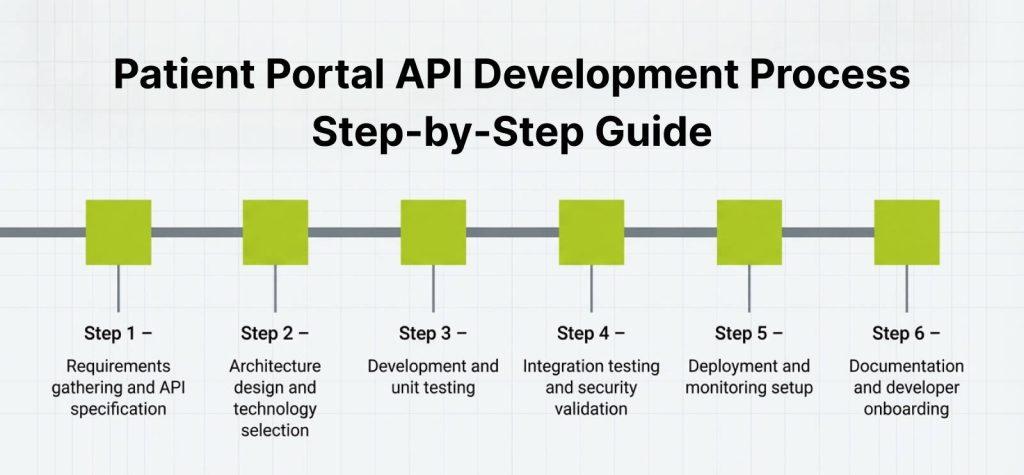
Successful patient portal API development follows a structured process that addresses technical, regulatory, and organizational requirements at each phase.
Step 1 – Requirements gathering and API specification
Begin by documenting functional and non-functional requirements from all stakeholders. Clinical teams describe workflow needs. IT teams identify integration points. Compliance teams specify regulatory requirements. This phase establishes the foundation for architecture decisions.
Action items
- Conduct stakeholder interviews with clinical, IT, and compliance teams
- Map data flows between EHR, portal, and third-party systems
- Define API endpoints, methods, and response structures
- Document compliance requirements, including HIPAA, FHIR, and state regulations
- Create API specification using OpenAPI/Swagger format
- Identify performance requirements, including response times and throughput
- Establish security requirements and threat models
Step 2 – Architecture design and technology selection
Design the API architecture considering scalability, security, and integration complexity. Technology selection should balance team expertise, performance requirements, and long-term maintenance considerations. Document decisions and rationale for future reference.
Action items
- Choose a technology stack based on requirements and team capabilities
- Design API gateway and middleware architecture
- Plan authentication and authorization implementation
- Define data models and FHIR resource mappings
- Create infrastructure diagrams and deployment topology
- Establish a development, staging, and production environment strategy
- Define monitoring, logging, and alerting architecture
Step 3 – Development and unit testing
Build API endpoints following established design principles and coding standards. Implement security controls at every layer from the start rather than adding them later. Comprehensive unit tests validate functionality and catch regressions early.
Action items
- Develop RESTful or GraphQL endpoints per specification
- Implement OAuth 2.0 authentication and role-based access control
- Build input validation and error handling logic
- Create unit tests targeting 80%+ code coverage
- Generate API documentation from code annotations
- Implement audit logging for all data access
- Conduct code reviews with a security focus
Step 4 – Integration testing and security validation
Test API integrations with EHR systems, third-party applications, and frontend interfaces. Security validation through penetration testing identifies vulnerabilities before production deployment. Performance testing confirms APIs meet requirements under load.
Action items
- Execute integration tests with EHR sandbox environments
- Perform end-to-end testing with the patient portal frontend
- Conduct penetration testing and vulnerability assessments
- Validate HIPAA compliance controls with the compliance team
- Test performance under expected and peak load conditions
- Verify audit logging captures the required information
- Test failover and disaster recovery procedures
Step 5 – Deployment and monitoring setup
Deploy APIs to production with proper CI/CD pipelines, ensuring consistent, repeatable deployments. Monitoring and alerting catch issues before they impact users. Operational procedures prepare teams to respond effectively to incidents.
Action items
- Configure API gateway, load balancing, and auto-scaling
- Set up monitoring dashboards for key metrics
- Implement alerting for errors, latency, and security events
- Enable audit logging with appropriate retention
- Create runbooks for common operational scenarios
- Establish on-call rotation and escalation procedures
- Document rollback procedures for failed deployments
Step 6 – Documentation and developer onboarding
Publish comprehensive documentation enabling internal teams and external partners to integrate successfully. Self-service onboarding accelerates adoption while maintaining security through automated provisioning and access controls.
Action items
- Publish interactive API documentation
- Create a sandbox environment with synthetic test data
- Develop SDKs for common programming languages
- Write developer guides and integration tutorials
- Establish partner onboarding workflow
- Create support channels for developer questions
- Define API versioning and deprecation communication processes
Organizations seeking experienced teams to execute this process can hire patient portal developers with healthcare domain expertise and HIPAA compliance experience.
Understanding development costs helps organizations plan and budget appropriately.
Looking for Experienced Patient Portal API Developers?
Our healthcare-specialized development teams deliver FHIR-compliant, secure APIs on time and within budget. Discuss your project requirements with our experts.
Patient Portal API Development Cost and Timeline
Understanding investment requirements helps organizations plan patient portal API initiatives effectively. Costs vary significantly based on scope, complexity, and specific requirements.
The cost of patient portal API development ranges from $40,000 for basic implementations to $350,000 or more for comprehensive enterprise solutions. Timeline spans from 3 months for simple projects to 12 months or longer for complex multi-system integrations.
Several factors drive these variations. The table below breaks down typical investments by complexity level.
| Complexity Level | Features | Estimated Cost | Timeline |
| Basic | REST APIs, basic OAuth 2.0, 5–10 endpoints, single EHR integration | $40,000–$80,000 | 3–4 months |
| Intermediate | FHIR compliance, full OAuth 2.0/OIDC, webhooks, 20–30 endpoints, multiple integrations | $100,000–$180,000 | 5–7 months |
| Advanced | Multi-tenant architecture, AI/ML integration, partner ecosystem, full HIPAA audit, 50+ endpoints | $200,000–$350,000+ | 8–12 months |
These estimates assume a dedicated development team and include design, development, testing, deployment, and initial documentation. Ongoing maintenance typically costs 15-20% of initial development investment annually.
Factors that influence development cost
- The number and complexity of API endpoints directly impact development effort. Simple CRUD operations on standard resources require less work than complex business logic or data transformation.
- EHR vendors requiring integration affect both complexity and timeline. Epic, Cerner, and Allscripts each have different API capabilities, certification requirements, and integration patterns. Multi-vendor environments multiply this complexity.
- FHIR compliance and certification requirements add development and testing effort. ONC certification for health IT products requires demonstrating specific functionality through rigorous testing processes.
- Security and compliance audit needs influence both initial development and ongoing costs. Third-party penetration testing, SOC 2 certification, and HIPAA audits each require preparation and remediation efforts.
- AI and machine learning feature requirements add specialized development expertise. Building APIs that support predictive analytics, chatbots, or personalization engines requires data science capabilities alongside API development.
- Documentation and developer portal sophistication scale with partner ecosystem ambitions. Basic documentation supporting internal teams costs less than comprehensive developer portals enabling third-party ecosystems.
- Ongoing support and maintenance scope should factor into total cost of ownership calculations. APIs require monitoring, security patching, version updates, and developer support throughout their lifecycle.
Even well-planned projects encounter challenges that impact timelines and budgets. Let’s take a look at a few of them.
Common Challenges in Patient Portal API Development and How to Overcome Them
Patient portal API development presents unique challenges that span technical, organizational, and regulatory domains. Anticipating these challenges and planning mitigation strategies improves project outcomes.
Challenge 1: Legacy system integration complexity
Many healthcare organizations operate legacy EHR systems with outdated APIs or proprietary data formats. These systems often lack modern RESTful interfaces, use obsolete authentication mechanisms, and document poorly. Integration requires reverse-engineering behavior and building translation layers.
Solutions
- Deploy middleware layers that translate between legacy and modern API formats
- Use HL7 v2 to FHIR conversion tools for data standardization
- Implement phased migration strategies that minimize disruption to clinical workflows
- Consider API facade patterns that abstract legacy complexity from portal developers
- Engage vendor professional services for complex integrations with supported paths
Challenge 2: Maintaining HIPAA compliance across all endpoints
Every API endpoint handling PHI must meet stringent HIPAA requirements. Ensuring consistent compliance across dozens or hundreds of endpoints requires systematic approaches. A single overlooked endpoint can create compliance gaps and breach risks.
Solutions
- Implement security-by-design principles from project inception
- Use automated compliance scanning tools integrated into CI/CD pipelines
- Conduct regular third-party security audits and penetration assessments
- Establish clear data classification policies that guide implementation decisions
- Create reusable security components that enforce consistent controls across endpoints
- Maintain compliance documentation as living artifacts updated with each release
Challenge 3: Ensuring API performance at scale
Patient portals experience unpredictable usage patterns. Traffic spikes during open enrollment, flu season, or public health emergencies can overwhelm APIs designed for average load. Performance degradation frustrates patients and may prevent access to critical health information.
Solutions
- Implement caching strategies at the API gateway, application, and database layers
- Use asynchronous processing for operations that don’t require an immediate response
- Deploy auto-scaling infrastructure that responds to demand automatically
- Optimize database queries and implement connection pooling
- Consider read replicas for high-volume data retrieval operations
- Load test regularly to validate performance under various scenarios
Challenge 4: Managing API versioning without breaking integrations
As patient portals evolve, APIs must change to support new features and fix issues. However, breaking changes disrupt third-party integrations, mobile apps, and partner ecosystems. Organizations must balance innovation velocity with integration stability.
Solutions
- Adopt semantic versioning with published deprecation timelines
- Maintain backward compatibility for 12–18 months after announcing deprecation
- Provide detailed migration guides explaining changes and upgrade paths
- Use feature flags to gradually roll out changes and test with subsets of traffic
- Communicate changes through developer newsletters, portal announcements, and direct outreach
- Offer migration support for strategic partners during transition periods
Challenge 5: Balancing security with developer experience
Overly complex authentication flows and restrictive rate limits frustrate developers trying to build integrations. However, relaxing security controls exposes patient data to unauthorized access. Finding the right balance determines whether your API ecosystem thrives or stagnates.
Solutions
- Provide clear, comprehensive documentation that explains security requirements and rationale
- Offer sandbox environments with realistic synthetic data for development and testing
- Implement intuitive error messages that guide developers toward correct usage
- Create self-service portals for API key management and access requests
- Set rate limits based on actual usage patterns rather than arbitrary thresholds
- Provide dedicated support channels for developer questions and issues
Challenge 6: Achieving interoperability across multiple EHR vendors
Healthcare organizations frequently operate multiple EHR systems across departments, acquired facilities, or affiliated practices. Each vendor’s API has different capabilities, data models, authentication mechanisms, and rate limits. Building unified patient experiences across this fragmentation requires significant abstraction effort.
Solutions
- Adopt FHIR as the common data exchange standard wherever vendor support exists
- Build abstraction layers that normalize vendor-specific differences behind consistent interfaces
- Participate in regional health information exchanges that aggregate multi-vendor data
- Consider middleware platforms specifically designed for multi-vendor healthcare environments
- Test integrations thoroughly in each vendor’s sandbox before production deployment
- Plan for ongoing maintenance as vendors release API updates on different schedules
According to JMIR, 43.7% of patients reported using multiple patient portals, highlighting the fragmentation patients experience and the value unified APIs can provide.
Despite these challenges, the trajectory of patient portal API development points toward exciting opportunities.
Build Your Patient Portal APIs with Space-O AI
Patient portal API development requires expertise spanning healthcare standards, security architecture, integration patterns, and regulatory compliance. This guide covered FHIR implementation, OAuth authentication, HIPAA requirements, and emerging AI capabilities that define modern healthcare APIs.
Space-O AI brings 15+ years of AI development experience, 500+ AI projects delivered, and 97% client retention rate. Our teams understand the unique challenges of building technology that handles sensitive patient data while meeting strict regulatory requirements.
Our healthcare API specialists have implemented FHIR-compliant integrations, built AI-powered patient engagement features, and delivered secure, scalable solutions for health systems nationwide. We combine deep technical expertise with practical understanding of clinical workflows.
Ready to build patient portal APIs that transform your healthcare digital experience? Contact us for a free consultation to discuss your requirements, explore architectural options, and plan your path to modern healthcare interoperability.
Frequently Asked Questions on Patient Portal API Development
1. What is FHIR, and why is it important for patient portal APIs?
FHIR (Fast Healthcare Interoperability Resources) is an HL7 standard for exchanging healthcare data electronically. It provides standardized resource types and RESTful APIs that ensure interoperability, regulatory compliance with the 21st Century Cures Act, and simplified integration across healthcare systems.
2. How long does it take to develop patient portal APIs?
Development timelines range from 1–3 months for basic implementations with limited endpoints to 8–12 months for comprehensive solutions including multi-vendor EHR integration, AI capabilities, partner ecosystems, and full HIPAA compliance certification.
3. What security measures are required for patient portal APIs?
Patient portal APIs require OAuth 2.0 or SMART on FHIR authentication, TLS 1.2+ encryption for data in transit, encryption at rest for stored data, role-based access control, comprehensive audit logging, rate limiting, and regular penetration testing to maintain HIPAA compliance.
4. Can patient portal APIs integrate with AI and machine learning systems?
Yes, modern patient portal APIs can be architected to feed data to AI systems for predictive analytics, chatbots, personalization engines, and generative AI applications. This requires careful attention to data pipelines, security boundaries, and compliance with PHI handling requirements.
5. How do I ensure my patient portal APIs comply with the 21st Century Cures Act?
Implement FHIR-based APIs that provide patients access to their electronic health information without information blocking. Support standardized data formats, enable patients to share data with third-party applications of their choice, and avoid practices that restrict legitimate data access.


Build a Secure Patient Portal API
What to read next