- What Is NLP Patient Portal Development?
- How NLP Works in Patient Portals
- Benefits of NLP in Patient Portal Development
- Key Use Cases of NLP in Patient Portals
- NLP Development Process for Patient Portals
- Step 3: Model selection and development
- Challenges in Implementing NLP for Patient Portals and How to Overcome Them
- How Much Does NLP Patient Portal Development Cost?
- Build Your NLP-Powered Patient Portal with Space-O AI
- Frequently Asked Questions on NLP in Patient Portals
- 1. How does NLP improve patient engagement in healthcare portals?
- 2. Is NLP in patient portals HIPAA compliant?
- 3. What are the main use cases for NLP in patient portals?
- 4. How long does it take to implement NLP in a patient portal?
- 5. Can NLP handle multiple languages in patient portals?
- 6. Why choose Space-O AI for NLP in patient portal development?
- 7. What engagement models does Space-O AI offer for NLP projects?
- 8. How does Space-O AI ensure HIPAA compliance in NLP implementations?
NLP Patient Portal Development: A Complete Guide for

 Last Updated: March, 23 2026
Patient portals generate thousands of messages daily, yet most healthcare organizations struggle to process them efficiently. Patients describe symptoms in their own words, ask billing questions in fragmented sentences, and send urgent requests that get buried in overflowing inboxes. The result? Delayed responses, frustrated patients, and clinicians drowning in administrative work.
According to Future Market Insights, the healthcare NLP market was valued at USD 4,873.4 million in 2025 and is expected to grow to USD 24,446.1 million by 2035 at a CAGR of 17.5%. This growth reflects a fundamental shift in how healthcare organizations approach patient communication.
Natural Language Processing (NLP) changes this equation entirely. By enabling patient portals to understand, classify, and respond to human language, NLP transforms chaotic, unstructured data into actionable clinical insights.
Healthcare organizations investing in AI patient portal development services quickly realize that NLP serves as a foundational capability, not just an add-on, directly influencing how effective their portal becomes.
This guide explores how to develop NLP-powered patient portal solutions. We have shared insights from our 15+ years of experience as an experienced AI patient portal development agency to help you understand the use cases that deliver measurable ROI, implementation challenges, and what it takes to build NLP-powered patient engagement platforms.
What Is NLP Patient Portal Development?
NLP patient portal development refers to the process of building patient portals that use natural language processing to understand, interpret, and respond to human language across patient and provider interactions. Instead of relying only on structured forms, menus, or predefined inputs, NLP enables patient portals to process free text, voice inputs, and conversational data in a meaningful way.
In an NLP enabled patient portal, patients can communicate in their own words through messages, chat interfaces, or voice commands, while the system intelligently extracts intent, context, and key medical information. This allows the portal to deliver more accurate responses, route queries efficiently, surface relevant health information, and support clinical workflows without manual intervention.
By integrating NLP capabilities, patient portals move beyond static digital access points and become interactive engagement platforms. They help reduce administrative burden for care teams, improve response accuracy, and create a more intuitive experience for patients, especially those who may struggle with complex medical terminology or rigid digital interfaces.
The role of NLP in patient portals
NLP serves as the intelligent layer that transforms how patients and healthcare systems interact. Here’s why it matters:
1. Bridging the communication gap
Patients rarely describe their concerns using medical terminology. They write “my stomach has been acting up for days” instead of “persistent gastrointestinal discomfort.” NLP understands these natural expressions and maps them to clinical concepts, ensuring nothing gets lost in translation.
2. Automating administrative workflows
Healthcare staff spend hours manually reading, categorizing, and routing patient messages. NLP automates this process by instantly classifying incoming requests, assigning priority levels, and directing messages to appropriate departments or care teams.
3. Enhancing accessibility
Not every patient has the same health literacy level. NLP enables portals to translate complex medical information into plain language, generate simplified visit summaries, and adapt content based on individual patient needs.
4. Supporting clinical decision-making
By extracting structured data from unstructured patient messages, NLP helps clinicians identify patterns, flag potential risks, and make informed decisions without manually reviewing every communication.
5. Enabling personalization
NLP analyzes patient history, preferences, and communication patterns to deliver personalized responses, relevant health education content, and tailored recommendations.
How NLP Works in Patient Portals
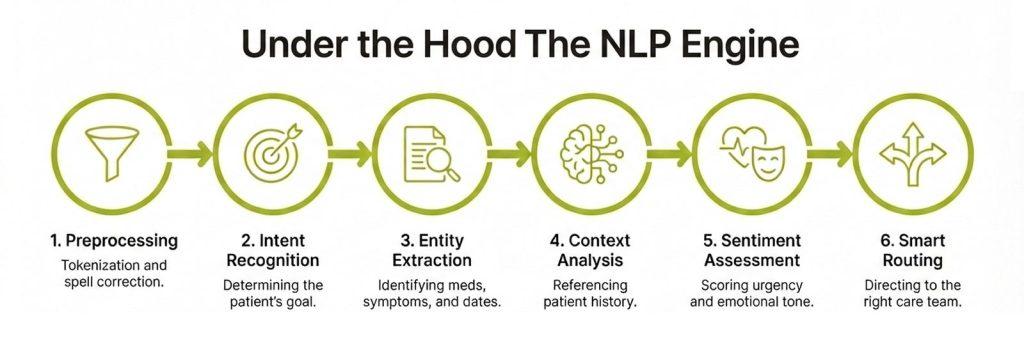
When a patient sends a message through a portal, NLP processes it through a series of steps that transform raw text into actionable information. Here’s how the workflow operates.
Step 1: Text preprocessing
Before analysis begins, the NLP system prepares the incoming message for processing. This stage handles the inconsistencies common in patient communications.
- Tokenization: Breaking the message into individual words and phrases
- Normalization: Converting text to lowercase, expanding abbreviations, and standardizing formats
- Spell correction: Fixing typos and autocorrect errors that could affect understanding
- Noise removal: Filtering out irrelevant characters, excessive punctuation, or formatting artifacts
For example, a message like “I need 2 refill my BP meds ASAP!!!” becomes structured input ready for analysis.
Step 2: Intent recognition
The system determines what the patient wants to accomplish. Intent recognition classifies the message into predefined categories based on the overall purpose.
Common intents in patient portals include:
- Appointment scheduling or rescheduling
- Prescription refill requests
- Clinical questions about symptoms or conditions
- Billing and insurance inquiries
- Lab result questions
- General feedback or complaints
AI chatbot systems use intent recognition to provide immediate responses or route complex queries to appropriate staff.
A single message may contain multiple intents, which the system identifies and separates for appropriate routing.
Step 3: Entity extraction
While intent tells us what the patient wants, entity extraction identifies the specific details within the message. The NLP system recognizes and tags key information such as:
- Medications: Drug names, dosages, and frequencies
- Symptoms: Pain descriptions, duration, and severity
- Dates and times: Appointment preferences, symptom onset
- Provider names: Physicians, specialists, or care team members
- Body parts: Locations of pain or discomfort
From “I need to reschedule my appointment with Dr. Johnson from Tuesday to Thursday,” the system extracts: intent (reschedule), provider (Dr. Johnson), current date (Tuesday), and preferred date (Thursday).
Step 4: Context analysis
NLP considers the broader context to interpret messages accurately. This includes:
- Patient history: Previous messages, conditions, and medications on file
- Conversation context: Earlier messages in the same thread
- Clinical context: Relevant medical knowledge to interpret symptoms
- Temporal context: Understanding references like “yesterday” or “last week”
Context helps the system understand that “the same problem as before” refers to a previously documented condition without requiring the patient to repeat details.
Step 5: Sentiment and urgency assessment
The system evaluates the emotional tone and urgency level of the message. This assessment influences routing and response priority.
- Sentiment scoring: Positive, negative, or neutral tone detection
- Urgency indicators: Words suggesting immediate attention needed
- Risk signals: Language patterns that may indicate crisis situations
- Frustration detection: Signs of patient dissatisfaction or escalating concerns
Messages flagged as urgent or containing risk signals bypass standard queues for immediate clinical review.
Step 6: Response generation or routing
Based on all previous analyses, the system takes appropriate action:
- Automated responses: Providing immediate answers to common questions
- Smart routing: Directing messages to the right department or staff member
- Form population: Pre-filling information for staff to review and complete
- Alert triggering: Notifying clinicians of urgent or high-risk messages
- Knowledge retrieval: Pulling relevant information from FAQs or knowledge bases
The entire process happens in milliseconds, enabling real-time patient interactions while maintaining clinical accuracy.
Understanding how NLP works provides the foundation for exploring the benefits this technology delivers to healthcare organizations.
Benefits of NLP in Patient Portal Development
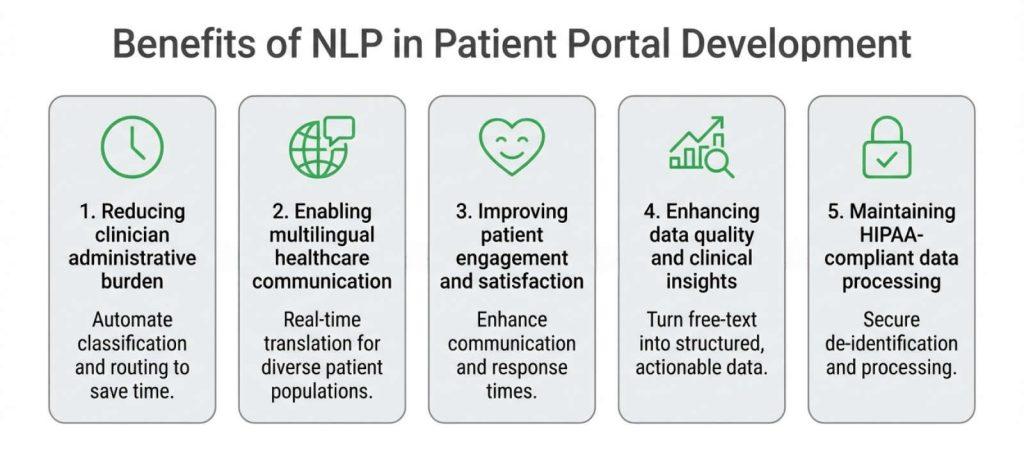
Implementing NLP in patient portals delivers measurable advantages for healthcare organizations, clinical staff, and patients. Here are the key benefits that drive adoption.
1. Reducing clinician administrative burden
NLP automates the processing of patient messages, eliminating hours of manual reading, classification, and routing. Clinical staff focus on patient care instead of inbox management. Repetitive inquiries that previously consumed staff time are handled automatically, freeing healthcare teams to address complex patient needs.
2. Enabling multilingual healthcare communication
NLP-powered portals serve diverse patient populations without language barriers. Real-time translation converts messages between languages while preserving clinical accuracy. Cultural adaptation ensures communications resonate with patients from different backgrounds. Healthcare organizations expand their reach without hiring multilingual staff for every language.
3. Improving patient engagement and satisfaction
Faster response times and personalized interactions increase patient satisfaction scores. NLP enables 24/7 intelligent self-service for common questions, appointment scheduling, and prescription refills. Patients receive immediate acknowledgment and relevant information instead of waiting days for staff to manually process their requests.
4. Enhancing data quality and clinical insights
NLP transforms unstructured patient messages into structured clinical data that integrates with electronic health records. Combined with machine learning development, this clean, consistent data improves population health analytics, risk stratification, and care quality reporting. Healthcare organizations gain insights that were previously buried in free-text communications.
5. Maintaining HIPAA-compliant data processing
NLP systems designed for healthcare include built-in compliance features. De-identification algorithms protect patient privacy during processing. Audit trails track every data access and transformation. Encryption secures data in transit and at rest. Organizations implement NLP while meeting regulatory requirements.
With these benefits in mind, let’s explore the specific use cases where NLP technology delivers measurable value.
Built NLP-Enabled Patient Portals With Space-O AI
Partner with Space-O AI to implement NLP solutions that understand patient language and automate clinical workflows seamlessly.
Key Use Cases of NLP in Patient Portals
NLP transforms patient portals from passive information repositories into intelligent communication platforms. Here are the use cases that deliver the most impact.
1. Automated classification of patient requests
Every day, patient portals receive hundreds or thousands of messages covering appointments, prescriptions, billing inquiries, clinical questions, and administrative requests. Manually sorting these messages consumes staff time and delays responses.
NLP automatically classifies incoming messages by:
- Type: Clinical question, appointment request, prescription refill, billing inquiry, or general feedback
- Urgency: Routine, time-sensitive, or urgent based on language patterns and clinical indicators
- Department: Primary care, specialty clinic, pharmacy, billing, or patient services
- Required action: Information only, response needed, or escalation required
This classification happens in milliseconds, ensuring that urgent messages reach clinicians immediately while routine requests route to appropriate staff members.
2. Sentiment analysis of portal feedback
Understanding how patients feel about their care goes beyond reading satisfaction surveys. NLP analyzes the emotional tone of every patient message to detect:
- Frustration signals: Repeated follow-ups, negative language, or escalating concerns
- Anxiety indicators: Questions about serious diagnoses, treatment side effects, or upcoming procedures
- Satisfaction markers: Positive feedback, gratitude expressions, or compliments
- Risk flags: Language suggesting depression, self-harm, or crisis situations
Healthcare organizations use sentiment analysis to proactively reach out to frustrated patients, provide additional support to anxious individuals, and identify at-risk patients who need immediate intervention.
3. Free-text symptom capture and structuring
Traditional symptom intake relies on dropdown menus and checkboxes that force patients into predefined categories. But symptoms rarely fit neat boxes. A patient might write: “I’ve had this weird pressure in my chest that comes and goes, mostly when I climb stairs, and sometimes my left arm feels tingly.”
NLP extracts structured clinical data from these descriptions:
- Symptom: Chest pressure, arm tingling
- Location: Chest, left arm
- Timing: Intermittent
- Triggers: Physical exertion (climbing stairs)
- Duration: Ongoing (implied)
This structured data populates pre-visit questionnaires, informs clinical decision support systems, and helps providers prepare for appointments with relevant context.
4. Entity extraction from patient inquiries
Patient messages contain valuable clinical information buried in casual language. NLP identifies and extracts:
- Medications: Brand names, generic names, dosages, and frequencies mentioned in messages
- Conditions: Diagnosed conditions, suspected issues, and symptom descriptions
- Providers: Names of physicians, specialists, or care team members
- Dates and times: Appointment references, symptom onset, and medication schedules
- Facilities: Hospital names, clinic locations, and pharmacy preferences
Extracted entities auto-populate patient records, reduce duplicate data entry, and ensure that relevant information reaches the right systems.
5. Voice-to-text for appointment notes
Many patients prefer speaking over typing, especially older adults or those with disabilities. NLP-powered voice-to-text enables:
- Voice message transcription: Patients leave audio messages that convert to searchable text
- Real-time dictation: Patients describe symptoms verbally while the portal captures structured notes
- Multilingual voice support: Speech recognition across multiple languages and accents
- Accessibility compliance: Meeting requirements for patients who cannot use traditional input methods
Voice capabilities expand portal accessibility while generating the same structured data as text-based inputs.
6. NLP for summarizing visit summaries
Clinical documentation is written for healthcare professionals, not patients. After-visit summaries filled with medical jargon leave patients confused about their diagnoses, treatment plans, and next steps.
NLP transforms clinical notes into patient-friendly summaries by:
- Simplifying terminology: Converting “hypertension” to “high blood pressure” and “dyspnea” to “shortness of breath.”
- Highlighting key points: Extracting the most important information from lengthy notes
- Generating action items: Creating clear lists of medications to take, appointments to schedule, and lifestyle changes to make
- Personalizing explanations: Adapting language complexity based on patient health literacy levels
These use cases demonstrate the practical applications of NLP in patient portals. Now let’s explore the structured process for implementing these capabilities.
NLP Development Process for Patient Portals
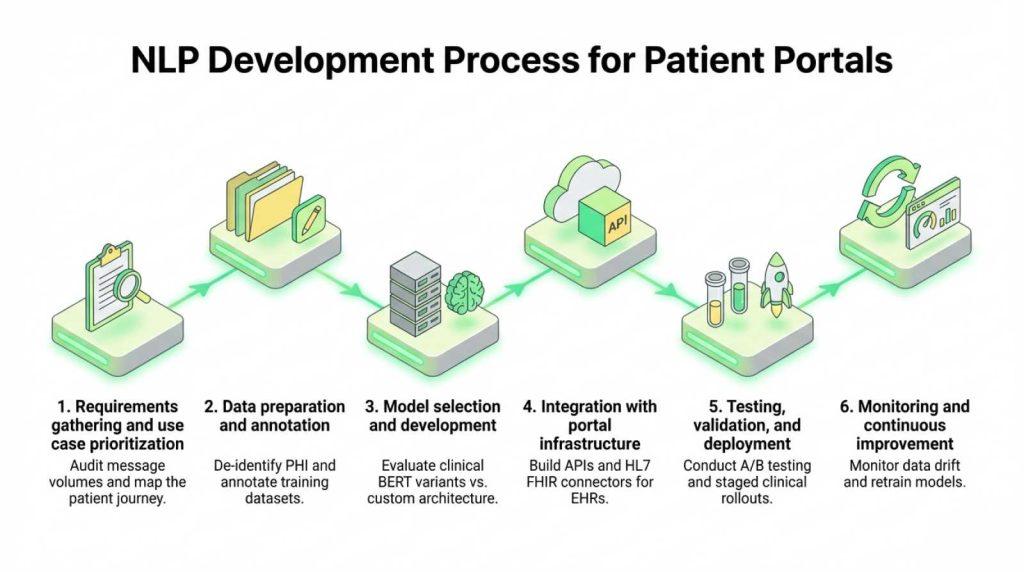
Building NLP capabilities into patient portals requires a structured approach that balances technical development with clinical validation. Here is the process that delivers production-ready NLP systems.
Step 1: Requirements gathering and use case prioritization
Before writing any code, you need clarity on what problems NLP will solve and how success will be measured. Working with patient portal consulting services helps organizations identify high-impact use cases and avoid scope creep that delays delivery.
Key actions
- Audit current patient message volumes and categorize by type, urgency, and handling time
- Interview clinical staff and administrators to understand pain points and workflow bottlenecks
- Define specific success metrics such as response time reduction, classification accuracy, and staff time savings
- Map the patient journey to identify touchpoints where NLP adds the most value
- Prioritize use cases based on impact, feasibility, and organizational readiness
Step 2: Data preparation and annotation
NLP models are only as good as the data they learn from. Healthcare organizations must prepare training datasets that represent real patient communications while maintaining privacy and compliance.
Key actions
- Collect representative samples of patient messages across all target use cases
- De-identify data to remove PHI while preserving linguistic patterns
- Create annotation guidelines that define how messages should be labeled
- Train annotation teams on clinical terminology and classification criteria
- Build validation datasets to measure model performance independently from training data
Step 3: Model selection and development
Choosing the right NLP approach depends on use case complexity, data availability, and performance requirements. Options range from pre-trained healthcare models to fully custom solutions.
Key actions
- Evaluate pre-trained healthcare NLP models, such as clinical BERT variants or specialized medical NLP platforms
- Determine whether fine-tuning existing models meets requirements or custom development is necessary
- Select appropriate model architectures for each use case (classification, entity extraction, summarization)
- Implement training pipelines with proper versioning and experiment tracking
- Validate model outputs against clinical standards and expert review
Step 4: Integration with portal infrastructure
NLP models must connect seamlessly with existing patient portal systems, EHRs, and clinical workflows. Poor integration undermines even the best models. Organizations often partner with a professional AI integration service provider ensure NLP capabilities work harmoniously with existing infrastructure.
Key actions
- Design APIs that expose NLP capabilities to portal applications
- Build connectors for EHR/EMR systems using HL7 FHIR or proprietary interfaces
- Implement message queuing for high-volume processing without performance degradation
- Create workflow orchestration that routes NLP outputs to appropriate systems and users
- Establish error handling and fallback procedures for model failures
Step 5: Testing, validation, and deployment
Healthcare NLP requires rigorous testing that goes beyond standard software quality assurance. Clinical validation ensures models perform safely in real-world conditions.
Key actions
- Conduct unit testing, integration testing, and end-to-end testing across all components
- Perform clinical validation with subject matter experts reviewing model outputs
- Run A/B testing to compare NLP-assisted workflows against baseline performance
- Execute staged rollouts starting with low-risk use cases before expanding
- Document model behavior, limitations, and appropriate use cases for end users
Step 6: Monitoring and continuous improvement
Deployment is not the finish line. NLP systems require ongoing monitoring, maintenance, and improvement to maintain accuracy as language patterns and clinical practices evolve.
Key actions
- Build performance dashboards that track classification accuracy, processing times, and error rates
- Implement feedback loops where staff corrections feed back into model training
- Schedule regular model retraining cycles with updated data
- Monitor for data drift that indicates changing patient communication patterns
- Conduct periodic audits to identify bias and performance disparities
Following a structured process helps, but organizations should also prepare for common implementation challenges.
Build Your NLP Patient Portal the Right Way
Work with Space-O AI to design and develop NLP-powered patient portals using a proven development process backed by 15+ years of healthcare and AI experience
Challenges in Implementing NLP for Patient Portals and How to Overcome Them
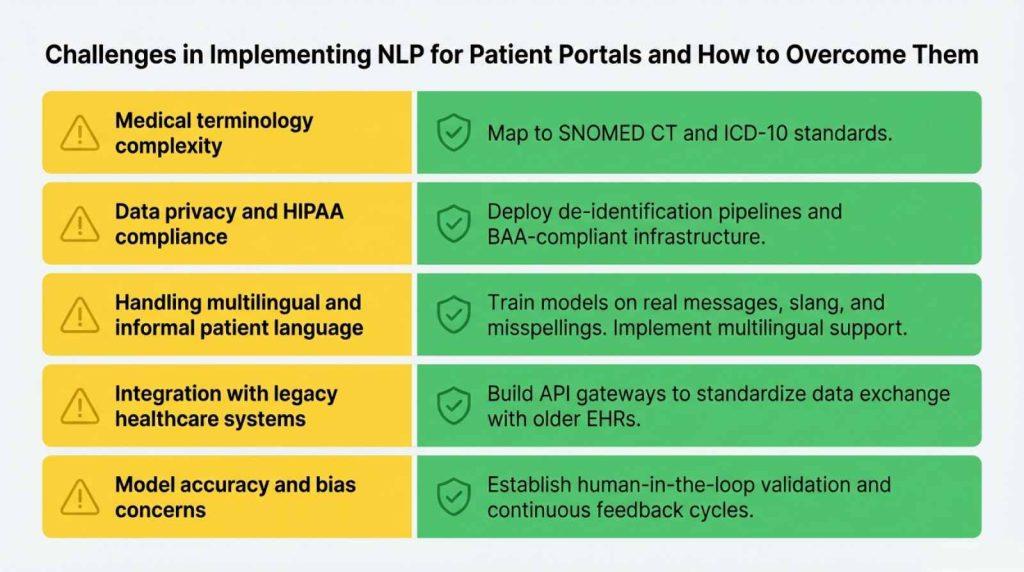
Building NLP capabilities into patient portals is not without obstacles. Understanding these challenges upfront helps organizations plan effectively and avoid common pitfalls.
1. Medical terminology complexity
Healthcare communication involves specialized vocabulary that general NLP models struggle to interpret accurately. Patients use everyday language while clinical systems expect standardized terms. Medical concepts often have multiple valid representations, and the same words can carry different meanings depending on the clinical context.
How to overcome it
- Use domain-specific NLP models trained on clinical text rather than general-purpose models
- Implement medical ontology mapping with SNOMED CT, RxNorm, and ICD-10 standards
- Continuously train models on your organization’s specific terminology and documentation patterns
- Include clinical validation in development workflows to catch misinterpretations
2. Data privacy and HIPAA compliance
Patient messages contain protected health information (PHI) that must be handled according to strict regulatory requirements. Cloud-based NLP services raise concerns about data security, and any breach could result in significant penalties and reputational damage.
How to overcome it
- Deploy on-premise or private cloud NLP models for sensitive data processing
- Implement de-identification pipelines that strip PHI before analysis when possible
- Work only with vendors who sign Business Associate Agreements (BAAs)
- Establish audit trails that track every data access and processing step
- Conduct regular security assessments and penetration testing
3. Handling multilingual and informal patient language
Patients do not write formal medical descriptions. They use slang, regional expressions, emojis, and incomplete sentences. Multilingual communities may mix languages within single messages. Spelling errors and autocorrect mistakes are common.
How to overcome it
- Train NLP models on real patient messages, not just formal clinical text
- Build custom dictionaries for common misspellings, slang terms, and regional expressions
- Implement context-aware processing that uses surrounding text to interpret ambiguous terms
- Support code-switching for multilingual patient populations
- Include spell-check and normalization layers before primary NLP processing
4. Integration with legacy healthcare systems
Most healthcare organizations run on legacy EHR systems, practice management software, and billing platforms that were not designed for AI integration. Data silos, inconsistent formats, and limited APIs create integration challenges. Patient portal integration service providers help organizations navigate these complexities effortlessly.
How to overcome it
- Build API gateways that standardize data exchange between NLP systems and legacy platforms
- Use FHIR-based integration where supported to ensure interoperability
- Implement middleware solutions that translate between modern NLP outputs and legacy system inputs
- Plan for phased integration that delivers value incrementally rather than requiring complete system overhauls
5. Model accuracy and bias concerns
NLP models can produce incorrect classifications, miss critical information, or exhibit bias based on training data limitations. In healthcare, these errors have real consequences for patient safety and care quality.
How to overcome it
- Implement human-in-the-loop validation for high-stakes classifications and clinical decisions
- Use diverse training data that represents your actual patient population
- Establish continuous monitoring dashboards that track model performance over time
- Create feedback loops where staff corrections improve model accuracy
- Conduct regular bias audits to identify and address disparities in model performance
Now, let’s look at what it takes from a cost perspective to implement NLP in your patient portal.
How Much Does NLP Patient Portal Development Cost?
Implementing NLP in patient portals within the USA varies widely based on system complexity, typically ranging from $10,000 to over $500,000 for initial development and integration. For comprehensive, customized AI solutions in large healthcare systems, costs can exceed $1 million.
Cost breakdown by complexity
The table below provides a detailed cost breakdown based on NLP implementation complexity.
| Component | Estimated Cost Range |
| Basic NLP Features (Chatbots, Querying) | $20,000 – $100,000 |
| Advanced/Custom NLP Systems (Clinical Data Mining, Complex Analysis) | $200,000 – $500,000+ |
| Integration with EHR (e.g., Epic, Cerner) | $25,000 – $200,000 |
| Data Preparation & Labeling | $15,000 – $100,000 |
These ranges reflect typical project scopes and may vary based on specific organizational requirements and existing infrastructure.
- Basic NLP Features ($20,000 – $100,000): FAQ chatbots, simple intent recognition, and automated responses to common patient questions.
- Advanced/Custom NLP Systems ($200,000 – $500,000+): Symptom extraction, sentiment analysis, clinical entity recognition, and custom models trained on organization-specific data.
- Integration with EHR ($25,000 – $200,000): Costs vary based on platform complexity and whether integration is read-only or bi-directional with real-time updates.
- Data Preparation & Labeling ($15,000 – $100,000): De-identification, clinical annotation, and dataset preparation required to train accurate NLP models.
Ongoing costs
Beyond initial development, organizations should budget for continuous operational expenses to maintain NLP system performance.
- Annual maintenance and upgrades: 15–25% of the initial project cost
- Cloud infrastructure: Compute and storage costs for model hosting and data processing
- Model retraining: Periodic updates to maintain accuracy as language patterns evolve
- Monitoring and support: Performance dashboards, issue resolution, and technical support
Factors that influence NLP patient portal development costs
1. Team composition and expertise
NLP projects require data scientists, ML engineers, healthcare domain experts, and integration specialists. Organizations that hire patient portal developers with healthcare experience often achieve faster time-to-value than those building capabilities from scratch with general-purpose teams.
2. Data preparation effort
The condition of existing data significantly impacts costs. Organizations with well-organized, annotated patient communication archives require less preparation. Those starting from scratch face higher annotation and cleaning costs.
3. Integration complexity
Connecting NLP systems to legacy EHRs, practice management systems, and billing platforms requires custom development. Organizations with modern FHIR-compliant systems integrate more easily than those running older platforms.
4. Compliance and security requirements
Healthcare-specific security controls, audit capabilities, and compliance documentation add development time. Organizations in highly regulated environments or those handling particularly sensitive data face higher compliance costs.
Get a Clear Cost Estimate for Your NLP Patient Portal
Talk to Space-O AI and receive a transparent development cost estimate based on your NLP requirements, integrations, and compliance needs.
Build Your NLP-Powered Patient Portal with Space-O AI
NLP in patient portal development transforms how healthcare organizations communicate with patients through automated message classification, sentiment analysis, clinical text processing, and multilingual support. These capabilities reduce clinician burden while improving patient engagement, satisfaction, and care quality outcomes.
Space-O AI brings 15+ years of experience in building production-ready AI solutions for healthcare organizations. We have successfully delivered 500+ AI projects, helping businesses worldwide implement intelligent systems that drive measurable results and operational efficiency.
Our team of 80+ AI specialists includes NLP engineers, healthcare domain experts, and HIPAA compliance professionals who understand clinical workflows. With a 97% client retention rate, we have earned trust by delivering AI chatbots, clinical NLP systems, and patient engagement platforms.
Ready to implement NLP in your patient portal? Contact Space-O AI for a free consultation to discuss your requirements, explore implementation options, and receive a detailed project estimate. Let’s build intelligent healthcare communication experiences together.
Frequently Asked Questions on NLP in Patient Portals
1. How does NLP improve patient engagement in healthcare portals?
NLP improves patient engagement by enabling faster response times through automated message classification and intelligent routing. It provides 24/7 self-service for common questions, supports multilingual communication for diverse patient populations, and delivers personalized interactions based on patient context and history. Patients receive immediate acknowledgment and relevant information instead of waiting for manual staff responses.
2. Is NLP in patient portals HIPAA compliant?
Yes, NLP solutions can be built to be fully HIPAA compliant when proper safeguards are in place. This includes encryption for data at rest and in transit, secure access controls, de-identification of training data, audit logging, and deployment on BAA-compliant infrastructure. Compliance depends on system architecture and operational controls rather than the NLP technology itself.
3. What are the main use cases for NLP in patient portals?
Common NLP use cases include automated classification and triage of patient requests, sentiment analysis to identify frustration or risk signals, free-text symptom capture converted into structured clinical data, entity extraction for medications and conditions, voice-to-text for accessibility, and generation of plain-language visit summaries from clinical notes.
4. How long does it take to implement NLP in a patient portal?
NLP implementation typically takes 3 to 6 months depending on complexity. Basic message classification projects may take 2 to 3 months. Moderate implementations with multilingual support and sentiment analysis require 3 to 4 months. Advanced deployments with clinical NLP, voice capabilities, custom models, and deep EHR integration can take 4 to 6 months or longer.
5. Can NLP handle multiple languages in patient portals?
Yes, multilingual NLP solutions can support diverse patient populations. Modern NLP models process dozens of languages and can handle code-switching within messages. Real-time translation enables accurate communication while preserving clinical meaning, and cultural adaptation ensures patient interactions remain contextually appropriate across languages.
6. Why choose Space-O AI for NLP in patient portal development?
Space-O AI brings over 15 years of experience and 500+ successful AI projects across healthcare and other industries. Our team includes NLP engineers, healthcare domain specialists, and HIPAA compliance experts. With a strong focus on security, scalability, and seamless integration, we deliver production-ready NLP solutions tailored to patient portal environments.
7. What engagement models does Space-O AI offer for NLP projects?
Space-O AI offers flexible engagement models, including dedicated AI teams for long-term initiatives, fixed-price contracts for clearly defined scopes, and time-and-materials models for evolving or exploratory NLP projects. Each engagement includes access to healthcare AI experts, structured project management, and ongoing technical guidance.
8. How does Space-O AI ensure HIPAA compliance in NLP implementations?
HIPAA compliance is ensured through end-to-end encryption, role-based access controls, secure API integrations, de-identification pipelines for training data, and detailed audit logging. Space-O AI conducts regular security assessments and works exclusively with BAA-compliant cloud and infrastructure providers to protect patient health information.


Planning to Build an NLP Powered Patient Portal?
What to read next