15 Natural Language Processing Examples Transforming Business in 2025

 Last Updated: December, 16 2025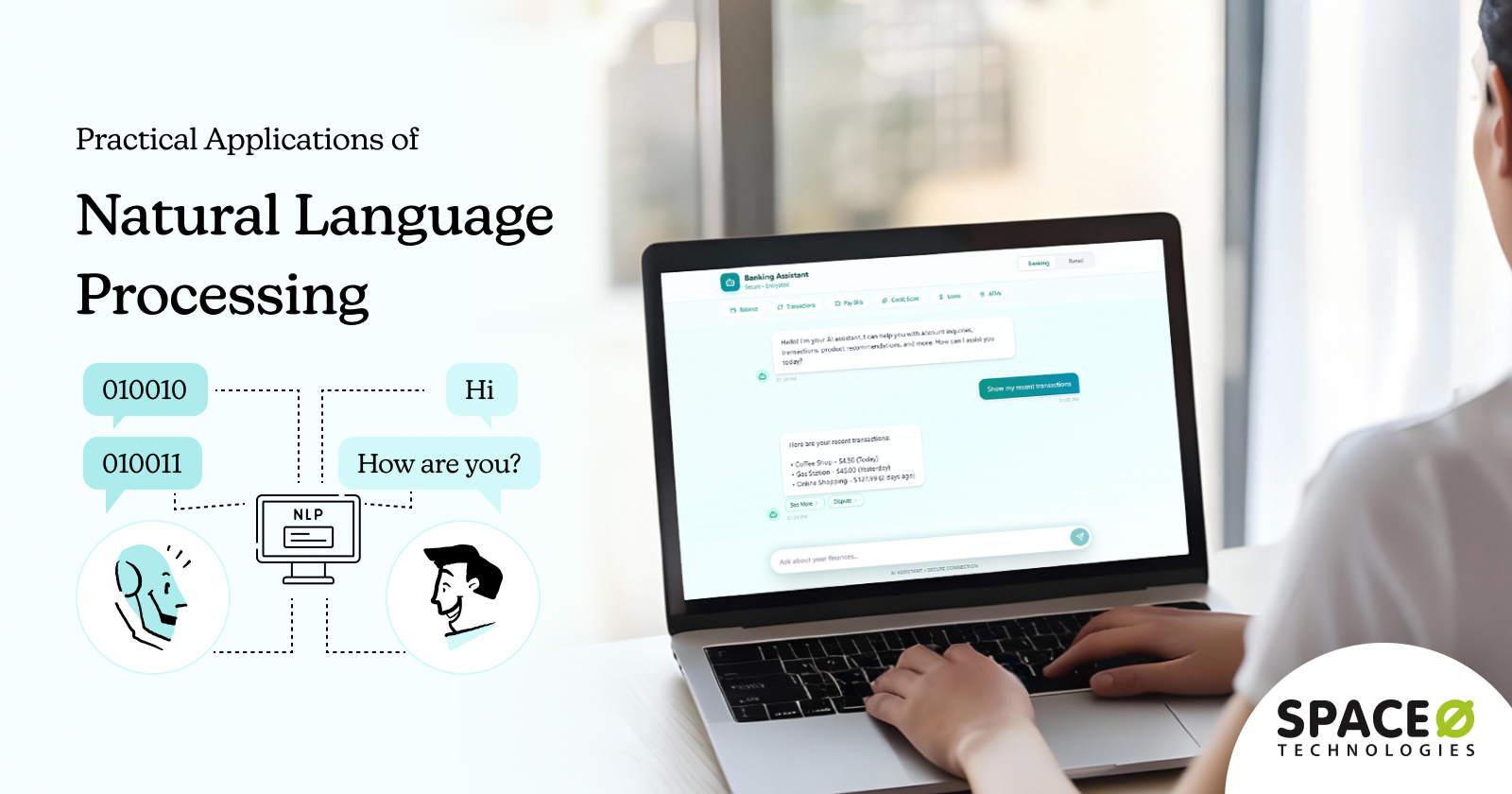
Natural language processing is one of the most widely used branches of artificial intelligence, yet it often feels abstract when explained only through definitions and models. Many people understand that NLP enables machines to work with human language, but struggle to visualize how it actually works in real life.
The growing adoption of NLP across industries highlights why practical understanding matters. According to Grand View Research, the global natural language processing market is expanding from $59.70 billion in 2024 to $439.85 billion by 2030, growing at a CAGR of 17.9%.
This rapid growth is being driven by real-world applications such as chatbots, voice assistants, sentiment analysis, intelligent search, and automated text processing. This is where real-world examples make all the difference.
In this blog, we break down the 15 most popular natural language processing examples across everyday tools and business applications. Get insights from our 15+ years of experience as an AI development firm to understand NLP’s uses for learning, product development, and business automation. Let’s get started.
15 Real-World Examples of Natural Language Processing
The following 15 examples of natural language processing show how organizations are using NLP to solve real business problems across industries. Each demonstrates the challenge organizations face, how NLP addresses it, and the measurable business impact they’ve achieved.
1. Everyday consumer applications
These are natural language processing applications you interact with daily. They’ve become so seamlessly integrated into your digital life that you might not realize NLP is powering them, but understanding how they work reveals the sophistication of modern language AI.
1.1 Email filtering and spam detection
The Challenge: Email inboxes receive hundreds of messages daily. Without intelligent filtering, users would be overwhelmed by spam, phishing attempts, and unwanted messages, making email communication impractical.
How NLP Solves It: Gmail’s spam filter uses NLP to analyze email characteristics, sender patterns, subject line keywords, message content, and user behavior. The system learns from your interactions, distinguishing legitimate emails from spam with sophisticated pattern recognition that understands context, not just keywords.
Key Business Benefits:
- Reduces email clutter and improves productivity
- Prevents security breaches from phishing attacks
- Maintains inbox as a viable communication channel
1.2 Smart assistants and voice recognition
The Challenge: Users want to interact with devices naturally through voice, but systems must understand context, intent, and natural speech patterns, including accents, background noise, and colloquialisms.
How NLP Solves It: Voice assistants like Siri, Alexa, and Google Assistant use NLP to understand context beyond literal words. “Call Mom” knows you mean phone, not video call. “What’s the weather tomorrow?” understands you mean your location. Multi-part commands like “Turn up the music and dim the lights” are parsed into separate actions.
Key Business Benefits:
- Enable hands-free interaction in manufacturing and service environments
- Improve accessibility for users with mobility or vision limitations
- Reduce customer service costs through 24/7 automated support
1.3 Autocomplete and predictive text
The Challenge: Users spend significant time typing on keyboards and in search bars. Manual input is slow and repetitive; systems that predict intent could dramatically improve user experience and productivity.
How NLP Solves It: Predictive text systems analyze billions of text examples to recognize patterns in how users communicate. They understand that “I’m feeling” typically precedes emotion words, and “What’s the best” usually leads to opinion-based searches. Smartphones, Gmail Smart Compose, and Google Search all use these models to suggest completions before users finish typing.
Key Business Benefits:
- Reduce typing time and user frustration
- Improve search efficiency and discovery
- Enhance user experience across communication platforms
1.4 Search engines and AI overviews
The Challenge: Traditional search returns ranked links; users must click and browse to find answers. Modern search expectations demand instant, synthesized answers directly on the results page.
How NLP Solves It: Google’s BERT and MUM algorithms use NLP to understand search intent beyond literal keywords. When you search “how to fix a leaky faucet,” the system understands you want procedural guidance, not academic articles. AI Overviews extract the most relevant passage from the web and synthesize it into a direct answer.
Key Business Benefits:
- Provide instant answers without click-through
- Improve search relevance and user satisfaction
- Shift content strategy from ranking to semantic clarity
1.5 Language translation
The Challenge: Global teams need to collaborate across language barriers. Manual translation is expensive and slow; real-time translation would enable seamless international communication.
How NLP Solves It: Neural Machine Translation (used by Google Translate, DeepL, and others) understands meaning rather than translating word-by-word. “It’s raining cats and dogs” is understood as an idiom and translated with equivalent expressions in the target language, maintaining meaning and tone.
Key Business Benefits:
- Enable global collaboration without language barriers
- Reduce translation costs and turnaround time
- Improve communication in distributed international teams
1.6 Content recommendations
The Challenge: Users are overwhelmed with content options. Platforms need to surface relevant content to keep users engaged; better recommendations directly drive revenue and reduce churn.
How NLP Solves It: Recommendation systems combine NLP with collaborative filtering. NLP analyzes content (plot synopses, descriptions, user reviews) while machine learning finds patterns in user behavior. Netflix estimates recommendations drive 80% of viewing activity, making this a core revenue lever.
Key Business Benefits:
- Increase user engagement and time spent on the platform
- Improve content discovery and user satisfaction
- Directly drive revenue through increased consumption
2. Business and enterprise applications
These NLP examples demonstrate how enterprises deploy NLP to drive measurable business outcomes, reducing costs, improving efficiency, and generating competitive advantages. The financial impact is quantifiable and significant.
2.1 Customer service chatbots
The Challenge: Customer service teams are overwhelmed with routine inquiries. Users expect 24/7 support; hiring sufficient staff to meet demand is cost-prohibitive, and most inquiries are straightforward questions that don’t require human expertise.
How NLP Solves It: Chatbots powered by NLP understand customer intent, retrieve relevant information, and provide instant responses. Bank of America’s Erica chatbot handles millions of monthly interactions, answering account questions and processing transactions. Sephora’s chatbot provides recommendations, checks inventory, and processes returns—all through natural conversation.
Key Business Benefits:
- Reduce support costs by 60–80%
- Provide 24/7 availability without proportional staffing increases
- Maintain 90%+ customer satisfaction on routine queries
Identifying which chatbot use cases align with your organization’s priorities requires strategic assessment. Partner with an experienced AI consulting agency that can help you prioritize high-impact implementations that deliver measurable ROI from day one.
2.2 Sentiment analysis and brand monitoring
The Challenge: Customers broadcast opinions constantly across social media, review sites, forums, and support channels. Manually monitoring feedback at scale is impossible; organizations miss reputation crises and product opportunities.
How NLP Solves It: AI sentiment analysis automatically analyzes customer feedback to understand brand perception in real-time. Coca-Cola monitors 120+ social media platforms, capturing sentiment instantly. Negative sentiment triggers response teams. Positive mentions identify brand advocates. Product mentions reveal demand signals that guide development.
Key Business Benefits:
- Prevent reputation crises through early detection
- Identify product opportunities from customer feedback
- Make data-driven decisions based on customer voice
The real power of sentiment analysis emerges when insights flow directly into your operations. This requires connecting NLP monitoring systems with your CRM, social media platforms, customer support systems, and internal alert mechanisms.
An AI integration service provider can handle this complex work, ensuring brand insights reach the teams that need to act on them immediately rather than sitting in dashboards.
2.3 Text analytics and data extraction
The Challenge/Context: Organizations generate massive amounts of unstructured text, customer emails, support tickets, surveys, and meeting notes. This data contains critical insights, but manual analysis at scale is impossible.
How NLP Solves It: NLP-powered text analytics automatically extracts insights from unstructured data. Legal teams identify key contract clauses. Healthcare providers extract clinical insights from patient notes. Manufacturers analyze maintenance logs to predict equipment failures.
Key Business Benefits:
- Unlock insights from 80% of enterprise data that’s unstructured
- Identify patterns and opportunities at scale
- Make decisions based on complete customer data, not samples
2.4 Automated report generation
The Challenge: Teams spend 5–10 hours weekly on documentation and report creation. This administrative work consumes time that could be spent on analysis and strategy.
How NLP Solves It: NLP generates natural language summaries from raw data. Financial institutions automatically generate earnings reports. Microsoft Teams transcribes meetings and generates summaries. Business intelligence platforms generate narrative insights from dashboards: “Revenue increased 15% this quarter due to 22% enterprise growth,” written automatically.
Key Business Benefits:
- Reduce documentation time by 60-80%
- Enable faster reporting cycles
- Free experts to focus on high-value analysis
2.5 Voice-to-text transcription and documentation
The Challenge: Physicians spend 6+ hours daily on documentation—more time typing than treating patients. This administrative burden drives clinician burnout, a critical healthcare challenge.
How NLP Solves It: Doctors dictate clinical notes naturally; NLP transcription systems achieve 99% accuracy in converting speech to text. Enterprise voice-to-text solutions are deployed across hundreds of thousands of physicians globally. These systems integrate directly with EHR platforms, automatically populating patient records and eliminating manual data entry.
Key Business Benefits:
- Reduce clinician burnout and improve retention
- Eliminate 2+ hours daily of administrative work
- Improve work satisfaction without increasing staffing
2.6 Market intelligence and competitive analysis
The Challenge: Organizations need to identify market trends and competitive threats quickly, but manually monitoring news, social media, and industry discussions is impractical.
How NLP Solves It: NLP systems monitor news, social media, earnings calls, and industry research to identify trends and threats. Investment firms use sentiment analysis to identify emerging opportunities. Retailers monitor competitor announcements. Manufacturers track supply chain discussions.
Key Business Benefits:
- Identify competitive threats and market opportunities early
- Make strategic decisions based on real-time market data
- Accelerate response to market changes
3. Industry-specific transformations
These examples demonstrate how NLP is reshaping industries, creating competitive advantages for early adopters and transforming how critical work gets done.
3.1 Healthcare: Clinical documentation and diagnostics
The Challenge: Healthcare providers struggle with documentation burden and diagnostic accuracy. Manual chart review is time-consuming; early detection of complications and drug interactions is critical but difficult at scale.
How NLP Solves It: NLP extracts clinical insights from patient records and Electronic Health Records (EHRs). Systems identify patients at risk of readmission, adverse drug interactions, or complications before they occur. Radiologists use AI-powered imaging systems that flag suspicious areas in scans as a second set of eyes.
Key Business Benefits:
- Reduce hospital readmissions and associated financial penalties
- Prevent adverse events through early detection
- Improve diagnostic accuracy and patient outcomes
Healthcare organizations implementing NLP solutions benefit from partners with deep expertise in AI healthcare software development services. They understand both clinical workflows and regulatory compliance requirements, such as HIPAA.
3.2 Finance: Fraud detection and risk assessment
The Challenge: Financial institutions process millions of transactions daily. Fraud detection must be accurate without creating false positives; risk assessment determines lending decisions affecting millions in capital.
How NLP Solves It: NLP analyzes transaction descriptions and patterns to identify suspicious activity. Rather than simple rules (“Flag transactions over $10,000”), NLP understands context, unusual merchant categories, atypical locations, and timing inconsistent with user behavior.
Key Business Benefits:
- Detect fraud with 95%+ accuracy, reducing fraud losses
- Accelerate loan processing from weeks to days
- Assess risk more accurately than traditional scoring
3.3 Legal: Contract analysis and compliance
The Challenge: Law firms and corporate legal departments process thousands of contracts annually. Manual review is expensive, slow, and error-prone; teams need to identify risks and inconsistencies quickly.
How NLP Solves It: NLP systems extract key clauses automatically, including payment terms, liability limitations, termination conditions, and non-compete clauses. They identify risks, inconsistencies with standard terms, and missing provisions. Contracts are compared to templates to spot deviations instantly.
Key Business Benefits:
- Reduce contract review time by 80-90%
- Identify legal risks automatically before they become problems
- Enable senior lawyers to focus on strategy and client counsel
These are the top use cases of natural language processing. Next, let’s understand how to choose the right use case as per your specific needs.
Explore NLP Use Cases for Your Business
See how natural language processing can be applied to your workflows. Talk to our expert AI consultants about identifying and building the right NLP solutions for your business needs.
Choosing the Right NLP Use Case for Your Business
Selecting the right NLP use case is critical to achieving measurable business outcomes. While natural language processing can be applied across many functions, the highest impact comes from aligning NLP initiatives with real operational needs, data readiness, and long-term goals. This section helps you evaluate where NLP fits best and how to approach implementation.
1. Identifying Language-Heavy Workflows
NLP delivers the highest ROI in workflows where large volumes of unstructured text or voice data are already being created. These are processes that rely heavily on human interpretation and manual effort.
Common language-heavy workflows include customer conversations across chat, email, and support tickets, user reviews and survey responses, internal documentation, contracts, policies, and reports, as well as sales emails and lead inquiries. In these areas, NLP can automate classification, extract insights, detect intent, and reduce response times.
To identify the right starting point, businesses should look for workflows that are repetitive, time-consuming, and directly tied to customer experience or operational efficiency. If teams spend significant time reading, tagging, summarizing, or responding to text, NLP is likely to deliver strong returns.
2. Build vs Buy Considerations
Once a relevant use case is identified, the next decision is whether to build a custom NLP solution or use existing APIs and platforms.
Pre-built NLP APIs and SaaS platforms are often suitable for simple, generic tasks such as basic sentiment analysis, language translation, or keyword extraction. They offer faster setup and lower upfront costs, making them useful for experimentation or short-term needs.
Custom NLP models, on the other hand, are designed around your specific data, workflows, and business logic. They provide greater control over accuracy, customization, data privacy, and system integration. While custom development requires more initial investment, it often delivers better long-term value for businesses with complex or evolving requirements.
The right choice depends on factors such as data sensitivity, accuracy expectations, integration complexity, and whether NLP is a core capability or a supporting feature.
3. When Custom NLP Development Makes Sense
Custom NLP development becomes essential when businesses deal with domain-specific language that generic models struggle to understand. This includes industry terminology, internal jargon, regulatory language, or multilingual content with regional nuances.
It also makes sense when compliance, security, and data ownership are critical. Industries such as healthcare, finance, and legal often require full control over how data is processed, stored, and audited, which off-the-shelf tools may not support.
Scalability is another key factor. As NLP use cases expand across teams, channels, or geographies, custom solutions allow businesses to fine-tune performance, improve accuracy over time, and adapt models as needs evolve. In these scenarios, investing in custom NLP development helps ensure that AI solutions remain reliable, compliant, and aligned with long-term business goals.
Turn NLP Ideas Into Real-World AI Solutions With Our Experts
From chatbots to text analytics, Space-O AI helps businesses design and deploy custom NLP solutions that deliver measurable impact.
Turn NLP Use Cases Into Real Business Impact With Space-O AI
Natural language processing has transcended academic research to become an indispensable business infrastructure. The 15 examples demonstrate how NLP drives efficiency, enhances customer experience, and unlocks insights from unstructured data across every industry, from healthcare to finance to legal services.
Implementing NLP successfully requires more than technical capability. Organizations need strategic partners who understand implementation complexity, organizational change management, and business context. Space-O AI brings 15+ years of expertise, 500+ completed projects, and deep knowledge across healthcare, finance, manufacturing, and logistics sectors.
As a skilled AI software development agency, we follow proven approaches that accelerate deployment while avoiding common pitfalls. We identify high-impact automation opportunities first, manage organizational transitions effectively, and continuously optimize systems post-launch.
Ready to discover what NLP could deliver for your organization? Schedule a consultation with our AI experts. We’ll analyze your processes, identify top automation opportunities, quantify potential impact, and build a roadmap aligned with your timeline and budget.
Frequently Asked Questions on NLP Use Cases
What NLP models and techniques power modern systems?
Modern NLP models are built on natural language processing techniques, including tokenization, named entity recognition, sentiment analysis, text classification, and machine translation. Transformer models (BERT, GPT-4, Claude) represent the cutting edge, processing entire sentences simultaneously to understand word relationships.
Large Language Models (LLMs) trained on billions of text examples provide remarkable accuracy. These natural language processing techniques enable systems to understand context, nuance, and intent with remarkable sophistication.
What NLP technology and tools should my organization consider?
NLP technology ranges from pre-built platforms to custom solutions. Natural language processing tools include cloud APIs from OpenAI, Google Cloud NLP, and AWS Comprehend for quick implementation.
Enterprise organizations deploy custom NLP applications integrated with existing systems. Choose based on complexity, budget, and timeline. Start with proofs-of-concept using accessible tools before committing to enterprise deployments for maximum ROI.
How does NLP differ from machine learning?
Machine Learning is the broader field of teaching computers to learn from data. Natural language processing is a specific machine learning application focused on language. All NLP uses machine learning, but not all machine learning involves language. Image recognition and predictive analytics use machine learning without NLP technology. Think of machine learning as the foundation, with NLP as one application built on it.
How much does it cost to implement NLP?
Implementation costs vary by complexity. Basic chatbots using pre-built natural language processing tools cost $5,000-$15,000 initial plus $500-$2,000/month. Custom NLP solutions range from $50,000-$200,000. Enterprise systems cost $200,000-$1,000,000+. Cloud API usage costs $1-$5 per 1,000 calls or $500-$5,000/month. ROI typically emerges within 12-18 months through labor savings, efficiency gains, and error reduction.
What industries benefit most from NLP applications?
Healthcare, finance, retail, customer service, legal, manufacturing, and HR all benefit significantly. Healthcare uses NLP applications for clinical documentation and diagnostics. Finance employs fraud detection and risk assessment. Retail optimizes recommendations. Legal automates contract analysis. Manufacturing predicts equipment failures.
Any industry processing text at scale sees substantial benefits from natural language processing use cases. Early adopters gain a competitive advantage.
How do I choose the right NLP implementation partner?
Evaluate partners’ industry expertise and implementation track record. Review case studies, client references, and measurable results. Assess security, compliance, and post-deployment support capabilities. Verify experience with comparable complexity and scale.
Consider organizational change management skills. Space-O Technologies brings 15+ years of expertise, 500+ completed projects, and proven success deploying natural language processing solutions across multiple industries.


Build Custom NLP Solutions
What to read next