- What Is Machine Learning in Patient Portal?
- Benefits of Implementing Machine Learning in Patient Portals
- 1. Improved patient engagement and retention
- 2. Reduced clinician and staff workload through automation
- 3. Better health outcomes through proactive interventions
- 4. Increased portal adoption rates
- 5. Operational cost savings from reduced no-shows and readmissions
- 6. Data-driven decision-making for care teams
- Key Use Cases of Machine Learning in Patient Portals
- How to Implement Machine Learning in Your Patient Portal: A Step-by-Step Roadmap
- Challenges of ML Implementation in Patient Portals and How to Overcome Them
- Build Your ML-Powered Patient Portal with Space-O AI
- Frequently Asked Questions on Machine Learning for Patient Portals
Machine Learning in Patient Portals: A Complete Guide

 Last Updated: March, 23 2026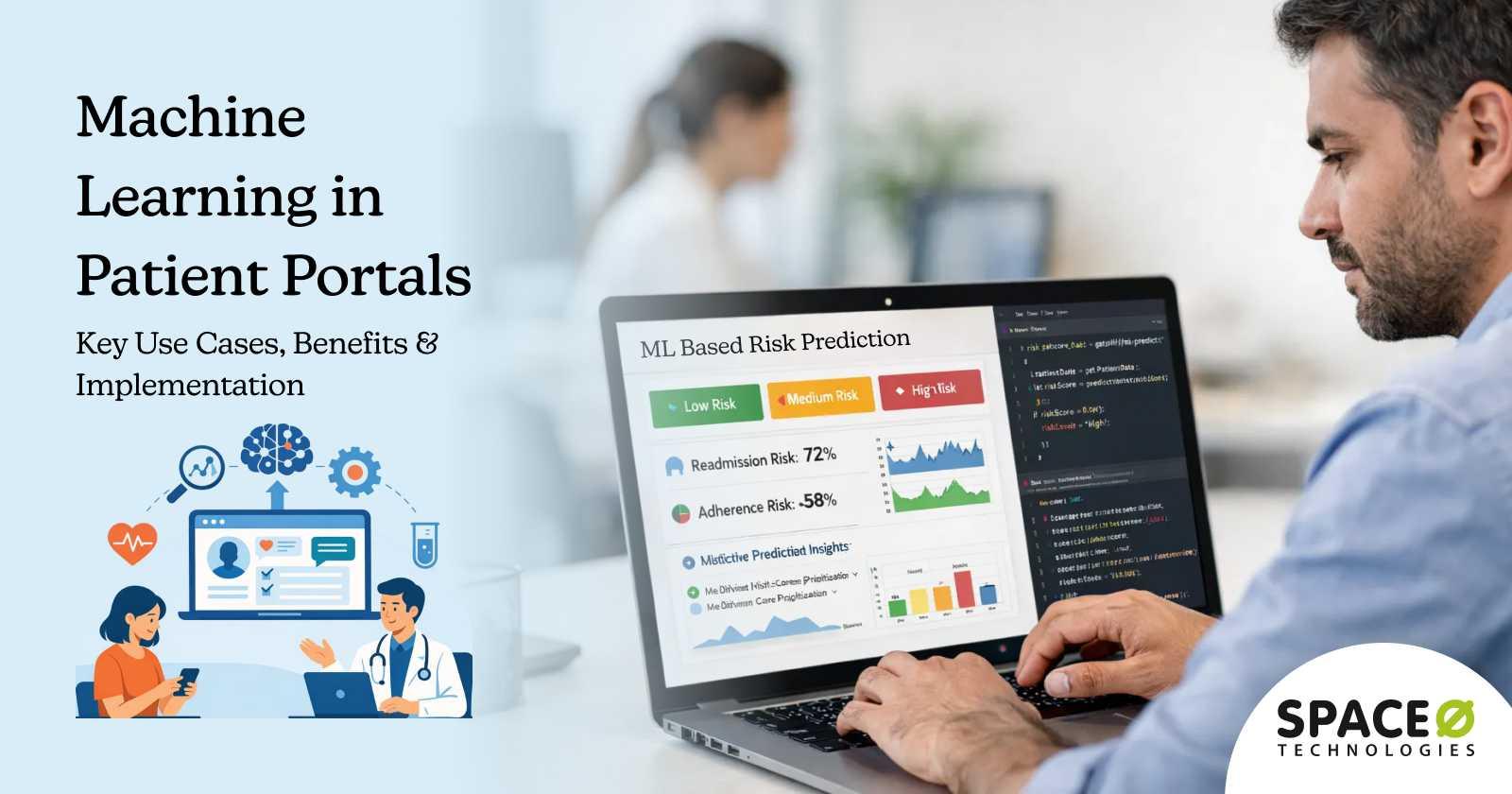
Patient portals are rapidly evolving as healthcare providers adopt advanced technologies to improve care quality and accessibility. According to Precedence Research, machine learning held the largest share of 39.8% in the AI healthcare technology segment in 2024. This highlights how machine learning has become the foundation for many intelligent healthcare applications.
As patient portals move beyond basic access to records and appointments, healthcare organizations are looking for ways to deliver more personalized, efficient, and responsive digital experiences. Static workflows and rule-based systems are no longer enough to meet modern patient expectations.
Machine learning enables patient portals to learn from patient behavior, clinical data, and interaction patterns to deliver smarter experiences. From personalized content and predictive insights to automated workflows, machine learning powered patient portals help healthcare providers improve patient care quality and accessibility.
In this blog, we explore the most impactful ways machine learning is used in patient portals. Based on our 15+ years of experience as a leading AI patient portal development agency, we have shared how machine learning capabilities support better digital healthcare delivery.
What Is Machine Learning in Patient Portal?
Machine learning in patient portals refers to the application of algorithms that learn from healthcare data to automate decisions, personalize experiences, and predict patient outcomes. Unlike rule-based systems that follow pre-programmed logic, ML models identify patterns in data and improve their accuracy over time without explicit programming.
Consider the difference between a traditional reminder system and an ML-powered one. A rule-based system sends appointment reminders 24 hours before every visit. An ML model analyzes each patient’s history, including past no-shows, preferred communication channels, response patterns, and appointment types, to determine the optimal timing, frequency, and message content for each individual. The result is higher show rates and fewer wasted reminders.
Role of machine learning in patient portals
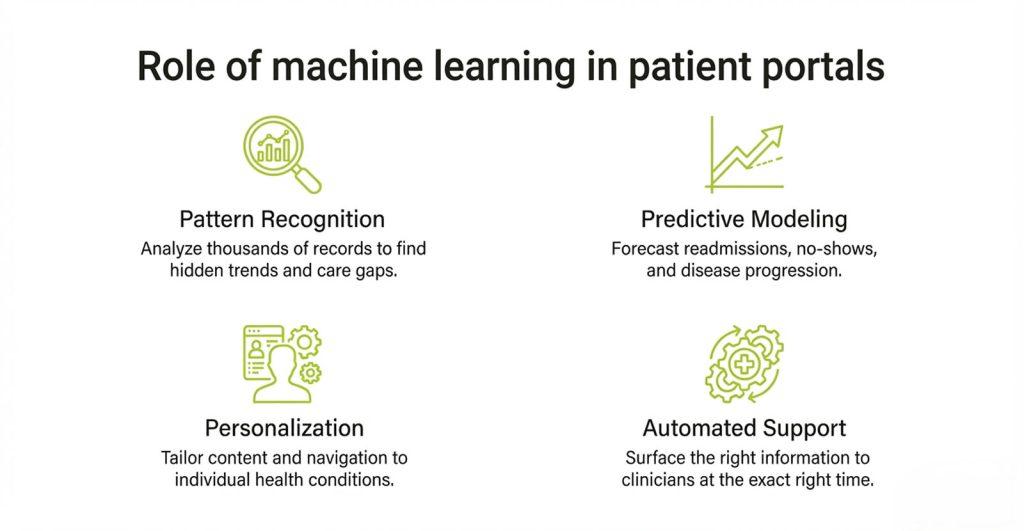
At its core, ML performs four critical functions within patient portals:
- Pattern recognition across patient populations. ML algorithms analyze thousands of patient records to identify trends, correlations, and anomalies that human reviewers would miss. These patterns inform everything from care gap identification to resource allocation.
- Predictive modeling for health outcomes. Models forecast future events like readmissions, medication non-adherence, appointment no-shows, and disease progression. These predictions enable proactive interventions before problems escalate.
- Personalization of patient experiences. Rather than showing every patient the same portal interface, ML tailors content, recommendations, and navigation based on individual health conditions, preferences, and engagement history.
- Automated decision support for care teams. ML surfaces the right information to the right clinician at the right time, prioritizing high-risk patients and suggesting evidence-based next steps.
Patients interact with ML-driven features daily, often without realizing the technology behind them. Smart appointment scheduling that suggests optimal times, personalized health articles based on conditions, medication reminders timed to individual routines, and risk alerts that prompt early outreach are all powered by machine learning models running continuously in the background.
Now that we understand what machine learning brings to patient portals, let’s examine the benefits organizations realize when implementing these capabilities.
Benefits of Implementing Machine Learning in Patient Portals
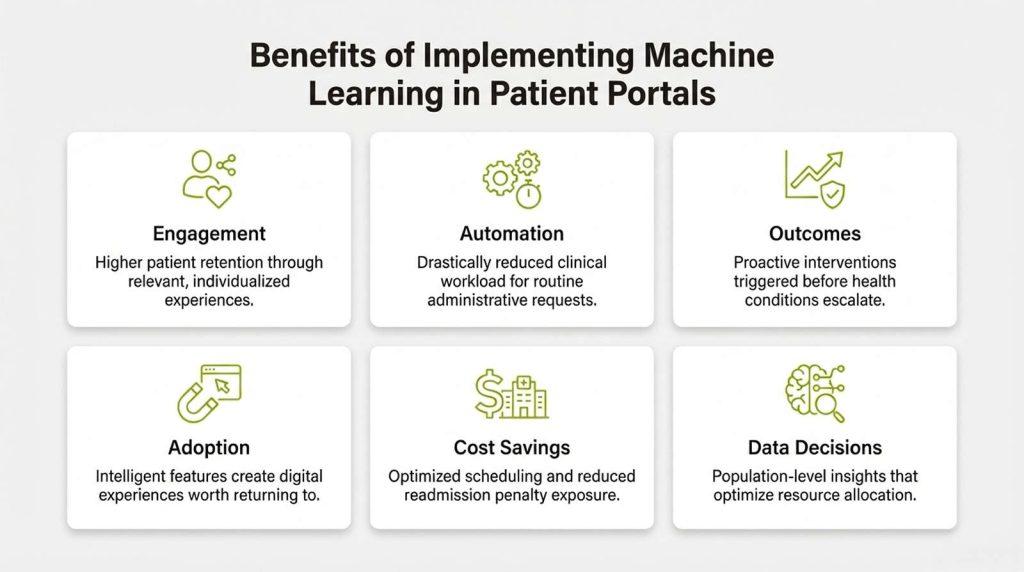
Healthcare organizations investing in ML-powered patient portals report measurable improvements across patient engagement, clinical outcomes, and operational efficiency. To understand the full scope of AI use cases in patient portals, these benefits compound over time as models learn from more data and organizations refine their strategies.
1. Improved patient engagement and retention
ML personalization makes portals more relevant to individual patients. When patients see content tailored to their conditions and preferences, they return more frequently. Higher engagement correlates with better adherence to care plans and stronger patient-provider relationships.
2. Reduced clinician and staff workload through automation
Routine tasks like appointment reminders, prescription refill requests, and basic health inquiries can be handled by an AI chatbot for patient portal support. frees clinical staff to focus on complex cases requiring human judgment while reducing burnout from repetitive administrative work.
3. Better health outcomes through proactive interventions
Predictive models identify at-risk patients before problems escalate. Early outreach for medication non-adherence, care gap closure, and risk factor management prevents costly emergency visits and hospitalizations while improving quality metrics.
4. Increased portal adoption rates
Patients who find value in their portal experience become regular users. ML-driven recommendations, personalized interfaces, and intelligent notifications create experiences worth returning to, driving the adoption rates required for population health management.
5. Operational cost savings from reduced no-shows and readmissions
Predictive scheduling optimization reduces appointment gaps. Readmission risk models enable targeted transitional care. These improvements translate directly to revenue protection and reduced penalty exposure under value-based contracts.
6. Data-driven decision-making for care teams
ML analytics surface population-level insights that inform strategic decisions. Organizations can identify which interventions work best for which patient segments, allocate resources based on predicted demand, and continuously optimize care delivery models. To maximize these benefits, many organizations engage with a healthcare AI consulting agency like Space-O AI to align ML capabilities with specific clinical and business objectives.
With these benefits in mind, let’s explore the specific use cases driving ML adoption across healthcare organizations.
Implement Machine Learning in Your Patient Portal
Space-O AI integrates machine learning models that automate workflows and personalize patient interactions.
Key Use Cases of Machine Learning in Patient Portals
Healthcare organizations are deploying machine learning across their patient portals to address specific operational and clinical challenges. The following use cases represent the highest-impact applications currently transforming patient engagement.
1. Patient risk scoring and stratification
Function: Identify high-risk patients before adverse events occur by analyzing clinical and behavioral data to generate actionable risk scores.
Key capabilities
- Analyze clinical data, social determinants, utilization patterns, and behavioral signals
- Generate real-time risk scores that update as new patient data flows in
- Trigger automated alerts when risk thresholds are exceeded
- Predict hospital readmission likelihood within 30 days post-discharge
Impact: High-risk patients receive prominent prompts to schedule preventive visits or complete health assessments. Care managers receive automated alerts when a patient’s risk score increases, enabling timely outreach.
Patients themselves can access personalized risk information with actionable recommendations to improve their health trajectory. Organizations seeking to implement risk scoring often benefit from patient portal consulting services that help define scoring methodologies aligned with clinical workflows.
2. Predictive appointment and adherence reminders
Function: Forecast appointment no-show risk and medication adherence gaps to optimize reminder strategies and reduce revenue leakage.
Key capabilities
- Analyze historical attendance patterns, appointment lead times, and transportation barriers
- Consider weather forecasts, time-of-day preferences, and billing status
- Identify patients likely to discontinue medications based on refill patterns
- Determine optimal reminder timing, frequency, and channel for each patient
Impact: Patients identified as high no-show risk receive additional touchpoints, alternative scheduling options, or transportation assistance offers through the portal. Medication adherence nudges arrive before gaps occur, reducing preventable hospitalizations and improving chronic disease management outcomes.
3. Personalized content and recommendations
Function: Deliver relevant health education and clinical recommendations tailored to individual patient circumstances rather than generic materials.
Key capabilities
- Analyze diagnoses, care gaps, reading history, and engagement patterns
- Surface condition-specific educational content automatically
- Generate next-best-action recommendations based on health risk factors
- Learn from click patterns and reading completion to refine recommendations
Impact: A diabetic patient sees articles about blood sugar management rather than generic wellness tips. A post-surgical patient receives recovery milestones specific to their procedure. The portal suggests specific actions like scheduling mammograms or completing depression screenings, dynamically prioritized by clinical importance and patient responsiveness.
4. Behavior-based patient segmentation
Function: Group patients by engagement patterns to enable tailored portal experiences and targeted outreach strategies for each segment.
Key capabilities
- Cluster patients using ML algorithms based on login frequency, feature usage, and response patterns
- Identify segments like “digital enthusiasts,” “reactive users,” and “disengaged at-risk” patients
- Tailor portal interfaces and communication strategies for each segment
- Predict portal churn and trigger re-engagement campaigns proactively
Impact: Frequent users see advanced features and detailed data. Infrequent users get simplified interfaces with critical information upfront. Disengaged patients receive re-engagement campaigns through alternative channels. This segmentation enables organizations to design portal strategies aligned with their population’s actual behaviors and engagement preferences.
5. Anomaly detection in remote patient monitoring (RPM)
Function: Identify concerning deviations from individual health baselines in continuous data streams from wearables and connected devices.
Key capabilities
- Analyze continuous vital sign data against personalized baselines
- Flag abnormal patterns before they escalate to emergencies
- Differentiate between individual normal variations and clinically significant changes
- Integrate alerts seamlessly with care team workflows
Impact: A patient whose blood pressure readings trend upward receives a prompt to contact their care team. Irregular heart rate patterns trigger educational content about when to seek care. Weight fluctuations in heart failure patients generate medication adherence reminders and dietary guidance. ML models learn each patient’s normal patterns, reducing false positives that erode trust in the alerting system.
Implementing RPM anomaly detection requires specialized expertise, which is why many organizations hire patient portal developers with experience in real-time data processing and clinical alerting systems.
Now that we’ve covered use cases, let’s walk through a step-by-step roadmap for bringing machine learning to your patient portal.
Explore How ML Can Elevate Your Patient Portal
Our healthcare AI specialists help assess your current portal capabilities and recommend high-impact ML features tailored to your patient population.
How to Implement Machine Learning in Your Patient Portal: A Step-by-Step Roadmap
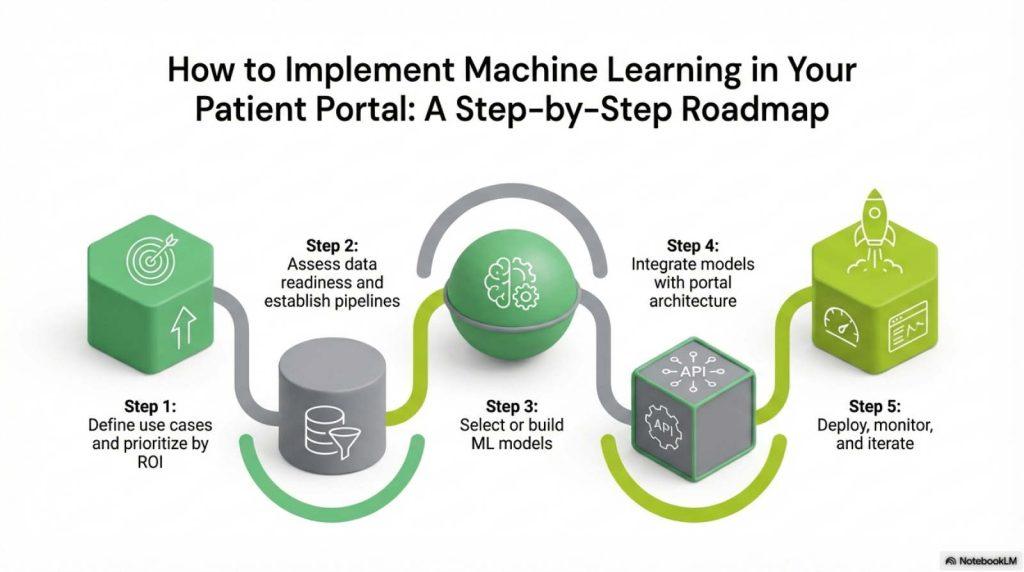
Successfully implementing machine learning in patient portals requires a structured approach that balances quick wins with long-term scalability. The following roadmap guides organizations from initial planning through production deployment and continuous improvement.
Step 1: Define use cases and prioritize by ROI
Before selecting algorithms or building infrastructure, clearly define which problems you want ML to solve. Engage clinical, operational, and IT stakeholders to identify pain points where predictive capabilities would deliver the most value. Prioritize use cases based on data availability, implementation complexity, and expected return on investment.
Action items
- Conduct stakeholder interviews to surface high-impact patient engagement challenges
- Map each potential use case to available data sources and required integrations
- Estimate value by quantifying current costs (no-shows, readmissions, staff time) that ML could reduce
- Score use cases on a complexity-value matrix and select 1-2 initial pilots
- Define success metrics and baseline measurements before implementation begins
Step 2: Assess data readiness and establish pipelines
Machine learning is only as good as the data feeding it. Audit your current data landscape to understand what’s available, what’s missing, and what quality issues exist. Build the data infrastructure required to feed clean, integrated data to your ML models on an ongoing basis.
Action items
- Inventory all relevant data sources, including EHR, scheduling, claims, and patient-generated data
- Assess data quality dimensions: completeness, accuracy, timeliness, and consistency
- Identify and remediate critical data gaps that would undermine priority use cases
- Design and implement ETL/ELT pipelines that normalize and integrate data from multiple sources
- Establish data governance processes to maintain quality as new data flows through the system
Step 3: Select or build ML models
With use cases defined and data infrastructure in place, decide whether to build custom models, leverage pre-built solutions, or combine both approaches. This decision depends on your organization’s data science capabilities, timeline requirements, and how specialized your needs are.
Action items
- Evaluate build vs. buy vs. partner options for each priority use case
- For custom models, select appropriate algorithms based on problem type and explainability requirements
- For vendor solutions, assess healthcare-specific validation, integration capabilities, and compliance certifications
- Develop or configure models using historical data, reserving holdout sets for validation
- Validate model performance against clinical benchmarks and stakeholder expectations before proceeding
Step 4: Integrate models with portal architecture
ML models must connect seamlessly with your patient portal to deliver value. This requires API development, user interface updates, and workflow integration that surfaces predictions and recommendations at the right moments in the patient and clinician experience.
Action items
- Design APIs that expose model predictions to the portal front-end and clinical workflows
- Update portal UI to display personalized recommendations, risk indicators, and smart notifications
- Implement event-driven triggers that invoke models based on patient actions or data changes
- Build fallback mechanisms that maintain portal functionality if ML services are unavailable
- Conduct integration testing across all portal touchpoints affected by ML features
- Leverage AI integration services for complex multi-system implementations
Step 5: Deploy, monitor, and iterate
Launch ML features in production with robust monitoring and feedback mechanisms. Continuous improvement requires tracking model performance, gathering user feedback, and refining both models and interfaces based on real-world results.
Action items
- Deploy to production using a staged rollout, starting with a subset of patients or facilities
- Implement monitoring dashboards tracking model accuracy, latency, and business impact metrics
- Establish alerting thresholds that trigger investigation when performance degrades
- Create feedback channels for clinicians and patients to report issues or suggestions
- Schedule regular model reviews to assess retraining needs and identify optimization opportunities
- Document learnings and apply them to accelerate future ML use case implementations
Organizations that partner with experienced development teams can accelerate this roadmap significantly while avoiding common pitfalls that delay time-to-value.
While the roadmap provides a clear path forward, organizations must also prepare for implementation challenges. Let’s examine the common hurdles and how to overcome them.
Accelerate Your ML Implementation with Expert Guidance
From use case definition through production deployment, our healthcare AI team provides end-to-end support for ML-powered patient portal projects.
Challenges of ML Implementation in Patient Portals and How to Overcome Them
Implementing machine learning in patient portals involves technical, regulatory, and organizational hurdles. Understanding these challenges and their solutions is essential for successful deployment. Organizations that anticipate these obstacles and plan mitigation strategies from the outset achieve faster time-to-value and higher clinical adoption rates.
Challenge 1: Data quality and integration complexity
Healthcare data lives in silos. EHRs store clinical records. Practice management systems track scheduling. Claims databases hold billing history. Third-party apps capture patient-generated data. None of these systems was designed to talk to each other.
The result? Missing values, inconsistent formats, duplicate records, and conflicting information across systems all degrade model accuracy. Organizations routinely discover that their EHR contains multiple different ways to record the same diagnosis.
How to overcome it
- Establish data governance with clear ownership and quality standards before starting ML development
- Implement FHIR-based APIs for standardized data exchange between systems
- Build automated ETL/ELT pipelines that cleanse, normalize, and validate data continuously
- Start with a single high-quality data source, prove value, then expand
- Partner with [patient portal integration services] specialists who understand healthcare data ecosystems
Challenge 2: HIPAA compliance and patient privacy
ML requires PHI. There’s no way around it. Risk stratification needs diagnoses. Appointment prediction needs attendance history. Personalization needs health conditions. Every feature that makes ML valuable in patient portals requires protected health information.
This creates three problems: regulatory exposure if data isn’t properly secured, legal risk if consent isn’t properly managed, and patient trust erosion if people feel their health data is being exploited.
How to overcome it
- De-identify training data using expert determination or safe harbor methods
- Apply differential privacy techniques that add noise to protect individual records while preserving statistical patterns
- Maintain comprehensive audit trails documenting every data access and model decision
- Build transparent consent flows that explain how patient data improves their experience
- Ensure all ML vendors sign BAAs and demonstrate SOC 2 Type II compliance
- Conduct regular privacy impact assessments as new ML features launch
Challenge 3: Model explainability and clinical trust
Clinicians won’t trust what they can’t understand. When a model flags a patient as high-risk for readmission, the care team needs to know why. Is it the recent ER visit? The medication non-adherence? The social determinants? Without answers, clinicians ignore the prediction, and the ML investment delivers zero value.
This isn’t optional in healthcare. A recommendation engine suggesting movies faces different stakes than one recommending clinical interventions. Explainability isn’t a nice-to-have feature. It’s a requirement for clinical adoption.
How to overcome it
- Select interpretable model architectures (gradient boosting, logistic regression) over black boxes when accuracy trade-offs are acceptable
- Implement SHAP values or LIME to surface the top factors driving each prediction
- Design clinician-in-the-loop workflows where humans make final decisions and AI provides supporting evidence
- Display confidence scores alongside predictions so clinicians understand certainty levels
- Roll out new models with clinical champions who provide feedback and build peer trust
- Track not just model accuracy, but clinician override rates as a proxy for trust
Challenge 4: Scalability and continuous model monitoring
Models degrade. It’s not a matter of if, but when. Patient populations shift. Clinical protocols change. New medications enter formularies. Seasonal patterns affect utilization. A model trained on 2024 data will underperform on 2026 patients.
Without monitoring, this degradation happens silently. Organizations discover problems only when clinicians complain or outcomes data reveal failures months later. By then, trust is damaged, and remediation is expensive.
How to overcome it
- Implement MLOps pipelines that automate model versioning, testing, and deployment
- Build monitoring dashboards tracking prediction accuracy, latency, and throughput in real-time
- Detect data drift by comparing incoming data distributions against training baselines
- Define automatic retraining triggers when accuracy drops below thresholds
- Maintain model registries with full lineage from training data to production deployment
- Allocate ongoing budget for model maintenance and retraining
Challenge 5: Change management and user adoption
The best ML model in the world delivers zero value if nobody uses it. Healthcare staff already face alert fatigue, system overload, and constant workflow changes. Adding another notification, another dashboard, another recommendation system creates friction unless it’s thoughtfully integrated.
Resistance comes from multiple directions: clinicians skeptical of AI replacing their judgment, administrators worried about liability, IT teams concerned about integration complexity, and patients uncertain about how their data is being used.
How to overcome it
- Involve end users (clinicians, care managers, patients) in design from day one
- Start with opt-in features that demonstrate clear value before making them default
- Integrate ML outputs into existing workflows rather than creating new screens to check
- Provide training that explains not just how to use features, but why they work
- Celebrate and communicate early wins to build organizational momentum
- Collect feedback continuously and iterate based on actual user experience
- Measure adoption rates by role and address resistance patterns proactively
Now, let’s address common questions healthcare leaders ask when evaluating machine learning for their patient portals.
Build Your ML-Powered Patient Portal with Space-O AI
Machine learning in patient portals transforms passive record viewers into intelligent engagement platforms that predict patient needs, personalize experiences, and automate routine workflows. From risk stratification to appointment optimization, the use cases covered in this guide deliver measurable improvements in outcomes and efficiency.
Space-O AI brings 15 years of software development expertise and 500 successful projects to healthcare organizations seeking to modernize their patient engagement capabilities. Our team combines deep AI engineering skills with healthcare domain knowledge to accelerate your implementation timeline.
Our healthcare AI consulting and machine learning development teams have delivered HIPAA-compliant ML solutions for health systems, digital health vendors, and specialty practices. We understand the unique challenges of healthcare data, clinical workflows, and regulatory compliance.
Ready to explore how machine learning can transform your patient portal? Contact our team for a free consultation to discuss your specific use cases, data readiness, and implementation roadmap. Let’s build something that improves patient lives.
Frequently Asked Questions on Machine Learning for Patient Portals
1. What types of ML models are used in patient portals?
Patient portals use classification models for predicting no-show risk and readmission likelihood, regression models for cost forecasting, clustering algorithms for patient segmentation, and recommendation systems for personalized content. NLP models analyze patient messages and clinical notes. Model selection depends on the specific problem, available data, and explainability requirements.
2. Is machine learning in patient portals HIPAA compliant?
Yes, ML can be implemented with full HIPAA compliance using proper safeguards. This requires secure data handling throughout the ML pipeline, access controls for PHI, comprehensive audit trails, and business associate agreements with third-party providers. De-identification and privacy-preserving ML methods enable analytics without exposing individual patient records.
3. How much does it cost to implement ML in a patient portal?
Costs vary based on scope and build-vs-buy decisions. Pre-built vendor solutions cost less for integration, while custom model development requires a larger investment, depending on data engineering complexity. Ongoing costs include cloud infrastructure, monitoring, and retraining. ROI typically materializes through reduced no-shows, prevented readmissions, and staff efficiency gains.
4. What data is needed to train ML models for patient portals?
Effective ML models require EHR data, scheduling history, claims information, patient demographics, portal interaction logs, and patient-generated data from wearables. Data quality matters more than quantity. Clean, complete data from fewer sources often outperforms noisy data from many sources. Start with available high-quality data and expand over time.


Build an ML-Enabled Patient Portal
What to read next