- What Is AI Mental Health Care Patient Portal Development?
- Benefits of Developing AI-Enabled Mental Health Care Patient Portals
- 1. Improved patient engagement and treatment adherence
- 2. Reduced administrative burden on clinical staff
- 3. Extended care beyond traditional session boundaries
- 4. Enhanced clinical decision-making through data
- 5. Increased access to care for underserved populations
- 6. Better crisis prevention and early intervention
- 7. Stronger patient-provider relationships
- 8. Competitive differentiation in the market
- 9. Improved regulatory compliance and documentation
- Key Features of an AI-Driven Mental Health Patient Portal
- AI-Driven Mental Health Patient Portal Development Process
- HIPAA Compliance and Privacy Considerations for Mental Health Portal Development
- Integration with EHR and Practice Management Systems
- How Much Does AI-Driven Mental Health Patient Portal Development Cost?
- Common Challenges in AI-Driven Mental Health Portal Development (and How to Overcome Them)
- Space-O AI — Your Trusted Partner for AI Mental Health Portal Development
- Frequently Asked Questions
- 1. How long does it take to develop an AI-driven mental health patient portal?
- 2. How do we ensure HIPAA compliance in mental health portal development?
- 3. Can AI be safely used in mental health patient portals?
- 4. What is the cost of developing an AI-driven mental health patient portal?
- 5. How do mental health portals integrate with existing EHR systems?
AI-Driven Mental Health Patient Portal Development: A Complete Guide

 Last Updated: March, 10 2026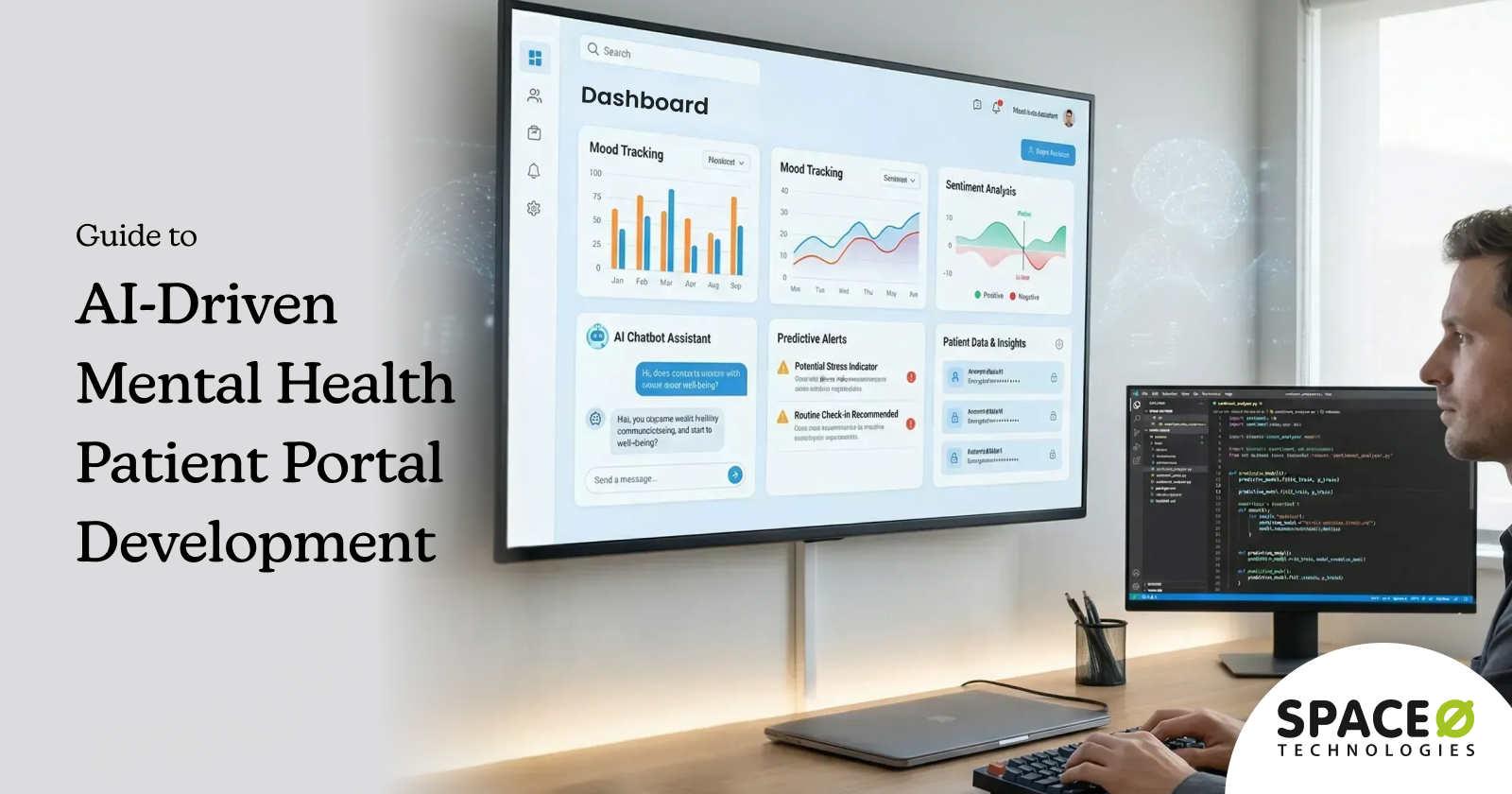
Mental health care is undergoing rapid digital transformation as providers seek scalable, secure, and patient-centric technology solutions. With rising awareness around behavioral health and increasing demand for virtual therapy, remote monitoring, and digital engagement tools, healthcare organizations are investing heavily in advanced software platforms.
According to Roots Analysis, the global behavioral healthcare software market was valued at USD 3.37 billion in 2024 and is expected to grow to USD 13.59 billion by 2035. This strong growth reflects the urgent need for intelligent digital systems that can support therapy management, patient engagement, compliance, and data-driven care delivery.
Traditional patient portals often lack the intelligence and personalization required for behavioral health settings, where privacy sensitivity, continuous communication, symptom tracking, and long-term care coordination are critical. AI-enabled mental health patient portals address these gaps by introducing intelligent automation, predictive analytics, conversational support, and seamless EHR integration.
In this blog, we explore how to develop an AI mental health patient portal. Get insights from our 15+ years of experience as a leading AI patient portal development company on the key features, benefits, development process, architecture considerations, compliance requirements, and cost factors you should evaluate when building intelligent digital mental health solutions.
What Is AI Mental Health Care Patient Portal Development?
AI mental health care patient portal development refers to the process of designing and building secure digital platforms for behavioral health providers that are enhanced with artificial intelligence capabilities. These portals enable patients to access therapy records, schedule sessions, complete assessments, communicate with therapists, and track their mental health progress, while AI improves personalization, automation, and clinical insights.
Unlike traditional patient portals that primarily provide static access to information, AI-enabled mental health portals actively support both patients and providers. They are built to handle the unique requirements of behavioral healthcare, including continuous symptom monitoring, secure and confidential communication, long-term treatment tracking, and remote care delivery.
Unlike traditional patient portals that primarily provide static access to information, AI-enabled mental health portals actively support both patients and providers. They are built to handle the unique requirements of behavioral healthcare, including continuous symptom monitoring, secure and confidential communication, long-term treatment tracking, and remote care delivery.
Core components of an AI-driven mental health patient portal include:
- AI-powered secure messaging with NLP analysis to flag concerning language patterns
- Intelligent chatbots providing 24/7 support, guided exercises, and crisis escalation
- Predictive analytics identifying patients at risk of deterioration or treatment dropout
- Mood tracking with sentiment analysis using validated instruments like PHQ-9 and GAD-7
- Personalized content recommendations adapting to patient progress and engagement
- Telepsychiatry integration for video-based therapy and psychiatric consultations
- Automated crisis detection with escalation protocols and safety planning features
AI-driven mental health portals must balance intelligent automation with clinical safety. All AI features require human-in-the-loop oversight to ensure patient well-being and appropriate therapeutic intervention.
Now that we understand what AI-driven mental health portals are, let’s explore the key benefits they deliver to behavioral health organizations and their patients.
Benefits of Developing AI-Enabled Mental Health Care Patient Portals
AI-driven mental health patient portals deliver measurable value for behavioral health organizations, clinicians, and patients. The following benefits demonstrate why investing in an intelligent portal pays dividends across multiple dimensions.
1. Improved patient engagement and treatment adherence
Portals keep patients connected to their care between sessions. Access to therapy tools, mood tracking, and educational content reinforces treatment plans. Studies show engaged patients demonstrate higher medication adherence and better attendance rates.
2. Reduced administrative burden on clinical staff
Self-service features for scheduling, messaging, and form completion shift routine tasks from staff to patients. This automation frees clinicians to focus on direct patient care rather than administrative activities that consume valuable time.
3. Extended care beyond traditional session boundaries
Digital therapy tools and asynchronous messaging enable continuous therapeutic support. Patients can practice CBT exercises, journal their thoughts, and communicate concerns without waiting for their next appointment.
4. Enhanced clinical decision-making through data
Mood tracking and symptom monitoring provide clinicians with objective data trends. This longitudinal view reveals patterns that patients may not report verbally, enabling more informed treatment adjustments.
5. Increased access to care for underserved populations
Telepsychiatry integration removes geographic barriers to mental health services. Patients in rural areas, those with transportation challenges, or individuals with mobility limitations can access care from home.
6. Better crisis prevention and early intervention
Automated monitoring and predictive analytics identify patients showing warning signs before crises occur. Early intervention through proactive outreach can prevent hospitalizations and improve outcomes.
7. Stronger patient-provider relationships
Secure messaging maintains a connection between sessions, building trust and rapport. Patients feel supported knowing they can reach their therapist when concerns arise, strengthening the therapeutic alliance.
8. Competitive differentiation in the market
Organizations with modern patient portals attract tech-savvy patients who expect digital engagement. A well-designed portal signals commitment to patient experience and positions practices ahead of competitors.
9. Improved regulatory compliance and documentation
Portals create automatic audit trails of patient communications and consent. Digital documentation simplifies compliance reporting and reduces risk during audits or legal proceedings.
With these benefits established, let’s examine the specific features required to achieve them.
Ready to Build an AI-Driven Mental Health Patient Portal?
Our healthcare AI experts help you design HIPAA-compliant portals with NLP-based mood analysis, predictive analytics, intelligent chatbots, and crisis management capabilities built for behavioral health workflows.
Key Features of an AI-Driven Mental Health Patient Portal
Building an effective AI-driven mental health patient portal requires features that address both clinical workflows and patient engagement needs. Each feature must be designed with privacy sensitivity, AI governance, and therapeutic value in mind.
1. Core Features
1.1 Secure messaging and therapist communication
End-to-end encrypted messaging enables asynchronous communication between patients and therapists. Features include attachment support, read receipts, message threading, and automated keyword detection to flag crisis language for clinician review.
1.2 Telepsychiatry and video session integration
HIPAA-compliant video conferencing supports individual therapy, psychiatric consultations, and group sessions. Virtual waiting rooms, pre-session intake forms, and post-session summaries enhance the telehealth experience for both patients and clinicians.
1.3 Digital therapy tools and self-help resources
Interactive CBT exercises, digital journaling with structured prompts, guided meditation, and psychoeducation libraries extend therapeutic support between sessions. These tools help patients practice skills and engage with treatment plans independently.
1.4 Mood tracking and symptom monitoring
Daily or weekly check-ins capture mood, anxiety, sleep quality, and other metrics. Integration with validated screening instruments like PHQ-9 and GAD-7 provides longitudinal data with automated alerts for concerning trends.
1.5 Crisis resources and safety planning
One-touch access to crisis hotlines, digital safety plans, and emergency contact configuration ensures patients can access immediate help. Automated escalation protocols trigger clinical response when concerning activity is detected.
1.6 Medication management and reminders
Comprehensive medication lists, refill tracking, and customizable reminders via push notifications, SMS, or email support adherence. Side effect logging and e-prescribing integration streamline prescription management for controlled substances.
1.7 Appointment scheduling and group therapy management
Self-service booking allows patients to schedule, reschedule, and cancel appointments. Group therapy enrollment, waitlist management, automated reminders, and calendar synchronization reduce no-shows and administrative burden.
2. AI Features
Artificial intelligence offers significant opportunities to enhance mental health patient portals. When implemented responsibly with appropriate safeguards, AI can improve patient engagement, support clinical decision-making, and extend care beyond traditional session boundaries.
However, AI in mental health contexts requires careful consideration. All AI features must include human-in-the-loop oversight, clear limitations, and appropriate escalation to human clinicians. The goal is to augment clinical care, not replace the therapeutic relationship.
2.1 NLP-based mood analysis and sentiment tracking
Natural language processing analyzes patient journal entries and messages to identify emotional patterns. Sentiment tracking, automated flagging for concerning language, and topic extraction provide clinicians with actionable insights while maintaining human oversight.
2.2 AI chatbots for 24/7 patient support
Virtual assistants handle FAQ automation, appointment queries, and guided self-help exercises around the clock. Critical escalation pathways ensure immediate handoff to human agents or crisis resources when patients express concerning thoughts. Organizations seeking to implement these capabilities can work with an experienced AI chatbot development agency that understands healthcare compliance requirements.
2.3 Personalized content and treatment recommendations
AI recommends relevant psychoeducation articles, videos, and exercises based on patient diagnoses and engagement patterns. Progress-based suggestions adapt as patients advance through treatment, offering appropriately challenging content aligned with clinician guidance.
2.4 Predictive analytics for intervention triggers
Risk scoring models identify patients showing signs of deterioration, treatment dropout, or crisis before problems escalate. No-show prediction and adherence monitoring enable proactive outreach while keeping clinicians informed for final decisions.
With these key features defined, building them requires navigating complex compliance requirements. Let’s examine the privacy and security considerations specific to mental health portals.
Integrate AI Into Your Mental Health Portal Without Compromising Patient Safety
Space-O AI builds HIPAA-compliant AI solutions with proper guardrails, human oversight, and clinical governance built in from day one for behavioral health organizations.
AI-Driven Mental Health Patient Portal Development Process
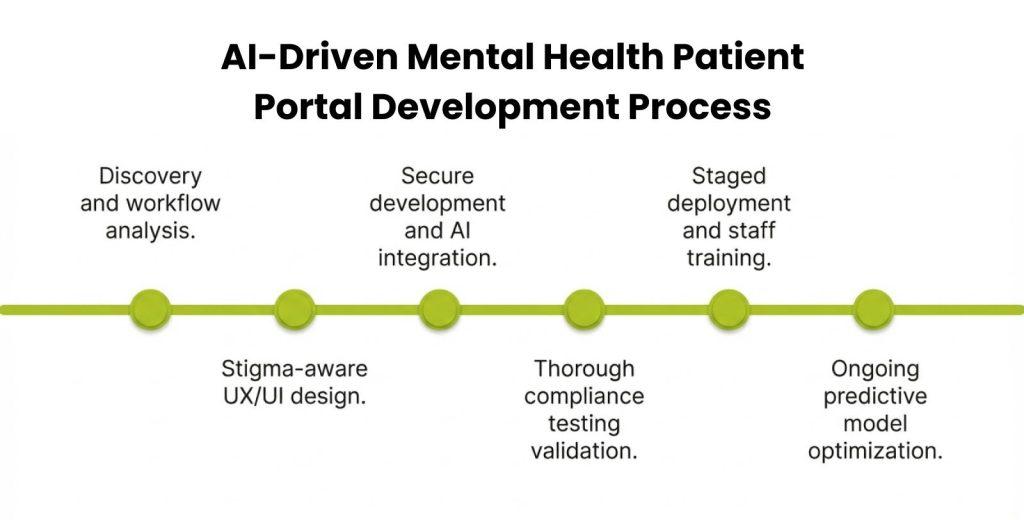
Developing an AI-driven mental health patient portal requires a structured approach that addresses clinical, technical, AI governance, and compliance requirements. The following process ensures comprehensive coverage while maintaining flexibility for organizational needs.
Step 1: Discovery and requirements gathering
The discovery phase establishes the foundation for successful development. This phase involves understanding organizational needs, clinical workflows, patient populations, and technical constraints. Thorough discovery prevents costly changes later in development.
Key activities in this phase
- Conduct stakeholder interviews with clinicians, administrators, IT staff, and patient representatives
- Analyze existing workflows to identify pain points and opportunities for improvement
- Document functional requirements prioritized by clinical and business value
- Assess technical infrastructure and integration requirements
- Review regulatory requirements including HIPAA, 42 CFR Part 2, and state regulations
- Define success metrics and key performance indicators
Step 2: UX/UI design with mental health sensitivity
Design for mental health portals requires particular attention to user experience. Patients may be experiencing distress, cognitive impairment, or low motivation. The interface must be simple, calming, and accessible.
Key activities in this phase
- Conduct user research with mental health patients and clinicians
- Develop personas representing diverse patient populations and use cases
- Create wireframes and prototypes for key workflows
- Apply stigma-aware design principles to language and visual elements
- Ensure accessibility compliance with WCAG 2.1 guidelines
- Design mobile-first responsive layouts for varied device usage
- Test designs with representative users and iterate based on feedback
Step 3: Development and AI integration
Development transforms designs into functional software. Agile methodologies enable iterative progress with regular stakeholder feedback. Security and compliance must be built in from the start, not added later.
Key activities in this phase
- Establish the development environment with appropriate security controls
- Implement core portal functionality in iterative sprints
- Develop AI features with clinical guardrails and human oversight
- Build integration layers for EHR and practice management connectivity
- Implement security controls, including encryption, access control, and audit logging
- Conduct code reviews with attention to security vulnerabilities
- Create automated testing suites for regression prevention
Step 4: Testing and compliance validation
Thorough testing ensures the portal functions correctly, performs adequately, and meets compliance requirements. Testing should involve both technical validation and user acceptance.
Key activities in this phase
- Execute functional testing across all features and user roles
- Conduct security testing, including penetration testing and vulnerability assessment
- Perform HIPAA compliance validation against technical safeguard requirements
- Complete user acceptance testing with clinicians and patient representatives
- Validate clinical workflows against documented requirements
- Test integrations with connected systems under various conditions
- Conduct performance and load testing to ensure scalability
Step 5: Deployment and training
Deployment introduces the portal to production use. A staged approach reduces risk and allows for issue identification before full rollout. Training ensures that staff and patients can use the system effectively.
Key activities in this phase
- Deploy to the production environment with a staged rollout plan
- Conduct a pilot with a limited user group to identify issues
- Provide comprehensive staff training on portal administration and clinical use
- Develop patient onboarding materials, including guides and videos
- Establish support channels for user questions and issues
- Monitor system performance and user feedback during initial rollout
- Address issues identified duringthe pilot before expanding access
Step 6: Ongoing maintenance and optimization
Launch is the beginning, not the end. Ongoing maintenance ensures continued security, compliance, and functionality. Optimization based on usage data improves the portal over time.
Key activities in this phase
- Monitor system performance, availability, and security continuously
- Apply security patches and updates promptly
- Gather user feedback through surveys, support tickets, and usage analytics
- Prioritize and implement feature enhancements based on user needs
- Retrain AI models as data accumulates and patterns change
- Conduct periodic compliance audits and security assessments
- Update documentation and training materials as features evolve
Understanding the development process helps organizations plan budgets. Let’s examine the cost factors for mental health portal development.
HIPAA Compliance and Privacy Considerations for Mental Health Portal Development
Mental health patient portals face heightened privacy requirements beyond standard healthcare applications. The sensitive nature of behavioral health data, combined with additional regulatory frameworks, demands rigorous security architecture and privacy-sensitive design.
According to the HIPAA Journal, 742 large healthcare data breaches were reported in 2024, affecting over 276 million records. Mental health organizations cannot afford to be among these statistics, given the particularly sensitive nature of their patient data.
1. Regulatory framework for behavioral health data
Mental health portals must comply with HIPAA, but many must also address 42 CFR Part 2 regulations that govern substance use disorder treatment records. These regulations impose stricter consent requirements and limit redisclosure of patient information.
HIPAA technical safeguards
- End-to-end encryption for all data transmission and storage
- Role-based access control limiting staff to necessary information
- Comprehensive audit logging tracking all record access
- Automatic session timeout and secure authentication
42 CFR Part 2 requirements
- Written patient consent before any disclosure
- Restrictions on redisclosure of substance use disorder records
- Prohibition on use of records in legal proceedings without consent
- Special handling for minors in treatment programs
Vendor and infrastructure compliance
- Business Associate Agreements with all vendors handling PHI
- BAA-backed cloud hosting with appropriate security certifications
- Regular security risk assessments and vulnerability scanning
- Incident response plans and breach notification procedures
2. Privacy-sensitive design principles
Mental health portals require design decisions that account for stigma and patient vulnerability.
Data minimization
- Collect only information necessary for care delivery
- Apply de-identification techniques for analytics and AI training
- Implement automatic data retention and deletion policies
- Limit PHI exposure in AI systems to essential functions
Stigma-aware notifications
- Design alerts that avoid revealing sensitive information on shared devices
- Use neutral language in SMS and email notifications
- Allow patients to customize notification preferences
- Provide discrete app icons and portal branding options
Proxy access controls
- Implement granular permissions for caregiver access
- Address adolescent privacy rights and parental involvement balance
- Support court-ordered access restrictions
- Enable patient-controlled information sharing
For organizations requiring enterprise-grade security architecture, partnering with an enterprise AI development agency like Space-O AI provides the infrastructure and expertise needed for compliant implementations.
3. Consent management for behavioral health
Mental health portals need granular consent management that goes beyond standard healthcare applications.
Patient consent controls
- Allow patients to control what information is shared and with whom
- Support consent withdrawal with system accommodation
- Provide clear, accessible consent workflows without legal complexity
- Document all consent decisions with timestamps
Special consent considerations
- Research use of patient data
- AI model training and improvement
- Quality improvement activities
- Third-party integrations and data sharing
Transparency about data use builds patient trust and supports ethical practice. Privacy and security create the foundation. The next critical component is connecting the portal with existing clinical systems.
Integration with EHR and Practice Management Systems
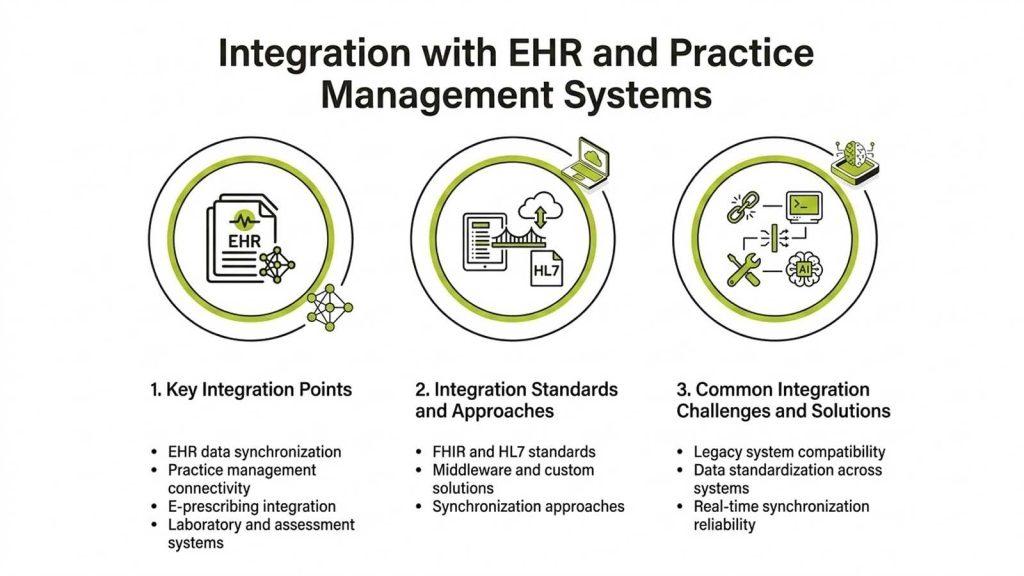
A mental health patient portal delivers maximum value when it connects seamlessly with electronic health records and practice management systems. Integration ensures data consistency, reduces duplicate entry, and supports clinical workflows.
Many behavioral health organizations struggle with integration complexity. Legacy systems, diverse EHR platforms, and limited IT resources create barriers. Understanding integration approaches and challenges helps organizations plan effectively.
1. Key Integration Points
EHR data synchronization
- Bi-directional sync for appointments, demographics, and clinical notes
- Medication lists and prescription history
- Treatment plans and care team information
- Document sharing and clinical summaries
Practice management connectivity
- Insurance verification and eligibility checks
- Copay collection and payment processing
- Claims submission and billing integration
- Revenue cycle management data flow
E-prescribing integration
- EPCS certification for controlled substances
- Prescription history and refill management
- Pharmacy network connectivity
- Prior authorization workflows
Laboratory and assessment systems
- Screening results and lab values
- Psychological assessment scoring
- Clinical decision support feeds
- Diagnostic imaging access
2. Integration Standards and Approaches
FHIR and HL7 standards
- FHIR-based APIs for modern, RESTful connectivity
- HL7 v2 messaging for legacy system support
- CDA document exchange for clinical summaries
- SMART on FHIR for secure application authorization
Middleware and custom solutions
- Integration engines for format translation
- Custom API development for limited-capability systems
- FHIR wrappers exposing legacy data through standardized endpoints
- Message brokers for reliable data routing
Synchronization approaches
- Real-time webhooks and event-driven architecture
- Near-real-time polling for systems without webhook support
- Batch synchronization for non-critical data
- Conflict resolution protocols for bidirectional sync
3. Common Integration Challenges and Solutions
Legacy system compatibility
Many behavioral health organizations use older EHR systems with limited integration capabilities.
Solution
- Develop custom middleware translating between legacy formats and modern standards
- Implement FHIR wrappers exposing legacy data through standardized APIs
- Consider phased EHR modernization alongside portal implementation
Data standardization across systems
Different systems use different terminologies, code sets, and data structures.
Solution
- Implement clinical terminology mapping using SNOMED CT, ICD-10, and RxNorm
- Develop data normalization layers standardizing information before portal display
- Establish data governance processes maintaining consistency over time
Real-time synchronization reliability
Network issues, system outages, and processing delays cause synchronization failures.
Solution
- Implement event-driven architecture with message queuing for reliability
- Design retry mechanisms and failure handling for transient errors
- Provide clear user communication when real-time data is unavailable
With the integration architecture defined, the development process can proceed systematically. Let’s take a look at it.
How Much Does AI-Driven Mental Health Patient Portal Development Cost?
AI-driven mental health patient portal development typically costs between $40,000 and $350,000 or more, depending on complexity, AI capabilities, and integration requirements. Understanding cost factors helps organizations budget appropriately and make informed decisions about scope and phasing.
Several factors influence the total investment required. Feature scope determines the amount of development work. AI capabilities add complexity and specialized expertise requirements. Integration depth affects both development effort and ongoing maintenance. Compliance requirements may necessitate additional security infrastructure and validation activities.
The following table provides estimated cost ranges based on portal complexity.
| Complexity Level | Features Included | Estimated Cost Range |
| Basic MVP | Secure messaging, appointment scheduling, basic telehealth, medication list, crisis resources | $40,000–$100,000 |
| Mid-Range | Above + mood tracking, PHQ-9/GAD-7 screening, EHR integration, mobile app, digital journaling | $100,000–$200,000 |
| Advanced/Enterprise | Above + AI chatbot, NLP analysis, predictive analytics, multi-location support, advanced reporting | $200,000–$350,000+ |
These estimates include design, development, testing, and initial deployment. They do not include ongoing hosting, maintenance, and support costs, which typically run 15-25% of initial development cost annually.
Factors that increase cost
- AI and machine learning capabilities require specialized expertise and additional development effort. NLP analysis, predictive models, and conversational AI add significant complexity.
- Extensive integrations with multiple EHR systems, practice management platforms, and third-party services increase development scope and testing requirements.
- Multi-location or multi-tenant architecture for organizations with multiple sites or SaaS platforms serving multiple clients requires additional infrastructure and configuration capabilities.
- Advanced compliance requirements such as state-specific regulations, international standards, or specialized certifications may require additional security controls and validation.
Engagement models
Organizations can structure their development engagement in several ways depending on their needs and constraints.
- Fixed price works well for a clearly defined scope with stable requirements. The development partner commits to delivering specified functionality for an agreed price.
- Time and materials provides flexibility for evolving requirements. Organizations pay for actual effort expended, allowing scope adjustments as learning occurs.
- A dedicated team suits long-term engagements with ongoing development needs. A committed team works exclusively on the organization’s portal, building deep domain knowledge.
To build your AI-driven mental health patient portal with experienced specialists, you can hire patient portal developers who understand NLP, predictive analytics, healthcare compliance, and behavioral health workflows.
Understanding costs helps with planning. Equally important is anticipating challenges that commonly arise during mental health portal projects.
Get a Detailed Cost Estimate for Building Your AI Mental Health Portal
Our healthcare AI specialists provide transparent, detailed project estimates covering AI capabilities, integrations, and compliance. Receive your customized estimate within 48 hours.
Common Challenges in AI-Driven Mental Health Portal Development (and How to Overcome Them)
AI-driven mental health patient portal projects face distinct challenges beyond typical healthcare IT initiatives. Understanding these challenges and their solutions helps organizations plan for success.
Challenge 1: Lagging IT infrastructure and limited funding
Many behavioral health organizations operate with outdated technology and constrained budgets. Community mental health centers and nonprofit treatment organizations often lack the IT infrastructure and capital for major technology investments.
Solution
- Start with MVP: Focus initial development on highest-impact features. Expand functionality over time as value is demonstrated and funding becomes available.
- Consider cloud-based SaaS: Subscription models reduce upfront capital requirements. Cloud hosting eliminates infrastructure investment and maintenance burden.
- Pursue grant funding: Federal and state programs support health IT adoption. SAMHSA and HRSA offer grants specifically for behavioral health technology.
- Prioritize ROI features: Focus on capabilities that reduce costs or generate revenue, such as telehealth that expands service capacity or patient engagement features that reduce no-shows.
Challenge 2: Privacy, safety, and clinical liability concerns
Mental health data carries heightened sensitivity. Clinicians worry about liability for patient communications through the portal. Organizations fear data breaches involving behavioral health records.
Solution
- Implement robust consent workflows: Clear, granular consent management ensures patients understand and control how their data is used.
- Establish clinical governance: Define policies for portal-based communication, response time expectations, and documentation requirements.
- Require human-in-the-loop for AI: All AI outputs related to clinical care must be reviewed by qualified clinicians before action.
- Invest in security: Encryption, access controls, monitoring, and regular assessments reduce breach risk.
- Obtain appropriate insurance: Cyber liability and professional liability coverage should address portal-related risks.
Challenge 3: Telehealth integration and workflow friction
Integrating video sessions into existing clinical workflows disrupts established practices. Clinicians may resist technology that changes how they work with patients.
Solution
- Design around existing workflows: Rather than forcing clinicians to adapt to technology, configure technology to support how clinicians prefer to work.
- Involve clinicians in design: Clinician input during requirements and design phases ensures the portal meets actual clinical needs.
- Provide comprehensive training: Hands-on training builds confidence. Ongoing support addresses issues as they arise.
- Start with early adopters: Pilot with clinicians enthusiastic about technology. Their success stories help bring along resistant colleagues.
Challenge 4: Crisis routing and safety protocols
Mental health portals must handle crisis situations reliably. Failures in crisis response can have tragic consequences. Organizations need confidence that escalation pathways work.
Solution
- Integrate established crisis resources: Connection to 988 Suicide and Crisis Lifeline provides professional crisis response around the clock.
- Implement automated escalation: System monitoring can detect concerning patterns and trigger alerts without relying solely on patient self-report.
- Test crisis pathways rigorously: Regular testing ensures escalation protocols function correctly. Tabletop exercises prepare staff for crisis scenarios.
- Maintain human oversight: Technology supports but never replaces human clinical judgment in crisis situations.
Challenge 5: Patient engagement and adoption
Mental health patients may be hesitant to use technology due to symptoms, stigma concerns, or unfamiliarity with digital tools. Low adoption undermines portal value.
Solution
- Design for simplicity: Intuitive interfaces reduce barriers. Minimize steps required to complete common tasks.
- Offer multiple channels: Web, mobile app, SMS, and other options accommodate different preferences and capabilities.
- Provide onboarding support: Guided setup, tutorial content, and staff assistance help patients get started successfully.
- Demonstrate value quickly: Ensure patients experience meaningful benefit early in their portal use to encourage continued engagement.
- Address digital literacy: Provide resources for patients unfamiliar with technology. Consider offering in-person orientation sessions.
Navigating these challenges requires experienced partners who understand both technology and behavioral health care. Organizations can benefit from healthcare AI consulting services to develop strategies that address these obstacles systematically.
Transform Your Mental Health Practice with an AI-Driven Patient Portal
From NLP-based mood analysis to predictive intervention triggers, our healthcare AI specialists deliver intelligent mental health portals that clinicians and patients trust. Start your digital transformation today.
Space-O AI — Your Trusted Partner for AI Mental Health Portal Development
AI-driven mental health patient portal development requires specialized expertise in NLP, predictive analytics, privacy-sensitive design, crisis management, and HIPAA compliance. This guide covered essential features, AI capabilities, development process, and cost considerations for building intelligent behavioral health platforms.
Space-O AI brings over 15 years of software development experience and has successfully delivered 500+ projects worldwide. We specialize in healthcare AI solutions that prioritize clinical safety, regulatory compliance, and measurable patient outcomes across diverse healthcare organizations.
Our team includes 80+ developers experienced in NLP, conversational AI, and predictive analytics for healthcare. We have built HIPAA-compliant platforms with AI-powered mood analysis, intelligent chatbots, and predictive intervention features that meet the unique demands of behavioral health.
Ready to build an AI-driven mental health patient portal that improves patient engagement and clinical efficiency? Contact Space-O AI for a free consultation to discuss your project requirements, timeline, and budget with our healthcare AI experts today.
Frequently Asked Questions
1. How long does it take to develop an AI-driven mental health patient portal?
Development timelines range from 4-6 months for a basic MVP to 9-12 months or more for full-featured enterprise solutions with advanced AI. Timeline depends on AI complexity, integration requirements, NLP model training, and compliance validation. Phased approaches can deliver initial value quickly while building toward comprehensive AI functionality.
2. How do we ensure HIPAA compliance in mental health portal development?
HIPAA compliance requires end-to-end encryption for data transmission and storage, role-based access control limiting information access, comprehensive audit logging of all record access, BAA-backed cloud hosting, regular security risk assessments, and workforce training. Mental health portals must also address 42 CFR Part 2 for substance abuse treatment records.
3. Can AI be safely used in mental health patient portals?
Yes, AI can enhance mental health portals when implemented with appropriate safeguards. Requirements include human-in-the-loop oversight for all clinical outputs, clinical governance frameworks defining AI use boundaries, appropriate guardrails preventing harmful recommendations, clear escalation protocols to human clinicians, and transparency with patients about AI capabilities and limitations.
4. What is the cost of developing an AI-driven mental health patient portal?
Costs range from $40,000–$100,000 for basic MVP functionality to $200,000–$350,000 or more for enterprise solutions with advanced AI capabilities like NLP analysis and predictive analytics. Factors affecting cost include AI complexity, integration requirements, multi-location support, and compliance validation needs. Ongoing maintenance typically costs 15–25% annually.
5. How do mental health portals integrate with existing EHR systems?
Integration uses HL7 and FHIR standards for healthcare interoperability. FHIR-based APIs provide modern connectivity with major EHR platforms. Middleware solutions bridge legacy systems lacking modern APIs. Bi-directional synchronization ensures data consistency between the portal and clinical systems. Clinical terminology mapping using SNOMED CT and ICD-10 standardizes information across platforms.


Build Your AI Mental Health Patient Portal
What to read next