- What Is HIPAA-Compliant AI Patient Portal Development?
- Key HIPAA Requirements for Patient Portal Development
- Essential Features of a HIPAA Compliant Patient Portal
- Step-by-Step Development Process for HIPAA Compliant Patient Portals
- Step 1: Security risk assessment and compliance planning
- Step 2: Architecture design with a security-first approach
- Step 3: Feature development with HIPAA controls built in
- Step 4: EHR and third-party integrations
- Step 5: Security testing and vulnerability assessment
- Step 6: Compliance documentation and training
- Step 7: Deployment with a compliant cloud infrastructure
- Step 8: Ongoing monitoring and audit
- Challenges in Building HIPAA Compliant Patient Portals (And How to Overcome Them)
- AI and HIPAA Compliance: Building Intelligent Yet Secure Patient Portals
- Partner with Space-O AI for HIPAA Compliant Patient Portal Development
- Frequently Asked Questions on Developing HIPAA-Compliant Patient Portals
- 1. What are the penalties for HIPAA non-compliance in patient portals?
- 2. How do we ensure PHI security in patient portal development?
- 3. Can AI features be added to HIPAA-compliant patient portals?
- 4. What cloud providers support HIPAA-compliant patient portal hosting?
- 5. How long does it take to develop a HIPAA-compliant patient portal?
- 6. What is required for BAA compliance with third-party vendors?
HIPAA Compliant Patient Portal Development: Build Secure Healthcare Portals

 Last Updated: March, 31 2026
AI-powered patient portals are rapidly becoming essential to modern healthcare delivery. They streamline appointment scheduling, enable secure messaging, automate patient support, and deliver personalized health insights. But as portals become more intelligent, they also handle increasing volumes of sensitive patient data, making security and compliance non-negotiable.
According to HIPAA Journal, 742 large healthcare data breaches exposed 276,775,457 patient records in 2024 alone, averaging 758,288 records compromised every single day. These numbers highlight a critical reality: healthcare platforms, especially those powered by AI, are prime targets for cyber threats.
HIPAA-compliant AI patient portal development goes beyond adding encryption or basic access controls. It requires secure architecture, strict PHI handling policies, compliant cloud infrastructure, audit mechanisms, and responsible AI implementation.
In this guide, we break down how to build an AI-enabled patient portal that protects sensitive data while delivering intelligent, patient-centric experiences. Drawing from our experience as a leading AI patient portal development agency, we have shared insights on the essential requirements, AI integration strategies, development processes and common challenges around building HIPAA-compliant patient portals.
What Is HIPAA-Compliant AI Patient Portal Development?
HIPAA-compliant AI patient portal development refers to the process of designing and building a patient portal that integrates artificial intelligence capabilities while fully adhering to HIPAA regulations for protecting Protected Health Information (PHI).
A traditional patient portal allows patients to access medical records, book appointments, view lab results, and communicate with providers. When AI is integrated, the portal becomes more intelligent and proactive, enabling features such as automated appointment reminders,
AI-powered chat support, predictive health insights, document summarization, and personalized care recommendations. However, once AI interacts with PHI, the compliance requirements become significantly more complex.
HIPAA-compliant AI patient portal development ensures that:
- All PHI is encrypted both in transit and at rest
- AI models process data within secure, compliant infrastructure
- Access controls follow strict role-based authentication policies
- Audit logs track every interaction with sensitive data
- Business Associate Agreements are in place with cloud and AI service providers
- Data minimization and secure storage policies are enforced
It also involves implementing secure API integrations with EHR systems, applying standards such as FHIR for interoperability, and ensuring that AI models do not expose, misuse, or retain sensitive patient data beyond approved boundaries.
Key HIPAA Requirements for Patient Portal Development
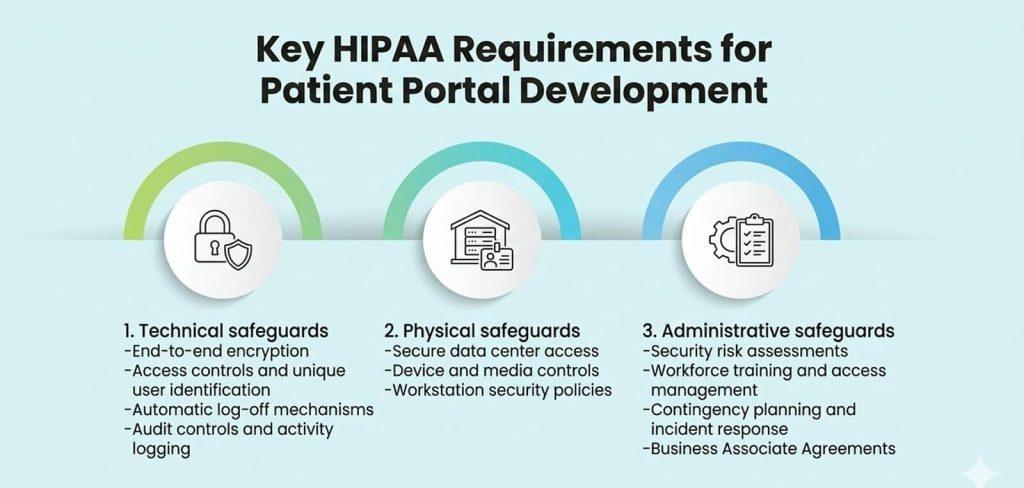
Building an AI-powered patient portal that meets HIPAA standards requires implementing safeguards across three categories. Each category addresses different aspects of ePHI protection while enabling intelligent features like chatbots, predictive analytics, and personalized recommendations.
1. Technical safeguards
Technical safeguards form the backbone of HIPAA-compliant patient portal development. These controls ensure that AI systems and patient-facing interfaces protect ePHI during storage, processing, and transmission.
1.1 End-to-end encryption
End-to-end encryption protects data at rest and in transit. All patient information, including data processed by AI models, must be encrypted using industry-standard protocols like AES-256 for storage and TLS 1.3 for transmission. This ensures intercepted data remains unreadable to unauthorized parties.
1.2 Access controls and unique user identification
Access controls ensure only authorized users have access to specific ePHI. AI-driven portals must implement role-based access control (RBAC) that restricts what data each user, including AI systems, can access. Every user requires unique credentials to maintain accountability.
1.3 Automatic log-off mechanisms
Automatic log-off terminates sessions after periods of inactivity. This prevents unauthorized access to patient data left visible on unattended devices, particularly important when patients interact with AI chatbots on shared or public devices.
1.4 Audit controls and activity logging
Audit controls track all access to ePHI, including when AI systems process patient data. These logs capture who accessed what information, when, and what actions they performed. Complete audit trails are essential for compliance audits and breach investigations.
2. Physical safeguards
Physical safeguards protect the hardware and facilities where AI-powered patient portals and their data reside.
2.1 Secure data center access
Secure data center access restricts physical entry to servers hosting patient portal infrastructure. Cloud providers must maintain HITRUST certification or equivalent security standards with controlled access, surveillance, and environmental protections.
2.2 Device and media controls
Device and media controls govern how hardware containing ePHI is handled, moved, and disposed of. This includes servers running AI models trained on patient data, backup media, and decommissioned equipment requiring secure data destruction.
2.3 Workstation security policies
Workstation security policies ensure devices accessing the patient portal meet minimum security requirements. This includes endpoint protection, secure configurations, screen locks, and physical positioning to prevent unauthorized viewing.
3. Administrative safeguards
Administrative safeguards establish organizational policies and procedures governing AI-driven patient portal operations.
3.1 Security risk assessments
Security risk assessments identify vulnerabilities in patient portal architecture, including AI components that process ePHI. HIPAA requires regular assessments with documented findings and prioritized remediation plans addressing identified gaps.
3.2 Workforce training and access management
Workforce training ensures all personnel understand HIPAA requirements. Staff working with AI systems need specialized training on handling ePHI in machine learning contexts, recognizing security threats, and following proper data handling procedures.
3.3 Contingency planning and incident response
Contingency planning prepares organizations for data breaches and system failures. AI-driven portals require specific protocols for AI system failures that could expose patient data, including backup procedures and disaster recovery plans.
3.4 Business Associate Agreements
Business Associate Agreements (BAAs) are legally required contracts with vendors who access ePHI. This includes cloud providers, AI platform vendors, and your patient portal integration partner who handle patient data on your behalf.
The following table summarizes these safeguard categories and their primary requirements for AI-driven patient portals.
| Safeguard Category | Key Requirements | AI-Specific Considerations |
| Technical | Encryption, access controls, audit logs, auto log-off | AI model data isolation, API security, inference logging |
| Physical | Data center security, device controls, workstation policies | GPU server protection, model storage security |
| Administrative | Risk assessments, training, BAAs, and incident response | AI governance policies, model audit trails |
With these safeguards established, the next step is understanding what specific features your HIPAA-compliant patient portal needs to deliver secure, intelligent patient engagement.
Ready to Develop a HIPAA-Compliant AI Patient Portal?
Our team at Space-O AI delivers end-to-end HIPAA-compliant AI patient portal development, including secure architecture, EHR integration, and AI model implementation.
Essential Features of a HIPAA Compliant Patient Portal
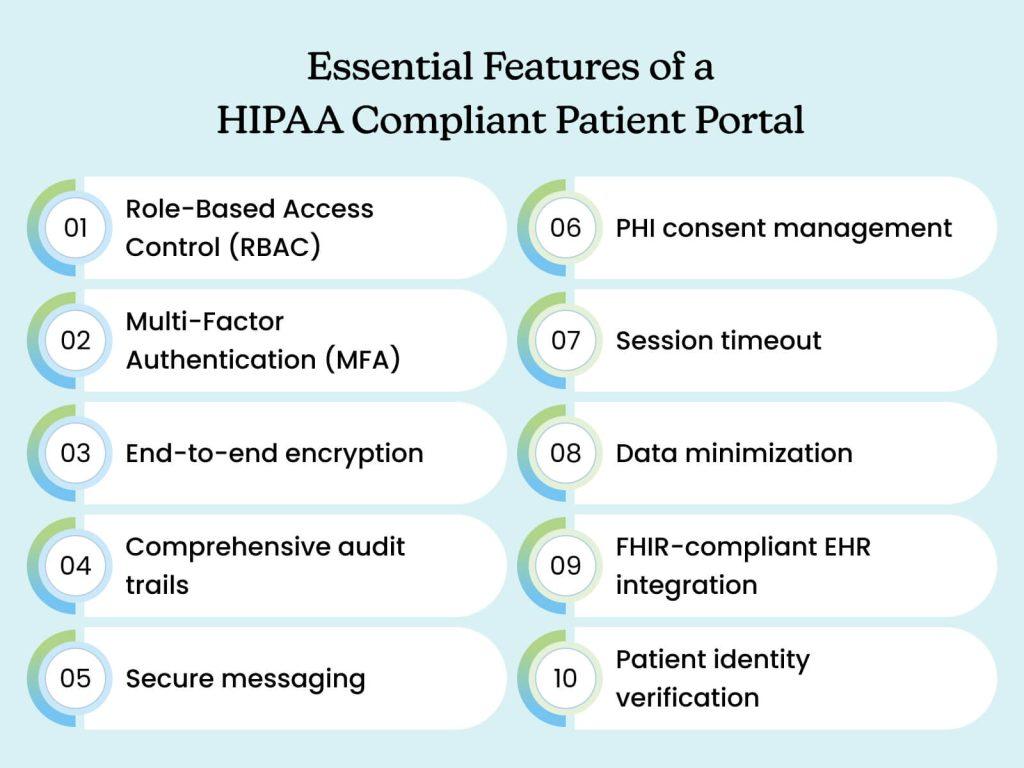
AI-driven patient portals require specific features that satisfy HIPAA requirements while enabling intelligent automation and personalized experiences. The following features balance security with functionality to create compliant yet user-friendly platforms.
1. Role-Based Access Control (RBAC)
Role-based access control restricts system access based on user roles. Patients see only their own records while providers access relevant patient information based on their care responsibilities. This enforces the HIPAA minimum necessary access principle. AI systems must also receive minimum permissions, accessing only the specific data required for their functions rather than complete patient histories.
2. Multi-Factor Authentication (MFA)
Multi-factor authentication adds security layers beyond passwords using biometric verification, SMS codes, or authenticator apps. This prevents unauthorized access even when credentials are compromised. For AI-powered portals, MFA secures chatbot sessions and sensitive interactions where patients discuss health concerns or access protected information.
3. End-to-end encryption
End-to-end encryption protects all data transmissions between patients, providers, and AI systems. This ensures data remains unreadable if intercepted during transmission. AI-generated recommendations, model outputs, and any patient data processed by intelligent systems must be encrypted both at rest and in transit.
4. Comprehensive audit trails
Comprehensive audit trails log every interaction, including patient logins, provider access, and system queries. These records enable compliance verification during audits and support breach investigations when incidents occur. For AI systems, audit trails must track every query made against patient data and every recommendation generated, ensuring full accountability.
5. Secure messaging
Secure messaging enables HIPAA-compliant communication between patients and care teams with encryption protecting all exchanges. This safeguards sensitive health discussions from unauthorized access. AI can enhance secure messaging by prioritizing urgent messages and routing communications appropriately while maintaining encryption throughout.
6. PHI consent management
PHI consent management tracks patient authorization for data use with granular consent options. This ensures a legal basis exists for all data processing activities. Consent management is especially critical for AI features since patient authorization must be obtained before using their data for personalization, predictions, or training machine learning models.
7. Session timeout
Session timeout terminates inactive sessions after configurable periods automatically. This prevents unauthorized access to patient data left visible on unattended devices. For AI chatbot conversations, session timeouts protect sensitive health discussions from exposure if patients step away from their devices.
8. Data minimization
Data minimization ensures systems access only the minimum ePHI necessary for their function. This reduces breach exposure and limits potential damage if unauthorized access occurs. AI chatbots should access only data relevant to current patient queries rather than pulling complete medical histories for routine interactions.
9. FHIR-compliant EHR integration
FHIR-compliant EHR integration connects portals with electronic health records using standardized APIs. The FHIR R4 standard maintains security during data exchange while enabling interoperability. This secure integration layer enables AI systems to retrieve patient data from EHRs without compromising ePHI protection.
10. Patient identity verification
Patient identity verification confirms user identity before granting portal access using knowledge-based questions or biometric methods. This prevents unauthorized account access and ensures the right patient accesses the right records. AI-powered verification can enhance both security and convenience through intelligent authentication that adapts to user behavior patterns.
Building these features requires experienced developers who understand both AI and healthcare compliance, which is why many organizations choose to hire patient portal developers with specialized expertise in HIPAA requirements and intelligent system development.
Understanding essential features prepares you for the development process. Let’s examine how to build an AI-powered, HIPAA-compliant patient portal step by step.
Step-by-Step Development Process for HIPAA Compliant Patient Portals
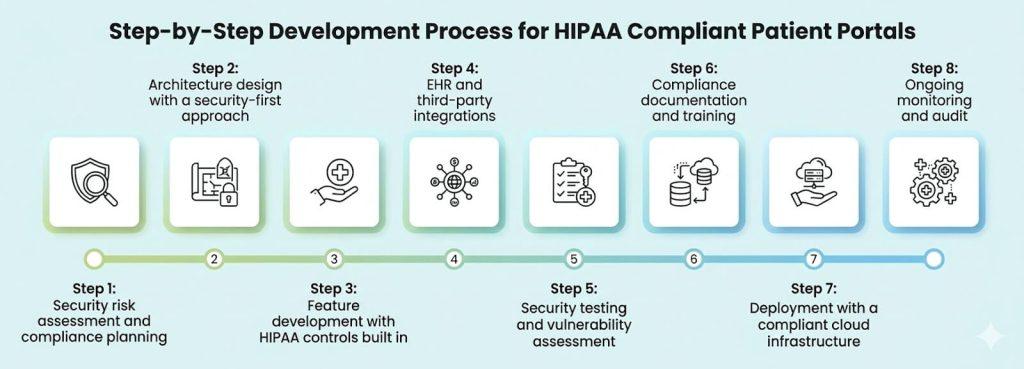
Developing an AI-driven patient portal requires a structured approach that embeds HIPAA compliance from the first line of code. The following eight-step process ensures security while enabling intelligent features that improve patient engagement.
Step 1: Security risk assessment and compliance planning
Every HIPAA-compliant patient portal development project begins with understanding your current security posture and identifying gaps. This foundational step shapes all subsequent development decisions.
Action items
- Identify all ePHI touchpoints where AI systems will access patient data
- Evaluate existing infrastructure security against HIPAA requirements
- Document gap analysis with prioritized remediation recommendations
- Establish compliance benchmarks and success metrics for AI components
Step 2: Architecture design with a security-first approach
The architecture phase defines how AI features, patient interfaces, and backend systems interact while maintaining HIPAA compliance. Security decisions made here impact the entire portal.
Action items
- Design secure data flows between AI models, APIs, and patient-facing interfaces
- Select encryption strategies for data at rest, in transit, and during AI processing
- Create an access control framework defining permissions for users, providers, and AI systems
- Plan infrastructure for compliant cloud hosting with appropriate redundancy
Step 3: Feature development with HIPAA controls built in
Development integrates HIPAA safeguards directly into AI-powered features rather than adding them as afterthoughts. This approach reduces vulnerabilities and simplifies compliance audits.
Action items
- Implement authentication systems with MFA and session management
- Build comprehensive audit logging, capturing all AI system interactions with ePHI
- Develop secure messaging with end-to-end encryption and attachment scanning
- Create AI chatbots and predictive features with data minimization principles
Step 4: EHR and third-party integrations
Connecting your AI-driven portal with existing healthcare systems requires careful attention to data security during exchange. Proper patient portal integration services ensure HIPAA compliance across all touchpoints.
Action items
- Implement FHIR R4-compliant APIs for secure EHR data exchange
- Execute Business Associate Agreements with all vendors accessing ePHI
- Configure secure data exchange protocols with third-party AI platforms
- Test integration security with penetration testing and vulnerability scanning
Step 5: Security testing and vulnerability assessment
Rigorous testing identifies vulnerabilities before they become breaches. AI components require specialized testing to ensure they do not expose or leak patient data.
Action items
- Conduct penetration testing against the patient portal and AI system interfaces
- Perform code reviews focusing on ePHI handling in AI model pipelines
- Execute vulnerability scanning across infrastructure and application layers
- Test AI systems for data leakage, prompt injection, and unauthorized data access
Step 6: Compliance documentation and training
Documentation proves HIPAA compliance during audits, while training ensures staff understand their responsibilities when working with AI-powered healthcare systems.
Action items
- Create policies and procedures governing AI system access to ePHI
- Document security controls, risk assessments, and remediation activities
- Develop workforce training covering HIPAA requirements for AI-driven portals
- Establish incident response plans specific to AI system breaches
Step 7: Deployment with a compliant cloud infrastructure
Deployment infrastructure must meet HIPAA requirements. Cloud providers must sign BAAs and maintain appropriate certifications before hosting AI-powered patient portals.
Action items
- Deploy on HITRUST-certified or SOC 2 Type II compliant cloud infrastructure
- Configure BAA-backed hosting providers like AWS, Azure, or Google Cloud
- Implement network segmentation, isolating AI systems processing ePHI
- Enable continuous monitoring and automated compliance alerting
Step 8: Ongoing monitoring and audit
HIPAA compliance is not a one-time achievement but requires continuous attention. AI systems introduce unique monitoring requirements as models and data patterns evolve.
Action items
- Implement continuous security monitoring for the portal and AI components
- Schedule periodic security risk assessments as required by HIPAA
- Conduct regular compliance audits of the AI system’s ePHI access patterns
- Monitor the AI model behavior for drift that could impact data handling
Organizations benefit from engaging patient portal consulting services early in the planning phase to ensure compliance requirements are properly addressed throughout the development lifecycle.
Following a structured development process helps, but teams still encounter significant challenges when building AI-driven HIPAA-compliant portals. Let’s examine these obstacles and their solutions.
Need a Roadmap for Your HIPAA Compliant Patient Portal Project?
Partner with experienced healthcare developers who follow proven security-first methodologies. Get your customized development plan and timeline now.
Challenges in Building HIPAA Compliant Patient Portals (And How to Overcome Them)
Building AI-powered patient portals that meet HIPAA standards presents unique challenges. Understanding these obstacles and their solutions helps teams deliver secure, compliant platforms.
1. Legacy system integration complexity
Most healthcare organizations operate EHR systems, practice management platforms, and billing systems built years before modern AI capabilities existed. Integrating AI-driven patient portals with these legacy systems while maintaining HIPAA compliance creates significant technical challenges. Data formats vary, APIs may not exist, and security protocols differ between systems.
Solution
- Use FHIR R4 APIs as a standardization layer between legacy systems and modern AI components
- Implement middleware that translates between legacy protocols and secure modern interfaces
- Adopt phased integration approaches, connecting critical systems first while maintaining manual processes for others
- Partner with experienced integration specialists who understand healthcare interoperability
2. Maintaining compliance with evolving regulations
HIPAA requirements evolve, and new regulations like the 21st Century Cures Act and state-level AI laws add complexity. AI-driven patient portals must adapt to changing requirements without major redevelopment.
Solution
- Implement continuous compliance monitoring with automated alerting for regulatory changes
- Conduct regular security risk assessments that specifically evaluate AI component compliance
- Build modular architectures that allow updating specific components without full system overhauls
- Engage healthcare technology partners who track regulatory developments
3. Balancing security with user experience
Excessive security friction drives patients away from portal adoption. However, reducing security to improve usability risks HIPAA violations. AI-driven portals must achieve both secure and seamless experiences.
Solution
- Implement biometric authentication that is more secure and more convenient than passwords
- Use single sign-on (SSO) to reduce login fatigue while maintaining strong authentication
- Design intuitive security prompts that educate patients rather than frustrate them
- Deploy AI-powered risk-based authentication that adjusts security based on context
4. AI and LLM integration without data leakage
Large language models and generative AI create powerful patient engagement features but introduce risks of training data leakage, prompt injection attacks, and unauthorized data access. Protecting ePHI while leveraging AI capabilities requires careful architectural decisions.
Solution
- Deploy private LLM instances that never send ePHI to external servers
- Implement retrieval-augmented generation (RAG) architectures that separate patient data from model training
- Apply de-identification and differential privacy techniques when training on patient data
- Create strict prompt filtering and output sanitization to prevent data leakage
5. Vendor management and BAA requirements
AI-powered patient portals often rely on multiple vendors: cloud providers, AI platforms, integration partners, and security services. Each vendor accessing ePHI requires a Business Associate Agreement, creating administrative burden and compliance risk.
Solution
- Conduct thorough vendor vetting, focusing on HIPAA experience and certifications
- Negotiate comprehensive BAAs that specifically address AI and machine learning use cases
- Select cloud hosting providers with HITRUST certification and healthcare-specific compliance programs
- Maintain centralized BAA tracking and renewal management
These challenges are significant but solvable with proper planning and expertise. With security addressed, let’s explore how to integrate AI capabilities while maintaining HIPAA compliance.
AI and HIPAA Compliance: Building Intelligent Yet Secure Patient Portals
AI transforms patient portals from passive information displays into intelligent engagement platforms. However, integrating AI capabilities while maintaining HIPAA compliance requires specific architectural and governance approaches.
Organizations building an AI-powered patient portal must pay particular attention to audit logging and human-in-the-loop safeguards to remain compliant while enabling autonomous workflows.
1. AI capabilities in patient portals
Modern AI-driven patient portals leverage several technologies to improve patient experience and operational efficiency. Understanding the full range of AI use cases in patient portals helps organizations prioritize which capabilities to integrate while maintaining HIPAA compliance.
1.1 Conversational AI chatbots
The AI chatbot use cases in patient portals span 24/7 patient support for appointment scheduling, medication questions, and symptom guidance. These systems handle routine inquiries, freeing staff for complex patient needs while maintaining availability outside business hours.
1.2 Predictive analytics
Predictive analytics identify at-risk patients, forecast no-shows, and recommend personalized interventions. Machine learning models analyze patient data patterns to enable proactive care management and resource optimization.
1.3 Natural language processing
Natural language processing analyzes patient messages, extracts symptoms, and routes requests to appropriate care teams. NLP enables intelligent triage and ensures urgent communications receive immediate attention.
1.4 Generative AI
Generative AI creates personalized health education content, plain-language visit summaries, and medication instructions. These capabilities improve patient understanding and engagement with their care plans.
2. HIPAA considerations for AI and ML systems
AI systems processing ePHI face unique compliance requirements beyond traditional software.
2.1 De-identification of training data
De-identification of training data ensures machine learning models do not memorize or leak individual patient information. Models trained on properly de-identified data reduce compliance risk while maintaining analytical value.
2.2 PHI handling in LLMs and RAG systems
PHI handling in LLMs and RAG systems requires architectural decisions about where patient data lives and how it interacts with language models. Retrieval-augmented generation can separate patient context from model weights, reducing exposure risk.
2.3 Audit trails for AI recommendations
Audit trails for AI recommendations track what patient data AI systems accessed and what recommendations they generated. These logs support compliance audits, clinical quality reviews, and investigation of any adverse outcomes.
2.4 Private model deployment versus public APIs
Private model deployment versus public APIs determines whether patient data ever leaves your controlled environment. On-premises or private cloud AI deployment eliminates risks from third-party API calls but requires more infrastructure investment.
3. Intrategies for HIPAA-compliant AI integration
Successfully deploying AI in patient portals requires specific technical and governance approaches.
3.1 Differential privacy techniques
Differential privacy techniques add mathematical noise to training data, ensuring individual patient information cannot be extracted from models. This approach enables learning from patient populations while protecting individual privacy.
3.2 Federated learning approaches
Federated learning approaches train models across distributed data sources without centralizing ePHI. Each location keeps its data locally while contributing to improved model performance, reducing breach exposure.
3.3 Human-in-the-loop workflows
Human-in-the-loop workflows require clinical review of AI recommendations before patient communication. This maintains appropriate oversight for clinical decisions while leveraging AI efficiency for routine tasks.
3.4 Model governance frameworks
Model governance frameworks establish policies for AI system access to ePHI, output review, and ongoing monitoring. Clear governance ensures accountability and enables rapid response to any compliance concerns.
Want AI-Powered Features in Your HIPAA Compliant Patient Portal?
Our AI specialists build intelligent chatbots and predictive analytics while maintaining strict PHI protection. Discuss your AI integration needs today.
Partner with Space-O AI for HIPAA Compliant Patient Portal Development
Building a HIPAA-compliant patient portal requires robust security architecture, encryption, access controls, and audit mechanisms integrated with intelligent AI features. This guide covered essential requirements, development processes, challenges, and strategies for integrating AI while maintaining regulatory compliance.
With 15 years in the industry and over 500 projects shipped, Space-O AI brings proven expertise to healthcare software development. We partner with organizations that refuse to compromise on security while pursuing AI-driven patient engagement.
Our healthcare development team builds secure patient portals with end-to-end encryption, compliant EHR integrations using FHIR standards, and intelligent features like chatbots and predictive analytics, all architected to protect ePHI from day one. From BAA negotiations to penetration testing, we handle the compliance complexity so you can focus on patient care.
Let’s discuss your HIPAA-compliant patient portal project. Book a free consultation with our team to map your requirements, identify potential compliance gaps, and outline a clear path to launch.
Frequently Asked Questions on Developing HIPAA-Compliant Patient Portals
1. What are the penalties for HIPAA non-compliance in patient portals?
HIPAA violations carry tiered penalties based on violation severity. Tier 1 (unknowing) ranges from $100–$50,000 per violation. Tier 2 (reasonable cause) ranges from $1,000–$50,000. Tier 3 (willful neglect, corrected) ranges from $10,000–$50,000. Tier 4 (willful neglect, not corrected) carries a minimum of $50,000 penalties. Annual maximums can reach $1.5 million per violation category.
2. How do we ensure PHI security in patient portal development?
PHI security requires layered protection: end-to-end encryption for data at rest and in transit, multi-factor authentication for user access, role-based access controls limiting data visibility, comprehensive audit logging, automatic session timeouts, and regular security risk assessments. AI components require additional safeguards, including data minimization and model isolation.
3. Can AI features be added to HIPAA-compliant patient portals?
Yes, AI features like chatbots, predictive analytics, and personalized recommendations can be HIPAA compliant when properly implemented. Key requirements include using private AI models that do not send ePHI to external servers, implementing audit trails for AI recommendations, de-identifying training data, and maintaining human oversight for clinical decisions.
4. What cloud providers support HIPAA-compliant patient portal hosting?
Major cloud providers, including :contentReference[oaicite:0]{index=0}, :contentReference[oaicite:1]{index=1}, and :contentReference[oaicite:2]{index=2}, offer HIPAA-compliant hosting with signed Business Associate Agreements. These providers maintain HITRUST certification, SOC 2 Type II compliance, and healthcare-specific security controls. Organizations must properly configure these services and maintain their own compliance responsibilities.
5. How long does it take to develop a HIPAA-compliant patient portal?
Development timelines vary based on complexity. Basic portals with core HIPAA features typically require 4–6 months. Standard portals with AI chatbots and multiple integrations take 6–9 months. Enterprise solutions with advanced AI, custom workflows, and complex integrations may require 9–15 months. Compliance documentation and testing add time to all projects.
6. What is required for BAA compliance with third-party vendors?
Business Associate Agreements must be executed with any vendor accessing ePHI. BAAs must specify permitted uses and disclosures of PHI, require appropriate safeguards, mandate breach notification, and ensure vendor subcontractors also comply. For AI vendors, BAAs should specifically address model training, data retention, and algorithmic decision-making.


Need a Secure HIPAA Patient Portal?
What to read next