- What is Generative AI in Sales?
- Six Key Benefits of Generative AI in Sales
- Eight Real-World Use Cases of Generative AI in Sales
- 1. AI-guided prospecting and lead generation
- 2. Predictive lead scoring
- 3. Personalized outreach at scale
- 4. Intelligent sales coaching and real-time call guidance
- 5. Instant proposal and document generation
- 6. Sales forecasting and pipeline analysis
- 7. AI-powered sales enablement and training
- 8. Intelligent chatbots and virtual sales assistants
- Key Challenges in Implementing Generative AI in Sales
- How to Implement Generative AI in Sales: 6-Step Roadmap
- Future Trends: Where Generative AI in Sales Is Heading
- Let Space-O Build You Your Dream Generative AI Sales Solution
- Frequently Asked Questions About Generative AI in Sales
- Will generative AI in sales replace salespeople?
- How much does implementing generative AI cost?
- What ROI should we realistically expect?
- How long does implementation take?
- What’s the biggest challenge organizations face in implementing Gen AI SaaS solutions?
- Custom development vs. existing platforms, which is right?
Generative AI in Sales: How It Works, Use Cases, Benefits, and Best Practices

 Last Updated: January, 21 2026
Sales teams today are under constant pressure to do more in less time. Prospects expect faster replies, personalized communication, and a seamless buying experience. At the same time, sales reps are spending a large part of their day on manual tasks like researching prospects, writing emails, updating CRM records, and preparing for meetings.
This shift in expectations has accelerated the adoption of AI across the sales ecosystem. According to Market.us, the generative AI in the sales market size is projected to reach over 873 million dollars by 2033, growing at a CAGR of 10.9% (2024–33). This rapid growth shows how essential generative AI has become for revenue-focused teams looking to stay competitive.
Generative AI is creating real value by automating repetitive work, generating high-quality content, and offering real-time insights. It helps sales teams focus on what matters most: building relationships and closing deals. From writing personalized outreach to analyzing deal health, generative AI has quickly emerged as a powerful advantage for both sales reps and revenue leaders.
Based on our extensive experience as a generative AI development firm, we have curated this blog to break down how generative AI works in sales. Explore the top use cases, benefits, and the steps to implement gen AI in your sales workflow. If you are exploring AI to improve sales productivity, you will find practical guidance, examples, and insights that help you make informed decisions.
What is Generative AI in Sales?
Generative AI in sales refers to the use of artificial intelligence models that can understand data, generate new content, and assist with decision-making across the sales process. These models can create emails, call scripts, proposals, summaries, insights, forecasts, and other sales-related outputs based on the inputs they receive.
Instead of sales reps spending hours on tasks like researching prospects, drafting outreach, updating CRM fields, or preparing for meetings, generative AI automates and accelerates these activities. It uses historical sales data, CRM records, buyer interactions, and contextual prompts to generate accurate and personalized content that supports every stage of the sales cycle.
In simple terms, generative AI acts like a virtual sales assistant that helps reps work faster, communicate better, and focus more on selling rather than doing manual administrative work. This leads to higher productivity, better personalization, and more consistent sales performance across the team.
A real-world example
Your rep uploads a prospect profile into your AI sales system. Instantly, the system analyzes company size, industry, recent announcements, tech stack, and hiring activity. It compares these signals against patterns from your past successful deals.
Within seconds, three customized email variations appear, each highlighting different value propositions. The likely decision-maker is identified. Optimal follow-up timing is suggested based on historical patterns.
Your rep selects the strongest email variation and sends it. Work that took 45 minutes now takes 5. Response rates improve because the personalization is genuine and specific.
The technologies behind generative AI use cases in sales
Every generative AI for sales solution relies on a specific combination of technologies working together in harmony. Understanding these components helps you evaluate solutions, communicate with technical teams, and grasp why custom development often outperforms generic platforms.
These neural networks form the foundation of AI sales tools, trained on massive datasets to understand context, generate human-like responses, and adapt to your sales conversations in real-time. Here’s what powers these systems:
1. Large Language Models (LLMs)
Systems like GPT-4, Claude, and LLaMA generate human-like text, understand context, and reason through complex problems. They power content generation and intelligent recommendations in sales tools.
2. Natural Language Processing (NLP)
NLP enables systems to understand nuance, sentiment, and intent in customer communications. It allows AI to comprehend what prospects actually mean, not just what they literally say.
3. Predictive analytics
This technology identifies patterns in historical data to forecast outcomes. Predictive models determine which leads convert, when deals close, and which strategies succeed.
4. Retrieval-Augmented Generation (RAG)
RAG combines AI’s creative generation capabilities with access to your specific company data. It ensures recommendations ground themselves in your actual sales context and company knowledge, not generic patterns.
The competitive advantage belongs to organizations that move first. Recent advances in AI have improved accuracy while dramatically reducing costs and complexity. Your market is shifting. Your competitors are already moving. The organizations investing now compound advantages for years.
Now that you understand how the technology works, let’s explore what it actually delivers. Here are the six core benefits your sales team will experience when you implement generative AI in sales.
Six Key Benefits of Generative AI in Sales
Organizations implementing generative AI in sales aren’t just saving time. They’re fundamentally transforming how their teams operate, make decisions, and close deals. Here are the six core benefits companies experience right now.
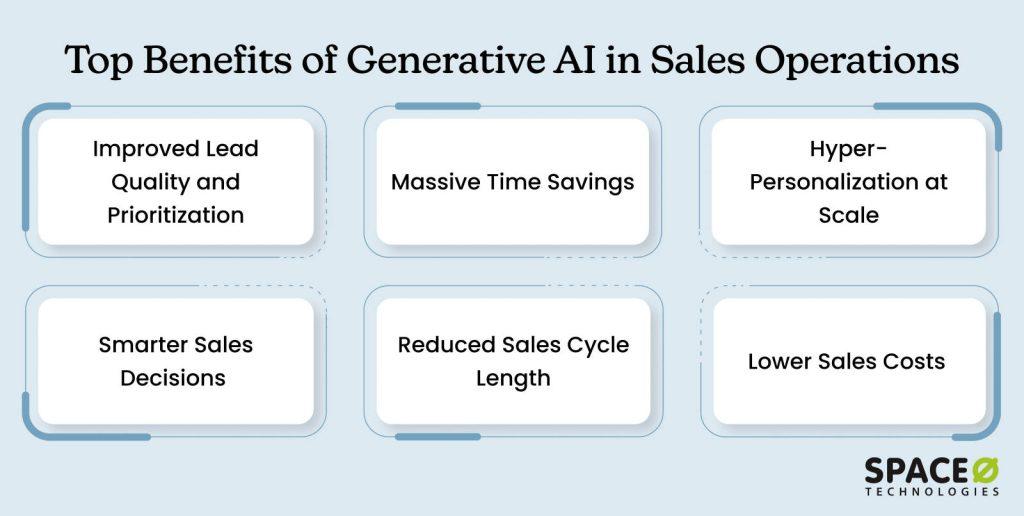
1. Improved lead quality and prioritization
Generative AI for sales analyzes engagement patterns, company growth signals, industry challenges, and historical deal outcomes simultaneously. Your team focuses on the highest-value leads, driving the majority of revenue. Better prioritization means higher-quality conversations and dramatically improved conversion potential.
2. Massive time savings (Real-time automation)
Sales reps waste hours on administrative work instead of selling. Prospecting, email drafting, proposals, call transcription, and data entry consume massive chunks of time. Automation changes this equation entirely. These repetitive tasks shift from manual processes to automated workflows. The freed-up time gets redirected toward closing deals and building genuine relationships with prospects where humans actually add value.
3. Hyper-personalization at scale
Manual personalization is impossible at scale. Generative AI in sales creates unique messaging for each prospect based on company data, industry challenges, mutual connections, and buying signals. Personalized outreach generates dramatically higher engagement rates than generic templates ever could.
4. Smarter sales decisions (data-driven insights)
Most sales decisions rely on incomplete information and gut feeling. Generative AI changes this by synthesizing historical data, market trends, and customer behavior into clear recommendations: which accounts to prioritize, when to escalate, and how to adjust strategy based on real signals rather than intuition. Better data drives better decisions.
5. Reduced sales cycle length
Generative artificial intelligence in sales accelerates every stage: faster prospecting, quicker lead qualification, instant proposals, and intelligent prioritization. Faster pipelines mean more deals annually without increasing headcount. Pipeline velocity directly impacts your revenue without proportional cost increases.
6. Lower sales costs (scaling without linear hiring)
Gen AI sales solutions enable handling substantially higher volume without proportional hiring increases. Automation drives efficiency, reduces wasted prospecting, and accelerates deal progression. Organizations achieve cost reduction while simultaneously improving conversion rates and overall performance.
Understanding these benefits is just the start. The real power emerges when you see how these benefits show up in practice. Organizations that develop custom generative AI models tailored to their specific sales processes and customer data unlock even greater competitive advantages. Let’s explore eight specific, real-world use cases where generative AI in sales and marketing delivers measurable results today.
Build a Future-Ready Sales Automation Solution with Space-O AI
Replace manual tasks with automated, intelligent workflows. Our team custom-builds AI features that integrate smoothly with your CRM and sales stack.
Eight Real-World Use Cases of Generative AI in Sales
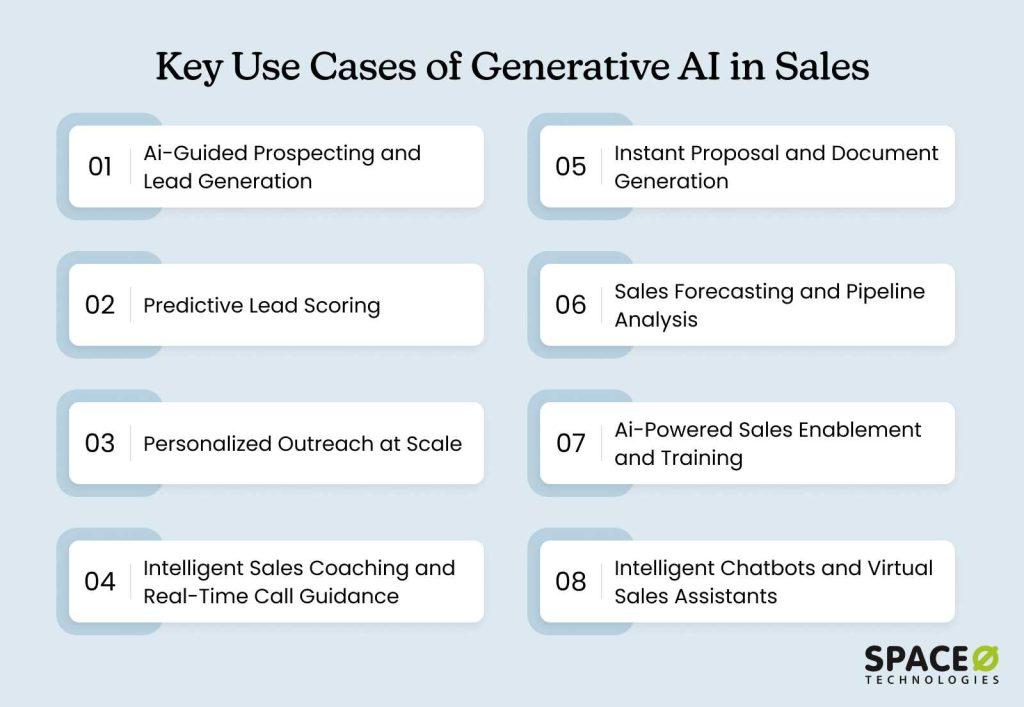
These are the specific applications where generative AI use cases in sales deliver immediate, measurable results. Organizations are implementing these generative AI use cases today and seeing tangible improvements in pipeline quality, sales velocity, and revenue.
1. AI-guided prospecting and lead generation
The challenge
Your reps spend weeks manually researching companies that might fit your Ideal Customer Profile. By the time a prospect list is compiled, market conditions have shifted, and the best timing to reach out has already passed. Opportunities vanish while reps are still doing detective work instead of actually selling.
What generative AI does
Rather than just flagging existing data, generative AI for sales creates prospecting recommendations from scratch by scanning company databases and continuously generating lists of prospects matching your ICP.
More importantly, it synthesizes information from multiple sources such as news, hiring patterns, LinkedIn signals, and funding announcements, then automatically attaches context and buying signals to each prospect. Instead of retrieving existing research, it creates entirely new insights by combining disparate data sources into actionable intelligence.
The outcome
Reps receive a prioritized list of qualified prospects with relevant background already attached. Instead of starting with research, they start with outreach. This is one of the most popular AI sales applications because the ROI is immediate and measurable.
2. Predictive lead scoring
The challenge
Manual lead scoring is guesswork, where one rep considers a lead hot while another dismisses it. Scoring becomes subjective and outdated quickly, and the patterns that separate buyers from tire-kickers stay invisible because detecting them requires analyzing datasets that humans simply cannot process at scale.
What generative AI does
Generative AI doesn’t just score leads; it learns your patterns and generates accurate scoring models by analyzing historical data from deals won and lost. It then generates scoring rules specifically tailored to your unique business, and as new data arrives, it continuously regenerates and refines the scoring model.
The system creates predictive patterns humans would miss entirely, then applies those patterns to new prospects with consistency that manual methods can never achieve.
The outcome
Your team focuses on leads most likely to close because prioritization becomes accurate and consistent across your entire sales organization. Understanding how to use AI in sales starts with implementing scoring that reflects your actual business rather than guesswork or industry theories.
3. Personalized outreach at scale
The challenge
Personalizing emails to dozens of prospects daily is impossible when done manually. Generic templates get deleted immediately, and your response rates suffer because nobody genuinely believes the message was actually written specifically for them.
What generative AI does
Generative AI in sales doesn’t retrieve templates or fill in blanks. Instead, it generates entirely new emails for each prospect by analyzing company data, industry challenges, mutual connections, recent announcements, and buying signals, then creating original copy tailored specifically to that individual prospect. Each email is uniquely written rather than templated, which changes how prospects perceive and respond to your outreach.
The outcome
Open rates increase noticeably, and response rates improve dramatically because conversations start with genuine relevance instead of generic pitching that feels mass-produced.
4. Intelligent sales coaching and real-time call guidance
The challenge
Managers can’t listen to every call, so reps fly blind during conversations without knowing what’s working. Best practices from top performers stay siloed within those individuals instead of spreading across the team, and coaching remains sporadic rather than continuous.
What generative AI does
Generative AI listens to calls in real time and generates coaching recommendations on the fly by transcribing conversations, identifying objections being raised, and generating relevant counter-arguments from your sales knowledge base.
It then generates the next best action recommendation based on what’s actually happening in that specific call, providing guidance that’s tailored to the real situation rather than generic training.
The outcome
Reps improve faster as objection handling strengthens and best practices spread automatically across your entire team, ultimately driving higher win rates across your organization.
5. Instant proposal and document generation
The challenge
Sales reps spend days manually creating proposals, consistency varies wildly between reps, and delays lose deals to faster competitors. Proposal creation becomes a bottleneck instead of a competitive advantage.
What generative AI does
Generative AI doesn’t fill templates. Instead, it generates complete, customized proposals from scratch by pulling requirements from your CRM, analyzing what matters most to this specific prospect, generating relevant sections using your company knowledge base, creating customized pricing structures, and generating professional layouts automatically. The output is a complete proposal ready for review.
The outcome
Turnaround drops from days to hours, improving prospect experience and closing more deals faster. This demonstrates why artificial intelligence in sales has become essential for competitive teams.
6. Sales forecasting and pipeline analysis
The challenge
Sales forecasts are notoriously inaccurate because leadership makes decisions based on unreliable predictions. Missing early signals about deal health creates last-minute surprises that disrupt planning and resource allocation.
What generative AI does
Generative AI generates forecasting models by analyzing historical close rates, current deal progression, prospect engagement patterns, and market conditions simultaneously. It synthesizes all this data to generate probabilistic forecasts and generates risk alerts when deals deviate from expected progression patterns. It continuously learns and regenerates predictions as new data arrives, making forecasts more accurate over time.
The outcome
Forecast accuracy improves and pipeline visibility increases, enabling leadership to make better decisions based on better data and allocate resources strategically rather than reactively based on incomplete information.
7. AI-powered sales enablement and training
The challenge
Onboarding new reps takes months because training is generic and doesn’t adapt to individual gaps. Poor training drives rep turnover, and new reps struggle longer than necessary before becoming truly productive contributors.
What generative AI does
Generative AI generates personalized training modules for each rep based on their role, experience level, and specific learning gaps. It generates customized sales playbooks on demand, creates just-in-time learning content delivered at the exact moment it’s needed in the workflow, and continuously regenerates training based on the rep’s performance and evolving needs.
The outcome
Onboarding accelerates, reps ramp faster, and retention improves because training feels personalized and relevant rather than generic. Company culture improves when employees feel genuinely supported in their professional development.
8. Intelligent chatbots and virtual sales assistants
The situation
Many prospects self-qualify and research independently, so companies miss inbound leads that go unanswered. Support teams drown in FAQs, and prospects looking for quick answers often move to competitors who respond faster.
What generative AI does
Generative AI in sales generates responses to prospect questions in real time rather than retrieving pre-written FAQ answers. It generates contextual, personalized responses based on what the prospect is actually asking, then generates lead qualification information, product recommendations based on prospect interests, and meeting scheduling confirmations automatically throughout the conversation.
The outcome
Response time drops from hours to seconds, leads get qualified before sales teams touch them, and prospects get immediate answers regardless of time of day, resulting in improved conversion rates throughout your entire funnel.
These use cases are real, and organizations are deploying them today. But understanding what’s possible and actually implementing generative AI in sales and marketing are different challenges entirely. The real obstacles emerge once you commit to deployment.
Launch Your Custom Sales AI Assistant With Our Experts
Create custom generative AI solutions that automate prospecting, outreach, and deal support. Talk to our gen AI engineers to get started.
Key Challenges in Implementing Generative AI in Sales
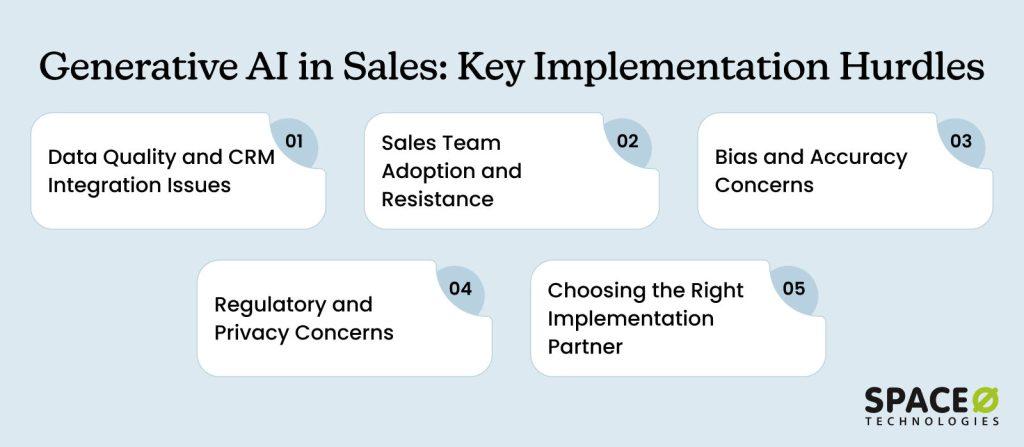
Every organization implementing generative AI for sales encounters consistent obstacles, whether using off-the-shelf platforms or partnering with a generative AI development company for custom solutions. The difference between successful and failed implementations is recognizing these challenges early and planning solutions proactively.
1. Data quality and CRM integration issues
The problem
Generative AI learns from data. If your data is messy, your AI will be messy. Most sales organizations have CRM systems with duplicate records, incomplete fields, and inconsistent formatting scattered across multiple systems that don’t communicate. Poor data quality produces garbage insights.
The solution
- Conduct an honest assessment of your data quality before partnering with vendors to identify what needs cleanup and what’s good enough.
- Invest in data hygiene before AI for sales teams deployment by cleaning your existing CRM, deduplicating records, standardizing formatting, and filling critical gaps.
- Use AI itself to accelerate data cleanup by identifying duplicates, suggesting corrections, and flagging incomplete records faster than manual review.
- Establish ongoing data governance processes that ensure new data maintains quality standards going forward.
2. Sales team adoption and resistance
The problem
When learning how to use AI in sales, reps worry about using AI-generated content that sounds robotic or inauthentic. They fear being responsible for mistakes in AI-created emails or proposals. GenAI outputs sometimes feel impersonal or miss nuance, making reps skeptical about trusting generated messaging with real prospects and deals.
The solution
- Start with lower-stakes use cases like internal brainstorming so reps build confidence in GenAI output before customer-facing content.
- Show examples of high-quality generated emails and proposals so reps see GenAI can produce authentic, personalized content.
- Establish clear workflows where reps review and customize all generated content before sending to maintain their voice and judgment.
- Celebrate early wins where AI-generated outreach actually outperforms manually written alternatives.
3. Bias and accuracy concerns
The problem
Generative AI models trained on historical sales data can perpetuate biases in who gets prioritized or what messaging gets generated for different segments. LLMs can hallucinate details like false case studies or invented statistics that sound plausible but are completely wrong. Reps sending AI-generated content with inaccurate claims damage credibility instantly.
The solution
- Audit training data for bias and test generated recommendations across different customer segments and industries.
- Implement human review of all AI-generated claims, statistics, and case study references before any customer contact.
- Fine-tune generative models using your verified company data so GenAI grounds recommendations in facts you’ve validated.
- Create feedback loops where reps flag inaccurate or problematic generated content to continuously improve the model.
4. Regulatory and privacy concerns
The problem
Generative AI models require training on your sales data and prospect information. LLMs may retain data from training, creating GDPR and CCPA risks. GenAI systems need access to customer data to generate personalized outreach, raising questions about data usage consent and how prospect information flows through generative systems.
The solution
- Partner with vendors using private or fine-tuned generative models that don’t send your data to public LLM APIs.
- Choose on-premise generative AI deployment so training data stays within your infrastructure and never reaches external vendors.
- Implement strict data governance specifying which information can be used to train generative models and how long it’s retained.
- Ensure customer consent for using their data in generative AI systems and document how GenAI processes prospect information.
5. Choosing the right implementation partner
The problem
Not all AI vendors understand generative AI or have experience fine-tuning LLMs for sales. Generic AI expertise doesn’t translate to building effective generative systems. Many vendors claim GenAI capability without proven experience in training and deploying language models for sales operations, wasting time and budget on unproven solutions.
The solution
- Evaluate vendors’ specific generative AI experience by asking about LLM fine-tuning, prompt engineering, and GenAI model customization.
- Request proof-of-concept projects showing AI-generated sales content so you can assess quality before committing resources.
- Prioritize partners with proven generative AI integration services experience who can build and deploy custom generative models tailored to your sales operations.
- Start with pilot testing to generate content quality, accuracy, and team adoption before enterprise-wide deployment.
These challenges aren’t roadblocks. They’re obstacles that successful organizations have already solved. Here’s the proven implementation roadmap that eliminates setbacks and accelerates your generative AI in sales deployment.
How to Implement Generative AI in Sales: 6-Step Roadmap
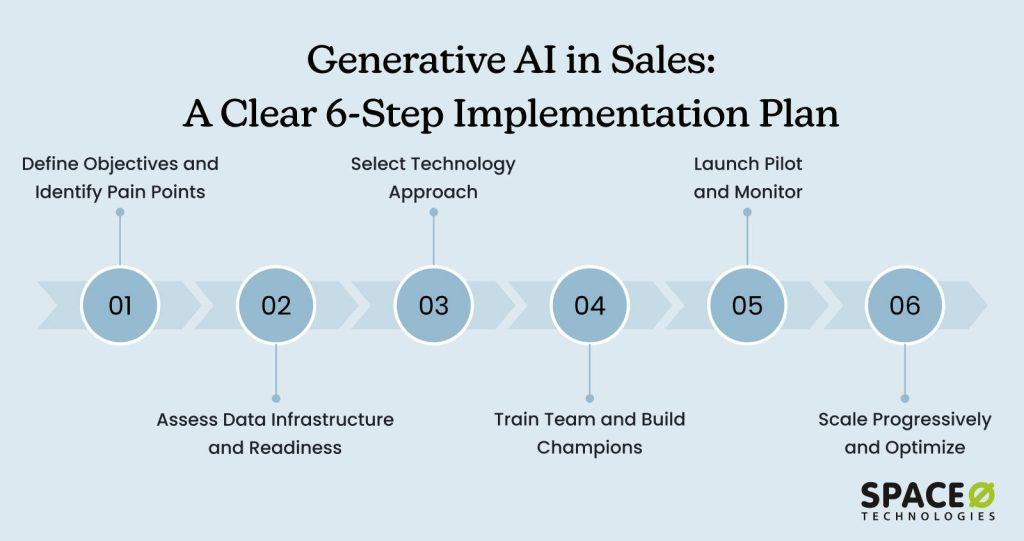
Moving from understanding the opportunity to deploying generative AI sales solutions requires a structured, phased approach. Organizations that rush this process encounter data problems and adoption failures. Those following each step systematically prove ROI quickly and scale with confidence.
Step 1: Define objectives and identify pain points
Get crystal clear on the business problem you’re solving, not just the technology opportunity.
What to do:
- Identify where your team loses most time or makes the poorest decisions
- Quantify the problem (hours/week, revenue impact, conversion loss)
- Define success metrics upfront
Why it matters: Prevents solving the wrong problem with expensive technology.
Example metrics: Conversion rate increase, sales cycle reduction, time saved per rep, forecast accuracy, cost per acquisition.
Step 2: Assess data infrastructure and readiness
Before buying anything, understand what you’re working with and what needs fixing first.
What to evaluate:
- CRM data quality (field completeness, consistency, accuracy gaps)
- System integration capabilities (API connectivity, legacy system constraints)
- Team technical sophistication (IT support resources available)
Why it matters: Prevents infrastructure from becoming a bottleneck during deployment.
Timeline: Plan 4–8 weeks for honest assessment before selection.
Step 3: Select technology approach and implementation partner
The right technology choice depends on your timeline, budget, and how specialized your needs are.
Three paths to choose from:
- Off-the-shelf platforms: Fast deployment, lower cost, standard use cases
Choose if: You need quick time-to-value - Custom generative AI development services: Tailored solutions, competitive differentiation, unique workflows
- Choose if: You have specialized sales processes requiring custom generative AI sales solutions
- Hybrid approach: Start with off-the-shelf platforms, add custom development as you scale
Choose if: You want both speed and future flexibility
Partner evaluation criteria:
- Proven generative AI development services experience
- Sales AI expertise (not generic AI)
- Proof-of-concept using your actual data
- References from comparable companies
- Clear pricing and exit provisions
If you plan to go for custom solutions, hire generative AI developers with strong generative AI tech stack expertise (LLMs, RAG, prompt engineering, model fine-tuning). Sales domain knowledge is valuable but secondary to proven AI development capability.
Step 4: Train team and build champions
Technology adoption fails without proper training and internal advocates who understand the system deeply.
Key activities:
- Provide hands-on training (not documentation)
- Identify power users who become internal champions
- Build playbooks: clear workflows for using AI recommendations
- Establish rapid feedback channels
Why it matters: Adoption fails when systems feel clunky or when reps don’t understand usage.
Success signal: When peers ask champions for help rather than reverting to old methods.
Step 5: Launch pilot and monitor
Start small to validate assumptions with real data before committing to full-scale deployment. Run the AI system in parallel with existing processes, AI recommends, while your team still makes final decisions. This preserves safety while you gather performance data to prove the system actually works.
What to measure:
- AI-generated lead scores vs. actual conversions
- AI-written email response rates vs. templates
- AI forecasts vs. traditional methods
- User feedback (what works, what’s clunky)
- Performance against Step 1 success metrics
- Why results miss targets (if they do)
Why it matters: Pilots prove nothing without clear success metrics defined upfront and continuous monitoring throughout.
Timeline: 4–12 weeks minimum. Document what worked, what didn’t, and what needs adjustment.
Step 6: Scale progressively and optimize
Expand proven solutions gradually while continuously improving based on real-world performance. Don’t declare victory after one pilot and deploy enterprise-wide. Add one team, validate consistent results, then expand. This prevents overwhelming support resources and catches problems before they scale.
Expansion approach:
- Add one team at a time (validate, then expand)
- Use pilot playbooks for new team training
- Monitor consistency across teams
Continuous improvement:
- Retrain your generative AI tech stack (LLMs, retrieval systems, data models) regularly as the business evolves
- Identify the next AI for sales teams’ use cases based on pilot success
- Expand from proven wins (lead scoring → proposals → coaching)
Avoid: Attempting multiple complex deployments simultaneously.
Execution beats technology choice. Each step builds on the previous: clearly define objectives, honestly assess infrastructure, choose the right partner, train your team properly, validate in a controlled pilot, then scale. This transforms generative AI sales solutions from experiments into lasting competitive advantages.
Implementing this roadmap positions you today. But generative AI in sales is evolving rapidly. The systems you deploy now will look fundamentally different in 12 to 36 months. Understanding where the technology is headed helps you build foundations that adapt and scale as capabilities advance.
Build an End-to-End AI-Powered Sales Workflow
Whether you need an AI assistant, a fine-tuned model, or a full platform, Space O AI brings deep technical expertise to help you build high-impact generative AI solutions for sales.
Future Trends: Where Generative AI in Sales Is Heading
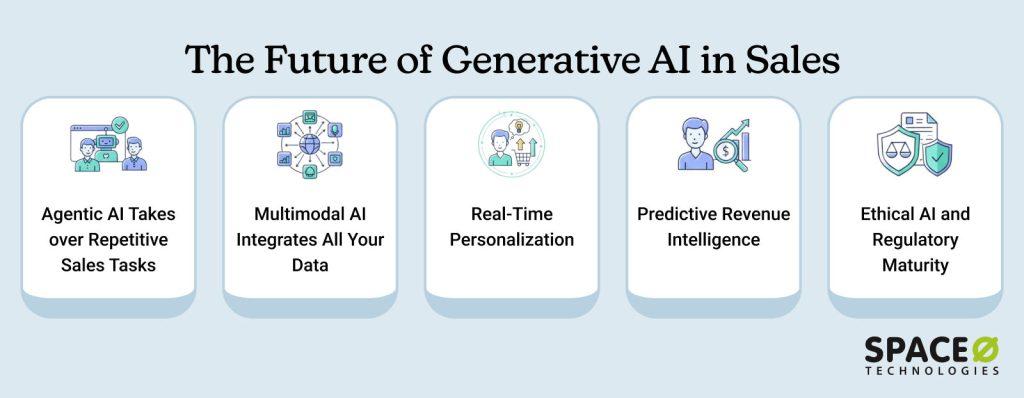
The competitive window for AI leadership in sales is closing fast. The next wave of innovation isn’t years away, it’s months away. Early visibility into emerging trends like agentic autonomy, multimodal intelligence, and prescriptive analytics separates organizations that lead from those that follow. Here’s what’s coming and why positioning yourself now matters—including how partnerships with top generative AI development companies can accelerate your implementation timeline
1. Agentic AI takes over repetitive sales tasks
AI agents handle prospecting autonomously, researching companies, identifying buying signals, crafting personalized outreach, and managing follow-ups. Your team reviews results rather than doing manual work. As capabilities advance, organizations transition from tools requiring human direction to agents operating with minimal supervision.
2. Multimodal AI integrates all your data
Next-generation systems integrate text, video, voice, and visual data simultaneously. Organizations that build AI voice assistant capabilities into these platforms enable AI to analyze tone, body language, and emotional cues from calls. It identifies website changes signaling business activity. Rather than forcing teams to piece insights together, comprehensive systems synthesize all information at once.
3. Real-time personalization and dynamic pricing
AI adjusts recommendations, messaging, and pricing in real time based on prospect behavior. Your pitch deck adapts mid-meeting based on engagement. Dynamic pricing adjusts per prospect using company size, industry, urgency, and close likelihood. Pricing becomes strategic, with systems continuously optimizing based on market conditions.
4. Predictive revenue intelligence
AI moves beyond simply forecasting revenue to understanding the reasons behind predictions. It identifies which deals are truly at risk and why (pricing objections, stakeholder changes, competitive threats). It recommends specific actions to address risks before deals deteriorate. AI becomes prescriptive intelligence, telling you not just what will happen, but what steps to take now.
5. Ethical AI and regulatory maturity
Regulatory frameworks tighten around explainability and bias detection. AI recommendations must be transparent, not black boxes. Vendors must prove systems perform equitably across demographics. Organizations building strong ethical practices now gain competitive advantages as regulations mature and customer expectations for responsible AI increase.
As generative AI continues to reshape sales strategies and customer engagement, staying ahead of these trends is critical for competitive advantage. Get our Gen AI consulting services to navigate this rapidly evolving landscape with confidence. Our experts help you assess which trends align with your business goals, develop a phased implementation roadmap, and build scalable solutions that position your sales organization for long-term success in the AI-driven marketplace.
Let Space-O Build You Your Dream Generative AI Sales Solution
Generative AI in sales automates prospecting, lead scoring, proposal generation, and personalization, eliminating administrative friction and preventing revenue growth. You’ve seen how organizations implement this strategically, from defining objectives and piloting solutions to scaling progressively. The technology works.
What matters now is choosing the right implementation partner to navigate challenges and capture real business value from your investment. This is where Space O AI can help. With 15+ years of experience as a leading AI development service provider, we are experienced engineers who can integrate generative AI solutions into your sales workflows.
Our team specializes in developing tailored generative AI applications that fit seamlessly into your sales ecosystem. We help you automate research, enhance prospecting, create personalized communication at scale, and build AI-driven workflows that elevate your entire revenue operation.
Whether you need a custom GPT trained on your sales data, an AI-powered assistant integrated with your CRM, or end-to-end automation for your sales outreach, we can support you with the right strategy and development expertise.
If you are ready to explore how generative AI can transform your sales performance, book a consultation with our experts and let us help you build the next generation of AI-enabled sales solutions.
Frequently Asked Questions About Generative AI in Sales
Will generative AI in sales replace salespeople?
No. AI automates repetitive work: research, admin, drafting. It doesn’t replace relationship building and complex negotiation. Salespeople freed from these tasks become more effective. They focus on prospects, ask better questions, build stronger relationships, and close more deals. Your best reps who embrace Gen AI solutions become even more valuable.
How much does implementing generative AI cost?
Pilot projects typically run $30,000 to $80,000. Full-scale generative AI sales solutions range from $100,000 to $300,000+. Ongoing costs are roughly 15–20% of the initial investment annually. Most organizations achieve positive ROI within 12–18 months through labor savings, improved efficiency, and revenue gains.
What ROI should we realistically expect?
Results vary by use case. Organizations typically see 10–30% conversion rate improvements, 20–30% sales cycle acceleration, and 25–40% time savings on admin tasks. Lead scoring and prospecting deliver the fastest returns. More complex applications take longer but often deliver larger gains.
How long does implementation take?
Timelines depend on scope and complexity. Pilot projects typically run 4–12 weeks. Full deployment of a single use case takes 3–6 months. Phased rollout across multiple capabilities spans 6–12 months. Custom solutions take longer than off-the-shelf platforms but integrate more seamlessly with your unique sales processes.
What’s the biggest challenge organizations face in implementing Gen AI SaaS solutions?
Data quality and team adoption are the top obstacles. Legacy systems create integration complexity. Reps worry about AI replacing them or generating poor-quality content. Overcome this through honest data assessment, transparent team communication, and involving your best reps in pilots. Proper implementation partners guide you through these challenges successfully.
Custom development vs. existing platforms, which is right?
Off-the-shelf platforms offer quick deployment but force your unique sales process into standard workflows. Custom solutions take longer upfront but deliver exactly what your team needs. If your sales process is unique and creates a competitive advantage, invest in custom development immediately. Earlier alignment means faster time-to-value and better long-term returns. Custom solutions scale and adapt as your business evolves.


Build Your Gen AI-Powered Sales Solution
What to read next