- What Is AI-Powered Enterprise EHR Development?
- 6 Key Benefits of AI-Powered EHR for Healthcare Enterprises
- Core Features of AI-Powered Enterprise EHR Systems
- AI Use Cases Transforming Enterprise EHR Systems
- AI-Powered Enterprise EHR Development Process
- Challenges in AI EHR Integration and How to Overcome Them
- AI-Powered Enterprise EHR Development Cost
- Build a Future-Ready Enterprise AI EHR Platform with Space-O AI
- Frequently Asked Questions
- How long does AI-powered enterprise EHR development take?
- What is the ROI of AI integration in EHR systems?
- Can AI be integrated with existing EHR systems like Epic or Cerner?
- What AI technologies are used in enterprise EHR development?
- How do we ensure HIPAA compliance in AI-powered EHR systems?
- What are the biggest challenges in AI EHR implementation?
AI-Powered Enterprise EHR Development: Benefits, Features, Process, Cost, and Challenges

 Last Updated: March, 10 2026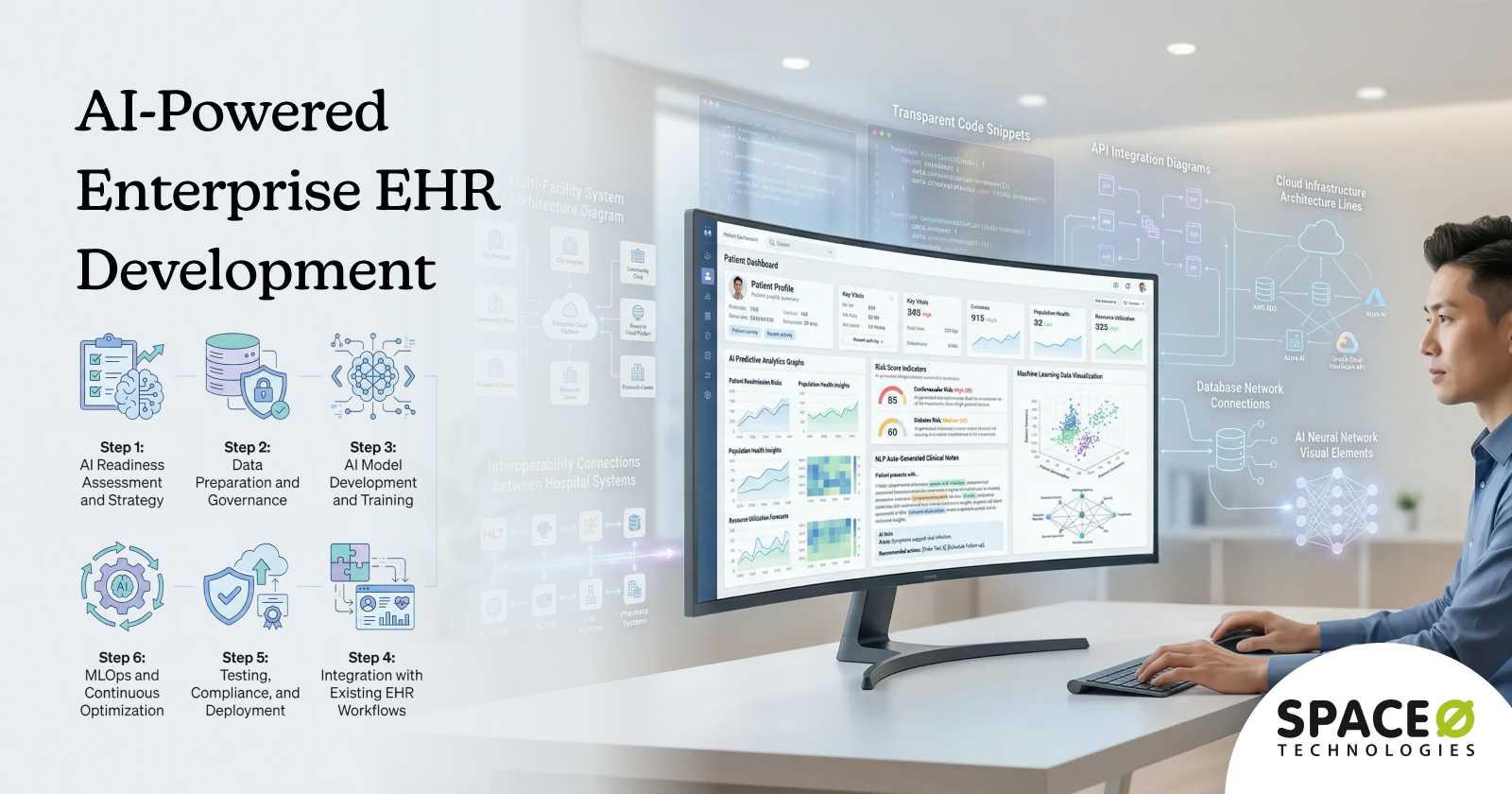
Healthcare enterprises face a critical inflection point. With physicians spending nearly 6 hours on EHR tasks for every 8 hours of scheduled patient time, the documentation burden has reached unsustainable levels.
According to Research and Markets, the AI-enhanced EHR market is projected to reach USD 28.09 billion by 2029 at a 31% CAGR, signaling massive enterprise investment in intelligent healthcare systems.
AI-powered enterprise EHR development addresses these challenges by embedding machine learning, natural language processing, and predictive analytics directly into clinical workflows. Unlike standard EHR implementations, enterprise-grade AI solutions handle multi-facility deployments, complex interoperability requirements, and massive data volumes while maintaining HIPAA compliance.
This guide covers everything you need to know about building AI-powered enterprise EHR systems, from core capabilities and implementation processes to costs and ROI considerations. Drawing from our experience in delivering AI EHR software development services to healthcare organizations, we’ll walk through the practical steps required to implement these systems successfully.
What Is AI-Powered Enterprise EHR Development?
AI-powered enterprise EHR development refers to building electronic health record systems that leverage artificial intelligence technologies to automate clinical workflows, enhance decision-making, and improve patient outcomes at scale. These systems go beyond basic record-keeping to deliver intelligent insights that transform healthcare delivery.
Traditional EHR systems serve as digital repositories for patient information. They store medical histories, lab results, medications, and clinical notes. However, they require manual data entry, offer limited analytical capabilities, and often contribute to physician burnout rather than alleviating it.
AI-powered enterprise EHR systems fundamentally change this paradigm. They actively analyze patient data, identify patterns, predict risks, and automate documentation tasks. The “enterprise” designation indicates these solutions are built for large healthcare organizations with complex requirements, including multi-facility deployments, thousands of concurrent users, and integration with dozens of clinical systems.
Enterprise vs. standard practice EHR requirements
Enterprise healthcare organizations face unique challenges that standard EHR solutions cannot address. They manage patient populations across multiple facilities, each with distinct workflows and specialties. They process millions of clinical transactions daily while maintaining strict compliance with HIPAA, HITECH, and state-specific regulations.
Health systems implementing AI-enhanced EHR platforms consistently report faster clinical documentation, improved care coordination, and better resource utilization. These operational improvements explain why enterprise organizations increasingly prioritize AI capabilities in their EHR strategies.
Enterprise AI EHR development addresses these requirements through scalable cloud architecture, robust security frameworks, and flexible integration capabilities that connect with existing hospital information systems.
Now that we understand the foundation, let’s explore the benefits of building an AI-enabled EHR system for enterprise healthcare operations.
6 Key Benefits of AI-Powered EHR for Healthcare Enterprises
AI-powered enterprise EHR systems deliver measurable improvements across clinical, operational, and financial dimensions. Healthcare leaders evaluating these investments need to understand the specific benefits that justify implementation costs and drive organizational transformation.
1. Reduces physician burnout
Physician burnout has reached crisis levels, with EHR documentation consistently cited as a major contributing factor. AI-powered documentation tools directly address this burden by automating routine tasks and reducing after-hours charting requirements.
When physicians spend less time on administrative work, they experience greater job satisfaction and can dedicate more attention to patient care. Organizations implementing AI documentation support report meaningful improvements in physician retention and workplace satisfaction.
2. Enhances clinical accuracy
AI systems analyze patient data with consistency that manual processes cannot match. Predictive models identify high-risk patients with accuracy levels that support confident clinical decision-making.
Clinical decision support reduces diagnostic errors by surfacing relevant information clinicians might otherwise miss, particularly for complex cases or atypical presentations. Automated coding eliminates transcription mistakes that lead to claim denials and ensures accurate capture of clinical complexity.
3. Improves operational efficiency
Enterprise AI EHR systems deliver a significant reduction in administrative workload through intelligent automation. Scheduling optimization reduces patient wait times and improves resource utilization across facilities.
Automated prior authorization processing accelerates approvals that previously required extensive staff time. These efficiency gains compound across the organization, freeing clinical and administrative staff to focus on higher-value activities.
4. Yields better patient outcomes
Real-time risk identification enables proactive interventions before adverse events occur, shifting care delivery from reactive to preventive. Care gap detection ensures patients receive recommended screenings and preventive services according to evidence-based guidelines.
Population health analytics identify trends that inform quality improvement initiatives across entire patient populations. These capabilities support value-based care models and drive measurable improvements in clinical quality metrics.
5. Optimizes Cost and maximizes ROI
Healthcare organizations implementing AI-powered EHR systems achieve cost savings through multiple channels: reduced claim denials, decreased readmissions, improved coding accuracy, and operational efficiency.
Revenue improvements come from more accurate documentation, complete charge capture, and reduced administrative overhead. The combination of cost reduction and revenue improvement delivers strong returns that justify initial implementation investment.
6. Aids scalable compliance management
AI systems maintain consistent HIPAA compliance across all interactions without requiring manual oversight. Automated audit trails document every access and modification, creating complete records for regulatory inquiries. Role-based access controls enforce security policies uniformly across thousands of users.
This scalable approach to compliance reduces organizational risk while freeing compliance staff from routine monitoring tasks to focus on strategic initiatives.
Realizing these benefits requires skilled development teams with healthcare domain expertise. Organizations looking to hire EHR developers should prioritize experience with clinical workflows, regulatory compliance, and enterprise integration.
With these benefits established, let’s examine specific use cases where AI transforms enterprise EHR operations.
Integrate AI Into Your Enterprise EHR System with Space-O AI
Our healthcare technology experts build intelligent enterprise EHR systems that improve operational efficiency and clinical decision-making.
Core Features of AI-Powered Enterprise EHR Systems
Enterprise EHR systems leverage multiple AI technologies working in concert to deliver comprehensive clinical intelligence. Understanding these features helps healthcare leaders identify which capabilities align with their organizational priorities and patient care objectives.
These features fall into two categories: must-have capabilities that form the foundation of any AI EHR implementation and advanced features that provide competitive differentiation.
Working with experienced EHR consulting services can help organizations prioritize the right features for their specific clinical environment.
1. Must-have features
These foundational features address the most pressing challenges in enterprise healthcare and deliver immediate operational value. Any enterprise AI EHR implementation should include these core capabilities.
1.1 Clinical decision support
Analyzes patient data in real-time to provide evidence-based recommendations at the point of care. Includes risk stratification models, drug interaction alerts, diagnostic support tools, contextual intelligence, and treatment pathway suggestions.
1.2 Automated clinical documentation
Reduces documentation burden through AI-assisted coding, transcription, and form completion. Includes ICD-10/CPT code suggestions, smart form pre-population, voice-enabled charting, structured note generation, and template automation.
1.3 Interoperability and data integration
Enables seamless data exchange across facilities, departments, and external partners. Includes FHIR-based APIs, HL7 messaging, automated data mapping, master patient index reconciliation, and terminology translation.
1.4 Compliance and security automation
Automates regulatory compliance monitoring and security enforcement across the enterprise. Includes automated audit trails, role-based access controls, PHI detection, encryption management, and policy enforcement.
1.5 Order management automation
Streamlines clinical ordering processes with intelligent suggestions and error prevention. Includes order set recommendations, duplicate order detection, formulary checking, and clinical pathway integration.
1.6 Patient matching and identity resolution
Ensures accurate patient identification across multiple systems and facilities. Includes probabilistic matching algorithms, duplicate record detection, cross-facility identity linking, and demographic validation.
1.7 Workflow orchestration
Coordinates clinical tasks and handoffs across care teams and departments. Includes task prioritization, workload balancing, escalation management, care team notifications, and status tracking.
1.8 Data quality management
Monitors and maintains data accuracy, completeness, and consistency across the enterprise. Includes automated validation rules, missing data alerts, outlier detection, data cleansing workflows, and quality dashboards.
These must-have features form the operational backbone of AI-powered enterprise EHR systems. Clinical decision support and documentation automation directly address physician burnout, while interoperability ensures data flows seamlessly across the care continuum.
2. Advanced features
These sophisticated capabilities provide competitive differentiation and address complex clinical and operational challenges. Organizations with mature AI programs implement these features to maximize clinical and operational value.
2.1 Predictive analytics
Analyzes vast datasets to forecast clinical and operational outcomes before they occur. Includes readmission prediction, sepsis early warning, length-of-stay forecasting, patient deterioration alerts, and no-show prediction.
2.2 Natural language processing
Unlocks clinical value from unstructured text, including notes, reports, and communications. Includes entity extraction, relationship mapping, clinical note summarization, PHI de-identification, and sentiment analysis.
2.3 Ambient clinical intelligence
Listens to patient-physician conversations and generates structured documentation automatically. Includes background audio capture, clinical concept identification, structured data extraction, and draft note generation.
2.4 Generative AI integration
Creates draft clinical summaries, patient communications, and care coordination documentation. Includes discharge summary generation, patient education materials, care coordination notes, and after-visit summaries.
2.5 Computer vision for medical imaging
Analyzes medical images to support diagnostic decisions and workflow automation. Includes image classification, anomaly detection, measurement automation, report pre-population, and quality scoring.
2.6 Population health analytics
Identifies patterns and risks across entire patient populations for proactive care management. Includes care gap identification, risk cohort segmentation, outcome trending, social determinants analysis, and quality measure tracking.
2.7 Revenue cycle optimization
Applies AI to billing, coding, and claims processes to maximize reimbursement accuracy. Includes charge capture optimization, denial prediction, prior authorization automation, undercoding detection, and payer rule validation.
2.8 Clinical trial matching
Identifies eligible patients for clinical trials based on EHR data analysis. Includes eligibility criteria matching, patient screening automation, protocol alignment, and recruitment optimization.
2.9 Voice-enabled clinical assistants
Provides hands-free EHR interaction through natural language voice commands. Includes voice navigation, order placement by voice, information retrieval, and voice-to-text documentation.
2.10 Real-time capacity management
Optimizes bed management and resource allocation using predictive demand modeling. Includes bed availability forecasting, discharge timing prediction, staffing optimization, surgical scheduling, and ED flow management.
Advanced features differentiate leading healthcare organizations from those with basic AI implementations. Predictive analytics enables proactive intervention before adverse events occur, while NLP and ambient intelligence fundamentally transform clinical documentation.
With these core features established, let’s examine the use cases of AI-powered EHR systems for healthcare enterprises.
AI Use Cases Transforming Enterprise EHR Systems
Understanding practical applications helps healthcare leaders identify opportunities within their organizations. These use cases represent proven implementations delivering measurable results across enterprise healthcare settings. Each use case follows a consistent structure to help you evaluate relevance for your organization.
1. Automated clinical documentation and coding
What it is
AI-powered documentation systems that capture, transcribe, and structure clinical information automatically. These systems use natural language processing to transform clinician-patient conversations and dictation into structured clinical notes, codes, and summaries without manual documentation effort.
Key capabilities
- Real-time transcription of clinician-patient conversations using ambient listening technology
- Automatic generation of structured clinical notes from unstructured dictation
- Real-time ICD-10 and CPT code suggestions based on clinical content
- Draft discharge summaries, progress notes, and patient after-visit summaries
- Smart form pre-population based on patient history and current encounter context
Benefits
- Significant reduction in the time physicians spend on documentation
- Improved coding accuracy and complete capture of billable services
- Reduced coding lag between encounter and claim submission
- Decreased after-hours charting burden contributes to physician satisfaction
- Consistent documentation quality across all providers and encounters
2. Predictive risk stratification
What it is
Machine learning models that analyze patient data to predict clinical risks and adverse events before they occur. These systems enable proactive intervention rather than reactive treatment, fundamentally shifting how care teams approach patient management.
Key capabilities
- Hospital readmission prediction analyzing demographics, clinical history, and social determinants
- Sepsis detection algorithms monitor vital signs, lab values, and clinical notes continuously
- Patient deterioration alerts based on subtle changes in physiological patterns
- Length-of-stay forecasting for capacity planning and discharge optimization
- Chronic disease progression modeling for long-term care planning
Benefits
- Earlier identification of high-risk patients enabling targeted interventions
- Improved survival rates through early detection of sepsis and deterioration
- Reduced readmissions through enhanced discharge planning for at-risk patients
- Better capacity management through accurate length-of-stay predictions
- Support for value-based care models requiring proactive population management
3. Care gap identification and population health
What it is
AI platforms that analyze entire patient populations to identify gaps in preventive care, chronic disease management, and recommended screenings. These systems enable systematic outreach and care coordination across large patient panels.
Key capabilities
- Automated identification of patients overdue for screenings, vaccinations, and preventive services
- Social determinants of health analytics flagging barriers to care access
- Risk-adjusted quality reporting for value-based care contract compliance
- Patient stratification for care management program enrollment
- Automated outreach campaign generation based on identified care gaps
Benefits
- Improved quality metrics through systematic care gap closure
- Prevention of disease progression through timely preventive interventions
- Better performance on value-based care quality measures is driving reimbursement
- Enhanced patient engagement through personalized outreach
- Identification of social factors impacting health outcomes for targeted support
4. Conversational AI and virtual assistants
What it is
Voice-enabled and chat-based AI interfaces that enable natural language interaction with EHR systems. These systems serve both clinicians seeking hands-free EHR access and patients seeking self-service capabilities for routine healthcare needs.
Key capabilities
- Voice-enabled EHR navigation for clinicians using natural language commands
- Hands-free access to patient information, order placement, and documentation
- Patient-facing chatbots for appointment scheduling and prescription refill requests
- Automated responses to routine patient inquiries based on individual health records
- Secure integration with EHR data for personalized, context-aware interactions
Benefits
- Improved clinician efficiency through hands-free EHR interaction during procedures
- Reduced administrative burden on front-office staff through patient self-service
- Enhanced patient experience through immediate responses to routine inquiries
- Extended access to healthcare services outside traditional office hours
- Consistent, accurate information delivery based on individual patient records
Now let’s explore the systematic process for developing and implementing AI-powered enterprise EHR systems.
Turn Enterprise EHR Use Cases into Scalable Solutions
Our healthcare software experts design and develop AI-powered enterprise EHR platforms tailored to complex hospital networks and healthcare organizations.
AI-Powered Enterprise EHR Development Process
Successful AI EHR implementation requires a systematic approach that addresses technical, clinical, and organizational requirements. This process ensures solutions deliver intended benefits while maintaining compliance and user adoption. Each phase builds on the previous, creating a comprehensive foundation for long-term AI success.
Step 1: AI readiness assessment and strategy
Every enterprise AI EHR project begins with a comprehensive assessment. This phase evaluates organizational readiness across multiple dimensions and establishes the strategic foundation for successful implementation.
Action items
- Conduct a data infrastructure audit to assess data quality, completeness, and accessibility
- Identify high-impact use cases aligned with strategic priorities and pain points
- Develop ROI models with realistic assumptions based on organizational baseline metrics
- Assess technical infrastructure, including cloud readiness, integration capabilities, and security posture
- Evaluate change management requirements and organizational capacity for transformation
- Define success metrics and governance structures for ongoing AI program management
Step 2: Data preparation and governance
AI systems are only as good as the data they analyze. This phase establishes the foundation for successful model performance and creates sustainable data management practices for ongoing AI operations.
Action items
- Implement data cleansing protocols to address inconsistencies, duplicates, and errors
- Establish de-identification procedures for training data that maintain utility while protecting privacy
- Design feature engineering pipelines that transform raw data into model-ready formats
- Create data governance frameworks defining ownership, quality standards, and access policies
- Build a data integration architecture connecting disparate source systems
- Establish ongoing data quality monitoring to maintain model performance over time
Step 3: AI model development and training
With clean data available, model development proceeds through iterative cycles of training, validation, and refinement. This phase transforms prepared data into production-ready AI capabilities tailored to your clinical environment.
Action items
- Select appropriate algorithms based on use case requirements and data characteristics
- Train models on historical EHR datasets with proper train-test splits to prevent overfitting
- Validate performance using clinically meaningful metrics, including AUROC, sensitivity, specificity, and F1 scores
- Conduct a bias assessment to ensure equitable performance across patient populations
- Document model behavior, limitations, and appropriate use cases
- Perform clinical review with subject matter experts to validate model recommendations
Step 4: Integration with existing EHR workflows
AI capabilities must integrate seamlessly with clinical workflows to deliver value. Partner with experienced AI EHR integration service providers to ensure smooth connectivity with existing platforms while enhancing rather than disrupting established care processes.
Action items
- Develop FHIR-based AI microservices that communicate with existing EHR platforms
- Build real-time inference APIs that deliver predictions within clinical workflow timeframes
- Design user interfaces that present AI insights without disrupting established workflows
- Implement feedback mechanisms allowing clinicians to validate or correct AI recommendations
- Create alert routing logic that delivers notifications to appropriate care team members
- Configure role-based access, ensuring appropriate visibility and permissions across user types
Step 5: Testing, compliance, and deployment
Rigorous testing ensures AI systems perform safely and effectively in production environments. This phase validates that AI capabilities meet clinical, technical, and regulatory requirements before full deployment.
Action items
- Execute user acceptance testing with representative clinical users across all roles
- Conduct a HIPAA security assessment and remediate any identified vulnerabilities
- Perform shadow mode deployment where AI runs alongside existing processes without impacting care
- Complete clinical validation demonstrating AI recommendations align with expert judgment
- Obtain necessary approvals from clinical leadership, compliance, and IT governance
- Develop rollback procedures and contingency plans for rapid response to production issues
Step 6: MLOps and continuous optimization
AI systems require ongoing monitoring and optimization to maintain performance over time. This phase establishes the operational framework for sustainable AI management across the enterprise.
Action items
- Implement model monitoring dashboards, tracking prediction accuracy and usage patterns
- Establish drift detection alerting when model performance degrades
- Create continuous retraining pipelines that incorporate new data while maintaining validation standards
- Develop feedback loops where clinician corrections improve future model performance
- Maintain documentation supporting regulatory requirements and internal governance
- Conduct regular model reviews to identify optimization opportunities and emerging use cases
Understanding the development process prepares organizations to address common implementation challenges, which we’ll explore next.
Challenges in AI EHR Integration and How to Overcome Them
AI EHR implementation presents significant challenges that organizations must anticipate and address. Proactive planning and experienced guidance dramatically improve success rates and help organizations avoid common pitfalls that derail AI initiatives.
1. Data quality and interoperability
Healthcare data is notoriously fragmented and inconsistent. Different systems use different terminologies, coding standards, and data formats. Missing data, duplicate records, and documentation variability all impact AI model performance. Without addressing data quality proactively, even the most sophisticated AI models will produce unreliable results.
Solution
- Implement comprehensive data governance, establishing quality standards and ownership
- Adopt FHIR and HL7 standards for consistent data exchange across systems
- Build data cleansing pipelines that run continuously rather than as one-time projects
- Create master patient indices that reconcile records across facilities
- Establish data quality metrics with regular monitoring and improvement cycles
2. Integration with legacy systems
Many healthcare organizations operate decades-old systems that lack modern integration capabilities. These legacy platforms often contain critical clinical data that AI systems need to access. The challenge lies in extracting value from legacy investments while enabling modern AI capabilities.
Solution
- Design an API-first architecture that abstracts legacy system complexity
- Implement phased migration strategies that maintain operational continuity
- Deploy middleware solutions that bridge modern AI capabilities with legacy data sources
- Consider cloud-based integration platforms that reduce on-premises complexity
- Plan for eventual legacy system replacement while delivering near-term AI value
3. AI model governance and explainability
Clinicians rightfully question AI recommendations that lack transparency. Regulatory requirements increasingly demand explainable AI, particularly for clinical decision support. Building trust requires demonstrating how AI reaches its conclusions and ensuring clinicians maintain decision-making authority.
Solution
- Implement explainable AI frameworks that provide reasoning for recommendations
- Establish human-in-the-loop validation requiring clinician approval for high-stakes decisions
- Deploy bias detection and monitoring across protected patient characteristics
- Create model cards documenting performance, limitations, and appropriate use cases
- Maintain audit trails supporting regulatory inquiries and quality investigations
4. HIPAA compliance and security
AI systems processing protected health information must meet stringent security requirements. Healthcare data breaches carry significant financial and reputational consequences that organizations must work proactively to prevent. Security must be built into AI systems from the ground up rather than added as an afterthought.
Solution
- Implement privacy-by-design architecture with security built into every component
- Deploy strong encryption for data at rest and in transit using industry-standard protocols
- Enforce role-based access controls with the principle of least privilege
- Maintain comprehensive audit logging of all data access and modifications
- Execute Business Associate Agreements with all AI service providers
5. Change management and clinician adoption
The most sophisticated AI system fails if clinicians don’t use it. Resistance often stems from workflow disruption, trust concerns, or inadequate training. Successful adoption requires treating change management as a core project component rather than an afterthought.
Solution
- Develop super-user training programs, creating clinical champions who support peers
- Plan phased rollouts that allow adjustment periods before full deployment
- Create continuous feedback loops, incorporating clinician input into system improvements
- Demonstrate value early by targeting high-impact, low-disruption use cases
- Address concerns transparently rather than dismissing clinician skepticism
Our healthcare AI consulting services help organizations navigate these challenges effectively. We guide healthcare enterprises through vendor selection, workflow optimization, and change management to ensure successful AI adoption.
With challenges addressed, let’s examine the investment required for AI-powered enterprise EHR development.
AI-Powered Enterprise EHR Development Cost
Developing an AI-powered enterprise EHR system requires significant investment that varies based on scope, integration complexity, and AI capabilities required. Understanding cost structures helps organizations budget appropriately and maximize return on investment. The following breakdown provides a framework for estimating your investment requirements.
AI-Powered Enterprise EHR Development Cost
Developing an AI-powered enterprise EHR system requires significant investment that varies based on scope, integration complexity, and AI capabilities required. Understanding cost structures helps organizations budget appropriately and maximize return on investment. The following breakdown provides a framework for estimating your investment requirements.
Cost by complexity level
The table below provides cost estimates organized by project complexity, helping you identify where your requirements fall and what investment to anticipate.
| Complexity Level | Features | Estimated Cost | Timeline |
| Basic | Predictive analytics, basic CDSS | $50,000–$150,000 | 3–6 months |
| Intermediate | NLP documentation, ML risk models | $150,000–$350,000 | 6–9 months |
| Advanced | Full AI suite, GenAI, voice AI | $350,000–$700,000 | 9–12 months |
| Enterprise-Scale | Multi-facility, custom models, MLOps | $700,000–$1.5M+ | 12–18 months |
Basic tier projects focus on foundational AI capabilities. These implementations typically include predictive analytics for specific use cases such as readmission risk or basic clinical decision support alerts. Organizations at this level are often testing AI capabilities before broader enterprise deployment.
Intermediate tier projects expand AI capabilities to include natural language processing for documentation assistance and multiple machine learning models for clinical risk stratification. These implementations require more sophisticated data pipelines and integration with core EHR workflows.
Advanced tier projects deliver comprehensive AI suites including generative AI for documentation, voice-enabled interfaces, and multiple interconnected AI capabilities. These implementations require significant integration effort and sophisticated MLOps infrastructure.
Enterprise-scale tier projects involve multi-facility deployment, custom model development tailored to organizational data, and comprehensive MLOps platforms for ongoing model management. These implementations represent transformational investments in AI-powered healthcare delivery.
Key factors driving EHR development cost
Several variables significantly impact total development investment beyond the base complexity level.
1. Scope of AI features
The breadth and sophistication of AI capabilities directly determine development complexity. Basic predictive analytics and clinical decision support require less investment than comprehensive solutions, including NLP documentation, generative AI, and ambient clinical intelligence. Organizations should prioritize features based on clinical impact and strategic importance.
2. Number of integrations
Each connection to external systems requires dedicated development and testing effort. Labs, pharmacy systems, imaging platforms, billing systems, and third-party applications all require integration work. Organizations with complex existing system landscapes should anticipate higher integration costs.
3. Deployment model
Cloud-based solutions reduce upfront capital requirements but create ongoing operational expenses tied to usage and data volumes. On-premise deployments require hardware investment and internal infrastructure management but may offer lower long-term costs for large organizations with existing data center capabilities.
4. Compliance requirements
HIPAA compliance, ONC certification, and state-specific regulations require documentation, security controls, and validation processes that impact timelines and budgets. Organizations in highly regulated environments or pursuing certification should budget for additional compliance-related development.
5. Team composition and location
Development team expertise and geographic location affect hourly rates. Specialized healthcare AI expertise commands premium rates regardless of location. Organizations should balance cost considerations with the value of healthcare domain expertise and regulatory knowledge.
Understanding these costs and returns prepares organizations to make informed investment decisions and set appropriate expectations for AI EHR initiatives.
Get a Custom Estimate for Your Enterprise AI-Powered EHR Platform
Talk to Space-O AI’s healthcare technology experts to understand the development cost and architecture required for your enterprise AI EHR system.
Build a Future-Ready Enterprise AI EHR Platform with Space-O AI
AI-powered enterprise EHR development represents a fundamental shift in how healthcare organizations manage clinical workflows, documentation, and patient care. This guide covered core features, implementation processes, use cases, and investment considerations to help you evaluate AI opportunities confidently.
Space-O AI combines 15+ years of AI development expertise with deep healthcare domain knowledge, having delivered 500+ successful AI development projects across enterprise sectors. Our team builds production-ready AI solutions that integrate seamlessly with existing EHR infrastructure while maintaining HIPAA compliance.
Our healthcare AI specialists bring expertise in clinical decision support, predictive analytics, NLP documentation, and EHR integration. We work as an extension of your team, whether you need to hire dedicated AI developers or comprehensive end-to-end development services.
The healthcare organizations gaining a competitive advantage today are those investing in AI-powered clinical intelligence now. Contact Space-O AI for a free consultation to discuss your enterprise EHR requirements and receive a tailored implementation roadmap for your organization.
Frequently Asked Questions
How long does AI-powered enterprise EHR development take?
Development timeline ranges from 3–6 months for MVP with core AI features to 12–18 months for full enterprise-scale deployment with custom models and multi-facility integration. Timeline depends on scope, integration complexity, and organizational readiness factors.
What is the ROI of AI integration in EHR systems?
Healthcare organizations typically achieve meaningful cost savings within the first year through reduced claim denials, improved coding accuracy, and operational efficiency. ROI recovery typically occurs within the first two years, with specific returns depending on baseline metrics and implementation scope.
Can AI be integrated with existing EHR systems like Epic or Cerner?
Yes, AI integration services connect with major EHR platforms through FHIR-based APIs, SMART on FHIR apps, and vendor-specific marketplaces like Epic’s App Orchard and Oracle Health’s (Cerner) developer portal.
What AI technologies are used in enterprise EHR development?
Core technologies include machine learning for predictive analytics, natural language processing for clinical documentation, generative AI for note drafting, computer vision for medical imaging integration, and conversational AI for voice-enabled interfaces.
How do we ensure HIPAA compliance in AI-powered EHR systems?
Compliance is built into the development process through privacy-by-design architecture, AES-256 encryption, role-based access controls, comprehensive audit logging, and Business Associate Agreements with all AI service providers handling protected health information.
What are the biggest challenges in AI EHR implementation?
Key challenges include data quality issues, legacy system integration, AI model explainability, clinician adoption, and maintaining HIPAA compliance. All are addressable with proper planning, experienced guidance, and systematic change management approaches.


Build an Enterprise-Grade EHR
What to read next