- What Are AI Agents for Patient Portals?
- Core Characteristics of Healthcare AI Agents
- Key Benefits of AI Agent Development for Patient Portals
- 1. 24/7 patient support without staff burden
- 2. Significant reduction in call center volume
- 3. Dramatically improved patient engagement rates
- 4. Faster care coordination across specialties
- 5. Measurable operational cost savings
- 6. Enhanced compliance and audit capabilities
- 7. Scalable capacity for growing patient volumes
- Top Use Cases of AI Agents in Patient Portals
- Technical Architecture AI Agent-Enabled Patient Portal Development
- Step-by-Step AI Agent Development Process for Patient Portals
- How Much Does AI Agent Development Cost for Patient Portals?
- Challenges in AI Agent Development for Healthcare and Solutions
- Build AI Agent-Powered Patient Portals with Space-O AI
- Frequently Asked Questions on AI Agent Development for Patient Portals
- 1. How do AI agents differ from chatbots in healthcare?
- 2. How long does it take to develop an AI agent for a patient portal?
- 3. Can AI agents integrate with existing EHR systems?
- 4. Why should I choose Space-O AI for patient portal AI agent development?
- 5. What healthcare AI projects has Space-O AI delivered?
- 6. Does Space-O AI provide ongoing support after deployment?
- 7. How does Space-O AI ensure HIPAA compliance in AI agent projects?
How to Develop an AI Agent-Powered Patient Portal Solution

 Last Updated: March, 27 2026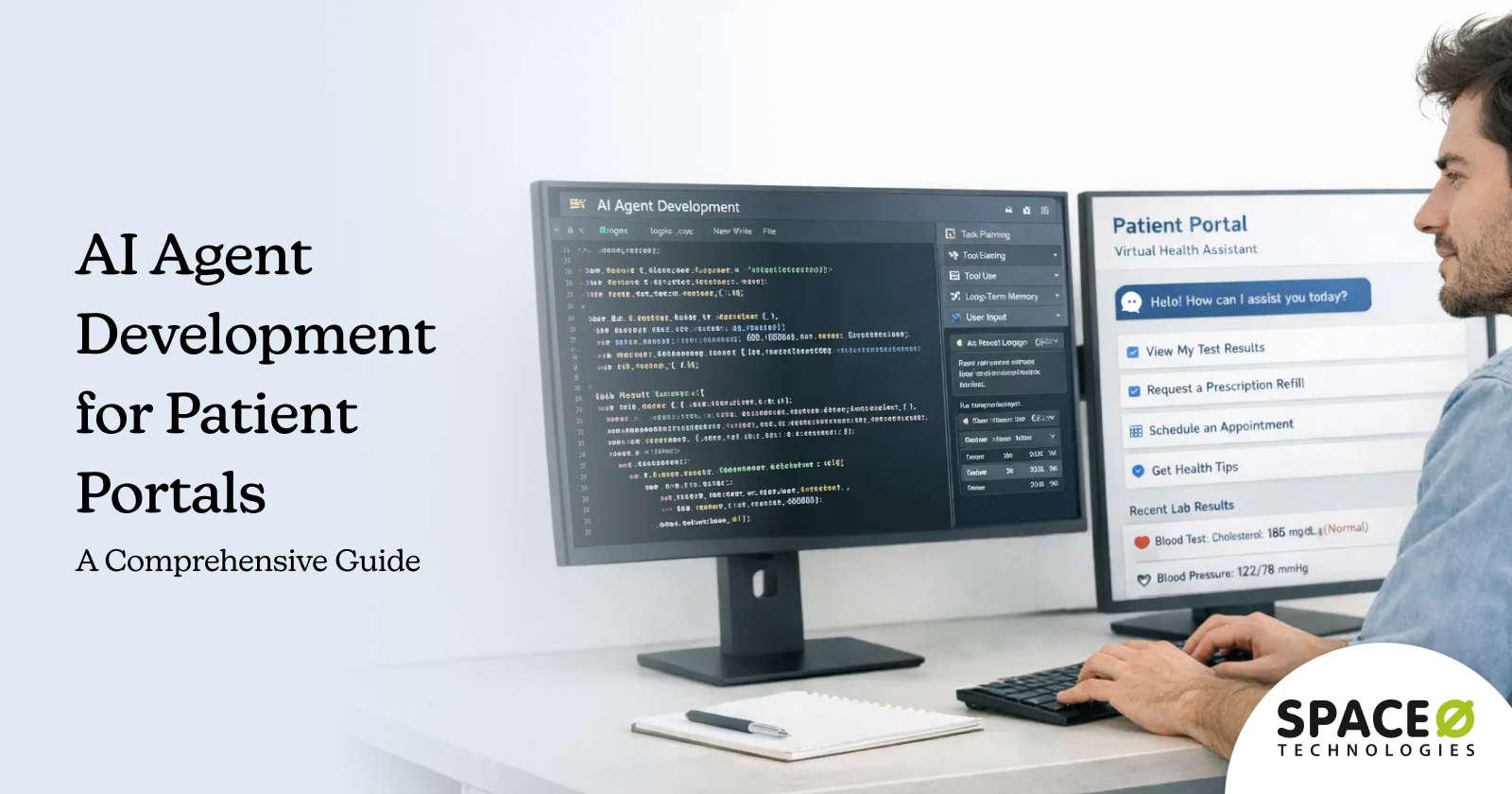
Patient portals are becoming a critical part of the digital healthcare infrastructure as providers invest in platforms that improve access, coordination, and patient engagement. According to KBV Research, the global patient portal market was valued at USD 4.31 billion in 2025 and is projected to reach USD 14.37 billion by 2032, growing at a CAGR of 18.7%. This rapid growth reflects the increasing demand for smarter and more automated patient portal solutions.
As patient portals scale, healthcare organizations face growing complexity in managing interactions, workflows, and care journeys across digital channels. Traditional rule based portals often struggle to deliver real time responses, personalized guidance, and efficient task coordination at scale.
AI agent development for patient portals addresses these challenges by introducing autonomous, goal driven agents that can manage tasks, interact with healthcare systems, and adapt to patient behavior.
This guide covers everything you need to know about AI agent development for patient portals. With our expertise as a leading AI patient portal development company, we have shared insights on what AI agents are, proven use cases in patient portals, technical architecture, implementation process, and cost considerations. Let get started.
What Are AI Agents for Patient Portals?
AI agents in patient portals are autonomous software systems that can perceive their environment, make decisions, and take actions to achieve specific healthcare goals. Unlike traditional automation that follows rigid rules, AI agents leverage large language models (LLMs) and reasoning capabilities to handle complex, multi-step tasks with minimal human intervention.
The distinction matters significantly in healthcare contexts. A traditional chatbot answers predefined questions. An AI agent understands patient intent, accesses relevant medical records, coordinates with scheduling systems, and completes tasks end-to-end while maintaining HIPAA compliance throughout the interaction.
AI agents vs chatbots vs traditional automation
Understanding the differences between these three approaches helps organizations choose the right solution for their patient portal needs.
The following table illustrates the key distinctions between traditional automation, chatbots, and AI agents in healthcare settings.
| Capability | Traditional Automation | Chatbots | AI Agents |
| Decision Making | Rule-based, fixed logic | Intent matching, scripted responses | Reasoning, planning, adaptive decisions |
| Task Complexity | Single-step, predefined | Multi-turn conversations, limited scope | Multi-step workflows, cross-system coordination |
| Context Retention | None or session-limited | Conversation context only | Long-term memory, patient history awareness |
| System Integration | Point-to-point connections | API calls for data retrieval | Tool-using capabilities across multiple systems |
| Autonomy Level | Requires human triggers | Responds to user inputs | Proactive outreach, self-initiated actions |
| Error Handling | Fails or escalates immediately | Scripted fallbacks | Reasoning through alternatives, graceful degradation |
| Learning | Static until reprogrammed | Limited pattern matching | Continuous improvement from interactions |
This comparison demonstrates why healthcare organizations increasingly invest in AI agent development rather than expanding traditional chatbot capabilities.
Core Characteristics of Healthcare AI Agents
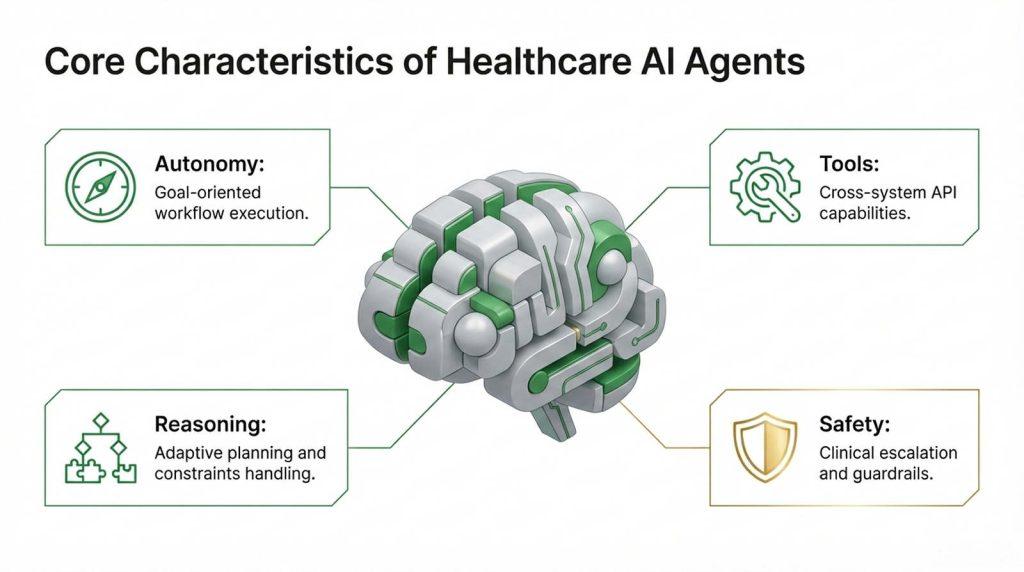
AI agents designed for patient portals exhibit several defining characteristics that enable autonomous healthcare workflows. Here are a few:
1. Autonomy and goal-oriented behavior
Agents receive high-level objectives and determine the best approach to achieve them. When a patient requests help understanding their lab results and scheduling a follow-up, the agent independently retrieves records, generates explanations, checks provider availability, and books appointments.
2. Tool-using capabilities
Healthcare agents connect to EHR systems, scheduling platforms, billing databases, and communication tools. They execute API calls, retrieve information, and take actions across integrated systems without human intermediation.
3. Reasoning and planning
Agents break complex requests into logical steps, consider constraints, and adapt when initial approaches fail. If a preferred appointment slot is unavailable, the agent explores alternatives rather than simply reporting failure.
4. Safety guardrails and escalation
Well-designed healthcare agents recognize their limitations. They escalate clinical questions to human providers, flag potential emergencies, and maintain audit trails for compliance verification.
Now that we understand what AI agents are, let us explore the key benefits driving AI agent adoption in patient portals.
Building Your First Healthcare AI Agent?
Our healthcare AI specialists help organizations move from concept to production-ready agents. From use case discovery to HIPAA-compliant deployment, we provide end-to-end guidance tailored to your patient portal ecosystem.
Key Benefits of AI Agent Development for Patient Portals
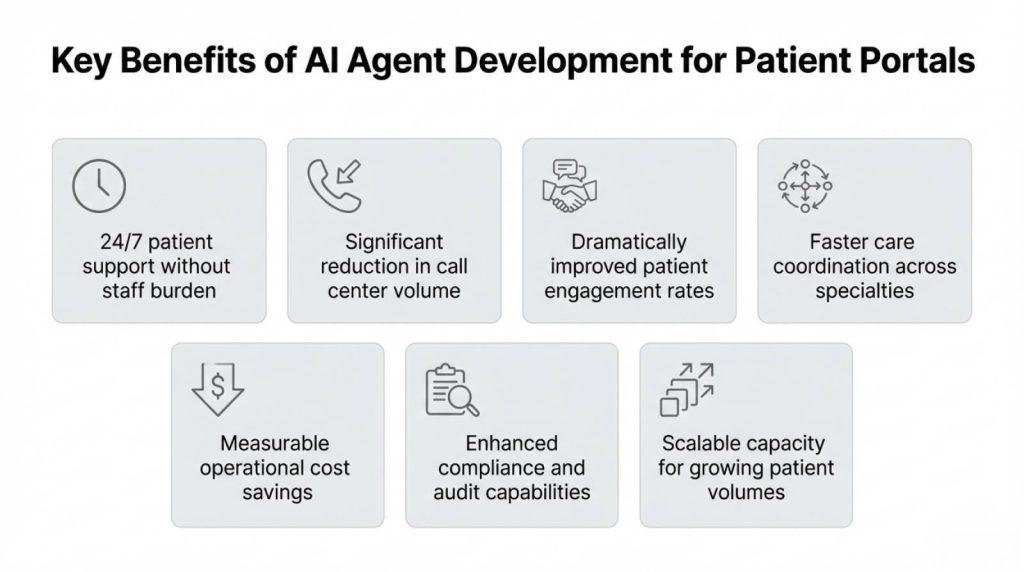
Healthcare organizations realize benefits across operational efficiency, patient experience, and clinical outcomes when implementing AI agents. The following advantages demonstrate why AI agents are useful for patient portals.
1. 24/7 patient support without staff burden
AI agents provide round-the-clock assistance for common patient needs, including appointment scheduling, prescription refills, and general inquiries. Patients receive immediate responses regardless of time, while staff focus on complex cases requiring human judgment and empathy.
2. Significant reduction in call center volume
Healthcare organizations experience substantial reductions in routine call volume after implementing intelligent agents. Patients resolve straightforward requests through self-service while agents handle multi-step workflows that previously required multiple phone calls and transfers between departments.
3. Dramatically improved patient engagement rates
Traditional portals see limited adoption because passive interfaces fail to deliver value. AI agents transform portals into proactive engagement tools that anticipate patient needs, deliver personalized recommendations, and complete tasks patients previously avoided.
4. Faster care coordination across specialties
Multi-agent systems orchestrate complex workflows spanning multiple departments and providers. Referrals, authorizations, and care transitions happen automatically rather than depending on manual handoffs that introduce delays and errors.
5. Measurable operational cost savings
Automation of repetitive administrative tasks reduces labor costs while improving throughput. Organizations achieve strong ROI through reduced staffing needs for routine tasks, improved collections, and decreased appointment no-show rates.
6. Enhanced compliance and audit capabilities
AI agents maintain comprehensive interaction logs supporting HIPAA compliance and quality improvement. Every decision, recommendation, and action is recorded, enabling audit trails that manual processes cannot match.
7. Scalable capacity for growing patient volumes
Unlike human staff, AI agents scale instantly to handle volume spikes without quality degradation. Seasonal fluctuations, marketing campaigns, and growth initiatives no longer require proportional staffing increases.
These benefits manifest across specific use cases. Let us examine the highest-impact applications transforming patient portal experiences.
Top Use Cases of AI Agents in Patient Portals
AI agents deliver measurable value across numerous patient portal functions. The following use cases represent the highest-impact opportunities for healthcare organizations to enhance engagement while reducing operational burden.
1. Care coordination and follow-up agents
Care coordination represents one of the most complex challenges in healthcare delivery. Patients often fall through the cracks between appointments, specialists fail to receive referral information, and follow-up care gets delayed or forgotten entirely.
AI agents transform care coordination by autonomously managing the entire follow-up lifecycle. These agents monitor patient records for completed visits, generate appropriate follow-up tasks, reach out to patients through their preferred channels, and coordinate scheduling across multiple providers when needed.
Key capabilities
- Automated post-discharge outreach with personalized recovery check-ins
- Cross-specialty referral management, ensuring information reaches receiving providers
- Care gap identification and proactive patient engagement for overdue screenings
- Chronic disease management with medication and lifestyle reminders
- Social determinants of health screening and resource connection
Impact: Healthcare systems implementing care coordination agents experience reduced readmission rates, improved care plan adherence, and fewer patients lost to follow-up. Clinical teams gain visibility into patient progress without manual tracking overhead.
2. Insurance and billing assistance agents
Insurance complexity frustrates patients and consumes substantial staff time. Prior authorizations, benefits verification, and cost estimates require navigating multiple systems and interpreting complex rules that change frequently.
AI agents handle these administrative burdens by connecting to payer systems, interpreting benefits information, and communicating results in patient-friendly language. They can initiate prior authorization requests, track status, and notify patients when approvals arrive.
Key capabilities
- Real-time benefits verification before appointments
- Automated prior authorization submission and tracking
- Out-of-pocket cost estimates based on specific insurance plans
- Payment plan setup and management
- Claims status tracking and dispute resolution support
Impact: Organizations deploying billing assistance agents see significant reductions in billing-related call volume, faster payment cycles, and improved patient satisfaction with financial transparency. Staff can focus on complex cases rather than routine inquiries.
3. Lab result interpretation agents
Patients increasingly access lab results through portals, but raw medical data often creates confusion and anxiety. Without context, abnormal values trigger unnecessary worry while subtle patterns requiring attention go unnoticed.
AI agents provide personalized result interpretation that considers individual patient history, reference ranges, and trending patterns. They explain what values mean in plain language, highlight items requiring follow-up, and connect patients with appropriate next steps.
Key capabilities
- Plain-language explanations of individual lab values and overall panels
- Historical trending showing how values have changed over time
- Contextual education linking results to patient conditions and medications
- Automated flagging of critical values requiring immediate attention
- Next-step recommendations, including lifestyle modifications and follow-up scheduling
Impact: These agents improve patient health literacy, reduce anxiety from misunderstood results, and decrease provider message volume for routine result questions. Patients feel more informed and engaged in their care journey.
4. Proactive outreach agents for at-risk patients
Reactive healthcare misses opportunities to prevent complications and hospitalizations. By the time patients seek care, conditions have often progressed beyond optimal intervention windows.
AI agents leverage predictive analytics to identify at-risk patients and initiate proactive outreach before problems escalate. They monitor clinical indicators, social factors, and engagement patterns to prioritize interventions for patients most likely to benefit.
Key capabilities
- Risk score monitoring with automated outreach triggers
- Medication adherence tracking and intervention for non-compliance
- Care gap closure campaigns for overdue preventive services
- Post-acute transition support for recently discharged patients
- Chronic condition management with symptom monitoring and escalation
Impact: Proactive outreach agents help organizations shift from reactive to preventive care models. Early interventions reduce emergency visits, prevent hospitalizations, and improve chronic disease outcomes while demonstrating value-based care capabilities.
5. Appointment management agents
Missed appointments strain healthcare resources while limiting access for patients who need care. Traditional reminder systems achieve modest results because they lack the intelligence to address the underlying reasons patients miss appointments.
AI agents approach appointment management holistically. They predict no-show likelihood, intervene proactively with at-risk patients, manage waitlists dynamically, and handle rescheduling requests autonomously.
Key capabilities
- Predictive no-show scoring with targeted intervention for high-risk appointments
- Intelligent rescheduling that considers patient preferences and urgency
- Waitlist management fills cancelled slots automatically
- Transportation barrier identification and resource coordination
- Preparation reminders with pre-visit instructions and required documentation
Impact: Organizations experience improved appointment utilization, reduced scheduling staff workload, and better patient access. Dynamic waitlist management ensures cancelled slots get filled quickly, maximizing provider productivity.
With clear use cases established, understanding the benefits helps build the business case for AI agent investment.
Technical Architecture AI Agent-Enabled Patient Portal Development
Successful AI agent implementations require robust technical foundations that balance capability with security and compliance. Organizations often engage patient portal consulting services to design architectures that meet both immediate needs and long-term scalability requirements. The following architectural components form the blueprint for production-ready healthcare agent systems.
1. Core components of an AI agent system
Healthcare AI agents comprise several integrated layers working together to deliver autonomous functionality while maintaining clinical safety.
1.1 Foundation model layer
Large language models provide the reasoning and language understanding capabilities that enable agents to interpret patient requests, generate appropriate responses, and make decisions. Organizations choose between API-based models (GPT-4, Claude) and self-hosted options depending on data sensitivity and control requirements.
1.2 Retrieval and knowledge layer
Retrieval-augmented generation (RAG) systems connect agents to organizational knowledge bases, clinical guidelines, and patient-specific information. This layer ensures responses reflect current policies and individual patient context rather than generic training data.
1.3 Tool and API integration layer
Agents execute actions through integrations with healthcare systems including EHRs, scheduling platforms, billing systems, and communication tools. Well-designed tool interfaces enable agents to retrieve information, create records, and trigger workflows across the technology ecosystem.
1.4 Memory and context management
Healthcare interactions require persistent context spanning multiple sessions. Memory systems store conversation history, patient preferences, and interaction outcomes, enabling agents to maintain continuity and personalization over time.
1.5 Orchestration and workflow engine
Complex healthcare tasks require coordinating multiple steps, handling conditional logic, and managing parallel processes. Orchestration layers break high-level goals into executable sequences while handling errors and exceptions gracefully.
1.6 Safety guardrails and escalation logic
Healthcare agents require robust safeguards to prevent harmful outputs and ensure appropriate human involvement. Guardrails filter responses for clinical accuracy, detect potential emergencies, and route sensitive situations to human providers.
2. Integration requirements with healthcare systems
AI agents must connect seamlessly with existing healthcare infrastructure to access necessary data and execute meaningful actions. To ensure the integration is effortless, organizations often opt for professional patient portal integration services to ensure these connections are secure, reliable, and compliant.
| Integration Type | Description |
| EHR/EMR integration | Connects to Epic, Cerner, or Meditech systems via native APIs, FHIR interfaces, or middleware for clinical data access and record creation. |
| FHIR-based interoperability | Provides standardized interfaces for accessing clinical data across systems, ensuring future-proof integrations aligned with mandated compliance. |
| Scheduling system connectivity | Bidirectional integration for provider availability visibility, appointment creation, modification, and cancellation. |
| Billing and revenue cycle integration | Connects to practice management systems for insurance verification, cost estimation, and payment processing. |
| Communication platform integration | Enables multi-channel outreach via secure messaging, SMS, email, and voice based on patient preferences. |
3. HIPAA compliance and security considerations
Healthcare AI agent development demands rigorous attention to privacy and security requirements that exceed typical software projects. The following security measures are essential for any production deployment handling protected health information.
| Security Requirement | Description |
| Data encryption and transmission security | All patient data is encrypted at rest and in transit with secure connections for conversation logs and memory systems. |
| Access control and authentication | Role-based access ensures agents only retrieve information appropriate for each patient with secure credential management. |
| Audit logging requirements | Comprehensive logs of all data retrievals, recommendations, and actions taken to support compliance audits. |
| Business associate agreements | Required for third-party AI services processing PHI; self-hosted options avoid BAA but add operational complexity. |
| PHI handling in AI models | Synthetic or de-identified data for model development; PHI access restricted to inference-time retrieval only. |
With architecture foundations established, let us examine the step-by-step development process for healthcare AI agents.
Step-by-Step AI Agent Development Process for Patient Portals
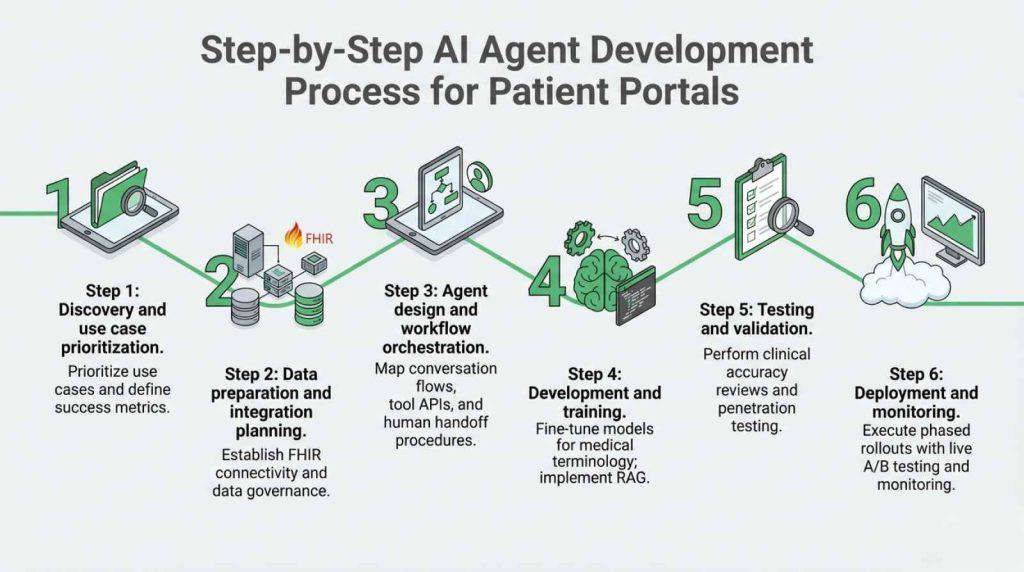
Successful AI agent implementations follow structured methodologies that balance rapid iteration with healthcare-specific requirements. The following process reflects best practices from projects across healthcare organizations.
Step 1: Discovery and use case prioritization
Every successful AI agent project begins with thorough discovery to understand organizational context, identify high-value opportunities, and establish clear success criteria. This phase typically spans 2–4 weeks and sets the foundation for everything that follows.
Action Items
- Conduct stakeholder interviews across clinical, operational, and IT leadership
- Analyze current portal usage patterns and identify friction points
- Review call center data to quantify repetitive inquiry types and volumes
- Map patient journeys to identify automation opportunities
- Prioritize use cases based on impact, feasibility, and strategic alignment
- Define measurable success metrics and KPIs for each prioritized use case
Step 2: Data preparation and integration planning
Healthcare AI agents require access to clean, well-structured data from multiple source systems. This phase establishes the data foundation, enabling intelligent agent behavior while ensuring compliance with privacy regulations.
Action Items
- Inventory available data sources, including EHR, scheduling, billing, and communication systems
- Assess data quality, completeness, and accessibility for agent use cases
- Design integration architecture specifying APIs, authentication, and data flows
- Establish FHIR connectivity for standardized clinical data access
- Create a data governance framework defining PHI handling procedures
- Build development and testing environments with synthetic or de-identified data
Step 3: Agent design and workflow orchestration
Agent design translates use case requirements into specific capabilities, conversation flows, and system interactions. This phase produces detailed specifications guiding development while ensuring clinical safety and user experience quality.
Action Items
- Define agent personas, capabilities, and knowledge domains for each use case
- Design conversation flows covering common scenarios and edge cases
- Map workflow orchestration, including conditional logic and parallel processes
- Specify tool integrations and API calls required for each agent capability
- Establish escalation criteria and human handoff procedures
- Create safety guardrails and clinical review checkpoints
Step 4: Development and training
Development transforms designs into working agent systems through iterative building, testing, and refinement. Healthcare agents require particular attention to prompt engineering, domain-specific fine-tuning, and safety implementation.
Action Items
- Develop core agent logic, including LLM prompts and orchestration code
- Build tool integrations connecting agents to healthcare systems
- Implement RAG systems for organizational knowledge and clinical guidelines
- Fine-tune models for healthcare terminology and domain-specific accuracy
- Develop memory systems for context retention across sessions
- Implement comprehensive safety guardrails and content filtering
Step 5: Testing and validation
Healthcare AI agents require rigorous testing exceeding typical software quality assurance. Clinical accuracy, security compliance, and edge case handling must be validated before production deployment.
Action Items
- Conduct functional testing, verifying agent capabilities across all use cases
- Perform clinical accuracy testing with a healthcare professional review
- Execute security assessment, including penetration testing and vulnerability scanning
- Complete HIPAA compliance audit of data handling and access controls
- Run performance testing, validating response times, and concurrent user capacity
- Facilitate user acceptance testing with representative patient and staff groups
Step 6: Deployment and monitoring
Production deployment requires careful rollout strategies that minimize risk while enabling rapid learning and improvement. Ongoing monitoring ensures agents maintain performance and safety standards over time.
Action Items
- Implement phased rollout starting with limited user populations
- Configure production monitoring for performance, accuracy, and safety metrics
- Establish alerting for anomalies, errors, and escalation patterns
- Deploy an A/B testing framework for continuous optimization
- Create feedback collection mechanisms for patients and staff
- Schedule regular model evaluation and retraining cycles
This structured process typically spans 4-8 months for initial agent deployment, depending on use case complexity and integration requirements. Organizations often see initial value within weeks through pilot deployments before full production rollout.
Understanding costs and expected returns helps organizations plan investments and secure stakeholder support. The following section provides transparent guidance on AI agent development economics.
Need a Trusted AI Agent Development Partner?
Connect with Space-O AI to plan and develop AI agent based patient portals that scale with your healthcare needs.
How Much Does AI Agent Development Cost for Patient Portals?
AI agent development for patient portals typically costs between $25,000 and $400,000+, depending on complexity and capabilities. Organizations achieving successful implementations report compelling returns across operational efficiency, patient engagement, and staff productivity. Understanding cost factors and realistic ROI timelines enables informed planning and appropriate expectation setting.
The cost of developing AI agents for patient portals varies based on complexity, capabilities, and integration requirements. The following table provides guidance based on agent type and functionality.
| Complexity | AI Agent Type | Cost Range (USD) | Key Features |
| Basic | Simple rule-based chatbot | $25,000–$50,000 | FAQ handling, appointment booking, basic responses |
| Moderate | NLP conversational agent | $40,000–$100,000 | Natural language understanding, EHR integration, patient queries |
| Advanced | Multi-task autonomous agent | $70,000–$150,000 | Complex workflows, predictive analytics, and decision-making |
| Enterprise | Autonomous reasoning agent | $150,000–$400,000+ | End-to-end automation, diagnostic support, and enterprise integration |
These ranges reflect typical project scopes and should be validated against specific organizational requirements and vendor capabilities. For a deeper breakdown of pricing, see our comprehensive guide on AI agent development cost.
Factors affecting AI agent development cost
Several variables significantly influence the total investment required for patient portal AI agents.
1. Integration complexity
Organizations with modern, well-documented APIs incur lower integration costs than those requiring custom interfaces to legacy systems. FHIR-ready environments accelerate development considerably.
2. Use case scope
Administrative use cases like appointment scheduling require less clinical validation than agents providing health information or care recommendations. Clinical applications demand additional safety engineering and review.
3. Compliance requirements
Organizations subject to enhanced regulatory scrutiny or operating across multiple jurisdictions require additional compliance engineering and documentation.
4. Customization depth
Agents using standard capabilities cost less than those requiring custom model training, specialized knowledge bases, or unique workflow orchestration. Organizations can hire patient portal developers with healthcare experience to optimize development costs while maintaining quality.
Ongoing operational costs
Production AI agents require continuous investment beyond initial development to maintain performance and deliver sustained value. Here are a few areas where you will be spending:
- Monitoring and maintenance: Regular performance monitoring, bug fixes, and system updates ensure agents continue functioning reliably. Organizations should budget for dedicated support resources.
- Model retraining and optimization: AI models require periodic retraining as data patterns evolve and organizational needs change. Continuous improvement cycles enhance accuracy and capabilities over time.
- Infrastructure and compute costs: Cloud hosting, API usage, and computational resources for AI inference represent recurring expenses that scale with usage volume.
- Annual budget guidance: Organizations typically allocate a percentage of initial development costs annually for ongoing operations, support, and iterative improvements.
Expected ROI from patient portal AI agents
Healthcare organizations implementing AI agents in patient portals typically experience returns across multiple dimensions over varying timeframes.
- Short-term returns: Call center volume reduction, improved appointment show rates, and faster administrative task completion deliver measurable savings in the initial months following deployment.
- Medium-term returns: Enhanced patient engagement, reduced readmissions, and improved care gap closure generate clinical and financial value as agents mature and adoption increases.
- Long-term strategic value: Competitive differentiation, patient loyalty, and operational scalability create strategic advantages that compound over time and position organizations for future growth.
Organizations should establish baseline metrics before deployment and track improvements systematically to demonstrate ROI and justify continued investment.
Even well-planned projects encounter challenges. The next section addresses common obstacles and proven strategies for overcoming them.
Challenges in AI Agent Development for Healthcare and Solutions
Healthcare AI agent projects face unique challenges stemming from regulatory requirements, clinical safety concerns, and organizational complexity. Anticipating these obstacles and implementing proven mitigation strategies significantly improves project success rates.
1. Data quality and integration complexity
Healthcare data exists in fragmented systems with inconsistent formats, incomplete records, and varying quality levels. Agents, depending on poor data, produce unreliable outputs that erode user trust and clinical value.
Solution
- Conduct a thorough data quality assessment before development begins
- Implement data validation and cleansing pipelines for agent inputs
- Design agents to handle missing or inconsistent data gracefully
- Build feedback mechanisms capturing data quality issues for remediation
- Consider synthetic data generation for the development and testing phases
2. Clinical safety and liability concerns
Healthcare organizations rightfully worry about AI agents providing incorrect medical information or missing critical warning signs. Liability questions around AI-assisted care decisions remain partially unresolved legally.
Solution
- Establish clear scope boundaries defining what agents can and cannot do
- Implement multiple safety layers, including output filtering and clinical review
- Design conservative escalation triggers that err toward human involvement
- Maintain comprehensive audit trails documenting agent recommendations
- Obtain legal review of agent capabilities and disclosure requirements
- Start with lower-risk administrative use cases before clinical applications
3. Patient trust and adoption barriers
Patients may distrust AI interactions, preferring human contact for health-related matters. Low adoption undermines ROI regardless of technical capability.
Solution
- Communicate clearly when patients interact with AI versus humans
- Demonstrate value quickly through successful task completion
- Provide easy escalation to human support when preferred
- Collect and act on patient feedback about agent interactions
- Consider generational and demographic preferences in channel design
- Build trust incrementally through consistent, helpful experiences
4. Regulatory compliance across jurisdictions
Healthcare regulations vary by state and continue evolving around AI specifically. Organizations operating across multiple jurisdictions face complex compliance landscapes, often requiring healthcare AI consulting services expertise to navigate effectively.
Solution
- Engage healthcare regulatory expertise early in project planning
- Design flexible architectures accommodating varying requirements
- Implement configurable guardrails adjustable by jurisdiction
- Monitor regulatory developments and plan for adaptation
- Document compliance measures thoroughly for audit readiness
- Consider state-specific AI disclosure requirements in patient communications
5. Staff resistance and change management
Clinical and administrative staff may view AI agents as threats to their roles or sources of additional work reviewing AI outputs. Resistance undermines adoption and effectiveness.
Solution
- Involve staff in use case selection and agent design processes
- Position agents as tools that eliminate drudgery rather than replace people
- Provide thorough training on agent capabilities and limitations
- Create clear workflows defining human-agent collaboration
- Celebrate early wins, demonstrating that staff benefit from agent assistance
- Address concerns transparently and adjust based on feedback
Now, let us address common questions organizations have about AI agent development for patient portals.
Navigate Healthcare AI Complexity with Confidence
From regulatory compliance to EHR integration, our team has solved the toughest challenges in healthcare AI implementation.
Build AI Agent-Powered Patient Portals with Space-O AI
AI agent development for patient portals represents a transformative opportunity for healthcare organizations seeking to enhance patient engagement while reducing operational burden. From care coordination to billing assistance, AI agents automate complex workflows that previously required extensive staff involvement, delivering 24/7 support that scales with organizational growth.
Space-O AI brings over 15 years of software development experience and 500+ successfully delivered projects to healthcare AI initiatives. Our teams combine deep expertise in generative AI development services with healthcare domain knowledge, ensuring solutions that meet both technical and clinical requirements while maintaining rigorous HIPAA compliance.
Our healthcare AI specialists have built intelligent patient engagement systems for organizations ranging from multi-hospital networks to specialty practices. Organizations looking to hire patient portal developers gain access to our experienced team skilled in EHR integrations, regulatory requirements, and the change management considerations that determine project success.
Ready to explore how AI agents can transform your patient portal? Contact our team for a complimentary consultation where we will discuss your specific use cases, assess technical feasibility, and outline a realistic implementation roadmap tailored to your organization.
Frequently Asked Questions on AI Agent Development for Patient Portals
1. How do AI agents differ from chatbots in healthcare?
AI agents differ from traditional healthcare chatbots in their ability to reason, adapt, and act autonomously. While chatbots follow predefined scripts and respond to specific intents, AI agents use large language models to understand context, reason through complex problems, access external systems, and execute multi-step workflows. AI agents can handle novel clinical scenarios, maintain long-term conversational memory, and proactively take actions such as scheduling appointments or retrieving patient data, which scripted chatbots cannot achieve.
2. How long does it take to develop an AI agent for a patient portal?
AI agent development timelines typically range from 3 to 12 months, depending on project scope and complexity. Basic single-use-case agents with standard integrations can be deployed within 3 to 4 months. Advanced multi-agent systems with complex EHR integrations and clinical workflows require 6 to 12 months. A phased development approach allows organizations to launch early capabilities within weeks while scaling toward enterprise-grade functionality.
3. Can AI agents integrate with existing EHR systems?
Yes, AI agents can integrate with leading EHR systems such as Epic, Cerner, Meditech, and others using native APIs, HL7 FHIR interfaces, or secure middleware platforms. Integration complexity depends on the EHR vendor, data access permissions, and specific clinical use cases. Organizations with modern, well-documented APIs experience faster and more seamless integration than those relying on legacy systems.
4. Why should I choose Space-O AI for patient portal AI agent development?
Space-O AI brings over 15 years of software development experience with more than 500 successfully delivered projects. Our team combines deep expertise in generative AI and agentic systems with strong healthcare domain knowledge. We understand HIPAA compliance requirements, EHR integrations, and real-world clinical workflows, enabling us to build reliable, secure, and scalable AI agents for healthcare environments.
5. What healthcare AI projects has Space-O AI delivered?
Our healthcare AI experts have delivered intelligent patient engagement and automation solutions for organizations ranging from multi-hospital networks to specialty clinics. Projects include AI-driven care coordination systems, appointment scheduling agents, billing and insurance assistance tools, and multi-agent platforms that autonomously manage complex clinical workflows across patient portals.
6. Does Space-O AI provide ongoing support after deployment?
Yes, Space-O AI offers comprehensive post-deployment support services, including system performance monitoring, model retraining, security updates, and feature enhancements. Our ongoing support ensures that AI agents continue to perform accurately and adapt to evolving healthcare regulations, workflows, and organizational needs.
7. How does Space-O AI ensure HIPAA compliance in AI agent projects?
We ensure HIPAA compliance through robust security and governance measures, including end-to-end data encryption, role-based access controls, detailed audit logging, and secure API integrations. Compliance reviews are conducted at every development stage, and we sign Business Associate Agreements (BAAs) when handling protected health information to meet regulatory requirements.


Build a Smart AI-Agent Powered Patient Portal
What to read next