- What Is AI-Driven Multi-Specialty Patient Portal Development?
- Benefits of AI-Driven Multi-Specialty Patient Portal Development
- 1. Improves patient experience and engagement
- 2. Enhances care coordination through AI automation
- 3. Improves operational efficiency through intelligent automation
- 4. Helps derive actionable insights from unified AI analytics
- 5. Increases patient retention through personalized care
- 6. Offers substantial cost savings through AI efficiency
- Key Features of an AI-Driven Multi-Specialty Patient Portal
- 1. Intelligent patient dashboard with AI-powered insights
- 2. AI-optimized scheduling across all specialties
- 3. Autonomous care coordination with agentic AI
- 4. Intelligent role-based access with adaptive interfaces
- 5. Smart billing with AI-assisted financial guidance
- 6. AI-powered secure messaging with intelligent routing
- 7. Intelligent triage and specialty routing
- 8. Predictive analytics for proactive care
- 9. Conversational AI for 24/7 intelligent support
- 10. Integration layer with AI-ready data pipelines
- 11. Generative AI for personalized content
- AI-Driven Multi-Specialty Patient Portal Development Process
- Step 1: AI readiness assessment and requirements gathering
- Step 2: AI architecture design and technology selection
- Step 3: Intelligent UI/UX design
- Step 4: Core platform development and integration
- Step 5: AI model development and deployment
- Step 6: Testing, validation, and AI safety
- Step 7: Deployment, training, and continuous improvement
- Cost of AI-Driven Multi-Specialty Patient Portal Development
- Challenges in AI-Driven Multi-Specialty Patient Portal Development
- Build Your AI-Driven Multi-Specialty Patient Portal with Space-O AI
- Frequently Asked Questions on AI Multi-Speciality Portal Development
AI-Driven Multi-Specialty Patient Portal Development: A Complete Guide

 Last Updated: February, 13 2026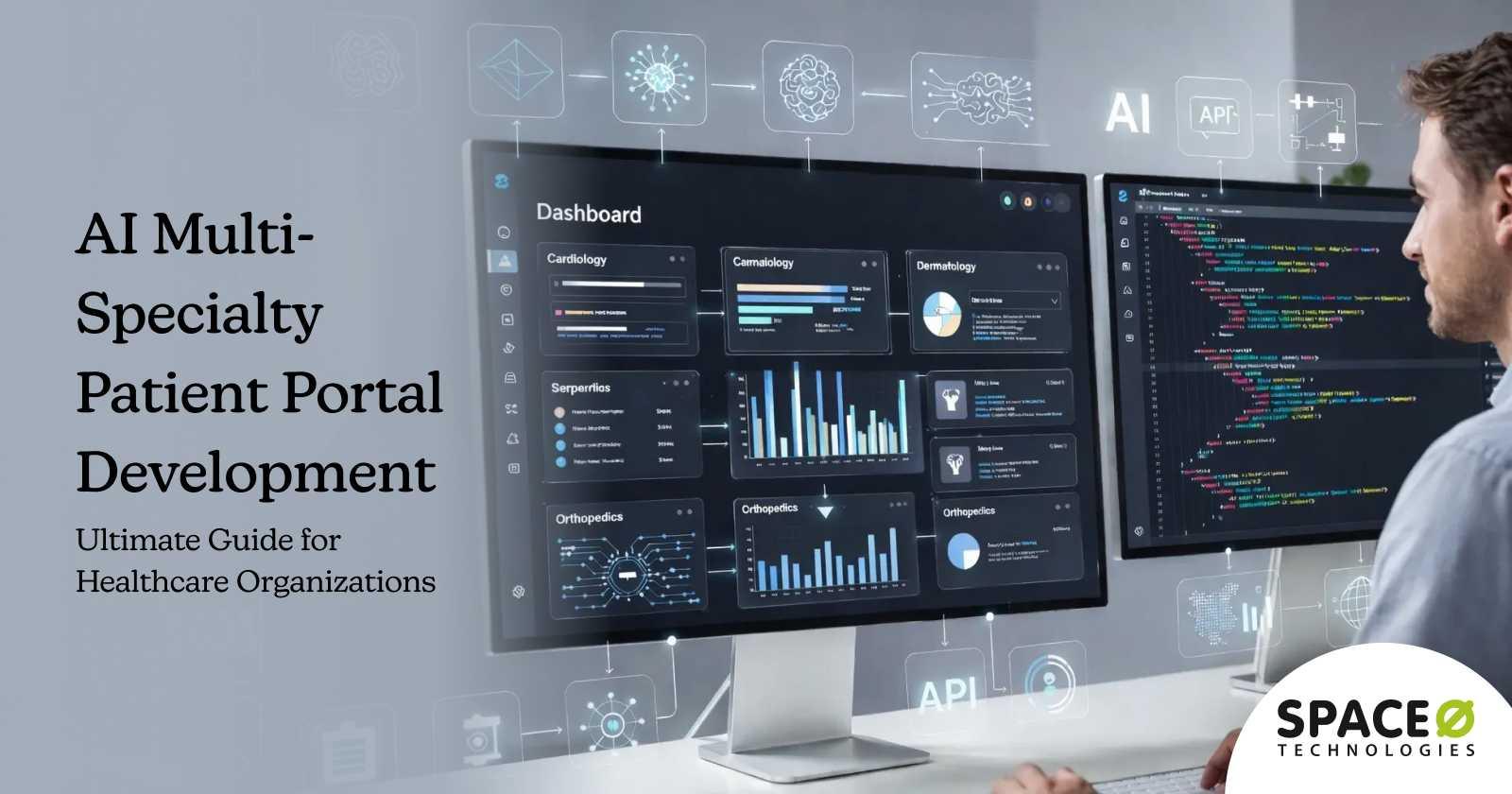
A patient visits a cardiologist for heart health, a dermatologist for skin concerns, and an orthopedic specialist for joint pain. Each department hands them separate login credentials, fragmented health records, and disconnected communication channels. Traditional portals simply digitize this chaos. AI-driven patient portals eliminate it entirely.
According to a 2025 JMIR study, 43.7% of patients reported using multiple patient portals, highlighting the significant fragmentation challenge in healthcare data access. For healthcare organizations, this fragmentation creates operational inefficiencies, care coordination gaps, and frustrated patients who may seek services elsewhere. The solution is not just unification but intelligence.
AI-driven multi-specialty patient portal development addresses this challenge by creating intelligent digital platforms where AI coordinates care across departments, predicts patient needs, automates routine tasks, and delivers personalized experiences at scale.
In this blog, we explore the process of developing an AI multi-specialty patient portal. Get insights from our 15+ years of experience as a leading AI patient portal development company on the key features, benefits, development process, architecture considerations, and cost factors you should evaluate when building a robust digital healthcare platform.
What Is AI-Driven Multi-Specialty Patient Portal Development?
AI-driven multi-specialty patient portal development refers to creating intelligent digital platforms that leverage artificial intelligence to serve patients across multiple medical specialties within a single healthcare organization.
Unlike traditional portals that merely aggregate information, AI-driven portals actively analyze data, predict needs, automate workflows, and personalize every patient interaction.
The core principle: intelligent systems that think, learn, and act on behalf of patients and providers.
Where traditional multi-specialty portals offer unified access to health records, AI-driven portals go further. They use machine learning to identify patterns across specialties, natural language processing to understand patient communications, predictive analytics to anticipate care needs, and agentic AI to coordinate complex multi-department workflows autonomously.
Key differentiators of AI-driven patient portals
- Predictive intelligence: AI analyzes patient data across all specialties to predict health risks, appointment no-shows, and care gaps before they occur
- Automated care coordination: Agentic AI manages referrals, follow-ups, and care transitions between departments without manual intervention
- Intelligent routing: NLP-powered triage directs patients to the right specialist based on symptoms, history, and urgency
- Personalized experiences: Machine learning customizes dashboards, recommendations, and communications for each patient’s unique health profile
- Conversational interfaces: AI chatbots provide 24/7 support across all departments, handling scheduling, questions, and guidance
- Smart automation: Routine administrative tasks like appointment reminders, prescription refills, and billing inquiries are handled by AI
Benefits of AI-Driven Multi-Specialty Patient Portal Development
Healthcare organizations investing in AI-driven multi-specialty patient portals realize benefits that extend far beyond traditional portal implementations. AI amplifies every advantage through automation, prediction, and personalization.
1. Improves patient experience and engagement
AI transforms patient interactions from passive information retrieval to proactive, personalized engagement. Intelligent chatbots answer questions instantly, predictive systems remind patients about upcoming care needs, and personalized dashboards surface the most relevant information automatically, increasing satisfaction and portal adoption rates significantly.
2. Enhances care coordination through AI automation
AI agents coordinate care across cardiology, orthopedics, and other specialties autonomously. These systems track referrals, ensure pre-appointment requirements are met, flag potential drug interactions across prescribing specialists, and alert care teams to emerging risks, all without manual intervention from overworked staff.
3. Improves operational efficiency through intelligent automation
AI handles routine tasks that consume staff time: appointment scheduling, prescription refill requests, billing inquiries, and basic triage. Natural language processing routes patient messages to the appropriate departments automatically. Predictive analytics optimizes scheduling to reduce no-shows, potentially saving healthcare organizations significant revenue annually.
4. Helps derive actionable insights from unified AI analytics
AI transforms fragmented multi-specialty data into actionable intelligence. Machine learning identifies patients at risk for readmission, predicts which patients need proactive outreach, and surfaces operational bottlenecks invisible to traditional reporting, enabling data-driven decisions that improve outcomes and efficiency.
5. Increases patient retention through personalized care
AI-driven personalization makes patients feel understood and valued. When the portal remembers preferences, anticipates needs, and provides relevant guidance across all specialties, patients develop loyalty that keeps them within your health system rather than seeking fragmented care elsewhere.
6. Offers substantial cost savings through AI efficiency
Beyond infrastructure consolidation, AI drives cost savings through automation. Reduced call center volume, fewer missed appointments, earlier intervention for at-risk patients, and streamlined administrative workflows compound to deliver a significant ROI that traditional portals cannot match.
With these benefits in mind, let us examine the specific features that make AI-driven multi-specialty patient portals effective.
Key Features of an AI-Driven Multi-Specialty Patient Portal
An AI-driven multi-specialty patient portal combines unified access with intelligent capabilities that actively improve care delivery. Here are the essential features that define these platforms:
1. Intelligent patient dashboard with AI-powered insights
Patients access a single dashboard displaying their complete health profile, including lab results, imaging, prescriptions, and visit summaries from every specialty. AI generates personalized health summaries, plain-language explanations, and proactive alerts about screenings or potential concerns based on multi-specialty data.
2. AI-optimized scheduling across all specialties
Patients schedule appointments across all specialties from one interface instead of navigating separate systems. AI predicts optimal times, groups related visits, identifies conflicts, and flags high-risk no-shows for confirmation outreach, improving resource utilization and reducing missed appointments.
3. Autonomous care coordination with agentic AI
When a primary care physician refers a patient to a specialist, autonomous AI agents manage the workflow from referral to completion. Specialists receive complete histories, patients track status in real time, and the system coordinates transitions, follow-ups, and protocol-based tasks with minimal manual intervention.
4. Intelligent role-based access with adaptive interfaces
Different users see tailored experiences based on their roles and behavior. Patients view AI-enhanced records and self-service tools, clinicians access prioritized patient lists and documentation, nurses manage coordination tasks, and administrators receive predictive operational insights, with interfaces adapting over time to usage patterns.
5. Smart billing with AI-assisted financial guidance
Patients receive consolidated billing statements instead of multiple disconnected invoices from different departments. AI generates cost estimates, explains charges in plain language, recommends payment plans, and assists with routine billing inquiries, improving financial transparency, satisfaction, and collection efficiency.
6. AI-powered secure messaging with intelligent routing
A single secure messaging interface connects patients with their entire care team. Natural language processing analyzes intent and urgency, routes messages to the right recipient, drafts suggested responses for review, automates safe routine replies, and escalates urgent issues immediately, reducing message burden on providers.
7. Intelligent triage and specialty routing
AI-powered triage systems analyze patient-reported symptoms, multi-specialty medical history, and urgency indicators to direct patients to the appropriate specialist or care setting automatically. These systems reduce misrouted appointments and continuously improve routing accuracy by learning from clinical outcomes.
8. Predictive analytics for proactive care
Machine learning models use data from multiple specialties to identify high-risk patients and upcoming needs. Capabilities include readmission risk scoring, no-show prediction, care gap detection, medication adherence risk, churn prediction, and demand forecasting for staffing and resource planning.
9. Conversational AI for 24/7 intelligent support
Conversational AI provides round-the-clock support that understands the organization’s full context. Chatbots handle scheduling, refills, billing FAQs, symptom guidance with escalation rules, and care navigation, reducing call center volume while maintaining safe boundaries and clear handoffs to human staff.
10. Integration layer with AI-ready data pipelines
To support these intelligent capabilities, the portal relies on robust data connectivity across EHRs, lab systems, imaging platforms, and billing solutions. You can partner with an expert patient portal integration agency to build secure, standards-based integrations and real-time data pipelines that feed AI models and ensure a unified, up-to-date patient view across all specialties.
11. Generative AI for personalized content
Large language models generate tailored explanations and communications for each patient. Applications include understandable lab and diagnosis summaries, condition-specific education, AI-drafted provider responses, personalized post-visit instructions, and multilingual content that aligns with patient health literacy levels.
These core and AI-driven features form the foundation of intelligent patient portals. Let us now examine the development process for building these sophisticated platforms.
Transform Your Multi-Specialty Practice with an AI-Driven Patient Portal
Partner with Space-O AI to transform your multi-specialty practice with an intelligent, AI-driven patient portal. Streamline care coordination, enhance patient engagement, and leverage our healthcare AI expertise for a seamless, personalized experience.
AI-Driven Multi-Specialty Patient Portal Development Process
Building an AI-driven multi-specialty patient portal requires systematic execution that addresses both platform fundamentals and AI-specific requirements. Here is the proven development process:
Step 1: AI readiness assessment and requirements gathering
Understanding your organization’s AI readiness forms the foundation of successful development. This phase evaluates data quality for AI training, maps current workflows for automation opportunities, and defines AI use cases aligned with organizational priorities.
Action items
- Assess data quality, availability, and structure across all specialties for AI training
- Identify high-impact AI use cases based on operational pain points
- Conduct stakeholder interviews to understand automation opportunities
- Define AI governance requirements, including safety, explainability, and oversight
- Document integration requirements with existing EHR, lab, and billing systems
- Establish success metrics for AI capabilities (accuracy, adoption, outcomes)
Step 2: AI architecture design and technology selection
AI-driven portals require architecture decisions that support machine learning workloads, real-time inference, and continuous model improvement alongside standard portal functionality.
Action items
- Design a unified data layer optimized for AI/ML training and inference
- Select AI infrastructure (cloud ML platforms, vector databases, model serving)
- Define API architecture connecting AI services with clinical systems
- Plan a microservices structure, separating AI components for independent scaling
- Establish MLOps infrastructure for model deployment, monitoring, and retraining
- Design security architecture addressing AI-specific concerns (data for training, model access)
Step 3: Intelligent UI/UX design
User experience for AI-driven portals must make AI capabilities discoverable and trustworthy. Design must communicate AI recommendations clearly while maintaining user control.
Action items
- Design AI-enhanced interfaces that surface insights without overwhelming users
- Create transparency patterns showing how AI reaches recommendations
- Develop conversational interfaces for chatbot and voice interactions
- Build feedback mechanisms allowing users to improve AI over time
- Design graceful degradation when AI confidence is low
- Conduct usability testing focusing on AI feature comprehension and trust
Step 4: Core platform development and integration
Building the platform foundation requires healthcare expertise combined with robust integration capabilities that feed data to AI systems.
Action items
- Develop a centralized patient record system aggregating multi-specialty data
- Build EHR integrations using FHIR R4 and HL7 standards
- Implement real-time data pipelines feeding AI systems
- Create a secure messaging infrastructure with AI routing capabilities
- Develop a scheduling engine with AI optimization hooks
- Build billing integration supporting AI-assisted inquiries
Step 5: AI model development and deployment
This phase develops the AI capabilities that differentiate intelligent portals from traditional solutions. Organizations needing guidance on AI implementation approaches benefit from healthcare AI consulting services from an experienced healthcare consulting company that identify high-impact use cases and deployment strategies relevant to your business.
Action items
- Develop and train predictive models for risk scoring, no-shows, and care gaps
- Build NLP models for message routing, intent recognition, and response drafting
- Implement conversational AI with healthcare-specific training
- Deploy agentic AI for care coordination workflows
- Establish model monitoring, tracking accuracy, bias, and drift
- Create human-in-the-loop workflows for AI oversight and escalation
Step 6: Testing, validation, and AI safety
AI-driven healthcare applications require extensive testing beyond traditional software validation, including AI-specific safety and accuracy verification.
Action items
- Execute a comprehensive HIPAA security assessment and penetration testing
- Validate AI model accuracy against clinical benchmarks
- Test AI safety, including edge cases, failure modes, and escalation paths
- Perform bias assessment, ensuring AI works fairly across patient populations
- Conduct load testing, including AI inference under peak conditions
- Complete clinical workflow validation with stakeholder sign-off
Step 7: Deployment, training, and continuous improvement
Successful deployment requires change management addressing AI adoption specifically, plus infrastructure for continuous AI improvement.
Action items
- Plan phased rollout starting with lower-risk AI features before full deployment
- Develop training programs explaining AI capabilities and appropriate use
- Create patient communication about AI features and privacy
- Establish feedback collection for AI improvement
- Implement continuous learning pipelines, improving models from new data
- Define governance processes for AI monitoring and updates
This process typically spans 8–14 months for comprehensive AI-driven implementations, though organizations can launch with core AI features in 6–8 months and expand capabilities iteratively.
Understanding the investment required helps organizations plan effectively. Let us examine the costs associated with AI-driven multi-specialty patient portal development.
Cost of AI-Driven Multi-Specialty Patient Portal Development
AI-driven multi-specialty patient portal development typically costs between $150,000 and $600,000+, depending on AI sophistication, organizational complexity, integration requirements, and scale. AI capabilities add 30–50% to traditional portal development costs but deliver substantially higher ROI through automation and intelligence.
The following table provides estimated cost ranges based on AI sophistication and portal complexity:
| AI Level | Key AI Features | Estimated Cost |
| AI-Assisted | AI chatbot, basic scheduling optimization, simple predictions | $150,000–$250,000 |
| AI-Enhanced | Full chatbot, predictive analytics, NLP routing, care gap identification | $250,000–$400,000 |
| AI-Driven | Agentic AI, comprehensive ML models, autonomous coordination, generative AI | $400,000–$600,000+ |
These estimates include development, AI model training, integration, and initial deployment but exclude ongoing operational costs.
Factors affecting development cost:
- AI capability scope: Basic chatbots cost less than comprehensive agentic AI with predictive analytics
- Number of specialties and departments: More specialties mean more workflows to automate and more data for AI training
- Integration complexity: AI requires real-time data pipelines beyond basic system connectivity
- Data preparation requirements: Poor data quality increases AI development effort
- Compliance and safety requirements: Healthcare AI requires extensive validation and monitoring infrastructure
- Customization depth: Custom AI models cost more than configuring pre-built solutions
AI-specific cost considerations:
- AI infrastructure: Cloud ML platforms, GPU instances, and vector databases add ongoing costs
- Model maintenance: AI models require monitoring, retraining, and updating (15–30% of AI development cost annually)
- Data preparation: Cleaning and structuring data for AI may require significant upfront investment
- AI talent: Specialized ML engineers and data scientists command premium rates
- Compliance validation: Healthcare AI requires extensive testing and documentation
ROI considerations for AI investment:
AI-driven portals deliver ROI through:
- Reduced call center volume (AI chatbots handling 40–60% of inquiries)
- Decreased no-show rates (predictive outreach improving show rates)
- Staff time savings (autonomous coordination reduces manual tasks)
- Improved patient retention (personalized experiences increasing loyalty)
- Earlier interventions (predictive risk identification, reducing costly events)
Organizations seeking cost-effective AI development approaches can hire patient portal developers through flexible engagement models, including dedicated AI teams, fixed-price projects, or time-and-materials arrangements matching their budget and timeline requirements.
Get a Custom Quote for Your AI-Driven Patient Portal Development Project
Every healthcare organization’s AI needs are unique. Share your requirements with our team and receive a detailed proposal tailored to your specific needs and budget.
Challenges in AI-Driven Multi-Specialty Patient Portal Development
AI-driven portal development presents unique challenges beyond traditional software projects. Understanding these obstacles helps organizations plan effectively and avoid common pitfalls.
Data quality and availability for AI training
AI systems require high-quality, properly structured data for training. Multi-specialty organizations often have inconsistent data practices across departments, missing fields, and data silos that limit AI effectiveness.
Solutions
- Conduct a comprehensive data quality assessment before AI development begins
- Implement data governance, improving quality at the source
- Use data augmentation and synthetic data techniques where appropriate
- Design AI models robust to imperfect real-world data
- Plan iterative improvement as data quality improves over time
AI safety and clinical accuracy
AI recommendations in healthcare carry significant responsibility. Errors in triage, risk prediction, or care coordination can impact patient safety.
Solutions
- Implement human-in-the-loop workflows for high-stakes AI decisions
- Design confidence thresholds triggering human review for uncertain predictions
- Establish clinical validation processes for AI models before deployment
- Create comprehensive monitoring to detect AI errors and drift
- Build clear escalation paths when AI cannot handle situations appropriately
Integration complexity across disparate systems
AI-driven portals require not just system connectivity but data pipelines feeding AI models in real-time. Legacy systems and varied data formats complicate these integrations.
Solutions
- Implement FHIR R4-based APIs enabling standardized data exchange
- Build integration middleware normalizing data for AI consumption
- Design event-driven architectures triggering AI on relevant data changes
- Plan phased integration, prioritizing the highest-value data sources for AI
- Partner with experienced integration specialists who understand AI data requirements
Regulatory compliance for AI in healthcare
AI in healthcare faces evolving regulatory requirements, including FDA guidance on clinical decision support, state AI regulations, and HIPAA implications for AI training data.
Solutions
- Engage regulatory expertise early in AI planning
- Design AI documentation supporting regulatory review requirements
- Implement audit trails tracking AI recommendations and outcomes
- Build explainability features showing how AI reaches conclusions
- Monitor regulatory developments and plan for compliance updates
User adoption and trust in AI
Healthcare staff and patients may distrust AI recommendations or resist AI-driven workflow changes. Adoption challenges can undermine AI investments. Solutions:
- Involve clinical stakeholders in AI design, ensuring practical utility
- Build transparency, showing users how AI works and its limitations
- Start with AI features that clearly help users rather than replace them
- Measure and communicate AI accuracy, building confidence over time
- Provide easy overrides so users maintain control
Partnering with experienced enterprise AI development services providers helps organizations build trustworthy AI that users embrace.
Scalability for AI workloads
AI inference adds computational requirements beyond traditional portal loads. Predictive models, NLP processing, and chatbot interactions require infrastructure that scales with usage.
Solutions
- Design cloud-native AI architecture with auto-scaling capabilities
- Implement model optimization, reducing inference costs
- Use caching strategies for frequently requested AI results
- Plan geographic distribution for latency-sensitive AI features
- Monitor AI infrastructure costs and optimize continuously
Overcome AI Implementation Challenges with an Experienced Development Partner
Our team has solved complex AI, integration, and compliance challenges for healthcare organizations. Share your requirements and receive expert guidance today.
Build Your AI-Driven Multi-Specialty Patient Portal with Space-O AI
AI-driven multi-specialty patient portals are transforming healthcare by combining intelligent automation, predictive analytics, and personalized patient experiences. From autonomous care coordination to AI-powered triage and conversational interfaces, these platforms represent the future of patient engagement across complex healthcare organizations.
Space-O AI brings 15+ years of software development experience and a track record of 500+ successful projects worldwide. Our healthcare AI expertise helps organizations create HIPAA-compliant, production-ready portals that leverage cutting-edge AI while performing reliably in demanding clinical environments.
Our team of 80+ skilled developers specializes in AI-powered healthcare solutions, including:
- Agentic AI for autonomous care coordination
- Predictive analytics for proactive patient management
- Conversational AI & NLP for intelligent communication
- Complex EHR integrations for unified data access
We have delivered intelligent patient engagement platforms that improve care coordination, operational efficiency, and patient satisfaction.
Ready to transform your multi-specialty practice? Contact Space-O AI for a free consultation today. Our experts will assess your AI readiness, identify high-impact use cases, and create a tailored development roadmap to bring your AI-driven portal to life.
Frequently Asked Questions on AI Multi-Speciality Portal Development
1. What data is needed to train AI models for patient portals?
AI models require historical patient data, including demographics, visit history, lab results, diagnoses, and outcomes. Data quality significantly impacts AI effectiveness. Organizations with limited data can start with pre-trained models and improve them as data accumulates.
2. How do we ensure AI safety in healthcare applications?
AI safety requires multiple layers: clinical validation before deployment, confidence thresholds triggering human review, comprehensive monitoring detecting errors, clear escalation paths, and human-in-the-loop workflows for high-stakes decisions. We design AI systems that assist rather than replace clinical judgment.
3. How do we handle AI bias in healthcare applications?
We address AI bias through diverse training data, bias testing across patient populations, ongoing monitoring for disparate outcomes, and regular model audits. AI systems are designed to improve care equity, not perpetuate existing disparities.


Build Your AI Multi-Specialty Patient Portal
What to read next