- What Is Conversational AI in Telemedicine?
- How Conversational AI Works in Telemedicine
- Key Applications of Conversational AI in Telemedicine
- 6 Key Benefits of Conversational AI for Telemedicine Solutions
- Challenges in Implementing Conversational AI in Telemedicine (How to Overcome Them)
- Implementation Best Practices for Conversational AI in Telemedicine
- How Much Does It Cost to Implement Conversational AI In Telemedicine Platforms?
- Build Intelligent Conversational AI-Enabled Telemedicine Solutions With Space-O AI
- Frequently Asked Questions
- 1. What is conversational AI in telemedicine?
- 2. How does conversational AI differ from traditional healthcare chatbots?
- 3. Is conversational AI in healthcare HIPAA compliant?
- 4. What is the ROI of implementing conversational AI in telemedicine?
- 5. Can conversational AI handle medical emergencies?
- 6. How long does it take to implement conversational AI in telemedicine?
- 7. What technical expertise is needed to build healthcare conversational AI?
Conversational AI in Telemedicine: Transforming Patient Care Through Intelligent Dialogue

 Last Updated: February, 9 2026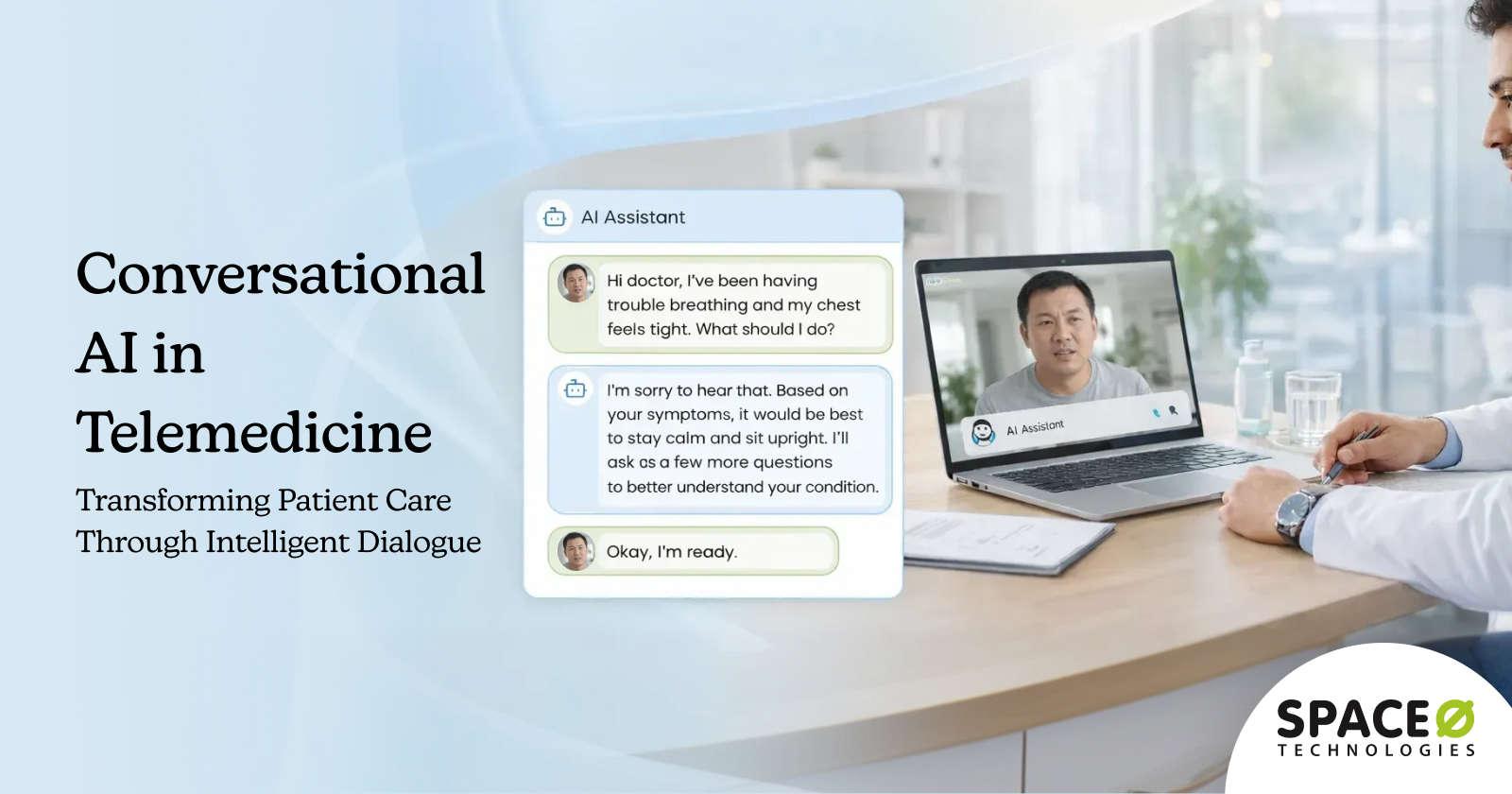
Telemedicine platforms are rapidly evolving as healthcare organizations seek smarter ways to manage patient interactions at scale. From appointment scheduling and symptom intake to follow-ups and care coordination, virtual care depends heavily on timely and accurate communication.
According to Precedence Research, the AI in the telemedicine market was valued at $26.11 billion in 2025 and is projected to reach $176.94 billion by 2034. This highlights the growing reliance on AI-driven technologies to support virtual healthcare delivery.
Conversational AI plays a central role in this transformation by enabling telemedicine platforms to engage patients through natural, context-aware conversations across chat, voice, and messaging channels. Powered by natural language processing and machine learning, conversational AI systems help automate routine interactions, guide patients through care journeys, and support clinicians by reducing administrative workload.
In this blog, we explore how conversational AI works in telemedicine, key use cases, benefits, and implementation considerations. Get insights from our 15+ years of experience as a leading AI telemedicine development partner to effectively implement conversational AI in your telemedicine platform.
What Is Conversational AI in Telemedicine?
Conversational AI in telemedicine refers to artificial intelligence systems that engage patients through natural, human-like dialogue across text and voice channels. Unlike simple rule-based AI telemedicine chatbots that follow scripted decision trees, conversational AI understands context, remembers previous exchanges, and generates responses that feel genuinely helpful rather than robotic.
The distinction matters significantly for healthcare applications. A basic chatbot might recognize the keyword “appointment” and display scheduling options.
Conversational AI understands when a patient says “I need to see someone about this rash that’s been getting worse since last Tuesday” and responds appropriately by asking relevant follow-up questions, assessing urgency, and guiding them toward the right care pathway.
Core components that power conversational AI
- Natural Language Understanding (NLU): The ability to interpret patient intent from unstructured text or speech, handling medical terminology, typos, and varied phrasing
- Dialogue Management: Systems that maintain context across multiple conversation turns, remembering what was discussed and building upon it logically
- Natural Language Generation (NLG): Creating responses that sound natural and empathetic rather than templated and mechanical
- Intent Recognition and Entity Extraction: Identifying what the patient wants to accomplish and extracting key information like symptoms, dates, medications, and severity levels
These systems exist on a spectrum of sophistication. Basic healthcare chatbots handle FAQs and simple tasks. Advanced conversational AI manages complex multi-turn medical conversations.
For healthcare organizations evaluating these technologies, understanding where your needs fall on this spectrum determines the right investment level and implementation approach.
Now that we understand what conversational AI encompasses, let’s explore how these systems actually work in healthcare settings.
How Conversational AI Works in Telemedicine
Conversational AI processes patient interactions through a multi-layered system that combines language understanding, clinical knowledge, and seamless integration with healthcare infrastructure. Here’s how each layer functions.
Step 1: Understanding patient input
When a patient types or speaks a message, the system first converts the input into processable data. For voice interactions, automatic speech recognition (ASR) transcribes speech to text, handling medical terminology, accents, and ambient noise.
The natural language understanding (NLU) layer then analyzes this text to determine intent and extract relevant entities. When a patient says, “I need to reschedule my cardiology appointment from Thursday to next week,” the system identifies the intent (reschedule), the specialty (cardiology), and the timing parameters (from Thursday to next week).
- Medical entity recognition identifies medications, conditions, symptoms, and procedures mentioned
- Negation detection distinguishes “no chest pain” from “chest pain.”
- Temporal reasoning understands timeframes like “since last Tuesday” versus “right no.w”
- Sentiment analysis detects frustration, anxiety, or urgency in patient messages
Step 2: Processing through clinical logic
Once the system understands the patient’s input, it applies clinical logic and business rules to determine the appropriate response. This layer connects to multiple knowledge sources and decision engines.
For symptom-related queries, the AI references medical knowledge bases to assess severity, ask relevant follow-up questions, and determine appropriate care pathways. For administrative requests, it checks scheduling systems, insurance rules, and organizational policies.
- Dialogue management maintains context across multiple conversation turns
- Clinical decision support applies evidence-based protocols to health inquiries
- Business rules enforce scheduling constraints, authorization requirements, and escalation triggers
- Personalization engines tailor responses based on patient history and preferences
Step 3: Generating contextual responses
The natural language generation (NLG) component creates human-readable responses that feel natural rather than robotic. Advanced systems adjust tone, complexity, and detail based on patient profiles and conversation context.
Response generation balances multiple objectives: clinical accuracy, regulatory compliance, empathy, and actionability. The system must provide helpful information while avoiding inappropriate medical advice and maintaining clear boundaries.
Organizations pursuing generative AI development for healthcare prioritize response quality, safety guardrails, and consistent brand voice.
Step 4: Integrating with healthcare systems
Conversational AI delivers maximum value when connected to existing healthcare infrastructure through secure integrations. EHR integration via FHIR and HL7 standards enables the AI to access patient history, medications, allergies, and appointments for personalized responses.
- Scheduling system integration enables real-time availability checks and booking
- Pharmacy connections support refill requests and interaction checking
- Billing system access allows insurance verification and cost estimates
- Care team notifications trigger alerts for urgent situations requiring human attention
Omnichannel deployment ensures patients engage through their preferred channel, whether patient portal, mobile app, SMS, or voice assistant, with context maintained across all touchpoints.
Understanding this workflow clarifies what these systems can accomplish. Let’s examine the specific applications transforming telemedicine today.
Key Applications of Conversational AI in Telemedicine
Conversational AI addresses multiple pain points across the patient journey, from initial symptom concerns through post-visit follow-up. Below are the most impactful telemedicine AI use cases with a focus on conversational AI capabilities.
1. Patient intake and symptom triage
What it is: An AI-driven system that replaces static intake forms with dynamic, adaptive conversations. The system gathers patient history, current symptoms, and concerns through natural dialogue while intelligently routing cases based on urgency and clinical appropriateness.
Key capabilities:
- Asks contextual follow-up questions based on patient responses
- Extracts structured data from natural language for direct EHR integration
- Flags urgent cases for immediate clinical attention
- Adapts conversation depth based on symptom severity
Impact: Healthcare organizations report a reduction in intake processing time while improving data completeness. The conversational approach also increases patient disclosure of sensitive information compared to traditional paper forms.
2. Appointment scheduling and reminders
What it is: A natural language scheduling system that allows patients to book, reschedule, or cancel appointments through simple conversation instead of navigating complex phone trees or portal calendars.
Key capabilities:
- Interprets requests like “I need to see Dr. Martinez next week, preferably in the afternoons.”
- Sends proactive reminders with preparation instructions
- Identifies high no-show risk patients for targeted outreach
- Handles rescheduling with automatic waitlist management
Impact: AI-driven engagement programs achieve a significant reduction in no-show rates through personalized outreach. If you need experienced AI developers to build these capabilities, working with teams who understand healthcare workflows is essential.
3. Clinical documentation automation
What it is: An AI system that automatically generates clinical notes from patient interactions and video consultations, addressing the documentation burden that consumes nearly two hours for every hour of direct patient care.
Key capabilities:
- Uses ambient listening during video visits to capture SOAP notes
- Surfaces relevant conversation segments on the clinician’s request
- Generates discharge instructions and patient education materials
- Integrates with EHR systems through expert AI integration services
Impact: Clinicians reclaim significant time previously spent on documentation, allowing them to see more patients or dedicate more attention to complex cases without extending work hours.
4. Medication management and adherence
What it is: A conversational system that handles medication-related inquiries, including refill requests, dosage questions, side effect concerns, and drug interaction checks through natural dialogue with appropriate clinical escalation.
Key capabilities:
- Processes refill requests and coordinates with pharmacy systems
- Checks for drug interactions when patients ask about combining medications
- Sends proactive refill reminders to prevent supply gaps
- Escalates concerning patterns to the clinical staff immediately
Impact: Improved medication adherence reduces hospital readmissions and emergency visits. Chronic disease patients benefit from regular AI-powered check-ins that capture symptom data and flag deterioration early.
5. Mental health support and monitoring
What it is: A 24/7 conversational support system that expands mental health access through structured between-session support, mood tracking, and crisis detection.
Key capabilities:
- Conducts mood assessments and tracks sleep patterns between sessions
- Provides evidence-based coping strategies and guided exercises
- Detects crisis indicators and escalates with appropriate resources
- Maintains conversation continuity for longitudinal tracking
Impact: Patients receive support during off-hours when crises often occur. Building empathetic mental health AI requires specialized expertise to ensure safe and patient-centric care.
These applications deliver substantial benefits across healthcare organizations. Let’s quantify the impact.
Identify the Right Conversational AI Use Case for Your Telemedicine Platform
With 15+ years of healthcare AI development experience, we work closely with healthcare organizations to identify high-impact conversational AI use cases based on patient journeys, clinical workflows, and operational goals.
6 Key Benefits of Conversational AI for Telemedicine Solutions
Healthcare leaders evaluating conversational AI investments and AI telemedicine MVP platform development need a clear understanding of the return these systems deliver. The benefits span operational efficiency, patient experience, and financial performance.
1. 24/7 patient availability without staffing increases
Conversational AI enables round-the-clock patient engagement without expanding call center headcount or after-hours coverage costs. Patients receive immediate responses to scheduling requests, symptom questions, and prescription inquiries at any hour, improving access and satisfaction while controlling operational expenses.
2. Reduction in administrative workload
Front-desk staff and clinical support teams spend significantly less time on routine tasks when conversational AI handles scheduling, intake, FAQ responses, and basic triage. This frees human staff to focus on complex patient needs, insurance issues, and situations requiring empathy and judgment.
3. Measurably improved patient satisfaction scores
According to the 2024 National Telehealth Survey, 89% of Americans reported full satisfaction with their telehealth experiences. Conversational AI contributes by eliminating hold times, providing personalized responses, and ensuring consistent service quality regardless of time or demand volume.
4. Scalable engagement during demand surges
Unlike human agents, conversational AI handles thousands of simultaneous patient interactions without quality degradation or wait times. This scalability proves essential during flu seasons, public health events, or rapid practice growth when traditional staffing cannot scale quickly enough.
5. Consistent quality and regulatory compliance
Every patient interaction follows standardized clinical protocols and approved messaging when delivered through conversational AI. This consistency reduces liability risk, ensures regulatory compliance across all touchpoints, and maintains organizational brand voice without depending on individual staff performance.
6. Measurable cost efficiency and ROI
Organizations typically achieve return on investment through reduced staffing requirements, lower patient acquisition costs, and decreased no-show losses. Most healthcare providers implementing conversational AI report positive ROI within 12–18 months with compounding benefits over time.
For organizations ready to explore these benefits, working with qualified AI consultants ensures realistic expectations and proper implementation planning.
While these benefits are substantial, organizations must address several challenges to achieve successful implementation.
Deliver Patient-Focused Virtual Care With Conversational AI
Space-O AI helps you implement conversational AI solutions designed around patient needs, enabling personalized interactions, faster responses, and seamless care navigation across telemedicine platforms.
Challenges in Implementing Conversational AI in Telemedicine (How to Overcome Them)
Successful conversational AI implementation requires an honest assessment of challenges and proactive mitigation strategies. Organizations that underestimate these factors often struggle with adoption, compliance issues, or disappointing results.
1. Medical accuracy and liability concerns
AI misinterpretation of symptoms or medical context creates genuine patient safety risks and potential organizational liability. Healthcare conversational AI operates in high-stakes territory where errors carry serious consequences.
Solution
- Implement human-in-the-loop oversight for any clinical decision support
- Conduct rigorous clinical validation before production deployment
- Establish clear scope limitations and communicate them transparently to patients
- Create audit mechanisms that catch and correct errors quickly
- Maintain regular accuracy monitoring and model updates as medical knowledge evolves
2. HIPAA compliance and data privacy requirements
Handling protected health information in conversational interfaces requires robust security infrastructure and operational procedures. Many general-purpose AI platforms lack the necessary compliance certifications.
Solution
- Select infrastructure and vendors with BAA agreements and HIPAA compliance certifications
- Implement end-to-end encryption for all conversation data in transit and at rest
- Establish de-identification protocols for any data used in model training
- Create comprehensive audit trails that log all PHI access and processing
- Conduct regular security assessments and penetration testing
3. Integration complexity with legacy systems
Most healthcare organizations operate EHR systems, practice management software, and billing platforms that weren’t designed for AI integration. Creating seamless connections requires significant technical effort.
Solution
- Adopt an API-first architecture that accommodates various integration methods
- Prioritize FHIR and HL7 standards for healthcare data exchange
- Plan phased integration starting with the highest-value workflows
- Budget adequately for integration development and testing
- Consider middleware solutions that simplify legacy system connections
4. Patient trust and adoption barriers
Some patients hesitate to discuss health concerns with AI systems, preferring human interaction regardless of wait times or inconvenience. Forcing AI interactions can damage patient relationships.
Solution
- Disclose AI involvement transparently at conversation start
- Provide seamless, immediate handoff to human agents when requested
- Introduce AI through low-stakes use cases like scheduling before expanding scope
- Collect feedback and iterate on conversation design based on patient preferences
- Respect patient choice and never make AI interaction mandatory for essential services
5. Multilingual and accessibility requirements
Diverse patient populations require language support and accessibility accommodations that many conversational AI platforms lack or implement poorly.
Solution
- Deploy multilingual telemedicine NLP models for languages common in your patient population
- Provide voice alternatives for patients who cannot or prefer not to type
- Ensure WCAG compliance for visual interface elements
- Test with patients who use screen readers and assistive technologies
- Consider cultural communication differences beyond simple translation
Understanding these challenges prepares organizations for successful implementation. Let’s explore proven best practices.
Implementation Best Practices for Conversational AI in Telemedicine
Organizations that achieve strong results with conversational AI follow consistent patterns in their implementation approach. These best practices emerge from successful deployments across health systems, clinics, and digital health companies.
1. Start with focused, high-value use cases
Attempting to deploy conversational AI across all patient touchpoints simultaneously overwhelms technical teams and confuses patients. Successful implementations start narrow and expand based on proven success.
Appointment scheduling and symptom triage represent ideal starting points. These use cases are high-volume, well-defined, and deliver immediate measurable value.
- Select one or two use cases with clear success metrics
- Define scope boundaries explicitly before development begins
- Validate effectiveness with pilot groups before broader rollout
- Build organizational confidence and technical capability through early wins
- Expand to additional use cases based on documented results
2. Design for clinical workflows, not around them
Conversational AI that forces clinicians and staff to change established workflows faces adoption resistance. The most successful implementations integrate seamlessly with existing processes.
- Involve clinicians, nurses, and front-desk staff in conversation flow design
- Map current workflows before designing AI interactions
- Identify integration points that enhance rather than disrupt current processes
- Build escalation paths that connect naturally to human agents
- Test with actual staff in realistic scenarios before deployment
3. Ensure compliance infrastructure from day one
Retrofitting compliance onto a deployed system is expensive and risky. Building HIPAA-compliant infrastructure from project inception avoids costly remediation and potential violations.
- Select a cloud infrastructure with healthcare compliance certifications
- Implement comprehensive logging and audit trails from the start
- Establish data governance policies before collecting patient information
- Document all data flows and processing activities
- Conduct security assessments at each development milestone
4. Build for continuous measurement and improvement
Conversational AI systems require ongoing optimization to maintain and improve performance. Organizations that treat deployment as the finish line miss significant value.
- Track conversation completion rates and identify drop-off points
- Monitor escalation frequency, reasons, and outcomes
- Collect structured patient feedback on conversation quality
- A/B test conversation flows, responses, and engagement approaches
- Plan for regular model retraining as data accumulates and medical knowledge evolves
With these best practices in mind, let’s examine the development investment required for healthcare conversational AI.
How Much Does It Cost to Implement Conversational AI In Telemedicine Platforms?
The cost of building an AI telemedicine solution with conversational AI technology requires investment that scales with solution complexity. Understanding these tiers helps organizations align expectations with the budget.
Cost breakdown by complexity
| Complexity | Total Investment | What’s Included |
| Basic | $50,000–$80,000 | Single use case (scheduling or FAQs), text-only NLU, basic EHR read access, single language, web deployment |
| Intermediate | $80,000–$150,000 | 2–3 use cases, medical entity recognition, bidirectional EHR integration, multi‑channel (web + mobile), 2–3 languages |
| Advanced | $150,000–$300,000 | Full symptom triage with clinical decision support, ambient documentation, omnichannel deployment, enterprise security (SOC 2/HITRUST ready), predictive engagement |
- Basic suits practices testing conversational AI with a single high-volume task before committing to broader implementation.
- Intermediate fits organizations ready to automate multiple patient touchpoints with deeper EHR connectivity and multilingual support.
- Advanced addresses health systems requiring clinical decision support, enterprise-grade security certifications, and comprehensive patient journey automation.
Ongoing costs
Annual maintenance typically runs 25–30% of initial development investment ($15,000–$80,000, depending on complexity). Key ongoing cost factors include:
- Model retraining – Regular updates to improve accuracy based on new conversation data and evolving medical terminology
- Security updates – Patches, vulnerability assessments, and penetration testing to maintain HIPAA compliance
- EHR API changes – Adapting integrations when healthcare systems update their interfaces
- Conversation flow optimization – A/B testing and refining dialogue paths based on completion rates and user feedback
- Compliance monitoring – Audit log reviews, policy updates, and documentation for regulatory requirements
- Infrastructure costs – Cloud hosting, compute resources for NLU processing, and data storage
Factors affecting investment
- Medical knowledge depth – Symptom triage with clinical protocols costs 2-3x more than administrative automation due to validation and liability considerations.
- Integration complexity – Modern FHIR-enabled EHRs integrate at a lower cost range. Legacy systems requiring custom middleware push toward upper bounds.
- Compliance certification – Basic HIPAA compliance is standard. SOC 2 Type II or HITRUST adds $20,000–$40,000.
- Voice capabilities – Adding ASR increases NLU costs by 30-40% for speech recognition and ambient noise handling.
- Deployment channels – Each additional channel (SMS, voice assistant, messaging apps) adds 15–20% to the development scope.
Get a Custom Cost Estimate for Conversational AI Implementation
Space-O AI provides transparent, use case-based cost estimates for conversational AI development and implementation, helping you plan budgets accurately and scale with confidence.
Build Intelligent Conversational AI-Enabled Telemedicine Solutions With Space-O AI
Conversational AI in telemedicine transforms patient engagement through intelligent dialogue systems that understand context, maintain conversation history, and respond with clinical accuracy. From symptom triage to documentation automation, these solutions reduce administrative burden significantly while improving patient satisfaction and delivering measurable ROI.
Space-O AI brings 15 years of AI development expertise and successful delivery of over 500 AI projects across healthcare, finance, and enterprise sectors. Our dedicated healthcare AI team understands clinical workflows, HIPAA compliance requirements, and EHR integration complexities that telemedicine platforms demand for reliable production deployment.
Our conversational AI development experts combine advanced NLP engines, secure HIPAA-compliant architecture, and seamless integration capabilities proven in real healthcare environments.
We have helped healthcare providers reduce documentation time by 40%, improve patient engagement scores measurably, and scale virtual care operations without proportional increases in staffing.
Ready to transform your telemedicine platform with conversational AI that patients trust and clinicians appreciate? Contact our healthcare AI specialists for a free consultation. We provide detailed project assessments, transparent pricing structures, and realistic timelines to bring your patient engagement vision to life.
Frequently Asked Questions
1. What is conversational AI in telemedicine?
Conversational AI in telemedicine refers to AI-powered systems that engage patients through natural dialogue via text or voice channels. These systems handle symptom triage, appointment scheduling, medication management, and health education while understanding context across multiple conversation turns. Unlike simple rule-based chatbots, conversational AI interprets intent, maintains memory of previous exchanges, and generates responses that feel helpful and human-like.
2. How does conversational AI differ from traditional healthcare chatbots?
Traditional healthcare chatbots follow scripted decision trees and can only respond to anticipated inputs. They fail when patients phrase questions unexpectedly or ask follow-up questions. Conversational AI uses advanced NLP and machine learning to understand varied phrasing, maintain context across extended dialogues, handle complex medical queries, and generate natural responses. It adapts to individual communication styles and improves through learning from interactions.
3. Is conversational AI in healthcare HIPAA compliant?
Conversational AI can be fully HIPAA compliant when properly implemented with appropriate technical and administrative safeguards. Requirements include end-to-end encryption for data in transit and at rest, secure data storage with access controls, business associate agreements with all vendors handling PHI, comprehensive audit logging, and regular security assessments.
4. What is the ROI of implementing conversational AI in telemedicine?
Healthcare organizations typically achieve ROI through multiple value streams. Administrative cost reduction of 40–60% results from automating routine tasks. Patient satisfaction improvements of 20–30% come from reduced wait times and 24/7 availability. No-show rate reductions of up to 16% improve revenue capture. Increased appointment throughput allows practices to serve more patients without proportional staffing increases. Most organizations achieve positive ROI within 12–18 months with compounding annual benefits thereafter.
5. Can conversational AI handle medical emergencies?
Conversational AI should never replace emergency services and must be designed with robust safety protocols. Well-implemented systems detect emergency keywords, symptom combinations indicating urgent conditions, and expressions of self-harm or crisis. Upon detection, the AI immediately directs patients to call 911, provides emergency resources, and can alert human staff for follow-up. Clear scope limitations and disclaimers must be communicated to patients from the first interaction.
6. How long does it take to implement conversational AI in telemedicine?
Implementation timelines vary based on scope and organizational readiness. A focused MVP addressing a single use case like appointment scheduling typically deploys in 8–12 weeks. Comprehensive solutions with multiple conversation flows, EHR integration, and clinical validation require 4–6 months. Enterprise-wide rollouts, including staff training, change management, and phased deployment across locations, may extend to 6–9 months. Starting with clear requirements and engaging experienced development partners accelerates timelines.
7. What technical expertise is needed to build healthcare conversational AI?
Building effective healthcare conversational AI requires expertise spanning NLP and machine learning engineering, healthcare domain knowledge, including clinical workflows and terminology, EHR integration experience with standards like FHIR and HL7, HIPAA compliance and security implementation, and UX design for healthcare contexts. Most organizations partner with specialized AI developers rather than building entirely in-house due to the breadth of skills required and the specialized nature of healthcare AI development.


Planning to Implement Conversational AI In Your Telemedicine Platform?
What to read next