- What is Conversational AI in Retail?
- Key Use Cases for Conversational AI in Retail
- Benefits of Conversational AI for Retailers
- Cost to Build Conversational AI for Retail
- How to Implement Conversational AI in Retail
- Real-World Examples: Retailers Using Conversational AI
- Challenges and Considerations to Build Conversational AI For Retailers
- How Space-O AI Helps Retailers Build Conversational AI Solutions
- 1. 15+ Years of AI Engineering Expertise
- 2. Custom Solutions for Retail Differentiation
- 3. End-to-End Development Partnership
- 4. Proven Retail Results
- How much does conversational AI for retail cost?
- How long does implementation take?
- Can conversational AI handle in-store and online channels?
- What ROI can retailers expect from conversational AI?
- Will AI replace retail staff?
Conversational AI in Retail: Benefits & Applications

 Last Updated: January, 2 2026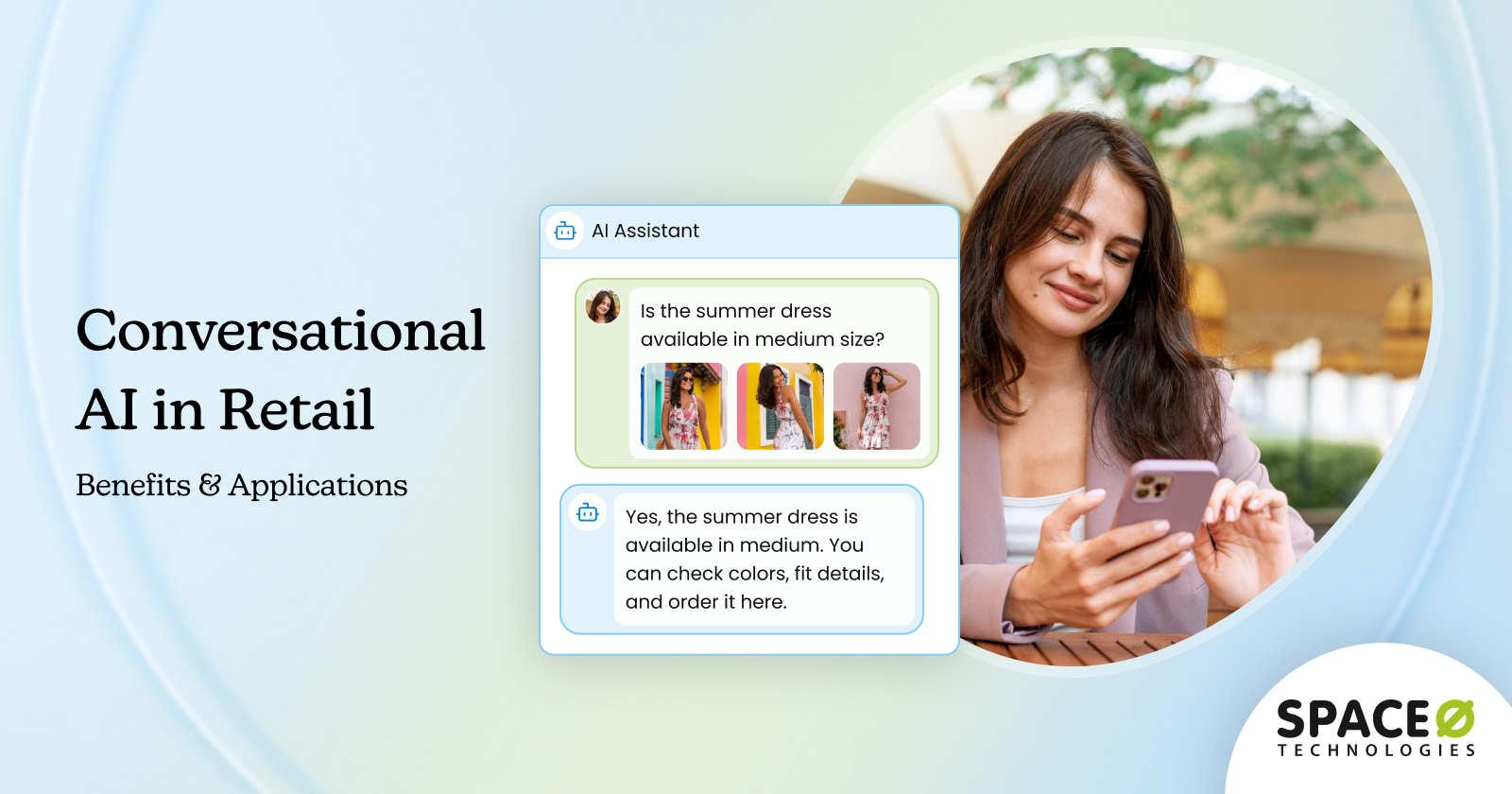
Retail has changed. Your customers now expect instant answers at 2 AM, personalized recommendations that actually match their style, and seamless experiences whether they are browsing online or walking through your store.
Meeting these expectations with traditional methods is nearly impossible. Hiring enough staff to provide 24/7 personalized service across every channel would bankrupt most retailers. Yet customers keep raising the bar, comparing every shopping experience to the best they have ever had.
Conversational AI in retail offers a practical solution to this challenge. According to Gartner, 87% of retailers are already using AI in some capacity. The retail conversational AI market has reached $2.1 billion in 2024, growing at 24% annually as retailers recognize the competitive advantage it provides.
The results justify the investment. Retailers implementing conversational AI report 15-25% conversion improvements, 30-40% cost reductions in customer service, and the ability to deliver personalized experiences at scale.
This guide covers everything you need to know about conversational AI in retail: what it is, proven use cases, implementation costs, and a practical roadmap for getting started. Whether you operate a single store or a national chain, you will find actionable insights to transform your customer experience.
What is Conversational AI in Retail?
Conversational AI represents a significant evolution in how retailers engage with customers. Understanding the technology helps you make informed decisions about implementation and set realistic expectations for outcomes.
Conversational AI refers to artificial intelligence systems that enable natural language interactions between retailers and customers. Unlike basic chatbots that follow rigid scripts, conversational AI understands context, learns from interactions, and delivers personalized responses that feel genuinely helpful.
The technology combines several AI capabilities working together:
- Natural Language Understanding (NLU) interprets what customers mean, not just what they literally say. When a shopper asks “Do you have this in a smaller size?”, the system understands they are referring to a specific product they have been viewing and want size alternatives.
- Machine Learning enables continuous improvement. Every interaction teaches the system to respond more accurately. The AI gets better at understanding your customers over time, recognizing patterns in how they phrase questions and what they actually need.
- Context Retention maintains conversation continuity. If a customer asks about a jacket, then follows up with “What colors does it come in?”, the AI remembers they are discussing that specific jacket without requiring them to repeat themselves.
- Generative AI and Large Language Models create natural, human-like responses rather than selecting from pre-written templates. This enables handling complex, open-ended questions that rigid systems cannot address.
For retail specifically, building a conversational AI solution connects to your product catalog, inventory systems, and customer data to provide accurate, personalized responses. A customer asking about product availability gets real-time inventory information. Someone inquiring about their order receives actual tracking data. The AI becomes a knowledgeable shopping assistant available across every channel.
Build a Conversational AI Solution That Transforms Retail Experiences
Ready to create personalized shopping journeys that drive sales? Partner with Space-O AI to develop conversational AI designed for your retail environment.
Key Use Cases for Conversational AI in Retail
Successful implementations start with specific, high-impact use cases. Understanding where conversational AI delivers the most value helps you prioritize your investment and demonstrate ROI quickly. The following use cases represent proven applications that retailers across segments have deployed successfully.
1. Personalized Product Discovery and Recommendations
Traditional product search forces customers to know exactly what they want. Conversational AI enables discovery through natural dialogue, helping shoppers find products that match their needs even when they cannot articulate precise specifications.
AI shopping assistants understand preferences expressed conversationally. A customer can say “I need something for a beach vacation” and receive relevant suggestions across categories. The system considers their purchase history, browsing behavior, and stated preferences to personalize recommendations.
1.1Visual Search and Style Matching
Customers upload images of products they like, and AI identifies similar items from your catalog. This capability proves particularly valuable for fashion and home decor, where customers often know what they want visually but struggle to describe it in search terms.
1.2Size and Fit Assistance
For apparel retailers, AI provides size recommendations based on customer measurements, past purchases, and brand-specific sizing data. This reduces return rates while improving customer confidence in purchases.
According to Salesforce, 88% of retailers using AI implement it for product recommendations. Space-O AI developed a product recommendation chatbot for Moov Store in Saudi Arabia that analyzes browsing history and purchase patterns to deliver personalized suggestions, significantly improving customer engagement.
2. Customer Support Automation
Support inquiries follow predictable patterns. Store hours, shipping policies, return procedures, and payment options represent questions that repeat thousands of times daily. Conversational AI handles these efficiently while maintaining quality.
The value extends beyond simple FAQ responses. AI provides 24/7 availability across time zones, ensuring international customers receive immediate assistance regardless of when they shop. According to IBM, AI now handles 70% of customer support queries for retailers who have implemented it effectively.
Seamless escalation matters for complex issues. When conversations require human judgment, AI transfers customers to agents with full context, eliminating the frustration of repeating information. Space-O AI’s work on an AI-Powered Receptionist SaaS achieved a 67% reduction in missed customer inquiries through intelligent routing and round-the-clock availability.
3. Order Tracking and Management (WISMO)
“Where is my order?” represents one of the highest-volume customer inquiries for any retailer. Conversational AI connects directly to order management systems, providing real-time status updates without agent involvement.
Customers ask about their order in natural language and receive accurate tracking information instantly. The system handles common requests including delivery time estimates, shipping address changes, and delivery instruction modifications.
Cognigy reports retailers achieving 52% automation of WISMO inquiries, freeing agents for complex issues while improving customer response times from hours to seconds.
4. Returns and Exchanges Processing
Post-purchase support significantly impacts customer lifetime value. AI streamlines returns by checking eligibility, generating shipping labels, providing drop-off locations, and initiating refund processing.
4.1 Eligibility Verification
The system instantly determines whether items qualify for return based on purchase date, product category, and condition requirements. Customers receive clear guidance without waiting for agent review.
4.2 Label Generation and Tracking
AI generates return labels, provides QR codes for carrier drop-off, and tracks return shipments. Customers can check refund status throughout the process.
This automation reduces friction in the returns experience while maintaining policy compliance. Retailers report improved customer satisfaction even when purchases do not work out.
5. In-Store AI Assistance
Conversational AI extends beyond digital channels into physical retail environments. Smart kiosks provide product lookup, inventory checking across locations, and store navigation assistance.
According to Accenture, 66% of customers prefer self-service kiosks for routine inquiries. In-store AI helps customers find products, check prices, and access additional information without waiting for associate availability.
5.1 Store Navigation
AI guides customers to specific products within large stores, reducing frustration and improving the shopping experience.
5.2 Cross-Location Inventory
When items are unavailable at the current location, AI checks nearby stores and offers transfer or shipping options, capturing sales that would otherwise be lost.
6. Loyalty Program Management
Loyalty programs drive retention but often frustrate customers with complicated redemption processes. Conversational AI simplifies engagement by handling points balance inquiries, reward redemption, and personalized offer delivery.
The system understands individual customer status, proactively suggests relevant rewards, and processes redemptions conversationally. Members can ask “What rewards can I use today?” and receive personalized options based on their points balance and current promotions.
7. Abandoned Cart Recovery
Cart abandonment exceeds 70% for most retailers, representing enormous lost revenue. Conversational AI addresses this through proactive, personalized outreach that identifies and resolves purchase barriers.
AI analyzes abandonment signals to determine likely causes. Price concerns prompt discount offers. Shipping uncertainty triggers delivery information. Product questions receive targeted assistance.
Juniper Research reports that AI-powered interventions reduce cart abandonment by 18-25%, significantly impacting revenue without proportional cost increases.
Create Your Custom Retail Chatbot Solution
Ready to reduce cart abandonment and increase conversions? Partner with Space-O AI to develop conversational AI that guides customers from browsing to purchase.
Benefits of Conversational AI for Retailers
Beyond addressing specific use cases, conversational AI delivers measurable business benefits across customer experience, revenue, operations, and strategic positioning. Understanding these benefits helps build the business case for investment.
1. Enhanced Customer Experience
Customer expectations for response time have compressed dramatically. Waiting hours for email replies or sitting on hold feels unacceptable when instant messaging is the norm in personal communication.
Conversational AI delivers responses in seconds, not minutes or hours. This speed directly impacts satisfaction. Forrester research shows CSAT improvements of 12-18% when AI handles customer interactions effectively.
1.1 Consistency Across Touchpoints
Human agents vary in knowledge, communication style, and performance. Conversational AI provides consistent, accurate information across every interaction. Customers receive the same quality response whether they connect at noon or midnight.
1.2 Personalization at Scale
AI analyzes customer data to personalize every interaction. Past purchases, browsing history, and stated preferences inform responses. Each customer feels recognized rather than processed through generic scripts.
2. Increased Revenue and Conversions
Conversational AI functions as a sales channel, not just a support tool. AI systems guide shoppers through product discovery, answer pre-purchase questions, and recommend complementary items.
Drift reports 15-25% conversion rate improvements when conversational AI engages shoppers during their buying journey. Salesforce data shows 20-35% increases in upsell and cross-sell revenue through AI-powered recommendations.
Consider a customer browsing winter jackets. AI can answer questions about warmth ratings, suggest matching accessories, and offer currently available promotions. This guided experience converts browsers into buyers while increasing average order value.
3. Operational Cost Savings
The operational benefits compound over time. AI handles routine inquiries instantly, reducing ticket volume for human agents by 25-45% according to Zendesk.
Cost per interaction drops 50-70% compared to fully human support. Juniper Research estimates average enterprise savings of $8 million annually from conversational AI implementation.
3.1 Peak Season Scalability
Retail faces dramatic demand fluctuations during holidays and sales events. Traditional models require temporary staffing, training, and quality management. AI scales instantly to handle volume spikes without proportional cost increases.
3.2 Agent Productivity Improvement
When AI handles routine queries, agents focus on complex issues requiring human judgment. Productivity improves 40-50% as agents spend time on meaningful problem-solving rather than repetitive answers.
4. Omnichannel Consistency
Modern retail customers move fluidly between channels. They research on mobile, compare in-store, and purchase online. Conversational AI maintains context across these transitions.
A customer who starts a conversation on your website can continue on mobile without repeating information. AI integration services connects conversations across web chat, mobile apps, social messaging, and in-store kiosks.
5. Actionable Customer Insights
Every conversation generates data. Conversational AI captures structured information about customer questions, concerns, product interests, and friction points.
This data reveals patterns invisible in traditional channels. You discover which products generate the most questions, what information is missing from product pages, and where the checkout process creates confusion. These insights inform product development, content strategy, and experience improvements.
Cost to Build Conversational AI for Retail
Understanding the investment required helps you plan effectively and set realistic expectations. Conversational AI costs vary significantly based on complexity, customization needs, and business scale. This section provides transparent cost guidance based on typical retail implementations.
Cost Breakdown by Business Size
| Business Size | Typical Investment | What’s Included |
| Small Retail (<50 locations) | $5,000 – $50,000 | Basic chatbot, limited integrations, template-based flows |
| Mid-Market Retail (50-500 locations) | $50,000 – $250,000 | Custom NLP, multiple integrations, personalization features |
| Enterprise Retail (500+ locations) | $250,000 – $2M+ | Full custom development, complex integrations, omnichannel |
Factors That Influence the Cost of Building Conversational AI for Retailers
Several variables determine where your implementation falls within these ranges. Understanding these factors helps you scope projects appropriately and prioritize investments.
1. Use Case Complexity
Simple FAQ automation costs significantly less than sophisticated product recommendation engines. Each additional use case adds development time and integration requirements.
Starting with high-impact, well-defined use cases like WISMO or basic support allows you to demonstrate value before expanding scope.
2. Integration Requirements
Connecting conversational AI to your retail systems requires development effort. The complexity depends on your current technology stack:
- Modern platforms (Shopify Plus, Magento 2, Salesforce Commerce) offer robust APIs that simplify integration
- Legacy systems with limited API support increase costs due to custom middleware requirements
- Multiple systems (POS, inventory, CRM, e-commerce) each add integration effort
3. Channel Coverage
Single-channel deployment (website chat only) costs less than omnichannel solutions spanning web, mobile app, in-store kiosks, WhatsApp, and voice interfaces.
Consider starting with your highest-traffic channel and expanding as you prove value.
4. Customization Level
Off-the-shelf chatbot platforms cost $50-500 per month but offer limited customization. Custom AI Software development requires a higher upfront investment but delivers unique capabilities tailored to your brand and processes.
For retailers seeking competitive differentiation, custom development creates experiences competitors cannot simply purchase.
5. AI Sophistication
Basic intent recognition costs less than advanced natural language understanding with context retention, sentiment analysis, and generative AI capabilities. More sophisticated AI delivers better customer experiences but requires greater investment.
Build vs. Buy Comparison
| Approach | Initial Cost | Monthly Ongoing | Best For |
| SaaS Platform | $0 – $5,000 | $200 – $2,000 | Quick deployment, standard use cases |
| Low-Code Platform | $5,000 – $25,000 | $500 – $1,500 | Moderate customization needs |
| Custom Development | $50,000 – $500,000+ | $2,000 – $15,000 | Competitive differentiation, complex integrations |
Ongoing Costs to Consider
Initial development represents only part of the total investment. Plan for ongoing expenses:
- Hosting and Infrastructure: $500 – $5,000/month, depending on scale
- LLM API Costs: $1,000 – $10,000/month at scale for generative AI capabilities
- Maintenance and Updates: 15-20% of initial development cost annually
- Training and Optimization: Continuous investment in model improvement
- Support and Monitoring: Ensuring system reliability and performance
Understand What Retail Conversational AI Really Costs
Ready to move beyond generic pricing to see actual development costs? Partner with Space-O AI for transparent estimates based on your retail platform and integration needs.
How to Implement Conversational AI in Retail
Successful implementation requires methodical planning and execution. This roadmap provides practical guidance based on proven approaches that minimize risk while maximizing value. Each step builds on the previous, creating momentum toward successful deployment.
Step 1: Define Clear Objectives and Use Cases
Start narrow. Attempting to automate everything simultaneously leads to mediocre results across the board. Identify your highest-impact, most repetitive inquiry categories.
1.1 Analyze Current Pain Points
Review your support ticket data. Which questions appear most frequently? Order status checks typically represent 20-30% of volume. Shipping and return inquiries add another 15-25%. These high-volume, low-complexity queries represent ideal starting points.
1.2 Align with Business Objectives
If cart abandonment is your primary concern, prioritize checkout assistance. If support costs are the issue, focus on FAQ automation. Clear priorities guide implementation decisions and success measurement.
1.3 Set Measurable Goals
Define specific targets: “Reduce support ticket volume by 30% within 6 months” or “Improve after-hours response rate from 0% to 95%.” Measurable goals enable objective evaluation of success.
Step 2: Assess Technology Infrastructure
Conversational AI requires data access to deliver value. Evaluate your current infrastructure honestly:
2.1 Product Catalog Integration
Is product data structured and accessible via API? Can the AI query specifications, pricing, and availability in real-time?
2.2 Inventory Systems
Can AI access accurate inventory across locations? Real-time availability information prevents customer frustration from out-of-stock situations.
2.3 Customer Data
Is CRM information available for personalization? Purchase history and preferences enable relevant recommendations.
2.4 Platform Compatibility
Does your e-commerce platform (Shopify, Magento, WooCommerce, custom) support the integrations you need? Modern platforms typically offer robust API capabilities.
Address gaps during planning rather than discovering them during implementation.
Step 3: Select the Right Approach
The build versus buy decision significantly impacts outcomes and costs.
3.1 Evaluate Options Against Your Needs
Platform solutions offer faster deployment but limited customization. If your requirements align with standard capabilities, platforms provide cost-effective starting points.
Custom development requires more investment but delivers differentiated capabilities. For retailers seeking competitive advantage through customer experience, custom AI creates experiences competitors cannot purchase.
Key Evaluation Criteria
- NLU accuracy for retail terminology and your specific products
- Integration capabilities with your existing systems
- Customization options for brand voice and conversation flows
- Scalability for peak seasons and business growth
- Total cost of ownership including ongoing optimization
Step 4: Plan System Integrations
Personalization depends on connected systems. Map the integrations required for your target use cases:
- Product Database: Real-time inventory, specifications, pricing, and images
- Order Management: Status, tracking, modification capabilities, and return processing
- Customer Data: Purchase history, preferences, loyalty status, and communication history
- Payment Systems: Transaction status and payment method management
- Marketing Platforms: Promotional offers, personalized campaigns, and loyalty rewards
AI integration services ensure seamless connection between conversational AI and your retail technology stack. Prioritize integrations based on use case requirements and implementation complexity.
Step 5: Train, Launch, and Optimize
4.1 Train on Your Data
AI effectiveness depends on training quality. Feed the system your product catalog, common customer questions, brand voice guidelines, and policy information. The more relevant data, the better initial performance.
4.2 Pilot Deployment
Start with a subset of traffic or specific use cases. This approach limits risk while generating real performance data. Monitor closely during initial deployment.
4.3 Define Success Metrics
- Containment rate: What percentage of inquiries does AI resolve without escalation?
- Customer satisfaction: Are CSAT scores maintained or improved?
- Conversion impact: How does AI engagement affect purchase rates?
- Cost per interaction: What are the economics compared to human-only support?
4.4 Continuous Improvement
Analyze conversation logs to identify failure patterns. Update training data to address gaps. Refine conversation flows based on actual usage. The AI improves with every interaction if you maintain an optimization rhythm.
Real-World Examples: Retailers Using Conversational AI
Understanding how successful implementations work helps clarify what is possible for your business. These examples demonstrate conversational AI applications across retail segments.
1. Fashion and Apparel
Fashion retail presents unique challenges that conversational AI addresses effectively. Size recommendations, style matching, and outfit coordination require sophisticated understanding of customer preferences and product attributes.
Sephora uses AI-powered virtual assistants to help customers find makeup products based on skin type, preferences, and occasions. The system provides personalized recommendations and tutorials, replicating the in-store consultant experience online.
Visual search capabilities allow customers to upload images of styles they like and find similar items from the catalog. AI understands fashion terminology, helping customers find “something like this but more casual” without requiring precise product specifications.
2. Grocery and Supermarkets
Grocery retail benefits from AI handling high-volume, routine inquiries while adding value through personalization.
Walmart deployed conversational AI for product search, store navigation, and order management. Customers can ask natural language questions about product availability, pricing, and store locations.
Recipe integration represents a unique grocery application. Customers describe what they want to cook, and AI suggests ingredients with real-time availability and substitution recommendations.
3. Electronics and Home Goods
Technical products generate complex questions about specifications, compatibility, and installation. Conversational AI provides expert guidance at scale.
Best Buy uses AI to help customers navigate technical specifications, compare products, and verify compatibility. The system handles pre-purchase questions that would otherwise require specialist knowledge.
AI assists with post-purchase support including setup guidance, troubleshooting, and warranty inquiries, reducing support costs while improving customer success with products.
Challenges and Considerations to Build Conversational AI For Retailers
Implementing conversational AI involves real challenges that require planning and resources. Understanding these challenges upfront enables better preparation and more realistic expectations.
1. Legacy System Integration
Older POS and inventory systems may lack modern APIs, creating integration complexity. Data silos across channels prevent the unified view necessary for effective personalization.
2. Addressing Integration Challenges
API layers and middleware can bridge legacy systems to modern AI capabilities. While this adds initial cost, it preserves existing infrastructure investments while enabling new capabilities.
Phased approaches allow you to start with systems offering better integration capabilities and expand as you modernize legacy components.
3. Training AI for Brand Voice
Maintaining consistent brand tone across AI interactions requires intentional effort. Generic AI responses can feel disconnected from your brand personality.
4. Ensuring Brand Consistency
Develop comprehensive brand voice guidelines for AI training. Include examples of appropriate responses, terminology preferences, and tone variations for different situations.
Continuous refinement based on conversation review ensures the AI learns and maintains your brand standards over time.
5. Data Privacy and Compliance
Conversational AI systems process sensitive customer data, triggering compliance requirements under GDPR, CCPA, and industry regulations.
Compliance Requirements
- Data residency and storage location controls
- Consent management and transparency in AI usage
- Right to erasure and data portability capabilities
- Payment data security (PCI-DSS compliance)
- Audit trails for customer interactions
Work with enterprise AI development partners who understand compliance requirements and build appropriate controls into solutions.
6. Managing Customer Expectations
Some customers prefer human interaction for certain situations. Others become frustrated when AI cannot handle complex requests.
Setting Appropriate Expectations
Clear communication about AI capabilities prevents frustration. Seamless handoff to human agents for complex issues maintains service quality.
Design escalation paths that provide agents with full conversation context, eliminating the frustration of customers repeating information.
Build Conversational AI That Scales Your Retail Operations
Ready to handle unlimited customer inquiries without expanding your support team? Partner with Space-O AI to create AI solutions that grow with your retail business.
How Space-O AI Helps Retailers Build Conversational AI Solutions
Building conversational AI that genuinely transforms retail operations requires more than off-the-shelf tools. Space-O AI partners with retailers to develop custom solutions tailored to their products, customers, and omnichannel workflows. Our approach combines deep technical expertise with practical business understanding.
1. 15+ Years of AI Engineering Expertise
Space-O AI brings over 15 years of AI engineering experience and 500+ successfully delivered projects. This is not theoretical knowledge. It is practical expertise developed through real implementations across industries.
Our team includes developers averaging 8+ years of experience, bringing depth in machine learning, natural language processing, and retail system integrations. Certifications include AWS Gen-AI Partner Badge, Google Cloud Machine Learning Specialization, and Microsoft Azure AI Solution Certification.
For retail specifically, Space-O has delivered product recommendation systems, AI shopping assistants, and customer support automation that drive measurable business results.
2. Custom Solutions for Retail Differentiation
Generic chatbot platforms force your business into their templates. Custom development builds AI around your specific needs:
- Product Expertise: AI trained on your catalog, understanding your product terminology, brand names, and specifications
- Brand Voice: Conversations that reflect your brand personality, not generic bot responses
- Unique Workflows: Integration with your specific systems and processes
- Competitive Differentiation: Capabilities your competitors cannot simply purchase
Custom solutions integrate seamlessly with your e-commerce platform, whether Shopify, Magento, WooCommerce, or a custom build. The AI connects to your inventory, orders, customer data, and marketing systems.
3. End-to-End Development Partnership
Space-O provides complete support across the implementation lifecycle:
- Strategy and Assessment: AI consulting services include readiness evaluation, use case prioritization, and ROI modeling to ensure your investment delivers results
- Design and Development: Conversation design, NLP model development, and integration architecture built for your requirements
- Deployment and Integration: Seamless connection with POS, inventory, CRM, and e-commerce systems
- Optimization and Support: Continuous improvement through analytics, A/B testing, and model refinement
This partnership approach means you are not left with a product and documentation. You have an ongoing relationship focused on improving AI performance over time.
4. Proven Retail Results
Space-O’s track record includes specific retail and e-commerce implementations:
- Moov AI (KSA): Product recommendation chatbot delivering personalized shopping experiences
- AI Product Comparison Tool (Clime): 90% reduction in comparison shopping time
- AI Agent Optimization: 93% cost reduction in AI operations
These results demonstrate the practical impact of well-implemented conversational AI. Whether you need product recommendations, customer support automation, or a complete omnichannel solution, Space-O delivers measurable outcomes.
Launch AI-Powered Shopping Assistants for Your Store
Ready to provide instant product recommendations and support across all channels? Partner with Space-O AI to create intelligent conversational solutions for your retail business.
Basic chatbots follow pre-programmed scripts and decision trees. When customers ask questions outside those scripts, chatbots fail. Conversational AI uses natural language processing and machine learning to understand context, learn from interactions, and provide personalized responses to a wide range of inquiries.
How much does conversational AI for retail cost?
Costs range from $5,000-$50,000 for small retailers to $250,000-$2M+ for enterprise implementations. Variables include use case complexity, integration requirements, channel coverage, and customization level. Mid-market retailers typically invest $50,000-$250,000 for meaningful implementations.
How long does implementation take?
Initial deployment typically takes 3-6 months for mid-market retailers, including discovery, development, integration, and testing. Enterprise implementations may require longer timelines. Ongoing optimization continues indefinitely as the AI improves through use.
Can conversational AI handle in-store and online channels?
Yes, modern solutions provide omnichannel support across web chat, mobile apps, in-store kiosks, social messaging platforms, and voice interfaces. The system maintains conversation context as customers move between channels.
What ROI can retailers expect from conversational AI?
Typical results include 15-25% conversion improvement, 30-40% customer service cost reduction, and 18-25% cart abandonment reduction. Most retailers achieve positive ROI within 6-12 months, with 75% reaching 400% ROI within 24 months.
Will AI replace retail staff?
AI handles routine queries, typically 60-80% of total volume. This frees staff for high-value interactions requiring human judgment, product expertise, and emotional intelligence. Most implementations augment human teams rather than replacing them.


What to read next