- What is Conversational AI in Insurance?
- Why Insurance Companies Are Investing in Conversational AI
- 8 High-Impact Use Cases for Conversational AI in Insurance
- 1. Claims Intake and First Notice of Loss (FNOL)
- 2. Policy Inquiry and Coverage Verification
- 3. Quote Generation and New Policy Sales
- 4. Claims Status and Updates
- 5. Policy Renewals and Upselling
- 6. Underwriting Support and Risk Assessment
- 7. Fraud Detection and Prevention
- 8. Agent Assist and Internal Support
- Benefits of Conversational AI for Insurance Companies
- Challenges and Considerations for Implementing Conversational AI in the Insurance Industry
- How to Implement Conversational AI in Your Insurance Organization
- Cost to Build Conversational AI Solutions for Insurance Companies
- How Space-O AI Builds Conversational AI Solutions for Insurance
- Conclusion
- Frequently Asked Questions
Conversational AI in Insurance: Use Cases and Benefits

 Last Updated: March, 16 2026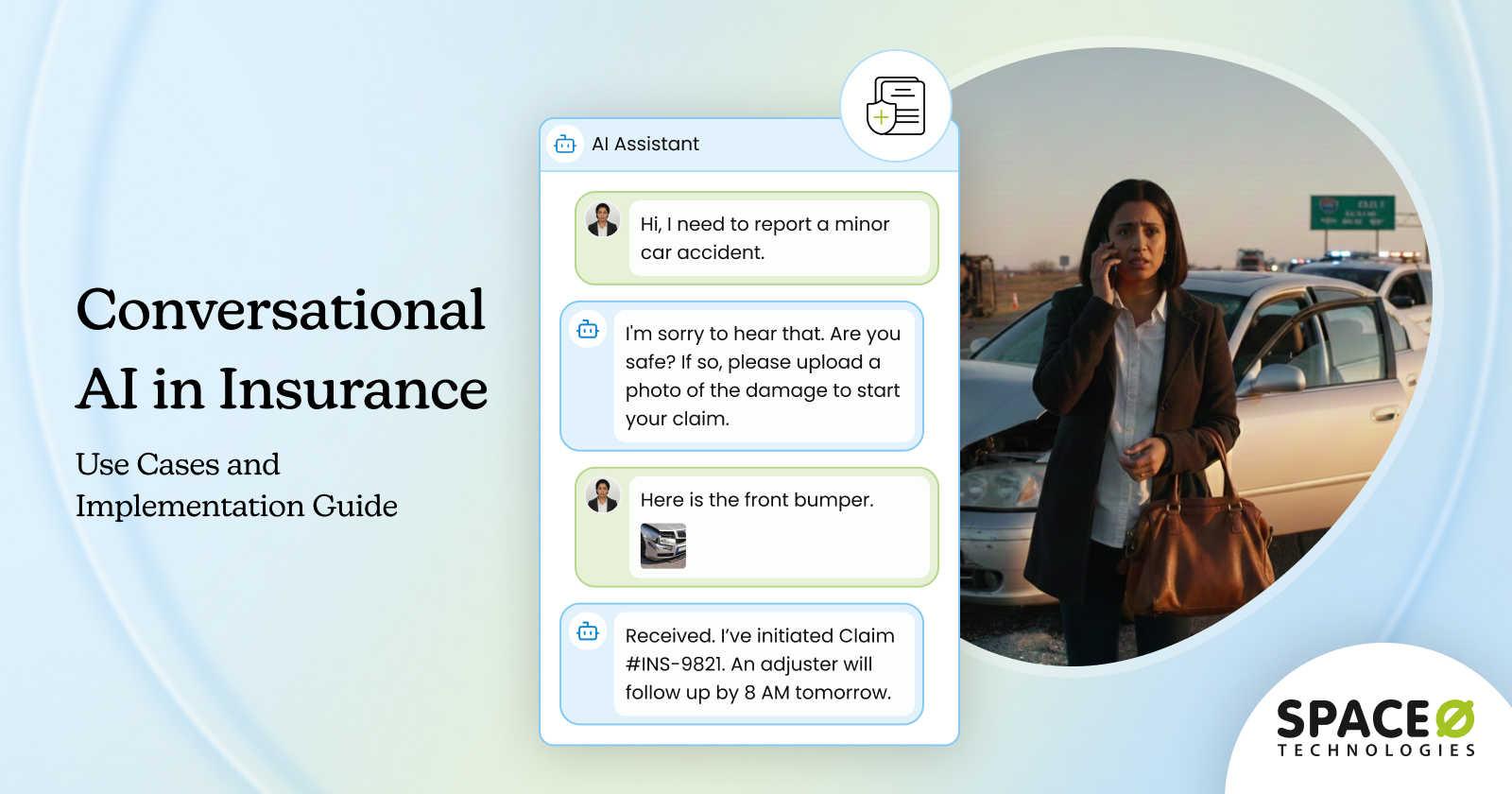
Insurance companies process millions of claims annually while fielding countless policy inquiries, quote requests, and customer service calls. The challenge? Most policyholders expect instant responses, but traditional insurance processes involve manual paperwork, hold times, and multi-day wait periods.
Conversational AI in insurance addresses this gap by automating customer interactions, claims intake, and policy inquiries around the clock. Unlike basic chatbots that follow rigid scripts, modern conversational AI understands context, interprets complex insurance questions, and delivers personalized responses that actually resolve customer needs.
The numbers validate this shift. According to Juniper Research, the insurance industry was projected to save $1.3 billion through chatbot automation by 2023 — a figure that reflects the operational impact AI has already delivered across motor, life, property, and health insurance. Meanwhile, the AI in insurance market is projected to reach $35.8 billion by 2030, growing at a 32.5% compound annual growth rate as adoption accelerates industry-wide.
This guide explores how conversational AI transforms insurance operations, from claims intake to underwriting support, with practical implementation steps and realistic cost expectations.
What is Conversational AI in Insurance?
Conversational AI represents a fundamental shift in how insurance companies interact with policyholders, agents, and claims adjusters. This section explains the technology and how it differs from traditional chatbot solutions that many insurers have already tried and abandoned.
At its core, conversational AI refers to AI systems that engage users in natural, human-like dialogue through text or voice. For insurance applications, this means understanding complex policy language, navigating multi-step claims processes, and providing accurate information about coverage, deductibles, and claim status.
The distinction from rule-based chatbots matters significantly. Traditional chatbots follow predetermined scripts and fail when customers ask questions outside their programmed responses. When you build a conversational AI solution for insurance, you use natural language processing to understand intent, maintain context across lengthy conversations, and generate dynamic responses based on real policy data.
Four core technology components power insurance conversational AI:
- Natural Language Processing (NLP): Interprets insurance terminology, policy language, and the various ways customers describe incidents and coverage questions
- Machine Learning Models: Continuously improve from claims patterns, customer interactions, and resolution outcomes
- Dialogue Management: Maintains context across multi-step claims processes and complex policy inquiries
- Integration Layer: Connects to policy management systems, claims databases, CRM platforms, and underwriting systems
Consider a practical example: A policyholder reports a car accident via chat at 11 PM. The AI asks clarifying questions about the incident, accesses their policy details, confirms coverage applies, guides them through uploading photos and documentation, schedules an adjuster for the next day, provides a claim number with expected timeline, and documents everything in the claims system — all without human intervention and available 24/7.
This level of automation requires custom AI chatbot development services tailored to insurance workflows rather than generic platform solutions.
Why Insurance Companies Are Investing in Conversational AI
The insurance industry has reached an inflection point where conversational AI has moved from experimental technology to operational necessity. Understanding the forces driving this investment helps organizations prioritize their own AI initiatives effectively.
The market momentum is substantial. The AI in insurance market is projected to grow to $35.8 billion by 2030, representing a 32.5% compound annual growth rate. This growth reflects real business value, not just technology hype.
Claims Processing Bottlenecks
High claim volumes create persistent backlogs that frustrate policyholders and strain operations. Manual processing introduces errors, extends cycle times, and consumes agent hours that could address complex cases requiring human judgment.
Conversational AI reduces claims processing time by 50-70% for routine claims. The AI handles initial intake, documentation collection, and status updates while routing complex claims to experienced adjusters. This isn’t about replacing claims professionals — it’s about ensuring they spend time on work that actually requires their expertise.
Customer Experience Expectations
Policyholders increasingly expect insurance to match the digital convenience they experience with banking, retail, and other industries. When customers can check bank balances instantly via app but must call and wait on hold for claim status, dissatisfaction follows.
Research from Salesforce shows that 61% of customers prefer self-service options for simple inquiries when the experience is fast and accurate. Millennials and Gen Z, now a significant policyholder demographic, expect chat-first interactions as the default rather than the exception.
Operational Cost Pressure
Insurance companies face margin pressure from competition while customer service costs continue rising. Traditional call center interactions involve significant agent time, infrastructure overhead, and handling complexity — particularly for claims and coverage questions that require system lookups. Conversational AI brings this cost down dramatically, handling the same queries in seconds at a fraction of the per-interaction cost.
For carriers handling millions of customer contacts annually, a 50-70% reduction in routine inquiry volume represents substantial savings potential that compounds year over year.
Agent Productivity and Retention
Insurance agents spend excessive time on routine inquiries that don’t require their expertise. Answering the same coverage questions, providing claim status updates, and handling basic policy changes contributes to burnout and turnover.
AI handles repetitive tasks so agents focus on complex cases, relationship building, and high-value advisory work. This improves job satisfaction, reduces turnover, and helps carriers retain experienced talent in a competitive labor market.
8 High-Impact Use Cases for Conversational AI in Insurance
Insurance operations offer numerous opportunities for conversational AI, but successful implementations focus on use cases with clear ROI and manageable complexity. The following eight applications deliver the strongest results across property and casualty, life, and health insurance sectors.
1. Claims Intake and First Notice of Loss (FNOL)
AI-powered claims reporting operates 24/7 across web, mobile, and voice channels. The system collects incident details through natural conversation, guides policyholders through photo and document uploads, and creates complete claim records without agent involvement.
Faster Claims Reporting, Day or Night
50-70% faster claims intake with reduced data entry errors. Policyholders can report incidents immediately rather than waiting for business hours.
A policyholder discovers water damage at midnight. The AI gathers incident details, captures photos of the damage, creates the claim record, and schedules an adjuster for the next morning. By 8 AM, the claims team has a complete file ready for processing.
2. Policy Inquiry and Coverage Verification
Policyholders frequently need to verify coverage, understand deductibles, or confirm what their policy includes. Conversational AI provides instant answers to these questions by accessing real policy data and explaining terms in plain language.
Instant Coverage Answers Without Phone Queues
70-80% of routine policy inquiries resolved without human involvement. Significant reduction in call center volume for billing, coverage, and deductible questions.
3. Quote Generation and New Policy Sales
Conversational quote experiences guide prospects through auto, home, and life insurance quotes via natural dialogue. The AI handles pre-qualification, collects necessary information, and presents options while qualifying leads for agent follow-up on complex cases.
More Leads Captured With Lower Acquisition Cost
30-40% improvement in quote completion rates. Captures leads 24/7 and qualifies prospects before agent handoff, improving sales efficiency and reducing wasted agent time on cold inquiries.
4. Claims Status and Updates
“Where is my claim?” represents one of the highest-volume inquiries at any insurance company. Conversational AI provides real-time status without policyholders calling the claims department, while proactive notifications keep customers informed throughout the process.
Fewer Status Calls, Better Customer Experience During Claims
40-50% reduction in status inquiry calls. Improved customer satisfaction during what is often a stressful experience — customers get answers immediately rather than waiting on hold.
5. Policy Renewals and Upselling
Automated renewal reminders delivered conversationally achieve higher engagement than email or mail. The AI can also analyze policyholder data to recommend relevant coverage additions or policy adjustments.
Higher Renewal Rates Through Proactive Engagement
15-25% improvement in renewal rates. Cross-sell and upsell opportunities identified and presented during natural renewal conversations, turning a routine touchpoint into a revenue opportunity.
6. Underwriting Support and Risk Assessment
AI assists underwriters by collecting application information conversationally, gathering required documentation, and providing preliminary risk scoring based on collected data.
Faster Application Processing With Fewer Information Gaps
40-60% reduction in underwriting cycle time. More consistent risk evaluation across applications, with fewer requests for missing information that slow processing.
7. Fraud Detection and Prevention
Conversational AI identifies inconsistencies in claims narratives that may indicate fraud. Pattern recognition across claims history and behavioral analysis during claims conversations flag suspicious claims for investigation.
Earlier Detection With Pattern-Based Analysis
20-30% improvement in fraud detection rates. Reduced fraudulent payouts and investigative costs, with flagged cases routed to specialists before payouts are processed.
8. Agent Assist and Internal Support
Not all conversational AI faces customers. Agent assist systems provide real-time information retrieval during customer calls, policy and procedure guidance, and suggested responses based on conversation context.
Shorter Calls and More Consistent Agent Responses
25-35% reduction in average handle time. Consistent information delivery across all agents regardless of experience level, reducing errors and training costs simultaneously.
Implementing these use cases requires AI software development expertise that understands both the technology and insurance domain requirements.
Benefits of Conversational AI for Insurance Companies
Beyond individual use case benefits, conversational AI delivers systematic advantages that compound across insurance operations. Organizations implementing these solutions see improvements in efficiency, customer experience, and financial performance.
Operational Efficiency and Cost Savings
The cost differential between human and AI-assisted interactions creates substantial savings at scale. Conversational AI dramatically reduces per-interaction costs for routine inquiries, allowing carriers to redirect resources from high-volume routine handling to complex cases.
More importantly, agents handle complex cases requiring judgment and empathy while AI manages high-volume routine interactions. This improves both efficiency and service quality for the cases that matter most.
Improved Customer Experience
Quantified results from insurance conversational AI implementations show consistent patterns:
- 50-70% faster claims processing for routine claims
- 24/7 availability across all time zones
- Consistent, accurate responses regardless of when customers contact
- Significantly reduced wait times for policy inquiries and claim status
Faster Claims Resolution
Streamlined FNOL and claims intake reduces the time from incident to claim creation. Automated status updates reduce customer anxiety and support calls. Fewer data entry errors mean fewer rework cycles.
The net result: 50-70% reduction in claims cycle time for claims suitable for AI-assisted processing.
Scalability Without Proportional Cost
Insurance operations face significant volume variability. Catastrophic events, open enrollment periods, and seasonal patterns create demand spikes that traditional staffing models handle poorly.
Conversational AI scales instantly to handle volume without additional staffing. Carriers can expand to new products and markets without proportionally increasing customer service costs.
Measurable ROI
Insurance conversational AI delivers measurable returns within a predictable timeline. Most carriers achieve positive ROI within 12-18 months, driven by reduced per-interaction costs, lower call center volume, and improved policyholder retention. Returns compound in year two and three as adoption rates increase and the AI improves from accumulated interaction data.
Additional value comes from 30-50% reduction in customer service staffing needs for routine inquiries, with those staff members redeployed to complex cases and high-value advisory roles.
Challenges and Considerations for Implementing Conversational AI in the Insurance Industry
Successful insurance AI implementation requires addressing several challenges that are specific to the industry. Understanding these considerations upfront helps organizations plan effectively and avoid common pitfalls.
Regulatory Compliance and Data Privacy
Insurance AI operates in a heavily regulated environment. Requirements include state insurance regulations and compliance documentation, GDPR and CCPA for customer data privacy, SOC 2 Type II certification for enterprise deployments, comprehensive audit trails for all customer interactions, data retention policies aligned with regulatory requirements, and claims documentation standards.
These requirements add 20-30% to implementation costs but are non-negotiable for production insurance deployments.
Integration with Legacy Systems
Many insurers operate on decades-old policy administration and claims management systems. These systems often lack modern APIs, creating integration challenges that generic AI platforms cannot address.
Successful implementations require custom API development for legacy system connectivity, real-time policy and claims data synchronization, integration with multiple systems (policy admin, claims, CRM, billing), and phased approaches that minimize disruption to existing operations.
This is where AI integration services become essential for connecting modern AI capabilities with existing insurance infrastructure.
Customer Trust and Acceptance
Research shows the majority of customers prefer self-service for simple tasks, but complex claims involving liability disputes or significant payouts require human interaction. The key is appropriate scope definition.
Building trust requires transparency about AI involvement in conversations, clear escalation paths to human agents, appropriate boundaries (AI for intake, humans for decisions), and consistent accuracy that builds confidence over time.
Accuracy in Claims and Underwriting
Insurance decisions carry significant financial impact. AI systems must maintain high accuracy while knowing their limitations. Human review remains essential for claim approvals, denials, and coverage determinations. AI assists but doesn’t replace underwriting judgment, and continuous accuracy monitoring with feedback loops is essential.
Balancing Automation with Empathy
Claims often involve customers during difficult situations: accidents, property damage, health issues, or loss. Technology should enhance human connection, not replace it. AI must be trained to recognize emotional cues and escalate appropriately to ensure automation never feels cold or dismissive during difficult moments.
How to Implement Conversational AI in Your Insurance Organization
Implementation success depends on methodical planning and execution. The following six-step approach has proven effective across insurance organizations of varying sizes and complexity.
Step 1: Identify High-Impact Use Cases
Start with use cases offering clear ROI and manageable complexity: policy inquiries (coverage questions, billing information), claims status updates, quote requests and lead capture, and FNOL intake for straightforward claims. Avoid starting with complex claims adjudication, underwriting decisions, or dispute resolution.
Step 2: Assess Technology and Integration Requirements
Before selecting solutions, evaluate your current infrastructure: policy administration system API capabilities, claims management system connectivity options, existing digital channels, data governance and security policies, and authentication and customer verification mechanisms.
Step 3: Ensure Regulatory Compliance
Address compliance requirements early in planning: document state insurance regulation requirements, plan for GDPR/CCPA compliance for customer data, establish audit trail capabilities, define data retention policies, and prepare for regulatory examinations.
Step 4: Choose the Right Technology Approach
Off-the-shelf platforms offer lower upfront costs ($1,000-8,000/month) and faster deployment but provide limited customization and may not integrate well with legacy insurance systems. Custom development requires higher initial investment but delivers solutions tailored to specific insurance workflows, deep integration with existing systems, and no vendor lock-in — typically the better long-term ROI for carriers with legacy systems.
Step 5: Plan for Change Management
Prepare staff for new workflows and responsibilities, address concerns about job displacement honestly, train agents to work alongside AI effectively, define escalation procedures and human handoff protocols, and establish feedback mechanisms for continuous improvement.
Step 6: Measure Outcomes and Iterate
Define success metrics before launch: CSAT/NPS scores, claims intake time and accuracy, resolution rates and escalation frequency, cost per interaction, containment rate, and policy sales conversion from AI-assisted quotes. Use these metrics to drive continuous improvement through AI consulting services and ongoing optimization cycles.
Cost to Build Conversational AI Solutions for Insurance Companies
Understanding investment requirements helps organizations plan budgets and evaluate ROI realistically. Costs vary based on company size, use case complexity, integration requirements, and build approach.
Cost by Organization Size
| Organization Type | Investment Range | Typical Scope |
|---|---|---|
| Regional Insurers | $75,000 – $200,000 | Basic claims status, policy inquiry, single channel |
| Mid-Market Carriers | $200,000 – $600,000 | Multi-use case, policy admin integration, 2-3 channels |
| National/Enterprise Carriers | $600,000 – $2M+ | Full platform, complex integrations, omnichannel |
Cost by Use Case Complexity
| Use Case | Development Cost | Annual Maintenance |
|---|---|---|
| Policy FAQ and inquiry | $35,000 – $90,000 | $9,000 – $22,000 |
| Claims status chatbot | $50,000 – $130,000 | $12,000 – $32,000 |
| FNOL and claims intake | $100,000 – $280,000 | $25,000 – $70,000 |
| Quote generation assistant | $80,000 – $220,000 | $20,000 – $55,000 |
| Full customer service platform | $250,000 – $800,000 | $60,000 – $200,000 |
| Underwriting support system | $150,000 – $450,000 | $40,000 – $110,000 |
Key Cost Factors
- Regulatory compliance requirements: State regulations, audit trails, and documentation add 20-30% to base costs
- Policy administration integration: Legacy system integration ranges from $50,000 to $200,000+
- Number of use cases: Each additional use case adds incremental development cost
- Channel deployment: Web, mobile, voice, and SMS each require additional development
- Custom NLP training: Insurance terminology and product-specific language models
- Ongoing optimization: MLOps, model retraining, and performance monitoring
Build vs. Buy Considerations
Off-the-shelf platforms provide lower upfront costs ($1,000-8,000/month subscription) and faster deployment, but limited customization depth. They often struggle with complex insurance workflows and legacy system integration.
Custom development requires higher initial investment but delivers tailored solutions for specific insurance products and workflows, deep policy admin and claims system integration, no vendor lock-in, and full ownership of the technology. Custom development is recommended for carriers with legacy systems, unique products, or competitive differentiation goals.
How Space-O AI Builds Conversational AI Solutions for Insurance
Insurance companies need more than generic chatbots. They need AI solutions designed for insurance workflows, regulatory requirements, and the sensitive nature of claims and policy interactions.
Insurance Industry AI Expertise
With 15 years of AI development experience and 500+ projects delivered, our team brings insurance and financial services AI expertise to every engagement. We understand the unique challenges of insurance operations, from regulatory compliance to legacy system integration.
Compliance-First Architecture
Security and regulatory compliance are built into our solutions from the foundation. This includes end-to-end encryption for all data, comprehensive audit trails for regulatory examinations, SOC 2 alignment for enterprise deployments, and data governance frameworks that meet state insurance requirements.
Custom Development for Insurance Workflows
Generic platforms don’t fit complex insurance operations. We build custom conversational AI tailored to your products, policy types, claims processes, and multi-state regulatory requirements — solutions that actually work for your specific operations rather than forcing your workflows to fit a vendor’s template.
Policy Admin and Claims System Integration
We integrate with major policy administration platforms, claims management systems, CRM platforms, billing systems, and underwriting tools. Real-time data synchronization ensures AI has accurate information for every customer interaction.
End-to-End Partnership
From initial strategy through deployment to ongoing optimization, we provide comprehensive partnership. Our MLOps practices ensure models maintain accuracy over time, with continuous monitoring and improvement cycles.
Proven Results
- 40-60% reductions in claims intake time
- 30% improvements in customer satisfaction metrics
- 25-35% reduction in agent handle time through AI-assisted workflows
- Positive ROI within 12-18 months
Conclusion
Conversational AI in insurance is no longer a future investment — it’s a present operational advantage. Carriers that deploy it effectively cut claims intake time by up to 70%, reduce routine inquiry volume by 40-80%, and give policyholders the 24/7 responsiveness they now expect as standard.
The path to a successful deployment follows a clear sequence: start with high-volume, lower-risk use cases like claims status and policy FAQ, resolve legacy integration and compliance requirements before launch, choose a build approach that matches your institution’s complexity, and measure outcomes continuously to guide expansion.
The technology is proven. The ROI is achievable within 12-18 months. The competitive pressure from carriers already deploying AI is real and growing. The question for most insurers is no longer whether to invest in conversational AI, but how quickly they can deploy it without compromising compliance or the human judgment that complex claims require.
Space-O AI has helped insurance organizations navigate this journey across 500+ AI projects. Contact our team for a free consultation to assess what conversational AI could deliver for your specific operations.
Frequently Asked Questions
What is the difference between an insurance chatbot and conversational AI?
Traditional insurance chatbots follow scripted, rule-based responses with limited understanding. They fail when customers ask questions outside their programmed responses. Conversational AI uses natural language processing and machine learning to understand intent, maintain context across complex conversations, and generate dynamic responses — handling nuanced queries like “I was in an accident, am I covered and how do I file a claim?” rather than just “How do I file a claim?”
Is conversational AI in insurance secure and compliant?
Yes, when properly implemented. Insurance conversational AI requires enterprise-grade security including end-to-end encryption, SOC 2 certification, and comprehensive audit trails. It must also comply with state insurance regulations, GDPR/CCPA for data privacy, and maintain documentation required for regulatory examinations.
How much does conversational AI cost for insurance companies?
Costs vary by carrier size and scope. Regional insurers typically invest $75,000-$200,000 for basic implementations, mid-market carriers $200,000-$600,000 for multi-use case deployments, and national carriers $600,000-$2M+ for enterprise platforms. Annual maintenance runs 20-25% of initial investment. Most insurers see positive ROI within 12-18 months.
What is the ROI of conversational AI in insurance?
Most insurers achieve positive ROI within 12-18 months, with returns compounding as AI adoption and containment rates improve over time. Key savings come from dramatically reduced per-interaction costs, 30-50% reduction in customer service staffing needs for routine inquiries, and improved policyholder retention through faster, more consistent service.
Can conversational AI handle complex insurance claims?
Conversational AI excels at claims intake, documentation collection, status updates, and routine processing. For complex claims involving liability disputes, coverage determinations, or significant payouts, AI assists adjusters but human judgment remains essential.
What are the best use cases to start with for insurance AI?
Start with high-volume, low-complexity interactions: policy inquiries, claims status updates, quote requests, and FNOL intake. These provide quick wins with clear ROI and lower risk.
How accurate are insurance AI chatbots?
Modern conversational AI achieves 85-95% accuracy for routine insurance queries when properly trained and integrated. Leading implementations include confidence scoring to route uncertain queries to human agents, maintaining high overall customer satisfaction.
How long does it take to implement conversational AI for insurance?
Basic implementations take 2-4 months. Complex deployments with policy admin integration take 4-8 months. Enterprise-wide omnichannel implementations may take 8-12 months. Phased approaches reduce risk and show early value.


What to read next