- What is Conversational AI in Healthcare?
- Why Healthcare Organizations Are Investing in Conversational AI
- 8 High-Impact Use Cases for Conversational AI in Healthcare
- 1. Patient Triage and Symptom Assessment
- 2. Appointment Scheduling and Management
- 3. Medication Reminders and Adherence Monitoring
- 4. Chronic Disease Management Support
- 5. Mental Health Support and Intervention
- 6. Administrative Workflow Automation
- 7. Clinical Documentation Assistance
- 8. Patient Engagement and Follow-Up Care
- Benefits of Conversational AI for Healthcare Organizations
- Challenges and Considerations for Implementing Conversational AI in Healthcare
- How to Implement Conversational AI in Your Healthcare Organization
- Cost to Build Conversational AI Solutions for Healthcare Organizations
- How Space-O AI Builds Conversational AI Solutions for Healthcare
- Conclusion
- Frequently Asked Questions About Conversational AI in Healthcare
- 1. What is the difference between a chatbot and conversational AI in healthcare?
- 2. How much does conversational AI cost for healthcare organizations?
- 3. What is the ROI of conversational AI in healthcare?
- 4. Can conversational AI replace healthcare workers?
- 5. What are the best use cases to start with for healthcare conversational AI?
- 6. How accurate are AI symptom checkers in healthcare?
Conversational AI in Healthcare: How It Works, Use Cases, and Implementation Guide

 Last Updated: January, 1 2026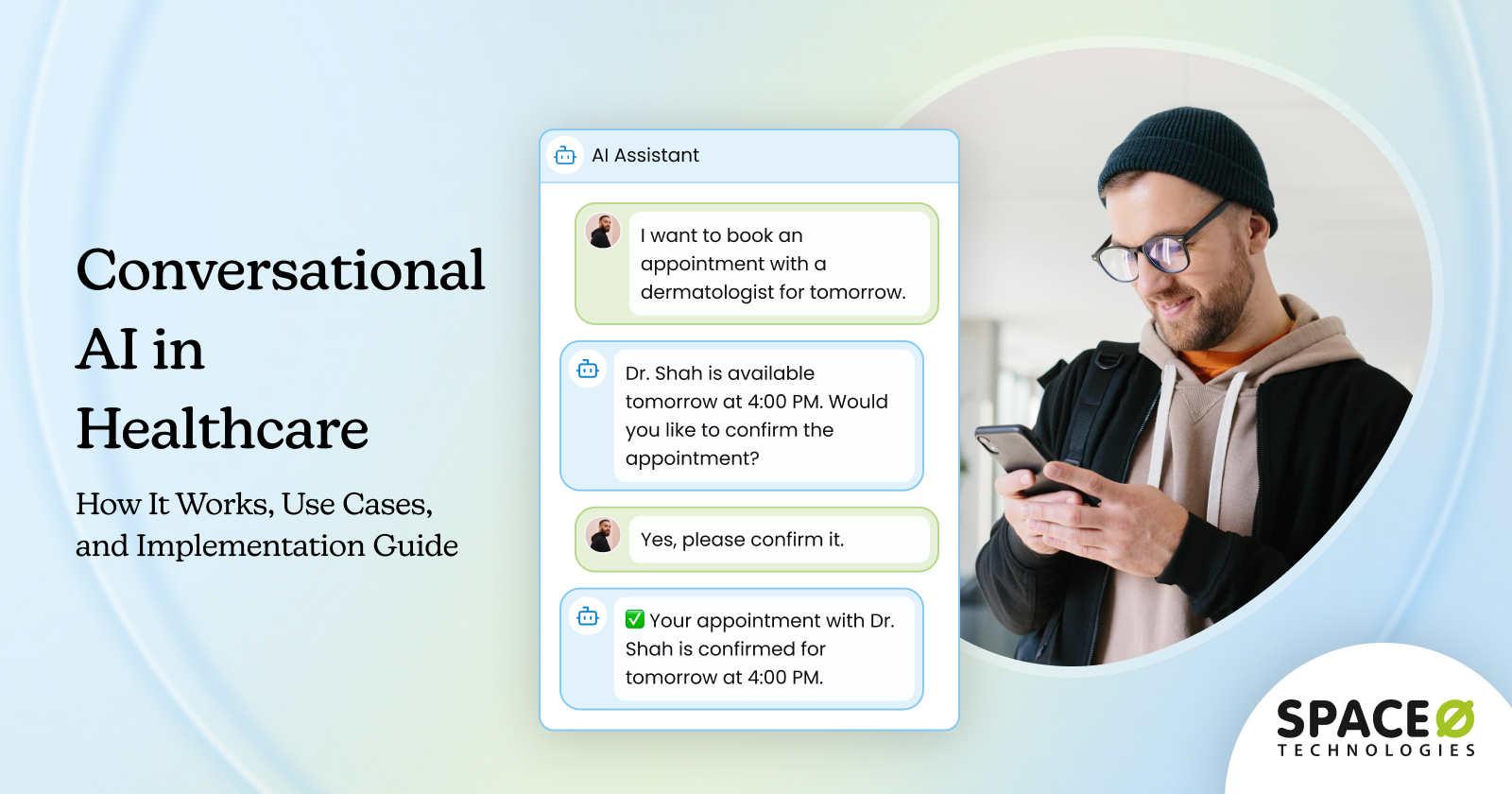
Healthcare systems face a critical challenge: delivering quality patient care while drowning in administrative burden. Clinicians spend hours on documentation, patients wait days for appointment confirmations, and call centers struggle to handle volume. Meanwhile, patient expectations for instant, personalized service continue to rise.
Conversational AI in healthcare addresses these challenges by automating patient interactions, streamlining administrative workflows, and providing 24/7 support without proportional increases in staff.
The market reflects this urgency. According to SNS Insider research, the conversational AI in healthcare market reached $16.9 billion in 2025 and is projected to expand to $123.1 billion by 2034, growing at a CAGR of 24.7%. Three out of four leading healthcare organizations are already testing or scaling generative AI use cases, according to Deloitte.
Yet adoption remains in early stages. An April 2025 MGMA Stat poll found only 19% of medical group practices currently use chatbots or virtual assistants for patient communication. This gap represents a significant opportunity for organizations willing to invest now.
In this guide, we cover what conversational AI means for healthcare, eight high-impact use cases with measurable results, implementation considerations, costs, and how to build solutions that improve both patient outcomes and operational efficiency.
What is Conversational AI in Healthcare?
Conversational AI in healthcare refers to artificial intelligence systems that engage patients and staff in natural, human-like dialogue through text or voice interfaces. These systems go beyond simple automation to create meaningful patient interactions that support clinical care and operational efficiency.
Unlike simple rule-based chatbots that follow scripted decision trees, conversational AI understands intent, maintains context across interactions, and generates dynamic responses based on the specific conversation. This distinction matters in healthcare, where patient inquiries range from straightforward scheduling requests to complex symptom descriptions requiring careful assessment.
Core Technology Components to Build Conversational AI in the Healthcare Industry
Conversational AI in healthcare must handle complex medical language, sensitive patient interactions, and multi-step workflows. To deliver accurate, secure, and context-aware conversations, these systems rely on a set of core technology components that enable understanding, learning, decision-making, and seamless integration with healthcare platforms.
- Natural Language Processing (NLP): Enables the system to understand human language, including medical terminology, colloquialisms, and context. Advanced NLP handles variations in how patients describe symptoms or ask questions, recognizing that “my chest hurts” and “I have tightness in my chest” may indicate similar concerns.
- Machine Learning Models: Allow the system to improve over time based on interactions. Models learn from successful conversations, refine responses, and better predict patient needs. In healthcare settings, these models are trained on clinical protocols and validated medical information.
- Dialogue Management: Maintains conversation context and guides interactions toward helpful outcomes. The system remembers previous questions, tracks conversation state, and knows when to escalate to human support. This is essential for multi-turn conversations about complex health concerns.
- Integration Layer: Connects conversational AI to healthcare systems (EHR, scheduling, pharmacy) to access patient data, update records, and trigger actions based on conversations. Without robust integration, AI remains limited to answering generic questions.
How It Works in Practice
A patient texts their healthcare provider about recurring headaches. The conversational AI:
- Greets the patient and understands their concern
- Asks clarifying questions about symptom duration, severity, and related factors
- Accesses the patient’s medical history to check for relevant conditions or medications
- Provides appropriate guidance based on clinical protocols
- Schedules an appointment if needed, or directs to urgent care if symptoms warrant
- Documents the interaction in the patient record
This entire interaction happens in minutes, available 24/7, without requiring staff involvement for routine cases. For healthcare organizations seeking to implement such systems, working with an experienced AI chatbot development partner ensures the solution meets clinical and compliance requirements.
Understanding these foundational concepts helps healthcare leaders evaluate solutions and set realistic expectations for what conversational AI can accomplish in their organizations.
Build a Conversational AI Solution That Improves Patient Care
Ready to enhance patient engagement and streamline healthcare operations? Partner with Space-O AI to develop HIPAA-compliant conversational AI designed for your healthcare environment.
Why Healthcare Organizations Are Investing in Conversational AI
Healthcare faces structural pressures that make conversational AI adoption compelling. Understanding these drivers helps identify where AI delivers the most value and why the investment timeline matters.
1. Market Momentum and Adoption Trends
The healthcare sector is projected to register the highest CAGR in the overall conversational AI market. According to Towards Healthcare, AI voice agents in healthcare alone grew from $472 million in 2025 and are projected to reach $11.7 billion by 2035, expanding at 37.85% CAGR.
However, adoption remains in early stages. The MGMA poll finding that only 19% of medical practices use chatbots contrasts sharply with the 75% of healthcare organizations testing generative AI. This gap between experimentation and production deployment represents both a challenge and an opportunity.
2. Cost Pressure
Healthcare organizations must deliver more with fewer resources. Labor costs continue rising while reimbursement pressures intensify. Conversational AI provides scalability at a lower cost than hiring additional staff.
AI chatbots are projected to save the healthcare industry $3.6 billion globally by 2025 through improved patient access, reduced administrative burdens, and lower operational costs. For organizations managing thousands of patient interactions daily, automation of routine inquiries translates to significant savings.
3. Patient Expectations
Consumers expect healthcare to match the convenience of other industries. According to Forbes, 72% of patients feel comfortable using voice assistants for tasks like scheduling appointments and managing prescriptions. They want instant responses, not voicemail callbacks or multi-day waits for simple questions.
Retail health clinics and digital-first telehealth companies have raised the bar for patient experience. Traditional healthcare organizations that can’t meet these expectations risk losing patients to more convenient alternatives.
4. Staff Shortages
Clinical and administrative staff shortages persist across healthcare. The nursing shortage alone affects patient care capacity nationwide. Automating routine interactions frees existing staff for complex cases requiring human judgment and empathy.
Contact center staff spend significant time answering repetitive questions about office hours, appointment availability, and prescription refills. Conversational AI handles these inquiries automatically, allowing staff to focus on situations that genuinely require human attention.
5. Data-Driven Care
Conversational AI enables continuous patient engagement, collecting data between visits that improves clinical decision-making. Rather than relying solely on periodic appointments, providers gain ongoing visibility into patient status through AI-facilitated check-ins.
Having validated patient data on hand allows providers to make more informed decisions about diagnosis, treatment, and preventive measures. This continuous engagement model aligns with value-based care requirements that emphasize outcomes over visit volume.
These converging pressures explain why healthcare organizations are moving from AI experimentation to implementation. The organizations that deploy effective solutions now will establish competitive advantages that become harder to replicate over time.
8 High-Impact Use Cases for Conversational AI in Healthcare
Conversational AI applies across the patient journey and healthcare operations. These use cases demonstrate where organizations are achieving measurable results today.
1. Patient Triage and Symptom Assessment
AI-powered symptom checkers serve as a digital front door for healthcare systems. Patients describe symptoms through conversational interfaces. The AI asks clarifying questions based on responses, assesses urgency, and navigates patients to appropriate care settings.
Benefits:
- Reduces inappropriate ER visits by directing non-urgent cases elsewhere
- Identifies high-acuity situations requiring immediate attention
- Collects structured symptom data before clinical encounters
- Available 24/7 when patients experience concerns
Example: A patient reports chest discomfort at 2 AM. The AI asks about pain location, duration, radiating symptoms, and risk factors. Based on responses indicating possible cardiac involvement, it immediately recommends calling emergency services and alerts on-call staff.
Research shows symptom assessment AI achieves 85-90% accuracy in directing patients to appropriate care levels.
2. Appointment Scheduling and Management
Conversational AI transforms scheduling from a phone-based bottleneck to an efficient self-service experience. Patients schedule, reschedule, or cancel appointments through natural language conversations without staff intervention.
Quantified Results: At Weill Cornell Medicine, AI chatbot implementation led to a 47% increase in appointments booked digitally. Automated reminders reduce no-shows by 15-25%, minimizing revenue losses estimated at $150-300 per missed appointment.
Capabilities:
- Find available appointments matching patient preferences
- Handle complex scheduling (multiple providers, recurring visits)
- Send personalized reminders via preferred channels
- Reschedule efficiently when conflicts arise
3. Medication Reminders and Adherence Monitoring
Medication non-adherence costs healthcare systems billions annually and leads to preventable complications. Conversational AI maintains ongoing patient engagement to improve adherence.
How It Works: The AI sends personalized medication reminders, asks patients to confirm they’ve taken medications, tracks adherence patterns, and escalates concerns to care teams. For complex regimens, it answers questions about timing, food interactions, and missed doses.
Impact: AI medication adherence programs improve compliance rates by 20-40%, reducing hospital readmissions and improving outcomes for chronic conditions.
4. Chronic Disease Management Support
Patients with chronic conditions benefit from continuous engagement between clinical visits. Conversational AI serves as an always-available resource for education, monitoring, and support.
Use Cases:
- Diabetic patients checking if foods are safe for their condition
- Hypertensive patients reporting blood pressure readings and receiving guidance
- Heart failure patients monitoring symptoms and weight changes
- COPD patients learning breathing techniques and recognizing exacerbation signs
According to PMC research, AI integrated into telehealth helps check patient adherence and provides real-time education, reducing readmissions and improving long-term outcomes.
5. Mental Health Support and Intervention
Mental health represents one of the most validated applications for conversational AI. AI-powered chatbots provide coping strategies, emotional assistance, and therapeutic techniques for stress, anxiety, and depression.
Evidence: According to ScienceSoft research, AI mental health chatbots have shown up to a 70% reduction in psychological distress while providing emotional support. They offer anonymous, judgment-free interactions available whenever patients need support.
Applications:
- Cognitive behavioral therapy (CBT) exercises
- Stress management and relaxation techniques
- Crisis detection and escalation to human counselors
- Ongoing mood tracking and pattern identification
6. Administrative Workflow Automation
Conversational AI handles administrative tasks that consume significant staff time, from insurance verification to form completion.
Automated Functions:
- Insurance eligibility verification
- Pre-visit intake and registration
- Prescription refill requests
- Referral coordination
- Medical record requests
- Billing inquiries and payment processing
Healthcare organizations report 30-50% reductions in administrative call volume after implementing conversational AI for these functions.
7. Clinical Documentation Assistance
Clinicians spend hours on documentation, time that could go toward patient care. Conversational AI listens during consultations and drafts structured documentation, cutting administrative burden significantly.
Benefits:
- Physicians look at patients instead of screens during encounters
- Documentation completed in real-time rather than after hours
- Structured notes that integrate seamlessly with EHR systems
- Reduced clinician burnout from administrative burden
8. Patient Engagement and Follow-Up Care
Post-visit engagement improves outcomes and patient satisfaction. Conversational AI maintains contact with patients after appointments, procedures, or hospitalizations.
Capabilities:
- Post-operative check-ins and recovery guidance
- Discharge instruction reinforcement
- Follow-up appointment scheduling
- Patient satisfaction surveys
- Care gap identification and outreach
Results: According to Coherent Solutions, healthcare chatbots reduce hospital readmissions by up to 25% through proactive patient engagement and early identification of complications.
These use cases demonstrate that conversational AI delivers value across clinical and operational domains. Organizations typically start with one or two use cases and expand as they build experience and demonstrate ROI.
Develop Your Custom Conversational AI Healthcare Solution
Ready to explore how conversational AI can address your specific healthcare challenges? Partner with Space-O AI for a complimentary assessment and implementation roadmap.
Benefits of Conversational AI for Healthcare Organizations
Beyond individual use cases, conversational AI delivers organizational benefits that compound over time. Understanding these benefits helps build the business case for investment.
1. Operational Efficiency and Cost Savings
Automating routine interactions reduces labor costs and improves throughput. Staff handle complex cases requiring human judgment while AI manages high-volume, straightforward interactions.
Projected Savings: AI chatbots are expected to save healthcare $3.6 billion globally by 2025 through improved access, reduced administrative workload, and lower operational costs. Individual organizations report cost per interaction reductions of 50-70% compared to human agents.
Contact center costs drop significantly when AI handles routine inquiries. At scale, organizations save $4-8 per patient interaction shifted from human to AI handling.
2. Improved Patient Outcomes
Research demonstrates conversational AI impact on clinical outcomes:
| Metric | Improvement |
| Hospital readmission reduction | Up to 25% |
| Patient engagement improvement | 30% |
| Consultation wait time reduction | 15% |
| Psychological distress reduction (mental health) | Up to 70% |
| Medication adherence improvement | 20-40% |
These outcome improvements translate to better quality scores, reduced penalties under value-based care contracts, and ultimately healthier patient populations.
3. 24/7 Availability Without Scaling Staff
Patient health concerns don’t follow business hours. Conversational AI provides constant, reliable support without the cost of 24/7 staffing.
A new mother asks about post-partum symptoms at 3 AM. A patient preparing for surgery reviews pre-operative instructions on demand. Someone experiencing anxiety needs coping strategies at midnight. This immediate access reduces anxiety and prevents minor issues from escalating into emergencies.
The value extends beyond convenience. Studies show that 92% of patients rate 24/7 availability as important, yet only 45% of healthcare organizations currently meet this expectation.
4. Enhanced Data Collection for Clinical Decisions
Conversational AI fills gaps in patient data through proactive engagement and comprehensive data collection. Rather than relying solely on periodic visit data, providers gain continuous visibility into patient status.
Continuous interaction between visits provides longitudinal data that improves care planning and enables population health management. When patients report symptoms, medication adherence, or lifestyle factors through AI conversations, this information becomes available for clinical decision-making.
The combination of operational efficiency, clinical improvement, and patient experience enhancement makes conversational AI a strategic investment rather than merely a cost reduction tool.
Challenges and Considerations for Implementing Conversational AI in Healthcare
Conversational AI in healthcare requires careful attention to unique industry requirements. Addressing these challenges upfront prevents costly problems during deployment.
1. Data Privacy and HIPAA Compliance
Healthcare AI must meet stringent privacy requirements. HIPAA compliance is non-negotiable for any system handling protected health information (PHI).
Requirements include:
- End-to-end encryption for patient communications
- Secure data storage with appropriate access controls
- Audit trails for all patient interactions
- Business Associate Agreements (BAAs) with AI vendors
- Data minimization and retention policies
- Patient consent and transparency about AI use
Organizations should work with a healthcare AI consulting company that understands these requirements and can implement compliant architectures from the start.
2. Integration with Existing Healthcare Systems
Value from conversational AI requires integration with EHR systems, scheduling platforms, pharmacy systems, and clinical workflows. Siloed chatbots that can’t access or update patient records provide limited utility.
Integration considerations:
- HL7 FHIR compatibility for data exchange
- API connectivity with existing platforms (Epic, Cerner, Meditech)
- Workflow integration (not just point solutions)
- Data synchronization and consistency
- Real-time vs. batch data updates
According to industry research, 95% of healthcare organizations rate EHR integration as critical, yet only 45% have achieved it with their AI solutions.
3. Patient Trust and Acceptance
While 72% of patients are comfortable using voice assistants for scheduling and prescription management, only 10% feel comfortable with AI-generated diagnoses, according to Statista research. This comfort gap affects how organizations should deploy AI.
Building trust requires:
- Transparency about AI involvement in interactions
- Clear escalation paths to human providers
- Appropriate scope boundaries (what AI can and cannot do)
- Consistent accuracy that builds confidence over time
- Human handoff for sensitive or complex situations
4. Clinical Validation and Accuracy
Physicians express legitimate concerns about AI limitations. According to PMC research, 76% worry chatbots can’t meet all patient needs, 72% cite lack of emotional understanding, and 74% express concern about inaccurate self-diagnosis.
Addressing these concerns requires:
- Clinical review of AI responses and protocols
- Continuous monitoring of accuracy metrics
- Clear limitations on the scope of AI recommendations
- Human oversight for complex or high-risk situations
- Regular updates based on clinical guidelines
5. Balancing Automation with Human Touch
Healthcare remains fundamentally human. Conversational AI should enhance, not replace, human connection. Patients facing serious diagnoses, grieving families, and individuals in crisis need human empathy that AI cannot provide.
Design for appropriate handoffs when patients need empathy, complex problem-solving, or clinical judgment that AI cannot provide. The goal is to augment human care, not eliminate it.
Understanding these challenges helps organizations plan implementations that succeed in the complex healthcare environment.
Develop AI Solutions That Meet Healthcare Standards
Ready to implement conversational AI that’s secure, compliant, and effective? Partner with Space-O AI to build HIPAA-compliant solutions designed for measurable healthcare impact.
How to Implement Conversational AI in Your Healthcare Organization
Successful implementation requires strategic planning, not just technology deployment. This step-by-step approach helps organizations navigate the process effectively.
Step 1: Identify High-Impact Use Cases
Start with use cases that have clear ROI and manageable complexity. Good starting points include:
- Appointment scheduling and reminders
- FAQ responses and patient education
- Prescription refill requests
- Pre-visit intake automation
Avoid starting with high-risk clinical use cases like symptom triage until the organization has built experience with simpler applications. Early wins build confidence and organizational support for expansion.
Step 2: Assess Data Readiness and Integration Requirements
Evaluate:
- What patient data is available and accessible?
- How will AI connect to EHR and other systems?
- What data governance policies apply?
- Are there data quality issues to address?
- What APIs and integration capabilities exist?
Data readiness often determines implementation timeline more than any other factor. Organizations with clean, accessible data move faster than those requiring significant data preparation.
Step 3: Ensure Regulatory Compliance
Healthcare AI requires compliance expertise. Address HIPAA requirements, state regulations, and organizational policies before deployment. Document compliance measures and maintain audit capabilities.
Work with legal and compliance teams early. Retrofitting compliance into an existing system costs more than building it in from the start.
Step 4: Choose the Right Technology Approach
Options range from off-the-shelf healthcare chatbot platforms to custom AI development. Consider:
- Customization needs for your specific workflows
- Integration complexity with existing systems
- Scalability requirements
- Total cost of ownership (development plus ongoing)
- Vendor lock-in implications
Custom AI software development typically delivers better results for organizations with unique workflows or complex integration needs. Platform solutions work well for standard use cases with minimal customization requirements.
Step 5: Plan for Change Management
Technology implementation without change management fails. Prepare staff for new workflows, address concerns about job displacement, and train teams to work alongside AI effectively.
Include frontline staff in design and testing. Their input improves the solution and builds buy-in for adoption. Communicate clearly about how AI will affect roles and workflows.
Step 6: Measure Outcomes and Iterate
Define success metrics before launch:
- Patient satisfaction scores
- Resolution rates and escalation frequency
- Time savings for staff
- Cost per interaction
- Clinical outcome improvements
- Adoption rates by patient demographic
Use data to continuously improve AI performance and expand to additional use cases. Conversational AI improves through iteration, so plan for ongoing optimization rather than one-time deployment.
This systematic approach reduces risk and increases the likelihood of successful implementation that delivers lasting value.
Cost to Build Conversational AI Solutions for Healthcare Organizations
Understanding the investment required for healthcare conversational AI helps organizations plan budgets and evaluate ROI. Costs vary significantly based on organization size, use case complexity, integration requirements, and build approach.
Cost by Organization Size
| Organization Type | Investment Range | Typical Scope |
| Small Practices (<100 providers) | $25,000 – $75,000 | Basic scheduling, FAQ chatbot, single channel |
| Mid-Market (100-999 beds) | $75,000 – $300,000 | Multi-use case, EHR integration, 2-3 channels |
| Enterprise Health Systems (1,000+ beds) | $300,000 – $1.5M+ | Full platform, complex integrations, omnichannel |
Cost by Use Case Complexity
| Use Case | Development Cost | Annual Maintenance |
| Appointment scheduling chatbot | $30,000 – $80,000 | $8,000 – $20,000 |
| Patient FAQ and education | $25,000 – $60,000 | $6,000 – $15,000 |
| Symptom triage and assessment | $75,000 – $200,000 | $20,000 – $50,000 |
| Medication adherence system | $50,000 – $150,000 | $12,000 – $35,000 |
| Full patient engagement platform | $150,000 – $500,000 | $40,000 – $120,000 |
| Mental health support chatbot | $80,000 – $250,000 | $25,000 – $60,000 |
Key Cost Factors Affecting Healthcare Conversational AI Solution
Several factors influence total investment:
- HIPAA compliance requirements:
Security infrastructure, encryption, and audit capabilities add 20-30% to base costs. This is non-negotiable for healthcare applications.
- EHR integration complexity:
Epic, Cerner, and Meditech integration requires specialized development, typically adding $30,000 – $100,000+, depending on the depth of integration.
- Number of use cases:
Each additional use case adds incremental cost, though shared infrastructure reduces per-use-case expense as the platform scales.
- Channel deployment:
Web, mobile, SMS, and voice each require additional development. Starting with one channel and expanding based on patient preference is often cost-effective.
- Custom NLP training:
Medical terminology and specialty-specific language models require custom training data and validation.
- Ongoing optimization:
MLOps infrastructure, model retraining, and performance monitoring represent ongoing costs beyond initial development.
Build vs. Buy Considerations
Off-the-Shelf Platforms:
- Lower upfront cost ($500 – $5,000/month subscription)
- Faster deployment (weeks vs. months)
- Limited customization and integration
- May not meet complex healthcare workflow needs
- Ongoing subscription costs accumulate over time
Custom Development:
- Higher initial investment
- Tailored to specific clinical workflows
- Deep EHR and system integration
- No vendor lock-in, full ownership
- Better long-term ROI for complex use cases
Custom development is typically recommended for organizations with unique workflows, multiple EHR integrations, or competitive differentiation goals.
Get Your Custom Healthcare AI Cost Estimate
Ready to explore Healthcare conversational AI Solution within your budget? Partner with Space-O AI to receive a detailed cost breakdown tailored to your healthcare needs.
How Space-O AI Builds Conversational AI Solutions for Healthcare
Healthcare organizations need more than generic chatbots. They need AI solutions designed for clinical workflows, regulatory requirements, and patient safety.
Space-O AI brings 15 years of AI development experience and 500+ projects to healthcare AI consulting and implementation. Our approach to conversational AI in healthcare addresses the unique challenges of this industry.
1. HIPAA-Compliant Architecture
We build an AI model with security and compliance built in from the foundation. End-to-end encryption, secure data handling, and comprehensive audit capabilities ensure your AI meets regulatory requirements from day one.
Our team understands the specific requirements for handling protected health information, implementing Business Associate Agreement protocols, and maintaining the documentation required for compliance audits.
2. Custom Development for Healthcare Workflows
Generic platforms don’t fit complex healthcare operations. We develop custom conversational AI tailored to your specific patient populations, clinical protocols, and operational workflows through our AI software development services.
Whether you need a symptom triage system aligned with your clinical guidelines or a patient engagement platform integrated with your specific EHR configuration, custom development delivers solutions that match your needs rather than forcing your organization to adapt to platform limitations.
3. EHR and System Integration
Conversational AI delivers value when integrated with your existing infrastructure. Our team handles integration with major EHR platforms including Epic, Cerner, and Meditech, as well as scheduling systems, pharmacy systems, and clinical workflows.
We use HL7 FHIR standards and custom API development to ensure seamless data flow between your conversational AI and the systems your staff use daily.
4. End-to-End Partnership
From AI consulting to assess feasibility through generative AI development and deployment to ongoing optimization, we serve as your complete healthcare AI solution development partner.
Our MLOps practices ensure models maintain accuracy over time, with continuous monitoring, retraining, and performance optimization. Healthcare AI requires ongoing attention, and our partnership model provides the support organizations need for long-term success.
Proven Results
Healthcare organizations working with Space-O AI have achieved:
- 40-60% reductions in administrative call volume
- 30% improvement in patient engagement metrics
- Measurable improvements in clinical outcomes
- Successful HIPAA compliance audits
- Integration with major EHR systems
Ready to explore how conversational AI can transform your healthcare organization? Contact our healthcare AI team for a free consultation to assess your opportunities and develop a roadmap for implementation.
Conclusion
Conversational AI in healthcare has moved from experimental technology to proven solution delivering measurable results. Organizations implementing AI-powered patient communication report significant cost savings, improved patient outcomes, and better staff efficiency.
The technology addresses real healthcare challenges: administrative burden consuming clinical time, patients expecting instant service, and staff shortages limiting capacity. With the market projected to grow from $16.9 billion to $123.1 billion over the next decade, early adopters gain a competitive advantage while laggards fall further behind.
Success requires more than deploying a chatbot. It demands strategic use case selection, robust integration with healthcare systems, HIPAA-compliant architecture, and continuous optimization based on outcomes data.
Frequently Asked Questions About Conversational AI in Healthcare
1. What is the difference between a chatbot and conversational AI in healthcare?
A basic chatbot follows pre-programmed scripts and decision trees, responding only to specific keywords or menu selections. Conversational AI uses natural language processing and machine learning to understand patient intent, maintain context across interactions, and generate dynamic responses. In healthcare, it can interpret symptom descriptions, personalize replies using patient data, and manage complex multi-turn conversations.
2. How much does conversational AI cost for healthcare organizations?
Healthcare conversational AI costs depend on organizational size and complexity. Small practices typically invest $25,000–$75,000 for basic scheduling and FAQs. Mid-market providers spend $75,000–$300,000 for multi-use solutions with EHR integration. Enterprise health systems invest $300,000–$1.5M+. HIPAA compliance adds 20–30%, while EHR integrations like Epic or Cerner add $30,000–$100,000+.
3. What is the ROI of conversational AI in healthcare?
Healthcare organizations often achieve 200–400% ROI within 24 months. Savings include $7–15 per diverted call, $150–300 per prevented no-show, and 30–50% reduction in administrative workload. Simple use cases like appointment scheduling see payback in 6–12 months, while clinical workflow automation typically reaches ROI within 12–24 months.
4. Can conversational AI replace healthcare workers?
No. Conversational AI augments healthcare staff rather than replacing them. It automates routine tasks such as scheduling, FAQs, prescription refills, and basic triage, allowing clinicians and administrators to focus on complex cases. Research shows most physicians believe AI cannot address all patient needs, especially those requiring empathy, judgment, or clinical expertise.
5. What are the best use cases to start with for healthcare conversational AI?
The best starting use cases offer clear ROI and low risk. These include appointment scheduling and reminders, patient FAQs and education, prescription refill requests, and pre-visit intake automation. Organizations should avoid complex clinical decision-making initially. Early success with simpler workflows builds trust and support for broader conversational AI adoption.
6. How accurate are AI symptom checkers in healthcare?
AI symptom checkers achieve 85–90% accuracy in guiding patients to appropriate care levels when properly implemented. Accuracy depends on high-quality training data, clinical validation, and continuous monitoring. Effective systems set clear boundaries, avoid definitive diagnoses, and escalate high-risk cases to clinicians, ensuring patient safety and regulatory compliance.


Building Conversational AI for Healthcare?
What to read next