
- What is Conversational AI in Banking?
- Why Banks Are Investing in Conversational AI Solutions
- 8 High-Impact Use Cases for Conversational AI in Banking
- Benefits of Conversational AI for Banking Institutions
- Challenges and Considerations for Implementing Conversational AI for Banking Institutions
- How to Implement Conversational AI in Your Bank
- How Space-O AI Builds Conversational AI Solutions for Banking
- Conclusion
- Frequently Asked Questions
Conversational AI in Banking: Use Cases and Benefits

 Last Updated: March, 16 2026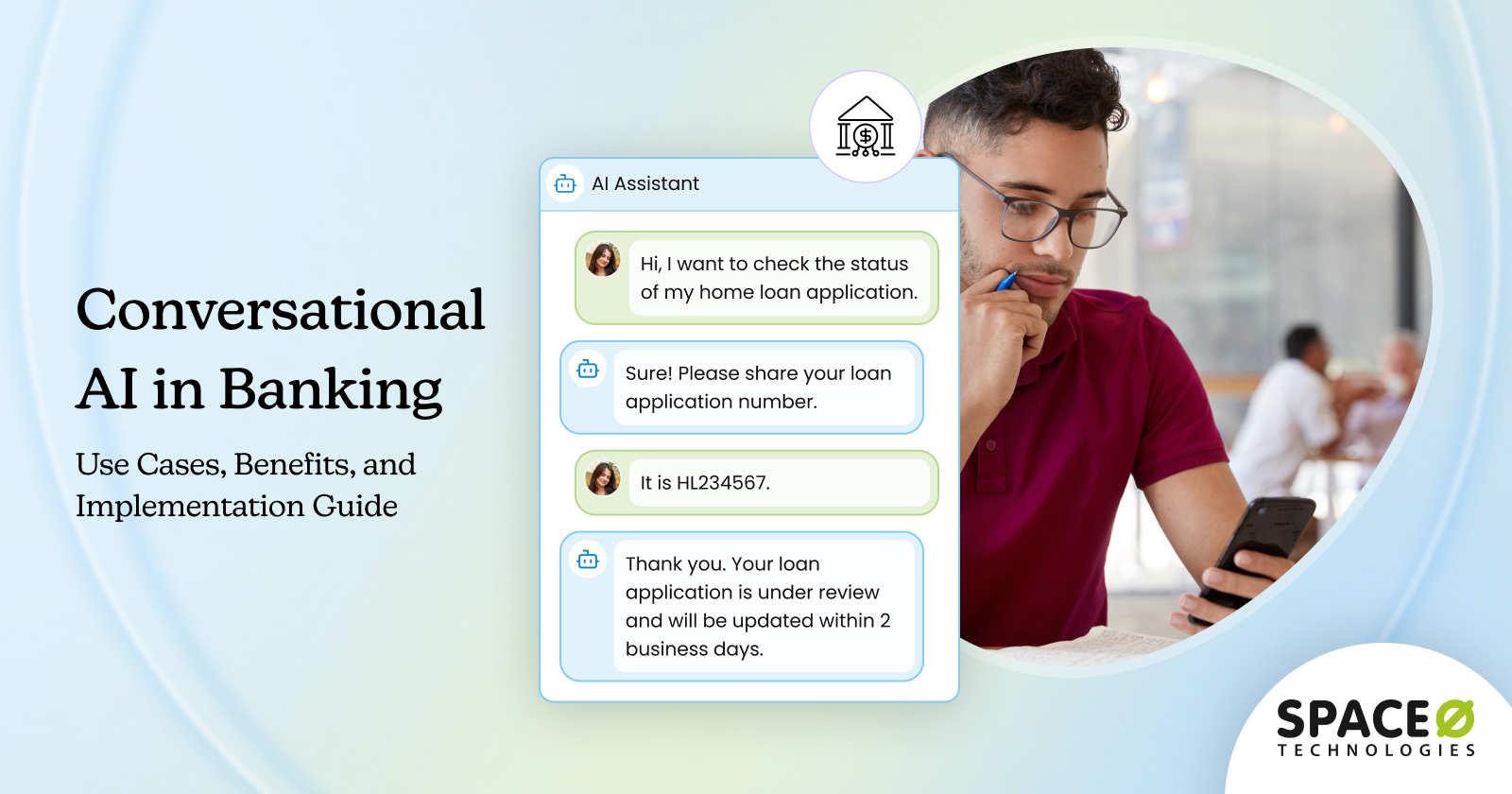
Banks face an impossible equation: customers demand instant, personalized service around the clock, but traditional contact centers cannot scale without proportional cost increases. The average customer service call costs banks $6.00, while 80% of inquiries are routine questions that follow predictable patterns.
Conversational AI in banking solves this equation. These intelligent systems handle millions of customer interactions simultaneously, providing instant responses at a fraction of traditional costs. Bank of America’s virtual assistant Erica has processed over 3 billion customer interactions, serving 50 million users with everything from balance inquiries to personalized financial insights.
The numbers reflect this shift. The AI in banking market reached $34.58 billion in 2025 and is projected to grow to $379.41 billion by 2034, representing a 30.63% compound annual growth rate. In North America alone, AI chatbot adoption among financial institutions has reached 92%, driven by pressure to reduce costs while improving service quality.
This guide explores how conversational AI transforms banking operations, examines eight high-impact use cases, addresses implementation challenges, and provides a practical roadmap for financial institutions ready to deploy these solutions. Whether you’re looking to enhance customer service or streamline operations, discover how AI for finance development services can transform your financial institution.
What is Conversational AI in Banking?
Conversational AI in banking refers to artificial intelligence systems that engage customers and employees through natural, human-like dialogue across text and voice channels. Unlike scripted chatbots that follow rigid decision trees, conversational AI understands context, interprets intent, and generates dynamic responses based on each unique interaction.
Core Technology Components
Understanding what powers these systems helps banks evaluate solutions and set realistic expectations for implementation.
Natural Language Processing (NLP)
NLP enables the system to understand customer messages regardless of how they phrase requests. When a customer types “check my balance,” “how much do I have,” or “what’s in my account,” the AI recognizes identical intent despite different wording. Banking-specific NLP models understand financial terminology, account types, and transaction language that general-purpose AI might miss. Learn more about building a conversational AI solution.
Machine Learning Models
These models improve continuously from interactions. Every conversation teaches the system about customer preferences, common questions, and effective responses. Over time, the AI becomes more accurate at predicting customer needs and providing relevant information without additional prompts.
Dialogue Management
Banking conversations often span multiple turns with complex context. A customer might ask about their balance, then request a transfer, then ask about fees for that transfer. Dialogue management maintains context throughout, eliminating the frustration of repeating information.
Integration Layer
The AI connects to core banking systems, CRM platforms, fraud detection, and authentication services. Our AI integration services enable real-time account access, transaction processing, and personalized responses based on customer history and preferences.
How It Works in Practice
Consider a customer who messages: “I noticed a charge I don’t recognize from yesterday. Can you help?”
The conversational AI identifies the intent (potential fraud inquiry), authenticates the customer through existing secure channels, accesses transaction history, presents the specific charge with merchant details, and offers next steps including dispute initiation or card replacement. The entire interaction takes seconds rather than the minutes spent navigating phone menus and waiting for agents.
Why Banks Are Investing in Conversational AI Solutions
Financial institutions allocate significant budgets to conversational AI because the technology addresses multiple strategic priorities simultaneously. Understanding these drivers helps justify investment and prioritize implementation.
1. Market Momentum
The financial services sector leads conversational AI adoption for compelling reasons. The AI in banking market grows at 30.63% annually, faster than most technology investments. Juniper Research projects $7.3 billion in operational savings from banking chatbot automation by 2023, a forecast that reflects the scale of cost reduction already underway across the industry.
2. Cost Pressure and Efficiency Demands
Banks operate in a margin-compressed environment where every interaction cost matters. Traditional customer service costs $6.00 per call when accounting for labor, infrastructure, and overhead. Conversational AI reduces this to approximately $0.50 per interaction, representing a 91% cost reduction.
This difference multiplies across millions of annual interactions. A regional bank handling 2 million customer service contacts annually could reduce costs from $12 million to $1 million, freeing $11 million for other priorities or margin improvement.
3. Rising Customer Experience Expectations
Banking customers compare their experience to every other digital interaction. They expect the instant responses they receive from retail apps, the personalization of streaming services, and the convenience of messaging their friends. Hold times and business-hours-only service feel unacceptable when other services respond immediately at any hour.
Research from Salesforce shows that 65% of customers are comfortable handling issues entirely without a human agent when the experience is fast and accurate. Banks that cannot meet these expectations lose customers to competitors and digital-native challengers.
4. 24/7 Global Service Requirements
Financial concerns do not follow business hours. Customers traveling internationally need assistance across time zones. Fraud happens at midnight. Payment questions arise on weekends. Traditional staffing models cannot economically provide round-the-clock coverage, but AI operates continuously without overtime costs or scheduling challenges.
5. Competitive Necessity
Major banks have already invested heavily in conversational AI. Bank of America’s Erica, Capital One’s Eno, and Wells Fargo’s virtual assistant set customer expectations. Smaller institutions that cannot match this capability risk appearing outdated. What was once a differentiator has become table stakes for competitive banking.
Build a Conversational AI Solution That Transforms Banking Services
Ready to deliver 24/7 customer support and personalized financial guidance? Partner with Space-O AI to develop secure, compliant conversational AI designed for your banking institution.
8 High-Impact Use Cases for Conversational AI in Banking
Conversational AI delivers value across numerous banking functions. These eight use cases represent the highest-impact opportunities based on customer demand, operational savings, and implementation feasibility.
1. 24/7 Customer Support and FAQ Resolution
The most common entry point for banking AI handles routine inquiries that consume agent time without requiring human judgment. Balance inquiries, transaction history, branch locations, hours of operation, and product information represent 80% of contact center volume at many institutions.
How to Deploy 24/7 AI Support
Deploy AI on primary customer channels (mobile app, website, phone IVR) to intercept routine queries before they reach human agents. The system provides instant answers while seamlessly escalating complex issues to appropriate staff.
Impact on Call Volume and Wait Times
Banks implementing 24/7 AI support report 30-50% reductions in contact center call volume. Customer satisfaction often improves because instant responses eliminate wait times. One regional bank reduced average response time from 8 minutes to 12 seconds for common inquiries.
2. Transaction Assistance and Account Management
Customers frequently need help with transactions: checking balances, reviewing recent activity, transferring funds between accounts, and paying bills. Conversational AI handles these requests through natural dialogue rather than requiring customers to navigate app screens or web forms.
Integrating AI with Core Banking Systems
Integrate the AI with core banking systems for real-time account access. Implement secure authentication flows that verify identity without excessive friction. Enable voice commands for hands-free banking while driving or multitasking.
Adoption and Engagement Outcomes
Transaction-capable AI reduces call volume by 35-45% for participating banks. Customer adoption rates reach 55-70% once users experience the convenience. Mobile engagement increases as customers discover they can complete tasks through conversation rather than screen navigation.
3. KYC and Customer Onboarding
Account opening traditionally requires branch visits or complex online forms. Conversational AI transforms onboarding into a guided conversation, collecting required information, initiating document verification, and explaining products along the way.
Designing Compliant Onboarding Flows
Design conversational flows that gather KYC information naturally while maintaining compliance. Integrate with document verification services for ID upload and validation. Provide progress indicators and save partial applications for later completion.
Completion Rate and Cost Improvements
AI-assisted onboarding reduces account opening time by 60% compared to traditional processes. Completion rates improve 40% because the conversational format feels less overwhelming than lengthy forms. One digital bank reduced customer acquisition cost by 35% through AI-powered onboarding.
4. Loan and Credit Card Applications
Lending inquiries represent high-value opportunities that often go unconverted due to application friction. Conversational AI guides customers through pre-qualification, collects application information, and maintains engagement throughout the process.
Guiding Customers Through the Lending Process
Start with pre-qualification conversations that assess eligibility without full applications. Progress qualified customers through document collection and submission. Provide status updates and answer questions throughout the approval process.
Application Completion and Cross-Sell Gains
Banks report 40% improvement in application completion rates when AI guides the process. Lead qualification improves because the AI captures customer information even when they are not ready to apply. Cross-sell success increases 15-25% as AI identifies opportunities during conversations.
5. Fraud Detection and Security Alerts
Speed matters critically in fraud response. Conversational AI enables instant notification of suspicious activity, immediate customer verification, and rapid response actions like card blocking or transaction dispute initiation.
Connecting AI to Fraud Monitoring Systems
Integrate AI with fraud detection systems for real-time alert delivery. Enable secure authentication within conversations. Provide self-service options for common responses (confirm transaction, block card, report fraud) while escalating complex cases.
Speed and Accuracy in Fraud Response
AI-powered fraud response reduces customer notification time from hours to seconds. False positive resolution improves as customers can quickly confirm legitimate transactions. Card replacement initiation through AI reduces customer effort and accelerates resolution.
6. Personalized Financial Advice
Beyond reactive support, conversational AI proactively helps customers improve their financial health. The system analyzes spending patterns, identifies savings opportunities, and provides personalized recommendations based on individual behavior and goals.
Building Proactive Recommendation Engines
Build on transaction data access to generate insights. Develop recommendation engines that identify actionable opportunities. Present suggestions conversationally rather than as reports or dashboards.
Engagement and Product Adoption Results
Bank of America’s Erica provides over 2 million daily interactions, many involving proactive financial insights. Banks offering AI-powered advice report improved customer engagement and increased product adoption as customers act on recommendations.
7. Agent Assist and Employee Support
Conversational AI supports bank employees as well as customers. During live calls, AI provides agents with real-time information retrieval, policy guidance, and suggested responses. This reduces handle time and improves accuracy.
Deploying AI as an Agent Copilot
Deploy AI as an agent copilot that monitors conversations and surfaces relevant information. Integrate with knowledge bases, policy documents, and customer records. Provide suggestions without requiring agents to search multiple systems.
Handle Time and Quality Improvements
Agent assist implementations reduce average handle time by 20-30%. New agent ramp time decreases as AI provides on-the-job guidance. Quality scores improve due to consistent information accuracy across all agents.
8. Collections and Payment Reminders
Collections conversations are traditionally adversarial and uncomfortable for both parties. Conversational AI provides a neutral, non-judgmental channel for payment discussions, improving response rates and customer retention.
Designing Empathetic Payment Conversations
Design empathetic conversation flows that acknowledge difficulties while presenting options. Enable self-service payment arrangements. Integrate with payment systems for immediate transaction processing.
Contact Rates and Retention Outcomes
AI-assisted collections improve contact rates by 15-25% as customers engage with less intimidating channels. Payment arrangement rates increase. Customer relationships preserve better than traditional collection approaches.
These eight use cases span customer-facing support, transactional banking, employee assistance, and proactive engagement. Most banks start with high-volume, lower-complexity use cases before expanding to more sophisticated applications.
Create Your Custom Banking Chatbot Solution
Ready to automate routine banking tasks and free your staff for complex issues? Partner with Space-O AI to develop conversational AI that integrates with your core banking systems.
Benefits of Conversational AI for Banking Institutions
Quantifying benefits helps justify investment and set performance expectations. The following outcomes reflect actual results from banking implementations.
1. Operational Efficiency and Cost Savings
The most immediately measurable benefit is cost reduction. Shifting interactions from human agents to AI reduces cost per contact by 85-91%. For high-volume institutions, this translates to millions in annual savings.
Quantified Results
| Metric | Typical Result |
|---|---|
| Cost per interaction reduction | 91% (6.00to6.00 to6.00to0.50) |
| Contact center call volume reduction | 30-50% |
| Agent productivity improvement | 40-50% |
| Average handle time reduction | 20-30% |
Beyond direct cost reduction, AI enables staff reallocation to higher-value activities. Agents spend less time on routine inquiries and more time on complex problem resolution, relationship building, and revenue-generating conversations.
2. Improved Customer Experience
Customer experience improvements often exceed expectations. Instant responses, 24/7 availability, and consistent service quality address the primary frustrations customers report with traditional banking service.
Quantified Results
| Metric | Typical Result |
|---|---|
| Wait time reduction | 85-95% |
| First contact resolution | 75-85% for routine queries |
| Customer effort score improvement | 25-35% |
3. Scalability Without Proportional Costs
AI handles volume spikes that would overwhelm traditional contact centers. Month-end inquiries, tax season questions, or promotional campaign responses scale automatically without additional staffing or degraded service.This scalability proves particularly valuable for banks expanding into new markets or customer segments. AI can serve new geographies and languages without proportional headcount increases.
4. Enhanced Data and Personalization
Every AI interaction generates data about customer needs, preferences, and behavior patterns. This intelligence improves marketing, product development, and service personalization in ways that were previously impossible at scale.
Banks use conversation analytics to identify common pain points, discover product opportunities, and improve processes based on actual customer feedback patterns.
Conversational AI delivers measurable improvements in cost efficiency, customer satisfaction, scalability, and data intelligence. The combination of immediate cost savings and long-term strategic benefits makes compelling investment cases.
Challenges and Considerations for Implementing Conversational AI for Banking Institutions
Realistic planning requires acknowledging challenges. Banks that anticipate these obstacles implement more successfully than those caught by surprise.
1. Data Security and Regulatory Compliance
Banking operates in a heavily regulated environment where data security is non-negotiable. Conversational AI must meet the same security standards as core banking systems while enabling natural, convenient interactions.
Critical Requirements
| Requirement | Description |
|---|---|
| End-to-end encryption | All conversations encrypted in transit and at rest |
| PCI-DSS compliance | Payment card data handling meets industry standards |
| SOC 2 certification | Security controls independently verified |
| Audit trails | Complete logging of all interactions for regulatory review |
| Data residency | Data stored in appropriate jurisdictions |
| Access controls | Role-based permissions for conversation data |
Organizations must verify that AI vendors meet these requirements through contracts, certifications, and technical assessments. Compliance failures carry severe regulatory and reputational consequences.
2. Integration with Legacy Banking Systems
Most banks operate core systems built decades ago on technologies that predate modern APIs. Connecting conversational AI to these legacy systems often proves the most challenging implementation aspect.
Common Integration Challenges
- Real-time data access from batch-oriented systems
- Authentication bridging between modern AI and legacy security
- Transaction processing through systems designed for different interaction patterns
- Data synchronization across multiple disconnected systems
Successful implementations often require middleware development or core system modernization alongside AI deployment.
3. Customer Trust and Adoption
While customer satisfaction rates for well-implemented banking AI are consistently high, trust varies by task complexity and customer segment. Some customers resist AI interactions entirely, while others embrace them for routine tasks but insist on human contact for significant financial decisions.
Trust-Building Strategies
- Transparent disclosure when customers interact with AI
- Clear, immediate paths to human agents when requested
- Consistent accuracy that builds confidence over time
- Appropriate scope limitations that respect complexity boundaries
Banks should not force AI interactions on reluctant customers. Providing choice while demonstrating AI value gradually shifts preferences.
4. Accuracy and Risk Management
Financial transactions require high accuracy. A misunderstood transfer amount or incorrect account information creates real financial harm and regulatory issues. Banks must implement safeguards that prevent errors without adding excessive friction.
Risk Mitigation Approaches
- Confirmation steps for financial transactions
- Human review for high-value or unusual activities
- Confidence scoring that routes uncertain queries to agents
- Continuous accuracy monitoring with rapid error correction
5. Balancing Automation with Human Connection
Banking relationships matter, especially for high-value customers and complex financial situations. AI should enhance rather than eliminate human connection. Implementation planning must define appropriate boundaries and handoff triggers.
Customers appreciate AI for routine tasks but expect human judgment for major financial decisions, emotional situations, and complex problems. Effective implementations recognize these boundaries and transition seamlessly between AI and human service.
Launch Secure Conversational Banking That Customers Trust
Ready to create banking experiences that are both convenient and secure? Partner with Space-O AI to build conversational AI designed for measurable impact in financial services.
How to Implement Conversational AI in Your Bank
Practical implementation guidance helps banks move from interest to action. This step-by-step approach reflects lessons from successful banking deployments.
Step 1: Identify High-Impact Use Cases
Start with use cases that combine high volume, clear ROI, and manageable complexity. Initial success builds organizational confidence and funds expansion. Our AI consulting services can help you identify the most impactful use cases for your institution.
Recommended Starting Points
| Use Case | Volume Impact | Risk Level | Implementation Complexity |
|---|---|---|---|
| FAQ and information | Very High | Low | Low |
| Balance inquiries | Very High | Low | Medium |
| Transaction history | High | Low | Medium |
| Branch/ATM locator | High | Low | Low |
| Card activation | Medium | Low | Medium |
Avoid starting with loan decisions, complex financial advice, or dispute resolution. These require more sophisticated AI, deeper integration, and carry higher risk if errors occur.
Step 2: Assess Technology and Integration Requirements
Evaluate your existing technology landscape honestly. What systems must the AI connect to? What APIs exist? What data is accessible in real-time versus batch? What authentication mechanisms are in place?
Assessment Checklist
- Core banking system API capabilities (or lack thereof)
- Customer authentication mechanisms and integration options
- Data quality and accessibility across relevant systems
- Existing digital channels (mobile app, website) for AI deployment
- Current contact center technology and potential integration
This assessment often reveals integration work that exceeds initial AI development effort. Include this scope in planning.
Step 3: Ensure Regulatory Compliance
Address compliance requirements early rather than retrofitting security later. Work with compliance teams to define requirements, select vendors that meet standards, and document controls.
Compliance Planning Elements
- Data handling and retention policies for conversation data
- Regulatory disclosure requirements for AI interactions
- Audit and examination preparation
- Vendor due diligence and contract requirements
- Ongoing compliance monitoring processes
Step 4: Choose the Right Technology Approach
Banks must decide between off-the-shelf platforms and custom development. Each approach has merits depending on institutional needs.
Off-the-Shelf Platforms
- Lower upfront cost ($1,000 − $10,000/month)
- Faster initial deployment (weeks)
- Limited customization for unique workflows
- May not meet complex integration needs
- Ongoing subscription costs accumulate
Custom Development
- Higher initial investment ($150,000-$750,000+)
- Tailored to specific banking workflows
- Deep integration with legacy systems
- No vendor lock-in, full ownership
- Better long-term ROI for complex use cases
Custom AI software development typically proves more effective for institutions with legacy systems, unique products, or competitive differentiation goals. Off-the-shelf works for banks with simpler needs or limited budgets seeking quick wins.
Step 5: Plan for Change Management
Technology implementation fails without organizational change. Staff need training, processes require updates, and concerns about job displacement must be addressed honestly.
Change Management Elements
- Staff communication about AI role and impact
- Training for employees working alongside AI
- Updated processes for AI-to-human handoffs
- Metrics and accountability for AI performance
- Feedback mechanisms for continuous improvement
Step 6: Measure Outcomes and Iterate
Define success metrics before launch and measure continuously. Use data to identify improvement opportunities and guide expansion to additional use cases.
Key Performance Indicators
| Metric | Measurement Approach |
|---|---|
| Containment rate | Queries resolved without human escalation |
| Customer satisfaction | Post-interaction surveys, NPS impact |
| Cost per interaction | Total AI costs divided by interaction volume |
| Resolution accuracy | Correct responses as verified by review |
| Agent handle time | Impact on calls that do reach humans |
Successful implementation follows a structured approach: start with proven use cases, assess technology requirements honestly, address compliance early, choose an appropriate build approach, manage organizational change, and measure outcomes for continuous improvement.
Launch AI-Powered Banking Assistants for Your Customers
Ready to provide instant account support and transaction assistance across all channels? Partner with Space-O AI to create intelligent conversational solutions for your financial services.
How Space-O AI Builds Conversational AI Solutions for Banking
Banks and financial institutions require more than generic chatbot platforms. They need AI solutions designed for financial workflows, regulatory requirements, and enterprise-grade security.
Financial Services AI Expertise
With 15 years of AI development experience across 500+ projects, Space-O brings deep expertise in financial services applications. This experience translates to faster implementation, fewer surprises, and solutions that work in production environments rather than demos.
Our team understands banking-specific challenges including core system integration, regulatory compliance, and the security requirements that distinguish financial services from other industries. Learn more about our AI for Banking solutions.
Security-First Architecture
Security is not an afterthought in our banking implementations. We build with end-to-end encryption, implement PCI-DSS compliant data handling, and design comprehensive audit capabilities from the foundation.
Our AI Chatbot Development services include security architecture review, compliance documentation, and ongoing security monitoring to ensure your conversational AI meets the highest financial industry standards.
Custom Development for Banking Workflows
Generic platforms cannot accommodate complex banking operations. Our custom conversational AI tailors to your specific products, customer segments, regulatory requirements, and operational workflows.
Whether integrating with decades-old core banking systems or modern API-first platforms, our development team builds solutions that work with your existing technology rather than requiring wholesale replacement.
Core Banking and System Integration
We specialize in connecting conversational AI to the systems that power your bank. From legacy core platforms to modern CRM, fraud detection, and authentication systems, our integration expertise ensures AI has access to the data it needs for meaningful customer interactions.
End-to-End Partnership
From initial strategy through deployment to ongoing optimization, we partner with banks throughout their AI journey. Our MLOps practices ensure models maintain accuracy over time through continuous monitoring, retraining, and improvement.
Proven Results
Banks working with Space-O achieve measurable outcomes:
- 40-60% reductions in customer service call volume
- 30% improvements in customer satisfaction metrics
- 25-40% improvement in agent productivity through AI-assisted workflows
- Successful regulatory examinations with AI documentation
Conclusion
Conversational AI in banking has moved from competitive advantage to operational necessity. Banks that deploy it effectively reduce customer service costs by up to 91%, improve response times from minutes to seconds, and free staff to focus on the complex, high-value work that builds lasting relationships.
The path to successful deployment follows a clear sequence: identify high-volume use cases where ROI is fastest, address legacy integration and compliance requirements upfront, choose the right build approach for your institution’s size and complexity, and measure outcomes from day one.
The technology is proven. Bank of America, Capital One, and Wells Fargo have established the benchmark. The question for most institutions is no longer whether to deploy conversational AI, but how quickly they can do it without sacrificing security or customer trust.
Space-O AI has helped banks navigate this journey across 500+ AI projects. If you’re ready to assess what conversational AI could deliver for your institution, contact our team for a free strategy consultation.
Frequently Asked Questions
What is the difference between a banking chatbot and conversational AI?
Traditional banking chatbots follow scripted, rule-based responses with limited understanding. They work from decision trees: if the customer says X, respond with Y. When customers deviate from expected patterns, these chatbots fail.
Conversational AI uses natural language processing and machine learning to understand intent, maintain context across multi-turn conversations, and generate dynamic responses. For banks, this means handling complex queries like “What’s my balance and can I transfer $500 to my savings if I have enough?” rather than requiring separate questions for each step.
The practical difference appears in customer experience. Chatbots frustrate users with “I don’t understand” responses and endless menu trees. Conversational AI feels like messaging with a knowledgeable bank employee.
Is conversational AI in banking secure?
Yes, when properly implemented with banking-grade security. Conversational AI for banks requires enterprise-level protections including end-to-end encryption for all conversations, PCI-DSS compliance for payment data handling, SOC 2 certification for security controls, and comprehensive audit trails for regulatory review.
Reputable solutions implement the same security standards as core banking systems. Customer authentication happens through existing secure channels before AI accesses sensitive account information. Data residency controls ensure information stays in appropriate jurisdictions.
The key is selecting vendors who specialize in financial services and can document their security controls through certifications and audits.
Can conversational AI replace bank employees?
Conversational AI augments rather than replaces bank staff. AI handles routine inquiries like balance checks, transaction status, and FAQ responses that consume agent time without requiring human judgment. This frees employees to focus on complex issues requiring expertise, empathy, or relationship building.
Most banks report staff redeployment to higher-value activities rather than workforce reduction. Customer service representatives transition to handling escalated issues, building relationships with high-value clients, or moving into new roles like AI training and quality assurance.
Employee satisfaction often improves as repetitive work decreases and remaining interactions become more meaningful.
What are the best use cases to start with for banking AI?
Start with high-volume, low-complexity interactions that provide quick wins with minimal risk. Recommended starting points include FAQ resolution, balance and account inquiries, transaction history access, branch and ATM locator, and basic product information.
These use cases handle significant volume (often 60-80% of total inquiries), have clear correct answers, carry low risk if errors occur, and build organizational confidence for expansion. Initial success with these foundations funds and justifies investment in more sophisticated use cases like transaction processing, loan applications, and personalized financial advice.
How accurate are banking chatbots?
Modern conversational AI achieves 85-95% accuracy for routine banking queries when properly trained and integrated with banking systems. Accuracy depends heavily on training data quality, integration depth with account systems, clearly defined scope boundaries, and confidence-based routing to human agents.
Leading implementations include confidence scoring that routes uncertain queries to human agents rather than guessing. This maintains high overall accuracy while ensuring complex or ambiguous situations receive appropriate human attention.
How long does it take to implement conversational AI in a bank?
Implementation timelines depend on scope and complexity. Basic implementations covering FAQ and simple inquiries take 2-4 months. Moderate deployments with core banking integration and transaction capabilities take 4-8 months. Enterprise-wide omnichannel implementations may take 8-12 months or longer.
Timeline factors include use case complexity, legacy system integration requirements, compliance and security verification, testing and quality assurance, and change management processes. Phased approaches that launch initial capabilities quickly while building toward comprehensive solutions often work better than attempting full-scope deployment at once.


