- What Is Conversational AI for Patient Portals?
- How Conversational AI Works in Healthcare Portals
- Key Benefits of Conversational AI in Patient Portals
- Top Use Cases of Conversational AI for Patient Portals
- Step-by-Step Implementation Process for Conversational AI in Patient Portals
- Challenges in Implementing Conversational AI for Patient Portals (and How to Overcome Them)
- How Much Does Conversational AI for Patient Portals Cost?
- The Future of Conversational AI in Patient Engagement
- Space-O AI — Your Trusted Partner for Conversational AI Patient Portal Development
- Frequently Asked Questions on Patient Portal Conversational AI
Conversational AI for Patient Portals: How It Works and Why It Matters

 Last Updated: March, 23 2026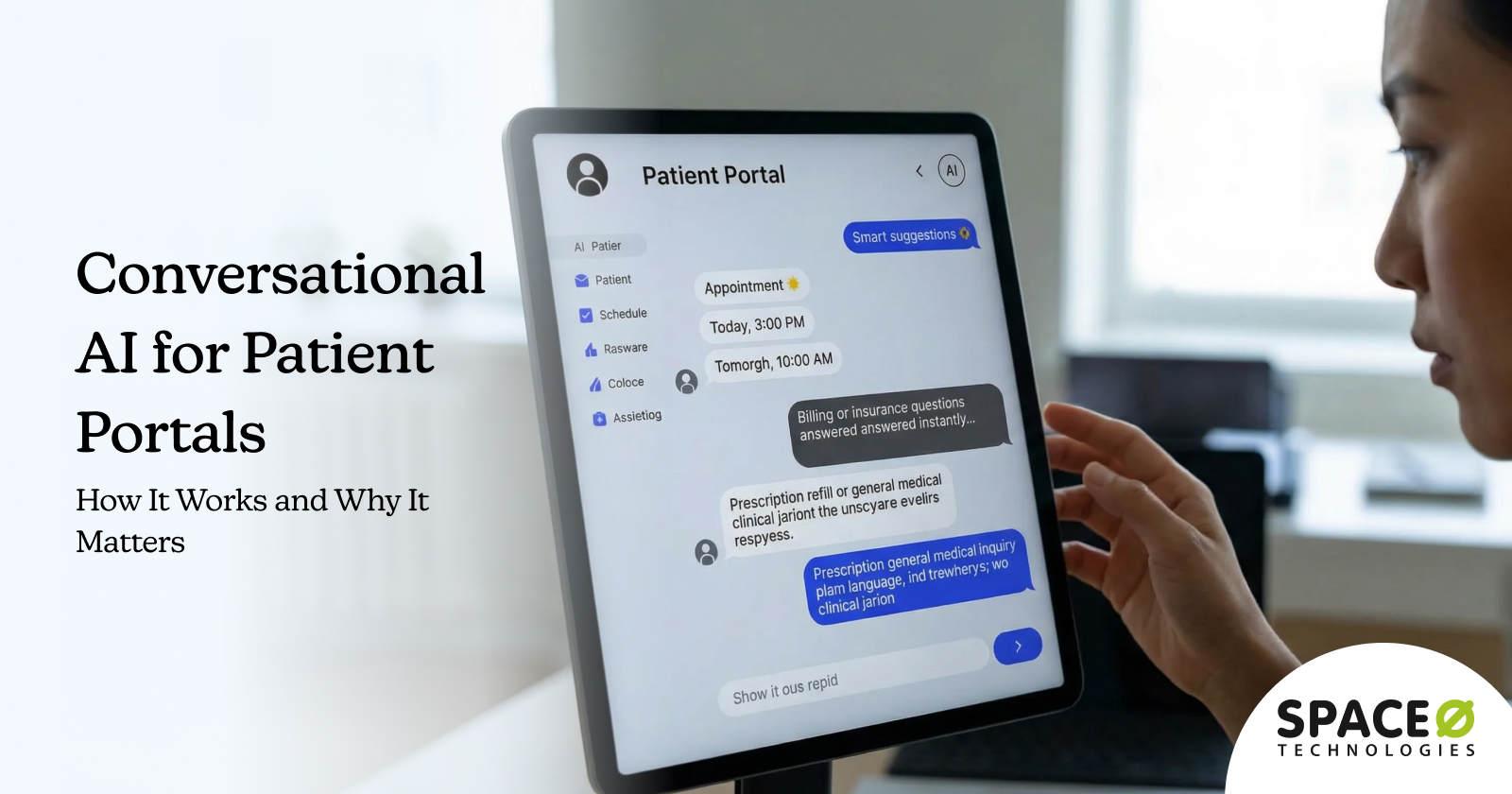
Patient portals are rapidly evolving as healthcare organizations look to deliver faster, more accessible, and more patient-friendly digital experiences. One of the strongest drivers behind this shift is Conversational AI.
According to Future Market Insights, the conversational AI in healthcare market is valued at USD 17.2 billion in 2025 and is forecasted to reach USD 169.5 billion by 2035, highlighting how quickly AI-driven patient interactions are becoming a core part of digital healthcare strategies.
Conversational AI enables patient portals to support natural, real-time conversations through chat and voice interfaces. Instead of navigating complex menus, patients can ask questions, schedule appointments, receive medication guidance, and get post-visit support in a conversational manner. This improves accessibility for patients while reducing the operational burden on care teams.
In this blog, we explore how conversational AI is used in patient portals. Drawing from 15+ years of experience as a leading conversational AI development company, we have shared insights on the key features it enables, high-impact use cases across the patient journey, and the benefits it delivers to both healthcare providers and patients. Let’s get started.
What Is Conversational AI for Patient Portals?
Conversational AI for patient portals refers to the use of AI-powered chat and voice interfaces that allow patients to interact with healthcare platforms through natural language conversations.
Instead of relying on static forms or complex navigation, Conversational AI enables patient portals to understand patient queries, respond in real time, and guide users through common healthcare tasks in a simple, intuitive way.
Healthcare organizations looking to take this further can learn how to develop an AI agent patient portal that goes beyond conversation to autonomously execute clinical and administrative workflows.
Within patient portals, Conversational AI supports interactions such as appointment scheduling, symptom-related queries, medication reminders, lab result explanations, and follow-up care guidance. By understanding intent and context, these AI-driven conversations help patients get accurate information quickly while improving accessibility for users of all age groups and technical abilities.
Conversational AI also enhances care team efficiency by automating routine patient communications and triaging requests before escalating them to human staff. This reduces response times, minimizes administrative workload, and ensures that patients receive consistent, timely support without compromising data security or compliance.
Healthcare organizations partnering with an AI healthcare software development company can unlock significant benefits, including reduced administrative costs, improved patient satisfaction, and round-the-clock accessibility by building conversational AI systems that seamlessly blend these components.
How Conversational AI Works in Healthcare Portals
Understanding the technical mechanics of conversational AI helps healthcare organizations make informed decisions about implementation. The process involves multiple stages that work together seamlessly to create natural patient interactions.
1. Intent recognition and classification
When a patient sends a message, the system first analyzes the text to determine what they want to accomplish. Advanced NLU models process the message, identifying the primary intent and extracting relevant entities like dates, names, or medical terms.
- Analyze incoming message for keywords, phrases, and semantic meaning
- Match the query against trained intent categories
- Extract entities such as appointment dates, medication names, or symptom descriptions
- Assign confidence scores to determine response accuracy
2. Context management across sessions
Effective conversational AI remembers previous interactions to provide coherent, personalized experiences. The system maintains conversation state and patient history to inform current responses.
- Store conversation history within active sessions
- Retrieve relevant patient data from integrated systems
- Track incomplete tasks like unfinished appointment bookings
- Personalize responses based on patient preferences and history
3. EHR and system integration
Real-time data access makes conversational AI genuinely useful. Through secure APIs, the system connects to electronic health records, scheduling platforms, and other clinical systems.
- Query EHR systems via FHIR or HL7 interfaces for patient records
- Access real-time appointment availability from scheduling systems
- Retrieve billing information and insurance details
- Update records based on patient-confirmed information
4. Response generation
Once the system understands the patient’s intent and has relevant data, it generates an appropriate response. Natural language generation creates replies that sound conversational rather than robotic.
- Select response templates based on intent and context
- Populate responses with personalized patient information
- Apply tone guidelines appropriate for healthcare communication
- Format complex information for easy comprehension
5. Human handoff protocols
Not every query can or should be handled by AI. Well-designed systems recognize their limitations and smoothly transition to human agents when necessary.
- Monitor conversation for escalation triggers like frustration or complex clinical questions
- Route urgent matters to the appropriate clinical staff
- Transfer full conversation context to human agents
- Enable seamless return to AI assistance after resolution
6. Continuous learning and optimization
Conversational AI systems improve over time by learning from interactions. Analytics identify common failure points and successful patterns.
- Log all conversations for quality analysis
- Identify frequently asked questions that need better handling
- Track patient satisfaction metrics and completion rates
- Update training data to improve future performance
Working with a healthcare AI consulting service provider like Space-O AI ensures these technical components are properly architected and integrated for your specific healthcare environment.
Build Intelligent Patient Portals with a Trusted Healthcare AI Development Partner
Space-O AI has delivered 500+ AI projects with proven expertise in HIPAA-compliant healthcare solutions.
Key Benefits of Conversational AI in Patient Portals
Implementing conversational AI in patient portals delivers measurable advantages for both healthcare organizations and the patients they serve. Each benefit contributes to improved care experiences and operational efficiency.
1. 24/7 patient support without wait times
Conversational AI provides instant responses at any hour, eliminating the frustration of waiting for office hours or sitting on hold. Patients can schedule appointments, request refills, or get answers to questions at midnight just as easily as midday.
2. Reduced administrative burden on staff
Automating routine inquiries frees clinical and administrative staff to focus on complex tasks requiring human judgment. Organizations report significant reductions in call center volume and front desk interruptions after implementing conversational AI.
3. Improved patient engagement rates
Conversational AI makes it easier for patients to interact with their healthcare providers, leading to higher engagement and better care plan adherence. Patients who can easily access information and complete tasks through natural conversation stay more connected to their care.
4. Personalized patient experiences
Conversational AI uses patient history, preferences, and clinical data to tailor every interaction. A patient managing diabetes receives different guidance than one recovering from surgery, with responses customized to their specific situation.
5. Scalable communication capacity
Unlike human staff, conversational AI handles thousands of simultaneous conversations without degradation in response quality. This scalability proves especially valuable during high-volume periods like flu season or public health emergencies.
6. Significant cost efficiency gains
By automating routine interactions, healthcare organizations reduce cost per patient contact while maintaining service quality. The savings compound as systems handle increasing conversation volumes without proportional staff increases.
7. Multilingual support for diverse populations
Conversational AI can communicate fluently in multiple languages, removing barriers for patients who prefer languages other than English. This capability expands access and improves care equity across diverse communities.
These benefits translate into tangible outcomes: higher patient satisfaction scores, reduced operational costs, and improved health outcomes through better engagement.
Top Use Cases of Conversational AI for Patient Portals
Conversational AI excels at handling specific patient portal functions where natural dialogue improves the user experience. The following use cases represent the highest-impact applications healthcare organizations typically implement.
1. Appointment scheduling and rescheduling
Patients can book, modify, or cancel appointments through simple conversation. Instead of navigating calendar interfaces, they simply state their needs: “I need to see Dr. Smith sometime next week” or “Can you move my Thursday appointment to Friday?”
The system checks provider availability, considers patient preferences, handles conflicts, and confirms bookings. It sends reminders and manages waitlists automatically, reducing no-show rates and filling cancelled slots efficiently.
2. Symptom assessment and triage
Conversational AI guides patients through structured symptom assessments, asking relevant follow-up questions based on their responses. While not replacing clinical judgment, these interactions help patients understand urgency levels and route them appropriately.
A patient describing chest pain receives different guidance than one with a minor rash. The system identifies red flags requiring immediate attention while providing reassurance for less urgent concerns.
3. Medication refill requests
Patients request prescription refills through natural conversation rather than form submissions. The system verifies eligibility, checks for interactions with other medications, and routes requests to appropriate providers for approval.
Automated reminders prompt patients when refills are due, improving medication adherence. Status updates keep patients informed throughout the fulfillment process.
4. Billing and insurance queries
Complex billing questions that previously required lengthy phone calls become simple conversations. Patients ask about charges, payment plans, insurance coverage, and account balances.
The system explains billing statements in plain language, helps patients understand their financial responsibility, and facilitates payments directly within the conversation.
5. Lab result navigation
When lab results become available, conversational AI helps patients understand what the numbers mean. It provides context-appropriate explanations without replacing physician interpretation for abnormal findings.
Patients can ask follow-up questions about specific values, reference ranges, and what results might indicate. The system schedules follow-up appointments when results require physician discussion.
6. Post-visit follow-ups
Automated check-ins after appointments or procedures ensure patients recover well and follow care instructions. The system asks about symptoms, medication side effects, and adherence to care plans.
Responses indicating complications trigger appropriate escalation to clinical staff. Routine recoveries proceed with supportive guidance and encouragement.
7. FAQ automation
Common questions about office locations, accepted insurance, preparation instructions, and policies receive instant, accurate responses. This automation handles significant inquiry volume without staff involvement.
The system learns which questions arise most frequently and refines responses based on patient feedback and follow-up patterns.
Turn Your Patient Portal Vision into Reality with Proven AI Experts
From MVP development to enterprise-scale deployment, our dedicated healthcare AI team delivers solutions that meet clinical and compliance standards.
Step-by-Step Implementation Process for Conversational AI in Patient Portals
Successful conversational AI implementation requires methodical planning and execution. The following process guides healthcare organizations from initial concept through production deployment and ongoing optimization.
Step 1: Discovery and requirement analysis
Begin by understanding your patient population’s needs and your organization’s operational challenges. This foundation ensures the conversational AI system addresses real problems rather than implementing technology for its own sake.
Action items
- Conduct patient surveys and analyze support call logs to identify pain points
- Map current patient portal usage patterns and abandonment points
- Document existing technology infrastructure, including EHR, scheduling, and billing systems
- Define measurable success criteria like reduced call volume or improved satisfaction scores
- Identify compliance requirements, including HIPAA, state regulations, and organizational policies
Step 2: Conversational design and flow mapping
Design the conversations your AI will handle before writing any code. This design phase determines user experience quality and prevents costly redesigns later.
Action items
- Create a comprehensive intent taxonomy covering all planned use cases
- Map dialogue flows for each intent, including happy paths and error handling
- Design escalation triggers and handoff procedures to human agents
- Develop persona guidelines defining the AI’s communication style and tone
- Write sample conversations to validate flow logic and response quality
Step 3: Technology selection and architecture planning
Choose the technical components that will power your conversational AI system. Decisions made here impact capabilities, costs, and long-term flexibility.
Action items
- Evaluate NLU platforms considering accuracy, language support, and healthcare domain fit
- Select conversation management frameworks compatible with your infrastructure
- Plan integration architecture for EHR, scheduling, billing, and pharmacy systems
- Design security architecture addressing encryption, access control, and audit logging
- Document deployment approach, including cloud versus on-premises considerations
Step 4: Development and integration
Build the conversational AI system according to your designs and architecture plans. This phase transforms planning into working software.
Action items
- Develop NLU models trained on healthcare-specific language and terminology
- Build integration connectors for each backend system using FHIR, HL7, or custom APIs
- Implement conversation management logic handling multi-turn dialogues
- Create administrative tools for content management and conversation monitoring
- Develop analytics dashboards tracking key performance metrics
Step 5: Testing and clinical validation
Rigorous testing ensures the system works correctly and safely before patient exposure. Healthcare applications demand higher testing standards than typical software.
Action items
- Execute functional testing covering all intents, entities, and conversation flows
- Perform integration testing, validating data accuracy across connected systems
- Conduct security testing, including penetration testing and vulnerability assessment
- Complete clinical validation ensuring appropriate handling of medical scenarios
- Run user acceptance testing with representative patient and staff groups
Step 6: Deployment and continuous optimization
Launch the system thoughtfully and commit to ongoing improvement based on real-world performance data.
Action items
- Deploy to a pilot user group for initial feedback and issue identification
- Monitor conversation logs and analytics closely during early operation
- Gather patient feedback through surveys and direct feedback mechanisms
- Iterate on conversation flows based on performance data and user input
- Expand deployment progressively as confidence in system performance grows
Organizations looking to hire patient portal developers with conversational AI expertise can accelerate this process while avoiding common implementation pitfalls.
Accelerate Your Implementation with a Trusted Healthcare AI Development Partner
Our 15+ years of AI development experience and 500+ successful projects ensure your conversational patient portal is built right the first time.
Challenges in Implementing Conversational AI for Patient Portals (and How to Overcome Them)
Despite clear benefits, conversational AI implementation presents challenges that healthcare organizations must address thoughtfully. Understanding these obstacles and their solutions prepares teams for successful projects.
1. HIPAA compliance and data security
Healthcare conversations inevitably involve protected health information, making security and compliance paramount. Conversational AI systems must meet stringent regulatory requirements while remaining useful.
Solution
- Implement end-to-end encryption for all conversation data in transit and at rest
- Design data flows that minimize PHI exposure and retention
- Execute Business Associate Agreements with all technology vendors
- Conduct regular security audits and penetration testing
- Train AI models using de-identified data to prevent PHI leakage
2. Integration with legacy EHR systems
Many healthcare organizations run older EHR systems that predate modern API standards. Connecting conversational AI to these systems requires creative technical approaches.
Solution
- Leverage FHIR APIs where available for standardized data exchange
- Build middleware layers that translate between legacy interfaces and modern systems
- Implement caching strategies to reduce load on legacy systems
- Plan for gradual migration as EHR systems modernize
- Consider read-only integration initially to reduce complexity and risk
3. Handling complex medical queries
Conversational AI cannot replace clinical judgment, yet patients will inevitably ask medical questions. Systems must recognize their limitations while still providing value.
Solution
- Design clear boundaries defining what the AI will and will not address
- Implement robust escalation paths to clinical staff for complex queries
- Build guardrails preventing the AI from providing clinical diagnoses or treatment advice
- Train the system to recognize urgent situations requiring immediate human attention
- Provide transparency to patients about AI limitations and when to seek human help
4. Patient trust and adoption
Some patients hesitate to interact with AI systems, preferring human contact. Building trust requires thoughtful design and clear communication.
Solution
- Disclose clearly when patients are interacting with AI rather than humans
- Design intuitive interfaces that feel natural rather than robotic
- Ensure easy access to human support for patients who prefer it
- Start with low-stakes use cases before expanding to more sensitive areas
- Gather and act on patient feedback to continuously improve experiences
5. Maintaining accuracy and safety
Healthcare AI systems must perform reliably over time. Accuracy degradation or safety incidents can damage patient trust and organizational reputation.
Solution
- Implement continuous monitoring of conversation quality and outcomes
- Establish clinical review processes for AI responses in medical contexts
- Build feedback loops enabling patients and staff to report issues
- Plan for regular model retraining as language patterns and use cases evolve
- Create incident response procedures for handling AI errors appropriately
For a deeper dive into the technical foundations, refer to our guide on how to build a conversational AI, which covers architecture patterns and safety considerations in detail.
With a clear understanding of implementation challenges and how to address them, the next consideration is budget.
How Much Does Conversational AI for Patient Portals Cost?
Developing conversational AI for patient portals costs widely, from $10,000 for simple bots to over $300,000 for complex, enterprise-grade solutions. The final price depends on features like EHR integration, NLP sophistication, and regulatory requirements. For advanced patient portals with meaningful clinical integration, expect costs in the $40,000 to $150,000 range.
Organizations should also budget for ongoing maintenance at 15–20% of initial development costs annually. Some vendors offer usage-based pricing models as an alternative to fixed project fees.
The table below provides a general cost breakdown based on project complexity.
| Complexity Level | Features Included | Estimated Cost Range |
| Basic | Appointment scheduling, FAQ automation, simple scripted responses, single-channel deployment | $10,000 – $50,000+ |
| Intermediate | Advanced NLP, contextual query handling, API integrations, medication refills, billing queries, mobile and web channels | $35,000 – $100,000+ |
| Advanced | Predictive analytics, diagnostic triage, generative AI capabilities, multi-system integrations, voice support, analytics dashboard | $70,000 – $400,000+ |
Understanding each tier
Basic implementations suit healthcare organizations starting their conversational AI journey. These solutions handle straightforward tasks like answering common questions about office hours, insurance accepted, or preparation instructions. They can manage simple appointment booking through guided conversation flows. While limited in sophistication, basic implementations provide immediate value by deflecting routine inquiries from staff.
Intermediate implementations represent the sweet spot for most healthcare organizations. These systems understand natural language variations, maintain context across conversation turns, and connect to backend systems through APIs. Patients can complete meaningful tasks like requesting prescription refills, checking billing balances, or navigating lab results. The investment delivers substantial ROI through reduced call volume and improved patient satisfaction.
Advanced implementations serve organizations with complex requirements or large patient populations. These solutions leverage predictive analytics to identify patients needing proactive outreach, use generative AI for personalized health education, and can assist with preliminary symptom triage. Enterprise deployments often include custom LLM fine-tuning, omnichannel presence, and sophisticated clinical workflow integration.
Key cost drivers
Beyond project complexity, several factors influence your final investment. Understanding these helps you make informed decisions about where to allocate budget and where to scale back.
- Natural language processing sophistication directly impacts pricing. Basic keyword matching costs less than systems that understand complex queries, detect patient sentiment, and handle ambiguous requests. Healthcare-specific NLP training adds additional expense but dramatically improves accuracy.
- EHR integration complexity represents a significant cost factor. Connecting securely to systems like Epic or Cerner adds thousands to tens of thousands in development costs, depending on integration depth. Read-only access costs less than bi-directional data exchange, requiring write permissions.
- Features and integrations compound costs as the scope expands. Adding speech recognition, image analysis for visual symptoms, multi-channel support across web, mobile, SMS, and voice, or predictive analytics capabilities each increases the investment required.
- Compliance requirements add necessary overhead. Ensuring HIPAA compliance demands specific security architecture, encryption protocols, audit logging, and ongoing compliance monitoring. GDPR compliance for international patients adds further requirements. These costs are non-negotiable for healthcare applications.
- Development team structure affects overall pricing. In-house development versus outsourcing, team location, and expertise level all influence rates. Specialized healthcare AI developers command premium rates but deliver faster, more reliable results than generalist teams learning healthcare requirements.
- Ongoing maintenance represents a continuing investment. Plan for 15–20% of initial development costs annually for model updates, conversation flow improvements, security patches, and performance optimization.
Healthcare organizations should also consider the return on investment. Successful implementations typically reduce call center volume by 30–50%, decrease administrative costs per patient interaction, and improve patient satisfaction scores. These savings often recover implementation costs within 12–18 months.
The Future of Conversational AI in Patient Engagement
Conversational AI continues evolving rapidly, with emerging capabilities that will further transform patient portal experiences. Healthcare organizations should monitor these trends when planning their technology roadmaps.
1. Voice-first interfaces
Voice interaction is becoming the preferred modality for many users. Patient portals will increasingly support voice-based conversations through smart speakers, mobile apps, and dedicated devices. Patients could manage their healthcare through voice commands while cooking dinner or driving to work, making healthcare interaction seamlessly integrated into daily life.
2. Agentic AI integration
The next generation of conversational AI moves beyond reactive responses to proactive assistance. Agentic AI systems will autonomously manage multi-step patient workflows, coordinating appointments, following up on care plans, and identifying patients who need outreach, a key shift highlighted in our conversational AI trends guide.
These systems act as persistent healthcare companions rather than on-demand assistants.
3. Generative AI for personalization
Large language models enable unprecedented personalization in patient communication. As generative AI adoption accelerates across healthcare, conversational systems will generate truly individualized health education, care instructions, and support content tailored to each patient’s condition, literacy level, and preferences.
4. Predictive conversational outreach
Rather than waiting for patients to initiate contact, future systems will proactively reach out based on predictive analytics. A patient at high risk for medication non-adherence might receive a check-in conversation before problems develop. This shift from reactive to proactive engagement improves outcomes while demonstrating care.
5. Multimodal conversations
Future conversational AI will seamlessly blend text, voice, images, and video within single interactions. Patients might describe a skin condition verbally while sharing a photo, receiving visual guidance overlaid on their image. This multimodal approach handles complex scenarios that current text-only systems cannot address.
These advancements will make conversational AI an even more valuable component of patient engagement strategies, moving healthcare toward more accessible, personalized, and proactive care models.
Space-O AI — Your Trusted Partner for Conversational AI Patient Portal Development
Conversational AI for patient portals represents a transformative opportunity to improve patient experiences while reducing operational burden. From natural language understanding to EHR integration, implementation requires careful planning, healthcare domain expertise, and commitment to continuous optimization for lasting success.
Space-O AI brings over 15 years of AI development experience and more than 500 successful projects across industries. Our teams understand the unique requirements of healthcare technology, from HIPAA compliance to clinical workflow integration, delivering solutions that work reliably in production.
Our healthcare AI specialists have built conversational systems processing millions of patient interactions for organizations ranging from specialty clinics to large health systems. We combine technical excellence with a deep understanding of patient engagement challenges to create solutions that genuinely improve care delivery.
Contact Space-O AI today to schedule your free consultation and explore how conversational AI can transform your patient portal. Our team will assess your requirements, recommend the right approach, and partner with you from strategy through deployment and beyond.
Frequently Asked Questions on Patient Portal Conversational AI
1. What is conversational AI for patient portals?
Conversational AI for patient portals refers to intelligent systems that enable patients to interact with healthcare services through natural text or voice conversations. Unlike traditional portals requiring form submissions and menu navigation, conversational AI understands patient intent and responds in human-like dialogue, handling tasks like appointment scheduling, medication refills, and billing inquiries.
2. How does conversational AI improve patient engagement?
Conversational AI improves engagement by providing instant, 24/7 access to healthcare services through natural interaction. Patients receive immediate responses rather than waiting for callbacks or office hours. Personalized interactions based on patient history create more meaningful connections. Studies show AI chatbot implementations achieve engagement rates exceeding 90% with significantly improved care plan adherence.
3. Is conversational AI in patient portals HIPAA compliant?
Conversational AI can be fully HIPAA compliant when properly implemented. Compliance requires end-to-end encryption, appropriate access controls, audit logging, and Business Associate Agreements with technology vendors. Organizations must design data flows that minimize PHI exposure and conduct regular security assessments. Properly architected systems meet all HIPAA Security Rule requirements.
4. How long does it take to implement conversational AI in a patient portal?
Implementation timelines depend on scope, integration complexity, and organizational readiness. A focused MVP covering core use cases like appointment scheduling might reach production in three to four months. Comprehensive implementations with multiple EHR integrations and extensive use case coverage typically require six to twelve months. Phased approaches deliver value incrementally while building toward full capability.


Make Your Patient Portal Conversational
What to read next