- What is Conversational AI for Ecommerce?
- Key Pain Points Conversational AI Solves for Ecommerce Businesses
- Benefits of Developing a Conversational AI Solution in Ecommerce
- Top Use Cases for Conversational AI in Ecommerce
- Real-World Examples: How Leading Brands Use Conversational AI
- How to Implement Conversational AI for Your Ecommerce Business
- Cost to Build a Conversational Solution AI for Ecommerce Businesses
- Key Technologies Powering Ecommerce Conversational AI
- Future Trends in Conversational AI for Ecommerce
- How Space-O AI Helps Ecommerce Businesses Build Conversational AI Solutions
- Frequently Asked Questions About Conversational AI for Ecommerce
- 1. What’s the difference between a chatbot and conversational AI?
- 2. How much does conversational AI for ecommerce cost?
- 3. How long does implementation take?
- 4. Will AI replace human customer service agents?
- 5. What ecommerce platforms integrate with conversational AI?
- 6. How do I measure conversational AI success?
Conversational AI for Ecommerce: Benefits & Applications

 Last Updated: January, 22 2026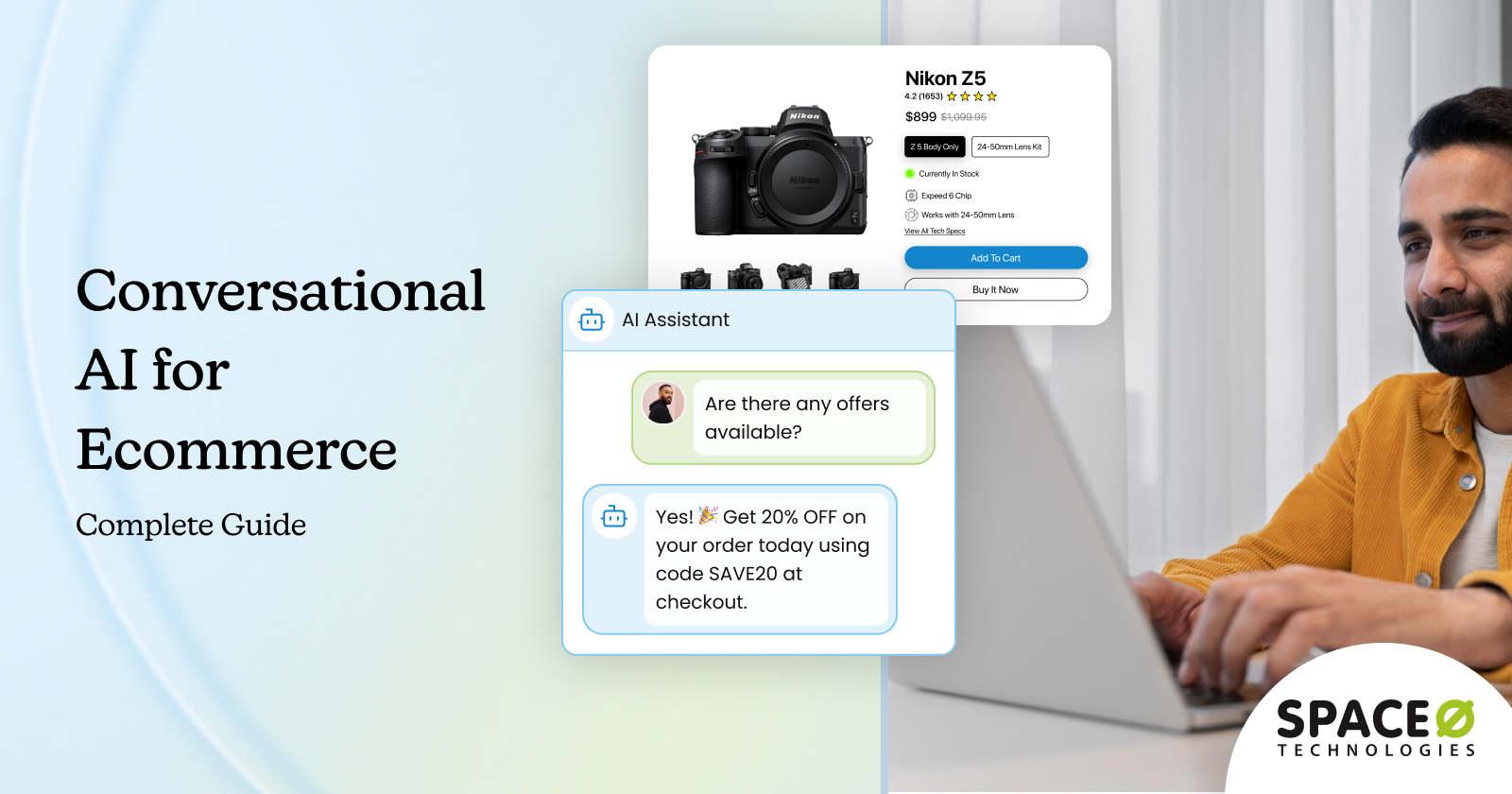
Your ecommerce business is growing. Customer inquiries are flooding in at all hours. Your support team is stretched thin, and you’re watching potential sales slip away because shoppers can’t get quick answers about products, shipping, or returns.
This is the reality for most ecommerce businesses today. The challenge of providing personalized, instant support at scale has become a defining competitive factor.
Conversational AI offers a solution. According to Shopify data, 80% of ecommerce sites now use AI-powered chatbots to handle customer interactions. The retail and ecommerce conversational AI market has reached $2.1 billion in 2024, with 75% of businesses in this sector already adopting some form of AI-driven customer engagement.
This guide covers everything you need to know about conversational AI for ecommerce: what it is, how it solves your most pressing challenges, real implementation examples, and a practical ai implementation roadmap for getting started. Whether you’re exploring AI for the first time or looking to upgrade from basic chatbots, you’ll find actionable insights to move forward.
What is Conversational AI for Ecommerce?
Conversational AI refers to technology that enables computers to understand, process, and respond to human language in a natural, conversational manner. In the ecommerce context, this means AI systems that can engage shoppers in meaningful dialogues about products, orders, and support inquiries.
The distinction between conversational AI and basic chatbots matters. Traditional chatbots follow pre-programmed scripts and decision trees. When a customer asks something outside those scripts, the bot fails. Conversational AI, by contrast, uses natural language processing (NLP) and machine learning to understand the intent behind customer messages, even when phrased in unexpected ways.
The core technologies for building conversational AI include:
- Natural Language Understanding (NLU): Interprets what customers mean, not just what they say
- Machine Learning: Continuously improves responses based on interaction data
- Context Retention: Remembers previous messages within a conversation for coherent multi-turn dialogues
- Generative AI/LLMs: Creates natural, contextually appropriate responses rather than selecting from pre-written templates
In practice, this means a customer can ask “Do you have this jacket in blue, size medium?” and the AI understands the request, checks inventory in real-time, and responds with accurate availability information. If the customer follows up with “What about the matching pants?”, the AI retains context and knows which product line they’re discussing.
For ecommerce businesses, conversational AI transforms customer interactions from transactional exchanges into personalized shopping experiences that drive conversions and build loyalty. To achieve this transformation, businesses can build conversational AI solution customized to their unique products, customer base, and operational requirements.
Key Pain Points Conversational AI Solves for Ecommerce Businesses
Ecommerce businesses face specific operational challenges that conversational AI directly addresses. Understanding these pain points helps clarify why adoption has accelerated so rapidly.
1. Scaling Customer Support Without Proportional Costs
Growing your customer base should be exciting. But for many ecommerce businesses, growth creates a support crisis. Every new customer means more inquiries, and traditional support models require proportional staffing increases.
The economics are challenging. A single phone support call costs $7-15 on average. As inquiry volume grows, so do staffing costs, training expenses, and quality control challenges. Consistency becomes difficult to maintain across a growing team.
Conversational AI changes this equation fundamentally. AI systems handle 60-80% of customer inquiries without human intervention. According to Deloitte, businesses achieve 30-40% call center cost reductions through AI implementation. More importantly, AI maintains consistent quality regardless of volume, whether handling 100 or 10,000 inquiries per day.
2. Providing 24/7 Availability for Global Customers
International customers don’t operate on your business hours. A shopper in London browsing your US-based store at 3 PM their time reaches you at 10 AM Eastern. But a customer in Sydney at 8 PM is contacting you at 4 AM.
Traditional support models force a choice: expensive overnight staffing or lost sales from unanswered after-hours inquiries. Neither option is sustainable for growing businesses.
Conversational AI provides always-on support without the staffing complexity. Juniper Research estimates that 24/7 AI availability saves businesses $2.3 billion annually across industries. For ecommerce specifically, this means capturing sales that would otherwise be lost when customers can’t get answers during their shopping window.
3. Cart Abandonment and Purchase Friction
Cart abandonment remains one of ecommerce’s most persistent challenges. Industry data shows abandonment rates exceeding 70%, representing massive lost revenue. Many abandoned carts result from unanswered questions: shipping costs, delivery times, return policies, or product specifications.
Conversational AI addresses abandonment through proactive intervention. When a shopper hesitates at checkout, AI can offer assistance, answer questions, or provide incentives. Juniper Research reports that AI-powered interventions reduce cart abandonment by 18-25%.
The key is timing and relevance. Unlike generic pop-ups, conversational AI engages contextually based on shopper behavior, offering help that actually addresses the hesitation rather than adding more friction.
4. Personalization at Scale
Today’s consumers expect personalization. Research shows 72% of consumers only engage with marketing messages tailored to their interests. They’ve experienced Amazon’s recommendation engine, Netflix’s content suggestions, and Spotify’s personalized playlists. Generic shopping experiences feel dated by comparison.
But personalization traditionally required significant human effort or expensive technology infrastructure. Small and mid-sized ecommerce businesses couldn’t compete with enterprise-level personalization.
Conversational AI democratizes personalization. AI systems analyze browsing behavior, purchase history, and conversation context to deliver individualized building product recommendations systems, relevant upsells, and tailored support. Every customer interaction becomes an opportunity for personalized engagement that drives conversions.
Build a Conversational AI Solution That Boosts Sales
Ready to transform browsers into buyers with intelligent conversations? Partner with Space-O AI to develop conversational AI that understands your products and customers.
Benefits of Developing a Conversational AI Solution in Ecommerce
Beyond solving immediate pain points, conversational AI delivers measurable benefits across customer experience, revenue, operations, and business intelligence.
1. Improved Customer Experience and Satisfaction
Customer expectations for response time have compressed dramatically. Waiting hours for email replies or sitting on hold feels unacceptable when instant messaging is the norm in personal communication.
Conversational AI delivers responses in seconds, not minutes or hours. This speed directly impacts satisfaction. Forrester research shows CSAT improvements of 12-18% when AI handles customer interactions effectively.
But speed isn’t everything. Consistency matters equally. Human agents have good days and bad days. They have knowledge gaps and varying communication styles. Conversational AI provides consistent, accurate information across every interaction. When complex issues require human intervention, AI handles the handoff smoothly, providing agents with conversation context so customers don’t repeat themselves.
2. Increased Conversions and Revenue
Conversational AI isn’t just a support tool. It’s a sales channel. AI systems guide shoppers through product discovery, answer pre-purchase questions, and recommend complementary items.
The conversion impact is significant. Drift reports 15-25% conversion rate improvements when conversational AI engages shoppers during their buying journey. Salesforce data shows 20-35% increases in upsell and cross-sell revenue through AI-powered recommendations.
Consider the shopping assistant use case. A customer browsing running shoes can ask the AI about fit, cushioning, and terrain suitability. The AI provides knowledgeable answers, suggests appropriate options, and recommends complementary products like moisture-wicking socks or a running belt. This guided experience converts browsers into buyers.
3. Operational Efficiency and Cost Savings
The operational benefits compound over time. AI handles routine inquiries instantly, reducing ticket volume for human agents by 25-45% according to Zendesk data. Agents focus on complex issues that require human judgment and empathy.
Agent productivity improves 40-50% when AI handles initial triage and provides relevant context for escalated issues. Agents spend less time gathering basic information and more time solving actual problems.
Cost per interaction drops 50-70% compared to fully human support. Juniper Research estimates average enterprise savings of $8 million annually from conversational AI implementation. For mid-market businesses, savings scale proportionally, often representing the difference between profitable and unsustainable support operations.
4. Valuable Customer Insights and Data
Every conversation generates data. Conversational AI captures structured information about customer questions, concerns, product interests, and friction points.
This data reveals patterns invisible in traditional support channels. You discover which products generate the most questions, what information is missing from product pages, and where the checkout process confuses customers.
These insights inform product development, content strategy, and UX improvements. The AI becomes a continuous feedback mechanism, surfacing customer needs that might otherwise go unnoticed.
Top Use Cases for Conversational AI in Ecommerce
Successful implementations start with specific use cases. Here’s where conversational AI delivers the highest impact for ecommerce businesses.
1. Product Discovery and Recommendations
AI shopping assistants transform product discovery from search-based browsing to conversational exploration. Customers describe what they’re looking for in natural language, and AI suggests relevant products based on their needs.
This approach works particularly well for complex product categories. Apparel shoppers can describe their style preferences, occasions, and fit requirements. Electronics customers can explain their use cases and technical needs. The AI translates these descriptions into product recommendations that match.
Space-O AI implemented this approach for Moov Store in Saudi Arabia. The ecommerce platform needed personalized product recommendations that went beyond basic collaborative filtering. Space-O developed an AI chatbot using natural language processing and a custom recommendation engine. The system analyzes browsing history, purchase patterns, and real-time conversation context to deliver personalized suggestions that increased customer engagement and shopping satisfaction.
Visual search capabilities extend this further. Customers upload images of products they like, and AI identifies similar items from your catalog. Size and fit assistance helps apparel shoppers find the right match, reducing return rates while improving satisfaction.
2. Order Management and Tracking
Order-related inquiries represent a significant portion of customer service volume. Where’s my order? Can I change my shipping address? How do I return an item? These questions are repetitive and well-suited for AI automation.
Conversational AI connects to order management systems to provide real-time status updates. Customers ask about their order in natural language and receive accurate tracking information instantly. Address changes, delivery instructions, and modification requests can be processed automatically when they fall within defined parameters.
Returns and exchanges follow similar patterns. AI guides customers through return eligibility, generates return labels, and initiates refund processing. Complex cases escalate to human agents with full context, but routine returns complete without manual intervention.
3. Customer Support Automation
FAQ handling represents the clearest automation opportunity. Most support inquiries fall into predictable categories: shipping policies, payment options, account management, and product specifications. AI handles these queries instantly, providing accurate information 24/7.
Space-O AI’s work on an AI-Powered Receptionist SaaS demonstrates this capability. The system achieved a 67% reduction in missed customer inquiries by providing round-the-clock automated responses. The AI handles routine questions, schedules appointments, and escalates complex issues appropriately.
Payment and billing inquiries benefit from similar automation. Customers check payment status, update payment methods, and resolve basic billing questions without waiting for human agents.
4. Purchase Assistance
The research phase of ecommerce purchases often determines conversion outcomes. Customers comparing products need quick access to specifications, compatibility information, and comparison data.
Space-O AI developed Clime, an AI Product Comparison Tool that achieved a 90% reduction in comparison shopping time. The system aggregates product data and uses NLP to help customers make informed purchasing decisions quickly. Rather than opening multiple tabs and manually comparing features, customers ask the AI directly and receive structured comparisons.
Stock availability checking handles a common friction point. Nothing frustrates customers more than completing research on a product only to discover it’s out of stock in their size or preferred color. AI provides real-time inventory information within the conversation flow.
5. Abandoned Cart Recovery
Proactive outreach transforms conversational AI from reactive support to active sales tool. When customers abandon carts, AI can initiate contact through messaging platforms, email, or on-site chat.
The key is relevance and timing. AI analyzes abandonment signals to identify likely causes. Price concerns prompt discount offers. Shipping uncertainty triggers delivery information. Product questions receive targeted assistance.
This personalized follow-up performs significantly better than generic abandonment emails. The conversational format allows customers to respond with questions or concerns, turning a one-way notification into a two-way sales conversation.
Build an AI Shopping Assistant with Space-O AI
Ready to guide customers from browsing to checkout seamlessly? Partner with Space-O AI to create conversational AI that boosts your ecommerce performance.
Real-World Examples: How Leading Brands Use Conversational AI
Understanding how successful implementations work helps clarify what’s possible for your business.
1. Retail and Fashion
Fashion and apparel brands leverage conversational AI to replicate the in-store shopping assistant experience online. Sephora’s chatbot helps customers find the right makeup products based on skin type, preferences, and occasions. H&M’s AI assists with outfit coordination and style recommendations.
Burberry uses conversational AI to provide personalized product recommendations and handle customer service inquiries. The AI understands fashion terminology and can guide customers through collections based on style preferences.
These implementations share common elements: deep product knowledge, personalization based on customer data, and seamless integration with inventory and order systems.
2. B2B Ecommerce
B2B ecommerce presents unique challenges that conversational AI addresses effectively. Product catalogs are often large and technical. Customers need specification details, compatibility information, and bulk pricing.
AI handles complex product inquiries that would otherwise require sales rep involvement. Customers ask about specifications in technical language and receive accurate answers. Quote generation automates for standard orders, with complex requests escalating to sales teams.
Account-based personalization ensures repeat customers see relevant products and pricing. The AI recognizes returning buyers and tailors interactions based on purchase history and account terms.
How to Implement Conversational AI for Your Ecommerce Business
Successful implementation requires methodical planning. Here’s a practical roadmap based on proven approaches.
Step 1: Define Clear Use Cases
Start narrow. Attempting to automate everything simultaneously leads to mediocre results across the board. Identify your highest-impact, most repetitive inquiry categories.
Analyze your current support tickets. Which questions appear most frequently? Order status checks? Shipping inquiries? Product availability? These high-volume, low-complexity inquiries represent ideal starting points.
Align use cases with business objectives. If cart abandonment is your primary concern, prioritize checkout assistance. If support costs are the issue, focus on FAQ automation. Clear priorities guide implementation decisions.
Step 2: Assess Data and Infrastructure Readiness
Conversational AI requires data access to deliver value. Evaluate your current infrastructure:
Product catalog: Is product data structured and accessible via API? Can the AI query specifications, pricing, and availability?
Order systems: Can AI access order status, tracking information, and customer purchase history?
CRM data: Is customer information available for personalization?
Platform compatibility: Does your ecommerce platform (Shopify, Magento, WooCommerce, or custom) support the integrations you’ll need?
Gaps in data accessibility limit AI capabilities. Address these gaps during planning rather than discovering them during implementation.
Step 3: Choose the Right Approach
The build versus buy decision significantly impacts outcomes. Platform solutions offer faster deployment but limited customization. Custom development requires more investment but delivers differentiated capabilities.
Evaluate platforms on specific criteria:
- NLU accuracy for your product domain
- Integration capabilities with your existing systems
- Customization options for conversation flows
- Scalability as your business grows
- Ongoing costs at projected volumes
For businesses seeking competitive advantage through customer experience, custom development often makes sense. Generic chatbots deliver generic experiences. Custom AI can understand your specific products, speak your brand voice, and handle the unique scenarios your customers present.
Step 4: Plan Integrations for Personalization
Personalization depends on connected systems. Map the integrations required for your target use cases:
Product database: Real-time inventory, specifications, pricing Customer data: Purchase history, browsing behavior, preferences Order management: Status, tracking, modification capabilities Payment systems: Transaction status, payment method management Marketing platforms: Promotional offers, loyalty program data
Each integration adds personalization capability. Prioritize based on use case requirements and implementation complexity.
Step 5: Launch, Measure, and Optimize
Start with a pilot deployment. Select a subset of traffic or specific use cases for initial rollout. This approach limits risk while generating real performance data.
Define success metrics before launch:
- Containment rate: What percentage of inquiries does AI resolve without escalation?
- Customer satisfaction: Are CSAT scores maintained or improved?
- Conversion impact: How does AI engagement affect purchase rates?
- Cost per interaction: What are the economics compared to human-only support?
Continuous improvement drives long-term success. Analyze conversation logs to identify failure patterns. Update training data to address gaps. Refine conversation flows based on actual usage patterns. The AI improves with every interaction if you maintain an optimization rhythm.
Start Building Your Conversational Commerce Solution
Ready to compete with industry leaders in AI-powered shopping? Partner with Space-O AI to develop conversational AI designed for measurable ecommerce impact
Cost to Build a Conversational Solution AI for Ecommerce Businesses
Understanding the investment required helps you plan effectively and set realistic expectations. Conversational AI costs vary significantly based on complexity, customization needs, and business scale.
Cost Breakdown by Business Size
| Business Size | Typical Investment | What’s Included |
| Small Business (<100 employees) | $5,000 – $50,000 | Basic chatbot, limited integrations, template-based flows |
| Mid-Market (100-1,000 employees) | $50,000 – $250,000 | Custom NLP, multiple integrations, personalization features |
| Enterprise (1,000+ employees) | $250,000 – $2M+ | Full custom development, complex integrations, advanced AI capabilities |
Factors That Influence Cost to Develop Conversational Solution AI for Ecommerce
1. Complexity of Use Cases
Simple FAQ automation costs less than sophisticated product recommendation engines. Each additional use case adds development time and integration requirements. Start with high-impact use cases and expand gradually.
2. Integration Requirements
Connecting conversational AI to your ecommerce platform, CRM, inventory system, and payment processors requires development effort. Legacy systems with limited API support increase costs. Modern, API-first platforms reduce integration complexity.
3. Customization Level
Off-the-shelf chatbot platforms cost $50-500 per month but offer limited customization. Custom AI development requires higher upfront investment but delivers unique capabilities tailored to your business.
4. NLP and AI Sophistication
Basic intent recognition costs less than advanced natural language understanding with context retention, sentiment analysis, and generative AI capabilities. More sophisticated AI delivers better customer experiences but requires greater investment.
5. Channel Coverage
Single-channel deployment (website chat only) costs less than omnichannel solutions spanning web, mobile app, WhatsApp, Facebook Messenger, and voice interfaces.
For accurate cost estimates tailored to your specific requirements, schedule a consultation with Space-O AI’s team.
Request a Cost Estimate for Your Ecommerce AI Solution
Ready to understand development costs, timelines, and expected returns? Partner with Space-O AI for transparent pricing and a roadmap built around your budget.
Key Technologies Powering Ecommerce Conversational AI
Understanding the technology stack helps you evaluate solutions and make informed implementation decisions.
1. Natural Language Processing (NLP) and Understanding (NLU)
NLP and NLU form the foundation of conversational AI. These technologies interpret customer messages, extracting meaning beyond the literal words.
Intent recognition identifies what customers want to accomplish. A message like “I need to return the shoes I ordered” triggers return processing flows. “These shoes don’t fit right” might trigger exchange options or sizing assistance.
Entity extraction pulls specific details from messages. Product names, order numbers, sizes, colors, and dates get parsed from natural language into structured data the system can process.
Sentiment analysis detects customer emotional state. Frustrated customers receive different handling than satisfied ones. Escalation triggers activate when sentiment indicates a human touch is needed.
2. Machine Learning and Recommendation Engines
Machine learning enables AI systems that improve with use. Each interaction generates training data that refines future responses.
Recommendation engines power personalized product suggestions. Collaborative filtering analyzes patterns across customers to identify products frequently purchased together. Content-based filtering matches product attributes to customer preferences.
Behavioral prediction anticipates customer needs based on browsing patterns. AI recognizes signals indicating purchase readiness or abandonment risk, enabling proactive intervention.
3. Generative AI and Large Language Models
Generative AI represents the current frontier in conversational capabilities. Large language models (LLMs) like GPT-4 and Claude generate natural, contextually appropriate responses rather than selecting from pre-written templates.
This technology enables handling of complex, open-ended queries that rule-based systems couldn’t address. Product description generation, comparison explanations, and detailed answer synthesis become possible.
Current adoption stands at approximately 35%, with projections suggesting 70% adoption by 2025. Early adopters gain experience advantages as the technology matures.
4. Omnichannel Integration
Customers engage across multiple channels, and conversational AI must meet them wherever they are.
Website chat widgets remain the primary channel, with 68% usage. Mobile app integration extends AI capabilities to native shopping apps. WhatsApp Business and Facebook Messenger connect AI to social messaging platforms where customers increasingly prefer to communicate.
Voice assistants and smart speakers represent growing channels, enabling voice-based shopping and support interactions. Effective conversational AI maintains context across channels, recognizing returning customers regardless of how they connect.
Future Trends in Conversational AI for Ecommerce
The technology continues to evolve rapidly. Understanding emerging trends helps you plan for long-term success.
1. Hyper-Personalization at Scale
Personalization capabilities are advancing beyond basic recommendation algorithms. AI systems increasingly analyze real-time behavior, contextual signals, and predictive modeling to deliver individually tailored experiences.
Current adoption sits at approximately 45%, with projections suggesting 92% adoption by 2030. Early investment in personalization infrastructure positions businesses for this increasingly personalized future.
2. Voice Commerce Growth
Voice-based shopping interactions are growing as smart speaker adoption increases and voice AI quality improves. Voice commerce is projected to reach $80 billion by 2030.
For ecommerce businesses, this means preparing conversational AI systems for voice interaction, not just text-based chat. Voice interfaces require different conversation design approaches and integration with voice platforms. To get started, businesses can build AI voice assistant solutions tailored to their specific shopping experiences and customer needs.
3. Multimodal AI Experiences
The future of conversational AI combines text, voice, and visual interactions. Customers might show an image, describe what they want verbally, and receive visual product recommendations.
AR/VR integration extends this further, enabling virtual try-on experiences and immersive product visualization guided by conversational AI. Current adoption is approximately 15%, but 75% adoption is projected by 2030.
4. Autonomous AI Agents
AI systems are evolving from reactive responders to proactive agents. Rather than waiting for customer inquiries, AI initiates contact based on behavioral signals, completes multi-step processes autonomously, and continuously optimizes its own performance.
This shift transforms conversational AI from a support tool to an autonomous sales and service channel capable of end-to-end customer journey management.
Build Conversational AI That Scales Your Ecommerce Business
Ready to automate support and increase sales simultaneously? Partner with Space-O AI to develop conversational AI solutions built for your product catalog and customers.
How Space-O AI Helps Ecommerce Businesses Build Conversational AI Solutions
Building conversational AI that truly transforms ecommerce requires more than generic chatbot platforms. Space-O AI partners with ecommerce businesses to create custom solutions aligned with their specific products, customers, and operational workflows.
With over 15 years of AI engineering expertise and 500+ delivered projects, Space-O brings proven experience in machine learning, natural language processing, and ecommerce integration. The team holds certifications including AWS Gen-AI Partner Badge, Google Cloud Machine Learning Specialization, and Microsoft Azure AI Solution Certification, with developers averaging 8+ years of hands-on experience.
Space-O delivers end-to-end solutions tailored to your business, not forced into generic templates. This includes AI trained on your product catalog and brand voice, seamless integration with your ecommerce platform (Shopify, Magento, WooCommerce, or custom builds), and connections to inventory, order management, and CRM systems. The partnership covers strategy and assessment, design and development, deployment and integration, plus ongoing optimization through analytics and model refinement.
Solutions are built for production-ready, enterprise-grade operation with high availability, security compliance, 99% accuracy targets, and scalable architecture. Proven results include product recommendation systems, customer support automation, and conversational commerce implementations that deliver measurable business impact across retail, finance, healthcare, and more industries.
Frequently Asked Questions About Conversational AI for Ecommerce
1. What’s the difference between a chatbot and conversational AI?
Basic chatbots follow predefined scripts and decision trees, often failing when questions fall outside their rules. Conversational AI leverages natural language processing and machine learning to understand context, learn from past interactions, and provide human-like responses across a wide range of customer inquiries, improving engagement and satisfaction.
2. How much does conversational AI for ecommerce cost?
Costs depend on project scope, complexity, and integration requirements. Mid-market businesses typically spend $50K–$250K for initial implementation, while enterprise solutions can range from $250K to $2M+. Ongoing costs include platform subscriptions, maintenance, and continuous optimization to ensure AI performance and relevance over time.
3. How long does implementation take?
Implementation timelines vary. For mid-market ecommerce, initial deployment usually takes 3–6 months, including discovery, development, integration, and testing. Enterprise deployments may require longer. Post-launch, AI continues to improve with ongoing optimization, ensuring enhanced accuracy and user experience as it learns from interactions.
4. Will AI replace human customer service agents?
Conversational AI handles routine queries, often 60–80% of total volume, freeing human agents to focus on complex issues requiring empathy and judgment. Most implementations augment customer service teams rather than replace them, reducing repetitive tasks, improving agent satisfaction, and enabling faster and more accurate support for customers.
5. What ecommerce platforms integrate with conversational AI?
Most major ecommerce platforms support AI integration through APIs. Platforms like Shopify, Magento, WooCommerce, BigCommerce, and custom-built systems can connect with conversational AI solutions. Integration complexity varies depending on platform capabilities, data structures, and required customizations for optimal performance.
6. How do I measure conversational AI success?
Measure success using metrics such as containment rate (percentage of queries resolved without human help), customer satisfaction scores, conversion rate impact, cost per interaction, and first contact resolution rate. Establish baselines before deployment and monitor these KPIs over time to continuously optimize AI performance and ROI.


What to read next