- Why the Vendor Decision Carries More Risk Than the Technology Decision
- The Eight Criteria for Evaluating a Sovereign AI Vendor
- Technical Due Diligence: What to Actually Test
- Understanding Vendor Engagement Models
- Red Flags: When to Walk Away
- Building Your Evaluation Scorecard
- Questions to Ask Every Sovereign AI Vendor
- Build Your Sovereign AI Stack With a Partner Who Has Done It Before
- Frequently Asked Questions
How to Choose the Right Sovereign AI Vendor

 Last Updated: April, 10 2026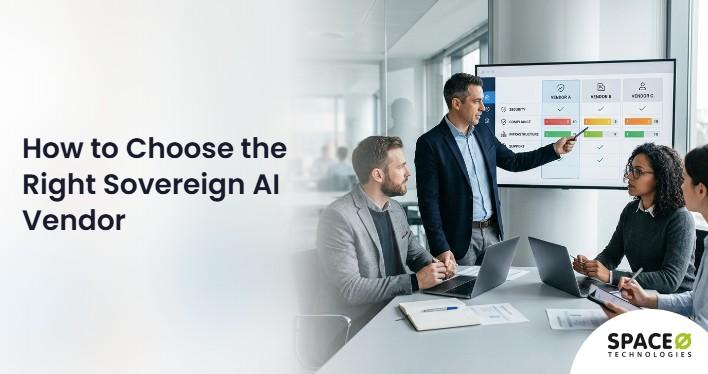
The sovereign AI vendor you choose will own the architecture your most sensitive data runs on. Pick the wrong partner and you face compliance gaps discovered after go-live, vendor lock-in baked into the foundation of your infrastructure, or a deployment that burns through CapEx and never reaches production.
Most organizations spend months evaluating sovereign AI architecture and far less time evaluating the partner who will build it. A Deloitte Enterprise AI Report from 2026 found that 93% of enterprise executives list AI sovereignty as a top priority, but vendor evaluation methodology remains the least-documented step in most organizations’ decision process. That gap is where sovereign AI deployments fail.
This guide gives you an eight-point evaluation framework, a weighted scoring model, a list of concrete red flags, and the exact questions to ask before signing anything.
Whether you are running a formal RFP or shortlisting vendors after an initial round of demos, these criteria apply directly to choosing a sovereign AI vendor who can actually deliver.
As a sovereign AI development partner that has guided enterprise clients through this evaluation across healthcare, financial services, and government, Space-O has built this framework from real deployment experience.
Why the Vendor Decision Carries More Risk Than the Technology Decision
Choosing a sovereign AI vendor is not like selecting a SaaS platform. You are not committing to a monthly subscription you can cancel next quarter. You are embedding a partner into the architecture of your most sensitive data infrastructure, under your compliance perimeter, for a deployment lifecycle measured in years.
Most organizations underestimate this. They treat vendor selection as a procurement exercise and approach it the way they would evaluate a cloud tool: request demos, review pricing, compare feature lists. T
his misses the variables that actually determine whether a sovereign AI deployment succeeds. The wrong vendor can build technically functional infrastructure that fails a compliance audit eighteen months post-go-live, or delivers on the initial build but has no model operations capability to sustain the system afterward.
Three failure modes define poorly-selected sovereign AI deployments. The first is compliance gaps discovered post-deployment, where a vendor lacked the regulatory implementation depth to instrument audit trails, data lineage, or encryption controls at the level required.
The second is performance problems from under-specified infrastructure, where the vendor lacked GPU cluster design experience and delivered a system that cannot meet production latency or throughput requirements.
The third is vendor lock-in through a proprietary software stack, where the organization discovers it cannot migrate or modify the system without returning to the original vendor.
The cost of any of these outcomes is substantial. Sovereign AI deployments that fail due to vendor selection errors routinely involve timeline overruns of six to eighteen months and CapEx losses in the $500K to $5M range.
Treat the sovereign AI build vs buy and the vendor selection that follows it as the highest-leverage decisions in your AI program, not as steps to get through quickly on the way to procurement.
The Eight Criteria for Evaluating a Sovereign AI Vendor
Eight criteria distinguish a qualified sovereign AI vendor from one with good marketing. The order matters: the first three are eliminators. A vendor who cannot meet them should not advance regardless of performance on the others.
1. Compliance Expertise
The vendor must demonstrate implementation experience across the regulations relevant to your industry, not just awareness. GDPR, HIPAA, EU AI Act, DPDP, and DORA each impose specific technical requirements on data handling, audit logging, encryption, and model governance.
Ask for compliance implementation documentation from prior deployments, not a checklist. A vendor who can describe exactly how they instrumented an audit trail for a HIPAA-regulated deployment is a different category of partner from one who can describe the regulation itself.
2. Infrastructure Credentials
Sovereign AI infrastructure is specialized. The vendor must have demonstrable experience deploying and operating GPU clusters, specifying hardware configurations (NVIDIA H100/H200/B200 or AMD MI300X), designing storage for AI workloads (NVMe flash arrays, S3-compatible object storage), and configuring the high-speed networking (InfiniBand, NVLink) required for multi-GPU inference at scale.
NVIDIA Partner Network membership is a useful credentialing signal. More important are reference deployments with comparable infrastructure scale to your requirements.
3. Security Depth
A qualified vendor implements zero-trust architecture as a default, not as an add-on. They have air-gapped deployment capability, not just the claim of it. Ask for SOC 2 Type II and ISO 27001 certifications, and verify that these are third-party audited, not self-declared.
Ask specifically whether they can provide a software bill of materials (SBOM) for a prior deployment. SBOM capability indicates whether the vendor can support the compliance audit documentation your regulators will eventually request.
4. Model Expertise
The vendor must have hands-on experience selecting, deploying, fine-tuning, and evaluating open-weight models. Llama 4, Mistral, DeepSeek R1, and Falcon 3 are the primary candidates for enterprise sovereign AI deployments. Fine-tuning using LoRA or QLoRA on domain-specific data is a distinct technical skill.
Ask whether the vendor has completed domain-specific fine-tuning in production, what evaluation harnesses they use to measure model quality, and how they manage model drift over time.
5. Integration Capability
Sovereign AI delivers value by integrating with your existing enterprise systems: ERP, CRM, HRMS, case management, and data warehouses. The vendor must have a track record in this integration layer, not only in the AI layer above it.
RAG architecture is the most common integration pattern: ask specifically about vector database design experience (Weaviate, Milvus), embedding model selection, hybrid search configuration, and re-ranking implementation. These are not theoretical skills. Ask for examples.
6. Ongoing Support and MLOps
Most sovereign AI deployments fail not at the initial build but in the six to eighteen months after go-live, when model performance drifts, infrastructure needs patching, and the internal team lacks the expertise to manage what was built.
The vendor must offer managed model operations capability, not only implementation and handoff. Confirm what their SLA covers in a managed engagement, what their incident response process looks like, and what model monitoring tooling they deploy.
7. Open-Source Stack
Eighty-one percent of organizations deploying sovereign AI cite an open-source stack as essential. A vendor who relies on proprietary-only inference frameworks, proprietary vector databases, or proprietary orchestration layers is building lock-in into the architecture from day one.
The vendor should be able to deploy vLLM, Weaviate, MinIO, and open-weight LLMs without proprietary wrappers. The ability to audit every layer is non-negotiable for regulated industry buyers. For a deeper look at what a complete sovereign AI stack involves technically, see our sovereign AI deployment guide.
8. Local Presence (for Regulated Industries)
Government and healthcare buyers often have requirements that extend beyond technical capability. Many jurisdictions require the contracting legal entity to be incorporated domestically, staff to be locally present, and data center relationships to be within national borders.
Verify the jurisdiction of the legal entity that will sign your contract and hold your data. A vendor incorporated in a foreign jurisdiction cannot satisfy these requirements regardless of their technical credentials, and discovering this late in a procurement process is expensive.
A qualified sovereign AI vendor will satisfy all eight criteria at a documented level. After working through this framework, the team behind Space-O’s sovereign AI development services is available to walk through how these criteria apply specifically to your deployment context.
Technical Due Diligence: What to Actually Test
Most vendor proposals look similar at the surface level. Differentiation appears in technical proof-of-concept execution and in the quality of reference checks. Do not skip these steps. No amount of proposal review replaces actually watching a vendor deploy.
Four specific things to validate in a proof-of-concept:
Inference performance. Ask the vendor to demonstrate tokens per second, inference latency under simulated production load, and GPU utilization metrics for the model you plan to run on hardware comparable to your target configuration. If they cannot produce these numbers from a live system, they have not done it.
Data isolation. Ask them to demonstrate exactly how your data is isolated from their other clients within the same infrastructure. This is the most important security boundary in a managed sovereign AI deployment. Any vague or redirected answer should disqualify the vendor.
Key management. Ask specifically who controls encryption keys in the proposed deployment. In a properly structured sovereign AI environment, the client controls keys cryptographically and the vendor has no access to client data, even in a managed model. If the vendor controls the keys, you do not have sovereignty.
Air-gap capability. If you have any workloads that require air-gapped deployment, ask the vendor to demo this specifically. Claiming air-gapped capability and having demonstrated it in a production or POC environment are very different things. Require documentation of a prior deployment.
For reference checks, ask for a client in your regulatory regime who is at least six months post-deployment. When you speak with that client, ask specifically about their compliance audit experience and how the vendor handled the first incident or model performance event after go-live. These are the conversations that reveal what a vendor is actually like to work with.
Evaluating Your Sovereign AI Partner?
Our team helps enterprise leaders map the right approach for their data environment, compliance requirements, and organizational readiness.
Understanding Vendor Engagement Models
The structure of your engagement with a sovereign AI vendor determines how much operational risk you carry post-deployment. Three models cover the spectrum, and the right choice depends on your internal AI team’s capability.
Build-and-Hand-Off (Project Model)
The vendor builds the sovereign AI environment and transfers full operational responsibility to your internal team at go-live.
This model requires a capable internal AI engineering team already in place, with experience in GPU infrastructure operations, LLM serving, MLOps tooling, and model governance. It is the right fit for large enterprises with a strong existing AI practice.
The risk is straightforward: if your internal team lacks hands-on sovereign AI operations experience, the deployment performance will degrade post-handoff and you will not have the expertise to diagnose why.
Managed Sovereign AI (Full MSP)
The vendor operates the infrastructure, model serving layer, and model update process. The client owns the data and the model weights. The vendor has no access to client data, enforced cryptographically.
This is the right fit for mid-market organizations and enterprises that want sovereign AI capability without building a dedicated internal operations team from scratch. Speed-to-value is the primary driver. The trade-off is less direct operational control than a fully internal deployment.
Co-Managed / Embedded (Hybrid)
The vendor embeds a team alongside your internal team with joint operational responsibility and a structured knowledge transfer program over twelve to twenty-four months.
This model is the best fit for most first-time sovereign AI deployers. It reduces delivery risk by keeping expert operators involved through the period when most deployments encounter their first serious operational challenges, while systematically building your internal capability at the same time.
Choosing the wrong engagement model is one of the most common sovereign AI vendor selection mistakes. Before finalizing the engagement structure, review your sovereign AI implementation roadmap expectations alongside the vendor’s delivery methodology. The two should align precisely.
Red Flags: When to Walk Away
Seven clear signals should end a vendor evaluation regardless of how well they performed on other criteria.
1. Proprietary-only stack
If the vendor cannot or will not deploy open-source inference frameworks, open-weight models, and open-source orchestration tooling, they are building lock-in from day one. This is not a preference issue, it is a structural risk.
2. No clear data isolation answer
Any vague, redirected, or deferred answer to “how is my data isolated from your other clients” should end the conversation immediately. This is not a complex question. A vendor who cannot answer it clearly has not solved it.
3. No SBOM capability
The inability to provide a software bill of materials means compliance audits will be unmanageable. Regulators are increasingly requiring SBOM documentation for AI systems in regulated industries. A vendor who cannot provide it cannot support your compliance function.
4. No industry references
A vendor who cannot name a client in your regulatory regime who is six or more months post-deployment has not operated in your compliance environment at production scale. Claims without evidence are not credentials.
5. Single-model-family lock-in
If the vendor only works with one model family or requires their proprietary fine-tuning pipeline as a condition of deployment, you lose model flexibility permanently. The open-weight model landscape evolves quickly. You need the ability to evaluate and migrate to better-performing models as they emerge.
6. No air-gapped deployment capability
For healthcare, defense, and government workloads at the highest sensitivity tier, air-gap capability is not optional. If a vendor cannot demonstrate a prior air-gapped deployment, they have not done it.
7. Self-certified compliance
Any vendor claiming HIPAA, GDPR, SOC 2, or ISO 27001 compliance without third-party audit documentation is self-certifying. This is not compliance. Require third-party certified audit reports as a procurement condition, not a nice-to-have.
Building Your Evaluation Scorecard
A vendor scorecard converts the evaluation framework into an auditable, weighted comparison. This removes the risk of selecting the vendor who delivered the best demo rather than the vendor best qualified to deliver the deployment.
The following weighting is a starting baseline. Adjust based on your regulatory context. Healthcare and government buyers may want to weight compliance higher. Organizations with existing internal AI teams may weight infrastructure credentials and support lower.
| Criterion | Suggested Weight |
|---|---|
| Compliance expertise | 20% |
| Infrastructure credentials | 20% |
| Security depth | 15% |
| Model expertise | 15% |
| Integration capability | 10% |
| Support and MLOps | 10% |
| Open-source stack | 5% |
| Local presence | 5% |
Score each vendor one through five per criterion. Multiply by the weight and sum the totals. Apply a minimum threshold rule: any vendor scoring below three on compliance expertise or security depth is eliminated, regardless of total score. These two criteria are not compensable by performance elsewhere.
Run the scorecard in parallel with the technical proof-of-concept. The POC results should feed directly into your infrastructure credentials and security depth scores, grounding those two criteria in observed evidence rather than proposal claims.
Questions to Ask Every Sovereign AI Vendor
Use this question set for RFP responses, vendor interviews, or reference checks. These are not generic procurement questions. They are designed to reveal the depth of sovereign AI expertise behind a proposal.
Compliance:
- Which specific regulations have you implemented in production? Can you share implementation documentation from a prior deployment?
- Do you hold third-party certified audit reports for HIPAA, GDPR, SOC 2 Type II, or ISO 27001?
- How have your deployments handled data subject access requests and right-to-erasure requirements under GDPR or DPDP?
Infrastructure:
- What GPU hardware configurations have you deployed in production? What is your current lead time and sourcing approach for H100 or equivalent hardware?
- What networking fabric do you deploy for multi-GPU inference clusters?
- Which hardware OEM partners do you work with, and can you provide reference contacts at those organizations?
Security:
- Can you provide a sample SBOM from a recent deployment?
- How are client encryption keys managed in your managed sovereign AI model? Do you, as the vendor, have any access to client data?
- Can you demonstrate an air-gapped deployment? Can you provide documentation of a prior air-gapped production deployment?
Model and MLOps:
- Which open-weight models have you fine-tuned in production? What fine-tuning methodology did you use?
- What tooling do you use for model monitoring, drift detection, and performance tracking post-go-live?
- How do you manage model version updates and rollbacks in a production deployment?
References:
- Can you name a client in our industry or regulatory regime who is six or more months post-deployment?
- Can we speak with their technical lead, specifically about their compliance audit experience?
Commercial:
- What is your standard engagement model: build-and-hand-off, fully managed, or co-managed?
- What does your SLA specifically cover in a managed deployment, and what is your incident response process?
- What does exit look like, both contractually and technically? How would we migrate workloads or data if we chose to end the engagement?
Not Sure If Your Current AI Vendor Setup Is Creating Risk?
We assess vendor dependency, compliance posture, and data exposure for enterprise AI environments.
Build Your Sovereign AI Stack With a Partner Who Has Done It Before
Choosing the right sovereign AI vendor is not a procurement exercise. It is a technical and compliance decision that will define how your organization runs AI workloads for years. The difference between a strong partner and a weak one is not visible in a proposal. It shows up in infrastructure specifics, third-party audit documentation, reference check conversations, and how they answer hard questions about data isolation and air-gapping.
Space-O Technologies has 15+ years of experience delivering enterprise software for regulated industries, with 500+ projects across healthcare, financial services, and government. Our team of 80+ developers and AI specialists brings deep sovereign AI expertise, from GPU cluster configuration through compliance framework implementation across GDPR, HIPAA, EU AI Act, and DPDP requirements.
We deploy open-weight models (Llama 4, Mistral, DeepSeek R1) on client-owned or dedicated infrastructure using fully auditable open-source stacks including vLLM, Weaviate, and MinIO. Every deployment includes a software bill of materials, third-party compliance documentation, and a structured knowledge transfer plan. Our clients include HIPAA-regulated healthcare platforms and financial services firms with air-gapped deployment requirements.
Ready to evaluate sovereign AI vendors against the criteria that actually matter? Contact Space-O Technologies to schedule a free technical consultation and discuss your infrastructure requirements, compliance context, and deployment timeline.
Frequently Asked Questions
What should I look for in a sovereign AI vendor?
The eight criteria that matter most are compliance expertise, infrastructure credentials, security depth, model expertise, integration capability, ongoing MLOps support, an open-source stack, and local presence for regulated industries. The first three are eliminators: a vendor who cannot demonstrate them at a documented level should not advance in your evaluation, regardless of how well they perform on the others.
How do I evaluate sovereign AI vendors beyond their proposals?
Run a proof-of-concept before selecting a vendor. Use it to test inference performance under load, data isolation controls, encryption key management, and air-gap capability if relevant. Follow up with reference checks from clients in your regulatory regime who are at least six months post-deployment. Proposals from different vendors look similar. POC results and reference conversations do not.
What certifications should a sovereign AI vendor hold?
At minimum, look for SOC 2 Type II and ISO 27001, both third-party audited rather than self-declared. For healthcare deployments, HIPAA Business Associate Agreement capability is required. Government and US federal deployments may require FedRAMP. NVIDIA Partner Network membership signals infrastructure credibility. ISO 42001, the AI management system standard introduced in 2023, is gaining traction as a meaningful signal for AI governance maturity.
What are the biggest red flags in a sovereign AI vendor?
Seven signals should end an evaluation: a proprietary-only stack with no open-source alternative, a vague answer to how client data is isolated from other clients, no SBOM capability, no industry references from clients six or more months post-deployment, single-model-family lock-in, no demonstrated air-gapped deployment capability, and self-certified compliance without third-party audit documentation.
How much does a sovereign AI vendor charge?
Engagement costs vary widely based on deployment complexity, infrastructure scale, and engagement model. A build-and-hand-off project for a mid-market deployment typically ranges from $200K to $800K. Fully managed sovereign AI engagements are structured as ongoing monthly fees, commonly $15K to $60K per month depending on infrastructure scale and SLA requirements. Co-managed or embedded models fall between these ranges. Request detailed scope-based pricing, not day rates, so you can compare vendors on total delivered cost.
Should I use a managed or build-and-hand-off sovereign AI vendor engagement?
This depends on your internal AI team’s capability. If you have experienced GPU infrastructure engineers, LLM operations staff, and MLOps practitioners in-house, a build-and-hand-off model is viable. If your team is building sovereign AI capability for the first time, a co-managed engagement reduces delivery risk and builds internal expertise in parallel. A fully managed model is right for organizations that want production sovereign AI without investing in a dedicated internal operations team.
How long does it take a sovereign AI vendor to deploy sovereign AI?
A well-scoped mid-market deployment, from signed contract to production go-live, typically takes four to nine months. The range depends on infrastructure complexity, data readiness, regulatory requirements, and integration scope. GPU hardware procurement alone can introduce lead times of eight to sixteen weeks for H100-class hardware. Vendors who quote shorter timelines without accounting for hardware procurement are either working with pre-provisioned inventory or presenting optimistic projections.
What questions should I ask a sovereign AI vendor before signing?
The highest-signal questions are: Which specific regulations have you implemented in production? Can you provide a SBOM from a prior deployment? Who controls encryption keys in your managed model? Can you demonstrate an air-gapped deployment? Can you name a client in our industry who is six months post-deployment and can we speak with their technical lead? What does exit look like contractually and technically? These questions expose the difference between a vendor with genuine delivery experience and one with strong proposal-writing capability.


What to read next