- Why the Build vs Buy Question Is More Complex Than It Looks
- The Build Path: When It Makes Sense and What It Costs
- The Buy Path: Speed, Risk, and What Vendors Don’t Tell You
- The Hybrid Path: What Most Mature Enterprises Actually Do
- Cost Comparison: Build vs Buy vs Hybrid Over 5 Years
- Compliance and Data Sovereignty: The Non-Negotiable Dimension
- A Decision Framework for Enterprise Leaders
- What to Do Before You Decide
- Conclusion
- Frequently Asked Questions
Build vs Buy Sovereign AI: A Framework for Enterprise Decision-Makers

 Last Updated: April, 7 2026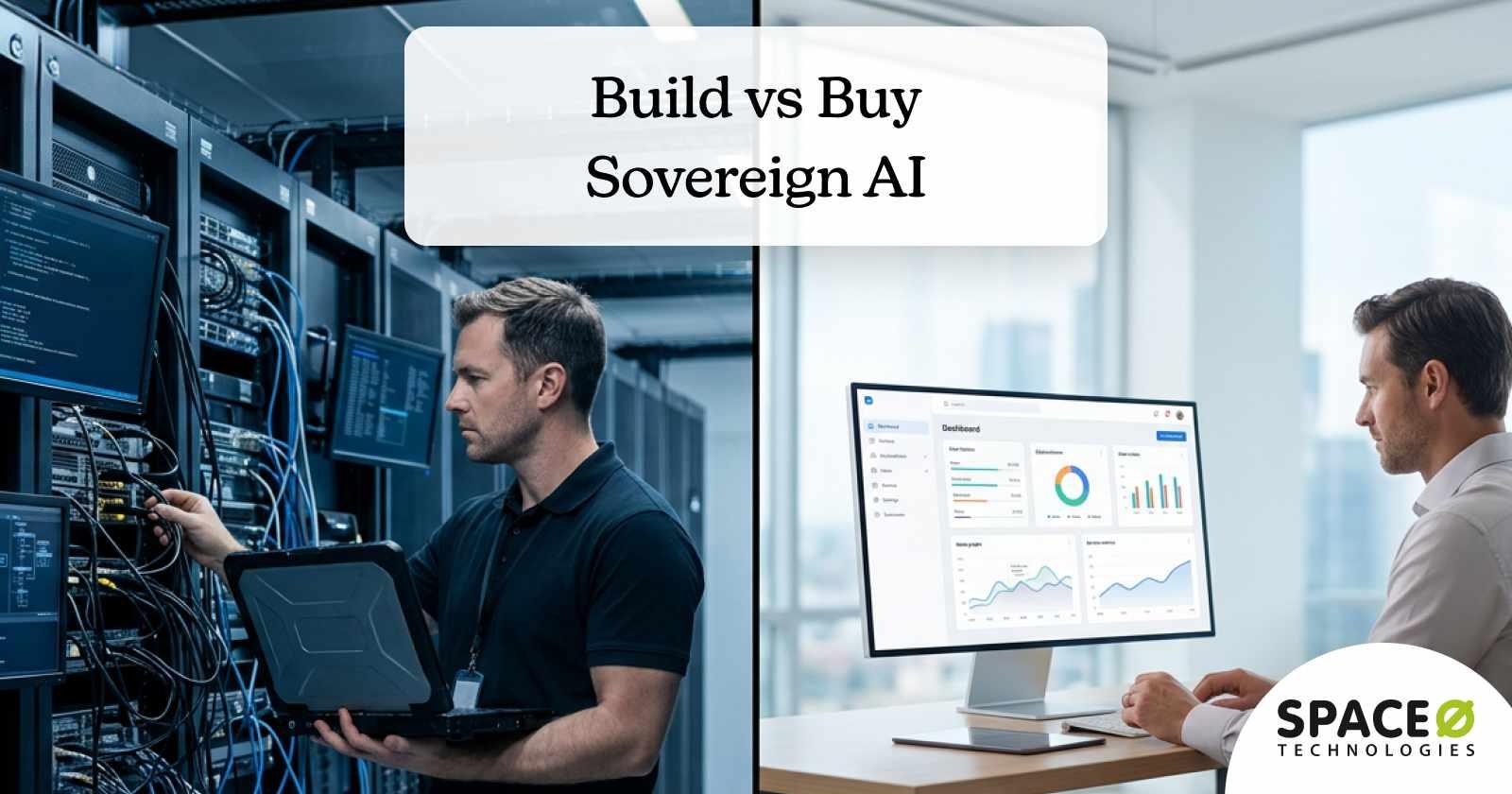
The question most enterprise leaders ask when evaluating sovereign AI is the wrong one. “Should we build or buy?” sounds like a clear binary, but it rarely is. The actual decision is more specific: given your data environment, your regulatory obligations, your internal talent, and your competitive positioning, what level of AI control do you need, and what can your organization realistically execute?
That framing matters because the build vs buy question carries real weight. Enterprises that commit to building without the talent, budget, or operational maturity to support it burn through capital and fall behind. Enterprises that buy into vendor-managed AI without accounting for lock-in, data exposure, and compliance gaps often discover the cost of that decision only after they are dependent on the platform and switching is prohibitively expensive.
As a sovereign AI development company, we will help you break down the build path, the buy path, and the hybrid approach that most mature enterprises actually use, with real cost context, compliance considerations, and a five-question decision framework you can apply today.
Why the Build vs Buy Question Is More Complex Than It Looks
Most technology decisions fit a straightforward make-or-buy framework: if a capability is core to your competitive advantage, build it. If it is commodity, buy it. That logic is clean, well-tested, and broadly applicable. AI breaks it.
The classic build vs buy framework
The traditional logic centers on two variables: differentiation and cost. Building gives you control and customization but requires capital, time, and specialized talent. Buying gives you speed and cost predictability but trades control for convenience. For most software categories, this tradeoff is manageable because the capability in question is either clearly core or clearly commodity.
AI sits in both categories simultaneously. A recommendation engine at a retail company is a direct revenue driver and a competitive differentiator. The same company’s HR chatbot is a productivity tool with no strategic value. The model architecture underlying both might be identical. Whether to build or buy depends on the use case, not the technology category.
Why sovereign AI changes the equation
Sovereign AI adds a third variable that does not exist in most make-or-buy decisions: data and jurisdictional control. An enterprise that processes patient health data, financial transactions, or defense-related information may not have a free choice between build and buy.
Regulations, contractual obligations, and internal risk policies frequently determine where data can be processed and who can access the infrastructure running it.
According to McKinsey’s analysis of sovereign AI ecosystems, governments and regulated enterprises increasingly treat AI infrastructure as a matter of strategic sovereignty, not just vendor preference.
When your data cannot leave a specific jurisdiction or your model outputs must be auditable by internal teams, the buy path narrows considerably regardless of its cost advantages.
The result is that the build vs buy decision for sovereign AI is not a binary. It is a three-option framework: build, buy, or a structured hybrid, with compliance and data sensitivity as the primary decision drivers.
Evaluating Your Sovereign AI Options?
Our team helps enterprise leaders map the right approach for their data environment, compliance requirements, and organizational readiness.
The Build Path: When It Makes Sense and What It Costs
Building sovereign AI infrastructure in-house gives an organization maximum control over data, models, and operations. It is also the most capital-intensive, talent-intensive, and time-intensive option. The organizations that succeed with the build path are the ones that go in with an accurate picture of what it actually costs.
When building makes strategic sense
The in-house build path is the right call in a defined set of circumstances:
- Your AI use case is a direct competitive differentiator. If the model is core to your product, not a supporting tool, owning it matters. A fintech company whose credit scoring model is its primary competitive advantage should not hand that capability to a vendor.
- Your data cannot leave the organization. Regulated PHI, classified government data, and proprietary training sets that would expose IP if shared with a third-party API are all signals toward building.
- Your regulatory environment mandates on-premises processing. Some compliance frameworks, including CMMC for defense contractors and certain HIPAA interpretations for healthcare organizations, effectively require on-premises infrastructure for specific data categories.
- Your volume justifies the capital investment over a 3-5 year horizon. Build economics improve substantially at scale. Organizations running high-volume AI workloads for multiple years consistently find that the total cost of ownership on owned infrastructure falls below equivalent cloud spend.
The real costs of building sovereign AI in-house
Most organizations that underestimate build costs do so by scoping the hardware layer and treating it as a proxy for total investment. Hardware is typically 30-50% of the real Year 1 cost. The remaining investment is distributed across staffing, software, networking, facilities, and compliance infrastructure.
A realistic Year 1 budget for an enterprise-grade sovereign AI build looks like this:
| Cost Layer | Typical Range (Year 1) |
|---|---|
| GPU hardware (8-32 GPUs) | $200,000–$1,200,000 |
| Networking and storage | $50,000–$500,000 |
| Software licensing or open-source engineering | $70,000–$300,000 |
| Staffing (AI engineers, MLOps, security) | $400,000–$900,000 |
| Facilities (power, cooling, data center) | $80,000–$300,000 |
| Compliance and security tooling | $20,000–$100,000 |
| Integration and consulting | $50,000–$200,000 |
| Total Year 1 (mid-range estimate) | $870,000–$3,500,000 |
These are not worst-case figures. They reflect what enterprise organizations actually spend across production-grade sovereign AI deployments at different scales. For a detailed component-by-component cost breakdown, the cost of building sovereign AI infrastructure pillar covers each layer in full.
Most organizations underestimate Year 1 build costs by 40-60%. The gap is almost always explained by underbudgeted staffing and undisclosed integration costs.
The talent problem
Hardware can be purchased. Talent is the genuine constraint on the build path, and it is consistently the most underestimated dimension of the in-house route.
A minimum viable sovereign AI engineering team requires AI/ML engineers, MLOps platform engineers, a security engineer with AI infrastructure experience, and a data engineer with model pipeline expertise. In the current market, a team of four to six covering those roles carries a fully loaded cost of $600,000–$1,200,000 per year. Most enterprises building their initial budget models assume one to two of those roles, not the full complement.
The shortage is real. AI and MLOps engineers with production infrastructure experience are among the most in-demand technical profiles in the market. Hiring timelines of six to twelve months for senior roles are common. Organizations that do not account for this in their implementation timeline end up with hardware sitting idle while recruiting catches up.
Building in-house is not the right path for organizations that cannot staff it properly. The sovereign AI infrastructure engineering services we provide are specifically designed for enterprises that want the control of the build path without the full talent burden of assembling and managing the team internally.
The Buy Path: Speed, Risk, and What Vendors Don’t Tell You
The buy path, meaning managed AI services, vendor-hosted models, and API-based AI platforms, offers clear advantages in the early stages of enterprise AI adoption. Speed to deployment, predictable initial costs, and access to state-of-the-art models without infrastructure overhead make it the default starting point for most organizations. The risks, however, are real and worth understanding before the dependency deepens.
When buying makes sense
The vendor-managed AI path is the right starting point in specific conditions:
- Speed to value is the primary requirement. A managed service can be live in weeks. A sovereign AI build takes months at minimum and often a year or more for full production readiness.
- The use case is non-core or commodity. Internal chatbots, document summarization, meeting transcription, and similar productivity tools do not justify the capital and talent investment of a sovereign build.
- Internal AI expertise is limited and cannot be built quickly. The buy path de-risks early AI adoption for organizations that do not yet have the engineering capability to operate infrastructure safely.
- Budget constraints rule out capital expenditure in the near term. API-based AI converts a large upfront CapEx into a predictable OpEx, which is easier to justify in early budget cycles.
The real risks of vendor-managed AI
The risks of the buy path are real and tend to compound over time. They deserve direct consideration before organizational dependency on a platform grows:
- Vendor lock-in. API dependencies, proprietary prompt formats, and vendor-specific fine-tuning methods make switching expensive. The longer the dependency, the higher the switching cost.
- Data exposure. Managed AI services vary significantly in what they do with your data. Some platforms use API inputs for model improvement. Understanding what happens to your data inside a vendor’s environment requires careful contract review, not assumptions.
- IP ownership ambiguity. When your proprietary data is used to fine-tune a model on a vendor platform, the ownership of the resulting model and its outputs is not always clear. This matters significantly for organizations whose data represents core IP.
- Compliance gaps. Not all managed AI services hold the certifications required for regulated industries. An enterprise in financial services or healthcare that adopts a managed AI platform without verifying its compliance posture may be creating a regulatory liability.
- Pricing volatility. API costs scale with usage. Organizations that start at manageable token volumes can find costs escalating rapidly as adoption grows, often without a clear break point at which the buy math stops working.
Questions to ask every AI vendor
Before signing any managed AI contract, decision-makers should have clear, written answers to the following:
- Where is my data stored and processed, and who within your organization can access it?
- Do you use my API inputs or fine-tuning data to train or improve your models?
- Who owns the outputs and fine-tuned model weights produced using my data?
- What compliance certifications do you hold, and do they cover our specific regulatory requirements?
- What is the process for exporting my data and model artifacts if we decide to migrate?
- What SLAs govern uptime, latency, and incident response, and what remedies exist for violations?
Vendors that cannot provide clear, written answers to these questions during the sales process are unlikely to be better partners after the contract is signed.
Not Sure If Your Current AI Vendor Setup Is Creating Risk?
We assess vendor dependency, compliance posture, and data exposure for enterprise AI environments.
The Hybrid Path: What Most Mature Enterprises Actually Do
The binary framing of build vs buy obscures the approach that most enterprises with mature AI programs actually use. A structured hybrid, combining owned infrastructure for high-value and sensitive workloads with vendor services for commodity capabilities, gives organizations control where it matters while avoiding the full capital and talent burden of a pure build.
What a hybrid sovereign AI architecture looks like
A hybrid sovereign AI architecture typically separates workloads by sensitivity and strategic value:
- Train in the cloud, infer on-premises. Model training is compute-intensive but the training data pipeline is often temporary and can be engineered to remain compliant in a cloud environment. Model inference, where the sensitive production data flows in real time, runs on-premises where data never leaves the controlled environment.
- Build for core IP, buy for commodity capability. The proprietary domain model that drives the core product is built and owned. Standard capabilities like embeddings, OCR, and document classification are purchased from vendors where no competitive differentiation is at stake.
- Multi-vendor as a risk mitigation strategy. Relying on a single AI provider for any critical workload creates concentration risk. A hybrid approach naturally distributes dependency across providers, making it easier to migrate individual workloads if a vendor relationship deteriorates.
- Modular architecture to preserve optionality. Designing the AI layer with abstraction between the application and the model provider means that switching a specific model or vendor does not require rebuilding the application layer.
The phased hybrid approach
The hybrid path is also the most practical on-ramp for organizations moving from no sovereign AI capability toward full control. A phased approach converts the theoretical hybrid model into an executable roadmap:
Phase 1: Deploy a managed AI service for one low-sensitivity, high-value use case. Generate demonstrable ROI. Build internal understanding of AI operations while the vendor carries the infrastructure burden.
Phase 2: Begin building internal AI engineering capability. Stand up an on-premises inference environment for the first sensitive workload. Migrate that workload from the managed service to the internal environment.
Phase 3: Core AI workloads run on owned infrastructure. Commodity capabilities remain on vendor services. The organization has full sovereignty over what matters and commercial flexibility over what does not.
This phased approach is lower-risk than a direct build commitment because it generates ROI in Phase 1 while building the capability required to execute Phase 2 and 3 without a fixed deadline on the transition.
Cost Comparison: Build vs Buy vs Hybrid Over 5 Years
The cost argument for each path looks different depending on the time horizon and usage volume. A one-year comparison almost always favors buying. A five-year comparison at enterprise scale almost always favors building or hybrid. The break-even point is where the strategic decision tends to get made.
Year 1 cost snapshot
The table below provides a directional comparison across three paths at a mid-scale enterprise deployment.
| Approach | Year 1 Cost Estimate | Primary Cost Drivers |
|---|---|---|
| Build (in-house) | $1,500,000–$3,500,000 | Hardware, staffing, setup |
| Buy (managed services) | $150,000–$600,000 | API usage, licensing, integration |
| Hybrid | $600,000–$1,500,000 | Targeted infra + vendor fees |
These figures are directional. Actual costs depend heavily on model scale, usage volume, compliance requirements, and internal engineering capacity. Year 1 strongly favors the buy path on cost.
The picture changes significantly over a multi-year horizon as the capital investment in the build path is amortized and API costs at scale continue to compound.
The break-even analysis
At low usage volumes, the buy path is cheaper for as long as the organization remains at that volume. At enterprise scale, with continuous or near-continuous inference workloads, the owned infrastructure investment typically reaches break-even against equivalent cloud spend within 18-36 months.
The practical threshold: if your monthly cloud AI spend consistently exceeds $15,000-$20,000 on a single use case, the economics of owning that inference workload are worth modeling seriously. Below that threshold, the operational overhead of running on-premises infrastructure generally outweighs the savings.
Hidden costs that derail budgets
Both the build and buy paths carry significant hidden costs that are absent from most initial budget models:
- Integration engineering is consistently 2-3x the expected cost. Connecting AI infrastructure to existing data pipelines, identity systems, and applications takes more time and specialized expertise than scoping documents typically reflect.
- Compliance auditing and certifications for regulated environments add $50,000-$200,000 in Year 1 depending on the frameworks required and whether internal or external audit resources are used.
- Organizational change management is routinely underfunded. Training internal users, retraining workflows, and managing the operational transition to AI-assisted processes carries real cost that almost never appears in infrastructure budgets.
- Model monitoring and drift correction is an ongoing operational cost on the build path that is frequently omitted from long-range financial models. Models degrade over time. Monitoring, retraining, and redeployment are recurring engineering activities, not one-time setup tasks.
Compliance and Data Sovereignty: The Non-Negotiable Dimension
For a significant portion of enterprises, compliance is not a factor to be weighed alongside cost and control. It is a constraint that determines which paths are available. Getting this dimension wrong is not a budget overrun. It is a regulatory violation.
What regulations actually require
The specific regulatory obligations vary by sector and jurisdiction, but the AI implications of the most common frameworks are clear:
- GDPR Article 46 requires that data transfers outside the European Union be governed by explicit legal mechanisms including standard contractual clauses or adequacy decisions. A managed AI service whose infrastructure sits outside the EU is not automatically GDPR-compliant simply because the vendor says it is. The legal basis for the transfer must be documented.
- HIPAA requires that protected health information be processed only in environments where all access is controlled, logged, and auditable. Most public cloud AI services do not meet this bar without specific Business Associate Agreements and significant additional technical controls.
- DORA (Digital Operational Resilience Act), effective for EU financial entities from January 2025, introduces specific requirements around third-party technology risk management that directly affect AI vendor relationships.
- CMMC (Cybersecurity Maturity Model Certification) for US defense contractors creates explicit requirements around controlled unclassified information that effectively preclude processing it on any non-US government-approved infrastructure.
According to IBM’s analysis of AI sovereignty, organizations operating across multiple jurisdictions increasingly face a patchwork of requirements that cannot be addressed by any single vendor’s compliance program. The result is that many regulated enterprises require on-premises infrastructure for specific data categories regardless of the economics.
What compliance actually means in practice for AI
Compliance in an AI context is not a checkbox. It is an ongoing operational posture across several dimensions:
- Data residency: Where data is stored and where it is processed are distinct concerns. Data may reside in a compliant location while being processed in a non-compliant environment during inference.
- Audit trails: Regulated decisions made by AI systems require logging and explainability sufficient to support regulatory review. Not all AI platforms produce audit-grade output by default.
- Access control: Who can access the model, the training data, and the inference logs is a compliance question, not just a security question. Third-party vendor staff access to any of these components may create obligations that require disclosure or contractual controls.
When compliance forces the build decision
For a defined set of organizations, compliance resolves the build vs buy decision before cost or talent considerations are reached:
- Healthcare and life sciences organizations processing PHI at scale often find that on-premises inference is the only architecture that satisfies the combination of HIPAA, state health data laws, and contractual obligations to patients and partners.
- Financial services firms operating under DORA and equivalent frameworks face third-party concentration risk requirements that limit how much of a critical AI capability can sit with a single external vendor.
- Government and defense contractors handling classified or controlled unclassified information typically have no legally compliant option other than government-approved on-premises infrastructure.
For a broader view of the compliance landscape as it relates to AI system design, the TechTarget guide to data sovereignty for AI compliance covers the jurisdictional and regulatory considerations in detail.
Operating in a Regulated Industry?
Our sovereign AI consulting team helps healthcare, financial services, and government organizations design compliant AI architectures before procurement begins.
A Decision Framework for Enterprise Leaders
The five questions below are designed to help enterprise leadership teams arrive at a directional answer on the build vs buy vs hybrid decision. Score each question from 1 to 3 using the guide provided. The total score maps to a recommended path.
The 5-question decision test
The following table provides a structured scoring guide. Answer each question honestly based on your organization’s actual current state, not its aspirational state.
| Question | Score 1 (Buy signal) | Score 2 (Hybrid signal) | Score 3 (Build signal) |
|---|---|---|---|
| 1. Data sensitivity: Is your AI use case processing regulated, proprietary, or classified data? | No / commodity or public data | Mixed: some sensitive, some commodity | Yes / highly regulated or classified |
| 2. Competitive differentiation: Is AI a core part of your product or primary revenue driver? | No / supporting function only | Partially / some use cases are core | Yes / AI is central to competitive advantage |
| 3. Internal talent: Do you have or can you hire the required MLOps and AI engineering team? | No / cannot hire in 12 months | Partial / some capability, gaps remain | Yes / team exists or can be staffed within 6 months |
| 4. Time horizon: Are you planning for 3-5 years at scale or a 12-month proof of concept? | 12-month MVP or pilot | 1-3 years, moderate scale | 3-5 years, enterprise scale |
| 5. Compliance requirements: Do specific regulations constrain where your AI can operate? | No regulatory constraints | Some requirements but flexible options exist | Strict requirements / mandates on-premises processing |
Scoring guide:
- 5-8 points: Buy path. Start with managed services. Focus on getting AI into production quickly and building internal operational familiarity before committing to infrastructure.
- 9-12 points: Hybrid path. Begin with a managed service for low-sensitivity workloads while building toward owned infrastructure for core use cases. Plan the phased migration explicitly.
- 13-15 points: Build path. The combination of data sensitivity, competitive stakes, talent, and compliance requirements justifies the investment in owned sovereign AI infrastructure.
This framework is directional, not definitive. Scores near the boundaries of each range warrant closer analysis rather than automatic assignment to a path. Most enterprises benefit from a structured assessment before committing capital to either direction.
What to Do Before You Decide
Committing to a sovereign AI architecture without a structured pre-decision process is one of the most common sources of expensive course corrections. The following steps reduce the risk of committing to the wrong path:
1. Audit your AI use cases by data sensitivity and strategic value. Not all of them belong in the same architecture. A single enterprise may have use cases that belong in all three paths simultaneously.
2. Map your regulatory obligations by jurisdiction and sector. Do not rely on vendor compliance claims. Identify your specific legal and contractual requirements and assess which paths are available given those constraints.
3. Assess your internal AI talent honestly. Be specific about what roles you have, what roles you would need, and what realistic hiring timelines look like in the current market. Aspirational assessments lead to build commitments that stall on staffing.
4. Model total cost of ownership for your top two use cases over a three-year horizon. Include integration, staffing, compliance, and operational costs alongside hardware and licensing. Single-variable cost comparisons routinely produce the wrong answer.
5. Run a pilot before committing to architecture. A one-use-case pilot on a managed platform generates real data on your internal AI operational maturity, your actual usage volumes, and the compliance edge cases that only surface in production. That data makes the subsequent architecture decision substantially more grounded.
The how to implement sovereign AI in enterprises guide covers the implementation path in detail once the architecture decision has been made.
Ready to Map Your Sovereign AI Architecture?
Before you commit to build, buy, or hybrid, our team helps you run the numbers, assess your compliance obligations, and define the right phased approach.
Conclusion
Build vs buy is the wrong frame for sovereign AI. The real question is: what level of AI control does your organization need, and what can you realistically execute given your data environment, your regulatory obligations, and your internal capacity?
For most enterprises, the answer is not a clean binary. It is a hybrid architecture with a phased transition, where owned infrastructure covers the workloads where control and compliance matter most, and vendor services cover the commodity capabilities where speed and cost efficiency take priority.
The organizations that navigate this decision well are the ones that assess it strategically before the technology conversation starts. Data sensitivity, compliance requirements, and organizational readiness determine the architecture. The technology follows from those decisions, not the other way around.If you are working through this decision, our sovereign AI consulting services are built specifically for enterprises at this stage. We help leadership teams map the right architecture for their data environment, validate the approach against compliance requirements, and build a phased implementation plan that fits the organization’s actual capacity, not its aspirational one.
Frequently Asked Questions
Should we build or buy our sovereign AI infrastructure?
There is no universal answer. The right path depends on your data sensitivity, regulatory environment, internal talent, and competitive positioning. Organizations processing regulated or proprietary data with long-term AI volume at scale and sufficient engineering capacity tend to favor building. Organizations that need speed, are early in AI adoption, or are deploying non-core use cases are better served starting with a managed buy. Most mature enterprises land on a hybrid of both.
How much does it cost to build sovereign AI in-house?
A realistic Year 1 investment for an enterprise-grade in-house sovereign AI build ranges from $870,000 to $3,500,000 depending on scale. Hardware typically represents 30-50% of that figure. Staffing is the largest ongoing cost, with a minimum viable engineering team running $600,000-$1,200,000 per year in fully loaded compensation. Hidden costs including integration, compliance tooling, and organizational change management account for much of the gap between initial estimates and actual spend.
What are the biggest risks of buying managed AI services?
The primary risks are vendor lock-in, data exposure, IP ownership ambiguity, compliance gaps, and pricing volatility at scale. API dependencies and proprietary model formats make switching expensive over time. Not all managed AI platforms meet the compliance requirements of regulated industries. And API costs that appear manageable at low volume can escalate significantly as organizational AI usage grows.
Is on-premises AI cheaper than cloud AI in the long run?
At enterprise scale and sustained high usage, yes. Self-hosted inference on owned GPU hardware consistently outperforms cloud API pricing at volume, often by a factor of 10-50x on a per-token basis. The break-even point against cloud GPU rental at continuous utilization is typically 10-18 months. The practical threshold where the build economics become compelling is around $15,000-$20,000 per month in cloud AI spend on a single use case.
What is a hybrid sovereign AI approach and how does it work?
A hybrid approach combines owned on-premises infrastructure for sensitive or strategically critical AI workloads with vendor-managed services for commodity capabilities. A common pattern is training models in the cloud where compute costs are variable and data handling can be engineered for compliance, while running inference on-premises where production data never leaves the controlled environment. The hybrid path also serves as a phased on-ramp to full sovereignty, allowing organizations to build internal capability progressively while generating ROI from vendor services in the interim.
How do compliance requirements affect the build vs buy decision?
For regulated industries, compliance often determines the decision before cost or talent factors are considered. Healthcare organizations processing PHI, financial services firms subject to DORA, and defense contractors operating under CMMC frequently find that specific regulatory requirements eliminate the buy path for their most sensitive workloads. Understanding your actual regulatory obligations at the data category level, not just at the platform level, is a prerequisite for any honest build vs buy analysis.
How long does it take to implement sovereign AI in-house?
A minimum viable sovereign AI environment with a single production use case typically takes 6-12 months from initial scoping through production deployment. That timeline assumes hardware procurement is initiated early, the core engineering team is staffed within the first quarter, and the use case scope is kept focused. Multi-use-case platforms and complex compliance environments extend that timeline to 12-24 months. Organizations that attempt to build while recruiting the team in parallel typically experience the longest delays.
Can we avoid vendor lock-in if we start with a buy approach?
Yes, with deliberate architectural choices. Using open standards for data formats and model artifacts, avoiding deep integration with vendor-proprietary features, and designing the application layer with an abstraction between the application and the model provider all reduce switching costs. A multi-vendor strategy that distributes AI workloads across more than one provider further limits concentration risk. The key is making these architectural decisions at the start of the vendor relationship, not after dependency has accumulated.


What to read next