- How Machine Learning Benefits Healthcare Across the Care Journey
- The 10 Benefits of Machine Learning in Healthcare in Detail
- 1. More accurate, earlier diagnosis
- 2. Predictive analytics and risk stratification
- 3. Personalized and precision treatment
- 4. Faster drug discovery and development
- 5. Smarter, faster clinical trials
- 6. Lower administrative burden and costs
- 7. Continuous patient monitoring and remote care
- 8. Insight from unstructured clinical data
- 9. Fraud detection and revenue-cycle accuracy
- 10. Better population health and resource planning
- Machine Learning Benefits for Providers, Patients, and Payers
- Build Your Healthcare Machine Learning Solution With Space-O AI
- Frequently Asked Questions on Machine Learning in Healthcare
10 Real-World Benefits of Machine Learning in Healthcare

 Last Updated: June, 9 2026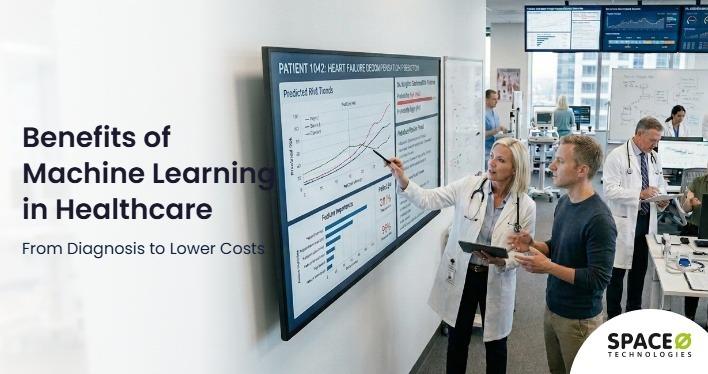
A hospital generates more data in a day than its staff could read in a year. Scans, lab results, notes piling up in the EHR: most of it never gets a second look. Machine learning (ML) changes that. It surfaces the patterns hiding in millions of records and images, then hands a clinician an answer right when a decision is due. Used well, ML drives better patient outcomes, lowers costs, and increases operational efficiency in healthcare.
That practical payoff is why the benefits of machine learning in healthcare now attract real budgets rather than pilot funding. In the US, machine learning holds a 45% share of the AI in healthcare market in 2025, more than any other AI technology, according to Towards Healthcare.
These gains are measurable, too. You can point to faster diagnoses, fewer avoidable admissions, and shorter drug-research timelines, and they add up across hospitals, payers, and research teams.
This article keeps its focus on the benefits and the outcomes that lead healthcare organizations to invest in machine learning development services. Below, you will find the 10 that matter most, who gains from each, and where they already deliver results.
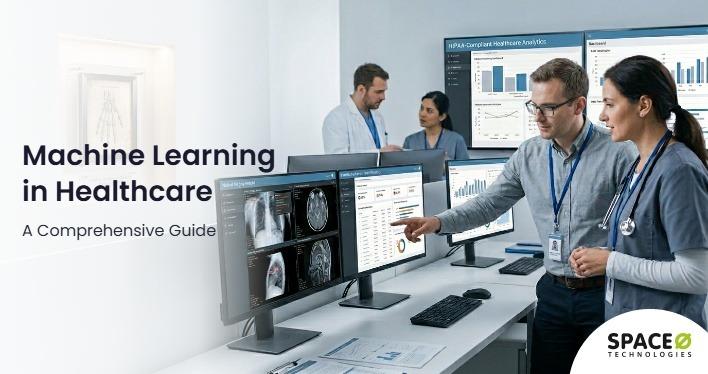
How Machine Learning Benefits Healthcare Across the Care Journey
Machine learning for healthcare earns its place by turning messy clinical data into decisions people can act on. It reads images, records, and device signals at a scale no team can match, which helps clinicians catch disease sooner, match treatment to the individual, and pull waste out of daily operations. The benefits of machine learning in healthcare run the length of the care journey, from a patient’s first scan to long-term population planning.
One thing worth saying up front: these gains track data quality far more than model hype. A simple model trained on clean, well-labeled records will out-deliver a sophisticated one fed messy data, which is why the strongest results tend to follow the teams that fix their data first.
This is not a single-department story. The same core capability sharpens how providers diagnose, how patients are monitored, how researchers develop therapies, and how administrators keep costs and fraud in check. The value lands at the clinical, operational, and financial level at once, and that breadth is exactly what a healthcare AI development company is built to deliver.
Here is where it shows up first:
- More accurate, earlier diagnosis
- Predictive analytics and risk stratification
- Personalized and precision treatment
- Faster drug discovery and development
- Smarter, faster clinical trials
- Lower administrative burden and costs
- Continuous patient monitoring and remote care
- Insight from unstructured clinical data
- Fraud detection and revenue-cycle accuracy
- Better population health and resource planning
Each of these earns its place, so let’s take them one at a time.
See Where Machine Learning Can Deliver the Fastest Wins in Your Organization
Across 500+ AI projects, we have learned the fastest ROI comes from the right first use case. We help healthcare teams pinpoint it, then build it around their data, budget, and timeline.
The 10 Benefits of Machine Learning in Healthcare in Detail
Every benefit below starts with the outcome, then shows how it plays out in day-to-day care. Together, they explain why machine learning healthcare applications keep moving out of the lab and into routine clinical work.
1. More accurate, earlier diagnosis
Some findings hide in plain sight. Machine learning algorithms in healthcare catch them on X-rays, MRIs, and pathology slides that a tired human eye skims past. The payoff is earlier, more accurate diagnosis and a dependable second read.
How it benefits care in practice:
- Spots early-stage disease such as cancer and Alzheimer’s on MRI and CT scans, when treatment can still change survival rates
- Detects tumors, fractures, and bleeds in radiology scans, often flagging urgent cases first for faster triage
- Flags arrhythmias on EKG readings and polyps during gastroenterology screening that a quick human read can skim past
- Screens retinal images for diabetic retinopathy, catching a leading cause of blindness before symptoms appear
- Identifies suspicious lesions in mammograms and dermatology images for a consistent second opinion
These same diagnostic models now reach patients directly. Our guide to AI symptom checker development shows how they triage symptoms at home and point people to the right level of care before a visit.
2. Predictive analytics and risk stratification
Risk rarely announces itself. ML models score each patient for conditions like sepsis, diabetes, or heart failure before the symptoms show, so care teams can step in while there is still time to change the outcome.
Where predictive analytics adds value:
- Early-warning scores for sepsis and clinical deterioration in hospital and ICU settings
- Readmission risk flags that trigger follow-up before a patient returns to the ER
- Onset prediction for chronic conditions like diabetes, kidney disease, and heart failure
3. Personalized and precision treatment
Two patients with the same diagnosis rarely need the same drug. By weighing a patient’s genetics, history, and lifestyle against millions of similar cases, machine learning in medicine points to the therapy and dose most likely to work for them.
Examples of precision treatment:
- Matching cancer patients to targeted therapies based on tumor genetics
- Predicting how a patient will respond to a specific drug or dosage
- Tailoring chronic care plans using lifestyle and continuous monitoring data
- Flagging likely drug interactions in advance to reduce adverse reactions
4. Faster drug discovery and development
Bringing a drug to market can take a decade. Deep learning applications in healthcare cut into that timeline, screening millions of compounds and predicting which will work before a lab test runs. Months replace years, and costs fall.
How ML accelerates drug development:
- Screens millions of compounds to shortlist the most promising candidates
- Predicts protein structures and how molecules will bind to their targets
- Identifies existing drugs that can be repurposed for new conditions
- Prioritizes safer candidates earlier, reducing costly late-stage failures
5. Smarter, faster clinical trials
Recruitment is where most trials stall. ML scans health records and matches eligible patients to studies in minutes, not weeks. It also flags likely dropouts early, so a trial holds its cohort and reaches reliable results on schedule.
Benefits across the trial lifecycle:
- Automated patient matching from EHRs against complex eligibility criteria
- Dropout prediction so coordinators can intervene and keep cohorts intact
- Smarter site selection based on patient populations and past performance
- Real-time data monitoring that catches quality issues before they spread
6. Lower administrative burden and costs
Paperwork is the quiet tax on every clinic. Machine learning automates the scheduling, coding, documentation, and record-keeping behind it, handing staff hours back and easing the load that drives clinician burnout. The operational savings follow.
Where ML reduces administrative load:
- Automated medical coding and claims preparation drawn from clinical notes
- Ambient documentation that drafts visit notes while the clinician focuses on the patient
- No-show prediction and smart scheduling that protect provider capacity
- Optimized surgery and operating-room scheduling that raises utilization without overbooking staff
- Faster, more accurate billing that reduces denials and rework
Most of these savings depend on a smarter EHR underneath, which is exactly what AI EHR mobile app development makes possible.
7. Continuous patient monitoring and remote care
Care used to pause the moment a patient went home. Now models read wearables and home devices in real time and alert clinicians the instant something shifts, catching trouble in the gap between visits.
What continuous monitoring enables:
- Remote tracking of vitals for chronic conditions like hypertension and heart disease
- Real-time alerts when readings cross dangerous thresholds
- Fall detection and activity monitoring for elderly and at-risk patients
All that remote data has to live somewhere safe. A HIPAA-compliant patient portal gives patients and clinicians a secure place to view it and act on it.
Cut Administrative Burden and Cost With Machine Learning Built for Your Workflows
From medical coding to scheduling and billing, we automate the repetitive work that drains staff time, so your team spends more hours on patients than paperwork.
8. Insight from unstructured clinical data
Most clinical detail never makes it into a tidy database field. It lives in free-text notes and reports. Natural language processing reads that unstructured data at scale and pulls out the diagnoses, symptoms, and patterns the structured fields miss.
How NLP unlocks hidden data:
- Extracts diagnoses, medications, and symptoms from physician notes
- Summarizes long patient histories into a usable clinical snapshot
- Captures social determinants of health buried in narrative text
- Converts documentation into structured codes for billing and analytics
Most of this runs on named entity recognition, which tags drugs, diagnoses, and symptoms inside plain-text notes.
9. Fraud detection and revenue-cycle accuracy
Billing fraud hides in volume. ML reviews claims data and flags irregular patterns people miss, catching fraud and coding errors before a payment goes out. That is why payers and agencies like the CMS run it across millions of claims.
How ML protects revenue:
- Flags anomalous, duplicate, or upcoded claims before payment
- Detects organized fraud patterns across large claim volumes, as the CMS does
- Predicts claim denials so teams can fix issues before submission
- Improves coding accuracy to lower compliance risk
10. Better population health and resource planning
Zoom out from the individual patient, and the picture changes. Machine learning analyzes whole populations to forecast disease spread, demand, and resource needs, so health systems staff the right shifts and stock the right supplies before the pressure hits.
Where population-level ML helps:
- Forecasts outbreaks and seasonal surges in demand
- Predicts ER visits, admissions, and bed occupancy for better staffing
- Targets preventive programs at high-risk communities
- Optimizes supply and equipment planning to avoid shortages
That is the full set of benefits. Which ones matter most, though, depends on where you sit in the system.
Machine Learning Benefits for Providers, Patients, and Payers
The table below maps the main benefits to each group, so you can see which healthcare use cases for machine learning matter most to your role.
| Stakeholder | Primary benefits | Example impact |
|---|---|---|
| Providers and clinicians | Earlier diagnosis, risk stratification, and less documentation | A reliable second read on images and more time with patients |
| Patients | Personalized treatment, remote monitoring, earlier intervention | Care matched to their data and fewer late-stage diagnoses |
| Payers and administrators | Fraud detection, cost reduction, and accurate coding | Lower claims leakage and cleaner revenue cycles |
| Pharma and research teams | Faster drug discovery, smarter trials | Shorter discovery timelines and faster recruitment |
The benefits also feed each other. A model that sharpens a clinician’s diagnosis gets the patient treated sooner and trims the payer’s downstream costs at the same time. That compounding is the real case for investing in machine learning healthcare applications, and capturing it usually starts with machine learning consulting services that map the highest-value use cases first.
Turn These Machine Learning Benefits Into a Working System for Your Team
Whether you serve patients, manage a plan, or run research, our 80+ AI specialists design and deploy production-ready ML, proven across 500+ projects, that fits your data, stack, and compliance needs.
Build Your Healthcare Machine Learning Solution With Space-O AI
The benefits in this article are not abstractions. Earlier diagnoses, personalized treatment, lower costs, and healthier populations are documented results. The difference between the organizations that achieve them and the ones still stuck in pilots usually comes down to execution: getting a model into production on clean, well-governed data.
Turning a promising prototype into a system clinicians trust is exactly where Space-O AI helps. With 15+ years of experience and 500+ AI projects delivered across healthcare, finance, and other regulated industries, our team of 80+ AI specialists builds machine learning systems that hold up in real clinical settings, not only in testing.
Our work covers the exact capabilities behind every benefit in this article: HIPAA-compliant healthcare AI platforms, custom diagnostic and predictive models, computer vision for medical imaging, natural language processing for clinical records, and full delivery from data preparation through deployment and ongoing monitoring.
We pair that engineering depth with strict attention to data quality, security, and compliance, the factors that decide whether a healthcare model succeeds in production.
Ready to turn your healthcare data into earlier diagnoses, lower costs, and better outcomes? Book a free consultation with our team to discuss your requirements, timeline, and the highest-ROI use cases for your organization. Let’s build a machine learning solution that delivers measurable results.
Frequently Asked Questions on Machine Learning in Healthcare
What is machine learning in healthcare?
Machine learning in healthcare is the use of algorithms that learn from medical data, like scans, records, and lab results, to find patterns and support clinical decisions. It is the practical core of machine learning and artificial intelligence in healthcare, and the most applied branch of data science for healthcare, powering tasks from diagnosis and risk scoring to billing and scheduling.
What is the biggest benefit of machine learning in healthcare?
The biggest benefit is earlier, more accurate decision-making. Machine learning detects disease and risk sooner than manual review alone, which improves outcomes and lowers the cost of late-stage care that would otherwise pile up. A model that catches a problem weeks earlier changes the whole treatment path. Most other benefits, from lower costs to personalized care, build on that single head start.
Which areas of healthcare benefit most from machine learning?
Medical imaging, predictive risk scoring, drug discovery, and administrative operations see the strongest returns today. They share two traits: large, structured datasets and clear, repeatable decisions. That combination is exactly where machine learning algorithms in healthcare perform best, because the models have enough clean data to learn from and a well-defined question to answer. Newer areas like genomics are catching up fast.
How does machine learning reduce healthcare costs?
It cuts costs in a few places at once. Machine learning automates admin work like coding and scheduling, heads off expensive complications through early detection, and catches fraud and billing errors before they turn into losses. Fewer late-stage cases and cleaner claims add up quickly across a health system. None of it requires cutting corners on the quality of care.
Why is machine learning important in healthcare?
Because healthcare’s real bottleneck is data, not effort, no clinician can read every scan, lab value, and note for every patient, so useful signals slip through. Machine learning reviews all of it in seconds and flags what needs a human look. That turns dormant data into earlier, more accurate diagnoses, safer decisions, and time given back to direct patient care.
What are the major advantages of AI ML in healthcare?
The headline advantages are earlier diagnosis, predictive risk scoring, personalized treatment, faster drug discovery, and lower admin cost. The thread running through them is scale: AI and machine learning in healthcare process more data than any team, then turn it into a decision at the point of care. That is why machine learning and AI in healthcare keep spreading into new roles.
How is machine learning used in healthcare?
Machine learning in the medical field shows up in a few recurring ways. The most common machine learning in healthcare examples are reading medical images, predicting patient risk, matching people to clinical trials, and flagging suspicious billing. In each case, the model does the heavy data work and turns raw clinical records into a clear answer at the point of care.
What are common applications of machine learning in healthcare?
So how can machine learning be used in healthcare? Across the whole care journey. The most common applications of machine learning in healthcare are medical imaging analysis, predictive risk analytics, NLP of clinical notes, drug discovery, trial matching, and billing fraud detection. Those AI ML use cases in healthcare look like reading a scan, flagging a deteriorating patient, or auto-coding a visit.
Do the benefits of machine learning replace doctors?
No. The point is augmentation, not replacement. Machine learning does the data-heavy work and surfaces what matters, while clinicians bring the judgment, context, and accountability that no model has. Used well, it gives doctors better information and more time with patients, rather than taking decisions out of their hands. The clinician stays firmly in charge of the final call.
Need a Healthcare ML Model Built?


What to read next