- 1. AI-Powered Patient Triage and Symptom Assessment
- 2. Real-Time Clinical Decision Support During Consultations
- 3. Ambient Clinical Intelligence for Documentation
- 4. Remote Patient Monitoring with Predictive Analytics
- 5. AI-Driven Chronic Disease Management
- 6. AI Chatbots for 24/7 Patient Engagement
- 7. Mental Health Support and Therapy Assistance
- 8. Automated Prior Authorization and Claims Processing
- 9. AI-Powered Medical Coding and Billing
- 10. AI Diagnostic Tools for Medical Imaging
- 11. Generative AI for Personalized Patient Education
- 12. AI-Powered Clinical Trial Matching
- Turn AI Telemedicine Use Cases Into Scalable Healthcare Solutions with Space-O AI
- Frequently Asked Questions
- 1. What is the most impactful AI use case to start with in telemedicine?
- 2. How do AI diagnostic tools in telemedicine comply with FDA regulations?
- 3. How long does it take to implement AI in an existing telemedicine platform?
- 4. What are the biggest challenges in AI telemedicine implementation?
- 5. Can AI reduce clinician burnout in telemedicine?
- 6. What is the typical ROI timeline for AI investments in telemedicine?
AI Use Cases in Telemedicine: 12 Applications Transforming Virtual Healthcare

 Last Updated: January, 12 2026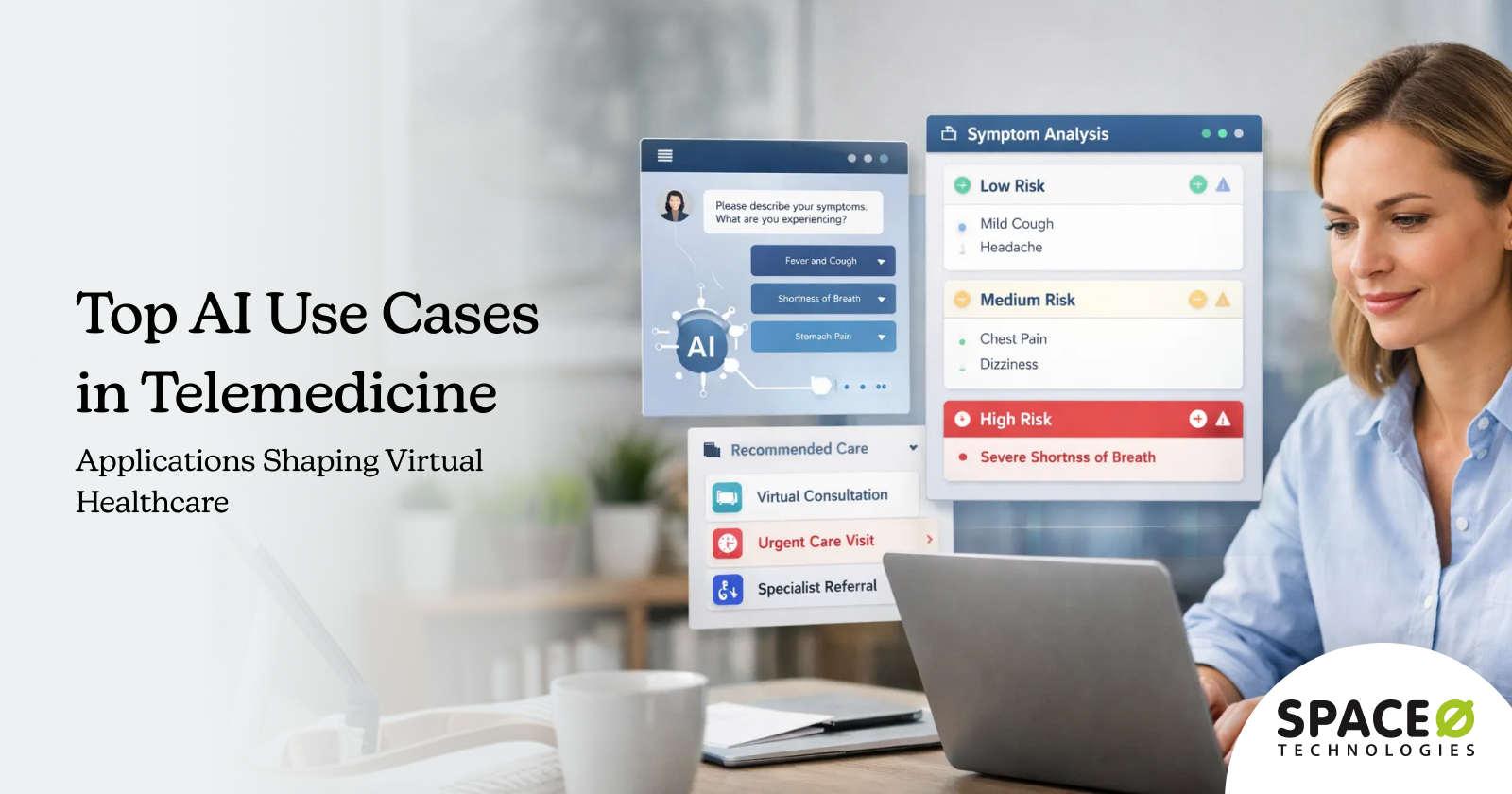
Telemedicine has evolved beyond basic virtual consultations into a comprehensive digital care ecosystem that supports diagnosis, treatment, monitoring, and ongoing patient engagement. As healthcare providers scale virtual care services, they are increasingly looking for ways to improve efficiency, maintain care quality, and manage growing volumes of clinical and patient data.
Artificial intelligence is playing a central role in this transformation by enabling automation, real-time insights, and data-driven decision-making across telemedicine workflows. According to Precedence Research, the AI in the telemedicine market is projected to reach $176.94 billion by 2034, highlighting the accelerating adoption of AI-driven capabilities in virtual healthcare.
AI use cases in telemedicine range from automated patient triage and clinical decision support to remote patient monitoring and predictive analytics. These applications help healthcare organizations deliver faster, more personalized care while optimizing resources and scaling virtual services effectively.
This blog explores the 12 impactful AI use cases in telemedicine. We have shared insights from our experience as a trusted AI healthcare software development agency to explain how healthcare providers, clinics, hospitals, and digital health companies can apply these use cases to improve patient outcomes and operational performance.
1. AI-Powered Patient Triage and Symptom Assessment
What it is
Intelligent symptom checkers leverage natural language processing and medical knowledge graphs to assess patient symptoms conversationally. These systems determine urgency levels and route patients to appropriate care pathways, whether emergency services, urgent care, or routine appointments.
Key applications
- Conversational symptom assessment via chatbot, voice, or mobile app interfaces
- Risk stratification with urgency scoring across emergency, urgent, and routine categories
- Pre-visit data collection that integrates directly with EHR systems
- Red flag detection algorithms for critical conditions requiring immediate attention
Implementation requirements
- Medical knowledge database with comprehensive symptom-condition mapping
- NLP engine trained on healthcare terminology and patient language patterns
- EHR integration for accessing patient history and providing contextual recommendations
- Clinical validation protocols ensuring accuracy across diverse patient populations
Implementation Complexity: Medium
2. Real-Time Clinical Decision Support During Consultations
What it is
Clinical decision support systems powered by AI provide physicians with evidence-based recommendations during live video consultations. These tools analyze patient data in real-time and surface relevant diagnostic possibilities, treatment options, and safety alerts.
Key applications
- Differential diagnosis suggestions based on symptoms, history, and current presentation
- Drug interaction and contraindication alerts before prescriptions are written
- Evidence-based treatment protocol recommendations aligned with clinical guidelines
- Compliance checks ensure care aligns with quality measures and best practices
Implementation requirements
- Real-time data processing infrastructure capable of sub-second response times
- Integration with prescription databases, lab systems, and clinical references
- Clinical decision support framework with physician override capabilities
- Comprehensive training programs for clinician adoption and workflow optimization
Implementation Complexity: High
Ready to Implement AI-Powered Clinical Decision Support for Your Platform?
Our healthcare AI experts have delivered 500+ successful projects with enterprise-grade security and 99% accuracy benchmarks validated in production environments.
3. Ambient Clinical Intelligence for Documentation
What it is
Ambient clinical intelligence systems listen to patient-physician conversations during virtual visits and automatically generate clinical documentation. This technology eliminates the need for physicians to manually type notes, allowing them to focus entirely on the patient.
Key applications
- Real-time transcription of video consultation audio with speaker identification
- Automatic SOAP note generation structured for EHR integration
- Medical entity extraction identifying symptoms, medications, diagnoses, and procedures
- Direct EHR population eliminates copy-paste workflows and duplicate entry
Implementation requirements
- Speech recognition models optimized for medical terminology and accents
- NLP pipelines for structuring free-form conversation into clinical note formats
- HIPAA-compliant audio processing with encryption and access controls
- EHR API integration supporting major platforms like Epic, Cerner, and Meditech
Implementation Complexity: Medium-High
This capability represents a significant step toward reducing clinician burnout. When combined with NLP in telemedicine applications, ambient intelligence transforms how virtual care is documented and delivered.
4. Remote Patient Monitoring with Predictive Analytics
What it is
Predictive remote patient monitoring combines continuous data collection from wearables and IoMT devices with machine learning models that detect health deterioration before it becomes critical. This proactive approach shifts care from reactive to preventive.
Key applications
- Continuous vital sign monitoring, including heart rate, SpO2, blood pressure, and temperature
- Anomaly detection algorithms identifying deviations from patient baselines
- Patient deterioration prediction using multi-variable risk models
- Automated escalation triggers care team notifications when thresholds are breached
Implementation requirements
- IoMT device integration supporting multiple manufacturer protocols and data formats
- Real-time analytics infrastructure processing continuous data streams
- Alert management systems prevent notification fatigue while ensuring critical alerts reach clinicians
- Patient-facing mobile applications for data collection and engagement
Implementation Complexity: High
5. AI-Driven Chronic Disease Management
What it is
Specialized AI applications help manage long-term conditions through personalized monitoring, medication optimization, and lifestyle coaching delivered via telemedicine platforms. These tools extend care between appointments and improve adherence.
Key applications
- Heart failure decompensation prediction using weight trends, symptoms, and vital signs
- Diabetes management with glucose pattern analysis and insulin optimization suggestions
- COPD exacerbation prediction based on respiratory metrics and environmental factors
- Hypertension monitoring with medication titration recommendations
Implementation requirements
- Disease-specific predictive models trained on longitudinal patient data
- Integration with condition-specific devices, including glucose monitors, smart scales, and pulse oximeters
- Patient engagement platforms delivering education and motivation
- Care coordination workflows connecting patients with care managers and specialists
Implementation Complexity: High
Chronic disease management represents one of the highest-value applications of AI for healthcare, addressing conditions that account for 90% of healthcare spending.
Implement AI Where It Matters Most
From patient triage to predictive analytics, our AI experts help you deploy telemedicine use cases that deliver measurable outcomes.
6. AI Chatbots for 24/7 Patient Engagement
What is it
Conversational AI agents handle patient inquiries, schedule appointments, send reminders, and provide health information around the clock without requiring staff expansion. These AI chatbot solutions serve as the first point of contact for many patient interactions.
To ensure the healthcare chatbot performs optimally, you can get assistance from an expert AI chatbot development agency like Space-O AI to build your telemedicine chatbot. Sch agencies bring years of development expertise and talent to build professional-grade solutions.
Key applications
- Appointment scheduling, rescheduling, and cancellation handling
- Pre-visit intake collecting symptoms, insurance, and demographic information
- Medication reminders and prescription refill request processing
- FAQ responses covering common questions about conditions, procedures, and logistics
Implementation requirements
- Natural language understanding engine trained on healthcare domain conversations
- Integration with scheduling, billing, and EHR systems for complete workflow automation
- Escalation protocols ensuring complex issues reach human agents appropriately
- Multi-channel deployment across web, SMS, WhatsApp, and patient portal interfaces
Implementation Complexity: Low-Medium
7. Mental Health Support and Therapy Assistance
What it is
AI-powered mental health tools provide screening, therapy support between sessions, and crisis detection for behavioral health telemedicine programs. These applications extend therapeutic reach while ensuring safety through appropriate escalation.
Key applications
- Mood tracking and symptom monitoring through daily check-ins
- Cognitive behavioral therapy exercises are delivered between live sessions
- Crisis detection algorithms identifying language patterns indicating risk
- Therapist session preparation with patient activity summaries
Implementation requirements
- Sentiment analysis models detecting emotional states from text and voice
- Evidence-based therapeutic content libraries developed with clinical oversight
- Emergency protocol integration with crisis hotlines and care teams
- Enhanced HIPAA compliance for sensitive mental health information
Implementation Complexity: Medium
8. Automated Prior Authorization and Claims Processing
What it is
AI systems automate insurance verification, prior authorization workflows, and claims submission to dramatically reduce administrative burden and accelerate reimbursement cycles that often delay patient care.
Key applications
- Real-time insurance eligibility verification at patient check-in
- Automated prior authorization request generation and submission
- Claims scrubbing, identifying errors before submission to reduce denials
- Denial management with automated appeal letter generation
Implementation requirements
- Payer API integrations across major insurance providers
- Rules engines encoding authorization requirements by payer and service type
- NLP for extracting clinical information from documentation to support requests
- Workflow automation platforms managing multi-step processes
Implementation Complexity: Medium
9. AI-Powered Medical Coding and Billing
What it is
NLP systems analyze clinical documentation and suggest appropriate ICD-10 and CPT codes, improving billing accuracy while reducing compliance risk and capturing revenue that might otherwise be missed.
Key applications
- Automated code suggestions generated from clinical note analysis
- Coding compliance auditing, identifying potential issues before claim submission
- Documentation improvement recommendations when notes lack specificity for optimal coding
- Revenue leakage identification, highlighting commonly missed billable services
Implementation requirements
- NLP models trained on medical coding standards and documentation patterns
- EHR and billing system integration for seamless workflow
- Coder review interfaces supporting efficient human oversight
- Continuous model updates reflecting annual code changes and payer requirements
Implementation Complexity: Medium
Build Custom AI Telemedicine Solutions for Your Use Cases
With 15+ years of proven AI engineering experience, we help healthcare organizations design and implement AI use cases that fit real clinical and operational requirements.
10. AI Diagnostic Tools for Medical Imaging
What it is
This is one of the most innovative computer vision applications in healthcare, where these systems analyze medical images submitted during telemedicine visits, supporting diagnostic decisions for conditions that can be assessed visually. These tools extend specialist capabilities to remote settings.
Key applications
- Dermatology analysis assessing skin lesions for melanoma and other conditions
- Diabetic retinopathy detection from retinal images captured with smartphone adapters
- Wound care assessment, tracking healing progress, and detecting infection signs
- Chest X-ray analysis supporting pneumonia and other respiratory condition detection
Implementation requirements
- Computer vision models trained and validated on diverse medical imaging datasets
- Image quality assessment, ensuring submitted images meet diagnostic standards
- FDA regulatory pathway navigation for clinical diagnostic claims
- Specialist review workflows, maintaining appropriate human oversight
Implementation Complexity: High
11. Generative AI for Personalized Patient Education
What it is
Large language models generate customized health education content, discharge instructions, and care plans tailored to individual patient needs, literacy levels, and language preferences.
Key applications
- Personalized health information written at appropriate reading levels
- Multilingual content generation serving diverse patient populations
- Custom discharge instructions based on specific diagnoses and procedures
- Treatment explanations and medication guidance in accessible language
Implementation requirements
- LLM integration with medical knowledge guardrails, preventing harmful content
- Content accuracy validation workflows with clinical review
- Patient literacy and language preference assessment
- Output monitoring, ensuring generated content meets quality standards
Implementation Complexity: Medium
12. AI-Powered Clinical Trial Matching
What it is
AI systems analyze patient records against clinical trial eligibility criteria, identifying patients who may benefit from research participation. This creates value for patients seeking new treatments and organizations participating in research.
Key applications
- Automated eligibility screening compares patient data against trial criteria
- Patient notification systems alerting eligible individuals to relevant opportunities
- Trial site coordination facilitates referrals between care providers and research centers
- Outcome tracking for patients enrolled through AI-matched programs
Implementation requirements
- Clinical trial database integration with major registries and sponsor systems
- NLP for parsing complex eligibility criteria into queryable rules
- Patient consent management for research-related data use
- Research coordinator workflows for managing matched patient outreach
Implementation Complexity: Medium-High
Understanding these use cases provides a foundation for implementing AI in healthcare settings. However, successful implementation requires careful attention to compliance, integration, and organizational change management.
Turn AI Telemedicine Use Cases Into Scalable Healthcare Solutions with Space-O AI
AI transforms telemedicine through powerful use cases spanning triage, diagnostics, remote monitoring, and administrative automation. Each application delivers measurable ROI while improving patient outcomes and reducing clinician burnout significantly.
Space-O AI is a leading AI development company with 15+ years of experience building production-ready healthcare solutions. We specialize in HIPAA-compliant telemedicine platforms that integrate seamlessly with existing clinical workflows.
Our healthcare AI expertise spans conversational chatbots, predictive analytics, computer vision diagnostics, and NLP-powered documentation. We have delivered 500+ successful AI projects, helping healthcare organizations achieve significant efficiency improvements.
From MVP development to enterprise-scale deployment, we partner with healthcare organizations at every stage. Our team provides end-to-end support, including strategy consulting, custom development, integration, and ongoing optimization.
Frequently Asked Questions
1. What is the most impactful AI use case to start with in telemedicine?
AI-powered patient triage and chatbots for scheduling offer the fastest time-to-value with manageable implementation complexity. They reduce administrative burden immediately while establishing AI infrastructure for more advanced applications. Start with a focused MVP targeting one specialty or service line before expanding.
2. How do AI diagnostic tools in telemedicine comply with FDA regulations?
AI diagnostic tools may be classified as Software as Medical Device requiring FDA clearance, depending on intended use and risk level. Tools providing clinical decision support with physician oversight typically face a lower regulatory burden than autonomous diagnostic systems. Engage regulatory experts early in development to navigate appropriate pathways.
3. How long does it take to implement AI in an existing telemedicine platform?
Implementation timelines range from 2-3 months for chatbots and scheduling automation to 6-12 months for complex predictive analytics and diagnostic tools. MVP approaches enable faster deployment of core functionality while allowing iterative enhancement based on real-world performance and user feedback.
4. What are the biggest challenges in AI telemedicine implementation?
Key challenges include EHR integration complexity, data quality issues affecting model performance, clinician adoption resistance, and maintaining HIPAA compliance throughout the AI lifecycle. Address these proactively through proper data governance, change management programs, and selecting implementation partners with healthcare experience.
5. Can AI reduce clinician burnout in telemedicine?
Yes. AI documentation tools reduce administrative burden by 40-60%, allowing clinicians to focus on patient care rather than typing. Chatbots handle routine inquiries that would otherwise interrupt clinical work. Decision support tools reduce cognitive load during complex cases. The key is designing AI to augment rather than complicate clinical workflows.
6. What is the typical ROI timeline for AI investments in telemedicine?
Organizations typically see positive ROI within 12-18 months for well-implemented AI solutions. Quick wins like chatbots and scheduling automation may demonstrate returns within 6 months. Complex implementations like predictive analytics require longer investment horizons but deliver higher long-term value through hospitalization prevention and outcome improvements.


Build Use Case–Driven AI Telemedicine Solutions
What to read next