- What Is AI Pharmacy Patient Portal Development?
- Benefits of Building an AI-Enabled Pharmacy Patient Portal
- Must-Have Features of an AI-Driven Pharmacy Patient Portal
- AI-Powered Capabilities in Modern Pharmacy Patient Portals
- 1. AI chatbots for 24/7 prescription inquiries
- 2. Predictive refill reminders based on prescription history
- 3. NLP for patient message processing and intelligent routing
- 4. Personalized medication education content via generative AI
- 5. Drug interaction checking enhanced by AI and knowledge graphs
- 6. Adherence prediction models to identify at-risk patients
- 7. Automated prior authorization assistance
- How to Develop an AI-Driven Pharmacy Patient Portal: Step-by-Step Process
- Step 1: Requirements gathering and compliance assessment
- Step 2: UX/UI design for patients and pharmacists
- Step 3: Backend development and integration
- Step 4: AI and automation implementation
- Step 5: Security implementation and HIPAA compliance
- Step 6: Testing and quality assurance
- Step 7: Deployment and ongoing support
- How Much Does It Cost to Develop an AI Pharmacy Patient Portal?
- Challenges in AI-Driven Pharmacy Patient Portal Development and How to Overcome Them
- Future Trends in AI-Driven Pharmacy Patient Portal Development
- Space-O AI — 15+ Years of AI Patient Portal Development Expertise
- Frequently Asked Questions on AI Pharmacy Patient Portal Development
AI Pharmacy Patient Portal Development: Features, Process, Cost, and Best Practices

 Last Updated: February, 13 2026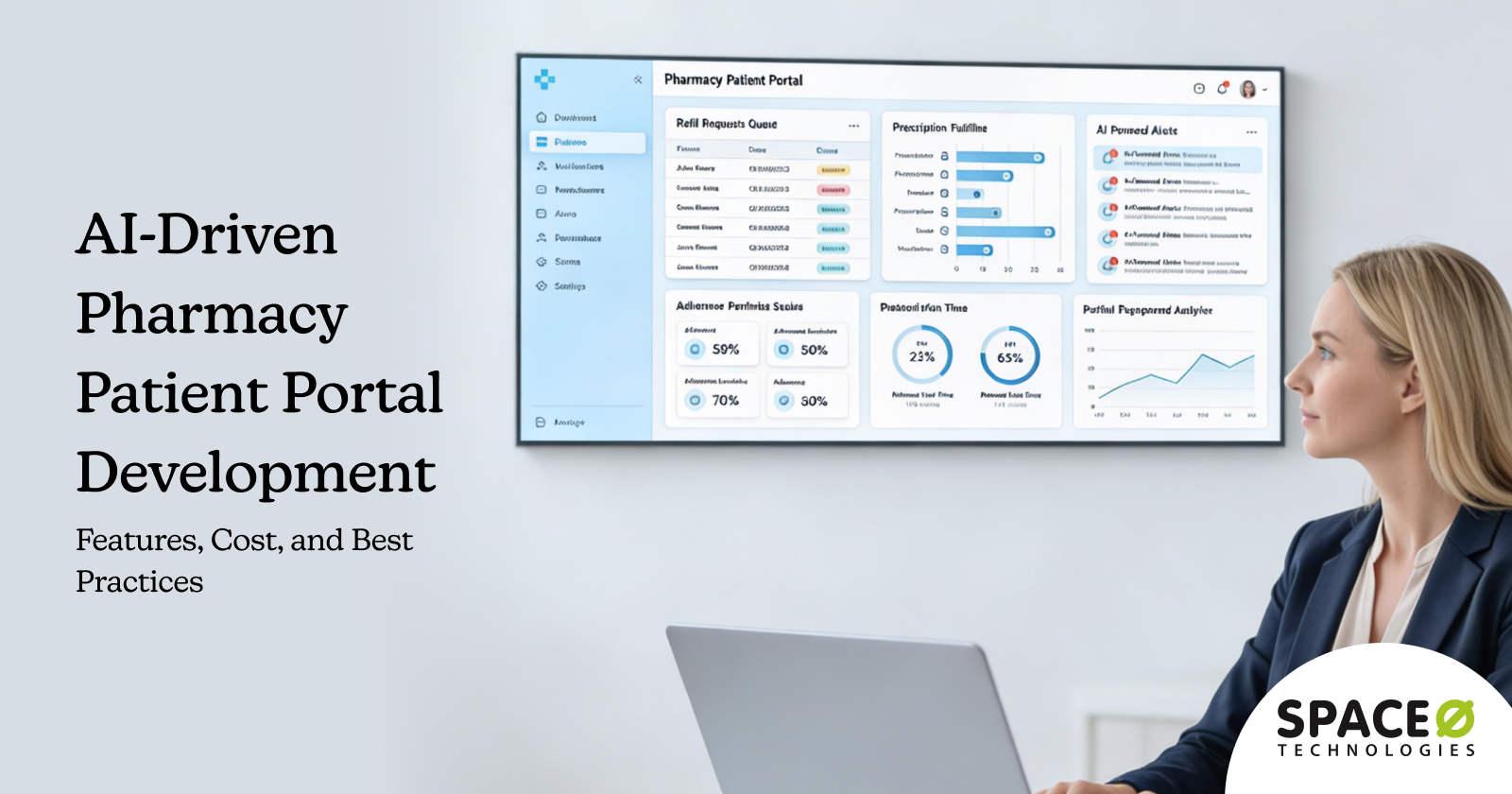
Pharmacies are rapidly evolving from traditional dispensing centers into digitally connected healthcare hubs. Patients now expect convenient online prescription refills, medication reminders, secure communication with pharmacists, digital payment options, and real-time order tracking. At the same time, pharmacies must manage high prescription volumes, ensure regulatory compliance, reduce errors, and improve operational efficiency.
The impact of digital transformation in pharmacy services is already measurable. According to a study published in PMC, digital patient portals for medication refills reduced waiting times by 95%, dropping from 45 minutes to just 2 minutes, while also improving medication adherence rates. This demonstrates how well-designed digital portals can significantly enhance both patient experience and operational workflows.
However, traditional pharmacy portals often provide limited functionality, focusing mainly on refill requests and order tracking. Modern pharmacy operations require intelligent systems that automate workflows, enhance medication adherence, detect potential drug interactions, and integrate seamlessly with EHR, pharmacy management, and insurance systems.
AI-enabled pharmacy patient portals address these needs by combining automation, predictive analytics, conversational AI, and real-time system integration. These platforms can support smart refill reminders, AI-driven medication alerts, secure messaging, automated insurance validation, and personalized health recommendations.
In this blog, we explore how to develop an AI pharmacy patient portal. Drawing from our experience as a trusted AI patient portal development firm, we cover key features, benefits, architecture considerations, development process, compliance requirements, and cost factors you should evaluate when building an intelligent pharmacy portal solution.
What Is AI Pharmacy Patient Portal Development?
AI pharmacy patient portal development refers to the process of designing and building a secure digital platform for pharmacies that is enhanced with artificial intelligence capabilities. These portals enable patients to manage prescriptions, request refills, track medication history, communicate with pharmacists, and make payments, while AI improves automation, safety, and personalization.
Unlike traditional pharmacy portals that mainly support refill requests and basic order tracking, AI-enabled pharmacy portals function as intelligent medication management systems. They streamline pharmacy operations and enhance patient engagement through real-time insights, predictive alerts, and workflow automation.
How AI enhances pharmacy patient portals
AI integration transforms a standard pharmacy portal into a smart healthcare interface by enabling:
- Automated prescription refill reminders based on medication schedules
- AI-powered drug interaction checks and dosage validation alerts
- Predictive adherence monitoring to identify patients at risk of missed doses
- Conversational AI chatbots for refill requests and common pharmacy queries
- Intelligent insurance eligibility verification
- Personalized health and medication guidance
These capabilities reduce manual workload for pharmacy staff while improving patient safety and adherence outcomes.
Now that we understand what AI-driven pharmacy portals are, let’s explore the benefits they deliver compared to traditional solutions.
Benefits of Building an AI-Enabled Pharmacy Patient Portal
Investing in AI-driven pharmacy patient portal development delivers measurable returns that exceed traditional portal implementations. The combination of intelligent automation, predictive analytics, and personalized engagement creates compounding benefits across operations, patient outcomes, and competitive positioning.
1. Reduced administrative workload
AI-driven portals go beyond basic self-service by automating routine tasks. Virtual assistants and intelligent workflows handle common inquiries, appointment scheduling, and status updates, allowing staff to focus on more complex or clinical responsibilities.
2. Improved medication adherence
AI supports patients with timely reminders, educational content, and proactive alerts for potential adherence issues. By identifying risks early, the system helps patients stay on track with their care plans, improving overall health outcomes.
3. Enhanced patient satisfaction and engagement
Portals that anticipate patient needs create smoother, more personalized experiences. Tailored notifications, automated responses, and easy access to information make patients feel supported, increasing engagement and trust.
4. Operational efficiency
Automation and predictive insights streamline workflows, reduce manual errors, and optimize staff time. Organizations can manage tasks more effectively, improving productivity and service quality.
5. Better clinical outcomes
AI-driven insights flag potential issues such as care gaps, medication conflicts, or high-risk behaviors, enabling proactive intervention. Clinicians and care teams can deliver timely, targeted support that improves outcomes.
6. Competitive advantage
Early adoption of AI-enhanced portals positions healthcare organizations as innovators in patient engagement and digital care. Improved efficiency, patient satisfaction, and proactive care create a strong differentiator in a competitive market.
Achieving these benefits requires partnering with an experienced AI healthcare software development agency like Space-O AI, who understand pharmacy workflows and compliance requirements.
To achieve these benefits, your portal needs the right features. Let’s explore the must-have capabilities that drive pharmacy portal success.
Ready to Transform Your Pharmacy with an AI-Driven Patient Portal?
Our healthcare AI experts have delivered 500+ successful projects. Get a free consultation and detailed project assessment to understand how an AI-driven patient portal can benefit your pharmacy.
Must-Have Features of an AI-Driven Pharmacy Patient Portal
Building an effective AI-driven pharmacy patient portal requires combining foundational capabilities with intelligent features that differentiate your solution. Here are the essential capabilities your portal must include, with AI enhancements that maximize value.
1. Medication refill requests and status tracking
The cornerstone of any pharmacy portal is streamlined refill management. Patients should be able to submit refill requests with a few taps, without logging into multiple systems or making phone calls.
- One-click refill requests from the medication list or prescription history
- Real-time status tracking showing processing, filling, and ready-for-pickup stages
- Automatic refill scheduling for maintenance medications
- Refill history with dates, quantities, and pharmacy locations
- Push notifications and SMS alerts when prescriptions are ready
2. E-prescribing integration
Seamless connectivity with prescribers eliminates manual prescription handling and reduces errors. Your portal should integrate with e-prescribing networks for end-to-end digital workflows.
- Direct integration with Surescripts network for electronic prescription receipt
- New prescription notifications sent to patients automatically
- Prescription transfer requests between pharmacies
- Prescriber communication for clarifications and renewals
- Electronic prior authorization status updates
3. Drug interaction alerts and safety checks
Patient safety requires automated clinical decision support that catches potential problems before they reach the pharmacist’s final review.
- Real-time drug-drug interaction warnings displayed to patients
- Allergy cross-checks against patient medication profile
- Duplicate therapy alerts when similar medications are prescribed
- Dosage warnings for elderly patients or those with renal impairment
- Clear, patient-friendly explanations of flagged interactions
4. Medication adherence dashboards
Visual tracking tools help patients understand their medication-taking patterns and motivate better adherence through transparency and gentle accountability.
- Calendar view showing scheduled doses and confirmed takes
- Adherence percentage scores with trend tracking over time
- Customizable reminder schedules via SMS, push, or email
- Refill-too-soon and refill-too-late indicators
- Integration with smart pill bottles and medication tracking apps
5. Patient-pharmacist secure messaging
Direct communication between patients and pharmacists reduces phone tag and enables asynchronous consultation that fits into busy schedules.
- HIPAA-compliant messaging with encryption at rest and in transit
- Structured message templates for common inquiries
- Photo attachment capability for medication identification questions
- MTM consultation scheduling and follow-up messaging
- Escalation workflows route urgent messages to on-duty pharmacists
6. Insurance and copay transparency
Cost surprises drive patients away. Your portal should provide clear pricing information before patients arrive for pickup.
- Real-time copay display after insurance adjudication
- Generic alternative suggestions with price comparisons
- Prior authorization status tracking and required documentation
- Coupon and discount program integration
- Out-of-pocket cost estimates for cash-pay patients
7. Delivery and pickup scheduling
Convenience features that fit pharmacy services into patients’ lives increase engagement and satisfaction.
- Curbside pickup time slot scheduling
- Home delivery tracking with estimated arrival windows
- Preferred pharmacy location selection for multi-location chains
- Drive-through lane reservation during peak hours
- Delivery address management for snowbirds and travelers
You can hire patient portal developers from Space-O AI to build these features. Hiring skills developers helps leverage healthcare domain expertise who understand both technical requirements and pharmacy operations.
These core features form the foundation of an effective pharmacy portal. Now let’s explore how AI elevates pharmacy portals to the next level with intelligent automation and personalization.
AI-Powered Capabilities in Modern Pharmacy Patient Portals
Artificial intelligence transforms pharmacy portals from simple self-service tools into intelligent platforms that anticipate patient needs and automate complex workflows. Here are the AI capabilities that differentiate leading pharmacy portals.
1. AI chatbots for 24/7 prescription inquiries
Conversational AI handles routine questions around the clock without pharmacist intervention. Patients can ask about refill status, drug interactions, side effects, and store hours through natural language conversations. Well-trained chatbots resolve maximum inquiries without human escalation.
2. Predictive refill reminders based on prescription history
Machine learning models analyze prescription fill patterns to predict when patients will need refills. Instead of generic reminders, the system sends personalized notifications timed to each patient’s actual usage patterns, accounting for early refills, late pickups, and seasonal variations.
3. NLP for patient message processing and intelligent routing
Natural language processing automatically categorizes incoming patient messages by urgency, topic, and required expertise. Urgent clinical questions route immediately to pharmacists, while billing inquiries go to administrative staff. This intelligent triage reduces response times and ensures appropriate handling.
4. Personalized medication education content via generative AI
Large language models generate patient-specific medication information tailored to health literacy levels, conditions, and medication combinations. Instead of generic drug information sheets, patients receive explanations written for their specific situation in language they understand.
5. Drug interaction checking enhanced by AI and knowledge graphs
AI-powered clinical decision support goes beyond simple database lookups. Knowledge graphs connect medications, conditions, lab values, and patient characteristics to identify subtle interaction risks that rule-based systems miss.
6. Adherence prediction models to identify at-risk patients
Machine learning identifies patients likely to become non-adherent before they miss doses. Predictive models analyze fill history, demographic factors, and behavioral signals to flag high-risk patients for proactive pharmacist outreach and intervention.
7. Automated prior authorization assistance
Intelligent document processing extracts required information from patient records and completes prior authorization forms automatically. AI reduces PA processing time from days to hours and increases approval rates by ensuring complete, accurate submissions.
With features and AI capabilities defined, let’s walk through the development process that brings your pharmacy portal from concept to launch.
Add AI Intelligence to Your Pharmacy Portal With Space-O AI
Our AI engineers specialize in healthcare applications with HIPAA compliance built in. Discover how AI chatbots and predictive analytics can transform your pharmacy operations.
How to Develop an AI-Driven Pharmacy Patient Portal: Step-by-Step Process
Developing an AI-driven pharmacy patient portal requires careful planning, healthcare-specific expertise, and specialized AI capabilities alongside rigorous compliance. Here is the proven process that delivers successful AI-driven pharmacy portal implementations.
Step 1: Requirements gathering and compliance assessment
The foundation of successful portal development is understanding your pharmacy’s specific needs, workflows, and regulatory environment. This phase identifies what you’re building and the constraints you must work within.
Action items
- Conduct stakeholder interviews with pharmacists, technicians, and operations leaders
- Document current workflows and pain points in prescription processing
- Identify integration requirements with existing pharmacy management systems
- Map HIPAA compliance requirements and state pharmacy board regulations
- Define success metrics and KPIs for portal performance
Step 2: UX/UI design for patients and pharmacists
Pharmacy portals serve diverse users with varying technical abilities. Design must balance comprehensive functionality with intuitive simplicity, especially for elderly patients managing multiple medications.
Action items
- Create user personas for different patient segments and pharmacy staff roles
- Develop wireframes and interactive prototypes for key workflows
- Conduct usability testing with real patients and pharmacy staff
- Ensure WCAG 2.1 accessibility compliance for users with disabilities
- Design responsive interfaces that work seamlessly on mobile and desktop
Step 3: Backend development and integration
The technical foundation connects your portal to pharmacy management systems, e-prescribing networks, and third-party services. Integration quality determines whether your portal streamlines operations or creates new friction.
Action items
- Build secure APIs connecting to pharmacy management systems like PioneerRx or Computer-Rx
- Integrate with Surescripts for e-prescribing and prescription routing
- Connect payment gateways for copay collection and cash transactions
- Implement HL7 FHIR standards for healthcare data exchange
- Develop middleware for legacy system connectivity
Seamless connectivity requires partnering with a patient portal integration agency to connect with pharmacy management systems and EHRs without disrupting existing operations.
Step 4: AI and automation implementation
Integrating AI capabilities requires specialized expertise in machine learning, natural language processing, and healthcare-specific model training.
Action items
- Deploy a conversational AI chatbot with pharmacy-specific training data
- Implement predictive models for refill timing and adherence risk
- Configure NLP for message classification and sentiment analysis
- Integrate clinical decision support for drug interaction checking
- Set up continuous learning pipelines for model improvement
Step 5: Security implementation and HIPAA compliance
Healthcare data requires the highest levels of protection. Security must be built into every layer of your portal, not added as an afterthought.
Action items
- Implement end-to-end encryption for data at rest and in transit
- Configure role-based access controls with principle of least privilege
- Deploy comprehensive audit logging for all PHI access
- Establish BAAs with cloud providers and third-party services
- Conduct security risk assessment per HIPAA requirements
Step 6: Testing and quality assurance
Rigorous testing catches issues before they affect patients or expose compliance vulnerabilities.
Action items
- Execute integration testing across all connected systems
- Perform security penetration testing and vulnerability scanning
- Conduct user acceptance testing with pharmacy staff and patient focus groups
- Validate HIPAA compliance through a third-party assessment
- Load test to ensure performance under peak prescription volumes
Step 7: Deployment and ongoing support
Launch is just the beginning. Successful portals require continuous monitoring, optimization, and support.
Action items
- Execute phased rollout starting with pilot locations or patient segments
- Provide comprehensive training for pharmacy staff on portal management
- Establish monitoring dashboards for performance and adoption metrics
- Implement feedback loops for continuous improvement
- Plan regular updates for new features and security patches
Understanding the process helps estimate costs. Let’s explore what drives pharmacy portal development costs and what budget you should plan.
How Much Does It Cost to Develop an AI Pharmacy Patient Portal?
Estimating the cost of developing an AI-driven pharmacy patient portal requires considering features, integrations, compliance complexity, and ongoing support. Custom patient portals with advanced functionality, including AI capabilities, are considerably more involved than simple static web applications and require specialized development expertise, robust security, and healthcare data compliance.
Typical cost ranges
While exact figures vary by vendor, region, and feature scope, market benchmarks suggest the following ranges for custom AI-enabled patient portals:
| Development Tier | Features Included | Estimated Cost |
| Basic AI Portal | Core patient portal with secure login, user profiles, appointment or refill requests, and simple AI chatbot support | $80,000 to $150,000 |
| Mid-Range AI Portal | Adds predictive reminders, NLP-based messaging, e-prescribing, and insurance integrations | $150,000 to $250,000 |
| Enterprise-Grade AI Portal | Full AI suite, including advanced chatbots, predictive analytics, personalization, multi-system integrations, and mobile apps | $250,000 to $400,000+ |
These figures reflect development for web and mobile experiences with AI-enabled features tailored to user engagement and clinical workflows.
What influences this cost
Development costs are influenced by several key factors:
- Feature Complexity: More advanced AI, such as predictive analytics, generative content, and NLP enhancements, increases development effort.
- System Integrations: Connecting with e-prescribing networks, pharmacy management systems, insurance adjudication, and EHRs adds technical complexity and testing requirements.
- Security and Compliance: Healthcare data requires comprehensive security measures, HIPAA-compliant architectures, and regular compliance assessments.
- User Experience and Accessibility: Designing an intuitive UI that works across devices and meets accessibility standards increases both design and testing time.
- Mobile Apps: Native mobile development for iOS and Android adds significant development hours compared to a web-only portal.
- Ongoing Costs: Post-launch expenses for cloud hosting, maintenance, AI model retraining, and compliance audits typically run 15 to 25 percent of the initial build annually.
Get a Detailed Cost Estimate for Your AI-Driven Pharmacy Portal
Every pharmacy has unique requirements and AI readiness levels. Our team provides detailed proposals with transparent pricing, timeline estimates, and ROI projections tailored to your specific needs.
Challenges in AI-Driven Pharmacy Patient Portal Development and How to Overcome Them
Every AI-driven pharmacy portal project faces unique obstacles beyond traditional development challenges. Understanding these challenges and their solutions helps you plan effectively and avoid costly mistakes.
Challenge 1: Medication adherence and patient engagement
Getting patients to actually use the portal remains the biggest challenge. Many pharmacies build portals that sit unused because they failed to make digital engagement more convenient than phone calls.
How to overcome it
- Implement AI-powered personalized reminders that adapt to patient behavior patterns
- Add gamification elements like adherence streaks and achievement badges
- Send proactive notifications with genuine value, not just marketing messages
- Offer incentives for portal adoption, like faster refill processing
- Design mobile-first experiences that work as easily as consumer apps
Challenge 2: Integration with pharmacy management systems
Legacy pharmacy software often lacks modern APIs, making integration difficult and expensive. Poor integration creates data silos and forces staff to work in multiple systems.
How to overcome it
- Adopt an API-first architecture that abstracts integration complexity
- Use HL7 FHIR standards for healthcare data exchange where supported
- Implement middleware solutions that bridge legacy systems
- Plan for bidirectional sync to keep all systems current
- Budget adequate time for integration testing and edge case handling
Challenge 3: Regulatory compliance (HIPAA, state boards)
Healthcare compliance is non-negotiable but adds complexity and cost. State pharmacy board regulations vary significantly, and HIPAA violations carry severe penalties.
How to overcome it
- Build compliance into architecture from day one, not as an afterthought
- Execute Business Associate Agreements with all vendors handling PHI
- Conduct regular security risk assessments and penetration testing
- Implement comprehensive audit logging for all data access
- Stay current on state-specific telepharmacy and digital communication rules
Challenge 4: Patient adoption and digital literacy
Not all patients are comfortable with technology. Elderly patients managing multiple medications often struggle with digital tools, yet they’re the population that could benefit most.
How to overcome it
- Design for accessibility with large text, high contrast, and simple navigation
- Create guided onboarding flows that walk patients through key features
- Offer multiple access channels, including web, mobile app, and SMS
- Provide in-pharmacy assistance for initial portal setup
- Include caregiver access features for family members helping elderly patients
Challenge 5: Real-time drug interaction checking
Clinical decision support must be fast, accurate, and actionable. Slow or unreliable interaction checking frustrates users and creates patient safety risks.
How to overcome it
- Integrate with established clinical databases like First Databank or Medi-Span
- Implement caching strategies that balance speed with data freshness
- Use AI to reduce alert fatigue by filtering clinically insignificant interactions
- Provide patient-friendly explanations, not just clinical terminology
- Enable pharmacist override workflows for known acceptable interactions
Beyond solving these challenges, staying ahead requires understanding where pharmacy portals are heading. Let’s explore the trends shaping the future of pharmacy patient engagement.
Future Trends in AI-Driven Pharmacy Patient Portal Development
The AI-driven pharmacy portal landscape is evolving rapidly as new technologies emerge. Understanding these trends helps you build a portal that remains competitive and positions your pharmacy for the next wave of innovation.
1. Voice-enabled medication management
Integration with Alexa, Google Assistant, and Siri enables hands-free refill requests and medication reminders. Patients can check prescription status, receive dosing reminders, and request pharmacist callbacks without touching a screen. Voice is particularly valuable for elderly patients and those with visual impairments.
2. Wearable device integration
Smartwatches and fitness trackers are becoming medication management tools. Portals that sync with Apple Watch, Fitbit, and similar devices can deliver dose reminders to the wrist, track medication-taking through motion sensors, and correlate adherence with health outcomes.
3. Blockchain for prescription verification
Distributed ledger technology enables secure, tamper-proof prescription tracking across pharmacies. Blockchain can verify controlled substance prescriptions, prevent duplicate fills across multiple pharmacies, and create auditable chains of custody.
4. Hyper-personalized AI recommendations
Machine learning models are moving beyond refill reminders to comprehensive health recommendations. Future portals will suggest relevant OTC products, identify drug-nutrient interactions with dietary patterns, and provide personalized wellness content based on medication profiles.
5. Telepharmacy integration
Virtual pharmacist consultations are becoming standard portal features. Patients can schedule video consultations for MTM reviews, new medication counseling, and complex therapy discussions directly within the portal without traveling to the pharmacy.
6. Predictive inventory management
AI is connecting patient refill patterns to pharmacy inventory systems. Predictive models forecast demand based on portal activity, enabling pharmacies to optimize stock levels, reduce waste, and ensure medications are available when patients need them.
7. Interoperability via TEFCA
The Trusted Exchange Framework and Common Agreement is enabling national health information exchange. Pharmacy portals will soon access patient medication histories from any provider, creating comprehensive views that improve safety and coordination.
8. Agentic AI for autonomous workflows
The next generation of AI goes beyond chatbots to autonomous agents that handle end-to-end processes. AI agents will manage complete refill workflows, from patient request through insurance verification, pharmacist review, and patient notification, with minimal human intervention.
Build a HIPAA-Compliant Pharmacy Portal With Space-O AI
Get a free consultation with our healthcare AI experts. We will discuss your requirements, analyze your current systems and AI readiness, and provide a detailed proposal with timeline and investment estimates.
Space-O AI — 15+ Years of AI Patient Portal Development Expertise
AI-driven pharmacy patient portal development requires balancing patient convenience, pharmacist workflows, regulatory compliance, and cutting-edge AI innovation. The right portal transforms your pharmacy operations while delivering measurable improvements in adherence, efficiency, and patient satisfaction that traditional solutions cannot match.
Space-O AI brings 15 years of healthcare technology experience and over 500 successful projects to your AI-driven pharmacy portal initiative. Our team understands the unique challenges pharmacies face, from legacy PMS integration to state-specific compliance requirements across different markets.
Our 80+ engineers include specialists in HIPAA-compliant development, pharmacy management system integration, AI chatbots for healthcare, machine learning for adherence prediction, and generative AI for personalized patient engagement. We have delivered AI-powered patient engagement platforms that achieve 99.9% uptime and measurable ROI.
Ready to discuss your AI-driven pharmacy patient portal project? Contact our team for a free consultation where we will analyze your requirements, recommend the right AI approach, and provide transparent cost and timeline estimates tailored to your pharmacy’s needs.
Frequently Asked Questions on AI Pharmacy Patient Portal Development
1. What compliance standards must a pharmacy portal meet?
Pharmacy portals must comply with HIPAA Privacy and Security Rules for protecting patient health information. PCI-DSS compliance is required if the portal processes payments. State pharmacy board regulations govern telepharmacy features and pharmacist-patient communication. Some states have additional requirements for prescription drug monitoring program integration.
2. Can a pharmacy patient portal integrate with existing pharmacy management software?
Yes, modern portals integrate with all major pharmacy management systems, including PioneerRx, Computer-Rx, PrimeRx, QS/1, and Liberty. Integration typically uses APIs, HL7 messaging, or custom middleware, depending on what the PMS supports. Legacy systems may require additional development effort, but integration is almost always achievable.
3. How do AI chatbots improve pharmacy patient portals?
AI chatbots provide 24/7 support for common questions without pharmacist involvement. They handle refill status inquiries, store hours, drug information questions, and appointment scheduling. Well-implemented chatbots resolve 60-80% of inquiries automatically, reducing staff workload while improving patient response times from hours to seconds.
4. How can pharmacies ensure patient adoption of the portal?
Successful adoption requires convenience, value, and support. Design mobile-first experiences that work better than phone calls. Provide clear benefits like faster refills and price transparency. Offer in-pharmacy setup assistance for first-time users. Send targeted communications highlighting features patients care about. Make portal access the path of least resistance for routine tasks.


Launch a Secure AI Pharmacy Portal
What to read next