- What Is AI Patient Portal SaaS Development?
- Benefits of Developing an AI-Patient Portal SaaS
- Key Features of an AI Patient Portal SaaS Platform
- Technical Considerations for Building an AI Portal SaaS
- Step-by-Step AI Patient Portal SaaS Development Process
- AI Patient Portal SaaS Development Cost and Pricing Models
- HIPAA Compliance in AI Patient Portal SaaS Development
- Integration Requirements for SaaS Patient Portals
- Challenges in AI Patient Portal SaaS Development and How to Overcome Them
- 1. Ensuring HIPAA compliance across multiple tenants
- 2. Achieving seamless EHR integration at scale
- 3. Balancing customization with multi-tenant efficiency
- 4. Managing infrastructure costs while scaling
- 5. Ensuring high availability and disaster recovery
- 6. Maintaining AI model accuracy and preventing bias
- Build Your AI Patient Portal SaaS Platform with Space-O AI
- Frequently Asked Questions
- 1. How long does it take to develop an AI patient portal SaaS platform?
- 2. What AI capabilities should an AI patient portal include?
- 3. How do multi-tenant AI models maintain data privacy?
- 4. What HIPAA compliance requirements apply to AI patient portals?
- 5. Can AI features be added to existing patient portal platforms?
- 6. What is the cost difference between basic and AI-powered patient portals?
- 7. How do you ensure AI recommendations are accurate and unbiased?
AI Patient Portal SaaS Development: Benefits, Features, Development Process, and Cost

 Last Updated: April, 3 2026
The healthcare industry is witnessing a fundamental shift toward intelligent patient engagement platforms. According to Research and Markets, the global patient portal market was valued at USD 6.45 billion in 2025 and is projected to reach USD 29.53 billion by 2032. This rapid growth reflects rising demand for scalable, digital-first patient engagement solutions across healthcare systems worldwide.
Patients now expect more than basic record access. They demand intelligent interactions, personalized recommendations, and 24/7 automated support. Traditional portals with static features no longer meet these expectations.
For health IT vendors, SaaS companies, and healthcare startups, AI patient portal SaaS development offers a strategic path to build intelligent, scalable platforms. These platforms deliver personalized patient experiences while serving multiple healthcare organizations from a single, cloud-native codebase.
In this blog, we explore how to develop an AI patient portal SaaS platform. Based on our 15+ years of experience as an AI patient portal development agency, we cover the core architecture, must-have features, development process, compliance requirements, pricing considerations, and scalability strategies required to launch a successful SaaS healthcare product.
What Is AI Patient Portal SaaS Development?
AI patient portal SaaS development refers to building cloud-hosted, subscription-based patient engagement platforms with embedded artificial intelligence capabilities. These platforms serve multiple healthcare organizations from shared infrastructure while delivering intelligent features like conversational chatbots, predictive analytics, personalized content, and automated workflow management.
Unlike traditional portals that simply display health records, AI-powered SaaS portals actively engage patients through intelligent interactions. They predict patient needs, automate routine tasks, and provide personalized experiences at scale.
Core characteristics of AI patient portal SaaS platforms include:
- Embedded AI capabilities, including chatbots, NLP, predictive analytics, and generative AI features
- Multi-tenant AI model architecture enabling shared intelligence while maintaining PHI isolation
- Subscription-based pricing with usage-based billing for AI feature consumption
- Cloud-native infrastructure supporting AI workloads, model serving, and auto-scaling
- Continuous AI improvement through MLOps pipelines that enhance models over time
- Configurable AI behaviors allowing tenants to customize chatbot responses, notification triggers, and recommendation rules
Now that we understand what AI patient portal SaaS development involves, let’s examine the specific benefits this approach offers over traditional portal solutions.
Benefits of Developing an AI-Patient Portal SaaS
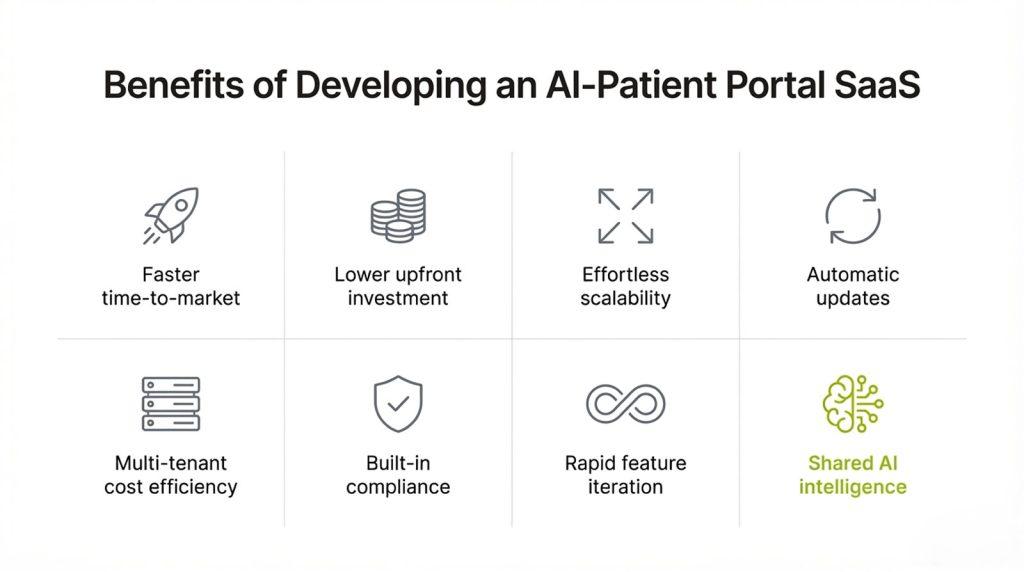
Building AI-powered patient portals as SaaS platforms delivers significant advantages for vendors and healthcare organizations alike. Here are the key benefits that make this approach increasingly popular.
1. Faster time-to-market
Healthcare organizations can launch patient portals within weeks instead of months. Pre-built modules and cloud infrastructure eliminate lengthy hardware procurement and setup cycles, allowing faster deployment and quicker revenue realization for SaaS vendors.
2. Lower upfront investment
SaaS eliminates heavy capital expenditure on servers, data centers, and infrastructure. Subscription-based pricing spreads costs over time, making enterprise-grade patient portals accessible to smaller practices, startups, and organizations with limited IT budgets.
3. Effortless scalability
Cloud-native architecture allows instant scaling as patient volumes and tenant counts grow. Whether onboarding 100 or 100,000 users, SaaS platforms handle increased demand through auto-scaling without hardware upgrades, downtime, or capacity planning headaches.
4. Automatic updates and maintenance
Vendors handle security patches, feature updates, and compliance changes centrally for all tenants. Healthcare organizations benefit from continuous improvements and security fixes without dedicating internal IT resources to maintenance tasks or upgrade projects.
5. Multi-tenant cost efficiency
Shared infrastructure across tenants reduces per-customer operational costs significantly. This efficiency enables competitive pricing for healthcare clients while maintaining healthy margins for SaaS vendors serving multiple organizations from one platform.
6. Built-in compliance frameworks
Reputable SaaS platforms include HIPAA-compliant infrastructure, encryption, access controls, and audit trails by default. Healthcare organizations inherit these security controls rather than building and maintaining compliance capabilities from scratch.
7. Rapid feature iteration
SaaS delivery enables continuous deployment of new features based on user feedback and market demands. Healthcare organizations benefit from ongoing innovation without disruptive upgrade cycles, migration projects, or version compatibility issues.
8. Shared AI intelligence across tenants
Multi-tenant AI models learn from aggregated, anonymized patterns across all healthcare organizations while maintaining strict PHI isolation. This shared learning accelerates AI model accuracy and enables smaller tenants to benefit from insights that would require massive datasets to develop independently.
With these benefits established, let’s explore the specific features that an AI-powered multi-tenant patient portal SaaS platform must include to meet market expectations.
Key Features of an AI Patient Portal SaaS Platform
Building a competitive AI patient portal SaaS platform requires a comprehensive feature set that combines traditional portal capabilities with intelligent automation. The features must balance standardization for multi-tenant efficiency with flexibility for tenant-specific AI configurations.
1. Core patient portal features
Core features form the foundation of the platform and are critical for patient adoption, operational efficiency, and regulatory compliance. These capabilities enable patients to access care, communicate with providers, and manage their healthcare journey digitally.
- Secure patient authentication and access control
HIPAA-compliant login with multi-factor authentication, role-based access, and proxy access for caregivers. - Secure messaging with care teams
Encrypted patient–provider communication with message threading, attachments, and routing to appropriate departments. - Appointment scheduling and management
Real-time availability, self-scheduling, automated reminders, waitlist management, and rescheduling options. - Health records and clinical data access
On-demand access to lab results, visit summaries, medications, immunization records, and care plans via FHIR-based integrations. - Prescription and medication management
Refill requests, medication history, dosage instructions, pharmacy selection, and adherence tracking. - Billing, payments, and statements
Online bill pay, payment plans, insurance explanations of benefits, and transaction history. - Telehealth and virtual care support
Video consultations, virtual visit scheduling, pre-visit questionnaires, and post-visit summaries. - Tenant administration and configuration
White-label branding, feature toggles, workflow configuration, role-based permissions, and self-service onboarding for healthcare organizations. - Analytics and reporting dashboards
Patient engagement metrics, feature adoption tracking, usage analytics, and operational insights at the tenant level.
2. AI-powered features
AI-powered features transform traditional patient portals into intelligent engagement platforms. These capabilities automate routine interactions, personalize patient experiences, and provide actionable insights for healthcare teams.
- AI chatbots for 24/7 patient support
Conversational AI handles appointment queries, prescription questions, billing inquiries, and general health information using natural language understanding. - Natural language processing (NLP) for message triage
NLP models categorize and route incoming patient messages by urgency, topic, and required response type, reducing staff workload. - Predictive analytics for patient engagement
Machine learning models identify patients at risk of missed appointments, medication non-adherence, or disengagement, enabling proactive outreach. - Generative AI for personalized health content
AI-generated visit summaries, care instructions, lab result explanations, and educational content tailored to individual patient contexts. - Operational optimization using machine learning
No-show prediction, appointment slot optimization, and resource allocation to improve clinic efficiency. - Autonomous AI agents for workflow automation
Intelligent agents handle multi-step workflows such as appointment scheduling, insurance verification, and care coordination with minimal human intervention. - AI model configuration at the tenant level
Customizable chatbot behavior, notification triggers, and recommendation logic per healthcare organization while maintaining data isolation.
While features define what an AI patient portal SaaS platform can do, its underlying architecture determines how securely, efficiently, and reliably those capabilities operate at scale. Let’s take a look.
Ready to Build a Feature-Rich Patient Portal SaaS Platform for Healthcare?
Our healthcare AI experts have delivered 500+ successful projects. Get a free technical consultation and detailed feature roadmap for your patient portal SaaS platform.
Technical Considerations for Building an AI Portal SaaS
Architecture decisions made early in development determine the platform’s scalability, AI performance, and long-term maintainability. AI patient portal SaaS platforms require careful attention to multi-tenancy patterns, AI model serving infrastructure, and integration design.
1. Multi-tenancy architecture patterns
The most fundamental architecture decision is how to isolate tenant data while maintaining operational efficiency. Three primary patterns exist, each with distinct tradeoffs:
- Database-per-tenant provides the strongest isolation by giving each healthcare organization a dedicated database. This pattern simplifies compliance audits, enables tenant-specific backups, and allows performance tuning per tenant. However, it increases infrastructure costs and operational complexity as tenant counts grow.
- Shared database with schema isolation uses a single database with separate schemas per tenant. This balances isolation with efficiency, reduces infrastructure costs, and simplifies some operational tasks. Schema migrations require careful coordination across tenants.
- Shared database with row-level isolation stores all tenant data in shared tables with tenant identifier columns. This offers the lowest infrastructure cost and simplest operations, but requires rigorous application-level isolation controls. A single query bug could expose data across tenants.
For healthcare SaaS platforms handling PHI, database-per-tenant or schema isolation typically provides the compliance posture required. Shared row-level isolation demands exceptional engineering discipline and comprehensive testing.
2. Cloud-native infrastructure
Modern patient portal SaaS platforms leverage cloud-native technologies for scalability and resilience. Here are a few:
- Containerization using Docker packages application components into portable units that run consistently across environments. Kubernetes orchestrates containers, handling deployment, scaling, and failover automatically.
- Microservices architecture decomposes the portal into independent services (authentication, messaging, scheduling, etc.) that can scale and deploy independently. This enables teams to iterate on specific features without system-wide deployments.
- Auto-scaling adjusts compute resources based on actual demand. Patient portals experience variable load patterns. Auto-scaling handles morning appointment rushes and end-of-day message volumes without over-provisioning for peak capacity.
3. API-first design for integrations
Healthcare SaaS platforms must integrate with numerous external systems. An API-first design approach treats APIs as primary products rather than afterthoughts:
- FHIR-compliant APIs enable standardized data exchange with EHR systems. Building on FHIR R4 standards accelerates integration timelines and reduces custom development for each EHR connection.
- Webhook infrastructure pushes real-time events to integrated systems. Webhooks notify external applications when patients schedule appointments, send messages, or complete forms without polling.
- Developer portals with documentation, sandboxes, and SDKs enable third-party integrations and marketplace ecosystems. Well-documented APIs accelerate tenant implementations and partner integrations.
Step-by-Step AI Patient Portal SaaS Development Process
Building an AI patient portal SaaS platform requires systematic execution across multiple phases, with dedicated attention to AI model development and MLOps infrastructure. Each phase builds on the previous, with clear deliverables and decision points. Here is the development process we recommend based on our experience delivering intelligent healthcare platforms.
Phase 1: Discovery and requirements analysis
Understanding market needs, target customers, and compliance requirements forms the foundation of successful SaaS portal development. This phase defines the product roadmap and competitive differentiators that will drive adoption and revenue.
Action items
- Conduct market research to identify underserved segments and feature gaps
- Define ideal customer profiles (ICPs), including health systems, practices, and specialties
- Map HIPAA, state-level, and international compliance requirements
- Document functional requirements through stakeholder interviews
- Define non-functional requirements for performance, scalability, and availability
- Create a product roadmap with MVP scope and future phases
Phase 2: Architecture design and technology selection
Technical architecture decisions impact scalability, security, and long-term maintenance costs. Choosing the right multi-tenancy pattern and cloud infrastructure determines platform economics and compliance posture.
Action items
- Select a multi-tenancy database architecture pattern based on isolation needs
- Evaluate cloud providers for HIPAA compliance capabilities (AWS, Azure, GCP)
- Design a microservices architecture with service boundaries and communication patterns
- Plan security architecture, including encryption, authentication, and access control
- Define API standards and integration architecture
- Create infrastructure-as-code templates for repeatable deployments
Phase 3: MVP development and core features
Building a focused minimum viable product validates market fit before full-scale investment. Core patient-facing and tenant management features should demonstrate clear value while keeping development scope manageable.
Investing early in patient portal MVP development allows healthcare organizations to validate user experience, engagement workflows, and security requirements before expanding into advanced features.
Action items
- Develop patient authentication with MFA and identity verification
- Build a health records access module with FHIR data retrieval
- Create secure messaging with provider routing and notifications
- Implement appointment scheduling with availability management
- Build a tenant onboarding flow with white-labeling configuration
- Develop a role-based access control framework for staff permissions
- Create a basic analytics dashboard for tenant administrators
Phase 4: Integration layer development
Healthcare SaaS platforms must connect seamlessly with clinical systems. FHIR-compliant APIs and pre-built connectors accelerate tenant implementations and reduce deployment timelines for healthcare clients.
Action items
- Implement FHIR R4 API endpoints for standard resources
- Build EHR connectors for major platforms (Epic, Cerner, athenahealth)
- Integrate payment gateways for online bill pay functionality
- Develop webhook infrastructure for real-time event notifications
- Create an integration testing framework with mock EHR environments
- Build monitoring and alerting for integration health
Phase 5: Testing, compliance certification, and launch
Rigorous security testing and compliance validation protect both the SaaS vendor and healthcare clients. Third-party audits build trust and accelerate enterprise sales cycles where security questionnaires dominate procurement.
Action items
- Conduct penetration testing and vulnerability assessments
- Execute comprehensive functional and regression testing
- Complete HIPAA compliance audit and gap remediation
- Prepare BAA templates and compliance documentation
- Obtain SOC 2 Type II certification through the audit process
- Execute beta launch with pilot tenants for feedback
- Develop tenant implementation playbooks and training materials
Phase 6: Continuous iteration and optimization
Post-launch success depends on rapid iteration based on user feedback and platform data. MLOps practices ensure AI features remain accurate and effective over time as patient populations and behaviors evolve.
Action items
- Release features continuously based on tenant feedback and usage data
- Monitor AI model performance and trigger retraining when accuracy degrades
- Optimize cloud infrastructure costs through reserved instances and right-sizing
- Expand the EHR integration library based on tenant demand
- Build partner ecosystem and app marketplace capabilities
- Scale customer success operations as the tenant base grows
If you need experienced developers to execute this process, you can hire patient portal developers from our team with healthcare domain expertise and AI engineering capabilities.
With the development process outlined, let’s examine the costs involved in building a patient portal SaaS platform.
AI Patient Portal SaaS Development Cost and Pricing Models
AI patient portal SaaS development typically costs between $200,000 and $600,000+, depending on AI sophistication, integration requirements, and compliance certification scope. The embedded AI capabilities add development complexity but deliver significant competitive differentiation and operational value.
The following table breaks down development costs by platform complexity level.
| Complexity Level | Features Included | Estimated Cost Range |
|---|---|---|
| AI-Ready SaaS Portal | Patient authentication, health records access, secure messaging, appointment scheduling, rule-based chatbot, basic tenant management, single EHR integration | $200,000–$300,000 |
| AI-Powered SaaS Portal | All basic features + NLP chatbot, predictive analytics, multiple EHR integrations, white-labeling, ML-powered insights, payment processing | $300,000–$450,000 |
| Enterprise AI Platform | All advanced features + custom LLM fine-tuning, generative AI content, tenant marketplace, HITRUST certification, global deployment, and advanced MLOps | $450,000–$700,000+ |
AI-Ready SaaS Portal suits startups and vendors entering the market with foundational AI capabilities. This tier includes rule-based automation and basic chatbots while validating product-market fit before investing in advanced ML features.
AI-Powered SaaS Portal targets mid-market healthcare organizations requiring sophisticated AI capabilities, including NLP, predictive analytics, and intelligent automation. This tier supports competitive differentiation and premium pricing.
Enterprise AI Platform serves large health systems and vendors targeting enterprise contracts with custom AI requirements. This tier includes fine-tuned language models, advanced MLOps infrastructure, and compliance certifications that enterprise procurement demands.
These estimates cover initial development through launch. Ongoing operational costs add to the total investment.
Ongoing cost considerations:
- Cloud infrastructure: $5,000–$25,000 per month, depending on tenant count and usage
- Compliance maintenance: Annual audits, penetration testing, and certification renewals
- Support and operations: Customer success, technical support, and platform monitoring
- Feature development: Continuous improvement and competitive feature additions
Factors Affecting Development Cost
Several variables significantly impact the total investment required for patient portal SaaS development. Understanding these factors helps organizations budget accurately and prioritize features effectively.
Number and complexity of EHR integrations
Each EHR integration requires a dedicated development effort for API connectivity, data mapping, and testing. Major platforms like Epic and Cerner have well-documented APIs, while smaller EHRs may require custom interface development. Budget $15,000–$50,000 per integration, depending on complexity.
AI feature sophistication
Rule-based automation costs significantly less than machine learning-powered features. Basic chatbots using decision trees differ substantially from NLP-powered conversational AI. Our AI development services help organizations determine the right AI sophistication level for their market.
Compliance certification scope
SOC 2 Type II certification requires 6–12 months of control implementation and audit preparation. HITRUST certification demands more extensive controls and costs $50,000–$150,000 for initial certification. The certification path impacts both timeline and budget significantly.
Geographic deployment requirements
Single-region deployment on AWS or Azure costs less than multi-region or global infrastructure. Data residency requirements in healthcare often mandate specific geographic deployments, adding complexity and cost for international SaaS platforms.
White-labeling depth and customization flexibility
Basic white-labeling (logo, colors) requires minimal development, while deep customization (custom workflows, tenant-specific features) demands a robust configuration framework. The level of tenant customization directly impacts architecture complexity and development cost.
SaaS pricing models for vendors
When selling to healthcare organizations, SaaS vendors typically use these pricing structures:
- Per-tenant flat fee: Monthly or annual fee per healthcare organization, regardless of size
- Per-active-user pricing: Charges based on the number of patients or staff using the portal
- Usage-based billing: Fees tied to API calls, messages sent, or storage consumed
- Tiered feature packages: Basic, professional, and enterprise tiers with different capabilities
Successful SaaS businesses often combine models, using per-tenant base fees with usage-based charges for high-consumption features like AI chatbot interactions or storage.
Understanding costs prepares you for investment decisions, but anticipating challenges helps you avoid costly mistakes. Let’s examine common challenges in patient portal SaaS development and practical solutions.
Want an Accurate Cost Estimate for Your Patient Portal SaaS Project?
Our team provides detailed project estimates based on your specific requirements. Get a comprehensive proposal including timeline, team composition, and milestone-based pricing.
HIPAA Compliance in AI Patient Portal SaaS Development
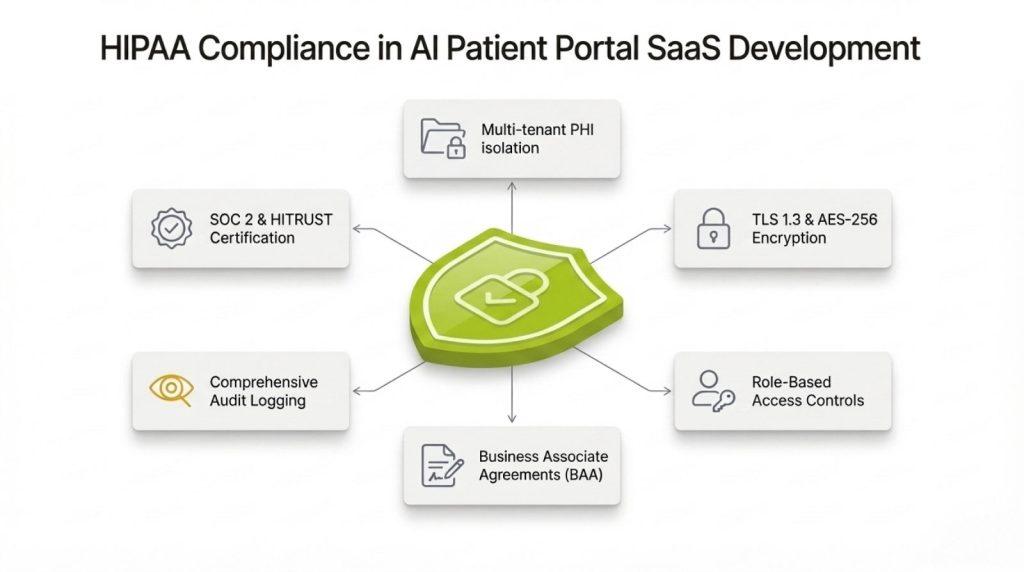
Healthcare data breaches continue to escalate. According to HIPAA Journal, 742 large healthcare data breaches were reported in 2024, exposing the protected health information of over 276 million individuals. For AI patient portal SaaS platforms, HIPAA compliance requires additional considerations around AI model training data, inference logging, and algorithmic transparency.
1. Multi-tenant PHI isolation
SaaS platforms must ensure absolute separation of protected health information between tenants. This requires:
- Tenant-specific encryption keys for data at rest
- Application-level access controls preventing cross-tenant data access
- Network isolation between tenant workloads, where feasible
- Comprehensive audit logging of all PHI access
2. Encryption requirements
HIPAA requires encryption of PHI both at rest and in transit. SaaS platforms should implement:
- TLS 1.3 for all data transmission
- AES-256 encryption for stored data
- Encryption key management with regular rotation
- Encrypted backups with tested recovery procedures
Implementing these encryption standards is just one part of building a secure system. For a complete breakdown of architecture, compliance workflows, and technical implementation, refer to our guide on HIPAA-compliant patient portal development.
3. Access controls and authentication
Role-based access control must limit PHI access to authorized users with a legitimate need. Requirements include:
- Multi-factor authentication for all portal access
- Session management with appropriate timeouts
- Privileged access management for administrative functions
- Regular access reviews and de-provisioning procedures
4. Business Associate Agreements
SaaS vendors handling PHI must execute Business Associate Agreements (BAAs) with healthcare clients. Cloud infrastructure providers (AWS, Azure, GCP) must also be covered under BAAs. SaaS vendors become responsible for their subcontractors’ compliance.
5. Audit logging and monitoring
HIPAA requires audit trails of PHI access. SaaS platforms must log:
- User authentication events
- PHI access, modification, and deletion
- Administrative actions and configuration changes
- Security events and anomalies
6. Certification considerations
While HIPAA does not have formal certification, third-party certifications demonstrate compliance maturity:
- SOC 2 Type II validates security controls over time
- HITRUST CSF provides healthcare-specific certification
- ISO 27001 demonstrates information security management
Expert healthcare AI consulting services can help organizations navigate compliance requirements and build platforms that meet regulatory expectations.
Compliance provides the foundation for trust, but healthcare organizations also need seamless integration with their existing clinical systems. Let’s examine integration requirements for SaaS patient portals.
Need Help Building a HIPAA-Compliant Patient Portal SaaS Platform?
Our team has built compliant healthcare platforms handling millions of patient records. Get expert guidance on architecture, security controls, and certification preparation.
Integration Requirements for SaaS Patient Portals
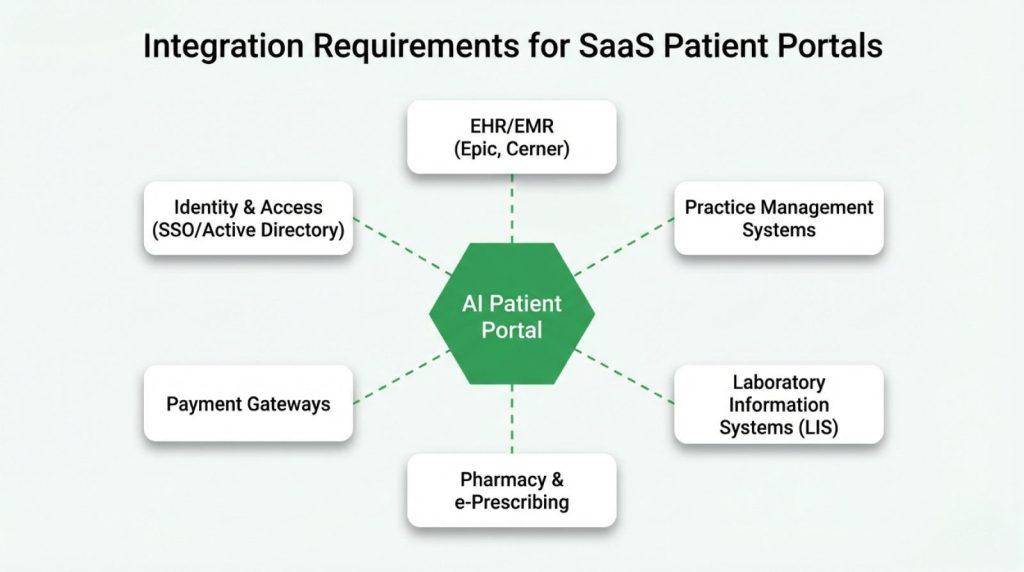
Patient portals must connect with the broader healthcare technology ecosystem to deliver value. Standalone portals that require manual data entry fail to achieve adoption. Successful SaaS platforms provide robust integration capabilities out of the box.
1. EHR/EMR integration
Electronic health record integration is the most critical connection. Patients expect real-time access to lab results, visit summaries, and clinical notes from their EHR. Key integration points include:
- Clinical data retrieval for lab results, medications, allergies, and problems
- Appointment scheduling with real-time provider availability
- Secure messaging routed to EHR in-basket workflows
- Document exchange for visit summaries and care plans
Major EHR platforms (Epic, Cerner, athenahealth, Allscripts) support FHIR APIs that standardize these integrations. SaaS platforms should build FHIR R4 connectors as the primary integration method.
2. Practice management system connectivity
Practice management systems handle scheduling, registration, and billing workflows. Integration requirements include:
- Patient demographic synchronization
- Appointment creation and modification
- Insurance eligibility verification
- Co-pay and balance information
3. Laboratory information systems
Direct LIS integration enables faster lab result delivery than waiting for EHR synchronization. Interfaces typically use HL7 v2 messages or FHIR DiagnosticReport resources.
4. Pharmacy and e-prescribing
Medication management features require pharmacy connectivity:
- Prescription history from pharmacy benefit managers
- Refill request routing to pharmacies
- Medication adherence tracking data
- Drug interaction checking
5. Payment gateway integration
Online bill pay requires secure payment processing integration:
- Credit card and ACH payment processing
- Payment plan management
- Statement generation and delivery
- Revenue cycle system reconciliation
6. Identity and access management
Enterprise healthcare organizations require integration with identity providers:
- Single sign-on (SSO) via SAML or OIDC
- Active Directory integration for staff authentication
- Patient identity verification services
- Proxy access management for caregivers
Challenges in AI Patient Portal SaaS Development and How to Overcome Them
Building AI patient portal SaaS platforms involves unique challenges that combine healthcare domain complexity, multi-tenant software engineering, and AI system design. Understanding these challenges early enables proactive mitigation rather than reactive problem-solving.
1. Ensuring HIPAA compliance across multiple tenants
Managing protected health information for multiple healthcare organizations in a shared infrastructure creates complex compliance challenges. Each tenant’s data must remain strictly isolated while the platform maintains operational efficiency. A single misconfiguration could expose PHI across tenant boundaries.
Solution
- Implement tenant-specific encryption keys with hardware security module (HSM) management
- Design strict data isolation at both the database and application layers with automated testing
- Conduct regular third-party penetration testing and compliance audits
- Maintain comprehensive audit logs per tenant with tamper-proof storage
- Create incident response procedures specific to multi-tenant breach scenarios
2. Achieving seamless EHR integration at scale
Healthcare organizations use diverse EHR systems with varying API capabilities, data formats, and authentication methods. Building integrations that work reliably across Epic, Cerner, athenahealth, and dozens of other systems requires significant ongoing investment.
Solution
- Adopt FHIR R4 as the primary integration standard to maximize compatibility
- Build a library of pre-certified EHR connectors with version management
- Partner with healthcare integration platforms like Redox or Health Gorilla for accelerated connectivity
- Offer professional services packages for custom integrations with non-standard systems
- Create comprehensive integration testing environments that simulate production EHR behavior
3. Balancing customization with multi-tenant efficiency
Healthcare tenants demand unique branding, workflows, notification rules, and feature configurations. However, excessive customization undermines the cost benefits that make multi-tenancy attractive. Finding the right balance determines SaaS business viability.
Solution
- Build a robust configuration layer that handles common customization needs without code changes
- Offer tiered customization options aligned with pricing tiers and contract values
- Use feature flags to enable tenant-specific capabilities without forking the codebase
- Reserve custom development for enterprise contracts with appropriate pricing premiums
- Create clear boundaries between configuration and customization in product documentation
4. Managing infrastructure costs while scaling
Cloud costs can spiral quickly as patient volumes, tenant counts, and data storage grow. Without careful architecture and continuous cost optimization, margins erode, and pricing becomes uncompetitive against established players.
Solution
- Implement auto-scaling policies that match compute resources to actual demand patterns
- Use reserved instances or savings plans for predictable baseline workloads
- Optimize database queries, implement caching layers, and tune performance continuously
- Monitor cloud costs at the tenant level to identify unprofitable accounts
- Right-size instances regularly based on actual utilization metrics
5. Ensuring high availability and disaster recovery
Healthcare portals must maintain uptime for patient access to critical health information. Portal downtime damages patient trust, strains provider relationships, and may violate contractual SLA commitments with healthcare clients.
Solution
- Deploy application components across multiple availability zones within each region
- Implement automated failover with health checks and load balancing
- Maintain regular backups with tested recovery procedures and documented RTOs
- Define clear SLA commitments with financial penalties to align incentives
- Create runbooks for common failure scenarios with on-call escalation procedures
6. Maintaining AI model accuracy and preventing bias
AI models in healthcare must maintain high accuracy while avoiding bias that could lead to disparate patient outcomes. Models trained on historical data may perpetuate existing healthcare disparities if not carefully monitored and corrected.
Solution
- Implement continuous model monitoring with accuracy tracking across patient demographics
- Establish human-in-the-loop review processes for high-stakes AI recommendations
- Conduct regular bias audits using fairness metrics and diverse test datasets
- Create model governance frameworks with clear accountability for AI decisions
- Build explainability features that help clinicians understand AI recommendations
Build Your AI Patient Portal SaaS Platform with Space-O AI
AI patient portal SaaS development requires more than technical execution. It demands a deep understanding of healthcare workflows, regulatory requirements, and the operational realities of multi-tenant platforms.
Space-O AI brings 15+ years of software development experience and has delivered 500+ successful projects. These include intelligent patient engagement platforms, clinical decision support systems, and healthcare automation solutions designed to scale securely across multiple organizations.
With a team of 80+ developers, Space-O AI combines expertise in machine learning, NLP, predictive analytics, and generative AI to build patient portal SaaS platforms that balance advanced intelligence with strict HIPAA compliance. Each solution is architected to support multi-tenancy, seamless EHR integration, and continuous AI improvement through mature MLOps practices.
From early-stage SaaS product development to enterprise-grade healthcare platforms, Space-O AI supports the full development lifecycle. This end-to-end approach helps organizations reduce development risk, accelerate time to market, and deliver intelligent patient engagement experiences aligned with clinical and business goals.
Ready to build your AI patient portal SaaS platform? Contact Space-O AI for a free consultation. Our healthcare AI experts will analyze your requirements, evaluate AI approaches, and create a development roadmap tailored to your business goals and competitive positioning.
Frequently Asked Questions
1. How long does it take to develop an AI patient portal SaaS platform?
MVP development with foundational AI capabilities typically takes 5–7 months with a dedicated team. A full-featured enterprise AI platform requires 10–14 months, including multiple EHR integrations, advanced ML features, MLOps infrastructure, and compliance certification. Timeline depends heavily on AI sophistication and integration complexity.
2. What AI capabilities should an AI patient portal include?
Essential AI capabilities include conversational chatbots for patient support, NLP for message categorization and routing, predictive analytics for engagement and no-show prediction, and generative AI for personalized health content. Advanced platforms add clinical decision support, voice interfaces, and autonomous workflow agents.
3. How do multi-tenant AI models maintain data privacy?
Multi-tenant AI architectures use federated learning, differential privacy, and strict data isolation to enable shared model intelligence without exposing individual tenant PHI. Models learn from aggregated, anonymized patterns while inference occurs within tenant-isolated environments. Proper architecture ensures compliance with HIPAA requirements.
4. What HIPAA compliance requirements apply to AI patient portals?
Beyond standard HIPAA requirements (encryption, access controls, audit logging), AI patient portals must address AI-specific concerns, including training data governance, inference logging, algorithmic transparency, and bias monitoring. Business Associate Agreements must cover AI model providers and cloud ML infrastructure.
5. Can AI features be added to existing patient portal platforms?
Yes. AI chatbots, predictive analytics, NLP categorization, and generative AI features can be integrated via APIs or deployed as microservices alongside existing portal components. This modular approach allows incremental AI adoption without rebuilding the core platform architecture.
6. What is the cost difference between basic and AI-powered patient portals?
AI-powered portals typically cost 30–50% more than basic portals due to ML infrastructure, model development, and MLOps requirements. However, AI capabilities drive significant ROI through reduced call center volume, improved patient engagement, and operational efficiency that often justifies the additional investment.
7. How do you ensure AI recommendations are accurate and unbiased?
Maintaining AI accuracy requires continuous model monitoring, regular bias audits, diverse training datasets, and human-in-the-loop review processes for high-stakes recommendations. Explainability features help clinicians understand and validate AI suggestions before acting on them.


Build Your AI Patient Portal SaaS
What to read next