- What Is an AI-Powered Patient Portal MVP?
- Key Benefits of AI-Powered Patient Portal MVP Development
- 1. Immediate ROI through intelligent automation
- 2. Data foundation for advanced AI capabilities
- 3. Faster time-to-market with smarter features
- 4. Lower long-term development costs
- 5. Competitive differentiation in patient experience
- 6. Continuous improvement through machine learning
- 7. Scalable patient engagement without proportional staff increases
- Core Features for AI-Powered Patient Portal MVP
- How to Develop an AI-Powered Patient Portal MVP: 5-Step Process
- AI-Powered Patient Portal MVP Development Cost and Timeline
- HIPAA Compliance and AI Governance for Patient Portal MVP
- Common Challenges in AI-Powered Patient Portal MVP Development
- Build Your AI Patient Portal MVP with Space-O AI — 15+ Years of AI Development Experience
- Frequently Asked Questions on Patient Portal MVP Development
- 1. What AI features should be included in a patient portal MVP?
- 2. How long does it take to develop an AI-powered patient portal MVP?
- 3. How much does AI-powered patient portal MVP development cost?
- 4. Is it safe to use AI chatbots in healthcare patient portals?
- 5. What are the HIPAA requirements for AI in patient portals?
- 6. How do you prevent AI hallucinations in healthcare chatbots?
- 7. Can AI-powered patient portals integrate with existing EHR systems?
AI-Powered Patient Portal MVP Development: Build Smarter Patient Engagement from Day One

 Last Updated: January, 29 2026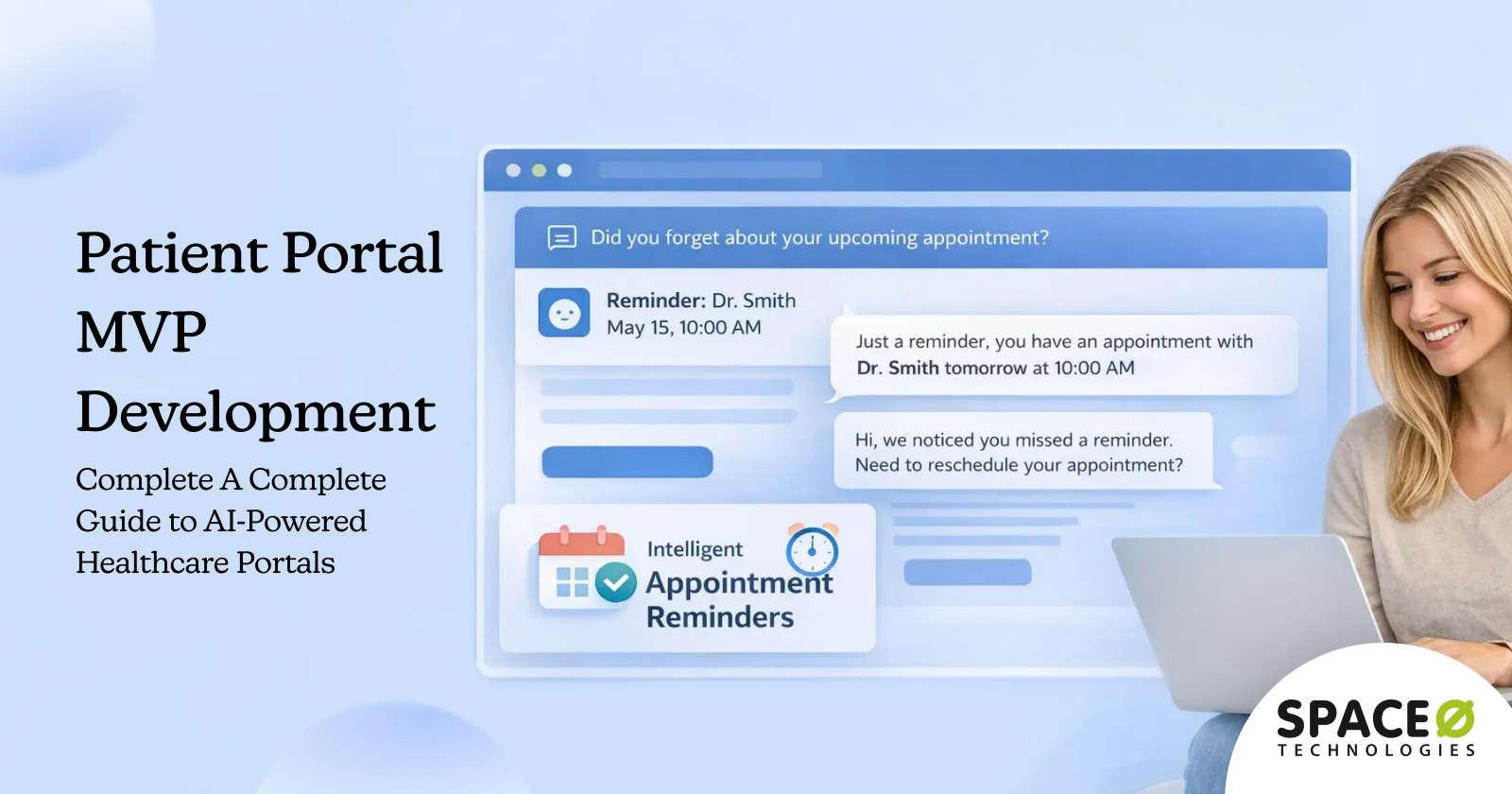
The demand for patient portals is rising as healthcare organizations prioritize digital access and patient engagement. According to KBV Research, the global patient portal market is projected to grow from $4.31 billion in 2025 to $14.37 billion by 2032. This rapid expansion highlights how patient portals are becoming a foundational component of modern healthcare delivery.
As adoption increases, healthcare providers face pressure to launch patient portals faster while minimizing risk and development costs. Building a full-scale solution upfront can be time-intensive and expensive, especially when patient expectations and regulatory requirements continue to evolve.
AI patient portal MVP development offers a practical approach to address these challenges. By developing a minimum viable product with core patient portal features and AI-driven capabilities, healthcare organizations can validate their ideas, gather real user feedback, and create a scalable foundation for future growth.
In this blog, we explore how AI patient portal MVP development works, its benefits, and best practices for launching a smart and compliant healthcare MVP. We’ve shared insights drawing from our 15+ years of experience as a leading AI patient portal development agency to help you build effective MVPs that validate your idea without major investments.
What Is an AI-Powered Patient Portal MVP?
An AI-powered patient portal MVP is a minimum viable version of a patient portal application that integrates artificial intelligence to deliver essential patient-facing functionality with intelligent automation. The goal of an MVP is to launch quickly with core features while validating user needs, workflows, and technical assumptions before investing in a full-scale product.
Unlike traditional patient portal MVPs that offer basic access to records and appointments, an AI-powered patient portal MVP includes smart capabilities such as automated appointment scheduling, intelligent notifications, conversational assistance, and personalized content recommendations. These AI features help improve early user engagement while reducing manual effort for healthcare staff.
From a development perspective, an AI-powered patient portal MVP focuses on scalability, security, and compliance from the start. It is designed to integrate with electronic health record systems, telehealth platforms, and other healthcare tools while meeting regulatory requirements.
This approach ensures that the MVP can evolve into a full-featured AI patient portal without major architectural changes.
What an AI-first patient portal MVP includes
An AI-powered patient portal MVP development approach addresses these challenges by launching with core AI capabilities from day one:
- At least one intelligent feature, typically an AI chatbot or predictive reminder system
- Data pipelines that capture structured interaction data for future model training
- Architecture designed to support advanced AI features like no-show prediction, personalized recommendations, and automated triage
Key Benefits of AI-Powered Patient Portal MVP Development
Building AI into your patient portal from day one delivers advantages that traditional development approaches cannot match. Here are the strategic benefits that make the AI-first MVP approach increasingly essential for healthcare organizations.
1. Immediate ROI through intelligent automation
AI chatbots and virtual assistants significantly reduce call center volume from day one by handling routine patient inquiries automatically. Organizations implementing healthcare AI report meaningful improvements in patient engagement and care plan adherence through intelligent, always-available support.
2. Data foundation for advanced AI capabilities
Every patient interaction in an AI-powered portal generates structured data that improves future AI performance. Launching with AI means you start collecting training data immediately, accelerating the path to advanced features like predictive analytics and personalized recommendations.
3. Faster time-to-market with smarter features
AI-powered patient portal MVP development delivers intelligent functionality within standard MVP timelines. Pre-trained models and modern AI frameworks make it possible to include chatbots and predictive features without extending development schedules compared to basic portal builds.
4. Lower long-term development costs
Retrofitting AI into existing portals costs significantly more than building AI-ready architecture from the start. An AI-first MVP approach avoids costly rearchitecture, database restructuring, and integration rework that organizations face when adding AI as an afterthought.
5. Competitive differentiation in patient experience
Patients increasingly expect intelligent, personalized digital experiences. An AI-powered portal that answers questions instantly, predicts needs, and personalizes content differentiates your organization from competitors still offering static, transactional portals.
6. Continuous improvement through machine learning
Unlike traditional software that remains static until manually updated, AI-powered portals improve automatically as they learn from patient interactions. This creates a compounding advantage: the longer your AI portal operates, the smarter and more valuable it becomes.
7. Scalable patient engagement without proportional staff increases
AI enables healthcare organizations to scale patient engagement without linearly scaling support staff. An AI chatbot can handle numerous simultaneous conversations while routing complex issues to appropriate staff, enabling growth without proportional headcount increases.
Now that we understand the benefits, let’s examine the specific AI features and capabilities you should prioritize for your patient portal MVP.
Core Features for AI-Powered Patient Portal MVP
An AI-powered patient portal MVP requires careful feature selection that balances intelligent capabilities with foundational functionality. The key is choosing AI features that deliver immediate value while building the data infrastructure for advanced capabilities. The following tables outline essential features across three categories: AI-powered capabilities, patient-facing functionality, and backend infrastructure.
1. AI-powered capabilities for MVP
These AI features form the intelligent core of your patient portal MVP. They deliver immediate ROI while generating the data needed for increasingly sophisticated AI capabilities over time.
| AI Feature | Description | Business Impact |
| AI Chatbot for Patient Support | LLM-powered conversational assistant handling FAQs, appointment queries, billing questions, and navigation | 30-50% reduction in call center volume; 24/7 patient support |
| Intelligent Appointment Reminders | ML-based prediction of no-show risk with personalized reminder timing and messaging | 15-25% reduction in no-shows; improved schedule utilization |
| Smart Search and Navigation | NLP-powered search enabling patients to find information using natural language queries | Reduced support tickets; improved patient satisfaction |
| Personalized Content Recommendations | AI-driven health education content matched to patient conditions and preferences | Higher engagement; improved health literacy |
| Automated Intake and Triage | AI-guided symptom assessment and pre-visit questionnaires that route patients appropriately | Reduced administrative burden; faster care access |
These AI capabilities are not futuristic add-ons. They are achievable within MVP timelines using modern LLM APIs, pre-trained models, and cloud AI services. The key is selecting a development partner with healthcare AI expertise who can implement these features efficiently.
2. Patient-facing portal functionality
While AI powers the intelligence layer, patients still need core functionality to complete essential tasks. These features work alongside AI to create a complete patient experience.
| Feature | Description | AI Enhancement |
| Secure Authentication | MFA, biometric login, and SSO integration | AI-powered fraud detection and anomaly alerts |
| Appointment Scheduling | Self-service booking, rescheduling, and cancellation | AI suggests optimal times based on patient patterns |
| Secure Messaging | HIPAA-compliant communication with care teams | AI drafts response suggestions; sentiment analysis for urgent routing |
| Lab Results Viewing | Access to test results with reference ranges | AI-generated plain-language explanations of results |
| Prescription Management | Refill requests and medication history | AI predicts refill needs; adherence reminders |
| Visit Summaries | After-visit documentation and care instructions | AI summarizes complex notes into patient-friendly language |
Each traditional feature becomes more powerful with AI enhancement. This is the core principle of AI-powered patient portal MVP development: AI is not a separate module but an intelligence layer woven throughout the experience.
3. Backend infrastructure for AI
The backend architecture determines whether your AI features can scale, learn, and improve over time. These infrastructure components are essential for sustainable AI-powered portals.
| Component | Description | Purpose |
| FHIR-compliant Data Layer | Standardized healthcare data storage and exchange | Enables AI models to access structured patient data |
| ML Data Pipeline | ETL processes that prepare interaction data for model training | Powers continuous improvement of AI features |
| Vector Database | Storage for embeddings used in RAG-based chatbots | Enables intelligent retrieval for chatbot responses |
| Event Streaming Architecture | Real-time event capture for patient interactions | Triggers AI-powered automations and personalization |
| Model Serving Infrastructure | APIs and endpoints for AI model inference | Delivers AI predictions at scale with low latency |
| Audit and Explainability Logging | Records of AI recommendations and decisions | Supports compliance and enables AI governance |
Building this infrastructure during MVP development, rather than retrofitting it later, reduces long-term costs and accelerates time-to-value for advanced AI features. Partner with an experienced AI software development company to ensure your architecture supports both immediate needs and future AI capabilities.
With feature priorities defined, let’s examine the development process for building an AI-powered patient portal MVP.
Ready to Build an AI-Powered Patient Portal That Transforms Patient Engagement?
Our healthcare AI experts specialize in HIPAA-compliant patient portals with intelligent chatbots, predictive analytics, and personalized engagement features.
How to Develop an AI-Powered Patient Portal MVP: 5-Step Process
Building an AI-powered patient portal MVP requires a structured approach that addresses both traditional development concerns and AI-specific requirements. Each phase must account for data strategy, model selection, and AI governance alongside standard portal development activities.
Step 1: AI discovery and use case prioritization
The first phase identifies which AI capabilities will deliver the most value for your specific patient population and operational context. This is where AI-powered patient portal MVP development diverges most significantly from traditional approaches.
Action items
- Conduct an AI readiness assessment evaluating data availability, infrastructure, and organizational capability
- Map patient journeys to identify high-volume, low-risk AI automation opportunities
- Prioritize AI use cases using an impact vs. effort matrix (chatbot, predictions, personalization)
- Define AI success metrics (deflection rate, prediction accuracy, engagement lift)
- Select AI technology stack: LLM provider, ML frameworks, vector database, cloud AI services
Step 2: Data architecture and AI infrastructure design
Your architecture decisions determine whether AI features can scale and improve over time. Design for AI from the start rather than attempting to retrofit intelligence into a traditional portal architecture.
Action items
- Design FHIR-compliant data models that support both portal operations and AI training
- Plan data pipelines for capturing, processing, and storing interaction data
- Select a vector database and an embedding strategy for RAG-based chatbot implementation
- Design event-driven architecture for real-time AI triggers and personalization
- Establish model versioning and deployment infrastructure (MLOps foundation)
Step 3: AI model development and integration
This phase involves building or configuring the AI models that power your intelligent features. Modern AI development leverages pre-trained models and APIs, significantly reducing time-to-value compared to training models from scratch.
Action items
- Configure LLM-based chatbot using healthcare-specific prompts and guardrails
- Implement RAG (Retrieval Augmented Generation) for accurate, contextual responses
- Develop or integrate predictive models for appointment no-shows and engagement
- Build a personalization engine using patient data and interaction history
- Create an AI testing framework covering accuracy, safety, and edge cases
Step 4: Portal development with AI integration
Core portal development proceeds in parallel with AI work, with careful attention to integration points. The goal is seamless AI experiences that feel native to the portal, not bolted-on features.
Action items
- Execute agile development sprints with AI features integrated throughout
- Implement EHR integration using HL7 FHIR standards
- Build security controls, including encryption, access management, and AI-specific audit logging
- Develop comprehensive test suites for both portal functionality and AI behavior
- Create fallback mechanisms ensuring graceful degradation when AI is unavailable
Step 5: AI validation, compliance, and launch
AI-powered portals require additional validation beyond traditional software testing. This phase ensures AI features are accurate, safe, and compliant before patient-facing deployment.
Action items
- Conduct AI-specific testing: accuracy validation, bias detection, edge case handling
- Perform security assessment, including AI-specific attack vectors (prompt injection, data leakage)
- Complete HIPAA compliance audit with focus on AI data handling and PHI protection
- Launch controlled pilot with select patient cohort for real-world AI validation
- Establish AI monitoring and continuous improvement processes post-launch
Working with an experienced AI healthcare software development company accelerates this process significantly. The right partner brings pre-built AI components, healthcare-specific model configurations, and compliance expertise that reduce both timeline and risk.
With the development process understood, let’s examine what this investment typically costs.
AI-Powered Patient Portal MVP Development Cost and Timeline
An AI-powered patient portal MVP can cost from $10,000 to over $500,000, with most projects falling in the $50,000-$150,000 range. The wide variance depends heavily on AI sophistication, HIPAA compliance requirements, EHR integration depth, and team composition.
The following table provides cost estimates for three AI-powered MVP configurations based on complexity and feature depth.
Development cost by complexity
| AI MVP Tier | Estimated Cost | Timeline | Features Included |
| Basic | $10,000–$50,000 | 2–3 months | Appointment booking, FAQ chatbot, basic messaging, simple AI automation |
| Intermediate | $50,000–$150,000+ | 3–5 months | Light EHR integration, polished UX, basic symptom checking, care team portal, device data import |
| Advanced | $150,000–$500,000+ | 5–9 months | Advanced NLP, multilingual support, voice AI, deep EHR/CRM integration, predictive analytics, robust compliance |
The basic tier is ideal for small practices or startups validating the patient portal concept. It includes essential AI features like a simple FAQ chatbot and appointment automation, providing a functional foundation without complex integrations.
The intermediate tier suits mid-sized healthcare organizations requiring EHR connectivity and more sophisticated patient interactions. This tier adds symptom checking, care team collaboration tools, and device data import while maintaining reasonable development timelines.
The advanced tier is designed for large health systems and enterprises requiring comprehensive AI capabilities. It includes voice AI, multilingual support, predictive analytics, and deep integrations with existing clinical and administrative systems.
These estimates cover initial development costs. Your actual investment will vary based on team location, existing infrastructure, and specific compliance requirements.
Key factors affecting the AI patient portal MVP development cost
- AI complexity: Basic FAQ chatbots cost significantly less than those with advanced Natural Language Processing (NLP), symptom triage, or predictive reasoning capabilities
- Compliance requirements: Meeting HIPAA and HL7 standards adds costs for legal review, security audits, penetration testing, and intrusion detection systems
- Integration depth: Connecting with EHR systems, billing platforms, or wearable devices increases development time and technical complexity
- Team composition and location: The mix of designers, developers, AI specialists, and project managers, along with their geographic location, directly impacts hourly rates and total cost
- Post-launch costs: Budget for ongoing maintenance, updates, and cloud hosting, typically 20-30% of initial development cost annually
Cost optimization strategies
Despite the investment required, organizations can optimize costs through strategic decisions:
- Start with a focused MVP scope and expand based on validated user needs
- Use pre-trained LLM APIs rather than custom model development for initial AI features
- Leverage cloud-based HIPAA-compliant infrastructure to reduce security overhead
- Partner with experienced healthcare AI developers who bring reusable components and proven frameworks
This brings us to a critical consideration: how do you ensure your AI-powered portal meets HIPAA requirements and maintains patient trust?
Get a Detailed Cost Estimate for Your AIPatient Portal MVP Development Project
Every healthcare organization has unique AI requirements and compliance needs. Connect with our team for a customized estimate and ROI projection.
HIPAA Compliance and AI Governance for Patient Portal MVP
AI-powered patient portals face heightened compliance scrutiny. Beyond standard HIPAA requirements, organizations must address AI-specific concerns, including data handling by LLM providers, model decision transparency, and patient consent for AI-driven interactions.
According to the HIPAA Journal, in 2024, 725 large healthcare data breaches exposed over 133 million patient records. This makes compliance non-negotiable. The following table outlines compliance requirements specific to AI-powered patient portals, beyond standard HIPAA controls.
| AI Compliance Requirement | Description | Implementation Approach |
| PHI Handling by AI Services | LLM APIs and cloud AI services must not retain or train on patient data | Use HIPAA-eligible AI services; implement zero-retention policies; verify BAAs |
| AI Decision Audit Logging | All AI recommendations and automated actions must be logged and explainable | Comprehensive logging of prompts, responses, and model versions |
| De-identification for AI Training | Patient data used for model training must be properly de-identified | Apply HIPAA Safe Harbor or Expert Determination methods |
| Consent for AI Interactions | Patients should understand when they are interacting with AI | Clear disclosure in chatbot interfaces; opt-out mechanisms |
| Model Bias Monitoring | AI systems must not discriminate based on protected characteristics | Regular bias audits; diverse testing populations |
| AI Failure Safeguards | Systems must gracefully handle AI errors without compromising safety | Human escalation paths; fallback mechanisms |
Building compliance into your AI architecture from day one avoids costly remediation and protects your organization from regulatory and reputational risk.
Key AI-specific compliance considerations
- LLM provider selection: Choose providers offering HIPAA BAAs and zero-data-retention options (Azure OpenAI, AWS Bedrock, or private deployments)
- Prompt engineering for safety: Design prompts that prevent AI from providing medical advice or making diagnostic claims
- RAG architecture for accuracy: Use retrieval-augmented generation to ground responses in verified, organization-approved content
- Human-in-the-loop design: Ensure AI recommendations can be overridden and that complex issues route to human staff
- Transparency requirements: Maintain clear records of how AI systems make recommendations for regulatory review
Working with an experienced AI software development partner like Space-O AI ensures your compliance architecture addresses both traditional HIPAA requirements and emerging AI governance standards.
Even with careful planning, AI-powered patient portal MVP development presents unique challenges. Let’s examine the most common obstacles and proven solutions.
Common Challenges in AI-Powered Patient Portal MVP Development
AI-powered patient portal MVP development introduces challenges beyond traditional software projects. Understanding these obstacles and having strategies to address them separates successful implementations from costly failures.
Challenge 1: AI accuracy and hallucination concerns
Healthcare AI must be accurate. LLMs can generate plausible-sounding but incorrect information (hallucinations), which is unacceptable in healthcare contexts where misinformation could harm patients or create liability.
Solution
- Implement RAG (Retrieval Augmented Generation) to ground responses in verified, organization-approved content
- Design prompts with strict guardrails preventing medical advice or diagnostic claims
- Use confidence scoring to route uncertain queries to human agents
- Establish continuous monitoring and feedback loops to identify and correct errors
Challenge 2: Patient trust and AI acceptance
Some patients may be uncomfortable interacting with AI, especially for health-related matters. Low trust can undermine adoption even when AI features work well technically.
Solution
- Provide clear, transparent disclosure when patients are interacting with AI
- Always offer easy escalation to human support
- Start with low-stakes AI use cases (FAQs, scheduling) before expanding to clinical applications
- Highlight AI benefits (instant responses, 24/7 availability) while acknowledging limitations
Challenge 3: Healthcare-specific AI expertise shortage
AI development requires specialized skills. Healthcare AI adds additional complexity: domain knowledge, compliance requirements, and integration with clinical systems. Finding teams with all three is challenging.
Solution
- Partner with an experienced AI development company specializing in healthcare
- Look for partners with pre-built healthcare AI components and proven implementations
- Consider dedicated team models that provide ongoing AI expertise rather than one-time development
Challenge 4: Integration with legacy clinical systems
Many healthcare organizations run legacy EHR systems that lack modern APIs. Connecting AI-powered portals to these systems while maintaining data quality and security is technically complex.
Solution
- Use healthcare integration engines and middleware to normalize data from legacy systems
- Adopt an FHIR-first architecture that can adapt to varying source system capabilities
- Implement phased integration: start with read-only data access, then add write capabilities
- Budget adequate time for integration testing and edge case handling
Challenge 5: Managing AI costs at scale
LLM API costs can grow significantly as usage scales. Without proper architecture, AI costs can erode the ROI that justified the investment.
Solution
- Implement intelligent query routing that uses AI only when it adds value
- Cache common responses to reduce redundant API calls
- Consider fine-tuned smaller models for high-volume, narrow use cases
- Monitor usage patterns and optimize prompts for efficiency
The organizations that succeed with AI-powered patient portal MVP development are those that anticipate these challenges and build solutions into their project plans from the beginning.
Facing AI Integration or Compliance Challenges in Your Patient Portal?
Our developers specialize in HIPAA-compliant healthcare AI with proven chatbot, predictive analytics, and EHR integration experience.
Build Your AI Patient Portal MVP with Space-O AI — 15+ Years of AI Development Experience
AI-powered patient portal MVP development enables healthcare organizations to launch intelligent patient engagement platforms faster and with lower risk. By embedding AI as core architecture from day one, you capture immediate value while building the foundation for advanced capabilities.
Space-O AI is a trusted AI development partner with over 15 years of experience and more than 500 successful projects delivered. We specialize in healthcare AI solutions that combine cutting-edge technology with a deep understanding of compliance requirements and clinical workflows.
Our team has delivered AI-powered patient portals featuring LLM chatbots, predictive analytics, and personalized engagement for healthcare organizations ranging from specialty practices to multi-hospital systems. We bring pre-built healthcare AI components and proven implementation frameworks that accelerate time-to-value.
Ready to build your AI-powered patient portal MVP? Schedule a free consultation with our healthcare AI experts to discuss your requirements, explore AI feature priorities, and receive a customized project estimate tailored to your organization.
Frequently Asked Questions on Patient Portal MVP Development
1. What AI features should be included in a patient portal MVP?
An AI-powered patient portal MVP should include at least one core AI feature that delivers immediate value: typically, an LLM-based chatbot for FAQ automation, appointment queries, and navigation assistance. Additional recommended features include intelligent appointment reminders with no-show prediction, personalized content recommendations, and AI-enhanced search. The key is building an AI-ready data infrastructure from day one so advanced features can be added post-launch.
2. How long does it take to develop an AI-powered patient portal MVP?
AI-powered patient portal MVP development typically takes 3-6 months, depending on AI sophistication. A foundation-tier MVP with an LLM chatbot and basic personalization can launch in 3-4 months. Standard implementations with predictive analytics and EHR integration require 4-6 months. Advanced MVPs with multi-specialty AI routing and voice capabilities take 6-9 months. These timelines assume a dedicated team with healthcare AI expertise.
3. How much does AI-powered patient portal MVP development cost?
AI-powered patient portal MVP development costs range from $10,000 to over $500,000, with most projects falling between $50,000 and $150,000. Basic MVPs with simple AI chatbots and messaging cost $10,000-$50,000. Intermediate implementations with light EHR integration cost $50,000-$150,000. Advanced MVPs with NLP, voice AI, and deep integrations cost $150,000-$500,000 or more. Budget an additional 20-30% annually for maintenance and hosting.
4. Is it safe to use AI chatbots in healthcare patient portals?
Yes, when implemented correctly. Safe healthcare AI chatbots use RAG (Retrieval Augmented Generation) to ground responses in verified content, include strict guardrails preventing medical advice or diagnostic claims, provide clear escalation paths to human agents, and maintain comprehensive audit logs. The key is partnering with developers who understand both AI capabilities and healthcare compliance requirements.
5. What are the HIPAA requirements for AI in patient portals?
AI-specific HIPAA requirements include using HIPAA-eligible AI services with signed BAAs, ensuring LLM providers do not retain or train on patient data, maintaining audit logs of all AI recommendations and decisions, properly de-identifying any data used for model training, and implementing human oversight for AI-driven actions. Standard HIPAA requirements (encryption, access control, audit logging) also apply to all AI components handling PHI.
6. How do you prevent AI hallucinations in healthcare chatbots?
Preventing AI hallucinations requires a multi-layered approach: implement RAG to ground responses in verified, organization-approved knowledge bases; design prompts with explicit instructions to avoid speculation and unsupported claims; use confidence scoring to route uncertain queries to human agents; establish continuous monitoring to identify and correct errors; and regularly update the knowledge base with accurate, current information.
7. Can AI-powered patient portals integrate with existing EHR systems?
Yes. AI-powered patient portals integrate with EHR systems using FHIR APIs for modern systems or HL7 interfaces for legacy systems. The AI layer adds intelligence to this integration: summarizing complex clinical notes, identifying relevant patient history for personalization, and enabling natural language queries across medical records. Integration complexity varies by EHR system, with modern cloud-based EHRs offering easier API access than legacy on-premise systems.


Need Expert Patient Portal MVP Development Guidance?
What to read next