- What Is AI in Supply Chain Management?
- Noteworthy Advantages of AI in Supply Chain
- Eight High-Impact Use Cases of AI for Supply Chain Management
- 1. Demand forecasting and inventory optimization
- 2. Intelligent route optimization and logistics
- 3. Predictive maintenance and equipment reliability
- 4. Quality inspection and defect detection
- 5. Warehouse automation and robotics coordination
- 6. Supplier risk management and procurement optimization
- 7. Autonomous guided vehicles and fleet management
- 8. Anomaly detection and exception handling
- Common Challenges in Implementing AI in Supply Chain Management [And Solutions]
- Steps to Implement AI in Supply Chain Successfully
- Partner With Space-O AI to Transform Your Supply Chain With AI
- Frequently Asked Questions on AI for Supply Chain Optimization
- What’s the typical cost and ROI timeline for implementing AI in our supply chain?
- How long does it take to implement AI supply chain solutions?
- Which AI supply chain use case should we prioritize first?
- Our data is fragmented across legacy systems. Can we implement AI supply chain solutions effectively?
- Will AI supply chain automation eliminate warehouse and logistics jobs?
- Can we integrate AI supply chain solutions with our legacy systems without replacing them?
AI in Supply Chain Management: The Complete Guide to Transforming Operations in 2026

 Last Updated: January, 6 2026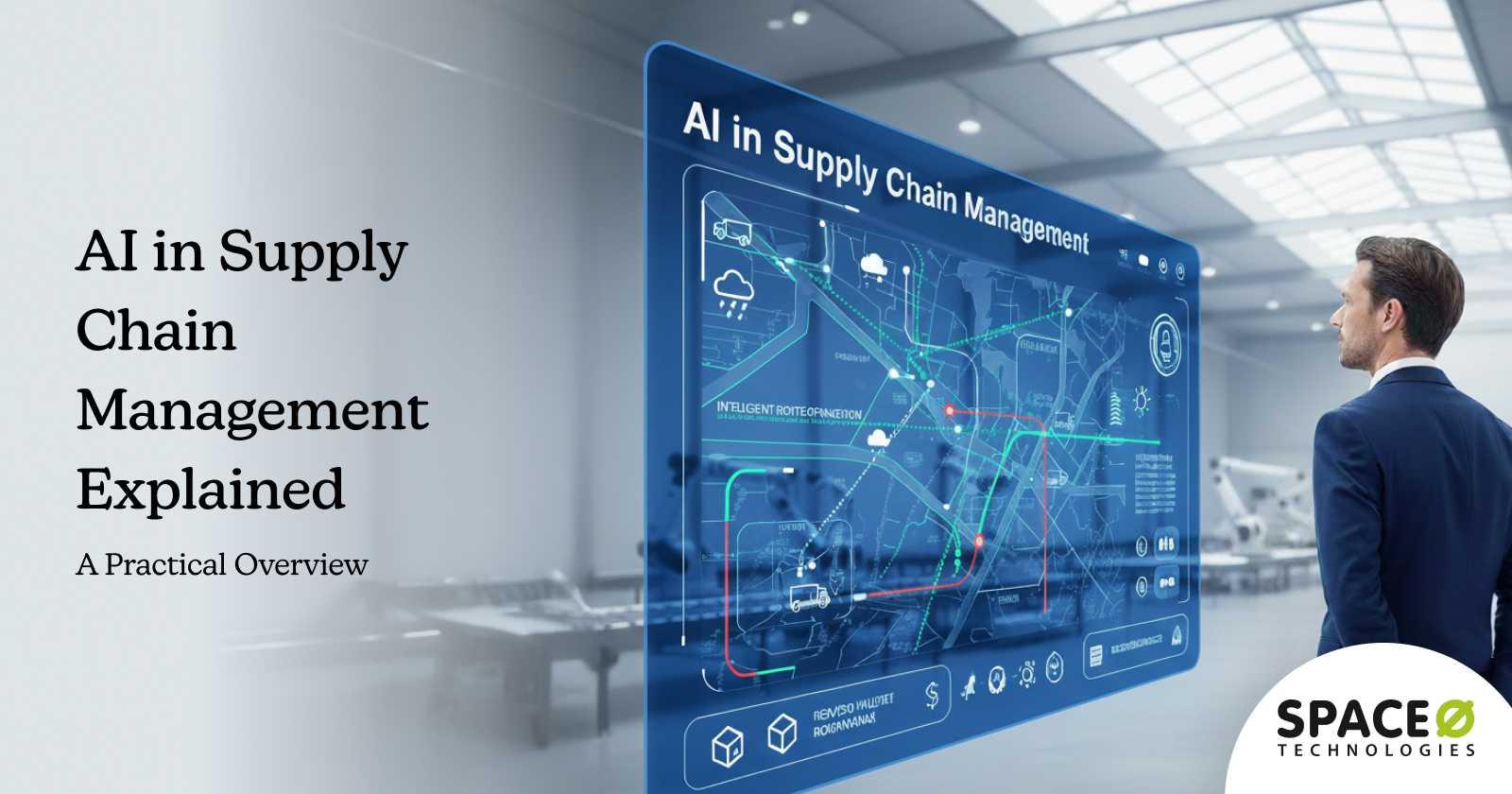
Artificial intelligence is reshaping how modern supply chains operate. From demand forecasting and inventory planning to logistics, warehousing, and last-mile delivery, AI is helping businesses respond faster, reduce operational costs, and make smarter decisions backed by real-time data.
The shift is accelerating. According to Precedence Research, the global AI supply chain market is projected to grow from USD 9.94 billion in 2025 to USD 192.51 billion by 2034. With supply chains becoming more complex and disruptions becoming more frequent, companies are turning to AI to create more efficient, agile, and resilient operations.
AI-powered systems can analyze massive data sets, predict future demand, optimize stock levels, and improve delivery accuracy at a scale that is impossible with manual processes. This allows businesses to streamline workflows, minimize errors, and maintain consistent service levels even during unstable conditions.
As a result, AI is no longer a future technology for supply chain teams. It is now a practical, high-impact tool that supports every stage of the supply chain. In this guide, you will learn what AI in supply chain means, how it works, the top use cases, real-world examples, challenges to consider, and future trends.
Based on our experience as a trusted AI software development company, we have shared insights on how businesses can adopt AI successfully and create a smarter, data-driven supply chain strategy. Let’s get started.
What Is AI in Supply Chain Management?
AI in supply chain management refers to the use of advanced algorithms, machine learning, predictive analytics, and automation technologies to improve the way goods move from suppliers to customers. It enhances every stage of the supply chain by analyzing large volumes of data, identifying patterns, and making accurate predictions that help businesses plan better and operate more efficiently.
At its core, AI enables supply chain teams to shift from reactive decision-making to proactive, data-driven strategies.
Instead of relying on manual processes or historical trends alone, AI systems process real-time information from multiple sources such as sales data, market trends, inventory levels, supplier performance, and external risk indicators. This allows businesses to forecast demand, optimize stock, improve logistics, and reduce operational costs with higher precision.
How AI works in the supply chain
AI-powered supply chain systems operate through three stages that transform raw data into actionable intelligence.
Stage 1: Data collection
The system ingests data from multiple sources: ERP systems, IoT sensors, supplier databases, market feeds, weather data, and logistics platforms. This creates a unified dataset representing your entire supply chain ecosystem in one place for the first time.
Stage 2: Pattern analysis and learning
Machine learning algorithms analyze the dataset to identify patterns, relationships, and anomalies that humans would miss. The system learns what “normal” looks like, recognizes warning signs of disruptions, and predicts future outcomes like demand shifts, equipment failures, or delays.
Stage 3: Actionable insights and automation
Based on patterns, AI generates real-time recommendations or automated decisions. Quality systems flag defects before shipping. Route optimization finds efficient paths. Inventory systems recommend reordering points. Risk monitoring alerts you to disruptions 3-5 days before impact.
Building these intelligent systems requires specialized expertise. Leading AI software development companies combine deep machine learning knowledge with supply chain domain understanding to create solutions tailored to your specific operational context.
Now that you know how AI operates, let’s look at what really matters: the measurable business results companies are achieving right now.
Noteworthy Advantages of AI in Supply Chain
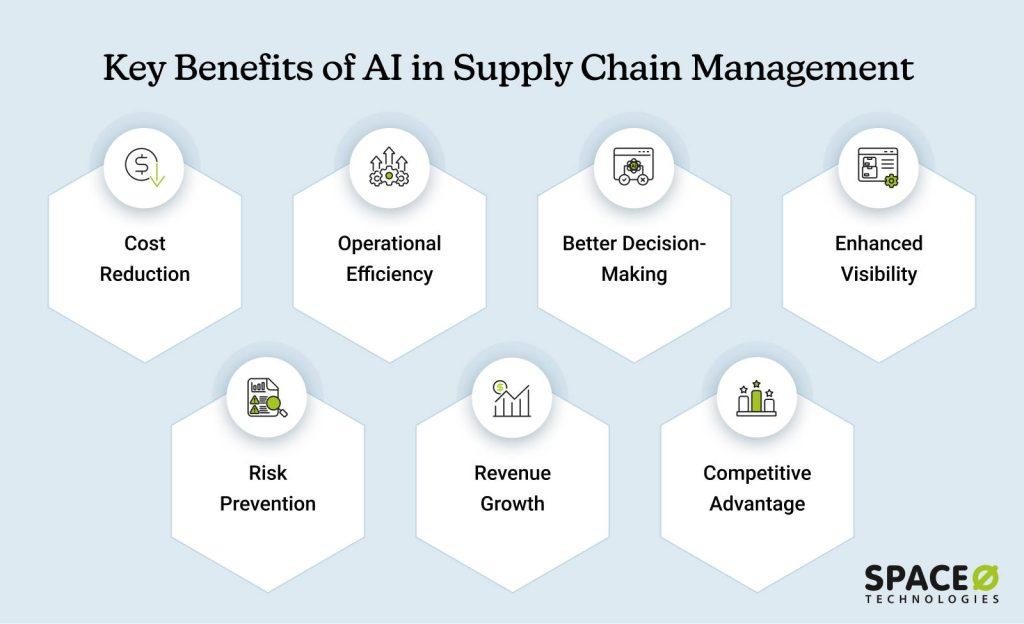
When companies deploy AI for supply chain operations, they don’t just improve metrics. They transform entire business models. Organizations see concrete improvements in cost, speed, quality, and competitiveness. Here are the benefits of AI in the supply chain in practice.
1. Cost reduction
AI eliminates manual tasks through automation and optimizes logistics routing, inventory levels, and maintenance schedules. Companies reduce operational expenses by 15% to 35% across supply chain functions, directly improving margins and profitability.
2. Operational efficiency
AI processes millions of data points instantly, making real-time decisions that would take humans hours or days. Throughput increases, error rates drop, and systems operate continuously without fatigue or breaks, multiplying productivity per resource.
3. Better decision-making
Real-time insights replace manual analysis. AI demand forecasting and risk alerts provide automatic recommendations. Supply chain leaders make faster, data-driven decisions with complete visibility instead of relying on incomplete information and intuition.
4. Enhanced visibility
End-to-end supply chain visibility becomes possible for the first time. Track inventory, shipments, and supplier performance in real-time across your entire network. Identify bottlenecks and disruptions immediately instead of discovering problems after they cascade.
5. Risk prevention
AI detects anomalies and predicts disruptions 3 to 5 days before they impact operations. Proactive alerts enable contingency planning. Supplier risks, demand shifts, and equipment failures are identified early, preventing costly crises and production shutdowns.
6. Revenue growth
Better AI inventory management eliminates stockouts and lost sales. Faster delivery improves customer satisfaction and repeat orders. Quality improvements reduce returns and warranty costs. These benefits combine to directly increase revenue while reducing costs.
7. Competitive advantage
Early adopters build internal expertise and data assets that compound over time. Systems improve continuously, creating widening gaps between AI leaders and followers. First-mover advantage in your industry becomes increasingly difficult for competitors to overcome.
Now you know what’s possible. The question is: where do you start? Seven proven use cases show exactly where AI delivers the highest impact in supply chain operations, and which problems your competitors might already be solving.
Transform Your Supply Chain with Custom AI Solutions
Modernize forecasting, logistics, inventory, and operations with AI solutions built specifically for your business. Work with Space-O AI to design, develop, and deploy high-impact supply chain systems.
Eight High-Impact Use Cases of AI for Supply Chain Management
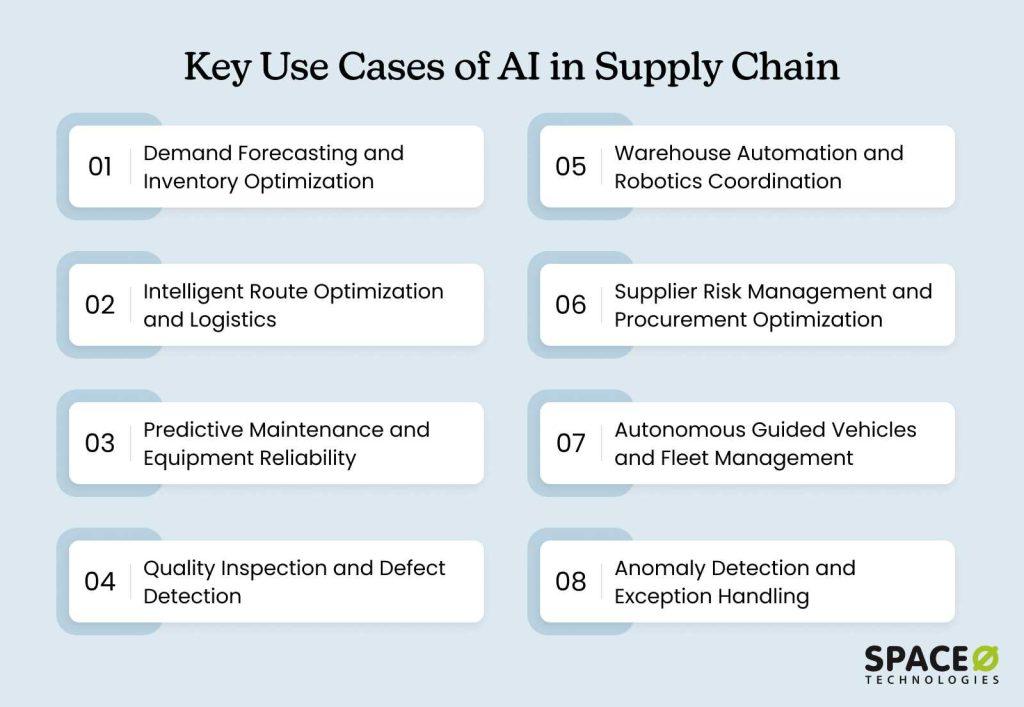
Real-world AI in supply chain use cases demonstrates how companies capture competitive advantages today. Whether your challenge is inventory management, logistics efficiency, or risk mitigation, AI has a solution already proven in production environments.
1. Demand forecasting and inventory optimization
Present challenge
Traditional demand forecasting misses a majority of demand fluctuations, resulting in either excess inventory tying up capital or stockouts losing sales. Manual inventory management is reactive, not predictive. The cost impacts everything: warehouse space, carrying costs, lost revenue, and customer satisfaction all suffer simultaneously.
How AI solves this
- Analyzes historical sales, seasonal patterns, market trends, and competitor activity continuously
- AI-based inventory management incorporates real-time demand signals and external factors automatically
- Adapts to changing conditions by recalculating forecasts based on new data
- Detects emerging trends before they become obvious to manual analysis
- Dynamically adjusts inventory levels based on predictive insights
Impact
- Reduces stockout situations significantly
- Decreases overstock scenarios substantially
- Improves inventory turnover and efficiency
- Lowers warehouse space requirements and carrying costs
- Improves customer satisfaction through better product availability
- Free working capital for strategic investments
This is why leading retailers have shifted to demand prediction. When you hire AI developers with supply chain expertise, they build systems that know what customers want before they know it themselves.
2. Intelligent route optimization and logistics
Present challenge
Manual route planning produces inefficient paths. Real-time traffic, weather, and order changes aren’t factored in. Drivers follow predetermined routes created hours earlier, resulting in unnecessary miles, excessive fuel consumption, missed delivery windows, and frustrated customers demanding faster service.
How AI solves this
- Processes real-time traffic, weather forecasts, order volumes, and vehicle capacity data
- Models thousands of possible routes in seconds to find optimal solutions
- Dynamically updates recommendations as conditions change during delivery
- Factors in delivery time windows, driver availability, and compliance requirements
- Recommends alternative routes immediately if congestion or delays develop
Impact
- Reduces unnecessary miles driven across the delivery network
- Decreases fuel consumption and operational costs
- Improves on-time delivery performance
- Supports sustainability goals through reduced emissions
- Generates cumulative savings across every delivery operation
- Enhances customer satisfaction through reliable service
The companies winning in logistics aren’t just faster drivers. They’re using technology to eliminate inefficiency before it starts.
3. Predictive maintenance and equipment reliability
Present challenge
Equipment failures disrupt operations catastrophically. Production lines halt. Warehouse conveyors stop. Refrigeration units fail. Companies manage equipment reactively: run until failure, then repair. Downtime is unpredictable, replacement parts aren’t on hand, and emergency repairs cost significantly more than planned maintenance.
How AI solves this
- Monitors equipment continuously through IoT sensors tracking vibration, temperature, and pressure
- Establishes normal operating patterns for each asset automatically
- Detects anomalies when readings deviate from baseline patterns
- Predicts failures before they occur, enabling proactive intervention
- Identifies optimal maintenance scheduling during non-critical periods
Impact
- Reduces maintenance costs through a preventive approach
- Decreases unplanned downtime and production interruptions
- Extends equipment lifecycle through proper maintenance
- Optimizes production schedules around anticipated maintenance
- Improves overall operational reliability and consistency
- Prevents cascading failures across interconnected systems
The shift from reactive maintenance to predictive maintenance isn’t just about cost savings. It’s about operational certainty and eliminating the unpredictability that has plagued supply chains for decades.
4. Quality inspection and defect detection
Present challenge
Manual quality inspection relies on human attention over repetitive tasks. Inspectors tire, attention lapses, and subtle defects escape detection. Error rates around 10-15% mean defective products reach customers, causing returns, complaints, and brand reputation damage that compounds over time.
How AI works
- Uses cameras and image analysis to inspect products continuously without fatigue
- Trains machine learning models on thousands of images to recognize defect patterns
- Identifies surface defects, including scratches, dents, cracks, and color inconsistencies
- Operates 24/7, maintaining consistent accuracy standards
- Continuously improves detection accuracy as it processes more products
Impact
- Achieves superior defect detection accuracy compared to human inspection
- Reduces returns and product recalls significantly
- Improves customer satisfaction and brand protection
- Stops production immediately when issues are detected
- Prevents defective batches from reaching customers
- Protects brand reputation and long-term customer relationships
Quality isn’t just about customer satisfaction anymore. It’s about brand survival. AI ensures quality control becomes a competitive advantage rather than a cost center.
5. Warehouse automation and robotics coordination
Present challenge
Manual picking and sorting operations are labor-intensive, error-prone, and difficult to scale. Finding products in massive warehouses takes time. Picking errors around 5% mean one in twenty items is incorrect. These operations represent significant labor costs and create fulfillment bottlenecks.
How AI works
- Uses computer vision to guide autonomous robots through warehouse operations
- Learns demand patterns and recommends optimal product placement automatically
- Places high-velocity products in easily accessible locations
- Assigns incoming orders to the nearest available picking location
- Optimizes picker routing to minimize travel distances
- Updates inventory in real-time as items are picked
Impact
- Improves pick accuracy and order fulfillment quality
- Reduces labor costs through task automation
- Increases throughput and fulfillment capacity
- Enables robots to work continuously without breaks
- Frees human workers for higher-value tasks
- Improves workplace safety by reducing manual handling
Warehouse automation is no longer a luxury for mega-retailers. It’s becoming table stakes for any company competing on speed and accuracy in fulfillment. Integrated computer vision in supply chain systems guides robots through precise picking operations, making warehouse automation seamless and highly efficient.
6. Supplier risk management and procurement optimization
Present challenge
Supply chain disruptions often start with supplier failures. Financial troubles, geopolitical events, natural disasters, and regulatory changes all impact suppliers silently. Without visibility, companies discover problems after they impact production. Traditional supplier selection relies on historical performance and price alone, missing emerging risks entirely.
How AI works
- Analyzes financial metrics, performance history, and compliance records continuously
- Monitors news, geopolitical events, and environmental factors automatically
- Identifies patterns predicting supplier disruption months in advance
- Detects early warning signs before problems become obvious
- Identifies alternative suppliers with relevant capabilities proactively
- Assembles comprehensive risk profiles for each supplier
Impact
- Enables early intervention before disruptions impact operations
- Reduces supply chain disruptions through proactive risk management
- Improves supplier selection through comprehensive data analysis
- Increases procurement efficiency and decision-making speed
- Supports contingency planning with backup supplier identification
- Builds more resilient and sustainable supplier networks
Supplier risk management used to be a reactive crisis response. AI transforms it into strategic foresight that prevents crises from happening in the first place.
7. Autonomous guided vehicles and fleet management
Present challenge
Fleet management involves complex optimization. Hundreds or thousands of vehicles make thousands of daily trips. Each trip has a starting point, destination, and timing requirement. Optimizing across all variables manually is impossible. Vehicles take inefficient routes, some are underutilized, while others are overloaded, and accident rates include preventable incidents.
How AI works
- Tracks all vehicles in real-time, knowing location, capacity, and availability
- Assigns tasks to the nearest available vehicle that matches the requirements
- Models thousands of possible assignments to find optimal combinations
- Optimizes across distance, time, fuel consumption, and safety compliance
- Monitors driving behavior and detects unsafe patterns continuously
- Identifies maintenance needs before vehicle breakdowns occur
Impact
- Improves fleet utilization, enabling the same vehicles to complete more trips
- Reduces fuel consumption through optimized routing
- Decreases safety incidents and accidents
- Lowers maintenance costs through predictive servicing
- Extends vehicle lifecycle through proper maintenance
- Enhances driver safety through continuous behavior monitoring
Fleet optimization goes beyond saving fuel. It’s about extracting maximum productivity from every asset while keeping drivers safe and operations predictable.
8. Anomaly detection and exception handling
Present challenge
Supply chain disruptions start small. A shipment arrives one day late. Inventory counts don’t match by a few units. A supplier misses a minor specification. Individually, these seem minor, but they cascade into major problems if not caught early. Detecting which anomalies matter among thousands of daily transactions is impossible manually.
How AI works
- Monitors shipment arrivals, inventory movements, and supplier performance continuously
- Learns what normal patterns look like for each type of transaction
- Flags deviations from normal patterns as potential anomalies automatically
- Prioritizes anomalies by their potential impact on operations
- Identifies root causes of issues automatically
- Provides context to distinguish urgent issues from routine variations
Impact
- Detects disruptions days before they would impact operations manually
- Enables preventive action before minor issues escalate
- Reduces operational losses from preventable disruptions
- Improves response time to actual supply chain problems
- Prevents cascading failures across interconnected systems
- Protects revenue and customer relationships through early intervention
Early detection isn’t just about avoiding problems. It’s about giving your team the breathing room to make smart decisions instead of emergency ones.
Now you understand what’s possible. The question shifts: what obstacles stand between you and actually implementing these solutions? The answer is important. Because knowing the challenges upfront means you can plan for them, budget for them, and overcome them systematically.
Build a Smarter, Faster, More Predictive Supply Chain
Leverage AI-powered forecasting, optimization, and automation to reduce costs and boost efficiency. Our team helps you turn complex supply chain challenges into scalable solutions.
Common Challenges in Implementing AI in Supply Chain Management [And Solutions]
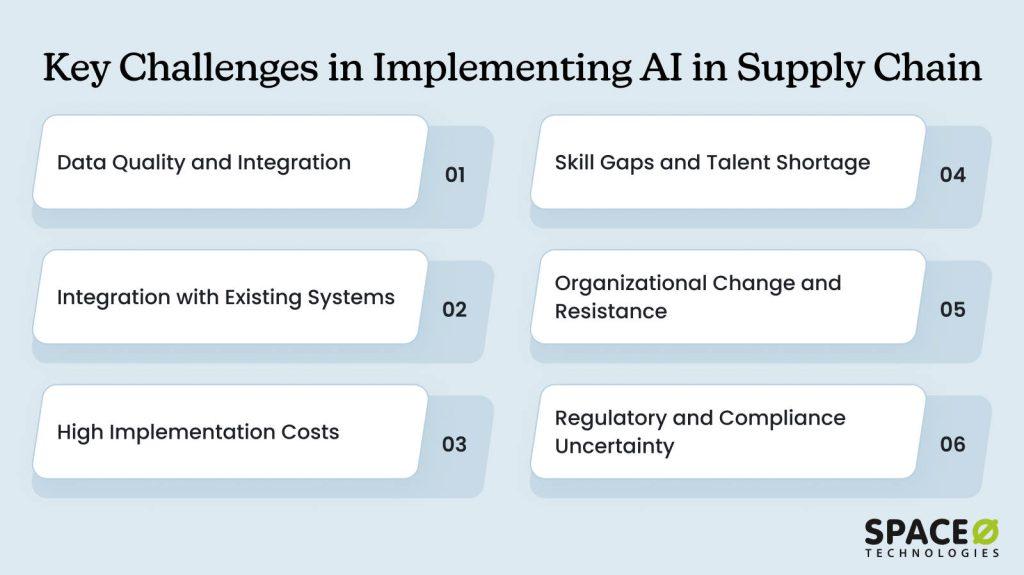
Implementing artificial intelligence in supply chain management comes with real obstacles. Understanding these challenges upfront helps you plan effectively and avoid costly mistakes. This section covers the most common barriers and provides practical solutions to overcome them systematically.
Challenge 1: Data quality and integration
Your legacy systems store data in incompatible formats across disconnected silos, making unified access difficult. Real-time integration with existing ERP systems is complex, and before meaningful artificial intelligence and supply chain implementation begins, cleaning and standardizing data requires substantial upfront effort and investment.
Solutions
- Invest in data governance frameworks before AI implementation begins
- Build APIs and middleware connecting legacy systems without complete replacement
- Start with high-quality pilot datasets to prove value quickly
- Use synthetic data augmentation to fill training data gaps
- Establish clear data quality standards across all systems
Challenge 2: Integration with existing systems
Legacy ERP and warehouse systems lack API readiness for modern integration, making custom connections expensive and time-consuming. Implementation downtime disrupts operations while teams resist changes to familiar systems. These integration barriers delay deployment and increase project costs significantly.
Solutions
- Partner with an expert AI integration service provider with proven experience integrating with legacy systems
- Implement phased rollouts, starting with one operational area
- Use cloud-based AI for supply chain solutions that integrate more easily
- Plan for parallel operation periods where old and new systems run simultaneously
- Invest in strong change management and comprehensive training programs
Challenge 3: High Implementation Costs
AI platform licensing starts at $50,000 to $200,000, while hardware infrastructure and data preparation add substantial costs. Integration services, ongoing maintenance, and optimization accumulate into significant annual expenses. Budget constraints limit adoption across small and medium-sized organizations, especially.
Solutions
- Start with high-ROI use cases that deliver quick payback and visibility
- Use AI-as-a-Service models that spread costs over time instead of a large upfront investment
- Leverage pre-trained models instead of building custom AI systems from scratch
- Cloud-based solutions lower capital expenses and offer flexible scaling options
- Calculate real ROI upfront to justify the investment to leadership and stakeholders
Challenge 4: Skill gaps and talent shortage
Few supply chain professionals understand AI and machine learning deeply enough to lead implementation. Data scientists are expensive to hire and difficult to retain internally. Training existing staff takes significant time, and relying entirely on external vendors creates dependency risks.
Solutions
- Partner with an experienced AI consulting company for initial implementation
- Train existing supply chain professionals gradually in AI concepts and interpretation
- Build an internal AI center of excellence over time to reduce vendor dependency
- Plan for hiring or retaining AI specialists as your internal capability grows
- Start with vendor-led implementation and gradually shift toward internal ownership
Challenge 5: Organizational change and resistance
Employees fear job loss, especially in warehouse and logistics roles that manage routine tasks. Skepticism about AI reliability slows adoption while teams resist leaving comfortable existing processes. Change fatigue from previous initiatives compounds resistance throughout the organization.
Solutions
- Frame AI as an augmentation that eliminates repetitive work, not a replacement for people
- Communicate early and often about how AI makes jobs more interesting and strategic
- Include end-users in design phases so they shape solutions that work for them
- Show quick wins through pilots, so skeptics become believers and advocates
- Get visible leadership sponsorship demonstrating a genuine commitment to transformation
Challenge 6: Regulatory and compliance uncertainty
Regulations around AI use are evolving without clear universal pathways for implementation. Data privacy requirements under GDPR and CCPA impose strict limitations, while industry-specific compliance rules vary. Liability questions remain unresolved when AI recommendations prove incorrect.
Solutions
- Start with less-regulated use cases like warehouse automation or transportation routing
- Engage regulators early through pre-submission meetings for sensitive applications
- Implement rigorous validation testing before any production deployment
- Maintain detailed audit trails documenting how AI recommendations were made
- Include clear liability provisions in vendor contracts and ensure proper insurance coverage
Knowing the obstacles is half the battle. The other half is executing with a proven process that accounts for these realities. Here’s the step-by-step implementation roadmap that turns challenges into competitive advantages.
Steps to Implement AI in Supply Chain Successfully
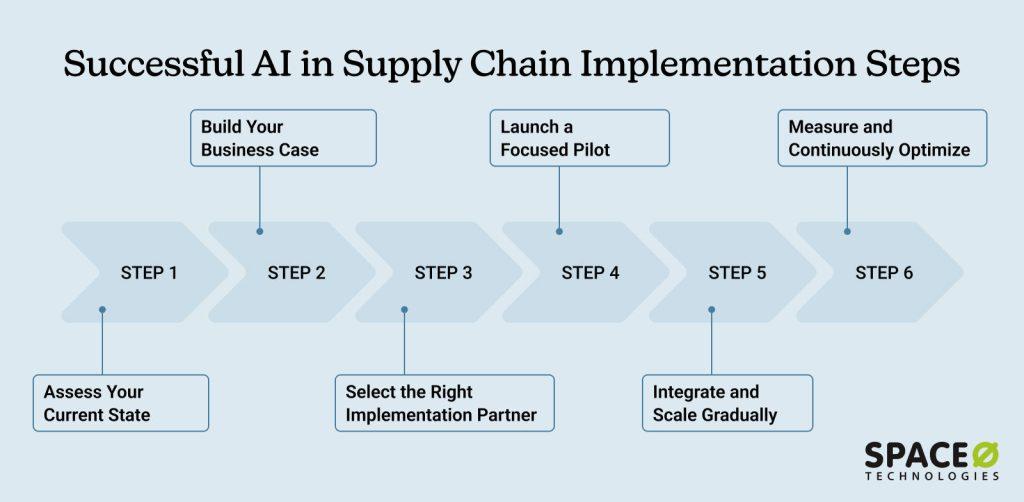
Implementing AI in supply chain management doesn’t have to be overwhelming. By following a structured approach, you can move from planning to operational results systematically. This roadmap guides you through each phase, from identifying opportunities to measuring success. Companies that follow this process reduce implementation risk while accelerating time-to-value.
Step 1: Assess your current state
What to do:
- Map supply chain processes end-to-end
- Identify high-volume, repetitive tasks consuming significant resources
- Quantify current problems: inventory costs, delivery delays, defect rates, maintenance expenses
By understanding where inefficiencies exist, you can target AI for supply chain optimization in the areas with the highest potential ROI. You walk away with a prioritized list of opportunities ranked by impact and implementation complexity.
Step 2: Build your business case
What to do:
- Calculate potential ROI for top 3–4 use cases
- Define measurable success metrics: cost reduction %, throughput improvement, accuracy gains
- Reference AI in supply chain examples with proven results
- Present timelines and budgets to leadership
A strong business case secures executive buy-in and implementation funding. You gain alignment on expectations, investment, and measurable goals before moving forward.
Step 3: Select the right implementation partner
What to do:
- Evaluate vendors with proven AI in supply chain and logistics experience
- Verify industry use cases and technical capabilities
- Request proof-of-concepts using your data
- Choose partners offering end-to-end support
Selecting the right partner minimizes risk and accelerates execution. You start with a clearly defined contract outlining deliverables, timelines, and support requirements.
Step 4: Launch a focused pilot
What to do:
- Choose one high-impact operational area
- Run AI alongside existing processes for validation
- Collect real-world performance results and team feedback
A controlled pilot proves the value, validates assumptions, and builds internal confidence before full-scale rollout. You end this phase with proven results and clear learnings.
Step 5: Integrate and scale gradually
What to do:
- Connect AI to ERP, warehouse management, transportation, and logistics systems via APIs
- Train teams on AI-led workflows
- Introduce SOPs for AI-supported decision-making
Scaling in phases reduces operational disruption and ensures adoption. You expand into additional areas while maintaining performance stability.
Step 6: Measure and continuously optimize
What to do:
- Monitor success metrics against baselines
- Collect operational team feedback
- Conduct quarterly reviews of AI in supply chain management performance
- Identify additional use cases
Ongoing optimization ensures ROI continues growing over time. You create a continuous improvement loop with documented gains and a roadmap for the next phase of innovation.
Partner with Experts in AI-Driven Supply Chain Development
From demand planning models to intelligent logistics systems, we create custom AI solutions that align with your goals. Start your supply chain transformation with Space-O AI.
Partner With Space-O AI to Transform Your Supply Chain With AI
The gap between AI leaders and followers in supply chain management is widening fast. Companies implementing AI for supply chain management today are capturing advantages that will persist for years.
Understanding the technology is step one. Executing it successfully is everything. Artificial intelligence in supply chain management requires more than software. It demands a partner who speaks both machine learning and supply chain language.
Space-O AI has spent 15+ years building custom AI solutions for supply chain and logistics that actually work. Our 80+ specialists have delivered 500+ successful projects across manufacturing, retail, and logistics. We don’t build one-size-fits-all tools. We build solutions aligned with your specific operational challenges, whether that’s demand forecasting, warehouse automation, or risk management.
Explore our portfolio to see how we’ve transformed companies across industries through intelligent, scalable AI systems.
AI Receptionist Development: Welco
A USA-based entrepreneur needed to automate front desk operations and manage customer calls 24/7. Space-O built Welco using NLP and voice technology for seamless call handling and appointment scheduling. Result: 67% reduction in missed inquiries, enabling businesses to deliver consistent support without expanding staff.
Moov AI: Product Recommendation Chatbot
In just 22 days, our team delivered Moov AI to Moov Store, Saudi Arabia’s leading eCommerce platform. Using OpenAI technology and vector embeddings, the chatbot generates personalized product recommendations. Result: faster checkouts, increased customer satisfaction, and significantly improved conversion rates through intelligent product matching.
AI Product Recommendation System: Clime
Businesses struggle to match customers with the right products at scale. We built this AI solution for our client that analyzes purchase history, behavior patterns, and preferences to deliver personalized recommendations automatically. Result: higher conversion rates, increased repeat purchases, and improved customer experience through data-driven intelligent suggestions.
Today, the real question isn’t whether to invest in AI. It’s how quickly you can deploy it effectively. Ready to explore which use cases matter most for your supply chain? Get in touch with our experts today for a free strategy session.
Frequently Asked Questions on AI for Supply Chain Optimization
What’s the typical cost and ROI timeline for implementing AI in our supply chain?
Implementation ranges from $50,000-$100,000 for focused pilots to $200,000-$500,000+ for full deployments. The key is prioritizing high-impact use cases. With AI for supply chain optimization, most organizations achieve ROI within 12-18 months through labor savings, error reduction, and improved efficiency. Many see positive cash flow within 6-9 months by starting with quick-win applications like route optimization or demand forecasting.
How long does it take to implement AI supply chain solutions?
Pilot projects typically require 8-16 weeks from planning to operation. Full deployments span 6-12 months, including assessment, vendor selection, development, integration, and training. Timeline depends on data readiness and system complexity. Starting with one high-impact operational area accelerates results. Many companies see tangible benefits within 3-4 months when the data is clean and the scope is focused.
Which AI supply chain use case should we prioritize first?
Identify your biggest operational challenge: inventory imbalances, logistics inefficiency, quality issues, or equipment failures. Compare against AI in supply chain examples to find proven implementations. Demand forecasting and warehouse automation typically deliver the fastest returns. Route optimization cuts fuel costs immediately. Success in one area builds organizational confidence and expertise for broader scaling.
Our data is fragmented across legacy systems. Can we implement AI supply chain solutions effectively?
Data fragmentation is manageable but requires upfront investment. Start by auditing data quality, identifying incompatible formats, and establishing governance standards. Don’t try to perfect everything; begin with high-quality pilot datasets in one area to prove value. This builds support for broader data initiatives. Poor data quality is the primary barrier to AI in supply chain and logistics success, so data preparation before deployment is essential.
Will AI supply chain automation eliminate warehouse and logistics jobs?
No. AI in supply chain and logistics eliminates repetitive manual work, data entry, counting, routine exception handling, freeing teams for strategic decisions and relationship management. Employees focus on complex supplier negotiations, exception handling, and continuous improvement. Organizations report higher job satisfaction as tedious tasks disappear. Frame it as an augmentation, involve teams early, and demonstrate quick wins through pilots.
Can we integrate AI supply chain solutions with our legacy systems without replacing them?
Yes. Modern solutions integrate with legacy ERP and warehouse systems through APIs and middleware. Cloud-based platforms generally offer easier integration than on-premise options. Experienced implementation partners bridge old and new technology through phased approaches. Select AI software development companies with proven legacy integration experience to avoid operational disruption during deployment.


Build AI-Powered Supply Chain Solutions
What to read next