- What Is an AI Development Framework?
- The 15 Best Frameworks for AI Development
- How to Choose the Right AI Framework for Your Business Needs?
- Let’s Build Your AI Solution the Right Way
- Frequently Asked Questions on AI Frameworks
- 1. Which AI framework is best for beginners?
- 2. Are open-source AI frameworks reliable for enterprise use?
- 3. Can I combine multiple AI frameworks in the same project?
- 4. Which framework should I use for real-time inference or scaling models?
- 5. What frameworks are best for building conversational or autonomous AI agents?
- 6. How fast can I build a working prototype using an AI framework?
15 Best AI Frameworks: Types, Uses, and Features

 Last Updated: January, 6 2026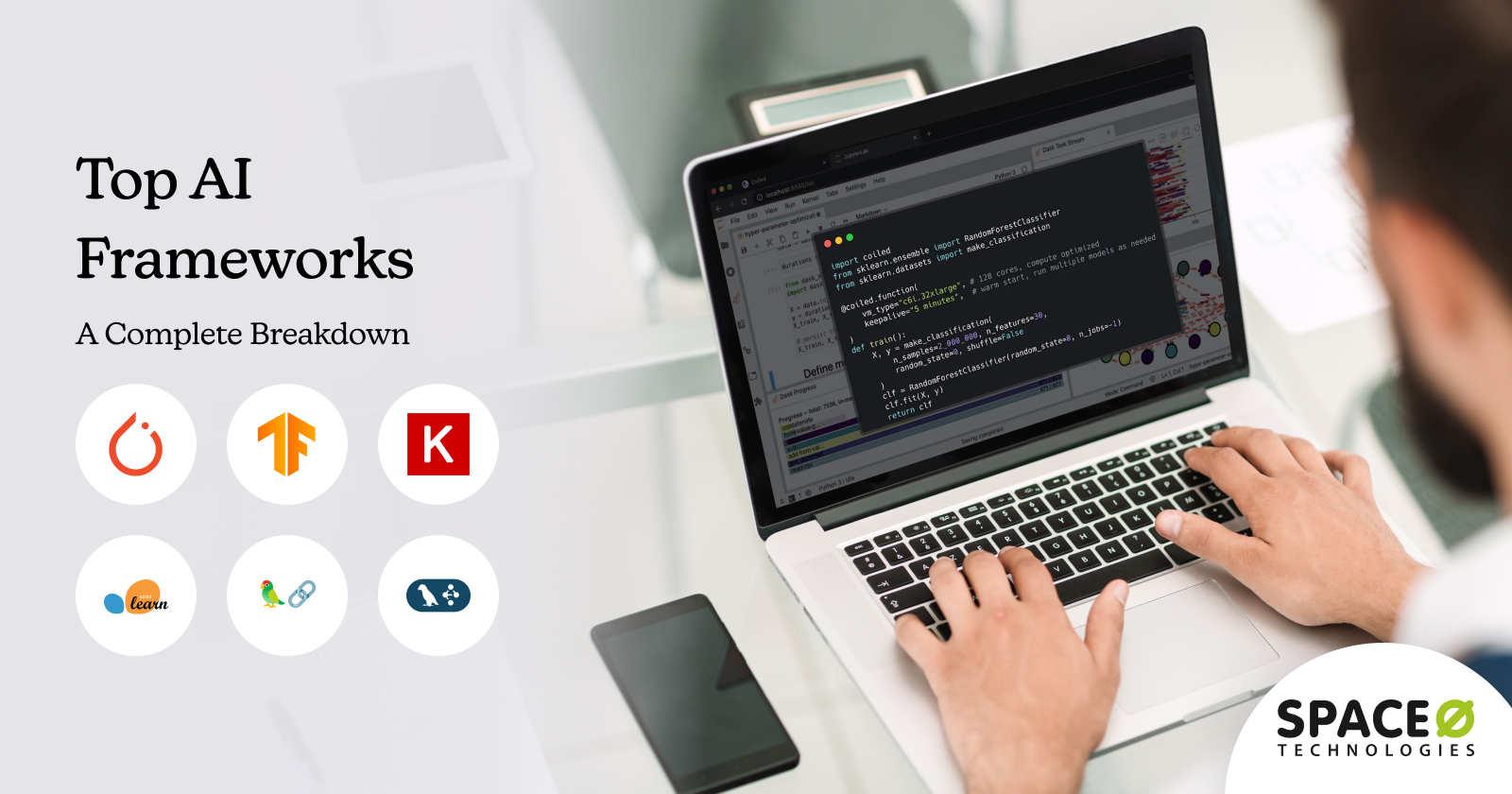
Artificial intelligence has become a core part of modern software development, and much of its progress is driven by powerful AI frameworks. These frameworks give developers ready-to-use tools, libraries, and workflows that simplify the process of building, training, and deploying AI models. Instead of creating algorithms from scratch, teams can rely on proven frameworks that handle complex math, hardware optimization, and large-scale data processing.
Each framework offers different strengths, programming language support, and ideal use cases, which makes the selection process even more important for developers and product teams. As a leading AI software development company, we understand that framework selection isn’t just a technical decision. It impacts timelines, costs, and your ability to scale.
This blog explores 15 best artificial intelligence frameworks, with their strengths, features, and use cases. Whether you are building machine learning models, deep learning systems, or the next generation of generative AI applications, understanding AI frameworks will help you make faster and more informed development decisions.
What Is an AI Development Framework?
An artificial intelligence framework is a collection of pre-built tools, libraries, and functions designed to simplify building AI systems. Instead of writing thousands of lines of code to handle data preprocessing, algorithm implementation, GPU optimization, and deployment infrastructure, frameworks let your team focus on solving the actual business problem.
Why does this matter? Frameworks save development time by eliminating busywork. They optimize for performance using years of engineering expertise. They standardize development, so teams move faster, and code is more maintainable. Most importantly, they make AI accessible to teams that aren’t machine learning PhDs.
Three categories of modern AI frameworks
Modern AI frameworks fall into three distinct categories, each built to solve different problems.
1. Deep learning and ML frameworks
Like PyTorch and TensorFlow, these handle heavy computational lifting. They train neural networks, run complex mathematical operations, and optimize for GPU performance. Use these when building models that learn patterns from large datasets.
2. LLM and agent orchestration frameworks
Like LangChain and CrewAI, these are built for working with large language models. They connect LLMs to data, tools, and other systems. They handle the orchestration layer for chatbots, autonomous agents, and retrieval-augmented generation systems.
3. Specialized frameworks
These focus on specific domains. Caffe optimizes for computer vision. Haystack specializes in search and retrieval. vLLM focuses on LLM inference optimization. They excel in their narrow domain but are less flexible outside of it.
The 15 Best Frameworks for AI Development
These 15 AI frameworks power production systems at organizations ranging from startups to enterprises. Each has proven itself in real-world deployments and solved specific classes of problems. We’ve organized them by category so you can focus on frameworks most relevant to your use case.
1. Deep Learning frameworks
1.1 PyTorch
PyTorch is Meta’s open-source deep learning framework and is built on dynamic computational graphs. Researchers and practitioners favor it for custom model development because it feels natural to work with, allows flexible architecture design, and supports both research prototyping and production deployment.
Key strengths:
- Dynamic computational graphs for flexible model design
- Intuitive Python-like syntax and development experience
- PyTorch Lightning for enterprise-scale applications
- Strong GPU/TPU support and distributed computing
Best for:
- Custom neural network architectures
- Research projects and experimentation
- Fine-tuning large language models on custom data
When to choose: You need maximum flexibility in model design, or you’re building non-standard architectures. Your team has intermediate-to-advanced ML expertise and values development speed over ease of learning.
1.2 TensorFlow
Google’s production-grade deep learning framework is deployed more widely than any other in enterprise environments. Built for scalability across multiple platforms, including cloud servers, mobile devices, and edge hardware. Includes TensorBoard for visualization and monitoring.
Key strengths:
- Unmatched deployment flexibility across all platforms
- TensorBoard visualization and debugging tools
- Enterprise-scale production support
- Proven reliability at massive scale
Best for:
- Large-scale production systems
- Multi-platform deployment (cloud, mobile, edge)
- Enterprise environments requiring long-term support
When to choose: You need production-grade scalability or must deploy across multiple platforms. Enterprise support and long-term reliability matter more than quick prototyping.
1.3 Keras
High-level API that abstracts deep learning complexity by running on top of TensorFlow, PyTorch, or JAX. Write neural networks in just a few lines of code by stacking pre-built layers. Keras removes boilerplate and lets developers focus on architecture rather than low-level mathematical implementation details.
Key strengths:
- Simple, intuitive syntax requiring minimal code
- Fast experimentation and rapid prototyping
- Minimal boilerplate and configuration overhead
- Excellent for learning deep learning concepts
Best for:
- Quick prototyping and rapid experimentation
- Educational purposes and learning deep learning
- Teams new to neural networks
When to choose: Development speed matters more than low-level control. Your team is new to deep learning, or you need to ship a working model quickly.
1.4 Scikit-Learn
Python’s standard library for traditional machine learning on structured data. Provides implementations of classification, regression, clustering, and dimensionality reduction algorithms. Exceptional documentation and a beginner-friendly API make it the go-to for tabular data problems.
Key strengths:
- Excellent documentation and educational resources
- Consistent, intuitive API across all algorithms
- Perfect for structured/tabular data
- Active community and widespread adoption
Best for:
- Structured data analysis and classification
- Regression and clustering tasks
- Business intelligence and data science projects
When to choose: Working with tabular data and need the simplest possible path to a working model. Your team prefers clear, well-documented libraries with minimal configuration.
1.5 XGBoost
Gradient boosting framework specifically optimized for structured data. Dominates machine learning competitions and production systems requiring maximum accuracy on business data. Provides exceptional performance, interpretability features, and efficient training.
Key strengths:
- Exceptional accuracy on tabular/structured data
- Fast and efficient training
- Feature importance and model interpretability
- Handles missing values automatically
Best for:
- Classification and regression on structured data
- Business analytics and financial modeling
- Risk modeling and fraud detection
When to choose: Maximum accuracy on tabular data is your priority. You need model interpretability and feature importance for business stakeholders.
2. LLM and Agent Orchestration Frameworks
2.1 LangChain
Flexible framework for building applications with large language models. Chains together prompts, models, memory, and external tools into multi-step workflows. A massive ecosystem of integrations enables building everything from chatbots to document processors to autonomous agents.
Key strengths:
- Hundreds of integrations with LLMs and data sources
- Built-in agent framework for autonomous systems
- Modular design allows component reuse
- Exceptional documentation and active community
Best for:
- Complex multi-step LLM workflows
- Chatbots and conversational AI
- Retrieval-augmented generation and autonomous agents
When to choose: Maximum flexibility needed across multiple data sources and tools. Your team has time to invest in learning a powerful but complex framework.
2.2 LangGraph
Built on LangChain for stateful multi-step agent workflows. Represents workflows as graphs with nodes and edges instead of linear chains. Provides better state management, visual clarity, and debugging capabilities for complex agent systems.
Key strengths:
- Graph-based workflow visualization
- Explicit state management across interactions
- Better debugging and reasoning about agent behavior
- Built-in error recovery mechanisms
Best for:
- Autonomous agents and complex workflows
- Multi-agent systems requiring coordination
- Stateful applications with explicit state management
When to choose: Need visual workflow representation and explicit state management. You’re building agents that need to maintain context across multiple interactions.
2.3 LlamaIndex
Framework specializing in connecting LLMs to diverse data sources. Handles indexing, querying, and retrieving information from both structured databases and unstructured documents. Seamlessly integrates with vector databases for retrieval-augmented generation.
Key strengths:
- Seamless handling of structured and unstructured data
- Excellent vector database integration
- Simple API for data indexing and retrieval
- Scales well for large document collections
Best for:
- RAG applications connecting LLMs to proprietary data
- Multi-source document analysis and indexing
- Retrieval systems querying data unseen by the LLM
When to choose: The Primary need is to integrate LLMs with diverse data sources. You have scattered data across multiple systems and want unified retrieval.
2.4 CrewAI
Framework for building teams of AI agents working toward common goals. Enables role-based agent definitions where specialized agents collaborate naturally. Beginner-friendly with strong momentum in the agent development community. If you’re exploring AI agent frameworks, CrewAI stands out for its simplicity and intuitive agent coordination.
Key strengths:
- Simple role-based agent definition
- Natural agent coordination and collaboration
- Beginner-friendly interface
- Growing ecosystem and community
Best for:
- Multi-agent systems with specialized roles
- Automated research and report generation
- Collaborative workflows requiring agent coordination
When to choose: Need multiple specialized agents working together. You want the simplest path to a working multi-agent system without steep learning curves.
2.5 AutoGen
Microsoft’s framework, where agents communicate via natural conversation. You define agent roles and their capabilities, then the framework orchestrates their interactions through dialogue, automatically handling context switching and error recovery.
Agents talk to each other to complete complex tasks. Production-tested at Microsoft with built-in error recovery and conversation management.
Key strengths:
- Conversation-based agent coordination
- Built-in error handling and recovery
- Production-proven at Microsoft scale
- Good for code generation workflows
Best for:
- Complex multi-step problem-solving workflows
- Code generation and software development tasks
- Agent-based systems requiring conversation coordination
When to choose: Complex workflows requiring agent conversation and collaboration. You want production-proven reliability backed by Microsoft’s infrastructure experience.
2.6 Haystack
Specialized framework optimized for semantic search and question-answering systems. Uses semantic search (meaning-based retrieval) to find relevant information from large document collections at scale. Powers legal research, documentation search, and knowledge base systems.
Key strengths:
- High-performance semantic search at scale
- Flexible pipeline architecture
- Handles millions of documents efficiently
- Advanced querying capabilities
Best for:
- Search engines and semantic search applications
- Question-answering systems
- Legal research and knowledge base platforms
When to choose: Fast, accurate retrieval from large document collections is your core need. You’re building search-first applications, not general-purpose LLM apps.
2.7 Semantic Kernel
Microsoft’s lightweight framework for embedding AI capabilities into enterprise applications. Integrates seamlessly with the .NET ecosystem. Purpose-built for adding AI features to existing business applications without major architectural changes.
Key strengths:
- Excellent .NET integration
- Lightweight and production-focused
- Built-in skills and planner architecture
- Microsoft ecosystem support
Best for:
- Enterprise .NET applications
- AI copilots and feature embedding
- Adding AI capabilities to existing business software
When to choose: Building on the Microsoft stack or adding AI features to existing .NET apps. Enterprise integration and ecosystem compatibility matter more than maximum flexibility.
3. Specialized and optimization frameworks
3.1 vLLM
vLLM is a specialized LLM framework optimizing inference for large language models. Its PagedAttention algorithm improves GPU memory management by treating attention cache like virtual pages. Serve larger models with the same hardware, handle more concurrent users, and reduce costs.
Key strengths:
- PagedAttention for optimized GPU memory usage
- High throughput with low latency
- Production-proven serving performance
- OpenAI-compatible API
Best for:
- Production LLM serving at scale
- High-volume applications requiring low latency
- Cost-optimized LLM deployment
When to choose: Running LLMs at scale with minimal latency requirements. You need to maximize throughput and minimize hardware costs for inference.
3.2 Hugging Face Transformers
A library providing thousands of pre-trained NLP models with tools for fine-tuning. Works with PyTorch, TensorFlow, and JAX. Democratizes access to state-of-the-art models for text generation, classification, translation, and summarization.
Key strengths:
- Thousands of pre-trained models available
- Compatible with multiple deep learning frameworks
- Easy fine-tuning on custom datasets
- Active community and continuous updates
Best for:
- NLP applications and text processing
- Quick fine-tuning of pre-trained models
- Transfer learning on custom datasets
When to choose: Building NLP systems without training models from scratch. You want access to thousands of pre-trained models with easy fine-tuning capabilities.
3.3 Caffe
Deep learning framework optimized specifically for computer vision applications. Known for efficiency, speed, and suitability for edge deployment on resource-constrained devices. Still widely used in legacy systems and specialized vision applications.
Key strengths:
- Highly optimized for computer vision tasks
- Lightweight and efficient for edge deployment
- Fast inference on resource-constrained devices
- Mature and battle-tested in production
Best for:
- Computer vision and image processing
- Edge deployment on resource-constrained devices
- Real-time inference on limited hardware
When to choose: Computer vision is the primary focus, or edge deployment is required. You need lightweight, efficient inference on devices with limited resources.
You’ve now seen 15 production-ready frameworks across deep learning, LLM orchestration, and specialized use cases. Each solves specific problems for specific situations. The question is: which one is right for your project? The answer depends on understanding your requirements and matching them to framework strengths.
How to Choose the Right AI Framework for Your Business Needs?
Step 1: Start with your core problem
Don’t start with frameworks. Start with the problem. Write down: “We need to build X to solve Y.” Be specific. “Build a chatbot that answers customer questions using our documentation” beats “build an AI system.” Specific problems point to specific frameworks.
Vague problems lead to vague (wrong) framework choices. A clear problem definition eliminates half your options immediately. The more specific you are, the faster you’ll find the right framework.
Step 2: Map to framework categories
Identify which category applies to you:
- Training models from scratch? Use deep learning (PyTorch, TensorFlow, Keras)
- Building with existing LLMs? Use orchestration (LangChain, CrewAI, LlamaIndex)
- Specialized domain? Use specialized (Caffe, Haystack, vLLM)
Most problems fall clearly into one category. If you’re confused between categories, your problem definition needs refinement. Understanding which category you belong to is more important than picking the exact framework.
Step 3: Consider your constraints
Map out your hard constraints before evaluating frameworks. These constraints often eliminate options faster than use cases do:
- Budget: vLLM and TensorFlow need serious GPUs. Scikit-Learn runs on a laptop.
- Timeline: Keras/Scikit-Learn are the fastest. PyTorch/LangChain takes longer.
- Team: New to Python? Start simple. Experienced? Handle complexity.
- Deployment: Mobile or edge needs? Eliminates some options immediately.
Constraints are non-negotiable. A perfect framework that doesn’t fit your budget or timeline is useless. Write down your constraints first, then filter frameworks against them.
Step 4: Narrow down to 2-3 options
Filter by problem type and constraints. You should end up with 2-3 viable options. This prevents both analysis paralysis and eliminating good options too early.
If you have five options, narrow further. If you have zero options, expand your constraints slightly or reconsider your problem definition. The sweet spot of 2-3 options gives you real choice without decision paralysis.
Step 5: Run a proof-of-concept
Spend 1-2 weeks building a prototype with your top options. This isn’t wasted time. It’s the best way to learn how a framework actually feels to work with in practice.
Ask yourself: Does documentation help you? Can your team code confidently? Does it solve your actual problem? Are integrations available? Does performance meet your needs? POCs answer these far better than reading about frameworks. Real experience beats theory every single time.
Step 6: Make the decision
Choose the framework that meets all four criteria:
- Solves your actual problem (practically, not just theoretically)
- Your team can work confidently and productively
- Scales to production today and will work tomorrow
- Has good community support and active development
If multiple frameworks meet all criteria, pick the one with the fastest time-to-value. Ship beats perfectly. You can optimize and migrate later if needed. Starting is what matters.
Need Help Choosing the Right AI Framework for Your Project?
With 15+ years of hands-on AI engineering experience, our AI experts evaluate your requirements and recommend the ideal framework for your business goals.
Let’s Build Your AI Solution the Right Way
You now understand the complete AI/ML frameworks landscape. You know what each framework does best, their strengths and limitations, and how to systematically choose the right one for your needs. Framework selection isn’t about the “hottest” tool. It’s about matching the right tool to your actual problem, your team’s expertise, your timeline, and your deployment environment.
With over 15 years of AI expertise and more than 500 completed projects, Space-O AI, a leading AI development company, has worked across every framework in this guide. We combine technical depth with business understanding. We don’t just build impressive technology. We build technology that delivers measurable ROI within 12-18 months.
Our clients consistently achieve positive returns from day one because we focus on business impact, not technical sophistication. When you work with us, framework selection becomes part of a larger strategy designed around your specific goals and constraints. Check our portfolio to see how we’ve helped organizations solve complex AI challenges across industries.
AI Headshot Generator iOS App
A Canadian entrepreneur needed to democratize professional headshots for Gen Z professionals. Our team built an iOS app converting selfies into studio-quality portraits using Flux LoRA and cloud GPU hosting. Generation time reduced from 12 minutes to 3 minutes, supporting 15+ languages with polished results.
Learn More
Clime: AI Product Recommendation System
Clime, a sustainable eCommerce platform, required an intelligent product discovery solution. We developed a conversational AI recommendation engine with a hybrid algorithm that eliminates repetitive results by showing three relevant brands per query, featuring contextual follow-up questions and comprehensive product comparisons.
Learn More
AI Google Ads Optimization Software
We transformed a UK entrepreneur’s Replit prototype into a production-ready Google Ads optimization platform. Our solution automates keyword optimization, bid adjustments, and budget allocation using AI, reducing manual campaign management from hours to minutes while enabling multi-account management and intelligent recommendations.
Learn More
Ready to start developing your AI solution? Get a free consultation with our experts to discuss your idea and find the fastest path from concept to production. We’ll analyze your requirements, recommend the optimal framework, and build your proof-of-concept to validate the choice before full development.
Frequently Asked Questions on AI Frameworks
1. Which AI framework is best for beginners?
For beginners, Keras and Scikit-Learn are ideal because they offer simple syntax, clean APIs, and minimal configuration. They allow developers to experiment quickly, learn machine learning concepts, and build working models without deep mathematical expertise. Once comfortable, developers can transition to more advanced frameworks like PyTorch or TensorFlow for greater flexibility and control.
2. Are open-source AI frameworks reliable for enterprise use?
Yes. Most enterprise AI solutions use open-source frameworks like PyTorch, TensorFlow, Hugging Face, and LangChain because they’re actively maintained, widely adopted, scalable, and production-tested. Enterprises value them due to flexibility, integration support, and large communities. Many organizations also layer enterprise tools or cloud services on top for security, governance, and managed deployment.
3. Can I combine multiple AI frameworks in the same project?
Yes. In production systems, it’s common to mix frameworks: for example, PyTorch for model training, vLLM for inference, LangChain for orchestration, and Hugging Face for fine-tuning. Combining frameworks enables leveraging specialized strengths rather than forcing one tool to do everything. The key is ensuring compatibility, deployment alignment, and clear architecture documentation.
4. Which framework should I use for real-time inference or scaling models?
vLLM, TensorFlow Lite, and ONNX Runtime are strong choices when low latency, speed, and optimized inference matter. These frameworks are designed for efficient memory use, high throughput, and real-time response. They’re suitable for serving LLMs in production, powering mobile or edge devices, or handling large user traffic without significantly increasing infrastructure cost.
5. What frameworks are best for building conversational or autonomous AI agents?
LangChain, CrewAI, AutoGen, and LangGraph are specifically designed for agent workflows. They allow LLMs to reason, use tools, access external data, and collaborate across multi-step tasks. These frameworks also provide memory management, state tracking, and orchestration layers needed for advanced conversational experiences, research assistants, or autonomous task execution.
6. How fast can I build a working prototype using an AI framework?
If you’re using pre-trained models and an appropriate framework, a functional prototype can be built in 1–2 weeks. Development time depends on use case complexity, required integrations, data availability, and team familiarity with the framework. Frameworks speed up development by eliminating repetitive engineering work and simplifying experimentation, testing, and early validation.


Build AI Solutions on the Right Framework
What to read next