- What Is AI EHR SaaS Development?
- Benefits of AI-Powered EHR SaaS for Healthcare Organizations
- Must-Have Features in Modern AI-Driven EHR SaaS Platforms
- Multi-Tenant Architecture for EHR SaaS Development
- HIPAA Compliance Requirements for Cloud-Based EHR SaaS
- EHR SaaS Development Process: Step-by-Step Explanation
- AI Integration Strategies for Existing EHR SaaS Platforms
- How Much Does It Cost to Build an AI-Powered EHR SaaS?
- Challenges in EHR SaaS Development and How to Overcome Them
- Build Your AI-Powered EHR SaaS with Space-O AI
- Frequently Asked Questions on Developing an AI-Powered EHR SaaS
- What is the difference between EHR SaaS and traditional EHR systems?
- How does AI enhance EHR SaaS platforms?
- What compliance standards must EHR SaaS development meet?
- How long does it take to develop an AI-powered EHR SaaS platform?
- What are the ongoing costs of maintaining an EHR SaaS solution?
- Can existing EHR systems be migrated to a SaaS model?
- How do multi-tenant EHR platforms ensure data privacy?
Custom AI-Powered EHR SaaS Development: A Guide to Strategy, Cost, and Timeline

 Last Updated: March, 10 2026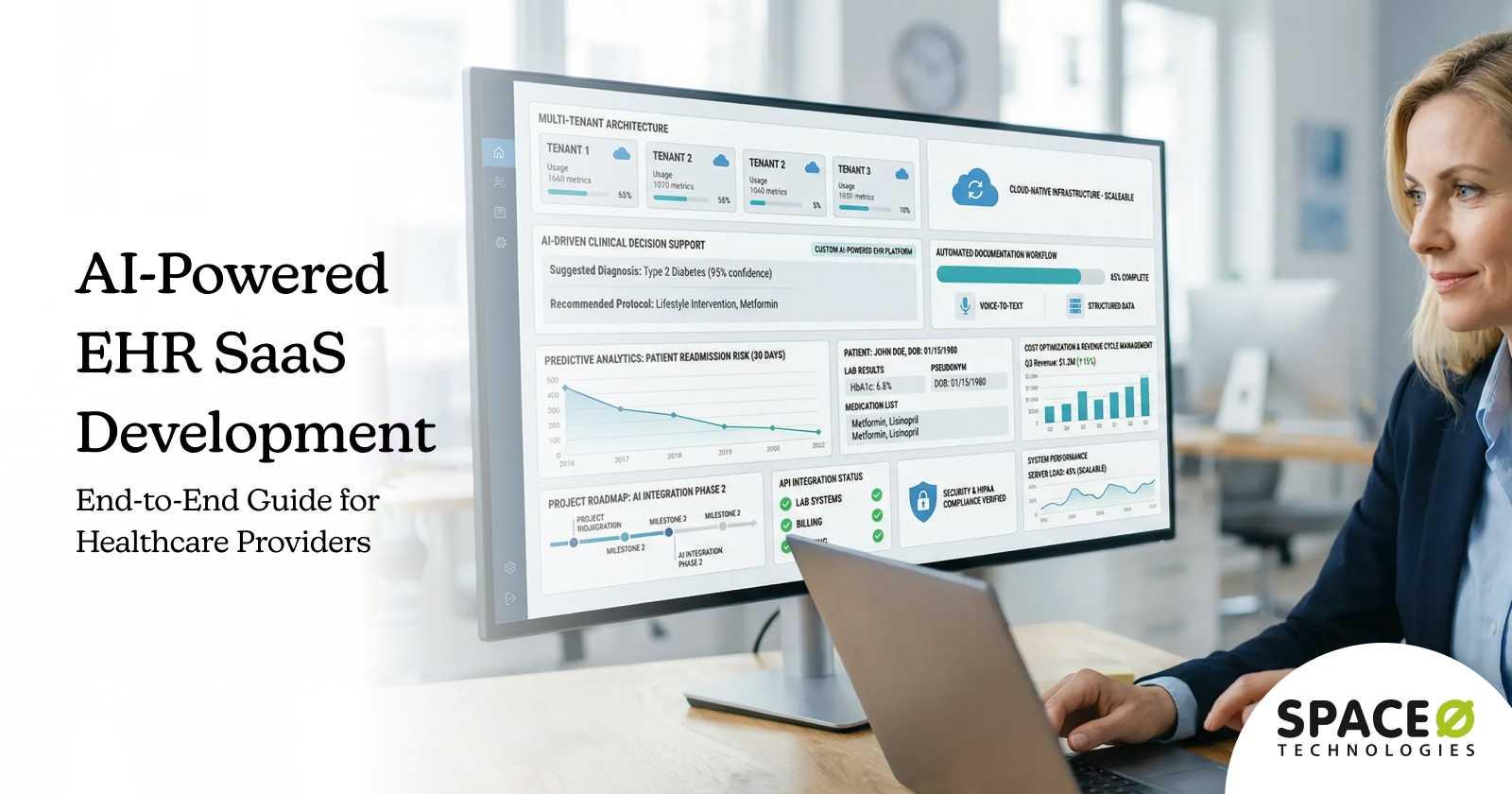
Healthcare providers are rapidly abandoning legacy on-premise systems in favor of cloud-native solutions that scale with their needs. The shift isn’t just about infrastructure. It’s about unlocking AI capabilities that were previously impossible with traditional deployments.
EHR SaaS development has become the preferred approach for healthcare organizations seeking flexibility, cost efficiency, and access to cutting-edge artificial intelligence features. According to DataM Intelligence, the AI-enhanced EHR market is projected to grow from $6.57 billion in 2024 to $52.50 billion by 2033, representing a 26.2% CAGR.
As a leading provider of AI EHR development services, we’ve observed firsthand how cloud-based architectures enable intelligent automation that transforms clinical workflows. Healthcare systems that once struggled with documentation burdens and fragmented data now leverage AI-powered SaaS platforms to improve patient outcomes while reducing operational costs.
This guide covers everything from multi-tenant architecture design to HIPAA compliance, AI feature integration, and cost considerations for building production-ready EHR SaaS platforms. Let’s begin by understanding what EHR SaaS development entails and how it differs from traditional approaches.
What Is AI EHR SaaS Development?
AI EHR SaaS development refers to building AI-enabled electronic health record systems delivered as Software-as-a-Service through cloud infrastructure. Unlike traditional on-premise EHR systems that require significant hardware investments and in-house IT management, SaaS-based EHR platforms operate on a subscription model where the software runs on remote servers managed by the provider.
How EHR SaaS Differs from On-Premise Systems
The fundamental difference lies in deployment and accessibility. On-premise EHR systems tie healthcare organizations to physical infrastructure, creating limitations around scalability, remote access, and feature updates. Cloud-native EHR SaaS platforms eliminate these constraints by providing:
- Anywhere-access enables clinicians to access patient records from any location
- Automatic updates delivering new features and security patches without manual intervention
- Elastic scalability that grows with organizational needs without hardware procurement
- Reduced IT burden as the provider manages infrastructure and maintenance
Key Characteristics of AI-Powered EHR SaaS Platforms
Modern EHR SaaS platforms integrate artificial intelligence at their core rather than as an afterthought. These platforms feature:
- Multi-tenant architecture with centralized AI processing, allowing all tenants to benefit from machine learning models
- Serverless computing enables intelligent automation that scales automatically based on clinical workload
- Real-time analytics with predictive capabilities running continuously in the background
- Automated clinical decision support providing evidence-based recommendations at the point of care
Now that we understand what EHR SaaS development involves, let’s explore the tangible benefits these platforms deliver to healthcare organizations.
Benefits of AI-Powered EHR SaaS for Healthcare Organizations
AI-powered EHR SaaS platforms deliver measurable advantages across clinical, operational, and financial dimensions. Healthcare organizations adopting these solutions gain competitive advantages while improving care quality.
1. Reduced Physician Burnout and Documentation Burden
Documentation consumes a significant portion of every clinical day. AI-powered EHR SaaS platforms address this through ambient clinical intelligence and automated note generation. AI scribes transcribe patient encounters in real-time, significantly reducing documentation time while improving note accuracy and completeness.
2. Enhanced Clinical Decision Support and Patient Outcomes
Predictive analytics embedded within EHR SaaS platforms identify at-risk patients before adverse events occur. AI-driven risk stratification models analyze historical data to flag potential complications, enabling proactive interventions that improve outcomes and reduce costly emergency care.
3. Lower Total Cost of Ownership Compared to On-Premise
The subscription model eliminates capital expenditure on hardware, reduces IT staffing requirements, and includes automatic updates within the service fee. Healthcare organizations achieve substantially lower total cost of ownership over multi-year periods compared to on-premise alternatives.
4. Improved Interoperability and Data Exchange
FHIR-native architecture built into modern EHR SaaS platforms enables seamless connectivity with health information exchanges, payers, and third-party applications. Cloud-based systems facilitate real-time data sharing that improves care coordination across organizational boundaries.
5. Scalable Infrastructure for Multi-Location Practices
Cloud-native architecture supports unlimited growth without infrastructure overhaul. Adding new locations, providers, or specialties requires configuration rather than hardware procurement. Auto-scaling ensures consistent performance during peak usage periods without manual intervention.
These benefits create compelling business cases for EHR SaaS adoption. Let’s examine the specific AI features that drive these advantages.
Partner with Space-O AI for Your AI EHR SaaS Development Project
With 500+ successful AI projects delivered and 15+ years of AI engineering experience, we build HIPAA-compliant, cloud-native EHR platforms with embedded AI capabilities.
Must-Have Features in Modern AI-Driven EHR SaaS Platforms
Modern EHR SaaS platforms require both foundational clinical capabilities and advanced AI features to meet evolving healthcare demands. The right combination of core functionality and intelligent automation differentiates competitive solutions from legacy systems.
Core Clinical Features Required
Every EHR SaaS platform must include essential clinical and administrative capabilities that support daily healthcare operations.
| Feature Category | Key Capabilities | Clinical Applications |
|---|---|---|
| Patient Management | Demographics, insurance verification, appointment scheduling, patient portal | Registration, eligibility checks, self-service booking, secure messaging |
| Clinical Documentation | Progress notes, encounter summaries, templates, e-signatures | Charting, visit documentation, specialty-specific workflows |
| Order Management | CPOE, lab orders, imaging requests, referral management | Prescription routing, diagnostic ordering, specialist coordination |
| Billing and Revenue Cycle | Charge capture, claims submission, payment processing, denial management | Coding compliance, reimbursement optimization, collections |
| Interoperability | HL7 FHIR APIs, ADT messaging, lab interfaces, HIE connectivity | Data exchange, care coordination, external system integration |
| Reporting and Analytics | Clinical dashboards, quality measures, population health reports | Performance tracking, regulatory reporting, outcome analysis |
AI-Powered Features That Differentiate
Artificial intelligence capabilities differentiate modern EHR SaaS platforms from legacy systems. These features automate routine tasks, surface clinical insights, and support better decision-making across the care continuum.
| AI Feature Category | Key Capabilities | Clinical Applications |
|---|---|---|
| Natural Language Processing | Ambient clinical listening, entity extraction, medical coding automation, clinical note generation | Automated documentation, ICD-10/SNOMED CT coding, discharge summary creation |
| Predictive Analytics | Risk stratification models, early warning systems, patient deterioration alerts | Readmission prediction, sepsis detection, care gap identification |
| Generative AI | Large language model integration, automated content generation, and intelligent summarization | Progress notes, discharge summaries, patient message drafting, and prior authorization letters |
| Conversational AI | Voice-enabled navigation, patient triage chatbots, and appointment scheduling automation | Hands-free EHR interaction, 24/7 symptom assessment, automated booking |
| Clinical Decision Support | Evidence-based recommendations, drug interaction alerts, protocol adherence monitoring | Point-of-care guidance, medication safety, chronic disease management |
| Computer Vision | Medical image analysis, document digitization, form recognition | Radiology support, paper record conversion, and intake form processing |
Organizations seeking guidance on implementing these capabilities can leverage healthcare AI consulting services to identify the right features for their clinical workflows. Building these AI capabilities requires a robust technical architecture. Let’s explore the multi-tenant design patterns that enable scalable EHR SaaS platforms.
Multi-Tenant Architecture for EHR SaaS Development
Multi-tenant architecture enables single software instances to serve multiple healthcare organizations while maintaining strict data separation. This approach delivers cost efficiency and simplified management while presenting unique challenges in healthcare contexts.
1. Understanding Multi-Tenancy Models
The fundamental decision in EHR SaaS development involves selecting the right tenancy model. Each approach offers different trade-offs between isolation, cost, and complexity.
| Architecture Pattern | Data Isolation | Cost Efficiency | Scalability | HIPAA Complexity |
|---|---|---|---|---|
| Separate database per tenant | Highest | Lower | Complex | Easier |
| Shared database with schema separation | High | Medium | Moderate | Moderate |
| Shared database with tenant ID | Medium | Highest | Simple | More complex |
| Containerized multi-tenant | High | Medium-High | Highly scalable | Moderate |
Each pattern suits different scenarios. Separate databases per tenant work well for enterprise clients requiring maximum isolation, while shared database approaches suit smaller practices prioritizing cost efficiency.
2. Tenant Isolation Strategies for Protected Health Information
PHI protection in multi-tenant environments requires defense-in-depth approaches across multiple layers.
2.1 Database-Level Isolation
Row-level security policies ensure database queries automatically filter results to the authenticated tenant, preventing accidental cross-tenant data exposure. Schema separation provides logical boundaries between tenant data within shared database instances.
2.2 Application-Level Isolation
Tenant-aware security tokens embed organizational context into every API request. Authentication systems validate both user identity and tenant membership before granting access to any resource.
2.3 Encryption-Based Isolation
Data encryption per tenant uses unique encryption keys for each organization. Even in shared database scenarios, this approach ensures that compromised keys expose only single-tenant data.
2.4 Emergency Access Controls
Break-the-glass emergency access controls allow authorized personnel to access records during emergencies while maintaining comprehensive audit trails. These mechanisms balance patient safety with privacy protection.
3. Scalability Considerations for Healthcare SaaS
Scalable architecture ensures consistent performance as user bases grow and clinical workloads fluctuate.
3.1 Horizontal Scaling Strategies
Horizontal scaling distributes EHR workloads across multiple servers based on demand. Unlike vertical scaling that requires larger individual machines, horizontal approaches add capacity incrementally as usage grows.
3.2 Auto-Scaling for Clinical Workflows
Auto-scaling based on clinical workflows adjusts resources dynamically. Morning census reviews, afternoon documentation pushes, and month-end reporting peaks receive appropriate computational resources automatically.
3.3 Geographic Distribution
Multi-region deployment supports disaster recovery and performance optimization. Patient data replicates across geographic regions to ensure availability during outages while reducing latency for distributed healthcare networks.
3.4 Content Delivery Optimization
CDN integration for medical imaging accelerates the delivery of large diagnostic images. Content delivery networks cache imaging studies at edge locations near clinical users, improving radiologist productivity and clinician satisfaction.
With architecture patterns established, compliance requirements demand careful attention. Let’s examine HIPAA considerations for cloud-based EHR platforms.
Build HIPAA-Compliant EHR Solutions with Space-O AI
Our 80+ healthcare AI specialists implement security-first architecture with encryption, access controls, and comprehensive audit trails. Protect patient data while building scalable, compliant EHR solutions.
HIPAA Compliance Requirements for Cloud-Based EHR SaaS
Healthcare data security remains paramount in EHR SaaS development. HIPAA regulations establish baseline requirements, but effective security programs exceed minimum compliance to protect against evolving threats.
1. Technical Safeguards
The HIPAA Security Rule mandates technical safeguards covering access controls, audit controls, integrity controls, and transmission security. Cloud-based EHR platforms must implement these controls across distributed infrastructure while maintaining usability.
1.1 Encryption Requirements
AES-256 encryption protects data at rest within databases and storage systems. TLS 1.3 secures data in transit between clients, servers, and third-party integrations. Encryption key management requires secure generation, storage, rotation, and destruction procedures.
1.2 Authentication Controls
Multi-factor authentication has become essential rather than optional. Combining knowledge factors (passwords), possession factors (mobile devices), and inherence factors (biometrics) dramatically reduces unauthorized access risks.
1.3 Audit and Logging
Audit trail and logging requirements capture all access to PHI. Comprehensive logs record who accessed what information, when, from where, and what actions they performed. These records support breach investigations and demonstrate compliance during audits.
2. Administrative Safeguards
2.1 Business Associate Agreements
Business Associate Agreements establish contractual obligations between covered entities and their technology partners. Cloud infrastructure providers, analytics vendors, and integration partners all require BAAs documenting their HIPAA responsibilities.
2.2 Workforce Training
Regular security awareness training ensures all personnel understand their responsibilities for protecting PHI. Training programs cover phishing recognition, password hygiene, and incident reporting procedures.
2.3 Risk Management
Ongoing risk assessments identify vulnerabilities before they lead to breaches. Regular penetration testing and vulnerability scanning validate security controls against evolving threat landscapes.
3. Security Safeguards Checklist for EHR SaaS Platforms
Comprehensive security programs address administrative, physical, and technical dimensions. The following checklist covers essential technical safeguards:
- Role-based access control (RBAC) limits users to the minimum necessary access based on job functions
- Automatic session timeout terminates inactive sessions after configurable idle periods
- Unique user identifiers ensure individual accountability for all system access
- Breach notification protocols define procedures for detecting, containing, and reporting security incidents
- Data backup and recovery procedures protect against data loss with tested restoration capabilities
- Vulnerability management programs identify and remediate security weaknesses before exploitation
- Penetration testing validates security controls through simulated attacks by ethical hackers
Healthcare organizations uncertain about compliance requirements can benefit from EHR consulting services to ensure their SaaS platform meets all regulatory standards from day one. With compliance foundations established, let’s walk through the development process for AI-powered EHR SaaS platforms.
EHR SaaS Development Process: Step-by-Step Explanation
Building AI-powered EHR SaaS platforms requires a structured methodology that balances speed with compliance rigor. The following process ensures successful delivery while managing healthcare-specific risks.
Step 1: Discovery and AI Feasibility Assessment
Discovery establishes project foundations through stakeholder interviews, workflow analysis, and technical assessment. This phase identifies clinical priorities, integration requirements, and AI use cases that deliver measurable value. Comprehensive discovery prevents costly mid-project pivots.
Action Items:
- Documenting current clinical workflows and pain points across departments
- Identifying AI opportunities with quantifiable ROI potential
- Mapping regulatory requirements, including HIPAA, state laws, and certification needs
- Evaluating technology stack options based on scalability and AI capabilities
- Defining success metrics and project governance structures
Step 2: Architecture Design and Cloud Infrastructure Planning
Architecture decisions made early in development have long-lasting implications. This phase establishes technical foundations for multi-tenancy, AI processing, security, and scalability. Careful planning prevents expensive refactoring as the platform matures.
Action Items:
- Selecting multi-tenancy models based on isolation requirements and cost targets
- Designing AI/ML infrastructure for training, inference, and model management
- Defining integration architecture for EHR-to-EHR and third-party connectivity
- Establishing security frameworks covering encryption, authentication, and access control
- Planning cloud infrastructure across compute, storage, and networking layers
Step 3: MVP Development with Core AI Features
Minimum viable product development delivers functional software quickly while managing scope. Healthcare MVPs must include compliance essentials alongside clinical features. Iterative development validates assumptions before investing in full-scale implementation.
Partnering with an experienced AI healthcare software development company ensures a proven methodology that prioritizes compliance and clinical usability from the initial sprint.
Action Items:
- Core clinical documentation and order entry workflows
- Essential AI capabilities such as NLP-assisted documentation or basic CDS
- HIPAA-grade security controls including encryption, access control, and audit logging
- Interoperability foundations using HL7 FHIR for future integration flexibility
- Patient portal with secure messaging and basic self-service features
Step 4: Testing, Certification, and Compliance Validation
Healthcare software demands rigorous testing beyond standard quality assurance. Clinical safety, regulatory compliance, and security vulnerabilities require specialized testing approaches. Certification preparation begins early to avoid delays.
Action Items:
- Clinical safety testing with physician and nursing stakeholders
- HIPAA security assessment, including vulnerability scanning and penetration testing
- ONC certification preparation for Certified EHR Technology designation
- Integration testing with laboratory, pharmacy, and imaging systems
- User acceptance testing across clinical and administrative personas
Step 5: Deployment and Continuous AI Model Improvement
Production deployment marks the beginning rather than the end of development. Cloud-native platforms enable continuous improvement through automated pipelines. AI models require ongoing monitoring and retraining to maintain accuracy.
Action Items:
- Cloud deployment to HIPAA-eligible services on AWS, Azure, or GCP
- MLOps pipeline implementation for model versioning, monitoring, and retraining
- Performance monitoring with alerting for availability and response time degradation
- Continuous integration and deployment for rapid feature delivery
- User training and change management to drive adoption
This structured process applies to greenfield development. Organizations with existing systems often need different approaches to add AI capabilities.
Let Space-O AI Guide Your EHR SaaS Development Journey
From discovery through deployment, we provide proven methodologies, expert architects, and best practices for successful EHR platform launches.
AI Integration Strategies for Existing EHR SaaS Platforms
Many healthcare organizations operate established EHR platforms and seek to enhance them with AI capabilities rather than replacing entire systems. Integration strategies enable incremental AI adoption while preserving existing investments.
1. Integration Approaches
1.1 FHIR-Based AI Microservices
FHIR-based AI microservices provide modular intelligence that connects to any FHIR-compliant EHR. These standalone services handle specific AI tasks such as risk prediction, NLP processing, or clinical recommendations, communicating through standardized APIs.
1.2 Vendor-Agnostic AI Layers
Vendor-agnostic AI layers abstract intelligence from underlying EHR platforms. This approach enables healthcare systems with multiple EHR vendors to deploy consistent AI capabilities across their entire network.
1.3 SMART on FHIR Applications
SMART on FHIR AI applications leverage the industry-standard application framework to embed intelligence directly into clinical workflows. These apps launch within the EHR context, accessing relevant patient data while presenting AI-driven insights.
2. Processing Pipeline Options
2.1 Real-Time Inference
Real-time inference suits time-critical use cases. Sepsis prediction requires immediate analysis as vital signs stream into the EHR. Clinical decision support alerts must appear before providers finalize orders.
2.2 Batch Processing
Batch processing works effectively for population-level analytics. Overnight batch jobs analyze entire patient panels for care gap identification, risk stratification updates, and quality measure calculations.
3. Integration Patterns for AI Capabilities
Successful AI integration requires thoughtful architecture that balances clinical utility with technical feasibility.
3.1 API-Based Integration
- RESTful AI APIs expose prediction endpoints that EHR systems call during clinical workflows
- GraphQL interfaces enable flexible data retrieval for complex AI model inputs
3.2 Event-Driven Integration
- Clinical event triggers initiate AI processing when specific actions occur
- Message queues decouple AI services from core EHR transactions for reliability
3.3 User Interface Integration
- Embedded widgets display AI insights within existing EHR screens without workflow disruption
- Background processing runs continuous analysis with alerts surfaced through existing notification channels
3.4 Distributed Learning
- Federated learning approaches train models across institutions without centralizing sensitive data
- Privacy-preserving analytics enable collaborative AI development while protecting PHI
Specialized AI EHR integration services providers help healthcare organizations embed machine learning models, NLP engines, and predictive analytics into their existing clinical workflows without disrupting operations.
4. Data Considerations
Feature extraction from EHR data requires careful attention to data quality and completeness. AI models perform only as well as their training data. De-identification pipelines enable AI training on real clinical data while protecting patient privacy. With technical approaches defined, understanding cost structures helps organizations plan investments appropriately.
Add AI Capabilities to Your Existing EHR with Space-O AI
With 15+ years of healthcare IT experience and 500+ AI projects delivered, our integration specialists connect AI models with your clinical workflows without disrupting current operations.
How Much Does It Cost to Build an AI-Powered EHR SaaS?
Developing an AI-powered EHR SaaS follows a tiered pricing structure where costs are dictated by the depth of AI integration and the scale of the deployment. Standard estimates range from a $40,000 MVP to over $1 million for enterprise-grade platforms.
| Complexity Level | Estimated Cost Range | Key AI Capabilities | Typical Use Case |
|---|---|---|---|
| Basic MVP | $40,000–$100,000 | Rule-based automation, simple chatbots, patient intake forms | Validating a single workflow for a small clinic or niche use case |
| Mid-Level Solution | $100,000–$450,000 | AI-powered virtual assistants, smart billing suggestions, department-specific tools | Multi-site clinic platforms with moderate EHR integration and decision support |
| Enterprise Platform | $500,000–$1,000,000+ | Deep learning for diagnostics, predictive analytics for hospital operations, full clinical decision support | Hospital-wide systems requiring advanced security, multiple integrations, and clinical validation |
Understanding Development Tiers
Basic MVP ($40,000-$100,000) includes core clinical documentation, patient scheduling, rule-based automation, and essential HIPAA compliance features. This tier suits small practices or startups validating market fit with a single workflow before expanding functionality.
Mid-Level Solution ($100,000-$450,000) adds intelligent capabilities, including AI-powered virtual assistants, smart billing suggestions, and department-specific clinical tools. This tier serves multi-site clinics requiring moderate EHR integration, basic decision support, and cross-location data synchronization.
Enterprise Platform ($500,000-$1,000,000+) delivers sophisticated clinical intelligence, including deep learning for diagnostics, predictive analytics for hospital operations, and comprehensive clinical decision support. This tier requires advanced security architecture, multiple system integrations, clinical validation studies, and regulatory certification preparation.
Factors Affecting Development Costs
Multiple variables determine where projects fall within cost ranges. Understanding these factors enables more accurate estimation and scope management.
- AI feature complexity drives significant cost variation. Basic NLP assistance costs less than comprehensive ambient clinical intelligence with multiple AI models working in concert.
- Integration requirements multiply with each connected system. Laboratory, pharmacy, imaging, billing, and HIE connections each require development and testing efforts.
- Compliance certification needs add cost for the ONC Certified EHR Technology designation. Certification involves testing fees, documentation requirements, and ongoing surveillance obligations.
- Development team location influences hourly rates significantly. North American developers command premium rates while equally skilled teams in other regions offer cost advantages.
- Ongoing maintenance and MLOps represent continuing costs beyond initial development. AI models require monitoring, retraining, and infrastructure that add 15–25% annually to development costs.
With cost structures understood, anticipating challenges enables proactive mitigation.
Get an Accurate Cost Estimate for Your EHR SaaS Project
Space-O AI provides detailed project estimates based on your specific requirements, complexity, and timeline. No hidden costs.
Challenges in EHR SaaS Development and How to Overcome Them
EHR SaaS development presents unique challenges stemming from healthcare complexity, regulatory requirements, and AI implementation risks. Anticipating these obstacles enables effective mitigation strategies.
1. Maintaining HIPAA Compliance in Multi-Tenant Environments
The Problem: Multi-tenancy introduces data segregation risks that single-tenant architectures avoid. Misconfigured access controls or query logic could expose PHI across organizational boundaries. The consequences include regulatory penalties, reputational damage, and patient harm.
Solution:
- Implementing tenant-level encryption keys, ensuring cross-tenant data remains unreadable
- Enforcing row-level security policies that automatically filter queries by tenant context
- Conducting regular third-party security audits to validate isolation controls
- Establishing clear data segregation protocols with automated compliance monitoring
- Testing tenant isolation through deliberate cross-tenant access attempts during QA
2. Ensuring AI Model Accuracy and Avoiding Bias
The Problem: AI models trained on biased data perpetuate and amplify those biases in clinical recommendations. Models may perform differently across patient populations, potentially creating care disparities. Inaccurate predictions erode clinician trust and may cause patient harm.
Solution:
- Curating diverse training datasets representing the full patient population
- Implementing continuous model monitoring that detects performance degradation
- Requiring human-in-the-loop validation for high-stakes clinical decisions
- Applying explainable AI frameworks that reveal the reasoning behind recommendations
- Conducting regular fairness audits across demographic groups
3. Achieving Interoperability with Legacy Systems
The Problem: Healthcare organizations operate diverse technology ecosystems accumulated over decades. Legacy systems use proprietary interfaces and outdated standards. Integration complexity multiplies with each connected system.
Solution:
- Adopting FHIR-first API design that positions platforms for ecosystem connectivity
- Building HL7 v2 message translation layers for legacy system communication
- Deploying integration engines that normalize diverse data formats
- Planning phased migration strategies that modernize connections incrementally
- Participating in health information exchange networks for broader connectivity
4. Managing Alert Fatigue in AI-Powered Systems
The Problem: Excessive clinical alerts desensitize providers, leading them to dismiss or ignore warnings. Critical alerts lose impact when buried among trivial notifications. Alert fatigue contributes to burnout and may compromise patient safety.
Solution:
- Implementing contextual alert filtering that suppresses irrelevant notifications
- Applying machine learning for alert prioritization based on clinical significance
- Offering customizable notification thresholds aligned with organizational preferences
- Continuously optimizing clinical workflows to reduce alert generation
- Measuring and reporting alert override rates to identify improvement opportunities
Navigating Data Migration from Legacy Systems
Migrating patient data from legacy EHR systems presents significant technical and clinical risks. Data formats vary across vendors, historical records may lack standardization, and incomplete migrations can compromise patient safety. Organizations face pressure to maintain operations during transition while ensuring zero data loss.
Solution:
- Conducting comprehensive data audits to identify inconsistencies before migration begins
- Building robust ETL pipelines with validation checkpoints at each transformation stage
- Implementing parallel running periods where both systems operate simultaneously
- Creating rollback procedures that enable quick recovery if critical issues emerge
- Engaging clinical stakeholders in data validation to ensure the accuracy of migrated records
Addressing these challenges proactively significantly improves project outcomes.
Overcome EHR SaaS Development Challenges with Space-O AI
Our team has navigated HIPAA compliance, AI bias mitigation, legacy system integration, and alert optimization for 500+ healthcare projects.
Build Your AI-Powered EHR SaaS with Space-O AI
Frequently Asked Questions on Developing an AI-Powered EHR SaaS
What is the difference between EHR SaaS and traditional EHR systems?
EHR SaaS delivers electronic health records through cloud infrastructure with subscription pricing, while traditional systems require on-premise hardware and perpetual licenses. SaaS platforms offer automatic updates, anywhere-access, and elastic scalability without infrastructure management. Traditional systems provide maximum control but require significant IT resources and capital investment.
How does AI enhance EHR SaaS platforms?
AI automates clinical documentation through ambient listening and NLP, provides predictive analytics for risk stratification, enables clinical decision support with evidence-based recommendations, and streamlines administrative tasks through generative AI. These capabilities reduce physician burnout, improve patient outcomes, and increase operational efficiency across healthcare organizations.
What compliance standards must EHR SaaS development meet?
HIPAA Security and Privacy Rules establish baseline requirements for protected health information. ONC certification criteria apply to systems used for federal incentive programs. State-specific regulations may impose additional requirements. SOC 2 Type II certification demonstrates operational security controls. HITRUST certification provides comprehensive healthcare security validation.
How long does it take to develop an AI-powered EHR SaaS platform?
Timeline varies significantly based on scope and complexity. Basic platforms with limited AI features require 6-9 months. Comprehensive systems with advanced AI capabilities, full specialty support, and extensive integrations typically require 12-18 months. MVP approaches can deliver initial functionality in 4-6 months for early validation.
What are the ongoing costs of maintaining an EHR SaaS solution?
Annual maintenance typically runs 15-25% of initial development costs. This includes cloud infrastructure, security monitoring, compliance updates, bug fixes, and feature enhancements. AI-powered systems add MLOps costs for model monitoring, retraining, and infrastructure. Support staff and vendor management add operational costs beyond technical maintenance.
Can existing EHR systems be migrated to a SaaS model?
Migration is possible but involves significant effort. Data migration requires careful mapping and validation to ensure clinical accuracy. Workflow reconfiguration adapts processes to new system capabilities. Integration reconnection establishes connections with existing ecosystem partners. User training enables staff adoption. Most organizations pursue phased migrations to manage risk.
How do multi-tenant EHR platforms ensure data privacy?
Multi-tenant platforms employ multiple isolation mechanisms, including tenant-specific encryption keys, row-level security policies, network segmentation, and access controls. Regular security audits validate isolation effectiveness. Business associate agreements establish contractual privacy obligations. Comprehensive audit logging enables investigation of any suspected privacy incidents.


Hire Expert AI EHR Developers
What to read next