- EHR Development Cost Breakdown by Complexity Level
- Cost of AI Integration in EHR Systems
- Hidden and Ongoing EHR Development Costs
- EHR Development Cost by Deployment Model
- Regional Variations in EHR Development Pricing
- How to Reduce EHR Development Cost Without Compromising Quality
- Build Your AI-Powered EHR Solution with Space-O AI
- FAQ
How Much Does It Cost to Develop an EHR System: Detailed Breakdown

 Last Updated: March, 10 2026
Healthcare organizations lose millions annually by underestimating EHR development costs or choosing solutions that fail to deliver long-term value. According to Research and Markets, the AI-enhanced EHR market is growing at an unprecedented 31% CAGR and projected to reach 28.09 billion USD by 2029, signaling a fundamental shift toward intelligent healthcare systems.
Custom AI-powered EHR development typically costs $40,000–$500,000+, depending on complexity, features, and the level of artificial intelligence integration required. Whether you’re a small clinic exploring affordable options or a hospital network planning enterprise-scale deployment, understanding these costs upfront prevents budget overruns and implementation failures.
This guide breaks down every cost component of AI-powered EHR development. Drawing from our 15+ years of experience as a leading AI EHR development agency, we share insights on costs of developing EHR systems. You’ll learn exactly what influences pricing, where hidden costs emerge, and how to optimize your budget without sacrificing quality.
EHR Development Cost Breakdown by Complexity Level
Understanding cost ranges by complexity level helps organizations align their budgets with realistic expectations. The investment required varies dramatically based on feature scope, AI integration depth, and organizational scale.
| Complexity Level | Cost Range | Timeline | AI Features | Best For |
|---|---|---|---|---|
| Basic EHR | $40K–$100K | 3–6 months | Rule-based alerts, basic automation | Small practices (1–10 physicians) |
| Mid-Level EHR | $100K–$250K | 6–12 months | ML analytics, NLP documentation | Mid-size organizations (10–50 physicians) |
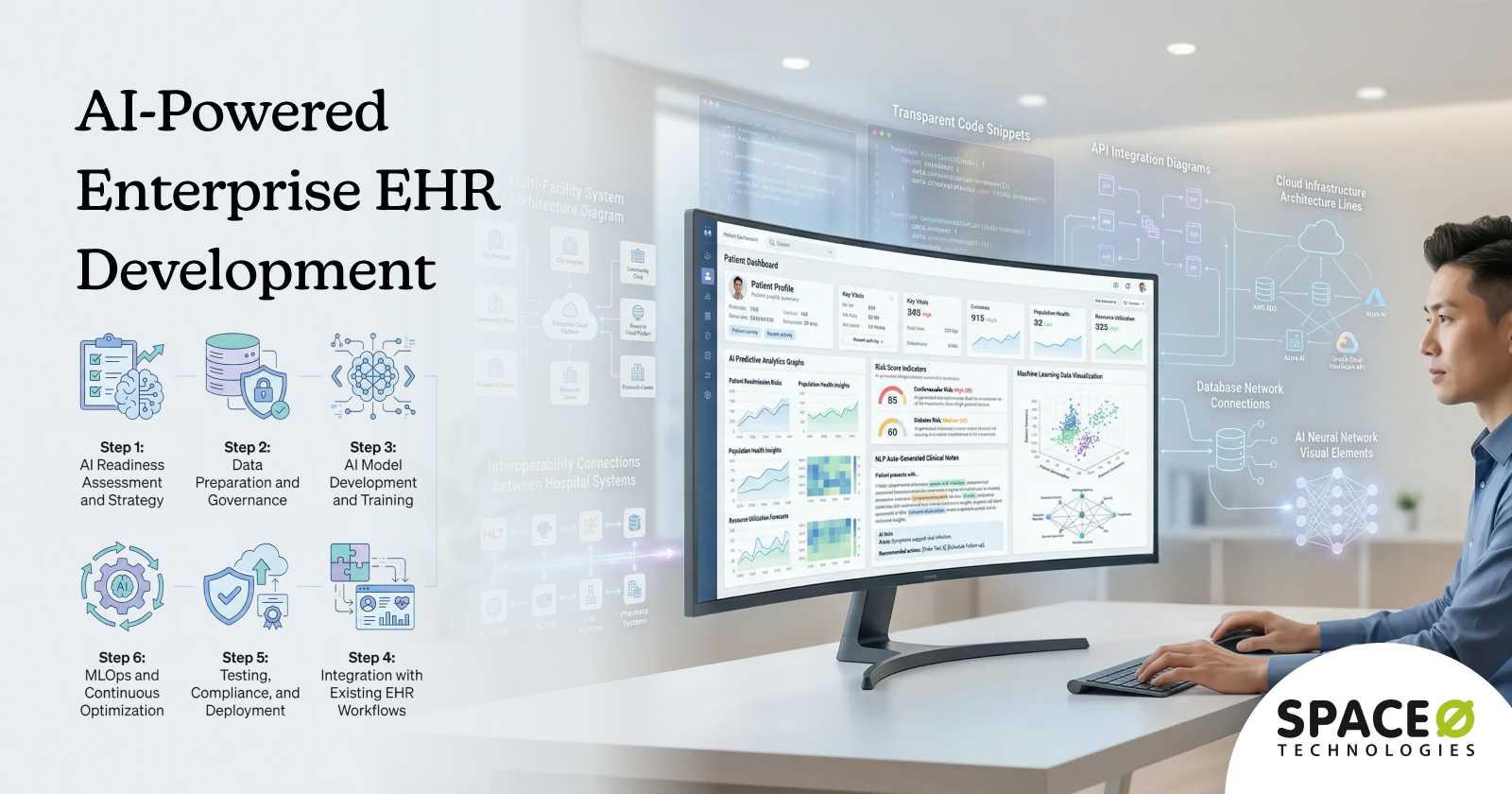
| Enterprise AI EHR | $250K–$500K+ | 12–18+ months | Full AI suite (predictive, generative, CDSS) | Hospitals and health systems |
1. Basic EHR Development Cost ($40,000–$100,000)
Basic EHR systems provide essential functionality for small practices and clinics operating with limited budgets. At this investment level, organizations receive core capabilities without advanced AI features.
Included Features:
- Electronic patient records management
- Appointment scheduling and calendar
- Basic billing and claims submission
- Prescription management (e-prescribing)
- Simple reporting and dashboards
- Rule-based clinical alerts
- Basic patient portal
AI Capabilities:
- Automated appointment reminders
- Basic data validation rules
- Simple workflow automation
- Template-based documentation assistance
Ideal For:
- Small practices with 1–10 physicians
- Clinics with straightforward workflows
- Organizations with limited IT budgets
- Practices transitioning from paper records
2. Mid-Level EHR Development Cost ($100,000–$250,000)
Mid-level systems balance comprehensive functionality with meaningful AI integration. Organizations at this investment level gain significant efficiency improvements through machine learning and natural language processing.
Included Features:
- Everything in the basic tier
- Advanced clinical workflows
- Comprehensive reporting and analytics
- Multi-location support
- Enhanced patient portal with messaging
- Telehealth integration
- Quality measure tracking
AI Capabilities:
- Machine learning-powered analytics
- NLP for clinical documentation
- Automated coding suggestions
- Basic predictive models (no-show prediction, risk flags)
- Intelligent scheduling optimization
- Voice-to-text transcription
Ideal For:
- Multi-physician practices with 10–50 providers
- Specialty clinics with complex workflows
- Organizations preparing for value-based care
- Practices seeking competitive differentiation
3. Enterprise AI-Powered EHR Development Cost ($250,000–$500,000+)
Enterprise systems represent comprehensive platforms with full AI suite integration. These solutions serve hospitals, health systems, and large medical groups requiring sophisticated capabilities.
Included Features:
- Everything in the mid-level tier
- Enterprise-wide interoperability
- Advanced population health management
- Comprehensive revenue cycle management
- Research and clinical trial support
- Custom module development
- White-label capabilities
AI Capabilities:
- Predictive analytics (readmission, sepsis, deterioration)
- Generative AI documentation (progress notes, discharge summaries)
- Advanced clinical decision support
- Real-time risk stratification
- Computer vision for medical imaging
- Conversational AI for patient engagement
Ideal For:
- Hospitals and health systems
- Large medical groups with 50+ providers
- Academic medical centers
- Organizations requiring advanced AI capabilities
Now that you understand complexity-based pricing, let’s examine AI integration costs in detail.
Ready to Get an Accurate Cost Estimate for Your AI-Powered EHR?
Our healthcare AI specialists have delivered 500+ successful projects. Get a detailed cost assessment and implementation roadmap tailored to your specific requirements and budget constraints.
Cost of AI Integration in EHR Systems
Artificial intelligence has transformed from a luxury feature to an essential component of modern EHR systems. With 71% of US hospitals now using predictive AI integrated with their electronic health records, organizations without AI capabilities risk falling behind competitors.
Partnering with experienced AI EHR integration services providers helps ensure seamless implementation of machine learning, NLP, and predictive analytics modules. It also helps maintain HIPAA compliance and overall system stability.
| AI Feature | Cost Range | Implementation Time | Business Impact |
|---|---|---|---|
| Predictive Analytics | $40K–$100K | 2–4 months | 20–30% reduction in readmissions |
| NLP Clinical Documentation | $50K–$150K | 3–5 months | 40–60% documentation time savings |
| Clinical Decision Support (CDSS) | $60K–$180K | 4–6 months | 15–25% improvement in diagnosis accuracy |
| Generative AI Documentation | $30K–$80K | 2–3 months | 70% reduction in manual note-taking |
| Conversational AI/Chatbots | $25K–$75K | 2–4 months | 40% reduction in call center load |
| ML Risk Stratification | $45K–$120K | 3–5 months | Early identification of high-risk patients |
1. Predictive Analytics ($40,000–$100,000)
Predictive analytics uses machine learning to analyze historical patient data and forecast outcomes like hospital readmissions, sepsis risk, and patient deterioration. These models enable proactive interventions, improve care quality, and support value-based care requirements by identifying high-risk patients before adverse events occur.
2. NLP Clinical Documentation ($50,000–$150,000)
Natural language processing extracts structured data from unstructured clinical notes, automates medical coding (ICD-10, CPT), and generates patient history summaries. NLP dramatically reduces documentation burden, addressing physician burnout while improving coding accuracy and enabling faster care transitions between providers.
3. Clinical Decision Support System ($60,000–$180,000)
CDSS provides real-time clinical guidance, including drug interaction alerts, evidence-based treatment recommendations, and diagnostic assistance. These systems analyze patient data against clinical guidelines to suggest optimal care paths, reduce medication errors, and improve diagnosis accuracy at the point of care.
4. Generative AI Documentation ($30,000–$80,000)
Generative AI drafts clinical notes, discharge summaries, and patient communications using ambient listening during encounters. Clinicians review and approve AI-generated content rather than creating documentation from scratch, reducing manual note-taking by up to 70% and freeing time for patient care.
5. Conversational AI and Chatbots ($25,000–$75,000)
Healthcare chatbots handle patient inquiries, appointment scheduling, symptom triage, and medication reminders through natural conversation. These AI assistants operate 24/7, reducing call center volume by up to 40% while improving patient access and satisfaction through immediate, consistent responses.
6. ML Risk Stratification ($45,000–$120,000)
Machine learning risk stratification models continuously analyze patient data to identify individuals requiring immediate attention or preventive interventions. These systems support population health management by segmenting patients based on risk levels, enabling targeted care coordination and resource allocation.
Understanding AI costs is essential, but organizations must also budget for expenses that aren’t immediately obvious.
Don’t Let Hidden Costs Derail Your EHR Project Budget
Get a transparent, no-obligation cost estimate for your AI EHR development project from Space-O AI.
Hidden and Ongoing EHR Development Costs
Many healthcare organizations focus solely on initial development costs, overlooking expenses that emerge during and after implementation. These hidden costs can add 30–50% to your total investment if not planned properly.
Engaging healthcare AI consulting services helps organizations plan for the total cost of ownership, including ongoing AI maintenance, compliance requirements, and operational expenses that many first-time buyers miss.
1. Data Migration and Legacy System Integration
Transferring data from existing systems to your new EHR requires careful planning and execution. The complexity depends on data volume, format consistency, and the number of source systems involved.
Larger datasets require more processing time and validation, while inconsistent or incomplete records need cleansing before migration. Organizations with multiple legacy systems face additional complexity in mapping data fields and ensuring continuity of patient records.
Cost range: $10,000–$150,000, depending on data volume and source system complexity.
2. Staff Training and Change Management
Technology investments fail without proper user adoption. Training costs depend on system complexity, staff size, and the extent of workflow changes required. Effective programs include end-user training sessions, super-user development, administrator training, and ongoing refresher courses.
AI features require additional specialized education to ensure clinicians can leverage advanced capabilities effectively.
Cost range: $5,000–$100,000, depending on organization size and training depth.
3. Hardware and Infrastructure Requirements
On-premise deployments require server infrastructure, while AI workloads may need specialized hardware regardless of the deployment model.
Key considerations include server hardware and storage, network upgrades for performance, GPU resources for AI processing, backup and disaster recovery systems, and end-user devices such as workstations, tablets, and mobile devices.
Cost range: $5,000–$200,000, depending on deployment model and AI infrastructure needs.
4. Annual Maintenance and Support Fees
Ongoing maintenance ensures your EHR remains secure, compliant, and functional over time. This includes bug fixes, performance optimization, security patches, compliance updates for regulatory changes, help desk support, and minor feature enhancements.
Organizations should budget 15–25% of the initial development cost annually for comprehensive maintenance.
Cost range: 15–25% of the initial development cost annually.
5. Compliance Audits and Security Updates
Healthcare regulations evolve continuously, requiring regular compliance assessments and system updates. Organizations must budget for HIPAA security assessments, penetration testing, compliance documentation updates, and staff compliance training.
These ongoing investments protect against regulatory penalties and security breaches while maintaining patient trust.
Cost range: $12,000–$58,000 annually for comprehensive compliance maintenance.
6. AI Model Retraining and Optimization
AI systems require ongoing attention to maintain accuracy and relevance. Models trained on historical data may degrade as patient populations and clinical practices change.
Essential activities include performance monitoring, data drift detection, periodic model retraining, algorithm optimization, and new feature development. Larger AI implementations require dedicated resources for continuous improvement.
Cost range: $10,000–$200,000 annually, depending on AI complexity and scope.
With hidden costs understood, let’s compare how deployment models affect your total investment.
Don’t Let Hidden Costs Derail Your EHR Project Budget
Get a transparent, no-obligation cost estimate for your AI EHR development project from Space-O AI.
EHR Development Cost by Deployment Model
Your deployment model choice significantly impacts both initial investment and long-term operational costs. Each approach offers distinct advantages depending on organizational size, technical capabilities, and data sensitivity requirements.
The following table compares deployment options across key cost dimensions.
| Deployment Model | Initial Cost | Monthly/Annual Cost | Best For | AI Considerations |
|---|---|---|---|---|
| Cloud-Based SaaS | $30K–$150K | $200–$2,000/provider/month | Small–mid practices | Leverage cloud AI services |
| On-Premise | $150K–$500K+ | 15–25% annual maintenance | Large hospitals, data-sensitive orgs | Requires dedicated AI infrastructure |
| Hybrid | $100K–$350K | Mixed ongoing costs | Organizations with mixed requirements | Flexible AI workload distribution |
1. Cloud-Based EHR ($30,000–$150,000 Initial + $200–$2,000/Provider/Month)
Best For: Small to mid-size practices prioritizing lower upfront costs and minimal IT overhead.
Cloud deployment has become the preferred choice for many healthcare organizations, particularly smaller practices seeking to minimize upfront investment. The cloud model shifts capital expenditure to operational expenditure through subscription pricing.
Advantages:
- Lower initial investment with no server infrastructure required
- Predictable monthly costs and automatic scaling
- Built-in redundancy, disaster recovery, and security updates
- Access to cloud AI services (AWS, Azure, GCP) with pre-built APIs
Considerations:
- Subscription fees accumulate over time
- Data transfer costs for large datasets
- Potential vendor lock-in concerns
2. On-Premise EHR ($150,000–$500,000+ Initial + 15–25% Annual Maintenance)
Best For: Large hospitals, data-sensitive organizations, and enterprises with existing data center infrastructure.
On-premise deployment appeals to organizations requiring maximum control over data and infrastructure. While initial costs are higher, some organizations achieve lower long-term costs through ownership.
Advantages:
- Complete control over data and infrastructure
- No ongoing subscription fees after initial investment
- Custom AI infrastructure with dedicated GPU servers
- No dependency on external cloud providers
Considerations:
- Higher upfront capital expenditure
- Requires internal IT staff for maintenance
- Disaster recovery infrastructure costs additional
3. Hybrid EHR ($100,000–$350,000 Initial + Mixed Ongoing Costs)
Best For: Organizations with mixed requirements, strict data residency needs, and variable workloads.
Hybrid approaches combine cloud flexibility with on-premise control, allowing organizations to optimize cost and performance for different workloads.
Advantages:
- Balance between control and flexibility
- Keep sensitive data on-premise while leveraging the cloud for analytics
- AI training in the cloud with on-premise inference
- Optimized costs based on workload requirements
Considerations:
- More complex architecture to manage
- Requires expertise in both environments
- Integration between cloud and on-premise systems
Regional Variations in EHR Development Pricing
Development team location significantly impacts project costs while introducing quality and communication considerations. Organizations must balance cost savings against expertise requirements, particularly for specialized healthcare AI development.
When you hire EHR developers from different regions, understanding the trade-offs helps you make informed decisions that balance budget constraints with quality requirements.
The following table summarizes regional rate variations and key considerations.
| Region | Hourly Rate Range | AI/ML Specialist Premium | HIPAA Expertise | Communication |
|---|---|---|---|---|
| North America | $100–$250/hour | +20–30% | Excellent | Same timezone |
| Western Europe | $80–$180/hour | +15–25% | Good (GDPR focus) | Minor timezone difference |
| Eastern Europe | $40–$90/hour | +10–20% | Growing | 6–8 hour difference |
| Asia-Pacific | $25–$70/hour | +10–15% | Variable | 10–14 hour difference |
1. North America ($100–$250/Hour)
North American development teams offer the highest expertise in HIPAA compliance and US healthcare workflows. Premium rates reflect deep domain knowledge and regulatory familiarity.
Advantages: Native understanding of US healthcare regulations, no timezone challenges, strong AI/ML talent availability, and established healthcare IT track record.
Considerations: Highest hourly rates may require larger budgets for comprehensive projects.
Best For: Organizations requiring close collaboration, complex compliance requirements, and enterprises with substantial budgets.
2. Western Europe ($80–$180/Hour)
Western European teams provide strong technical expertise with a good understanding of healthcare regulations, particularly GDPR compliance, which shares principles with HIPAA.
Advantages: Strong AI talent pool, quality engineering standards, minor timezone differences with the US East Coast, and good English proficiency.
Considerations: Rates approaching North American levels for senior talent, HIPAA expertise may require additional guidance.
Best For: Organizations seeking quality development with moderate cost savings and manageable timezone overlap.
3. Eastern Europe ($40–$90/Hour)
Eastern European teams offer compelling value with strong technical skills at competitive rates. Countries like Ukraine, Poland, and Romania have developed significant healthcare IT expertise.
Advantages: Strong engineering education, growing healthcare domain expertise, and reasonable US East Coast timezone overlap.
Considerations: HIPAA expertise varies by vendor, may require additional compliance guidance, and some geopolitical considerations.
Best For: Cost-conscious organizations with clear requirements and the capacity to provide compliance direction.
4. Asia-Pacific ($25–$70/Hour)
Asia-Pacific regions offer the lowest rates but require careful vendor selection to ensure quality and compliance understanding.
Advantages: Lowest hourly rates, large developer talent pools, scalability for large teams, and 24/7 development possibilities.
Considerations: Variable quality across vendors, limited HIPAA-specific expertise, significant timezone challenges, and requires stronger project management.
Best For: Organizations with well-defined specifications, strong internal project management, and a primary focus on cost optimization.
Understanding regional costs helps with budgeting, but strategic approaches can reduce expenses without sacrificing quality.
How to Reduce EHR Development Cost Without Compromising Quality
Smart planning and strategic decisions can significantly reduce EHR development costs while maintaining the functionality and compliance your organization needs. Follow these six proven steps to maximize value from every dollar invested.
Step 1: Start with an MVP and Scale Incrementally
Build a minimum viable product with core functionality first, then add advanced features based on validated needs. Launch with essential capabilities like patient records, scheduling, billing, and basic compliance features.
Once your MVP is stable, add AI capabilities in phases: basic automation first, then predictive analytics, NLP documentation, and generative AI. This approach reduces risk, spreads costs over time, and ensures you’re investing in features users actually need.
Step 2: Leverage Cloud-Based AI Services
Use pre-built AI services from major cloud providers instead of building everything custom. Amazon Comprehend Medical, Google Cloud Healthcare AI, Microsoft Azure Health Bot, and AWS HealthLake offer production-ready capabilities at a fraction of custom development cost.
For example, cloud NLP integration costs $15,000–$40,000 plus usage fees, compared to $50,000–$150,000 for custom NLP development. This approach accelerates time-to-market while reducing development and maintenance burden.
Step 3: Choose the Right Development Partner
Engaging EHR consulting services before development begins helps you define requirements accurately and avoid costly scope creep. Select a partner with proven healthcare domain expertise, HIPAA compliance track record, AI and machine learning capabilities, transparent pricing, and strong post-launch support offerings. The right partner prevents expensive mistakes and rework that can derail project budgets.
Step 4: Prioritize Interoperability from Day One
Build interoperability into your system architecture from the start rather than retrofitting later. Implement FHIR-native architecture design, adopt standard terminologies like SNOMED and LOINC, use an API-first development approach, and create a modular integration framework. These upfront investments cost far less than rebuilding systems to meet interoperability requirements after launch.
Step 5: Use Agile Development Methodology
Adopt agile practices for better cost control through iterative development and regular feedback cycles. Agile enables regular working software deliveries, early detection of issues, flexibility to reprioritize features, better stakeholder alignment, and reduced risk of major rework. This approach keeps projects on budget by catching problems early and allowing scope adjustments based on evolving requirements.
Step 6: Leverage Open-Source Frameworks and Pre-Built Components
Reduce development time and cost by incorporating proven open-source healthcare frameworks rather than building everything from scratch. FHIR implementation libraries, open-source clinical terminologies, and pre-built UI component libraries can cut development effort by 20-30% for common functionality.
OpenMRS, HAPI FHIR, and similar healthcare-specific frameworks provide tested foundations for patient data management, interoperability, and clinical workflows. While customization is still required, starting with established components eliminates months of foundational development and reduces debugging time for standard features.
Build Your AI-Powered EHR Within Budget Without Cutting Corners
With 15+ years of software development expertise and 80+ AI specialists, we ensure maximum value from every dollar invested in your EHR system. Let’s discuss your requirements.
Build Your AI-Powered EHR Solution with Space-O AI
Understanding EHR development cost requires evaluating complexity, AI integration, compliance requirements, and deployment models. From basic systems starting at $50,000 to enterprise AI-powered solutions exceeding $500,000, strategic investment in the right features delivers measurable ROI through improved efficiency and better patient outcomes.
Space-O AI brings 15+ years of software development expertise with a specialized focus on AI-powered healthcare solutions. With 500+ successful AI projects delivered and a 97% client retention rate, we help healthcare organizations build HIPAA-compliant EHR systems that transform clinical workflows and enhance patient care.
Our team of 80+ AI specialists brings deep expertise in machine learning, natural language processing, and predictive analytics for healthcare applications. We maintain 99.95% system uptime and deliver production-ready EHR solutions designed for scalability, security, and long-term performance.
Ready to discuss your AI-powered EHR development project? Contact us for a free consultation and detailed cost estimate tailored to your requirements. Our healthcare AI specialists will help you plan a solution that fits your budget, meets compliance requirements, and delivers lasting value.
FAQ
What is the cost of integrating AI into an existing EHR system?
Integrating AI into an existing EHR system costs between $30,000 and $180,000, depending on the AI features required. Predictive analytics modules typically cost $40,000–$100,000, NLP documentation automation runs $50,000–$150,000, and clinical decision support systems range from $60,000–$180,000. Simpler AI features like chatbots or basic automation start around $25,000–$75,000.
How long does AI-powered EHR development take?
AI-powered EHR development timelines range from 3 to 18 months, depending on complexity. Basic systems require 3–6 months, mid-level solutions take 6–12 months, and enterprise platforms with comprehensive AI integration need 12–18 months or longer. Factors affecting the timeline include feature scope, AI complexity, integration requirements, and compliance validation needs.
Is cloud-based EHR cheaper than on-premise?
Cloud-based EHR has lower upfront costs but may cost more over time through subscription fees. Initial cloud investment ranges from $30,000–$150,000 versus $150,000–$500,000+ for on-premise. However, on-premise annual maintenance (15–25% of initial cost) may be lower than cumulative cloud subscriptions for large organizations over 5–10 years. Total cost of ownership analysis should guide your decision.
What are the ongoing costs of maintaining an AI-powered EHR?
Annual maintenance for AI-powered EHR systems typically costs 15–25% of the initial development investment. This includes bug fixes, security updates, compliance maintenance, and technical support. AI-specific ongoing costs add another $10,000–$200,000 annually, depending on AI complexity, covering model monitoring, retraining, and optimization. Larger AI implementations require dedicated resources for continuous improvement.
How can I reduce EHR development costs without compromising quality?
Reduce EHR development costs through MVP-first development (launch core features, add AI incrementally), leveraging cloud AI services instead of custom development, choosing experienced partners to avoid costly mistakes, prioritizing interoperability from the start, using agile methodology for better cost control, and incorporating open-source frameworks for standard functionality. Strategic planning and phased implementation can reduce total investment by 20–40%.


Estimate Your EHR Development Costs
What to read next