- What Is an AI Diagnostic Tool for Telehealth?
- How AI Diagnostic Tools Work in Telehealth
- Key Features of AI Diagnostic Tools for Telehealth
- Benefits of AI Diagnostic Tools for Providers and Patients
- Challenges of AI Diagnostic Tools and How to Overcome Them
- Build vs. Buy: Custom AI Diagnostic Development
- Implementation Best Practices for AI Diagnostic Tools
- Build Your AI Diagnostic Solution with SpaceO AI
- Frequently Asked Questions
- 1. How accurate are AI diagnostic tools compared to physicians?
- 2. What data is needed to train an AI diagnostic model?
- 3. How long does it take to implement an AI diagnostic tool?
- 4. Are AI diagnostic tools HIPAA compliant?
- 5. What liability concerns exist with AI-assisted diagnoses?
- 6. Can AI diagnostic tools work with limited internet connectivity?
AI Diagnostic Tool for Telehealth: Transforming Remote Care Delivery

 Last Updated: February, 9 2026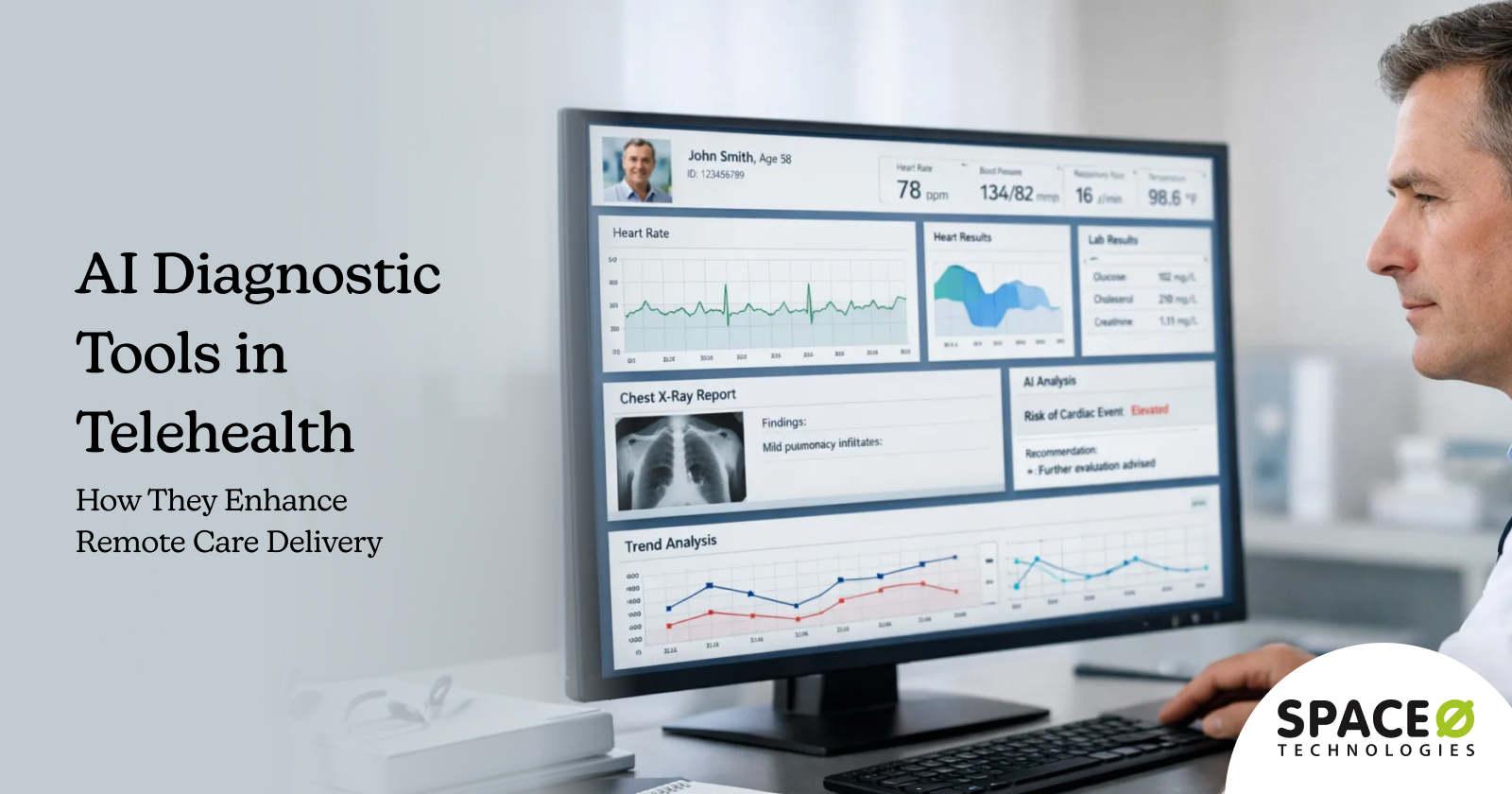
Telehealth has made healthcare more accessible, but diagnostic accuracy and speed remain critical challenges in virtual care. Clinicians often rely on limited patient inputs, asynchronous data, and time-constrained consultations, increasing the risk of delayed or missed diagnoses.
This is where AI diagnostic tools in telehealth are creating a meaningful impact. By analyzing symptoms, medical history, images, voice inputs, and real-time patient data, AI-powered diagnostic tools help clinicians identify potential conditions faster, prioritize high-risk cases, and make more informed decisions during virtual consultations.
The growing adoption of these tools is reflected in market momentum. According to PS Market Research, the AI in medical diagnostics market is projected to reach USD 8.31 billion by 2032, underscoring how rapidly healthcare organizations are investing in AI-driven diagnostic capabilities to strengthen virtual care delivery.
In this guide, we explore how AI diagnostic tools work in telehealth, key use cases, benefits, development considerations, and how expert partners like Space-O AI help bring these solutions to life. Drawing from our experience as a trusted healthcare AI software development partner, we have shared insights on the fundamentals, uses, benefits, and implementation steps for AI-powered telehealth diagnostic solutions.
What Is an AI Diagnostic Tool for Telehealth?
An AI diagnostic tool for telehealth is an intelligent software system that assists clinicians in making diagnostic decisions during virtual patient encounters. These tools analyze patient data, symptoms, medical history, and sometimes images or vital signs to generate diagnostic insights, risk assessments, and treatment recommendations.
Think of it as a clinical decision support layer that sits within your telehealth platform. While traditional telemedicine connects patients and providers through video, AI diagnostic tools add intelligence to that interaction.
They process information that would otherwise require physical examination or specialist consultation. Building these systems requires specialized healthcare AI development services to ensure clinical accuracy and regulatory compliance.
Core components of an AI telehealth tool
- Data input layer: Collects patient-reported symptoms, medical history from EHR, images from remote devices, and vital signs from wearables
- AI processing engine: Applies machine learning techniques and algorithms to analyze patterns and generate insights
- Clinical decision output: Provides differential diagnoses, confidence scores, and evidence-based recommendations
- Feedback mechanism: Captures clinician decisions to improve model accuracy over time
Types of AI diagnostic tools commonly deployed in telehealth
| Tool Type | Primary Function | Common Use Cases |
| Symptom-based triage | Assess urgency and route patients | Primary care, urgent care |
| Image analysis | Analyze medical images remotely | Dermatology, ophthalmology, radiology |
| Lab interpretation | Contextualize test results | Chronic disease management |
| Differential diagnosis | Generate ranked condition possibilities | General practice, specialist support |
| Clinical decision support (CDSS) | Provide evidence-based recommendations | All specialties |
These tools don’t replace physician judgment. They augment it by processing more data, identifying patterns humans might miss, and providing evidence-based support for clinical decisions. The physician remains in control, but with better information at their fingertips.
Understanding the use cases of AI in telemedicine and diagnostics reveals why they’re achieving clinical-grade accuracy in remote settings.
How AI Diagnostic Tools Work in Telehealth
AI diagnostic tools follow a structured workflow that transforms raw patient data into actionable clinical insights. Here’s how the process works.
1. Data collection and input
The diagnostic process begins with gathering patient information from multiple sources:
Patient-reported data
- Symptoms collected through conversational AI interfaces
- Chief complaints, duration, and severity ratings
- Natural language descriptions processed by NLP
Clinical data integration
- EHR data via HL7 FHIR APIs (diagnoses, medications, allergies)
- Real-time imaging from smartphones and remote devices
- Wearable sensor data (vitals, glucose, heart rate)
2. AI processing and analysis
Multiple AI technologies work together to generate diagnostic insights:
Core Technologies
- Machine Learning: Identifies patterns correlating with specific conditions using supervised learning models
- Natural Language Processing: Extracts clinical meaning from patient descriptions and clinical notes
- Computer Vision: Analyzes medical images for skin lesions, retinal conditions, and radiological findings
- Knowledge Graphs: Connects symptoms to conditions using ICD-10 codes and clinical guidelines
3. Clinical output and recommendations
The AI engine produces structured outputs for clinical decision-making:
Diagnostic outputs
- Differential Diagnosis: Ranked conditions with probability scores
- Risk Stratification: Urgency classification (emergency, urgent, routine)
- Treatment Recommendations: Evidence-based next steps aligned with clinical guidelines
- Confidence Indicators: Clear uncertainty signals when data is insufficient
4. Feedback Loop and Continuous Learning
AI diagnostic systems improve through structured feedback:
Improvement Mechanisms
- Clinician Feedback: Captures accepted, modified, or rejected recommendations
- Outcome Tracking: Validates accuracy against confirmed diagnoses
- Performance Monitoring: Tracks sensitivity, specificity, and predictive values over time
This continuous improvement cycle means AI diagnostic tools become more accurate as they process more cases within your specific patient population.
These working mechanisms translate into specific features that make AI diagnostic tools valuable for telehealth platforms.
Build AI diagnostics that Clinicians Trust
Space-O AI builds AI diagnostic tools with clinical validation, safety guardrails, and human-in-the-loop oversight
Key Features of AI Diagnostic Tools for Telehealth
When evaluating AI diagnostic tools to create an AI telemedicine app, certain features separate clinical-grade solutions from basic automation. Here’s what to look for in a comprehensive platform.
1. Intelligent symptom assessment
Effective symptom collection uses conversational interfaces that adapt based on patient responses, mimicking how experienced clinicians conduct patient histories.
| Aspect | Description |
| Context-Aware Questioning | Adjusts diagnostic pathways in real time based on responses. If chest pain is mentioned, automatically explores cardiac risk factors, timing, and associated symptoms. |
| Multi-Language Support | Provides accurate assessment across diverse populations using healthcare-specific language models rather than generic translation services. |
| Accessibility Features | Accommodates varying technical literacy, visual impairments, and cognitive challenges through voice input, large text options, and simplified interfaces. |
| Red Flag Detection | Identifies symptoms requiring immediate attention. Phrases like “worst headache of my life” trigger urgent pathways regardless of stated concern level. |
2. Medical image analysis
Remote image analysis extends specialist capabilities to any location with a camera or imaging device, enabling diagnostic support without in-person visits.
| Aspect | Description |
| Dermatology Analysis | Analyzes skin lesions, rashes, and wounds. Identifies concerning mole features, classifies conditions like eczema, and tracks wound healing progress. |
| Ophthalmology Screening | Detects diabetic retinopathy, glaucoma indicators, and macular degeneration from retinal images for primary care screening. |
| Radiology Support | Provides pre-read assessments and prioritization. Flags urgent findings and catches subtle abnormalities in high-volume settings. |
| Wound Care Monitoring | Tracks healing progression through standardized image capture. Measures dimensions, identifies infection indicators, and alerts to deterioration. |
3. Clinical decision support
Beyond generating diagnoses, robust tools provide actionable clinical guidance that integrates with existing care protocols.
| Aspect | Description |
| Drug Interaction Checking | Alerts prescribers to potential conflicts with current medications, especially valuable when patients see multiple providers. |
| Clinical Guideline Integration | Ensures recommendations align with current evidence and references specific guidelines supporting treatment approaches. |
| Specialist Referral Logic | Identifies when cases exceed primary care scope and suggests specific specialty referrals based on clinical presentation. |
| Documentation Support | Auto-generates clinical notes from diagnostic encounters, reducing administrative burden while ensuring complete documentation. |
4. EHR integration and interoperability
Standalone AI tools create workflow friction. Integrated solutions fit seamlessly into clinical practice and drive higher adoption rates. Professional AI integration services help ensure seamless connectivity with existing healthcare IT infrastructure, and businesses highly benefit by their expertise.
| Aspect | Description |
| HL7 FHIR Compatibility | Ensures standard data exchange with modern EHR systems. Patient demographics and encounter data flow bidirectionally without manual entry. |
| Major EHR Connectors | Provides pre-built integrations with Epic, Cerner, Athenahealth, and other dominant platforms, reducing implementation time significantly. |
| Single Sign-On | Eliminates separate logins for clinicians already authenticated in their EHR, reducing friction and increasing adoption. |
| Bidirectional Data Flow | Writes diagnostic outputs back to patient records. AI-generated assessments and risk scores become part of the permanent medical record. |
5. Risk stratification and triage
Efficient patient routing improves outcomes and resource utilization by ensuring the right patients receive the right level of care.
| Aspect | Description |
| Urgency Classification | Sorts patients into emergency, urgent, and routine categories ensuring high-risk patients receive immediate attention. |
| Acuity Scoring | Quantifies patient complexity for resource allocation. Higher scores trigger longer appointment slots or automatic specialist involvement. |
| Care Pathway Routing | Directs patients to appropriate services based on symptoms. Diabetes-related symptoms route to endocrinology; mental health concerns to behavioral health. |
| Predictive Scheduling | Anticipates no-shows and cancellations based on patient patterns, enabling overbooking strategies that maintain provider utilization. |
These features deliver measurable value for both healthcare providers and patients. Now, it’s time we take a look at the key benefits they deliver.
Benefits of AI Diagnostic Tools for Providers and Patients
AI diagnostic tools create value across the healthcare ecosystem. Understanding specific benefits helps build the business case for implementation and set appropriate expectations.
1. Benefits for healthcare providers
1.1 Improved diagnostic accuracy
AI tools process more data points and identify patterns across larger populations than any individual physician encounters. This provides specialist-level pattern recognition during virtual consultations, helping clinicians catch conditions they might otherwise miss.
1.2 Increased operational efficiency
AI automates time-intensive activities, including pre-visit symptom collection, real-time documentation, and routine triage. Physicians begin consultations with organized clinical information and spend less time on administrative tasks, enabling higher patient throughput.
1.3 Enhanced clinical confidence
AI provides evidence-based support that reduces diagnostic uncertainty in remote settings. When the system confirms clinical impressions or suggests alternatives, it reinforces decision-making and helps generalists identify cases requiring specialist referral.
1.4 Revenue and cost optimization
AI-assisted workflows enable higher patient volumes while maintaining quality. Reduced unnecessary referrals and testing, lower costs, while improved documentation quality reduces claim denials and supports appropriate billing codes.
1.5 Reduced administrative burden
AI generates clinical notes automatically from diagnostic encounters, significantly cutting post-visit charting time. Natural language processing converts conversations into structured documentation, freeing physicians to focus on patient care rather than paperwork.
1.6 Better resource allocation
AI-powered triage routes patients to appropriate care levels, ensuring complex cases receive physician attention while routine presentations flow through automated pathways. This optimizes staff utilization and reduces clinician burnout.
2. Benefits for Patients
2.1 Faster access to care
AI diagnostic tools provide immediate symptom assessment without appointment delays. Patients receive preliminary evaluations within minutes rather than waiting days or weeks, with 24/7 availability eliminating business-hour limitations for health concerns.
2.2 Better health outcomes
AI screening catches subtle patterns that might be missed in brief consultations, enabling early detection of serious conditions. Consistent diagnostic quality regardless of provider experience level improves prognosis through timely intervention and treatment initiation.
2.3 Improved patient experience
Patients receive quality healthcare from home without travel, parking, or waiting room time. AI tools provide clear explanations of conditions and treatments in patient-friendly language, reducing anxiety and improving understanding of their health status.
2.4 Cost savings
Appropriate AI-powered triage prevents unnecessary emergency department visits by routing symptoms to the right care level. Reduced travel requirements and faster diagnosis-to-treatment intervals minimize both direct healthcare costs and indirect expenses like lost wages.
2.5 Personalized care recommendations
AI analyzes complete medical history to generate treatment suggestions tailored to individual situations, comorbidities, and preferences. Personalized recommendations improve adherence and lead to better long-term health management outcomes for chronic conditions.
2.6 Greater healthcare accessibility
AI diagnostic tools extend specialist-level diagnostic support to underserved areas and populations with limited healthcare access. Rural patients and those with mobility challenges can receive quality assessments without traveling to distant medical facilities.
Despite these significant benefits, implementing AI diagnostic tools comes with challenges that must be addressed.
Need Help Building AI Diagnostic Capabilities That Deliver These Benefits?
We’ve built compliant healthcare AI systems for hospitals and telehealth startups that achieve measurable efficiency gains and improved patient outcomes. Let’s discuss your specific requirements.
Challenges of AI Diagnostic Tools and How to Overcome Them
Implementing AI diagnostic tools involves navigating technical, regulatory, and organizational hurdles. Understanding these challenges upfront enables proactive mitigation strategies.
1. Data quality and availability
AI models are only as good as their training data. Healthcare data presents unique difficulties: it’s often siloed across systems, inconsistent in format, incomplete in documentation, and protected by strict privacy regulations.
Small healthcare organizations may lack sufficient case volume to train accurate models. Rare conditions have limited examples in any dataset. Historical data may reflect outdated clinical practices or contain biases from past healthcare disparities.
Solutions
- Partner with established healthcare institutions or data providers for validated clinical datasets. Organizations like MIMIC-III for critical care or ISIC for dermatology provide research-quality datasets for model development.
- Implement robust data cleaning and normalization pipelines before training. Standardize terminology, handle missing values appropriately, and validate data quality at ingestion.
- Use synthetic data generation for rare conditions. Techniques like GANs can create realistic synthetic examples that augment limited real-world data while preserving privacy.
- Establish data governance frameworks early. Define ownership, quality standards, access controls, and retention policies before problems emerge.
- Consider federated learning approaches that train models across institutions without centralizing sensitive data. This expands available training data while maintaining privacy.
2. Clinical validation and accuracy concerns
Healthcare AI must meet stringent accuracy standards. A model that performs well on research data may fail in real-world clinical settings. Performance can vary significantly across different patient populations, healthcare settings, and clinical presentations.
Validating accuracy requires prospective studies with diverse patient groups, which are expensive and time-consuming. Edge cases and unusual presentations may not be represented in validation data.
Solutions
- Conduct prospective clinical validation studies before deployment. Retrospective validation on historical data is a starting point, but real-world performance testing is essential.
- Test across diverse demographics including age, ethnicity, sex, and comorbidity profiles. Models trained predominantly on one population may underperform on others.
- Implement confidence scoring that clearly communicates uncertainty. When the model encounters presentations outside its training distribution, it should flag reduced confidence rather than generating misleading certainty.
- Establish continuous performance monitoring dashboards. Track sensitivity, specificity, and predictive values in production. Set thresholds that trigger investigation when metrics degrade.
- Create feedback loops that capture clinician corrections. When physicians disagree with AI recommendations, this data improves future model versions.
3. Regulatory and compliance hurdles
AI diagnostic tools face complex regulatory requirements that vary by jurisdiction, intended use, and risk classification.
In the US, tools making diagnostic recommendations typically qualify as Software as Medical Device (SaMD), requiring FDA clearance. The regulatory pathway depends on device classification, from 510(k) clearance for moderate-risk devices to premarket approval for high-risk applications.
HIPAA compliance adds another layer. AI systems processing protected health information must implement administrative, physical, and technical safeguards. Training data handling, model storage, and inference logging all have compliance implications.
International deployment multiplies complexity. EU MDR, UK MHRA, and other regulatory frameworks have distinct requirements.
Solutions
- Engage regulatory consultants early in development. Understanding requirements before design decisions prevents costly rework.
- Build HIPAA compliance into architecture from day one. Encryption at rest and in transit, role-based access controls, audit logging, and minimum necessary data access should be foundational, not afterthoughts.
- Document clinical validation thoroughly for FDA submission. Maintain traceability from training data through model development to validation results.
- Implement audit trails and access controls that demonstrate compliance. Automated logging makes compliance verification straightforward during audits.
- Consider the regulatory strategy in vendor selection. If licensing components, verify that vendors maintain appropriate certifications and provide necessary documentation.
4. Clinician adoption and trust
Technology that clinicians won’t use delivers no value. Physicians may resist AI diagnostic tools due to workflow disruption, skepticism about accuracy, concerns about liability, or fear of being replaced.
Poor user experience amplifies resistance. Systems that require extra clicks, slow down consultations, or generate irrelevant recommendations quickly get abandoned.
Solutions
- Design intuitive interfaces that fit existing workflows. If clinicians already use a specific EHR, the AI tool should integrate seamlessly rather than requiring separate applications.
- Position AI as decision support, not replacement. Messaging matters. Tools that “help you catch what you might miss” are received differently than tools that “tell you what the diagnosis is.”
- Provide transparency in AI reasoning. Explainable AI that shows why a recommendation was made builds trust. “Suggesting diabetes screening because fasting glucose trend shows 15% increase over 6 months” is more credible than an unexplained recommendation.
- Start with narrow use cases that demonstrate clear value. A tool that saves 10 minutes per patient on documentation creates a visible benefit. Build from success.
- Involve clinicians in design and testing phases. Physicians who contribute to tool development become advocates for adoption.
- Provide adequate training and support during rollout. Don’t underestimate the change management investment required.
5. Integration with legacy systems
Healthcare runs on diverse technology stacks. Large health systems may have dozens of EHR instances, some running software versions that are years old. Integration that works with Epic may fail with Cerner. Custom-built systems present unique challenges.
Data formats vary. Terminology isn’t standardized. APIs may be limited or nonexistent.
Solutions
- Build API-first architecture using standard protocols. HL7 FHIR provides modern interoperability standards that most EHR vendors now support to some degree.
- Offer multiple integration options. Some organizations require cloud deployment; others mandate on-premise for data sovereignty. Hybrid architectures accommodate varying requirements.
- Provide dedicated integration support and documentation. Complex integrations require hands-on assistance, not just API documentation.
- Plan for phased rollout to minimize disruption. Pilot in one department before expanding. Identify and resolve integration issues at small scale before enterprise deployment.
- Budget adequate time for integration. Healthcare IT projects routinely take longer than planned due to unforeseen compatibility issues.
6. Bias and fairness in AI models
AI models can perpetuate or amplify biases present in training data. If historical data reflects healthcare disparities, perhaps certain populations received less thorough evaluation, and the model may perform worse for those groups.
Bias isn’t always obvious. A model may achieve high overall accuracy while systematically underperforming for specific subpopulations.
Solutions
- Audit training datasets for demographic representation. If 90% of dermatology training images are from light-skinned patients, performance on darker skin tones will likely suffer.
- Test model performance across patient subgroups. Stratify validation results by age, sex, ethnicity, and other relevant factors. Identify disparities before deployment.
- Implement bias detection and mitigation algorithms. Techniques like adversarial debiasing, resampling, and fairness constraints can reduce performance disparities.
- Establish ongoing fairness monitoring. Bias can emerge over time as patient populations shift or clinical practices change. Continuous monitoring catches problems early.
- Include diverse perspectives in development teams. Homogeneous teams are more likely to overlook bias affecting populations they don’t represent.
- With these challenges understood, organizations must decide whether to build custom solutions or leverage existing platforms.
Build vs. Buy: Custom AI Diagnostic Development
One of the most consequential decisions in AI diagnostic implementation is whether to build custom solutions or license existing platforms. Both approaches have merit depending on the organizational context.
1. When to build custom solutions
Custom development makes sense when off-the-shelf solutions don’t fit your specific requirements.
- Unique clinical workflows that existing tools don’t support justify custom development. If your care model involves novel patient engagement approaches, specialized triage protocols, or proprietary clinical pathways, commercial products may force workflow compromises.
- Proprietary data advantages create differentiation opportunities. Organizations with large, high-quality clinical datasets can train models optimized for their patient populations. This data moat provides a competitive advantage that licensing can’t match.
- Long-term strategic differentiation requires ownership. If AI-powered diagnostics are core to your business strategy, relying on vendors creates dependency risk. Custom development ensures you control your technology roadmap.
- Specialty-specific requirements often exceed commercial product capabilities. Rare disease diagnostics, novel imaging modalities, or cutting-edge treatment protocols may have no commercial solution available.
Key considerations for custom development
- Requires in-house AI expertise or a trusted AI development agency
- Higher upfront investment ($200K-$500K+ for production-ready systems)
- Longer time-to-market (8-18 months typical)
- Full ownership of intellectual property
- Complete customization flexibility
- Ongoing responsibility for maintenance, updates, and regulatory compliance
2. When to buy or license existing platforms
Licensing makes sense when speed, proven validation, or resource constraints drive decisions.
- Standard diagnostic use cases are well-served by commercial products. General symptom triage, common condition screening, and routine clinical decision support have mature solutions available.
- Faster time-to-market matters when competitive pressure or organizational urgency demands quick deployment. Licensing can deliver working solutions in 2-4 months versus 12+ months for custom development.
- A limited development budget may preclude custom development. Licensing spreads the cost over time through subscription fees rather than requiring a large upfront investment.
- Proven clinical validation reduces regulatory and liability risk. Established products have validation studies, FDA clearances, and deployment track records that custom solutions must build from scratch.
- No in-house AI team simplifies the build decision. If you lack AI engineering capabilities and don’t want to build them, licensing is the practical choice.
Key considerations for licensing
- Ongoing subscription costs ($50K-$250K+ annually depending on scale)
- Limited customization options
- Dependency on vendor roadmap and support
- Potential integration challenges
- Shared features with competitors using the same platform
3. The hybrid approach
Many organizations find optimal results combining licensed components with custom development. AI consulting services can help determine the optimal mix for your specific requirements.
- License proven components where commercial solutions excel. Medical NLP, general image analysis, and standard clinical decision support may not need custom development.
- Build custom layers for differentiation. Workflow integration, specialty-specific models, and proprietary algorithms can be custom while leveraging licensed infrastructure.
- Develop proprietary models as data accumulates. Start with licensed solutions, then progressively replace components with custom models trained on your data.
This approach balances speed-to-market with long-term flexibility.
4. Cost Comparison
| Approach | Initial Investment | Annual Ongoing | Time to Deploy | Customization Level |
| Build Custom | $200K–$500K+ | $50K–$100K (maintenance) | 8–18 months | Full |
| License Platform | $50K–$150K | $100K–$250K+ (subscription) | 2–4 months | Limited |
| Hybrid | $150K–$350K | $75K–$150K | 4–8 months | Moderate |
These ranges vary significantly based on scope, complexity, and vendor selection. The cost of developing a custom AI solutions higher than an off-the-shelf solution,s but the returns are equally better in the long run. Detailed requirements analysis is essential for accurate budgeting.
Total cost of ownership should include often-overlooked factors: integration development, training, change management, ongoing model monitoring, and eventual platform migration costs.
Regardless of the approach, following proven implementation practices ensures successful deployment.
Implementation Best Practices for AI Diagnostic Tools
Successful implementation requires more than good technology. Organizational readiness, change management, and continuous optimization determine whether AI diagnostic tools deliver their potential value.
1. Start with a narrow scope
Ambitious deployments frequently fail. Start small and expand based on validated success.
- Focus on a single specialty or condition initially. Diabetic retinopathy screening. Skin cancer detection. UTI triage. Narrow scope enables thorough validation and reduces implementation complexity.
- Select use cases with clear, measurable outcomes. Choose applications where success is quantifiable: diagnostic accuracy rates, time savings, cost reduction, and patient throughput. Avoid vague objectives like “improve care quality.”
- Define success metrics before development begins. What accuracy threshold makes the tool clinically useful? What time savings justify the investment? How will you measure patient and provider satisfaction? Establish these targets upfront.
- Plan an expansion roadmap based on validated results. Once the initial use case demonstrates value, systematic expansion to additional specialties, conditions, or care settings follows proven patterns.
2. Ensure clinical oversight
AI diagnostic tools augment physician judgment; they don’t replace it. Design workflows that maintain appropriate human oversight.
- Human-in-the-loop workflows require clinician review of AI recommendations before action. The AI provides information; the physician makes decisions. This is both clinically appropriate and legally defensible.
- Clear escalation pathways handle cases where AI confidence is low or findings are concerning. Define when cases automatically route to specialists, when additional testing is triggered, and when immediate intervention is required.
- Clinician override capabilities ensure physicians can disagree with AI recommendations. The system should capture these overrides for learning while respecting clinical judgment.
- Documentation of AI involvement creates audit trails. Record what information the AI provided, what recommendations it made, and what the clinician decided. This supports both quality improvement and liability management.
3. Prioritize user experience
Adoption depends on usability. Tools that create friction get abandoned.
- Design interfaces that fit existing clinical workflows. If physicians currently document in Epic, AI recommendations should appear within Epic, not in a separate application requiring additional login.
- Minimize clicks and cognitive load. Clinicians are busy. Every additional screen, scroll, or decision point reduces adoption. Design for efficiency.
- Provide clear, actionable outputs. “Consider diabetes screening” is actionable. “Glucose trend analysis suggests metabolic dysregulation consistent with prediabetic presentation, warranting further evaluation” is not. Write for clinical decision-making, not academic publication.
- Include mobile access for clinicians who conduct telehealth from varying locations. Responsive design that works on tablets and phones extends utility beyond desktop workstations.
4. Plan for continuous improvement
AI systems require ongoing optimization, not one-time deployment.
- Implement performance monitoring dashboards. Track accuracy metrics, usage patterns, clinician feedback, and system performance. Make this data visible to stakeholders responsible for AI success.
- Build feedback loops for clinician input. When physicians disagree with recommendations, capture why. This data drives model improvement.
- Establish model retraining pipelines. As new data accumulates and clinical patterns shift, models need updates. Plan for regular retraining cycles with validation before deployment.
- Track outcomes to validate diagnostic accuracy. Compare AI predictions against confirmed diagnoses. Did patients diagnosed with condition X actually have it? This outcome data provides the ultimate accuracy validation.
5. Address change management
Technology implementation is organizational change. Underestimating the human factors leads to failed projects.
- Involve clinicians in design and testing phases. Physicians who contribute to tool development understand its capabilities and limitations. They become advocates rather than resisters.
- Provide comprehensive training and onboarding. Don’t assume intuitive design eliminates training needs. Show clinicians how to use the tool effectively, when to trust its recommendations, and when to exercise independent judgment.
- Communicate a clear value proposition. Why should busy clinicians adopt another technology? Time savings, diagnostic confidence, reduced liability, and better patient outcomes are compelling, but only if clearly communicated.
- Celebrate and share early wins. When the AI catches a condition that might have been missed, share that story. When clinicians report time savings, quantify and publicize it. Success breeds adoption.
- Budget adequate resources for change management. Training, communication, support, and iteration require dedicated time and personnel. Skimping on change management undermines technology investments.
Transform Your Telehealth Platform with AI-Powered Diagnostic Intelligence
From strategy to deployment, our 500+ AI projects include diagnostic tools for healthcare organizations worldwide. Whether you’re building custom or evaluating platforms, we can help.
Build Your AI Diagnostic Solution with SpaceO AI
AI diagnostic tools for telehealth transform remote care by providing clinical decision support, improving diagnostic accuracy, and enhancing patient outcomes. From symptom assessment to imaging analysis, these intelligent systems bridge the gap between virtual consultations and confident diagnoses.
SpaceO AI brings 15+ years of AI development expertise with 500+ successful projects delivered globally. Our healthcare AI solutions help hospitals, clinics, and telehealth startups build production-ready diagnostic systems that meet rigorous clinical standards.
Our team specializes in HIPAA-compliant AI development, EHR integration, and clinical decision support systems. We’ve helped healthcare organizations achieve efficiency improvements while maintaining high accuracy standards through custom machine learning and computer vision solutions.
Ready to add AI diagnostic intelligence to your telehealth platform? Schedule a free consultation with our healthcare AI experts. We’ll assess your requirements, outline an implementation roadmap, and help you build diagnostic tools that transform patient care delivery.
Frequently Asked Questions
1. How accurate are AI diagnostic tools compared to physicians?
AI diagnostic tools typically achieve 85-95% accuracy in supported conditions, which is comparable to or exceeding specialist performance in specific domains. Dermatology AI models detect melanoma with sensitivity exceeding 90%, matching dermatologist performance.
Diabetic retinopathy screening AI has received FDA clearance based on performance equivalent to that of ophthalmologists. However, AI works best as decision support rather than replacement. The combination of AI analysis and physician judgment produces better outcomes than either alone.
2. What data is needed to train an AI diagnostic model?
Effective training requires diverse clinical data, including EHR records, clinical notes, medical images, lab results, and validated diagnoses. Quality and demographic diversity matter more than raw quantity, though most clinical AI models require thousands to millions of labeled examples, depending on task complexity.
Data must include ground truth diagnoses confirmed through appropriate clinical processes. For rare conditions, synthetic data generation and transfer learning from related domains can augment limited real-world examples.
3. How long does it take to implement an AI diagnostic tool?
Timeline varies significantly based on approach. Licensing existing platforms and integrating with your EHR typically takes 2-4 months. Custom development requires 8-18 months for a production-ready system, including clinical validation.
MVP approaches focusing on narrow use cases can deliver initial functionality in 4-6 months. Integration complexity, regulatory requirements, and organizational change management often take longer than the technical development itself.
4. Are AI diagnostic tools HIPAA compliant?
Properly designed AI diagnostic tools are fully HIPAA compliant. Compliance requires encrypted data transmission and storage, role-based access controls, comprehensive audit logging, Business Associate Agreements with vendors, and secure model training processes.
The AI vendor must sign a BAA if they process PHI. Training data must be properly de-identified or handled under appropriate data use agreements. Most reputable healthcare AI vendors maintain HIPAA compliance certifications and can provide compliance documentation.
5. What liability concerns exist with AI-assisted diagnoses?
The physician remains ultimately responsible for clinical decisions. AI tools serve as decision support, similar to laboratory tests, imaging studies, or clinical decision rules. Courts have consistently held that physicians, not their tools, bear diagnostic responsibility.
Documenting AI recommendations and final clinician decisions helps manage liability by demonstrating the physician exercised independent judgment. Most medical malpractice insurers now cover AI-assisted care without premium increases, recognizing that appropriate use reduces rather than increases diagnostic errors.
6. Can AI diagnostic tools work with limited internet connectivity?
Yes, edge computing and hybrid architectures enable functionality in low-bandwidth or intermittent connectivity scenarios. Critical diagnostic capabilities can run locally on devices, with models deployed to edge hardware rather than relying on cloud processing.
Results sync with central systems when connectivity returns. This is particularly important for rural telehealth deployments, international settings, and disaster response scenarios where reliable internet cannot be assumed.


Build a Telehealth AI Diagnostic Tool
What to read next