- What Is AI Dental Patient Portal Development?
- Core architecture of an AI dental patient portal
- Benefits of Developing an AI Dental Patient Portal for Your Dental Practice
- 1. Reduced no-shows and cancellations through predictive AI
- 2. Enhanced patient experience with 24/7 AI assistance
- 3. Streamlined administrative workflows through intelligent automation
- 4. Improved treatment acceptance with AI-generated explanations
- 5. Multi-location standardization for DSOs with centralized AI
- 6. Better patient retention through predictive engagement
- 7. Competitive differentiation in an underserved market
- Essential Features of AI Dental Patient Portal Development
- AI Dental Patient Portal Development Process
- How Much Does It Cost to Build an AI Dental Patient Portal?
- Key Challenges in AI Dental Patient Portal Development
- Partner with Space-O AI for Your Dental Patient Portal Development
- Frequently Asked Questions on AI Dental Patient Portal Development
AI Dental Patient Portal Development: A Complete Guide

 Last Updated: March, 10 2026
Dental practices are increasingly investing in digital platforms to enhance patient engagement, streamline communication, and improve operational efficiency.
According to KBV Research, the global patient portal market was valued at $4.31 billion in 2025 and is projected to reach $14.37 billion by 2032, reflecting the rapid expansion of digital healthcare infrastructure. As this market grows, dental providers must adopt advanced, AI-enabled solutions to stay competitive and meet rising patient expectations.
Traditional dental patient portals typically focus on basic appointment booking and record access. However, modern patients expect personalized communication, automated reminders, treatment transparency, and seamless digital interactions.
AI-powered dental patient portals address these expectations by integrating intelligent features such as automated scheduling optimization, personalized treatment summaries, predictive appointment reminders, conversational assistance, and real-time patient engagement tools.
In this blog, we explore how to develop AI dental patient portals. Get insights from our 15+ years of experience as a leading AI patient portal development partner on the key features, benefits, development process, architecture considerations, and cost factors you should evaluate when building intelligent digital dental care solutions.
What Is AI Dental Patient Portal Development?
AI dental patient portal development refers to the process of designing and building intelligent digital platforms specifically tailored for dental practices, enhanced with artificial intelligence capabilities. These portals enable patients to securely access treatment records, schedule appointments, review prescriptions, manage payments, and communicate with dental providers, while AI features improve automation, personalization, and operational efficiency.
Unlike traditional dental portals that primarily serve as information access tools, AI-powered portals actively support patient engagement and clinic workflows. AI can automate appointment reminders and confirmations, optimize scheduling based on chair availability and procedure duration, generate personalized treatment summaries, and provide conversational assistance for common patient queries related to procedures, insurance, or post-treatment care.
Overall, AI dental patient portal development focuses on creating secure, intelligent, and patient-centric digital ecosystems that enhance communication, improve treatment transparency, reduce administrative burden, and support better dental care experiences for both patients and providers.
How AI dental portals differ from general healthcare portals
| Aspect | General Healthcare Portals | AI Dental Patient Portals |
| Clinical data | Lab results, vitals, medications | Dental charts, X-rays, treatment plans, imaging |
| Scheduling | Standard appointment booking | Hygiene recalls, multi-provider coordination, chair time optimization |
| Treatment tracking | Medication adherence, chronic conditions | Orthodontic progress, cosmetic procedures, and periodontal tracking |
| Insurance | Medical claims, copays | Dental benefits, annual maximums, coverage verification |
| AI applications | General symptom checking | Predictive recall, treatment acceptance, and no-show prevention |
These distinctions require specialized development approaches that generic healthcare solutions cannot address effectively. A portal built for medical practices won’t understand dental charting notation, won’t integrate with dental-specific imaging formats, and won’t support the recall-based scheduling that drives hygiene department revenue.
Core architecture of an AI dental patient portal
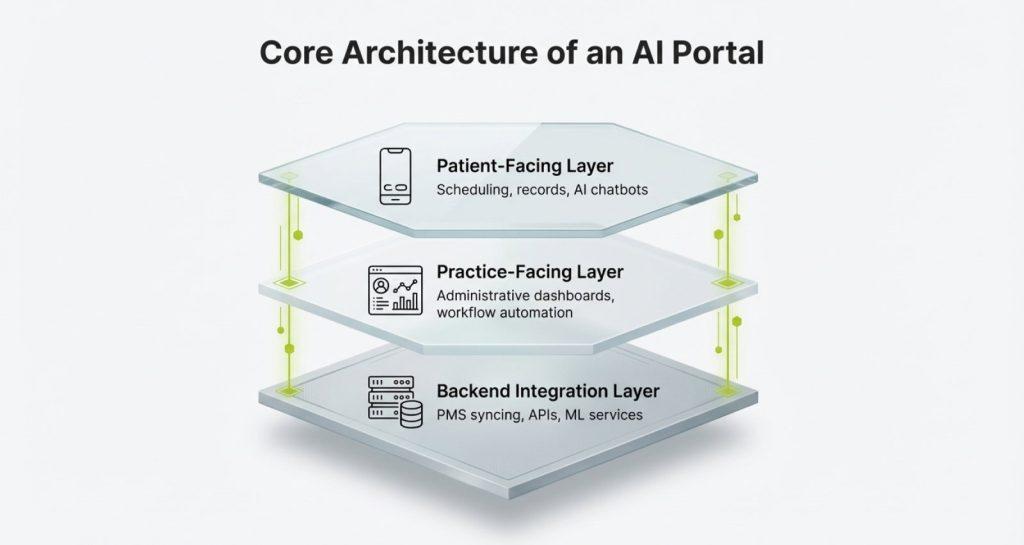
An effective AI dental patient portal consists of three integrated layers. The quality of integration between these layers determines overall portal performance.
1. Patient-facing layer
This layer includes the web portal, mobile apps, and AI chatbot interfaces. Patients use it for self-service tasks: scheduling appointments, accessing records, sending messages, paying bills, and completing intake forms. Design must prioritize simplicity for patients of all technical skill levels.
2. Practice-facing layer
Staff interact with administrative dashboards, workflow automation tools, and engagement analytics through this layer. It handles incoming messages, AI chatbot escalations, waitlist management, and performance reporting. For DSOs, role-based access lets corporate teams see aggregate data while practices focus on their own patients.
3. Backend integration layer
This invisible infrastructure powers everything: APIs syncing with your PMS, middleware translating between systems, and ML services running predictive analytics. It connects to Dentrix or Eaglesoft, insurance verification services, and payment gateways. The reliability of this layer determines whether your portal feels responsive or slow.
For DSOs managing multiple locations, understanding these components becomes critical. You can get guidance from a patient portal consulting agency like Space-O AI. Such agencies offer expert assistance to help you build a secure, robust architecture for your dental patient portal.
The architecture must support multi-location standardization while allowing practice-level customization. Now that we understand the fundamentals, let’s explore how AI specifically transforms dental patient portal capabilities.
Benefits of Developing an AI Dental Patient Portal for Your Dental Practice
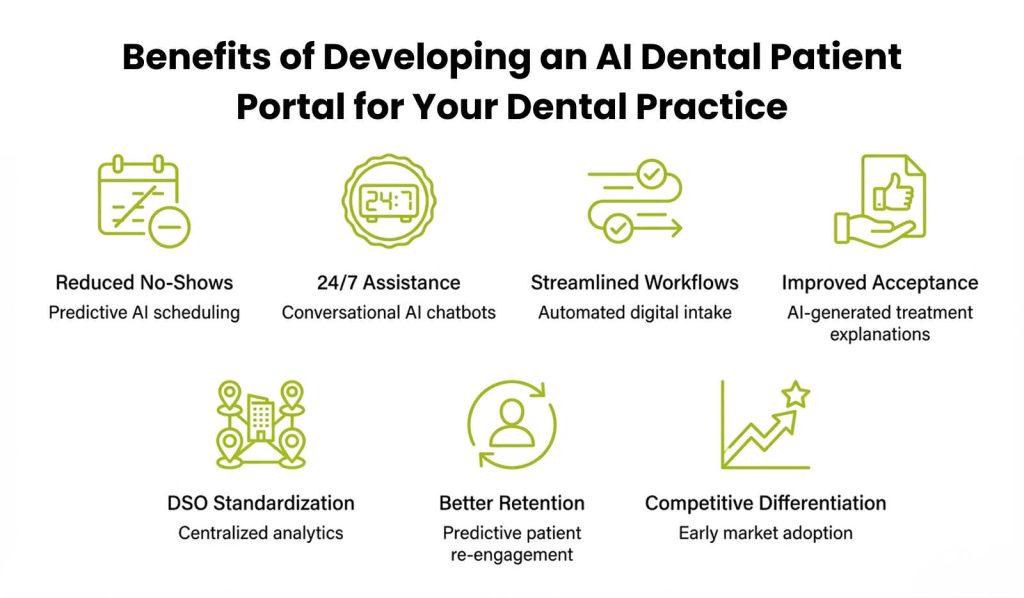
Investing in AI dental patient portal development delivers measurable returns across patient experience, operational efficiency, and revenue growth. Each benefit compounds over time as AI systems learn from practice data and patient interactions.
1. Reduced no-shows and cancellations through predictive AI
AI-powered reminders analyze patient history, appointment timing, and behavioral patterns to predict no-show risk. Intelligent reminder scheduling combined with automated waitlist management helps practices significantly reduce missed appointments and fill cancelled slots faster.
2. Enhanced patient experience with 24/7 AI assistance
Patients expect digital convenience comparable to retail and banking. AI chatbots provide instant responses to common questions while secure messaging enables asynchronous communication that respects patient schedules.
3. Streamlined administrative workflows through intelligent automation
Digital intake forms, automated insurance verification, and AI-assisted scheduling reduce front desk workload substantially. Staff focus shifts from repetitive tasks to high-value patient interactions that build relationships and drive practice growth.
4. Improved treatment acceptance with AI-generated explanations
AI translates clinical treatment plans into patient-friendly language with visual aids and cost breakdowns. Personalized financing recommendations based on patient financial profiles help increase acceptance rates for recommended treatments.
5. Multi-location standardization for DSOs with centralized AI
Unified portal architecture with shared AI models creates consistent patient experiences across all locations while centralized analytics provide enterprise-wide operational visibility and performance benchmarking.
6. Better patient retention through predictive engagement
AI identifies patients at risk of churning based on appointment gaps, treatment delays, or communication patterns. Automated re-engagement campaigns bring lapsed patients back before they switch providers.
7. Competitive differentiation in an underserved market
Most dental practices have yet to implement patient portals, creating significant opportunities for early adopters of AI-powered solutions to gain advantages in patient acquisition, satisfaction scores, and operational efficiency. Partnering with experienced healthcare software development services providers helps dental organizations realize these benefits faster.
Understanding these benefits leads to the next critical question: what specific features should an AI dental patient portal include?
Essential Features of AI Dental Patient Portal Development
Building an effective AI dental patient portal requires careful feature selection based on patient expectations, practice workflows, and operational goals. The following features represent the essential capabilities that modern dental practices and DSOs should prioritize in their portal development.
1. Patient-facing features
Patient-facing features form the foundation of portal adoption and satisfaction. These capabilities directly impact how patients perceive and engage with your dental practice digitally.
The following table outlines the essential patient-facing features, their descriptions, and the AI enhancements that differentiate modern portals from basic solutions.
| Feature | Description | AI Enhancement |
| Online appointment scheduling | 24/7 booking, rescheduling, and cancellation without phone calls | AI suggests optimal times based on patient history and predicts scheduling conflicts |
| Dental chart access | Complete dental history, including treatments, procedures, and timelines | AI-powered explanations translate clinical terminology into patient-friendly language |
| X-ray and imaging access | View radiographs, intraoral photos, and 3D scans through the portal | AI highlights areas of concern and provides educational context |
| Digital consent forms | Complete documentation before appointments, eliminating paperwork | AI pre-fills forms based on patient history and flags incomplete submissions |
| Secure messaging | HIPAA-compliant communication for questions and follow-up care | AI chatbots handle routine inquiries while routing complex questions to staff |
| Insurance verification | Coverage details, remaining benefits, and estimated out-of-pocket costs | AI integrates with insurance databases for real-time eligibility checks |
| Online bill payment | One-time payments, recurring plans, and financing applications | AI predicts payment behavior and sends personalized payment reminders |
| Patient intake forms | New patient registration and medical history updates | AI validates entries and requests clarification for inconsistencies |
These patient-facing features directly impact portal adoption rates. Practices that prioritize user experience during patient portal integration services see significantly higher engagement.
2. Practice management features
Practice management features enable staff to work more efficiently while maintaining high-quality patient care. These capabilities connect directly to operational metrics and practice profitability.
The following table outlines the essential practice-facing features that support daily operations and long-term practice growth.
| Feature | Description | AI Enhancement |
| Real-time appointment dashboard | Visual schedule management across providers and locations | AI-powered scheduling optimization maximizes chair time utilization |
| Automated recall management | Hygiene visit reminders and reactivation campaigns | Predictive recall compliance identifies patients likely to miss appointments |
| Treatment plan workflows | Digital presentation, acceptance tracking, and follow-up | AI predicts acceptance likelihood and suggests optimal presentation timing |
| Insurance eligibility tools | Real-time verification and benefits breakdown | AI interprets complex coverage rules and estimates patient responsibility |
| Multi-location reporting | Centralized metrics across all DSO practices | AI benchmarks performance and identifies improvement opportunities |
| Patient segmentation | Group patients by behavior, value, or engagement level | AI automatically segments and recommends targeted campaigns |
| Staff productivity tracking | Monitor response times and task completion | AI identifies bottlenecks and suggests workflow improvements |
| Waitlist management | Fill cancelled appointments automatically | AI matches waitlist patients to openings based on preferences and availability |
Effective practice management features require deep integration with existing dental systems, making experienced development partners essential for successful implementation.
3. AI-powered differentiating capabilities
The true differentiation in AI dental patient portal development comes from intelligent features that learn and improve over time. These capabilities set modern portals apart from basic patient communication tools.
The following table highlights the advanced AI capabilities that deliver competitive advantages.
| Capability | Function | Business Impact |
| Predictive no-show prevention | Analyzes patient patterns to identify high-risk appointments | Reduction in missed appointments |
| Intelligent chatbot | Handles routine inquiries without staff intervention | Reduction in phone call volume |
| Treatment acceptance prediction | Identifies patients likely to delay or decline treatment | Enables proactive outreach and personalized follow-up |
| Smart appointment reminders | Optimizes timing and channel based on patient behavior | Higher confirmation rates than generic reminders |
| Insurance claim intelligence | Tracks submissions and predicts potential issues | Reduces claim denials and accelerates reimbursement |
| Patient churn prediction | Flags disengaging patients before they leave | Automated re-engagement prevents revenue loss |
| Personalized content delivery | Matches educational content to patient conditions | Improves treatment understanding and acceptance |
| Voice-enabled interactions | Allows hands-free portal navigation and queries | Accessibility for all patient demographics |
These AI capabilities require specialized development expertise and ongoing optimization to deliver maximum value.
With features defined, let’s examine the development process that brings an AI dental patient portal from concept to reality.
Transform Your Dental Practice with an AI-Powered Patient Portal
Our expert developers specialize in HIPAA-compliant dental portal solutions with AI capabilities that reduce no-shows and boost patient engagement.
AI Dental Patient Portal Development Process
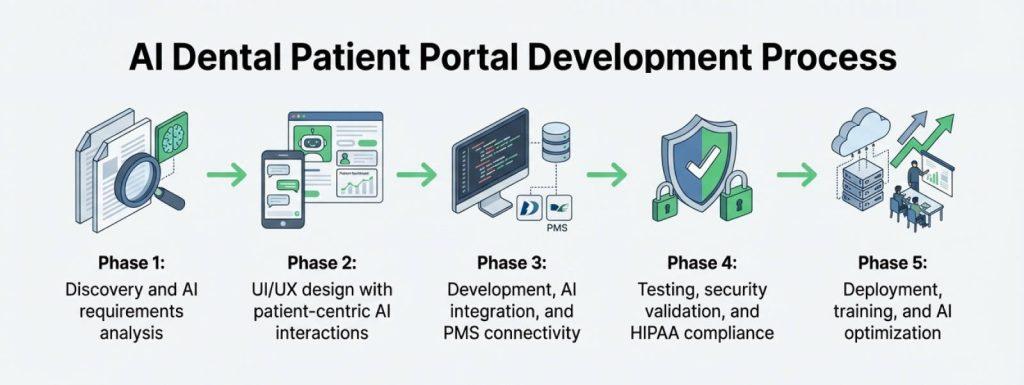
A structured development process ensures the AI dental patient portal meets clinical workflows, compliance requirements, and patient expectations while delivering the intelligent capabilities that justify the investment. Here’s the phased approach that successful dental portal projects follow.
Phase 1: Discovery and AI requirements analysis
Effective AI dental patient portal development begins with comprehensive discovery that maps current workflows, identifies automation opportunities, and defines success metrics. This phase typically requires 3–4 weeks and establishes the foundation for all subsequent development.
Action items
- Conduct stakeholder interviews with dentists, hygienists, front desk staff, and administrators
- Map patient journeys from appointment booking through treatment completion and follow-up
- Assess current PMS capabilities and integration requirements (Dentrix, Eaglesoft, Open Dental)
- Identify AI use cases with the highest impact potential based on practice data
- Define KPIs, including portal adoption rates, no-show reduction, and staff time savings
- Document HIPAA compliance requirements and security specifications
Organizations seeking guidance during this phase benefit from consulting partners that bring experience from previous dental portal implementations.
Phase 2: UI/UX design with patient-centric AI interactions
Design for AI dental patient portals must balance feature richness with simplicity, ensuring patients of all ages and technical abilities can navigate the platform confidently. AI interactions require special attention to conversational design and error handling.
Action items
- Create patient personas representing different demographics and technical comfort levels
- Design mobile-first interfaces optimized for smartphones and tablets
- Develop conversational flows for AI chatbot interactions
- Prototype key patient journeys, including scheduling, messaging, and payment
- Conduct usability testing with actual dental patients
- Design staff dashboards for AI-assisted workflow management
Phase 3: Development, AI integration, and PMS connectivity
The development phase builds the portal infrastructure, implements AI capabilities, and establishes integrations with existing dental systems. Practices looking to hire patient portal developers should prioritize teams with healthcare experience and AI expertise.
Action items
- Build a responsive frontend using modern frameworks (React, Vue, or Angular)
- Develop a secure backend with API-first architecture
- Implement an AI chatbot using natural language processing (NLP)
- Integrate machine learning models for predictive analytics
- Connect with dental PMS through APIs or middleware solutions
- Implement payment gateway and insurance verification integrations
- Build notification systems for email, SMS, and push notifications
Phase 4: Testing, security validation, and HIPAA compliance
Thorough testing ensures the portal functions correctly, protects patient data, and meets regulatory requirements before deployment. AI systems require additional testing for accuracy and bias.
Action items
- Execute functional testing across all features and user flows
- Perform security penetration testing and vulnerability assessments
- Validate HIPAA compliance, including encryption, access controls, and audit logging
- Test AI chatbot responses for accuracy and appropriate escalation
- Verify PMS integration data accuracy and synchronization
- Conduct load testing to ensure performance under peak usage
Phase 5: Deployment, training, and AI optimization
Successful deployment requires careful change management, staff training, and patient onboarding. AI systems continue learning after launch, requiring ongoing monitoring and optimization.
Action items
- Deploy to the production environment with proper security configurations
- Train staff on portal administration and AI-assisted workflows
- Create patient onboarding materials, including video tutorials
- Execute phased rollout starting with the pilot patient group
- Monitor AI performance and refine models based on real-world data
- Establish ongoing support and enhancement processes
With the development process clear, let’s address one of the most common questions: What does AI dental patient portal development actually cost?
Ready to Build Your AI Dental Patient Portal?
Partner with our experienced healthcare development team. We’ve delivered 500+ successful projects with proven expertise in dental technology solutions.
How Much Does It Cost to Build an AI Dental Patient Portal?
AI dental patient portal development typically costs between $40,000 and $300,000+, depending on feature complexity, AI capabilities, integration requirements, and whether the solution serves a single practice or multi-location DSO. Understanding the cost structure helps practices budget appropriately and prioritize features that deliver the highest return on investment.
Cost by complexity level
Development costs vary significantly based on the scope and sophistication of the portal solution. The following table provides estimated cost ranges based on portal complexity levels.
| Complexity Level | Included Features | AI Capabilities | Timeline | Estimated Cost |
| Basic | Scheduling, messaging, digital forms, and basic records access | Rule-based chatbot, automated reminders | 4–5 months | $40,000–$80,000 |
| Standard | + Insurance verification, online payments, imaging access, recall management | NLP chatbot, basic predictive analytics | 5–7 months | $80,000–$150,000 |
| Advanced | + Multi-location support, advanced analytics, treatment planning, financing integration | ML-powered predictions, personalized AI, voice capabilities | 7–9 months | $150,000–$300,000 |
| Enterprise DSO | + Custom integrations, white-label options, advanced reporting, API access | Full AI suite with continuous learning, custom models | 9–12 months | $300,000–$500,000+ |
These estimates include development, testing, and initial deployment. Practices should also budget for the ongoing costs detailed below.
Factors affecting development cost
Several factors significantly influence the total development investment. Understanding these drivers helps practices make informed decisions about scope and priorities.
- Feature scope has a high impact on cost. More features require more development time, so practices should prioritize based on ROI potential.
- AI sophistication significantly affects pricing. Advanced machine learning models cost more than rule-based automation, but deliver greater long-term value through continuous improvement.
- The number of integrations adds complexity. Each PMS, imaging system, or payment processor requires dedicated development effort and ongoing maintenance.
- Mobile app requirements influence budget decisions. Native iOS and Android apps cost more than responsive web portals but offer better user experience and device-specific features.
- Multi-location needs for DSOs add role-based access, reporting, and configuration complexity that single-practice solutions don’t require.
- Custom branding and white-label solutions require additional design and configuration work beyond standard implementations.
- Compliance requirements, including HIPAA, state regulations, and security certifications, add testing and documentation overhead.
- Data migration from existing systems requires extraction, transformation, and validation processes that vary based on data volume and source system complexity.
Practices should discuss these factors with potential development partners during the discovery phase to receive accurate project estimates.
Ongoing costs after launch
Beyond initial development, AI dental patient portals require ongoing investment to maintain performance, security, and feature relevance.
- Hosting and infrastructure typically run $12,000–$36,000 annually, covering cloud servers, databases, CDN, and security services.
- Maintenance and support costs $15,000–$40,000 per year for bug fixes, security patches, and minor enhancements that keep the system running smoothly.
- AI model optimization requires $10,000–$25,000 annually for model retraining, accuracy improvements, and developing new use cases as practice needs evolve.
- Third-party services add $5,000–$15,000 yearly for SMS and email providers, payment processing fees, and AI API usage costs.
- Compliance and security investments of $5,000–$15,000 cover annual security audits, penetration testing, and certification renewals.
- Feature enhancements vary based on new capabilities requested through user feedback and market demands.
Total ongoing costs typically range from 15–25% of the initial development investment annually. These costs ensure the portal remains secure, performant, and competitive.
Beyond cost considerations, successful AI dental portal development requires navigating key challenges. Let’s examine these obstacles and proven strategies to overcome them.
Key Challenges in AI Dental Patient Portal Development
Every AI dental patient portal development project faces predictable challenges. Understanding these obstacles and their solutions before development begins dramatically improves project success rates and accelerates time to value.
Challenge 1: Ultra-low patient adoption rates
Patient portal adoption in dental practices often remains limited, with many patients not actively using available portal features. When adoption is low, even well-designed or advanced capabilities, such as AI-driven tools, fail to deliver meaningful value or impact.
Solution
- Design intuitive onboarding flows that get patients using core features within their first session
- Implement in-office enrollment where staff help patients register during appointments
- Create incentives for portal adoption, such as appointment priority or exclusive offers
- Use AI to personalize the portal experience based on patient preferences and behavior
- Send targeted campaigns highlighting specific features relevant to each patient segment
- Train staff to consistently promote portal benefits during every patient interaction
Challenge 2: Integration complexity with legacy dental systems
Many dental practices run on legacy PMS platforms that predate modern API standards, making integration challenging and sometimes requiring custom middleware development.
Solution
- Conduct a thorough technical assessment of existing PMS capabilities before development begins
- Adopt an API-first architecture that accommodates various integration approaches
- Build middleware solutions for systems lacking native API support
- Plan for phased integration, starting with the highest-value data connections
- Establish data synchronization schedules that balance real-time needs with system performance
- Partner with experienced integration providers familiar with dental systems
Challenge 3: HIPAA compliance and AI-specific security concerns
AI systems introduce unique compliance considerations beyond standard HIPAA requirements, including data used for model training, AI decision transparency, and third-party AI service agreements. A healthcare AI consulting agency can help navigate these complexities.
Solution
- Implement end-to-end encryption for all patient data at rest and in transit
- Establish role-based access controls that limit data exposure to necessary personnel
- Create comprehensive audit logging for all data access and AI interactions
- Ensure Business Associate Agreements (BAAs) cover all AI service providers
- Design AI systems with explainability so patients understand how decisions are made
- Conduct regular security assessments and penetration testing
Challenge 4: Multi-location standardization for DSOs
DSOs face unique challenges in creating consistent patient experiences across locations while respecting practice-level differences in workflows, branding, and staffing.
Solution
- Build centralized architecture with location-specific configuration options
- Implement unified patient identity across all locations for a consistent experience
- Create standardized AI models with location-specific training data
- Design role-based access that accommodates corporate, regional, and practice-level users
- Establish governance frameworks for feature rollouts and AI model updates
- Enable centralized analytics with drill-down capabilities for individual locations
Challenge 5: AI accuracy and patient trust
Patients may distrust AI-generated recommendations or chatbot responses, particularly for health-related information. Building trust requires transparency and appropriate human oversight.
Solution
- Clearly label AI-generated content and chatbot interactions
- Design escalation paths that smoothly transition from AI to human support
- Implement feedback mechanisms so patients can flag unhelpful AI responses
- Start with conservative AI use cases and expand as accuracy improves
- Provide AI explanations that help patients understand recommendations
- Maintain human oversight for all clinical-related AI interactions
With challenges and solutions understood, let’s address the most frequently asked questions about AI dental patient portal development.
Don’t Let Technical Challenges Delay Your Digital Transformation
Our team has solved these challenges for 500+ healthcare projects. Get expert guidance on your AI dental patient portal development journey today.
Partner with Space-O AI for Your Dental Patient Portal Development
AI dental patient portal development represents a significant opportunity for dental practices and DSOs to close the digital engagement gap, reduce operational costs, and deliver the convenient experience modern patients expect. The combination of dental-specific workflows, intelligent automation, and predictive analytics creates portals that actively improve practice performance rather than simply digitizing existing processes.
Space-O AI brings 15+ years of healthcare software development experience and 500+ successful projects to dental portal development. Our team understands both the technical complexities of AI implementation and the regulatory requirements that healthcare solutions demand, ensuring your portal delivers value while maintaining compliance.
Our 80+ developers specialize in HIPAA-compliant portal development, AI chatbot integration, predictive analytics, and reliable PMS connectivity. We’ve helped dental organizations achieve measurable results, including reduced no-shows, improved patient satisfaction, and significant administrative time savings through intelligent automation and thoughtful design.
Ready to transform your dental practice with an AI-powered patient portal? Contact Space-O AI for a free consultation. Our experts will assess your specific requirements, recommend the optimal approach for your practice size and goals, and help you build a portal that patients actually want to use.
Frequently Asked Questions on AI Dental Patient Portal Development
1. How long does AI dental patient portal development take?
AI dental patient portal development typically requires 5–9 months from project initiation to full deployment. Basic portals with limited AI features can launch in 4–5 months, while comprehensive solutions with advanced AI, multiple integrations, and multi-location support require 7–9 months. MVP approaches can deliver core functionality in 3–4 months with additional features added iteratively.
2. Can an AI dental patient portal integrate with Dentrix or Eaglesoft?
Yes. Modern AI dental patient portals integrate with major practice management systems, including Dentrix, Eaglesoft, Open Dental, Curve Dental, and Denticon. Integration approaches vary based on PMS capabilities, ranging from direct API connections to middleware solutions for systems with limited native integration support.
3. What makes AI dental patient portals HIPAA compliant?
HIPAA compliance requires multiple safeguards, including data encryption at rest and in transit, role-based access controls, comprehensive audit logging, secure authentication, and Business Associate Agreements with all vendors. AI-specific considerations include ensuring training data is properly de-identified and AI recommendations don’t expose protected health information inappropriately.
4. How do we get patients to actually adopt the portal?
Successful adoption requires multi-channel promotion: in-office enrollment during appointments, email campaigns highlighting specific benefits, staff training to consistently recommend the portal, and incentives for early adopters. AI personalization improves ongoing engagement by surfacing relevant features based on each patient’s needs.


Build an AI Dental Patient Portal
What to read next