- What Is an AI Chatbot for Patient Portals?
- Benefits of Integrating AI Chatbots In Patient Portals
- Top Use Cases of AI Chatbots in Patient Portals
- 1. 24/7 automated patient support
- 2. Appointment scheduling and reminders
- 3. Pre-visit intake and form completion
- 4. Symptom checker chatbot integration
- 5. Insurance and billing FAQ automation
- 6. Prescription refill requests
- 7. Lab result explanations
- 8. Escalation from chatbot to human agent
- 9. Multilingual patient support
- 10. Post-discharge follow-up
- Key Features of an Effective AI Chatbot for Patient Portals
- How to Implement an AI Chatbot for Patient Portals: Step-by-Step Process
- Step 1: Discovery and requirements gathering
- Step 2: Design conversational flows and architecture
- Step 3: Choose the right AI/NLP technology stack
- Step 4: Build integrations with EMR and healthcare systems
- Step 5: Implement HIPAA compliance and security
- Step 6: Test, train, and optimize
- Step 7: Deploy and monitor performance
- How Much Does It Cost to Implement an AI Chatbot for Patient Portals?
- HIPAA Compliance Considerations for Patient Portal Chatbots
- Challenges in Developing AI Chatbots for Patient Portals and How to Overcome Them
- Let’s Build Your AI Chatbot for Patient Portal with Space-O AI
- Frequently Asked Questions on AI Chatbots for Patient Portals
- 1. What patient data can AI chatbots access in a HIPAA-compliant manner?
- 2. How long does it take to develop an AI chatbot for a patient portal?
- 3. Are multilingual AI chatbots available for patient portals?
- 4. How do AI chatbots escalate complex queries to human agents?
- 5. Why should I choose Space-O AI for patient portal chatbot development?
- 6. Does Space-O AI have experience with healthcare AI projects?
- 7. How does Space-O AI handle HIPAA compliance during chatbot development?
- 8. What is Space-O AI’s development process for patient portal chatbots?
- 9. Can Space-O AI integrate chatbots with my existing EHR system?
AI Chatbot for Patient Portal: Use Cases, Benefits, and Implementation Guide

 Last Updated: March, 23 2026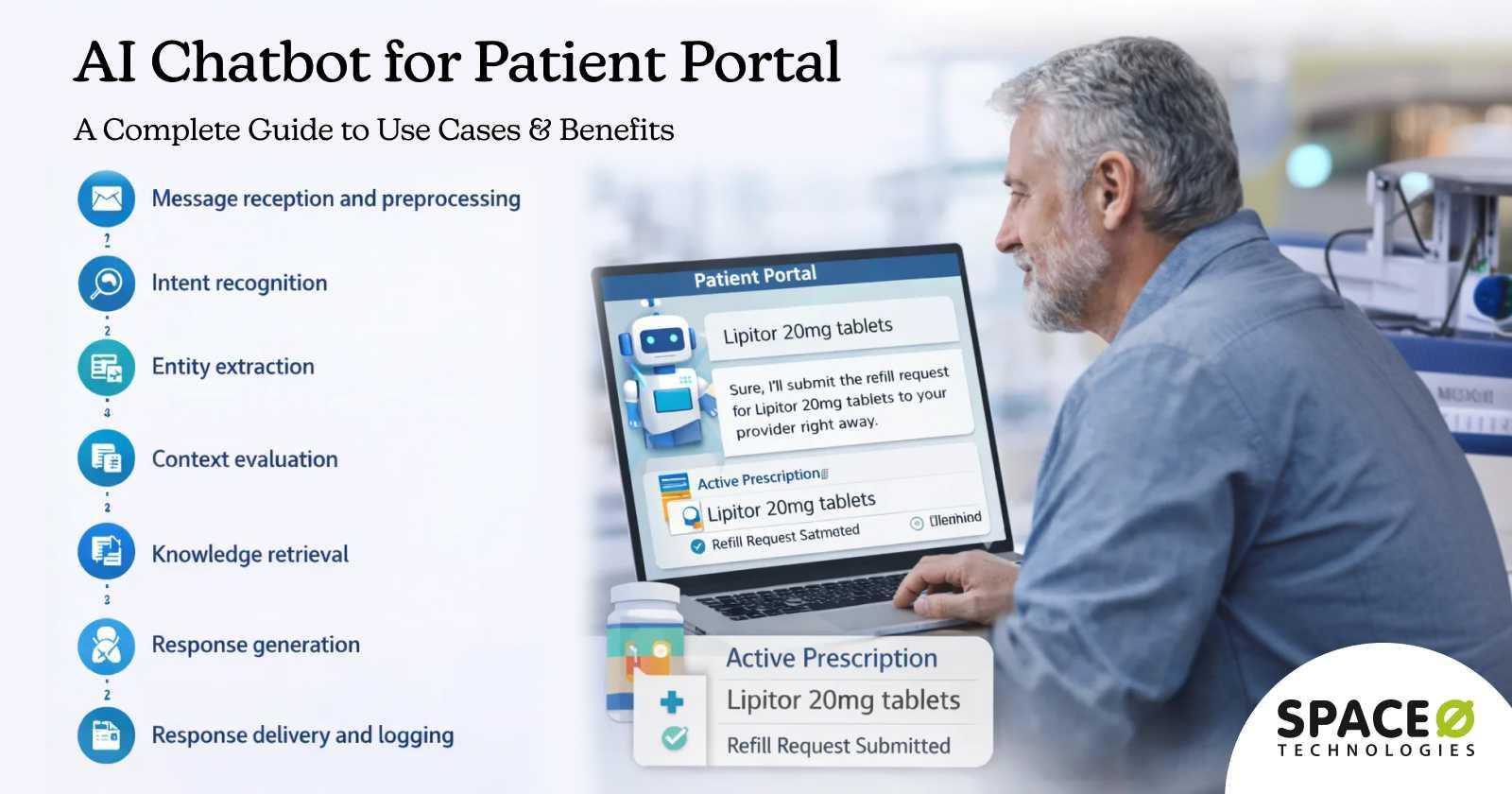
Patient portals promise convenience, but reality tells a different story. Patients struggle to find answers to basic questions, abandon complex interfaces, and ultimately call the front desk anyway.
Meanwhile, healthcare staff spend hours answering the same repetitive questions about appointment times, prescription refills, and billing inquiries. This cycle drains resources and frustrates everyone involved.
According to Precedence Research, the global healthcare chatbot market was valued at USD 1.20 billion in 2024 and is expected to reach USD 10.26 billion by 2034. This growth reflects a fundamental shift in how healthcare organizations approach patient engagement. An AI chatbot for a patient portal addresses these challenges by providing instant, accurate responses around the clock without adding to staff workload.
This guide covers everything you need to know about implementing AI chatbots in patient portals. We shared insights from our experience as a leading AI patient portal development agency to help you understand the top use cases driving adoption, the benefits for both patients and providers, development costs, must-have features, and HIPAA compliance requirements.
What Is an AI Chatbot for Patient Portals?
An AI chatbot for patient portals is an intelligent conversational interface that automates patient interactions within healthcare digital platforms. Unlike traditional rule-based chatbots that follow rigid decision trees, AI-powered chatbots use natural language processing (NLP) and machine learning to understand patient intent, process complex queries, and deliver personalized responses.
These chatbots serve as a virtual front desk that never sleeps. Patients can ask questions in their own words, and the chatbot interprets the meaning rather than matching exact keywords. This makes interactions feel natural and reduces the frustration patients experience with outdated menu-based systems.
How AI chatbots process patient queries
AI chatbots process patient queries through a sophisticated pipeline that transforms natural language into actionable responses. Here is how the process works step by step:
Step 1: Message reception and preprocessing
The chatbot receives the patient’s message and cleans the input by removing special characters, correcting common typos, and standardizing text format for analysis.
Step 2: Intent recognition
Natural language understanding (NLU) analyzes the message to identify what the patient wants to accomplish, whether scheduling an appointment, checking lab results, or asking about medications.
Step 3: Entity extraction
The system identifies key information within the message, such as dates, times, medication names, symptoms, provider names, or appointment types.
Step 4: Context evaluation
The chatbot considers previous messages in the conversation and patient history to understand the full context of the current request.
Step 5: Knowledge retrieval
For complex queries, the chatbot retrieves relevant information from connected systems, including electronic health records, scheduling platforms, or billing databases.
Step 6: Response generation
Using retrieved information and conversation context, the chatbot generates an appropriate response. Modern implementations use large language models (LLMs) for natural, contextual answers.
Step 7: Response delivery and logging
The chatbot delivers the response to the patient and logs the interaction for compliance, analytics, and continuous improvement purposes.
Benefits of Integrating AI Chatbots In Patient Portals
Implementing an AI chatbot for a patient portal delivers measurable improvements across operational efficiency, patient satisfaction, and revenue protection. Healthcare organizations report significant returns within the first year of deployment. Here are the key benefits driving adoption.
1. Reduced operational costs
AI chatbots handle routine patient inquiries without human intervention. This reduces call center staffing requirements and allows existing staff to focus on complex cases that genuinely require human attention and expertise.
2. Improved patient engagement
Patients use portals more frequently when they can get instant answers. Chatbot implementations transform underutilized portals into valuable communication channels that patients actually want to use regularly.
3. Round-the-clock availability
Chatbots provide consistent support at any hour without staffing overhead. Patients no longer wait until business hours for answers, reducing anxiety and preventing unnecessary urgent care visits.
4. Faster response times
Average chatbot response time is under five seconds compared to several minutes for phone or email support. This immediate assistance improves patient satisfaction scores and reduces abandonment rates.
5. Consistent information delivery
Human agents provide varying answers depending on training and experience. Chatbots deliver standardized, pre-approved responses that ensure every patient receives accurate information aligned with organizational policies.
6. Enhanced patient satisfaction
Patients appreciate self-service options that respect their time. Organizations implementing AI chatbots report measurable improvements in patient satisfaction surveys and Net Promoter Scores.
7. Staff productivity gains
When chatbots handle appointment scheduling and billing questions, clinical staff can focus on patient care activities that require human expertise, judgment, and empathy.
8. Reduced appointment no-shows
Automated reminders and easy rescheduling options through chatbots reduce no-show rates significantly. Each prevented no-show represents recovered revenue and better resource utilization.
9. Scalable support capacity
Flu season, public health emergencies, or practice growth do not require proportional staffing increases. Chatbots scale instantly to handle volume spikes without degraded service quality.
10. Actionable patient insights
Chatbot analytics reveal what patients ask most frequently, where they struggle, and what information gaps exist. This intelligence informs content strategy, staff training, and service improvements.
Understanding the benefits, let’s explore the specific use cases driving adoption in patient portals.
Implement a Smart, Autonomous AI Chatbot in Your Patient Portal
Space-O AI builds intelligent chatbots that automate patient interactions and reduce support burden.
Top Use Cases of AI Chatbots in Patient Portals
Healthcare organizations deploy AI chatbots across multiple touchpoints in the patient journey. Each use case addresses specific pain points while reducing operational burden on staff. Here are the most impactful applications transforming patient portal experiences.
1. 24/7 automated patient support
Patients have questions outside business hours, and unanswered queries lead to anxiety and unnecessary emergency room visits. AI chatbots provide instant responses to common questions about office hours, provider availability, facility directions, and general health information at any time of day or night.
2. Appointment scheduling and reminders
Appointment scheduling chatbots allow patients to book, reschedule, or cancel appointments through natural conversation. The chatbot checks provider availability in real time, considers patient preferences, and sends confirmation along with automated reminders. This reduces no-show rates and eliminates phone tag between patients and scheduling staff.
3. Pre-visit intake and form completion
Completing intake forms in waiting rooms wastes time and creates data entry errors. Chatbots guide patients through pre-visit questionnaires conversationally, collecting medical history, current symptoms, medication lists, and insurance information before the appointment. This data flows directly into the EHR, giving providers a complete picture before the patient arrives.
4. Symptom checker chatbot integration
Symptom checker chatbots help patients understand their symptoms and determine appropriate care levels. By asking structured questions about symptoms, duration, and severity, the chatbot provides general guidance on whether to seek urgent care, schedule a routine appointment, or manage symptoms at home. Clear disclaimers ensure patients understand this is informational, not diagnostic.
5. Insurance and billing FAQ automation
Billing questions consume significant staff time. Chatbots handle inquiries about account balances, payment options, insurance coverage, and explanations of benefits. Patients can check claim status, set up payment plans, or request itemized statements without waiting on hold.
6. Prescription refill requests
Patients can request prescription refills through the chatbot by simply naming the medication or selecting from their active prescriptions. The chatbot verifies the request, checks refill eligibility, and routes it to the appropriate provider or pharmacy for approval. Patients receive notifications when refills are ready for pickup or delivery.
7. Lab result explanations
Receiving lab results without context causes patient anxiety. AI chatbots can explain what specific tests measure, what normal ranges mean, and provide general context about results. For abnormal findings, the chatbot recommends scheduling a follow-up with the provider while avoiding diagnostic conclusions.
8. Escalation from chatbot to human agent
Not every query can be resolved by AI. Effective chatbots recognize when to escalate, whether the patient requests human assistance, the query exceeds safe boundaries, or sentiment analysis detects frustration. The handoff includes a full conversation context so patients do not repeat themselves.
9. Multilingual patient support
Multilingual healthcare chatbots serve diverse patient populations by communicating in their preferred language. This improves access for non-English speakers who might otherwise struggle with portal navigation or avoid seeking care due to language barriers.
10. Post-discharge follow-up
After hospital discharge, chatbots check in with patients about recovery progress, medication adherence, and warning signs that require medical attention. This proactive outreach reduces readmission rates and helps patients feel supported during vulnerable recovery periods.
These use cases demonstrate the versatility of AI chatbots. Healthcare organizations looking to implement these capabilities should hire chatbot developers with healthcare domain expertise. The next step is identifying the features that make a patient portal chatbot truly effective.
Enhance Patient Support with AI Chatbots, Built To Your Use Case
Our healthcare AI team has 15+ years of experience building HIPAA-compliant chatbots for leading healthcare organizations. Get a free consultation and project estimate today.
Key Features of an Effective AI Chatbot for Patient Portals
Not all chatbots deliver equal value. The difference between a frustrating bot that patients avoid and a helpful assistant they rely on comes down to features. Here are the capabilities that separate effective patient portal chatbots from mediocre ones.
1. Must-have features
Every patient portal chatbot requires certain foundational capabilities to function effectively and meet healthcare industry standards. The following table outlines the essential features your chatbot must include.
| Feature | Description |
| Natural language understanding (NLU) | Interprets patient intent regardless of phrasing variations, handling questions like “When’s my appointment?” and “Can you tell me when I’m supposed to come in?” as equivalent requests. |
| HIPAA-compliant data handling | Ensures all PHI interactions meet HIPAA requirements, including encryption, access controls, audit logging, and secure data storage. |
| EMR/EHR integration | Provides real-time access to patient records, appointment schedules, medication lists, and billing information for personalized responses. |
| Context-aware conversations | Remembers previous messages in the conversation and maintains context throughout the interaction. |
| Secure patient authentication | Verifies patient identity before accessing personal health information through portal authentication or multi-factor verification. |
| Human agent escalation | Recognizes limitations and routes complex queries to human agents with full conversation context preserved. |
| Multi-channel support | Maintains consistent functionality across web portals, mobile apps, and SMS while adapting to each platform. |
These foundational features ensure your chatbot meets basic patient expectations and compliance requirements.
2. Advanced features for competitive advantage
Organizations seeking differentiation should consider advanced capabilities that enhance patient experience beyond basic functionality. The following table describes features that provide a competitive advantage.
| Feature | Description |
| Voice-enabled interactions | Improves accessibility for elderly patients and those with visual impairments through natural speech recognition and audio responses. |
| Generative AI responses | Enables generative AI development to craft contextual responses rather than selecting from pre-written templates. |
| Predictive analytics | Anticipates patient needs by proactively offering appointment scheduling when checkups are due or suggesting medication refills. |
| Multilingual support | Communicates fluently in multiple languages including medical terminology translation and cultural sensitivity. |
| Sentiment analysis | Detects emotional cues in patient messages to trigger appropriate responses or escalation to human agents. |
| Telehealth integration | Assesses care needs and facilitates scheduling for virtual or in-person visits with pre-visit instructions. |
Advanced features differentiate your patient portal and deliver experiences that build long-term patient loyalty.
With features defined, the next step is understanding the development process.
Don’t Let Outdated Patient Support Systems Drain Your Resources and Staff
Partner with healthcare AI specialists who understand HIPAA compliance and EMR integration. We have helped 500+ businesses achieve their digital goals.
How to Implement an AI Chatbot for Patient Portals: Step-by-Step Process
Building a successful AI chatbot for a patient portal requires methodical planning and execution. Rushing into development without proper groundwork leads to chatbots that frustrate patients and fail to deliver ROI. Working with experienced chatbot development companies ensures your project follows proven methodologies. Here is a proven development process that healthcare organizations follow.
Step 1: Discovery and requirements gathering
Begin by documenting what the chatbot must accomplish and for whom. Interview stakeholders across clinical, administrative, and IT teams to understand pain points, existing workflows, and success metrics. Define the patient personas who will use the chatbot and the specific problems you are solving.
Action items
- Identify primary user personas (patients, caregivers, staff)
- Document the top 20 most common patient inquiries from call logs
- Map existing systems requiring integration
- Define measurable success criteria and KPIs
- Establish compliance requirements and constraints
Step 2: Design conversational flows and architecture
Translate requirements into conversation designs that guide patient interactions. Create dialog flows for each use case, including happy paths, error handling, and edge cases. Design the technical architecture specifying how components connect.
Action items
- Build conversation flow diagrams for priority use cases
- Design fallback responses for unrecognized queries
- Plan escalation pathways and handoff protocols
- Create an information architecture for a knowledge base
- Define API contracts for system integrations
Step 3: Choose the right AI/NLP technology stack
Select technologies that match your requirements, budget, and technical capabilities. Decisions include choosing between cloud LLM providers or on-premise models, NLU engines, vector databases for retrieval, and development frameworks. Consider long-term scalability and vendor dependencies.
Action items
- Evaluate LLM providers (OpenAI, Anthropic, open-source options)
- Select an NLU engine appropriate for healthcare terminology
- Choose a vector database for knowledge retrieval
- Define hosting infrastructure (cloud, hybrid, on-premise)
- Plan for model versioning and updates
Step 4: Build integrations with EMR and healthcare systems
Partnering with specialists offering patient portal integration services simplifies connecting your chatbot to existing healthcare systems. These integrations enable real-time data access for personalized responses while your IT teams focus on authentication protocols, data mapping, and navigating system constraints.
Action items
- Implement FHIR APIs for EHR connectivity
- Connect to scheduling and appointment systems
- Integrate billing and payment platforms
- Establish secure authentication flows
- Build data transformation layers for legacy systems
Step 5: Implement HIPAA compliance and security
Embed compliance into every layer of the chatbot architecture. This is not a final checkbox but an ongoing discipline throughout development. Document all compliance measures for audit readiness.
Action items
- Implement end-to-end encryption for all PHI
- Configure role-based access controls
- Establish comprehensive audit logging
- Execute Business Associate Agreements with vendors
- Conduct a security risk assessment
Step 6: Test, train, and optimize
Rigorous testing catches issues before patients encounter them. Train the chatbot on healthcare-specific terminology and realistic patient queries. Optimize based on test results until the chatbot meets accuracy and performance standards.
Action items
- Conduct unit testing for individual components
- Execute integration testing across all connected systems
- Perform user acceptance testing with real patient scenarios
- Train NLU on medical terminology and abbreviations
- Benchmark response accuracy against success criteria
Step 7: Deploy and monitor performance
Launch strategically, starting with a limited rollout before expanding to all patients. Monitor performance metrics continuously and iterate based on real-world usage patterns. Establish feedback loops for ongoing improvement.
Action items
- Deploy to the pilot user group first
- Monitor key performance indicators daily
- Collect and analyze patient feedback
- Iterate on conversation flows based on usage data
- Scale to the full patient population after validation
With the development process outlined, healthcare organizations often ask about the cost. Let’s break down AI chatbot development costs.
How Much Does It Cost to Implement an AI Chatbot for Patient Portals?
The cost to build an AI-powered patient portal chatbot typically ranges from $30,000 to $150,000 or more, depending on complexity, features, and integration requirements. Understanding what drives these costs helps organizations budget appropriately and avoid unexpected expenses.
Several factors influence the final AI development cost for patientportal chatbots. Feature scope determines whether you need basic FAQ automation or advanced capabilities like generative AI and voice support. Integration complexity depends on your existing systems, with legacy EHRs requiring more development effort than modern FHIR-compliant platforms. Compliance requirements add overhead for security audits, penetration testing, and documentation.
The following table breaks down typical costs by complexity level.
| Complexity Level | Features Included | Estimated Cost Range |
| Basic | FAQ automation, appointment scheduling, and basic NLP | $30,000 – $50,000 |
| Intermediate | EMR integration, symptom checker, billing queries, multi-channel support | $50,000 – $100,000 |
| Advanced | Generative AI, voice support, multilingual, predictive features, agentic workflows | $100,000 – $150,000+ |
The basic tier is suitable for smaller practices or organizations testing chatbot adoption. It covers essential functionality like answering frequently asked questions and simple appointment booking without deep system integrations.
The intermediate tier serves mid-size healthcare organizations requiring EHR connectivity and more sophisticated patient interactions. This level includes symptom assessment capabilities and multi-channel deployment across web and mobile platforms.
The advanced tier targets large health systems and organizations seeking competitive differentiation. It incorporates generative AI for natural conversations, voice interfaces, multiple language support, and predictive engagement features.
These estimates cover initial development. Plan for additional investment in ongoing operations.
Factors that influence chatbot development cost
1. AI sophistication level
Rule-based chatbots cost less but handle fewer scenarios. LLM-powered chatbots require more development but deliver superior patient experiences. The choice depends on your use case complexity and patient expectations.
2. Number and complexity of integrations
Connecting to one scheduling system differs from integrating with EHR, billing, pharmacy, and lab systems simultaneously. Each integration requires API development, testing, and ongoing maintenance.
3. Compliance and security requirements
HIPAA compliance adds cost for encryption, access controls, audit logging, and security assessments. Organizations in highly regulated environments should budget 15–25% additional for compliance activities.
4. Customization and branding
Off-the-shelf chatbot platforms cost less upfront but limit customization. Custom development costs more initially but delivers experiences aligned precisely with your brand and workflows.
Hidden costs to consider
1. Ongoing maintenance and updates
Chatbots require continuous improvement based on user feedback, new use cases, and system changes. Budget 15–20% of the initial development cost annually for maintenance.
2. LLM API costs
Generative AI chatbots incur per-query costs for LLM API calls. High-volume implementations can accumulate significant monthly expenses depending on conversation complexity and length.
3. Training and change management
Staff need training to handle escalations, monitor chatbot performance, and update knowledge bases. Patient education may also be necessary to drive adoption.
4. Content development
Creating comprehensive knowledge bases, conversation flows, and response libraries requires subject matter expert time and content strategy investment.
Compliance is critical in healthcare. Let’s dive deeper into HIPAA requirements for patient portal chatbots.
Get a Detailed Cost Estimate for Your Patient Portal Chatbot
Every healthcare organization has unique requirements. Our team provides transparent pricing with no hidden costs. Share your project scope and receive a customized estimate within 48 hours.
HIPAA Compliance Considerations for Patient Portal Chatbots
Patient portal chatbots interact with protected health information (PHI) constantly. They access appointment details, medication lists, lab results, and billing records. Every interaction must meet HIPAA Security Rule and Privacy Rule requirements.
1. Data encryption and secure transmission
All PHI must be encrypted both in transit and at rest. Chatbot communications should use TLS 1.2 or higher for transmission. Data stored in databases, logs, and backups requires AES-256 encryption. Encryption keys must be managed securely with regular rotation schedules.
2. Access controls and authentication
Implement role-based access controls, ensuring users only access information necessary for their function. Patient authentication should verify identity before revealing any PHI. Consider multi-factor authentication for sensitive operations like viewing test results or requesting prescriptions.
3. Audit logging and monitoring
Every chatbot interaction involving PHI requires detailed logging. Logs should capture who accessed what information, when, and what actions were taken. Implement real-time monitoring to detect suspicious patterns and potential breaches. Retain logs for the HIPAA-required minimum of six years.
4. BAA requirements with vendors
Any vendor whose technology touches PHI must sign a Business Associate Agreement (BAA). This includes LLM API providers, cloud hosting services, analytics platforms, and integration middleware. Verify that your entire technology stack is covered by appropriate BAAs.
5. Data minimization principles
Collect and retain only the minimum PHI necessary for chatbot functionality. Avoid storing conversation transcripts containing sensitive information longer than operationally required. Design conversations to minimize PHI exposure when possible.
6. Patient consent for AI interactions
Inform patients that they are interacting with an AI system and how their data will be used. Provide clear options to request human assistance. Document consent mechanisms and ensure patients understand their rights regarding AI-processed health information.
Compliance requires ongoing vigilance, not one-time implementation. Regular audits, staff training, and policy updates ensure continued adherence as regulations evolve.
Organizations seeking patient portal consulting services should prioritize compliance expertise when evaluating partners.
With compliance addressed, let’s explore the challenges you might face and how to overcome them.
Challenges in Developing AI Chatbots for Patient Portals and How to Overcome Them
Building an AI telemedicine chatbot is more complex than consumer applications. Healthcare-specific challenges require thoughtful solutions to avoid costly mistakes and patient safety issues. Understanding these challenges upfront allows organizations to plan effectively.
1. Ensuring clinical accuracy and safety
Healthcare chatbots operate in a domain where incorrect information can harm patients. A chatbot that provides wrong medication information or misinterprets symptoms creates liability and erodes trust. The stakes are higher than a chatbot that recommends the wrong movie.
Solution
- Curate medical knowledge bases with clinical expert oversight
- Implement human-in-the-loop review for responses involving clinical content
- Add clear disclaimers that chatbot information is not medical advice
- Establish strict boundaries, preventing diagnostic statements
- Conduct regular accuracy audits with clinical staff
2. Handling sensitive patient data securely
Healthcare data breaches make headlines and destroy patient trust. Chatbots create new attack surfaces and data exposure risks that must be managed carefully throughout the system lifecycle.
Solution
- Implement defense-in-depth security architecture
- Encrypt all data in transit and at rest
- Conduct regular penetration testing and vulnerability assessments
- Train all staff on security protocols and incident response
- Monitor for anomalous access patterns continuously
3. Managing patient expectations and trust
Some patients embrace AI assistance while others distrust it entirely. Chatbots must build trust through transparency, competence, and appropriate boundaries rather than pretending to be human.
Solution
- Clearly disclose that patients are interacting with AI
- Provide easy, obvious options to reach human agents
- Design empathetic response patterns for sensitive situations
- Demonstrate competence by handling queries accurately
- Avoid overpromising capabilities the chatbot cannot deliver
4. Integration with legacy healthcare systems
Many healthcare organizations run EHR systems and infrastructure that predate modern API standards. Connecting AI chatbots to these systems requires creative solutions and patience.
Solution
- Use middleware and integration platforms to bridge legacy gaps
- Implement FHIR adapters for older EHR versions
- Plan phased integration, starting with the most accessible systems
- Budget additional time and resources for legacy connectivity
- Consider data replication for read-only access when direct integration is impractical
5. Training AI on medical terminology
Healthcare language includes abbreviations, acronyms, brand names, and clinical terms that general AI models may not understand correctly. A chatbot that confuses medications or misinterprets symptoms fails patients.
Solution
- Train NLU models on healthcare-specific corpora
- Include common misspellings and patient vernacular
- Have clinical experts review terminology mappings
- Implement continuous learning from real conversations
- Maintain updated drug and procedure databases
6. Measuring ROI and performance
Proving chatbot value requires clear metrics, but healthcare organizations often struggle to define and track meaningful success indicators beyond simple deflection rates.
Solution
- Define KPIs aligned with business objectives before launch
- Track deflection rates, resolution rates, and escalation patterns
- Measure patient satisfaction through post-interaction surveys
- Calculate cost savings from reduced call volume
- Monitor clinical metrics like appointment adherence and no-show rates
Organizations that hire patient portal developers with healthcare domain expertise can navigate these challenges more effectively.
Understanding these challenges prepares you for successful implementation. Let’s look at the emerging trends shaping the future of AI chatbots in patient portals.
Let’s Build Your AI Chatbot for Patient Portal with Space-O AI
An AI chatbot for a patient portal transforms how healthcare organizations engage patients. From 24/7 automated support and appointment scheduling to symptom guidance and billing assistance, chatbots reduce operational costs while improving patient satisfaction and care outcomes significantly.
Space-O AI brings 15+ years of software development experience and over 500 successful projects across industries. Our team has helped healthcare organizations build HIPAA-compliant AI solutions that integrate with existing systems and deliver measurable results from day one.
Our healthcare AI expertise includes EMR integration, conversational AI development, and compliance-focused architecture. With 80+ developers skilled in NLP, machine learning, and generative AI, we can help you hire patient portal developers who understand healthcare workflows and regulatory requirements.
Ready to transform your patient portal with AI-powered chatbot capabilities? Contact us for a free consultation to discuss your requirements, explore solutions, and receive a detailed project estimate. Let’s build something that patients will actually use.
Frequently Asked Questions on AI Chatbots for Patient Portals
1. What patient data can AI chatbots access in a HIPAA-compliant manner?
With proper authentication and security controls, AI chatbots can access appointment schedules, medication lists, lab results, billing information, and care instructions. The chatbot should only access the minimum necessary data for each interaction and must maintain encryption, audit logging, and access controls throughout.
2. How long does it take to develop an AI chatbot for a patient portal?
Development timelines typically range from three to nine months, depending on complexity. A basic FAQ chatbot might take three to four months, while a comprehensive solution with multiple integrations, generative AI, and advanced features could require six to nine months or longer.
3. Are multilingual AI chatbots available for patient portals?
Yes, AI chatbots can support multiple languages to serve diverse patient populations. Modern NLP models handle many languages effectively, and healthcare-specific terminology can be trained for each supported language. Multilingual support improves access and equity for non-English speaking patients.
4. How do AI chatbots escalate complex queries to human agents?
Effective chatbots recognize escalation triggers, including explicit patient requests, queries exceeding safe boundaries, detected frustration through sentiment analysis, and clinical safety concerns. When escalation occurs, the chatbot transfers the full conversation context to human agents so patients do not repeat information.
5. Why should I choose Space-O AI for patient portal chatbot development?
Space-O AI brings 15 years of software development experience with 500+ AI projects delivered across healthcare, finance, and other regulated industries. Our team understands HIPAA compliance requirements, EMR integration challenges, and the clinical accuracy standards healthcare chatbots demand. We build production-ready solutions, not proofs-of-concept that never scale.
6. Does Space-O AI have experience with healthcare AI projects?
Yes. Our team has built HIPAA-compliant solutions, including patient portals, telemedicine platforms, and clinical decision support systems. We understand healthcare workflows, HL7/FHIR integration standards, and the regulatory requirements that govern patient data handling. This domain expertise reduces development risk and accelerates time to deployment.
7. How does Space-O AI handle HIPAA compliance during chatbot development?
HIPAA compliance is built into our development process from day one. We implement end-to-end encryption, role-based access controls, comprehensive audit logging, and secure authentication protocols. We execute Business Associate Agreements with all technology vendors and conduct security risk assessments before deployment. Our ISO-aligned processes ensure documentation and controls meet audit requirements.
8. What is Space-O AI’s development process for patient portal chatbots?
We follow a structured process: discovery and requirements gathering, conversational design, technology selection, EMR integration development, compliance implementation, testing with clinical scenarios, and phased deployment. You receive regular progress updates and have visibility into every stage. Post-launch, we provide ongoing support and optimization based on real usage data.
9. Can Space-O AI integrate chatbots with my existing EHR system?
Yes. We have experience integrating with Epic, Cerner, Allscripts, and other major EHR platforms through FHIR APIs and custom connectors. For legacy systems without modern APIs, we build middleware solutions that bridge the gap. Our integration approach ensures real-time data access while maintaining security and compliance standards.


Planning an AI Chatbot for Your Patient Portal
What to read next