- What Is Agentic AI in Telemedicine?
- How Agentic AI Works in Telemedicine Workflows
- Key Use Cases of Agentic AI in Telemedicine
- Benefits of Agentic AI for Healthcare Organizations
- Core Components of an Agentic AI System for Telemedicine
- Challenges in Implementing Agentic AI in Telemedicine
- How to Implement Agentic AI Into Your Telemedicine Platform
- Build Impactful Agentic Telemedicine Solutions with Space-O AI
- Frequently Asked Questions
- 1. What is agentic AI in telemedicine?
- 2. How does agentic AI differ from healthcare chatbots?
- 3. How is agentic AI different from AI agents in telemedicine?
- 4. What are the main use cases for agentic AI in healthcare?
- 5. Are telemedicine agentic AI solutions HIPAA compliant?
- 6. How long does it take to develop an agentic AI system for telemedicine?
- 7. What is the cost of implementing agentic AI in healthcare?
- 8. Can agentic AI replace healthcare professionals?
Agentic AI in Telemedicine: Transforming Healthcare Through Autonomous Intelligence

 Last Updated: January, 23 2026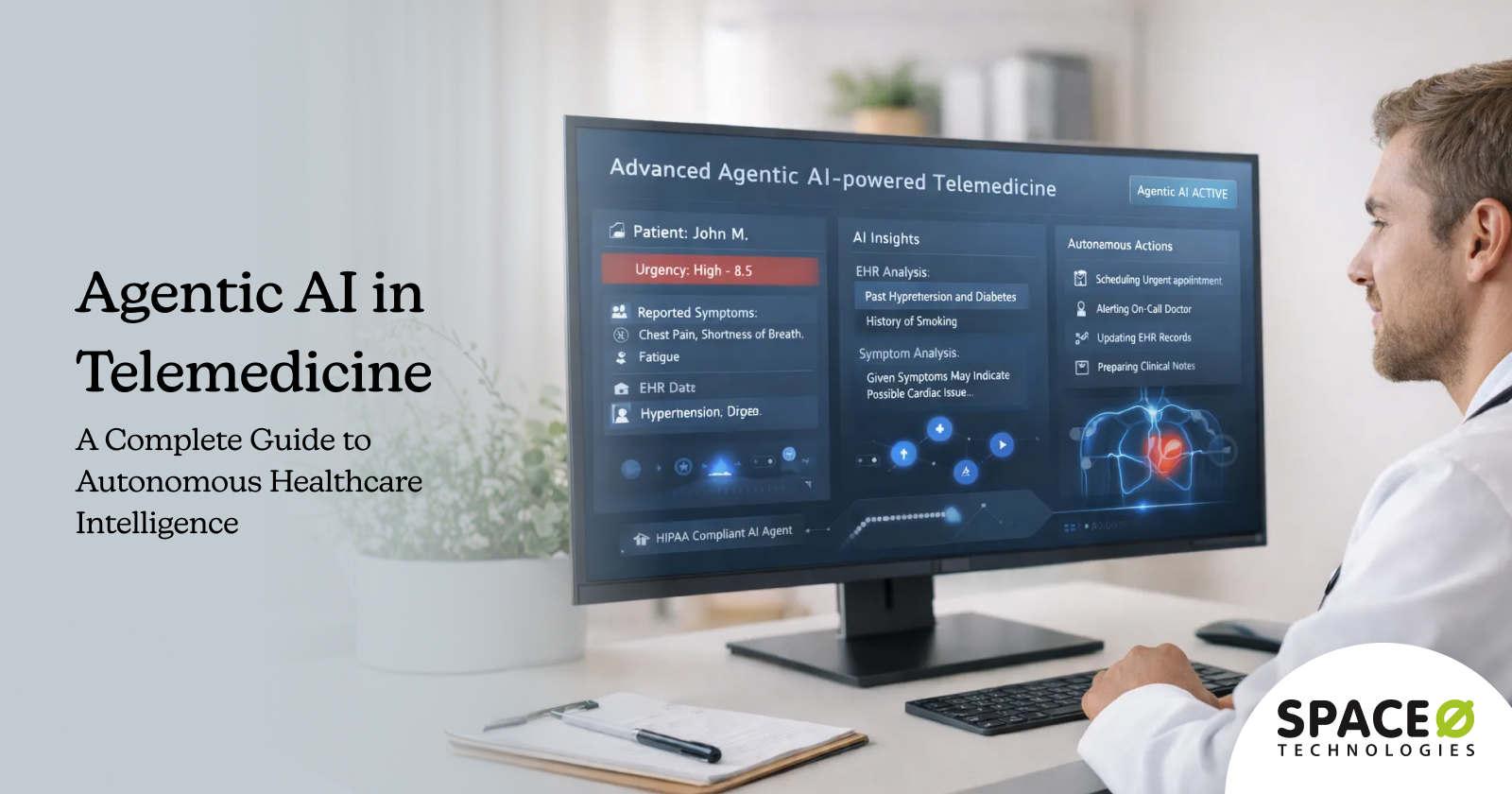
The rapid adoption of artificial intelligence is reshaping how telemedicine platforms deliver virtual care at scale. As healthcare organizations look to automate workflows, improve clinical efficiency, and reduce operational overhead, advanced AI capabilities are becoming a core component of modern telemedicine systems.
According to Precedence Research, the AI in the telemedicine market is projected to reach $176.94 billion by 2034, highlighting the accelerating investment in intelligent virtual care technologies.
Within this evolution, agentic AI in telemedicine represents a significant shift. Unlike traditional AI models that respond to predefined inputs, agentic AI systems are designed to reason, plan, and take autonomous actions across complex healthcare workflows. These AI agents can manage patient interactions, coordinate care processes, and support clinicians in real time, enabling telemedicine platforms to operate with greater efficiency and adaptability.
In this blog, we explore what agentic AI means for telemedicine, how it works, key use cases, benefits, and implementation considerations. Drawing from our expertise as a leading agentic AI development company, we have shared how healthcare organizations can implement agentic AI solutions responsibly and at scale.
What Is Agentic AI in Telemedicine?
Agentic AI in telemedicine refers to AI systems designed to operate as autonomous agents that can reason, plan, and take actions to achieve specific healthcare goals within virtual care environments. Unlike traditional AI models that execute predefined tasks or respond only to direct inputs, agentic AI systems are goal-driven and capable of managing multi-step workflows with minimal human intervention.
In telemedicine platforms, agentic AI agents act as intelligent digital assistants that coordinate patient interactions, clinical workflows, and operational tasks.
For example, an agentic AI system can autonomously guide patients through intake, assess symptoms, schedule appointments, trigger follow-ups, and escalate cases to clinicians when predefined risk thresholds are met. These agents continuously evaluate context, patient data, and system feedback to determine the next best action.
What sets agentic AI apart is its ability to combine decision-making, tool usage, and collaboration. Agentic AI systems can interact with EHRs, telehealth platforms, scheduling systems, and clinical decision support tools to complete end-to-end processes rather than isolated tasks.
Agentic AI vs. AI agents in telemedicine: understanding the distinction
AI Agents for Telemedicine are task-specific systems focused on single functions. A scheduling agent books appointments. Agentic AI in Telemedicine orchestrates multiple AI agents to achieve broader healthcare goals. The table below summarizes these differences.
| Characteristic | AI Agents | Agentic AI |
| Scope | Single task (scheduling, triage) | Multi-step care workflows |
| Autonomy | Follows predefined rules | Goal-oriented decision-making |
| Coordination | Works independently | Orchestrates multiple agents |
| Adaptability | Limited to programmed responses | Dynamic adaptation to context |
| Learning | Static or periodic updates | Continuous learning from interactions |
| Example | Appointment booking bot | End-to-end virtual care coordinator |
This distinction shapes development approach, infrastructure requirements, and governance models.
Agentic AI vs. traditional telehealth chatbots and virtual assistants
Traditional chatbots operate reactively with scripted, single-turn interactions. They answer the question asked, then wait for the next input. Even advanced AI chatbot development produces systems that remain fundamentally reactive.
Virtual assistants add context awareness. They remember previous interactions within a session and can handle multi-turn conversations. But they remain prompt-dependent, acting only when explicitly asked.
Agentic AI transcends both. It demonstrates:
- Proactive behavior: Initiates actions based on patient needs without waiting for requests
- Multi-step reasoning: Breaks complex goals into actionable sequences
- Autonomous workflow execution: Completes entire care processes independently
- Self-correction: Adjusts approaches when initial attempts fail
For telemedicine, this matters because clinicians need systems that handle complexity. A physician managing 30 virtual visits daily cannot manually coordinate intake, documentation, prescriptions, referrals, and follow-ups for each patient. Agentic AI handles this coordination autonomously.
Now that we understand what agentic AI is, let us examine how these systems actually work within telemedicine workflows.
How Agentic AI Works in Telemedicine Workflows
Agentic AI operates through a coordinated system of components that enable autonomous decision-making and task execution. Understanding this architecture helps organizations plan implementations and set realistic expectations. The following five mechanisms work together to power intelligent telemedicine automation.
Step 1: Reasoning and planning through the cognitive engine
The cognitive engine serves as the brain of agentic AI. It uses chain-of-thought processing to decompose complex healthcare tasks into executable steps. This capability is powered by advanced LLM development and domain-specific fine-tuning.
How it works in practice
Consider a prescription refill request. The agentic system reasons through the following sequence:
- Patient requests a refill for blood pressure medication
- Agent checks medication history in EHR
- Verifies last appointment was within the required timeframe
- Checks for potential drug interactions with current medications
- Reviews recent vital signs and lab results
- Determines if clinician approval is required based on clinical rules
- If approved autonomously, it sends a prescription to the pharmacy
- If a clinician review is needed, prepare a summary and routes for approval
- Notifies patient of outcome and next steps
The planning module determines the optimal sequence based on patient context, clinical guidelines, and organizational policies. It adapts when encountering unexpected situations, such as discovering the patient has recently started a new medication that requires review.
Step 2: Tool integration and system connectivity
Agentic systems connect to multiple healthcare tools through APIs and integration layers. This connectivity enables the agent to gather information and execute actions across disparate systems.
Systems that agents access
- EHR/EMR systems for patient records, history, and clinical data
- Scheduling platforms for appointment management and resource allocation
- Billing systems for insurance verification and claims processing
- Prior authorization portals for payer communication
- Clinical knowledge bases for guidelines and protocols
- Drug databases for interaction checking and formulary status
- Communication channels, including SMS, email, and patient portals
Seamless connectivity requires robust AI integration services that handle the complexity of healthcare IT environments. The agent autonomously decides which tools to use based on the task at hand.
Step 3: Memory and context management
Effective agentic AI maintains multiple types of memory to deliver personalized, context-aware interactions.
Memory types and their functions
- Short-term memory keeps context within a single care episode. The agent remembers what the patient said earlier in the conversation and what actions have already been taken.
- Long-term memory retains patient preferences, communication history, and care patterns across sessions. The system knows this patient prefers afternoon appointments, responds better to text than email, and has previously expressed concerns about medication costs.
- Cross-session awareness enables understanding of the patient’s longitudinal health journey. The agent recognizes that the current complaint relates to a condition diagnosed six months ago and factors this into its reasoning.
Example: If a patient mentioned transportation challenges during a previous visit, the agent proactively offers telehealth for the follow-up rather than an in-person appointment.
Step 4: Goal-oriented execution with self-correction
Agentic AI pursues defined healthcare objectives rather than simply completing tasks. An objective might be “ensure patient completes diabetes management protocol” rather than “send appointment reminder.”
How goal-oriented execution works
- The system monitors progress toward goals continuously
- When obstacles arise, it automatically adjusts its approach
- If a patient does not respond to an email reminder, the agent switches to SMS
- If SMS fails, it escalates to staff for phone outreach
- Routine exceptions are handled autonomously
- Complex situations trigger human intervention
Building these capabilities requires experienced generative AI engineers who understand both the technology and healthcare context.
Self-correction means the agent learns from failures. If a particular approach consistently underperforms for certain patient segments, the system adapts its strategy.
Step 5: Human-in-the-loop safety checkpoints
Autonomous does not mean unsupervised. Critical decision points trigger clinician review. The system uses confidence thresholds to determine when to escalate versus proceed independently.
What safety mechanisms includes
- Transparent reasoning trails documenting every autonomous decision
- Clinician review capabilities for agent actions
- Override options at any point in the workflow
- Configurable autonomy levels based on task risk
- Audit logs for compliance and quality assurance
These safety checkpoints ensure autonomous systems remain under appropriate clinical oversight.
Understanding how agentic AI works provides the foundation for exploring specific applications. Let us examine the key use cases transforming telemedicine operations.
Key Use Cases of Agentic AI in Telemedicine
Agentic AI delivers value across the entire telemedicine care continuum. From initial patient contact through follow-up care, autonomous systems handle workflows that traditionally required significant staff time. The following six use cases represent the highest-impact applications organizations are implementing today.
1. Autonomous patient triage and intake
The challenge: Static intake forms and basic chatbots fail to gather comprehensive patient information. Staff spend hours on phone calls collecting symptoms and history.
How agentic AI solves it: Autonomous systems conduct intelligent intake conversations through natural dialogue. They gather symptoms, relevant history, medications, and social context without human involvement.
Key capabilities:
- Urgency assessment using clinical algorithms
- Automatic routing based on symptom severity
- Emergency symptom escalation to clinical staff
- Insurance verification and eligibility checking
- Pre-visit documentation preparation
Impact: These systems leverage machine learning development for accurate risk stratification, reducing triage time while improving accuracy.
2. Clinical documentation and ambient intelligence
The challenge: Documentation burden drives physician burnout. Clinicians spend nearly two hours on paperwork for every hour of patient care.
How agentic AI solves it: Real-time documentation during virtual consultations captures the clinical conversation automatically. The system extracts relevant information and generates structured notes.
Key capabilities:
- Automated SOAP notes from conversation
- Patient-friendly visit summaries in plain language
- Medical coding suggestions for billing
- Clinical decision support integration
- Quality measure documentation
Impact: Organizations report a reduction in documentation time. This capability is powered by advanced generative AI development focused on clinical accuracy.
3. Prior authorization and claims management
The challenge: Prior authorization creates care delays. Staff spend hours navigating complex payer requirements while patients wait for approvals.
How agentic AI solves it: End-to-end automation identifies authorization requirements, gathers documentation, submits requests, and monitors status without staff involvement.
Key capabilities:
- Automatic identification of authorization requirements
- Clinical documentation gathering from patient records
- Submission through payer portals
- Status monitoring and follow-up
- Additional information retrieval when requested
- Care plan updates upon approval
Impact: Authorization cycle times reduced from days to hours. Staff intervene only for complex denials requiring clinical judgment.
4. Appointment coordination and care scheduling
The challenge: Healthcare scheduling involves multiple constraints that overwhelm manual processes. No-shows, conflicts, and coordination failures waste resources.
How agentic AI solves it: Intelligent scheduling optimizes across provider availability, resources, patient preferences, and care protocols simultaneously.
Key capabilities:
- Multi-provider, multi-appointment scheduling
- Conflict detection and automatic rescheduling
- Intelligent reminders through preferred channels
- No-show prediction and proactive outreach
- Follow-up scheduling based on clinical outcomes
- Resource utilization optimization
Impact: No-show rates decrease through personalized outreach. Scheduling efficiency improves as the agent learns patterns.
5. Medication management and adherence monitoring
The challenge: Poor medication adherence leads to hospitalizations and worse outcomes. Traditional reminder systems have limited effectiveness.
How agentic AI solves it: Proactive monitoring detects adherence issues before they cause problems. Personalized interventions address root causes.
Key capabilities:
- Prescription refill coordination before depletion
- Drug interaction checking for new medications
- Personalized adherence nudges based on behavior patterns
- Root cause investigation when adherence drops
- Medication reconciliation for complex regimens
- Pharmacy and payer coordination
Impact: Adherence rates improve through intelligent, personalized intervention rather than generic reminders.
6. Clinical trial matching and patient recruitment
The challenge: Clinical trials struggle with recruitment. Eligible patients go unidentified while trials fail to meet enrollment targets.
How agentic AI solves it: Continuous screening matches patient populations against eligibility criteria automatically. Qualified patients receive timely outreach.
Key capabilities:
- Automated eligibility screening against trial criteria
- Patient population analysis for matching
- Outreach initiation for qualified patients
- Trial information delivery and question handling
- Research staff coordination
- Enrollment workflow management
Impact: Trial recruitment timelines can decrease through automated matching and proactive patient outreach.
The use cases demonstrate significant potential. Now, let us examine the concrete benefits organizations realize when implementing agentic AI.
Develop Use Case–Driven Agentic AI for Telemedicine
Space-O AI builds agentic AI solutions tailored to specific telemedicine use cases such as triage automation, care navigation, and clinical coordination.
Benefits of Agentic AI for Healthcare Organizations
Healthcare organizations implementing agentic AI realize measurable improvements across clinical, operational, and financial dimensions. These benefits compound over time as systems learn and optimize. The following advantages drive ROI for telemedicine investments.
Reduced clinician administrative burden
Agentic AI handles documentation, scheduling coordination, prior authorizations, and follow-up management autonomously. Clinicians focus on clinical decision-making and patient relationships rather than administrative tasks. Studies show physicians can reclaim 2-3 hours daily when administrative workflows are automated effectively.
1. Improved operational efficiency and throughput
Autonomous systems process tasks continuously without breaks or shift changes. Prior authorizations that took days to complete in hours. Intake that requires staff time happens automatically. Organizations report significant improvements in administrative task completion times. Those looking to build these capabilities can hire AI developers with healthcare experience.
2. Enhanced patient experience and engagement
Patients receive immediate responses rather than waiting for callbacks. Intake conversations happen at their convenience. Reminders arrive through their preferred channels. Follow-up coordination happens proactively. The result is higher satisfaction scores and improved perception of care quality.
3. Scalability without proportional headcount growth
Traditional scaling requires hiring proportionally more staff. Agentic AI enables volume growth without linear cost increases. A system handling 1,000 patient interactions scales to 10,000 with infrastructure investment rather than tenfold staffing increases. This fundamentally changes healthcare economics.
4. Fewer errors and improved compliance
Autonomous systems apply protocols consistently. They do not forget steps when busy or skip documentation when rushed. Audit trails capture every action. Compliance with care protocols improves as the system ensures required steps happen regardless of workload pressures.
5. Data-driven insights from autonomous workflows
Every interaction generates data. Agentic systems identify patterns in patient behavior, workflow bottlenecks, and outcome correlations. Organizations gain visibility into operations that were previously impossible. This enables continuous improvement based on evidence.
Realizing these benefits requires building systems with the right components. Let us examine the core architecture of agentic AI for telemedicine.
Core Components of an Agentic AI System for Telemedicine
Building production-ready agentic AI requires specific technical infrastructure. Each component serves a distinct function in enabling autonomous healthcare operations. Understanding these components helps organizations evaluate build-versus-buy decisions and assess vendor capabilities.
1. Agent orchestration and reasoning engine
The orchestration layer serves as the central coordinator for agentic AI systems. It manages how multiple specialized agents work together to accomplish complex healthcare goals.
What it does
- Decomposes high-level objectives into specific tasks
- Assigns work to appropriate specialized agents
- Coordinates information flow between agents
- Synthesizes results into coherent outcomes
- Handles conflicts and prioritization decisions
The reasoning engine enables chain-of-thought processing for healthcare decisions. It evaluates options against clinical guidelines, considers patient-specific constraints, and selects appropriate actions. This capability requires LLMs fine-tuned for clinical contexts with appropriate safety constraints.
2. Tool integration layer
Healthcare environments include dozens of systems that must work together. The integration layer connects agentic AI to these systems securely and reliably.
Required integrations
- EHR/EMR access using FHIR and HL7 protocols for patient data
- Scheduling systems for appointment management
- Billing platforms for claims and authorization
- Clinical knowledge bases for guidelines and protocols
- Communication channels for patient outreach via SMS, email, and portals
- Identity management for secure authentication
This requires seamless integration with existing healthcare infrastructure. Legacy systems with limited API capabilities often need middleware or custom connectors.
3. Memory and context management
Personalized, context-aware interactions require sophisticated memory architecture. Without proper memory management, agents cannot maintain continuity across patient interactions.
Memory architecture components
- Working memory holds the current task context and the active conversation state
- Episodic memory stores patient interaction history and outcomes
- Semantic memory contains clinical knowledge and organizational policies
- Procedural memory retains workflow patterns and learned best practices
This architecture enables agents to remember patient preferences, recognize returning patients, and build on previous interactions rather than starting fresh each time.
4. MLOps infrastructure for continuous improvement
Production agentic AI requires a robust operational infrastructure to maintain performance and enable ongoing optimization.
Essential MLOps capabilities
- Performance monitoring tracks accuracy, latency, and error rates
- Drift detection identifies when model performance degrades
- Continuous learning pipelines incorporate feedback to improve accuracy
- Version control enables safe updates and rollback capabilities
- A/B testing frameworks validate improvements before broad deployment
- Compliance logging maintains audit trails for regulatory requirements
Follow best practices outlined in our MLOps pipeline guide. Enterprise implementations also benefit from MLOps consulting expertise.
5. Human-in-the-loop oversight mechanisms
Clinical safety demands appropriate human oversight. Autonomous systems must include mechanisms for clinician review and intervention.
Required safety mechanisms
- Approval workflows route high-risk decisions to clinicians before execution
- Escalation triggers identify situations requiring human judgment
- Confidence thresholds determine when agents should defer to humans
- Audit trails document all autonomous actions with reasoning
- Override capabilities allow clinicians to intervene at any workflow point
- Performance dashboards provide visibility into agent behavior
Building robust oversight systems requires engineering expertise that balances autonomy with clinical safety requirements.
Understanding the components helps frame the challenges organizations face during implementation. Let us examine these challenges and their solutions.
Build Autonomous Agentic AI Solutions for Your Healthcare Organization
At Space-O AI, we specializes in developing secure, HIPAA-compliant autonomous AI agents with robust governance and oversight mechanisms.
Challenges in Implementing Agentic AI in Telemedicine
Implementing agentic AI in healthcare environments presents unique challenges beyond typical software deployments. Patient safety requirements, regulatory compliance, and clinician adoption all require careful attention. Organizations that address these challenges proactively achieve faster time-to-value and better outcomes.
1. Ensuring patient safety and clinical accuracy
Autonomous healthcare systems must meet rigorous safety standards. Errors can cause patient harm. Organizations worry about liability when AI makes independent clinical decisions.
Solutions
- Implement rigorous clinical validation protocols before deployment
- Establish guardrails that prevent autonomous action for high-risk decisions
- Deploy continuous monitoring that tracks accuracy and identifies degradation
- Maintain clear escalation paths to human clinicians
- Conduct regular audits of autonomous decisions against clinical standards
Work with an experienced healthcare AI consulting partner to establish safety frameworks appropriate for your organization’s risk tolerance.
2. HIPAA compliance and data governance
Agentic AI systems access sensitive patient data across multiple systems. They must maintain compliance with HIPAA privacy and security rules. Data handling for model training raises additional concerns.
Solutions
- Implement end-to-end encryption for data in transit and at rest
- Deploy role-based access controls, limiting agent data access to the minimum necessary
- Maintain comprehensive audit logging for all data access and actions
- Ensure BAA coverage for all AI infrastructure and services
- Use de-identified or synthetic data for model development when possible
Understand the full scope of compliant development through our AI software development guide.
3. Integration with legacy healthcare systems
Healthcare IT environments often include systems decades old with limited integration capabilities. Connecting agentic AI to these systems requires significant technical effort.
Solutions
- Leverage FHIR and HL7 standards where available for structured integration
- Deploy middleware layers that abstract legacy system complexity
- Implement phased rollout starting with better-integrated systems
- Build robust error handling for integration failures
- Plan for manual fallback when integrations are unavailable
Specialized integration expertise helps navigate complex healthcare environments with diverse system landscapes.
4. Clinician trust and adoption
Clinicians may distrust AI making autonomous decisions about their patients. Without adoption, even excellent systems fail to deliver value.
Solutions
- Provide transparent explanations of agent reasoning and actions
- Ensure clear escalation and override capabilities that keep clinicians in control
- Start with lower-stakes workflows and expand autonomy incrementally
- Share performance data demonstrating accuracy and reliability
- Involve clinical leaders in system design and governance decisions
These challenges are manageable with proper planning. Let us examine the development process for building agentic AI systems.
How to Implement Agentic AI Into Your Telemedicine Platform
Successful agentic AI implementations follow a structured development process that balances speed with clinical safety requirements. This five-step framework guides organizations from initial planning through production deployment and ongoing optimization.
Step 1: Define agent scope and clinical workflows
Successful agentic AI implementations start with a clear scope definition. Identify specific workflows where autonomous operation delivers value. Map decision points, data requirements, and escalation triggers. Document compliance and safety requirements that constrain system behavior.
Action items
- Select 2–3 high-value workflows for initial implementation (triage, documentation, scheduling)
- Map end-to-end workflow steps with decision points identified
- Define success metrics and performance thresholds
- Document regulatory and compliance constraints
- Identify integration requirements with existing systems
Begin with expert consulting to ensure the scope aligns with organizational priorities and capabilities.
Step 2: Design agent architecture and tool integrations
Architectural design determines system capabilities and constraints. Select appropriate LLM foundations, design integration approaches, and build memory management systems. Balance capability with safety and compliance requirements.
Action items
- Select an LLM backbone appropriate for healthcare (GPT-4, Claude, or fine-tuned medical models)
- Design secure API integrations for EHR, scheduling, and administrative systems
- Build memory and context management systems for patient continuity
- Develop tool abstraction layers that enable agent flexibility
- Plan for scalability and performance under production load
Following architectural best practices ensures enterprise AI systems meet performance and compliance requirements.
Step 3: Implement safety guardrails and oversight
Safety mechanisms must be designed into the system, not added afterward. Define approval workflows for high-risk actions. Build audit logging that captures reasoning and decisions. Implement confidence thresholds that trigger human review appropriately.
Action items
- Define human-in-the-loop approval workflows by decision type and risk level
- Build comprehensive audit logging with decision traceability
- Implement confidence thresholds that trigger escalation appropriately
- Create override mechanisms that allow clinician intervention at any point
- Develop monitoring dashboards for operational oversight
Working with developers who have healthcare compliance experience ensures safety requirements are met.
Step 4: Clinical validation and pilot testing
Before broad deployment, validate system performance against clinical standards. Run controlled pilots with selected provider groups. Gather feedback from clinicians and patients. Iterate on agent behavior based on real-world performance.
Action items
- Conduct accuracy testing against clinical benchmarks and gold-standard decisions
- Run controlled pilots with representative patient populations
- Gather structured feedback from participating clinicians
- Measure patient satisfaction and experience metrics
- Iterate on agent behavior based on findings
Step 5: Deployment and continuous optimization
Production deployment requires a robust operational infrastructure. Monitor performance continuously. Track metrics that matter for clinical and operational success. Implement continuous learning that improves system performance over time.
Action items
- Deploy with comprehensive monitoring and alerting systems
- Track key metrics: task completion rates, accuracy, escalation frequency, and user satisfaction
- Implement continuous learning pipelines that incorporate feedback
- Establish regular review cadences for system performance
- Plan for ongoing optimization and capability expansion
Robust MLOps infrastructure ensures production success through continuous monitoring and optimization.
Looking to Implement Secure and Compliant AI Agents?
Partner with Space-O AI to develop HIPAA-compliant agentic AI systems designed for real-world healthcare environments.
Build Impactful Agentic Telemedicine Solutions with Space-O AI
Agentic AI in telemedicine represents a fundamental shift from reactive tools to autonomous healthcare systems. Organizations implementing these solutions reduce administrative burden, improve operational efficiency, and deliver better patient experiences through intelligent automation and proactive care coordination.
Space-O AI brings 15 years of experience delivering production-ready AI solutions. We have completed over 500 successful projects for healthcare organizations, enterprises, and technology companies worldwide. Our systems operate reliably at scale with the security and compliance healthcare demands.
Our team of 80+ developers includes specialists in healthcare AI, LLM development, and agentic systems. We have built HIPAA-compliant platforms, integrated with major EHR systems, and deployed autonomous agents that handle millions of patient interactions.
Ready to explore how agentic AI can transform your telemedicine operations? Contact us for a free consultation to discuss your requirements, evaluate opportunities, and plan an implementation roadmap tailored to your organization’s needs and goals.
Frequently Asked Questions
1. What is agentic AI in telemedicine?
Agentic AI in telemedicine refers to artificial intelligence systems with goal-oriented autonomy that can execute complex healthcare workflows independently. Unlike traditional AI that responds to prompts, agentic AI proactively pursues defined healthcare objectives across multiple steps, such as managing entire patient journeys from intake to follow-up.
2. How does agentic AI differ from healthcare chatbots?
Traditional healthcare chatbots are reactive and scripted, responding only when prompted with limited single-turn interactions. Agentic AI is proactive and autonomous, initiating actions based on patient needs, maintaining context across interactions, and executing multi-step workflows without constant human direction.
3. How is agentic AI different from AI agents in telemedicine?
AI agents are task-specific systems focused on single functions like scheduling or triage. Agentic AI orchestrates multiple agents to achieve broader goals, exhibits autonomous decision-making across workflows, and adapts dynamically to changing situations. Think of AI agents as specialized workers and agentic AI as the intelligent coordinator managing them.
4. What are the main use cases for agentic AI in healthcare?
Key use cases include autonomous patient triage and intake, clinical documentation and ambient intelligence, prior authorization automation, appointment coordination, medication management and adherence monitoring, and clinical trial matching. These applications reduce administrative burden while improving care coordination and patient experience.
5. Are telemedicine agentic AI solutions HIPAA compliant?
Agentic AI can be built to be HIPAA-compliant when properly designed and implemented. This requires end-to-end encryption, role-based access controls, comprehensive audit logging, BAA-compliant infrastructure, and appropriate data governance policies. Compliance depends on implementation rather than the technology itself.
6. How long does it take to develop an agentic AI system for telemedicine?
Development timelines vary based on scope and complexity. An MVP focused on a single workflow might take 3-4 months. A comprehensive system handling multiple workflows typically requires 6-12 months. Factors include integration complexity, compliance requirements, and customization needs.
7. What is the cost of implementing agentic AI in healthcare?
Costs range from $150,000–$300,000 for focused MVP implementations to $500,000–$1,500,000+ for enterprise-scale systems with multiple workflow coverage. Key cost factors include scope complexity, integration requirements, compliance needs, and ongoing operational infrastructure.
8. Can agentic AI replace healthcare professionals?
Agentic AI augments healthcare professionals rather than replacing them. It handles administrative tasks, coordinates workflows, and provides decision support. Clinical judgment, patient relationships, and complex medical decision-making remain the domain of human clinicians. The goal is to enable clinicians to focus on what only humans can do.


Planning an Agentic AI Telemedicine Platform?
What to read next