- What Is Agentic AI Patient Portal Development?
- How agentic AI enhances patient portal capabilities
- How Agentic AI Works in Patient Portal Architecture
- Benefits of Agentic AI for Patient Portal Development
- Key Use Cases of Agentic AI in Patient Portals
- Implementation Process for Agentic AI in Patient Portals
- Challenges in Implementing Agentic AI for Patient Portals
- Cost of Agentic AI Development for Patient Portals
- Governance and Compliance for Agentic AI in Healthcare
- Emerging Trends in Agentic AI for Patient Portals
- Build Your Agentic AI Patient Portal with Space-O AI
- Frequently Asked Questions on Agentic AI Patient Portal Development
- 1. What is the difference between AI-enabled and agentic AI patient portals?
- 2. What is the difference between AI-enabled and agentic AI patient portals?
- 3. How does agentic AI improve patient engagement?
- 4. What safeguards prevent agentic AI from making harmful decisions?
- 5. How long does it take to implement agentic AI in a patient portal?
Agentic AI in Patient Portal Development: Transform Portals Into Engagement Engines

 Last Updated: March, 10 2026
Traditional patient portals are largely reactive. They allow patients to view records, book appointments, and communicate with providers. Even AI-enabled portals often focus on basic automation, such as chat support or reminders.
Agentic AI takes this a step further.
According to Grand View Research, the agentic AI in the healthcare market is projected to grow from USD 538.51 million in 2024 to USD 4.96 billion by 2030. This rapid growth signals a major shift toward intelligent systems that can autonomously take action, coordinate workflows, and proactively support patient care.
An agentic AI patient portal is designed to operate within defined clinical and compliance boundaries while initiating tasks, analyzing real-time patient data, triggering follow-ups, and optimizing scheduling without constant human input. However, building such a system requires advanced AI orchestration, secure API integrations, strict access controls, and healthcare-grade compliance frameworks.
In this guide, we explore how to develop an agentic AI-enabled patient portal. Drawing from our 15+ years of experience as a leading AI patient portal development partner, we have shared insights on the architecture, security, interoperability, and responsible AI deployment in healthcare environments.
What Is Agentic AI Patient Portal Development?
Agentic AI patient portal development refers to building a patient portal powered by AI agents that can autonomously make decisions, initiate actions, and coordinate workflows within predefined clinical, operational, and compliance boundaries.
Unlike traditional portals that simply respond to patient inputs, an agentic AI-enabled portal can proactively manage tasks. Instead of waiting for a patient to log in and take action, AI agents can monitor data, detect patterns, and trigger next steps automatically.
For example, an agentic AI patient portal can:
- Identify high-risk patients based on recent lab results and prompt follow-up scheduling
- Automatically reschedule missed appointments based on patient preferences and provider availability
- Trigger medication refill reminders based on prescription history
- Route patient queries to the appropriate department without manual triage
- Personalize communication based on engagement behavior
At its core, agentic AI patient portal development involves designing systems where AI agents operate with controlled autonomy. These agents are integrated with EHR systems, scheduling tools, billing platforms, and communication modules through secure APIs. They function within strict guardrails to ensure compliance, patient safety, and data privacy.
Key components of agentic AI-powered patient portals
- AI orchestration layer to manage multiple agents
- Role-based access controls and audit logs
- Secure PHI handling and encryption
- FHIR-based interoperability with healthcare systems
- Decision boundaries and human-in-the-loop mechanisms
In simple terms, agentic AI patient portal development is about transforming a static patient interface into an intelligent digital care coordinator. It shifts the portal from being a passive tool to becoming an active participant in patient engagement and healthcare workflow optimization.
How agentic AI enhances patient portal capabilities
The shift from traditional portals to agentic AI-enhanced portals represents a fundamental transformation in how patients interact with healthcare organizations.
1. From reactive to proactive
Traditional portals wait for patients to log in and take action. Agentic AI initiates outreach, sends personalized reminders, and prompts engagement based on patient health status and care needs.
2. From single-task to multi-step workflows
Where traditional portals handle one action at a time, agents coordinate complex sequences. A single patient request can trigger referral coordination, insurance verification, appointment scheduling, and confirmation messaging, all handled autonomously.
3. From generic to personalized
Static portal templates treat every patient the same. Agentic AI tailors interactions based on individual health history, preferences, communication styles, and current care needs.
4. From isolated to integrated
Traditional portals display information from connected systems. Agentic AI actively orchestrates across EHRs, scheduling platforms, billing systems, and messaging channels in real time.
The following table illustrates these differences clearly.
| Capability | Traditional Portal | Agentic AI Portal |
| Patient interaction | Reactive, query-response | Proactive, goal-driven |
| Task handling | Single-step, manual | Multi-step, autonomous |
| System integration | Siloed data views | Real-time API orchestration |
| Personalization | Static templates | Dynamic, context-aware |
| Learning | No improvement post-launch | Continuous optimization |
| Availability | Information display only | 24/7 autonomous support |
Understanding the conceptual difference is essential. Let’s examine how agentic AI actually works within patient portal architecture.
Ready to Develop an Agentic AI-Enabled Patient Portal?
Our team at Space-O AI designs and develops agentic AI patient portals that automate workflows, integrate securely with EHR systems, and maintain strict healthcare compliance.
How Agentic AI Works in Patient Portal Architecture
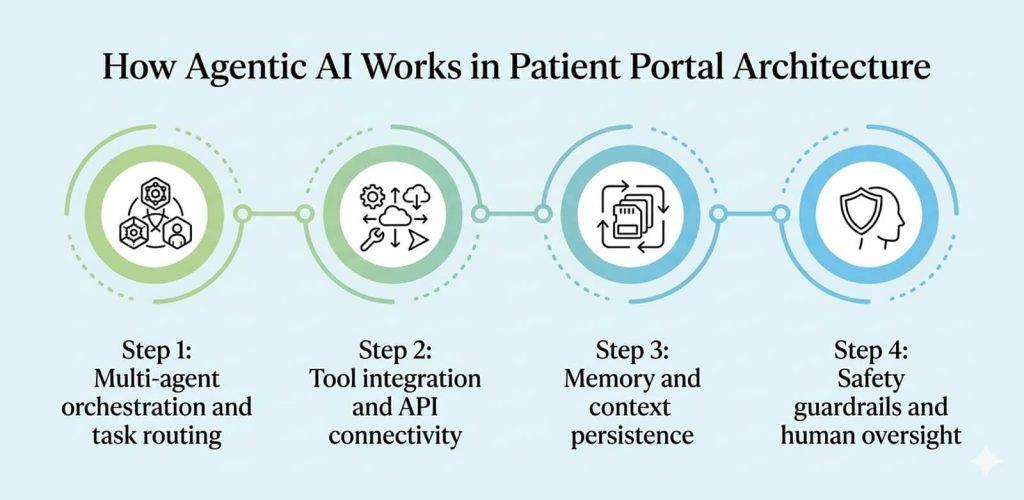
Building an agentic AI-enhanced patient portal requires an architecture that enables autonomous operation while maintaining safety and compliance. Here is how agentic AI functions within patient portal environments.
Step 1: Multi-agent orchestration and task routing
The foundation begins with deploying multiple specialized agents that work together. A care coordination agent handles scheduling and referrals. A billing agent manages insurance and payments. A messaging agent delivers notifications. An engagement agent monitors activity and triggers outreach.
These agents communicate through an orchestration layer that routes patient requests to the right agent, shares context between them, and coordinates handoffs when tasks span multiple domains.
Step 2: Tool integration and API connectivity
Agents connect to healthcare infrastructure through APIs to access and update patient information in real time. Key integration points include:
- EHR systems: Epic, Cerner, Athenahealth via FHIR APIs
- Scheduling and billing platforms: Appointment booking and payment processing
- Lab and pharmacy systems: Results retrieval and medication coordination
- Messaging systems: SMS, email, and in-app notifications
This integration layer allows agents to read data, trigger actions, and stay synchronized across all connected systems.
Step 3: Memory and context persistence
Agents build and maintain context across interactions over time. When a patient engages with an agent, it recalls previous conversations, understands their care history, and recognizes preferences. For example, an agent learns that a patient prefers text messages and responds better to morning communications. This knowledge automatically shapes future interactions.
Step 4: Safety guardrails and human oversight
Safety mechanisms govern autonomous operation in healthcare environments:
- Scope boundaries: Define what agents can do independently versus what needs approval
- Escalation triggers: Route to human staff when confidence is low, or risk is high
- Approval workflows: Insert checkpoints for sensitive clinical or financial actions
- Audit logging: Capture every action for compliance review
With this foundation in place, healthcare organizations can unlock significant benefits across patient engagement and operational efficiency.
Benefits of Agentic AI for Patient Portal Development
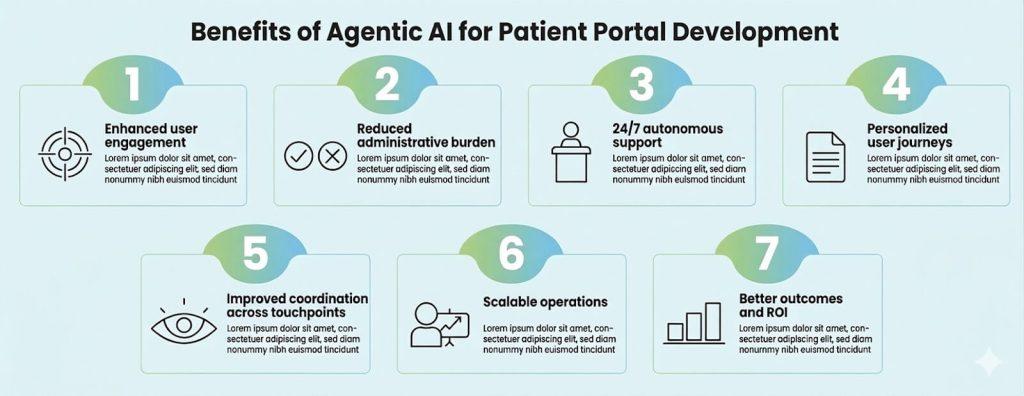
Organizations implementing agentic AI in their patient portals realize advantages across user experience, operational efficiency, and business outcomes.
1. Enhanced user engagement
Proactive AI agents drive significantly higher engagement compared to passive portals. Agents initiate meaningful interactions based on user needs rather than waiting for users to log in and navigate on their own.
2. Reduced administrative burden
Autonomous agents handle scheduling, inquiries, and verifications without staff intervention. Teams can focus on complex cases requiring human judgment instead of repetitive tasks that consume hours daily.
3. 24/7 autonomous support
Unlike human staff limited by shifts and availability, AI agents operate continuously. Users receive immediate responses to questions and requests at any hour, improving satisfaction and reducing call volume.
4. Personalized user journeys
Goal-driven agents tailor every interaction based on user profile, preferences, and history. This personalization improves satisfaction scores and increases engagement and retention rates.
5. Improved coordination across touchpoints
Agents seamlessly coordinate tasks, appointments, and transitions across departments. Multi-agent orchestration ensures nothing falls through the cracks in complex user journeys involving multiple touchpoints.
6. Scalable operations
Organizations can handle growing user volumes without proportional staff increases. AI agents absorb routine inquiries and administrative tasks, enabling sustainable growth without staff burnout or declining service quality.
7. Better outcomes and ROI
Proactive reminders, personalized nudges, and automated task completion improve key metrics. Organizations consistently report stronger adherence rates and improved patient outcomes when implementing AI-driven engagement support.
These benefits become tangible when examining specific use cases where agentic AI delivers measurable impact. Partnering with an AI healthcare software development company ensures these capabilities are implemented effectively.
Build a Smarter Patient Portal with Agentic AI Capabilities
With 15+ years of AI development experience and 500+ AI solutions delivered, we help healthcare organizations build intelligent, scalable, and future-ready patient portals.
Key Use Cases of Agentic AI in Patient Portals
Agentic AI transforms patient portals across multiple functional areas. The following use cases represent high-impact opportunities where autonomous agents deliver significant ROI.
1. Autonomous care coordination agents
What it does: Care coordination agents manage the entire follow-up process, including scheduling appointments after procedures, tracking referral status, and ensuring patients complete recommended care steps without manual staff intervention.
How it works: When a primary care physician refers a patient to a cardiologist, the agent automatically checks specialist availability, considers patient preferences, books the appointment, sends preparation instructions, and follows up to confirm attendance. Post-discharge, agents monitor recovery milestones and initiate outreach when patients miss expected check-ins.
Benefits:
- Reduces readmission rates through proactive post-discharge monitoring
- Eliminates manual follow-up tracking for administrative staff
- Improves continuity of care across multiple providers
- Decreases patient no-show rates with automated reminders
2. Billing and insurance support agents
What it does: Billing agents handle financial inquiries autonomously, explaining insurance coverage, tracking authorization status, providing claim updates, and helping patients understand their financial responsibility.
How it works: When a patient asks about an upcoming procedure cost, the agent pulls coverage details from connected systems, calculates estimated out-of-pocket expenses based on their plan, and offers payment plan options if needed. Agents track prior authorization workflows and proactively notify patients of status changes.
Benefits:
- Reduces billing-related call volume
- Improves patient financial transparency and satisfaction
- Free revenue cycle staff to focus on complex cases and denials
- Decreases accounts receivable days through proactive payment support
3. Intelligent triage and symptom routing
What it does: Triage agents assess patient-reported symptoms through conversational interactions and recommend appropriate care levels, whether self-care, scheduled appointment, urgent care, or emergency services.
How it works: Using clinically validated protocols, agents gather symptom information, assess severity indicators, and cross-reference patient history. Based on this analysis, agents provide guidance and facilitate next steps. Human-in-the-loop escalation ensures high-risk situations are routed immediately to clinical staff. Every interaction is documented for clinical records.
Benefits:
- Reduces unnecessary emergency department visits
- Improves patient safety through consistent triage protocols
- Decreases clinical staff time spent on routine symptom assessments
- Provides 24/7 triage support without staffing constraints
4. Proactive patient outreach agents
What it does: Outreach agents identify care gaps by analyzing patient records and initiate personalized reminders for preventive care, screenings, and medication refills before patients fall behind on recommended care.
How it works: Agents continuously monitor patient records against care protocols. When gaps are identified, agents send personalized messages explaining the importance of the missed care item and offer scheduling assistance. Risk stratification prioritizes outreach for at-risk populations, focusing resources where impact is greatest.
Benefits:
- Closes care gaps that impact quality metrics and reimbursement
- Improves preventive care compliance rates
- Reduces manual outreach workload for care management teams
- Enables population health management at scale
5. Lab result explanation agents
What it does: Explanation agents generate plain-language summaries of lab results tailored to patient health literacy levels, providing context about what values mean and what actions may be needed.
How it works: When new results arrive, agents analyze the data, compare it to previous results and normal ranges, and generate personalized explanations. Abnormal results are flagged with appropriate urgency levels. Agents provide context about lifestyle modifications or follow-up actions while avoiding clinical diagnosis.
Benefits:
- Reduces patient anxiety about routine lab variations
- Decreases portal message volume asking about the result meanings
- Improves patient health literacy and engagement
- Ensures abnormal results receive appropriate attention
Organizations exploring these use cases benefit from working with experienced custom AI agent development partners who understand both the technology and healthcare domain requirements.
Turning these use cases into reality requires a structured implementation approach.
Implementation Process for Agentic AI in Patient Portals
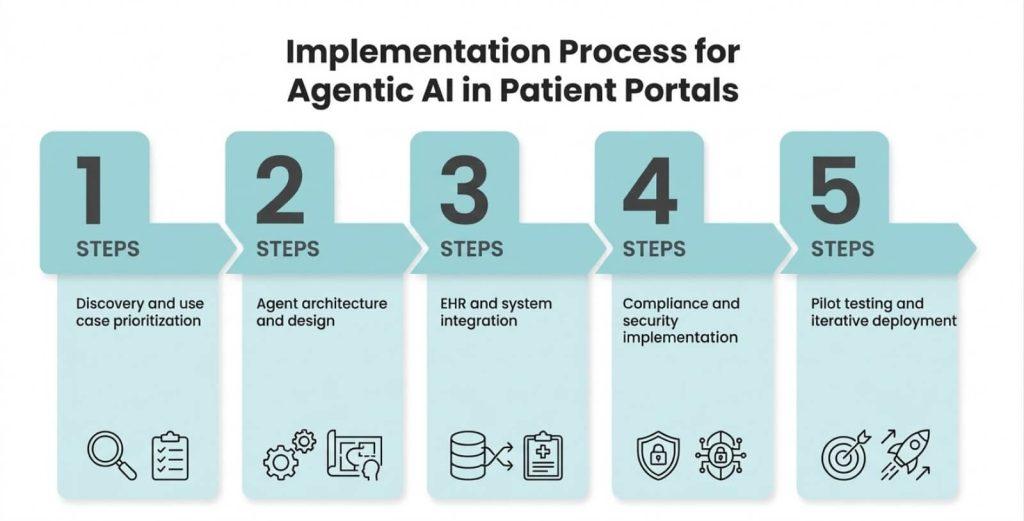
Successfully deploying agentic AI requires a structured approach that addresses technical, clinical, and organizational considerations. The following five-step process guides healthcare organizations from initial discovery through production deployment.
Step 1: Discovery and use case prioritization
Begin by assessing your organization’s specific pain points, patient journey gaps, and high-impact opportunities where autonomous agents can deliver measurable returns on investment.
Action items
- Conduct stakeholder interviews with clinical, IT, and administrative teams to understand current challenges
- Map existing patient workflows and identify friction points causing abandonment or dissatisfaction
- Analyze portal usage data to find where patients struggle or disengage
- Prioritize use cases by ROI potential, implementation complexity, and strategic alignment
- Define success metrics and KPIs for measuring agent performance post-launch
Step 2: Agent architecture and design
Design the multi-agent framework, clearly defining each agent’s goals, capabilities, integration requirements, and safety boundaries before any development begins.
Action items
- Define agent personas based on prioritized use cases (care coordinator, billing assistant, triage agent)
- Design orchestration logic governing how agents collaborate and hand off tasks
- Establish guardrails defining what agents can do autonomously versus what requires human approval
- Create detailed agent interaction flows and conversation designs
- Document escalation triggers and exception handling procedures
Step 3: EHR and system integration
Connect agents to existing EHR, scheduling, messaging, and billing systems using secure, compliant integration methods that ensure real-time data accuracy and synchronization.
Action items
- Implement FHIR-based API connections to primary EHR systems
- Build middleware layers to bridge legacy system gaps and normalize data formats
- Configure bi-directional data flows, ensuring agents have current patient information
- Establish error handling and retry logic for integration failures
- Test integration accuracy across representative patient scenarios
Step 4: Compliance and security implementation
Embed HIPAA compliance, comprehensive audit logging, and enterprise-grade security controls throughout the agent infrastructure from day one, not as an afterthought.
Action items
- Configure end-to-end encryption for data at rest and in transit
- Implement role-based access controls, limiting agent permissions appropriately
- Deploy comprehensive audit trails capturing every agent action and data access
- Conduct security assessments and penetration testing before launch
- Establish incident response protocols for AI-related security events
Step 5: Pilot testing and iterative deployment
Deploy agents in controlled pilot environments, gather feedback from patients and staff, and iterate on agent behavior before scaling across the organization.
Action items
- Launch pilot programs with select patient populations representing diverse use cases
- Collect quantitative metrics (engagement rates, task completion, escalation frequency)
- Gather qualitative feedback from patients and clinical staff
- Refine agent behavior based on real-world performance data
- Plan phased rollout with monitoring dashboards and support resources
Organizations seeking AI software development services benefit from partners who bring healthcare domain expertise alongside technical capabilities.
Even with a solid implementation process, organizations must navigate several challenges.
Need Expert Guidance on Agentic AI Implementation for Your Patient Portal?
Our healthcare AI team has delivered 500+ successful projects across industries. From discovery to deployment, we ensure your agentic AI implementation succeeds on time and within budget.
Challenges in Implementing Agentic AI for Patient Portals
Implementing agentic AI in healthcare environments presents unique challenges that organizations must address proactively. Understanding these obstacles and their solutions helps teams prepare for successful deployments.
Challenge 1: Clinical safety and liability concerns
Healthcare organizations rightfully worry about autonomous agents making recommendations that could lead to patient harm, misdiagnosis guidance, or significant legal liability exposure.
How to overcome it
- Implement human-in-the-loop escalation for all clinical decisions and recommendations
- Define clear scope boundaries that limit agent autonomy to non-clinical administrative tasks initially
- Maintain comprehensive audit trails documenting every agent action for liability protection
- Obtain clinical governance board approval before deploying patient-facing agents
- Start with low-risk use cases and expand autonomy gradually based on demonstrated safety
Challenge 2: EHR and legacy system integration
Many healthcare organizations operate legacy EHR systems with limited API capabilities, making agent integration complex, time-consuming, and prone to data synchronization issues that undermine agent effectiveness.
How to overcome it
- Prioritize FHIR-based integration standards where available in modern EHR versions
- Build middleware abstraction layers that normalize data from heterogeneous systems
- Partner with experienced healthcare integration specialists who understand specific EHR platforms
- Plan for phased integration starting with the highest-value, best-supported systems
- Budget adequate time and resources for integration testing and edge case handling
Challenge 3: HIPAA compliance and data governance
Autonomous agents handling sensitive PHI require robust compliance frameworks, proper data governance policies, and clear accountability for how patient information is processed, stored, and protected.
How to overcome it
- Implement end-to-end encryption and strict access controls aligned with the HIPAA Security Rule
- Ensure agents operate exclusively within BAA-covered infrastructure and vendor relationships
- Conduct regular security audits, vulnerability assessments, and penetration testing
- Establish clear data retention policies governing how long agent interaction logs are kept
- Document data flows and obtain appropriate patient consent for AI-assisted interactions
Challenge 4: Change management and staff adoption
Clinical and administrative staff may resist AI agents due to workflow disruption fears, concerns about job displacement, or skepticism about AI reliability in high-stakes healthcare settings.
How to overcome it
- Position agents as assistants that augment human capabilities rather than replace staff
- Involve clinical and administrative stakeholders in agent design, testing, and refinement
- Provide comprehensive training programs explaining how agents work and when to intervene
- Celebrate early wins and share success stories demonstrating staff and patient benefits
- Create feedback channels allowing staff to report issues and suggest improvements
Challenge 5: Explainability and trust building
Patients and providers need to understand why AI agents make specific recommendations or take certain actions. Black-box AI decisions erode trust and create adoption barriers that limit the value organizations realize.
How to overcome it
- Implement explainable AI features that articulate the reasoning behind agent responses
- Provide transparency into what data sources inform agent recommendations
- Allow patients and providers to review agent decision history through accessible interfaces
- Build confidence gradually through consistent, accurate, and transparent performance
- Offer easy opt-out mechanisms for patients uncomfortable with AI-assisted interactions
Working with healthcare AI consulting services helps organizations anticipate these challenges and implement proven solutions.
Understanding the investment required is essential for planning. Let’s examine the cost factors for agentic AI development.
Cost of Agentic AI Development for Patient Portals
Understanding the investment required for agentic AI implementation helps healthcare organizations plan budgets and evaluate ROI potential. The cost to develop agentic AI for patient portals varies widely based on complexity, integration requirements, and compliance needs.
Cost breakdown by complexity
The following table outlines typical cost ranges based on agent complexity and capabilities.
| Agent Type | Estimated Cost | Capabilities | Best For |
| Basic Agents | $20,000 – $50,000 | Rule-based systems handling static FAQs, appointment booking, and simple information retrieval | Small practices, MVP testing, proof of concept |
| Mid-Tier Agents | $50,000 – $90,000 | LLM-powered conversational support, EHR data queries, basic triage, personalized responses | Mid-size practices, specific use cases, initial deployments |
| Advanced Agents | $90,000 – $250,000 | Multi-agent systems with deep learning, real-time data processing, complex workflows (billing, diagnosis support), and deep system integration | Large practices, health systems, and comprehensive implementations |
| Enterprise Platform | $250,000 – $1,000,000+ | Full multi-agent ecosystem, enterprise-grade compliance, custom governance, multi-facility deployment, advanced analytics | Health systems, hospital networks, enterprise-scale deployments |
Basic Agents are ideal for organizations testing agentic AI concepts or addressing a single pain point. These rule-based systems handle straightforward tasks like answering common questions, displaying appointment availability, and providing basic information retrieval. They require minimal integration and serve as a low-risk entry point for practices new to AI.
Mid-Tier Agents introduce natural language understanding and EHR connectivity. These agents can hold genuine conversations, pull patient-specific information from connected systems, and provide personalized responses. Organizations typically deploy mid-tier agents for specific high-value use cases like appointment scheduling with intelligent slot recommendations or basic symptom triage.
Advanced Agents represent true agentic AI with autonomous multi-step workflows. These systems coordinate across multiple domains, handling complex sequences like referral management, insurance verification, and billing inquiries without human intervention. They require deep integration with EHR, scheduling, and billing platforms, along with sophisticated safety guardrails.
Enterprise Platform solutions deliver organization-wide transformation with multiple specialized agents working in concert. These implementations include custom governance frameworks, multi-facility deployment, advanced analytics dashboards, and the infrastructure to scale across thousands of daily patient interactions. Enterprise platforms require significant upfront investment but deliver proportionally greater operational impact.
Key factors influencing cost
Several variables determine the total investment for agentic AI patient portal development.
1. Complexity level
Simple rule-based agents cost significantly less than advanced systems using NLP, machine learning, and autonomous decision-making. The jump from basic FAQ handling to true agentic capabilities with planning and reasoning adds substantial development effort.
2. Data integration depth
Basic integrations with read-only access cost less than deep bi-directional EHR integration. Connecting to Epic, Cerner, or legacy systems via FHIR APIs requires significant development and testing effort.
3. Compliance requirements
HIPAA compliance, security audits, penetration testing, and governance frameworks add to implementation costs. Healthcare-grade security and audit trails are non-negotiable but increase investment.
4. Autonomy level
Higher autonomy requires more sophisticated safety guardrails, testing, and oversight mechanisms. Agents that can take actions (scheduling, messaging) require more development than those providing information only.
5. Build vs. buy vs. partner
Custom development offers maximum flexibility but the highest cost. SaaS platforms reduce upfront investment but may limit customization. Partnership models balance both considerations.
Deploying agentic AI responsibly requires robust governance frameworks. Let’s examine compliance and oversight requirements.
Get a Custom Cost Estimate for Your Agentic AI Patient Portal
Every agentic AI patient portal is unique. We provide tailored cost estimates based on your features, integrations, and compliance requirements.
Governance and Compliance for Agentic AI in Healthcare
Deploying autonomous AI agents in healthcare requires comprehensive governance frameworks that address regulatory compliance, clinical safety, and organizational accountability.
1. HIPAA compliance requirements
Agentic AI systems handling protected health information must meet HIPAA Security Rule requirements.
Key requirements include:
- Encryption: Data must be encrypted at rest and in transit using approved standards
- Access controls: Role-based permissions must limit agent access to the minimum necessary PHI
- Audit logging: All agent actions involving PHI must be logged for compliance review
- BAA coverage: AI vendors and cloud providers must execute Business Associate Agreements
- Patient rights: Patients must be able to access records of AI-assisted interactions
2. Clinical governance and oversight
Beyond regulatory compliance, healthcare organizations need clinical governance structures for AI systems.
Effective clinical governance includes:
- Establishing clinical review boards that evaluate and approve agent behavior before deployment
- Conducting regular audits of agent decisions to identify errors, biases, or safety concerns
- Defining clear escalation pathways and accountability chains for AI-related incidents
- Implementing continuous monitoring of agent accuracy and clinical appropriateness
- Creating feedback mechanisms for clinicians to report concerns about agent recommendations
3. State and federal AI regulations
The regulatory landscape for healthcare AI is evolving rapidly, creating compliance complexity.
Organizations must navigate:
- Emerging state-level AI disclosure requirements mandating patient notification of AI involvement
- Varying consent requirements for AI-assisted clinical interactions across jurisdictions
- Evolving federal guidance from HHS, ONC, and FDA regarding healthcare AI applications
- Potential future requirements around algorithmic transparency and bias testing
Building flexible governance frameworks that can adapt to regulatory changes protects organizations from costly retrofitting as requirements evolve.
4. Audit trails and explainability
Accountability requires comprehensive documentation of agent behavior.
Essential elements include:
- Logging every agent action, decision, and data access with timestamps and context
- Providing explainable AI capabilities that articulate the reasoning behind recommendations
- Enabling retrospective review of agent decisions for quality improvement and incident investigation
- Supporting regulatory inquiries with complete documentation of AI system behavior
With governance frameworks established, let’s examine the emerging trends shaping the future of agentic AI in healthcare.
Emerging Trends in Agentic AI for Patient Portals
The agentic AI landscape in healthcare is evolving rapidly. Organizations planning implementations should understand emerging trends that will shape capabilities and expectations in the coming years.
1. Multi-agent collaboration and specialization
Healthcare organizations are moving beyond single-purpose agents toward ecosystems of specialized agents that collaborate seamlessly. A care coordination agent works with a billing agent, which connects with a pharmacy agent, creating unified patient experiences across the entire care journey.
This specialization allows each agent to develop deep expertise in its domain while orchestration frameworks ensure smooth handoffs and context sharing. The result is more sophisticated handling of complex patient needs that span multiple functional areas.
2. Voice-enabled and multimodal agents
The next generation of patient portal agents will support voice interactions, image uploads for symptom documentation, and video consultation integration. Multimodal agents dramatically improve accessibility for elderly patients, those with visual impairments, and populations with limited digital literacy.
Voice-first interfaces also enable hands-free interaction, valuable for patients managing chronic conditions who may need assistance while performing other tasks.
3. Predictive and preventive agent capabilities
Agents are evolving from reactive task handlers to predictive health partners. By analyzing patterns in patient data, including engagement behavior, vital trends, and care history, agents proactively identify at-risk patients before problems escalate.
Predictive agents anticipate appointment no-shows, forecast medication adherence challenges, and recommend preventive interventions tailored to individual risk profiles. This shift from reactive to predictive represents a fundamental advancement in patient portal value.
4. Agentic AI for value-based care
With healthcare organizations now tying significant revenue to value-based care models, agents are being designed specifically to close care gaps, improve quality metrics, and optimize patient outcomes that directly impact reimbursement.
Agents track quality measure compliance, identify patients missing required screenings, and automate outreach to improve performance on HEDIS, MIPS, and other value-based metrics.
5. Federated learning and privacy-preserving AI
Emerging techniques allow agents to learn from patient interactions across organizations without sharing raw PHI. Federated learning enables continuous model improvement while maintaining strict privacy compliance.
Healthcare networks and health information exchanges are exploring federated approaches that allow agents to benefit from broader learning while keeping patient data within institutional boundaries.
6. Regulatory evolution and AI governance standards
State-level AI regulations are fragmenting, with varying requirements for disclosure, consent, and oversight. Federal guidance continues to evolve. Forward-thinking organizations are building flexible governance frameworks that can adapt to changing regulatory requirements without major system overhauls.
Organizations looking to hire patient portal developers should prioritize teams that stay current with these emerging trends and can build future-ready solutions.
Build Your Agentic AI Patient Portal with Space-O AI
Agentic AI in patient portal development transforms static portals into proactive, goal-driven engagement platforms. Autonomous agents handle care coordination, billing support, and patient outreach, delivering measurable improvements in engagement, efficiency, and outcomes for healthcare organizations.
Space-O AI brings 15+ years of AI engineering expertise and 500+ successful AI projects to healthcare AI. As a trusted AI development partner, we help healthcare organizations build compliant, scalable agentic AI solutions that deliver real, measurable business and clinical results.
Our team of 80+ AI specialists includes healthcare domain experts who understand HIPAA, EHR integration, and clinical workflows. We have delivered AI agents for patient engagement, care coordination, and administrative automation across hospitals, health systems, and medical groups.
Ready to build intelligent AI agents for your patient portal? Contact Space-O AI for a free consultation. Our healthcare AI experts will assess your requirements and design a compliant, effective agentic AI solution tailored to your needs.
Frequently Asked Questions on Agentic AI Patient Portal Development
1. What is the difference between AI-enabled and agentic AI patient portals?
AI-enabled patient portals typically automate specific tasks like chat support or reminders. Agentic AI patient portals use autonomous AI agents that can initiate actions, coordinate workflows, and make contextual decisions within predefined clinical and compliance boundaries.
2. What is the difference between AI-enabled and agentic AI patient portals?
AI-enabled patient portals typically automate specific tasks like chat support or reminders. Agentic AI patient portals use autonomous AI agents that can initiate actions, coordinate workflows, and make contextual decisions within predefined clinical and compliance boundaries.
3. How does agentic AI improve patient engagement?
Agentic AI proactively schedules follow-ups, sends personalized health reminders, monitors care gaps, and intelligently routes patient queries. This reduces friction, improves response time, and enhances overall patient satisfaction.
4. What safeguards prevent agentic AI from making harmful decisions?
Safety guardrails include defined scope boundaries limiting what agents can do autonomously, human-in-the-loop escalation for clinical decisions, comprehensive audit trails documenting all actions, and regular oversight reviews by clinical governance teams. Agents are designed to assist rather than replace clinical judgment, with clear escalation paths for uncertain or high-risk situations. Starting with low-risk use cases and expanding gradually builds confidence and a safety track record.
5. How long does it take to implement agentic AI in a patient portal?
Implementation timelines range from 4-6 months for MVP deployments targeting a single use case to 12-18 months for enterprise-scale multi-agent systems. Key factors include integration complexity with existing systems, compliance requirements and governance approvals, organizational change management needs, and the number of use cases being implemented. Pilot programs can launch faster, with iterative expansion based on results.


Planning to Develop an Agentic AI-Powered Patient Portal?
What to read next