- What Are Agentic AI Frameworks?
- Top Agentic AI Frameworks for Enterprise Deployment
- 1. LangGraph: Graph-Based Workflow Orchestration
- 2. Microsoft AutoGen: Enterprise-Grade Multi-Agent Conversations
- 3. CrewAI: Rapid Prototyping with Role-Based Agents
- 4. Microsoft Agent Framework: Production-Ready Convergence
- 5. LlamaIndex AgentWorkflow: Document-Centric Intelligence
- 6. OpenAI Agents SDK: Streamlined Multi-Agent Patterns
- How to Choose the Right Agentic AI Framework
- Enterprise Implementation Challenges
- Best Practices for Agentic AI Framework Implementation
- The Path Forward for Enterprise Agentic AI
- Getting Started with Agentic AI Frameworks
Agentic AI Frameworks: A Complete Enterprise Guide for 2026

 Last Updated: January, 6 2026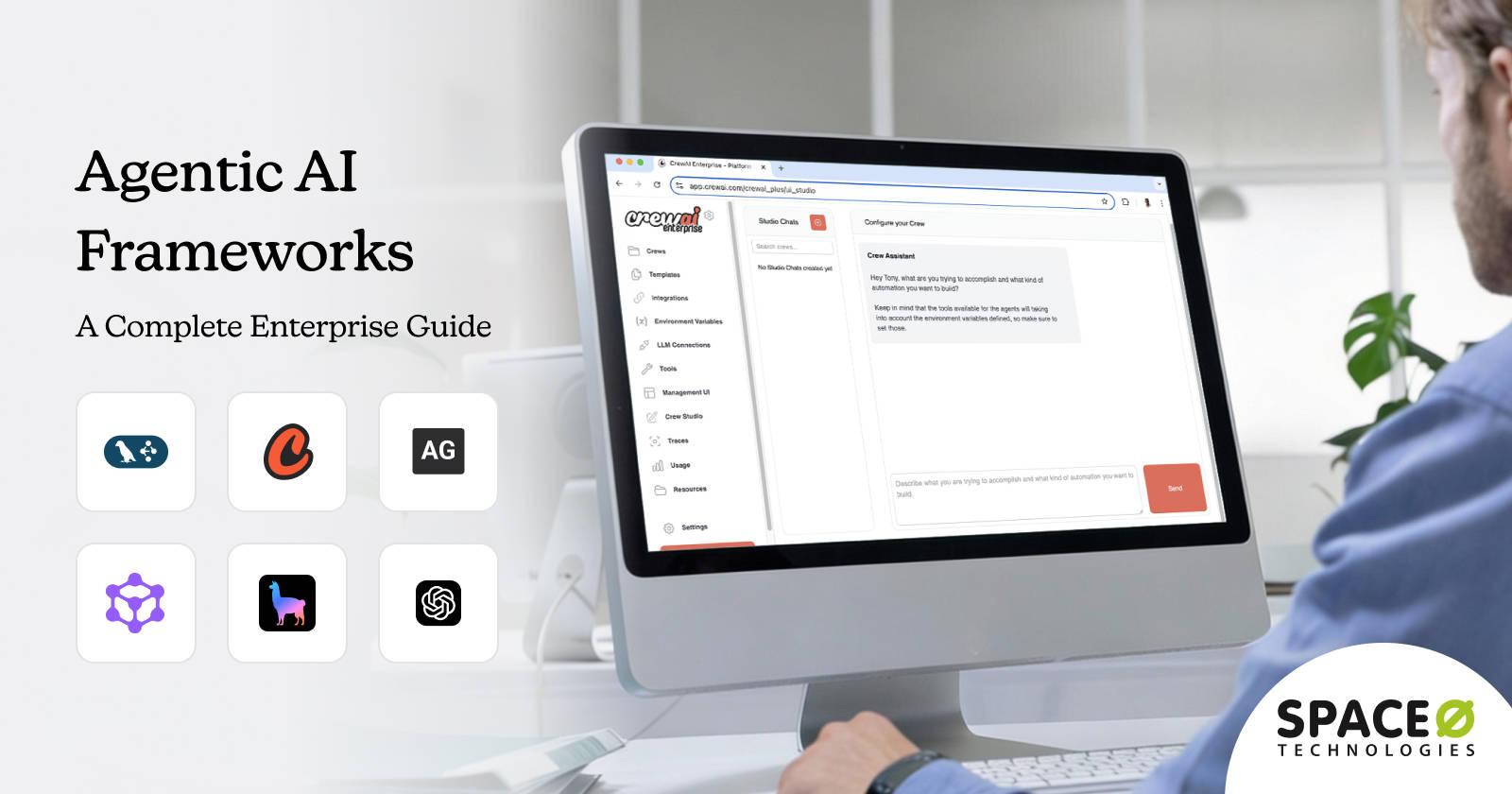
Enterprise AI has moved beyond simple chatbots and single-purpose models. Organizations now deploy autonomous AI agents that reason, plan, and execute multi-step tasks with minimal human intervention.
The global agentic AI market reached $7.6 billion in 2025, up from $5.4 billion in 2024. Long-term projections show the market hitting $196.6 billion by 2034, growing at a compound annual growth rate of 43.8%. Companies deploying agentic AI report average returns on investment of 171%, with U.S. enterprises achieving around 192%, exceeding traditional automation ROI by three times.
Yet despite this growth, only 2% of organizations have deployed agentic AI at scale, while 61% remain stuck in exploration phases. Gartner predicts over 40% of agentic AI projects will be canceled by the end of 2027 due to escalating costs, unclear business value, or inadequate risk controls.
The gap between experimentation and production often comes down to framework selection. Choosing the wrong framework leads to scaling failures, integration nightmares, and abandoned projects. Choosing the right one accelerates deployment, reduces development costs, and positions your organization for competitive advantage.
At Space-O AI, we have built multi-agent systems across healthcare, finance, and manufacturing using various agentic AI frameworks. This guide provides enterprise technology leaders with the comprehensive analysis needed to select and implement these frameworks successfully.
What Are Agentic AI Frameworks?
Agentic AI frameworks are software libraries and platforms that enable developers to build, orchestrate, and deploy autonomous AI agents. Unlike traditional AI applications that respond to single queries, agents built on these frameworks can break complex goals into subtasks, use external tools, maintain context across interactions, and collaborate with other agents.
These frameworks address three fundamental challenges that prevented earlier AI systems from operating autonomously:
Agent Definition and Capabilities: Specify what an agent knows, what tools it can access, and how it should behave. This includes defining system prompts, available functions, memory systems, and decision-making boundaries. Modern frameworks support everything from simple function-calling agents to complex reasoning systems with access to code interpreters, web browsers, and enterprise APIs.
Workflow Orchestration: Coordinate how multiple agents work together. This covers task routing, information sharing between agents, error handling, and state management across multi-step processes. Advanced frameworks support conditional branching, parallel execution, human-in-the-loop interventions, and dynamic agent spawning based on task requirements.
Production Infrastructure: Deploy agents reliably at scale. This encompasses logging, monitoring, authentication, rate limiting, and integration with enterprise systems. Production-ready frameworks provide observability through OpenTelemetry, security through identity management, and reliability through checkpointing and state persistence.
The frameworks differ significantly in how they approach each capability. Some prioritize rapid prototyping with minimal configuration. Others focus on enterprise-grade reliability with comprehensive governance features. Understanding these differences is essential for making informed technology decisions.
Top Agentic AI Frameworks for Enterprise Deployment
Six frameworks dominate the enterprise agentic AI landscape in 2025. Each serves different use cases, organizational requirements, and technical constraints.
1. LangGraph: Graph-Based Workflow Orchestration
LangGraph, created by LangChain, is an open-source AI agent framework trusted by companies including Klarna, Replit, and Elastic. It represents a fundamentally different approach to agentic workflows: instead of linear chains, you define a state machine with nodes, edges, and conditional routing.
Core Architecture
LangGraph organizes actions as nodes in a directed graph, enabling conditional decision-making, parallel execution, and persistent state management. The architecture consists of three primary components:
- Nodes are functions that perform computation. Each node represents a discrete operation: processing user input, querying a database, invoking an external API, or calling an LLM for reasoning.
- Edges define execution flow between nodes. Conditional edges enable dynamic routing based on state values, allowing agents to branch, loop, or terminate based on intermediate results.
- State is a shared memory object that flows through the graph. It stores messages, variables, intermediate results, and decision history. LangGraph manages state automatically with support for checkpointing, thread-local memory, and cross-session persistence.
State Management Capabilities
LangGraph offers cutting-edge state management with explicit, reducer-driven state schemas. Built-in checkpointers save workflow state at regular intervals or after each step, ensuring workflows can resume after errors, interruptions, or system failures. State can be stored short-term in memory or long-term in SQLite, PostgreSQL, or cloud storage like S3.
This persistence enables capabilities impossible with stateless architectures: long-running workflows that span hours or days, graceful recovery from failures, and the ability to pause for human review and resume without losing context.
Human-in-the-Loop Integration
For workflows requiring human judgment, LangGraph’s human-in-the-loop patterns allow manual intervention at any point. Execution can pause at specific nodes, presenting the current state to an operator for review. Based on their input, the workflow resumes with the full context preserved. This capability is critical for quality assurance, regulatory compliance, and high-stakes decision-making.
Control Flow Flexibility
LangGraph supports diverse control flows: single agent, multi-agent, hierarchical, and sequential patterns. Agents can revisit steps, retry failed actions, spawn sub-agents dynamically, and adapt their execution path based on intermediate results.
Deployment Options
LangGraph offers fully managed cloud deployment through LangSmith with automatic updates and zero maintenance. Organizations requiring data sovereignty can deploy entirely self-hosted on their own infrastructure.
Best Suited For: Complex, multi-step workflows requiring precise control over agent interactions. Organizations need intricate decision-making pipelines with conditional logic, branching workflows, dynamic adaptation, and long-running stateful processes.
Considerations: LangGraph demands a higher upfront investment in setup and learning. The graph-based paradigm requires developers to think differently about workflow design compared to more traditional linear approaches. Teams without prior experience in state machine design may face a steeper learning curve.
GitHub Stars: 13,900+
License: MIT (free to use)
Turn Agentic AI Concepts Into Autonomous Business Solutions
From intelligent workflow automation to multi-agent systems, Space-O AI helps businesses design and deploy custom agentic AI solutions that think, decide, and act independently.
2. Microsoft AutoGen: Enterprise-Grade Multi-Agent Conversations
Microsoft’s AutoGen, born from Microsoft Research, distinguishes itself as the enterprise-focused framework in the agentic AI space. Version 0.4, released in January 2025, represents a complete redesign aimed at improving code quality, robustness, and scalability of agentic workflows.
Architecture Redesign in v0.4
AutoGen v0.4 adopts a robust, asynchronous, and event-driven architecture. The framework comprises three layers:
- Core Layer: Provides foundational building blocks for event-driven agentic systems, including asynchronous messaging, agent lifecycle management, and distributed execution.
- AgentChat Layer: A task-driven, high-level API built on the core layer, featuring group chat, code execution, pre-built agents, and conversation patterns.
- Extensions Layer: Provides implementations of core interfaces and third-party integrations, including Azure code executor, OpenAI model client, and enterprise connectors.
Asynchronous Messaging Architecture
Agents communicate through asynchronous messages, supporting both event-driven and request/response interaction patterns. This architecture reduces blocking, making AutoGen well-suited for longer tasks or scenarios where agents need to wait on external events, API responses, or human input.
The asynchronous design enables massive parallelism. Multiple agents can work simultaneously on different aspects of a problem, coordinating through message passing rather than blocking calls. This makes AutoGen particularly effective for workloads involving many concurrent tasks or integration with slow external systems.
Observability and Debugging
AutoGen provides built-in tools for tracking, tracing, and debugging agent interactions with support for OpenTelemetry for industry-standard observability. This enterprise-grade instrumentation enables teams to monitor agent behavior in production, identify bottlenecks, trace decision paths, and debug failures.
AutoGen Studio
Rebuilt on the v0.4 AgentChat API, AutoGen Studio is a low-code interface for rapid prototyping. It introduces real-time agent updates, mid-execution control (pause conversations, redirect agent actions, adjust team composition), interactive feedback through the UI, and message flow visualization. This allows non-developers to experiment with agent configurations while developers focus on production implementation.
AutoGen Bench
AutoGen Bench enables developers to benchmark agents by measuring and comparing performance across tasks and environments. This systematic evaluation capability is essential for understanding agent reliability before production deployment.
Enterprise Integration
AutoGen integrates natively with Azure services, Microsoft Graph, and enterprise identity systems. Microsoft’s strategy combines AutoGen as a flexible developer framework with Copilot Studio for prebuilt agent applications, giving organizations multiple entry points based on their technical capabilities.
Best Suited For: Enterprise environments where reliability, advanced error handling, and Microsoft ecosystem integration are mission-critical. Organizations already invested in Azure gain significant integration advantages through native connectors and managed deployment options.
Considerations: AutoGen requires more setup compared to streamlined alternatives. The documentation and architecture changes from v0.2 to v0.4 require attention when following online tutorials, as the APIs differ significantly.
Enterprise Adoption: Proven at organizations including Novo Nordisk for production-grade agent orchestration.
3. CrewAI: Rapid Prototyping with Role-Based Agents
CrewAI stands apart as a lean, standalone, high-performance multi-AI agent framework built from scratch, independent of LangChain or other agent frameworks. It optimizes for speed and minimal resource usage, enabling faster execution with less overhead.
Two-Layer Architecture: Crews and Flows
CrewAI uses a distinctive two-layer architecture that balances autonomy with control:
Crews are teams of AI agents with true autonomy and agency, working together through role-based collaboration. Each agent has defined responsibilities, tools, and goals. Agents can delegate tasks to teammates, request clarification from humans, and collaborate to solve complex problems. This approach mirrors how human teams operate, making it intuitive to design and debug.
Flows are CrewAI’s modular orchestration layer, providing low-level control and high-level ease to automate anything from a single LLM call to a fully autonomous multi-agent crew. Flows support conditional logic, loops, real-time state management, and integration with external systems. According to CrewAI, Flows currently run over 12 million executions per day across industries from finance to federal government to field operations.
Enterprise Suite (AOP Suite)
The CrewAI AOP Suite is a comprehensive bundle for organizations requiring secure, scalable, and easy-to-manage agent-driven automation. It includes:
- Tracing and Observability: Real-time monitoring of agent behavior, decisions, and performance
- Unified Control Plane: Centralized management and scaling of workflows across teams
- Seamless Integrations: Connectors for existing enterprise systems and data sources
Practical Use Cases
CrewAI excels in scenarios requiring defined role delegation:
- Content Creator Flow: Multi-crew content generation with specialized agents for research, writing, editing, and SEO optimization
- Email Auto Responder Flow: Automated email monitoring with intelligent response generation
- Lead Score Flow: Sales lead evaluation with human-in-the-loop review for high-value prospects
- Meeting Assistant Flow: Automated meeting notes, action items, and integration with tools like Trello and Slack
Developer Adoption
With over 100,000 developers certified through community courses at learn. crewai.com, CrewAI has become a standard for teams wanting to move quickly from concept to working implementation.
Best Suited For: Rapid prototyping and team-oriented agent systems. Projects focused on defined role delegation where each AI agent receives clear responsibilities. Organizations that want fast time-to-value without deep framework expertise.
Considerations: The YAML-driven configuration approach balances simplicity and clarity but may require additional effort for customization as business needs grow beyond standard patterns.
4. Microsoft Agent Framework: Production-Ready Convergence
Released in public preview on October 1, 2025, Microsoft Agent Framework merges AutoGen’s dynamic multi-agent orchestration with Semantic Kernel’s production foundations. This unification means teams no longer have to choose between experimentation and production readiness.
Unified Architecture
The framework is the open-source SDK and runtime that simplifies multi-agent system orchestration. It supports both Python and .NET, delivers functional agents in under 20 lines of code, and provides native integration with Azure AI Foundry for cloud deployment.
The architecture includes:
- Modular Connectors: Pre-built integrations for Azure AI Foundry, Microsoft Graph, SharePoint, Elastic, Redis, and more
- Declarative Definitions: YAML and JSON agent definitions enable version-controlled workflows that can be reviewed, tested, and deployed through standard CI/CD pipelines
- AzureAIAgent: Specialized agent type providing advanced conversational capabilities with automated tool calling, secure conversation history management through threads, and access to built-in tools including file retrieval, code execution, Bing search, Azure AI Search, Azure Functions, and OpenAPI endpoints
Interoperability Standards
Microsoft Agent Framework embraces open standards for cross-platform collaboration:
- OpenAPI Integration: Connect any API through standard OpenAPI specifications
- Agent2Agent (A2A): Protocol for agents to collaborate across different runtimes and organizations
- Model Context Protocol (MCP): Dynamic tool connection allowing agents to discover and use new tools without code changes
Production-Ready Features
Native observability comes through OpenTelemetry and Azure Monitor integration. Security is handled through Entra ID authentication with role-based access controls. CI/CD support via GitHub Actions and Azure DevOps enables automated testing and deployment of agent configurations.
Organizations can experiment locally during development and then deploy to Azure AI Foundry with observability, durability, and compliance built in.
Responsible AI Capabilities
Responsible AI features in public preview include:
- Task Adherence: Helps agents stay aligned with assigned tasks, preventing scope creep or unauthorized actions
- Prompt Shields with Spotlighting: Protects against prompt injection attacks and highlights risky behavior
- PII Detection: Identifies and manages sensitive data to support compliance requirements
Enterprise Adoption
Early adopters demonstrate the framework’s versatility:
- KPMG: Building multi-agent systems for audit automation, automating testing and documentation workflows
- BMW: Deploying agents to analyze terabytes of vehicle telemetry data for quality and performance insights
- Commerzbank: Piloting avatar-driven customer support with multi-modal agent interactions
- Fujitsu: Embedding the framework into integration services to balance human and AI collaboration
Customer traction shows over 10,000 organizations using Azure AI Foundry Agent Service since general availability, with 230,000+ organizations using Copilot Studio for agent development.
Best Suited For: Organizations requiring enterprise-grade security, compliance, and native Azure integration. Teams wanting a unified approach that supports both experimentation and production deployment without framework migration.
Installation: pip install agent-framework for Python or dotnet add package Microsoft.Agents.AI for .NET
5. LlamaIndex AgentWorkflow: Document-Centric Intelligence
LlamaIndex has evolved from a retrieval-augmented generation (RAG) framework into a comprehensive multi-agent orchestration platform. The entire LlamaIndex documentation is now built around AgentWorkflow, reflecting this strategic shift.
AgentWorkflow System
AgentWorkflow makes it easy to build and orchestrate AI agent systems by building on LlamaIndex’s popular Workflow abstractions. It handles coordinating between agents, maintaining state, and managing tool access while providing flexibility and extensibility.
The system supports both single specialized agents and teams of collaborative agents. Whether your use case requires one agent with many tools or multiple agents with distinct responsibilities, AgentWorkflow provides the building blocks for robust, stateful agent applications.
Agent Types
The Agent module consists of two primary classes:
- FunctionAgent: For language models that support native function calling (OpenAI, Anthropic Claude, etc.)
- ReActAgent: For models without function calling, using reasoning and acting patterns to select tools
Both inherit from BaseWorkflowAgent, ensuring consistent interfaces regardless of underlying implementation.
Multi-Agent Patterns
LlamaIndex offers multiple orchestration patterns:
- AgentWorkflow (Built-in): Declare a set of agents and let AgentWorkflow manage handoffs based on agent capabilities and task requirements
- Orchestrator Pattern (Built-in): A dedicated orchestrator agent chooses which sub-agent to call next, providing explicit control over task routing
- Custom Planner (DIY): Write custom LLM prompts that plan execution sequences for maximum flexibility
Tools and functions in an AgentWorkflow have access to the global workflow Context, enabling state sharing and coordination across agents.
Agentic Document Workflows (ADW)
In 2025, LlamaIndex introduced Agentic Document Workflows, a significant advancement beyond traditional Intelligent Document Processing (IDP) and RAG paradigms. ADW combines document processing, retrieval, structured outputs, and agentic orchestration to enable end-to-end knowledge work automation.
This architecture is particularly powerful for enterprises dealing with complex document workflows: contract analysis, regulatory compliance, research synthesis, and knowledge extraction from unstructured data.
RAG Integration
LlamaIndex’s heritage in RAG makes it uniquely suited for document-heavy use cases. You can design AgentWorkflows that combine retrieval and computation, creating GraphRAG pipelines capable of answering structured queries while performing calculations on retrieved data.
Best Suited For: Organizations with heavy document processing requirements. Teams wanting to combine proven RAG capabilities with multi-agent orchestration in a unified framework. Knowledge-intensive workflows where retrieval accuracy is critical.
Considerations: Teams not focused on document-centric use cases may find other frameworks more directly aligned with their needs.
6. OpenAI Agents SDK: Streamlined Multi-Agent Patterns
OpenAI released the Agents SDK on March 11, 2025, as the production-ready evolution of their experimental Swarm framework. While Swarm was labeled educational and not intended for production, the Agents SDK is actively maintained and recommended for all production use cases.
Core Primitives
The Agents SDK has a deliberately minimal set of abstractions:
- Agents: LLMs equipped with instructions and tools, defining what an agent can do and how it should behave
- Handoffs: Allow agents to delegate to other agents for specific tasks, enabling specialization without complexity
- Guardrails: Validate agent inputs and outputs, preventing harmful or incorrect responses
- Sessions: Automatically maintain conversation history across agent runs, simplifying stateful interactions
Handoffs for Task Delegation
Handoffs enable seamless task delegation between agents based on capabilities. When an agent encounters a query outside its scope, it can transfer responsibility to a better-suited agent. This mechanism ensures efficient workflow orchestration through dynamic collaboration rather than rigid pipelines.
Handoffs can be triggered based on predefined rules or contextual analysis performed by the SDK, giving developers flexibility in how agents coordinate.
Built-in Tools
The Responses API supports new built-in tools:
- Web Search: Real-time internet search for current information
- File Search: Document retrieval and analysis from uploaded files
- Computer Use: Automated browser and desktop interactions
Function tools turn any Python function into a tool with automatic schema generation and Pydantic-powered validation, minimizing boilerplate code.
Tracing and Debugging
Built-in tracing lets you visualize, debug, and monitor workflows. Integration with OpenAI’s evaluation, fine-tuning, and distillation tools enables systematic improvement of agent behavior over time.
Model Compatibility
While optimized for OpenAI models, the Agents SDK works with the Responses API and Chat Completions API. The SDK also works with models from other providers that offer Chat Completions style endpoints, though some features may be limited.
Best Suited For: Teams wanting minimal abstractions and fast implementation. Organizations committed to OpenAI’s model ecosystem. Projects where handoff patterns match the problem structure.
Considerations: Organizations using diverse LLM providers may prefer framework-agnostic alternatives like LangGraph or Microsoft Agent Framework for greater flexibility. Some advanced orchestration patterns available in other frameworks require custom implementation.
Choose the Right Agentic AI Framework With Expert Guidance
Not sure which agentic AI framework fits your use case? Space-O AI helps you evaluate tools, architectures, and orchestration layers to build scalable agent-based AI systems aligned with your business goals.
How to Choose the Right Agentic AI Framework
Framework selection depends on your technical requirements, organizational context, deployment timeline, and existing technology investments. When comparing LangGraph vs AutoGen or evaluating other options, consider these decision criteria.
1. Decision Criteria by Priority
If workflow complexity is your primary concern: Choose LangGraph. Its graph-based architecture handles conditional branching, parallel execution, and complex state management better than alternatives. The explicit state machine model makes debugging and reasoning about agent behavior straightforward. The tradeoff is a steeper learning curve for teams unfamiliar with graph-based programming.
If enterprise reliability and Microsoft integration matter most: Choose Microsoft Agent Framework or AutoGen. Both are battle-tested at scale with robust error handling, comprehensive logging, and native enterprise integrations. Agent Framework provides the newest capabilities with production-ready deployment to Azure AI Foundry. The tradeoff is additional setup complexity and Azure dependency for full feature access.
If time-to-prototype is critical: Choose CrewAI. The fastest path from idea to working multi-agent system. Role-based configuration makes it intuitive for teams new to agentic AI. The tradeoff is potential customization limitations as requirements grow beyond standard patterns.
If document processing drives your use case: Choose LlamaIndex AgentWorkflow. Combines proven RAG capabilities with multi-agent orchestration. Agentic Document Workflows provide sophisticated document understanding out of the box. The tradeoff is that non-document use cases may not leverage the framework’s core strengths.
If you want minimal abstractions and OpenAI focus: Choose OpenAI Agents SDK. Streamlined primitives reduce cognitive overhead. Native integration with OpenAI’s model improvements and tooling. The tradeoff is reduced flexibility for multi-provider strategies.
2. Framework Comparison Summary
| Framework | Primary Strength | Learning Curve | Production Readiness | Best For |
| LangGraph | Complex stateful workflows | High | High | Conditional logic, long-running processes |
| AutoGen | Async multi-agent conversations | Medium-High | High | Enterprise conversations, parallel tasks |
| CrewAI | Rapid prototyping | Low | Medium-High | Role-based teams, fast iteration |
| Microsoft Agent Framework | Azure integration, governance | Medium | High | Enterprise deployment, compliance |
| LlamaIndex | Document workflows | Medium | Medium-High | RAG-heavy applications, knowledge work |
| OpenAI Agents SDK | Minimal abstractions | Low | Medium | OpenAI ecosystem, simple handoffs |
3. Technology Stack Considerations
Existing Cloud Provider: Organizations on Azure gain significant advantages with Microsoft Agent Framework. Those on AWS or GCP may prefer framework-agnostic options like LangGraph or CrewAI.
Language Preferences: All frameworks support Python. Microsoft Agent Framework and LangGraph also offer strong .NET support. Consider your team’s expertise and existing codebase.
Model Strategy: Single-provider strategies (OpenAI only) work well with OpenAI Agents SDK. Multi-provider strategies benefit from LangGraph or Microsoft Agent Framework’s model-agnostic design.
Build Production-Ready Agentic AI Systems With Space-O AI
From agent design and planning logic to tool integration and deployment, our agentic AI experts help you build reliable, autonomous AI solutions that move beyond experimentation.
Enterprise Implementation Challenges
Transitioning from prototype to production brings challenges that demand careful planning regardless of framework choice. Understanding these challenges helps organizations budget appropriately and set realistic expectations.
1. The Production Gap
Despite strong adoption intent, only 11% of organizations had deployed agentic AI by mid-2025, according to KPMG, while 99% plan to eventually deploy. Deloitte found that 93% of IT leaders intend to introduce autonomous agents within two years, and nearly half have already implemented some form of agentic AI.
This gap between intent and execution reflects real implementation difficulties. Gartner predicts over 40% of agentic AI projects will be canceled by the end of 2027 due to escalating costs, unclear business value, or inadequate risk controls. Most current projects are early-stage experiments driven by hype, which blinds organizations to the real cost and complexity of deploying AI agents at scale.
2. Security Challenges
Three out of four current agentic AI projects are on track to experience significant security challenges, and only 6% of organizations leverage an advanced security framework for AI. Already, 80% of organizations report encountering risky behaviors from AI agents, including improper data exposure and unauthorized system access.
AI agents provide new external entry points for attackers and can be thought of as “digital insiders” operating within systems with varying levels of privilege. Key security concerns include:
Unauthorized Action Execution: Agents may perform actions beyond their intended scope, either through prompt injection attacks or emergent behavior.
Data Leakage: Agents with access to sensitive data may inadvertently expose information through responses, logs, or integration with external systems.
Model Manipulation: Adversarial inputs can cause agents to behave unexpectedly, bypass safety measures, or reveal system information.
Identity and Access Management: Non-human identities (service accounts, API keys, machine identities) often wield significant system privileges while lacking traditional authentication safeguards.
Organizations should implement least-privilege access controls, role-based access management, API gateways that evaluate requests against policy in real-time, and regular access reviews to prevent privilege accumulation.
3. Governance Complexity
The characteristics that make agentic AI powerful, autonomy, adaptability, and complexity, also make agents difficult to govern. One primary challenge is their ability to make decisions independently, often in ways that are difficult to predict or explain.
McKinsey recommends establishing governance frameworks that include:
- Ownership and responsibilities within AI onboarding, deployment, and offboarding procedures
- Monitoring and anomaly detection tied to KPIs
- Defined triggers for escalations to human oversight
- Standards of accountability for agent actions
Organizations should create an Agentic Governance Council, a cross-functional body overseeing all agentic AI activity. This council should meet monthly, report to the board quarterly, and hold decision rights over agent deployment, modification, and retirement.
4. Regulatory Compliance
Agentic AI systems are not exempt from existing regulations. GDPR requirements for data minimization, lawful processing, and transparency apply to agent operations. In Europe, the AI Act takes a risk-based approach that may classify certain agentic AI deployments as “high risk” or prohibited, depending on context and autonomy level.
Organizations must ensure agents adhere to compliance standards or face both fines and erosion of customer trust. This requires audit trails of agent decisions, explainability for high-stakes outputs, and mechanisms for human override.
5. Integration Complexity
Traditional enterprise systems were not designed for agentic interactions. Most agents rely on APIs and conventional data pipelines to access enterprise systems, creating bottlenecks and limiting autonomous capabilities.
Integrating agents into legacy systems can be technically complex, often disrupting workflows and requiring costly modifications. Professional AI integration services help enterprises navigate these complexities while minimizing disruption.
Organizations are turning to data fabric architectures, integrated systems that connect and govern information across all business layers. By breaking down silos and enabling real-time access to enterprise-wide data, a data fabric empowers both human teams and agentic AI systems.
6. Organizational Alignment
The real challenge is often organizational rather than technical. IT leaders want predictable, scalable systems. CFOs need investment models with measurable returns. HR executives require performance management frameworks for human-AI collaboration. Business leaders demand both efficiency and adaptability.
Strategic oversight, ethical governance, and the ability to orchestrate human-AI teams become critical skills as agents handle tasks previously performed by humans. Organizations that thrive focus less on technology itself and more on the human systems surrounding it.
Best Practices for Agentic AI Framework Implementation
Based on our experience deploying agentic AI development services across industries, these practices improve implementation success and help organizations avoid common pitfalls.
1. Start with a Clear Value Definition
Pursue agentic AI only where it delivers clear value or ROI. The most common failure pattern involves organizations deploying agents because the technology is exciting rather than because specific business problems demand autonomous capabilities.
Define success metrics before selecting a framework:
- What process will agents automate?
- What accuracy thresholds must they meet?
- What cost savings or revenue improvements justify the investment?
- How will you measure agent performance over time?
Organizations reporting 171%+ ROI have one thing in common: they started with well-defined use cases where autonomous operation provides clear advantages over human-only or traditional automation approaches.
2. Design for Human Oversight
Find the right balance between AI autonomy and human oversight. Agents should handle routine decisions autonomously while escalating edge cases and high-stakes decisions to humans.
Build approval workflows into agent systems from the start:
- Define clear boundaries for autonomous action
- Track every agent action for audit purposes
- Implement kill switches that allow immediate human intervention
- Create feedback loops where human corrections improve agent behavior
The goal is augmentation, not replacement. Agents handle volume and routine tasks; humans provide judgment and handle exceptions.
3. Plan for Production from Day One
Many organizations build prototypes without considering production requirements, then struggle to scale. Consider from the outset:
- Monitoring: How will you track agent performance, accuracy, and reliability?
- Observability: What logging and tracing infrastructure is required for debugging?
- Authentication: How will agents authenticate with enterprise systems securely?
- Error Handling: What happens when agents encounter errors or unexpected inputs?
- Versioning: How will you update and version agent configurations without disruption?
- Rollback: Can you quickly revert to previous agent versions if issues arise?
4. Implement Comprehensive Security
Treat agents like digital employees requiring identity management:
- Assign unique service accounts or workload identities to each agent
- Define strict rules regarding what agents can and cannot do
- Implement controls preventing privilege escalation without oversight
- Use API gateways that evaluate agent requests against policy in real-time
- Conduct regular access reviews and automated privilege management
5. Invest in Evaluation Infrastructure
Regardless of framework, production maturity requires:
- Simulation Environments: Test agents against realistic scenarios before deployment
- Evaluation Systems: Measure accuracy, relevance, and safety of agent outputs
- Observability: Real-time visibility into agent behavior and decisions
- Alerts: Automated notification when agent accuracy drops below thresholds
- Human Review: Mechanisms for experts to review and correct agent responses
Build test suites covering normal operations, edge cases, and adversarial inputs. Establish baseline performance metrics and track drift over time.
6. Start Small and Expand
Begin with a single, well-defined use case rather than attempting enterprise-wide transformation. Prove value, learn from operational experience, and expand based on demonstrated success.
AtlantiCare demonstrated this approach: 50 providers tested an agentic AI clinical assistant, achieving 80% adoption and a 42% reduction in documentation time, saving approximately 66 minutes per day. This focused pilot built confidence for broader rollout.
Design Intelligent AI Agents Tailored to Your Workflows
We design custom agent architectures that align with your data, processes, and objectives, ensuring your agentic AI system is robust, explainable, and ready to scale.
The Path Forward for Enterprise Agentic AI
The agentic AI market is expanding rapidly. By 2026, 40% of enterprise applications will feature task-specific AI agents, up from less than 5% in 2025 according to Gartner. By 2027, Deloitte predicts 50% of enterprises using generative AI will deploy autonomous agents, doubling from 25% in 2025.
Organizations projecting average ROI of 171% from agentic AI deployments see results including 4-7x conversion rate improvements and 70% cost reductions in targeted processes. A 2025 Google Cloud study showed 88% of early adopters achieved positive ROI, compared with 74% of organizations using generative AI more broadly.
Success requires matching framework capabilities to specific requirements:
- LangGraph for complex stateful workflows with conditional logic
- AutoGen or Microsoft Agent Framework for enterprise reliability and Azure integration
- CrewAI for rapid prototyping and role-based collaboration
- LlamaIndex for document-centric applications and knowledge work
- OpenAI Agents SDK for streamlined implementation within OpenAI’s ecosystem
More importantly, success requires organizational AI readiness assessment: clear value propositions, appropriate governance frameworks, comprehensive security measures, and teams skilled in human-AI collaboration.
The organizations that thrive with agentic AI will not be those chasing the newest framework. They will be those that select frameworks deliberately, implement thoughtfully, and maintain appropriate human oversight as autonomous capabilities expand.
Getting Started with Agentic AI Frameworks
Evaluating agentic AI frameworks for your organization? We help enterprises move from experimentation to production with custom AI agent development that matches framework capabilities to business requirements.
Our approach starts with understanding your specific use cases, integration requirements, and production constraints. We then recommend framework architectures, build proof-of-concept systems, and deploy production-grade multi-agent solutions.
Contact our team to discuss your agentic AI requirements and explore which framework approach fits your enterprise context.


Build Your Agentic AI Solution
What to read next